Market Snapshot
Middle bar: base-year value × (1 + CAGR), rounded to two decimals. This is a calculated illustration, not a separately researched annual estimate.
The Singapore EV charging station market was valued at USD 155 million in 2025 and is projected to reach USD 672 million by 2030, expanding at a 34.09% CAGR across the 2026–2030 forecast period. Growth is attributed to the Singapore Green Plan 2030, a national target of 60,000 charging points by 2030, and battery-electric adoption that reached 45% of new-car registrations in 2025. The Singapore EV charging station market is among the fastest-scaling in Southeast Asia, anchored by mandatory EV-ready provisioning and dense public car-park deployment.
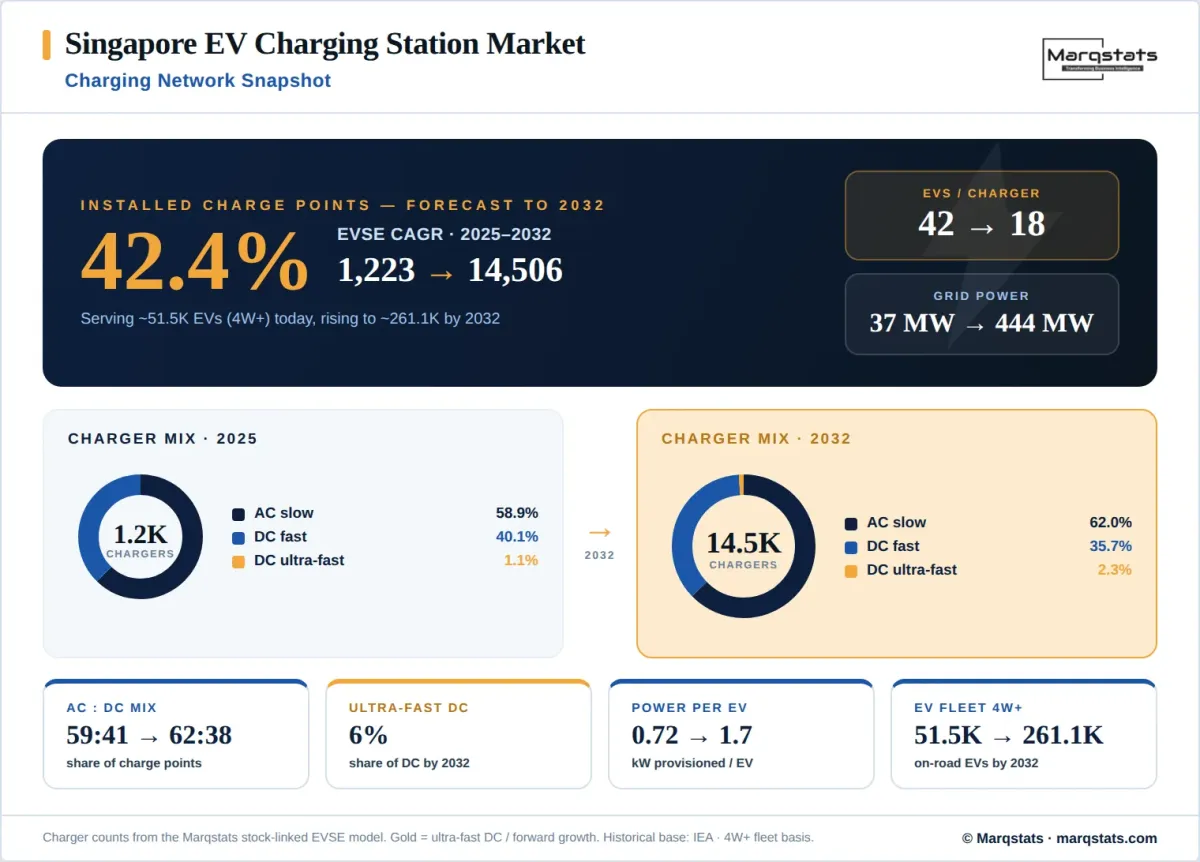
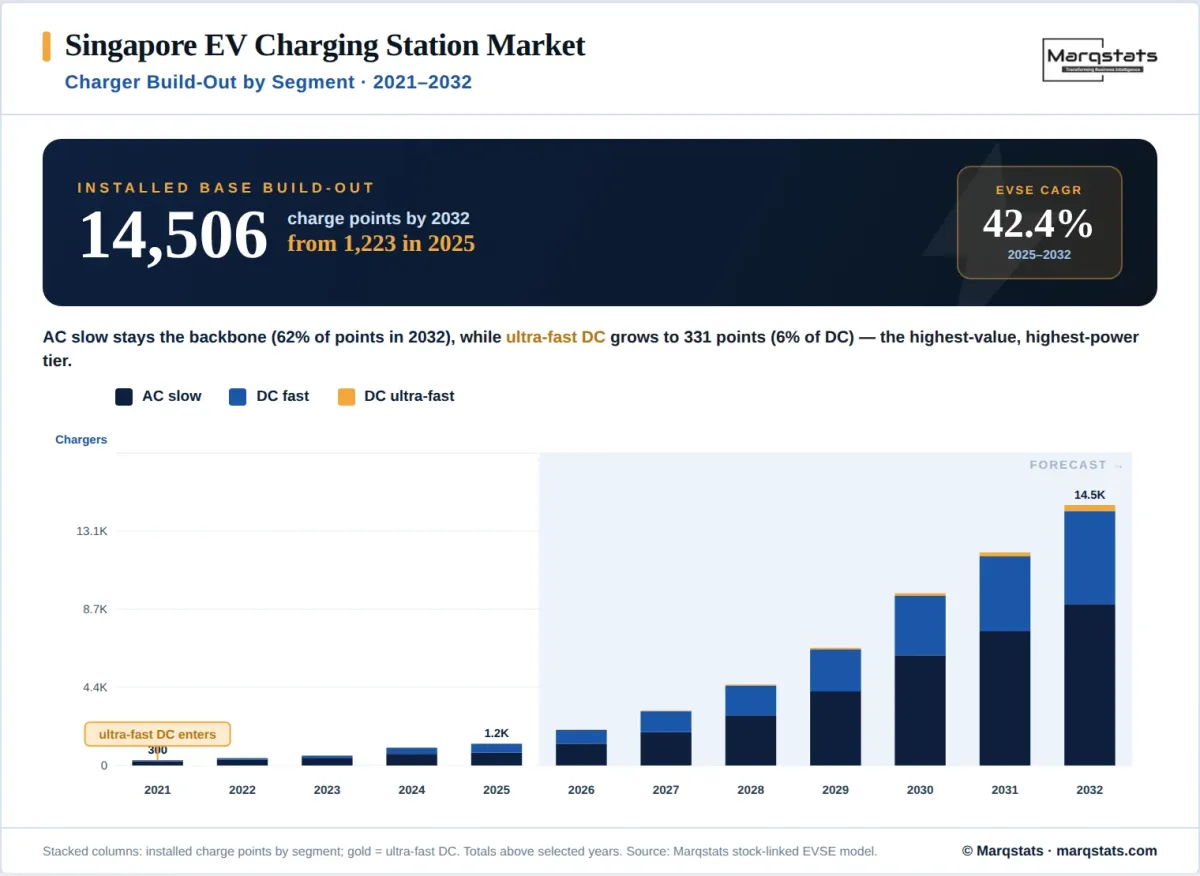
The market spans alternating-current and direct-current charging hardware, installation, networking software, and charging services across public car parks, private residences, commercial sites, and fleets. Singapore's installed base, reported by the Land Transport Authority, passed 30,500 charging points by March 2026, surpassing the halfway mark toward the 60,000 target. Alternating-current units dominate the installed base through the public car-park rollout, while direct-current fast chargers command higher per-unit value.
Charge-point operation is consolidating around a small group of large operators. SP Mobility runs more than 3,300 points across 800-plus locations, Charge+ operates extensive Housing and Development Board and condominium coverage, and ComfortDelGro ENGIE manages over 2,000 points, alongside Shell Recharge and the Strides-linked ChargEco network. Type 2 alternating-current and CCS2 direct-current connectors form the national standard. The five-operator Housing and Development Board tender, awarded to Charge+, ComfortDelGro ENGIE, SP Mobility, Shell Eastern Petroleum, and Strides, underpins a public rollout of at least 12,000 points across residential car parks.
Key Takeaways
Market Overview & Analysis
Report Summary
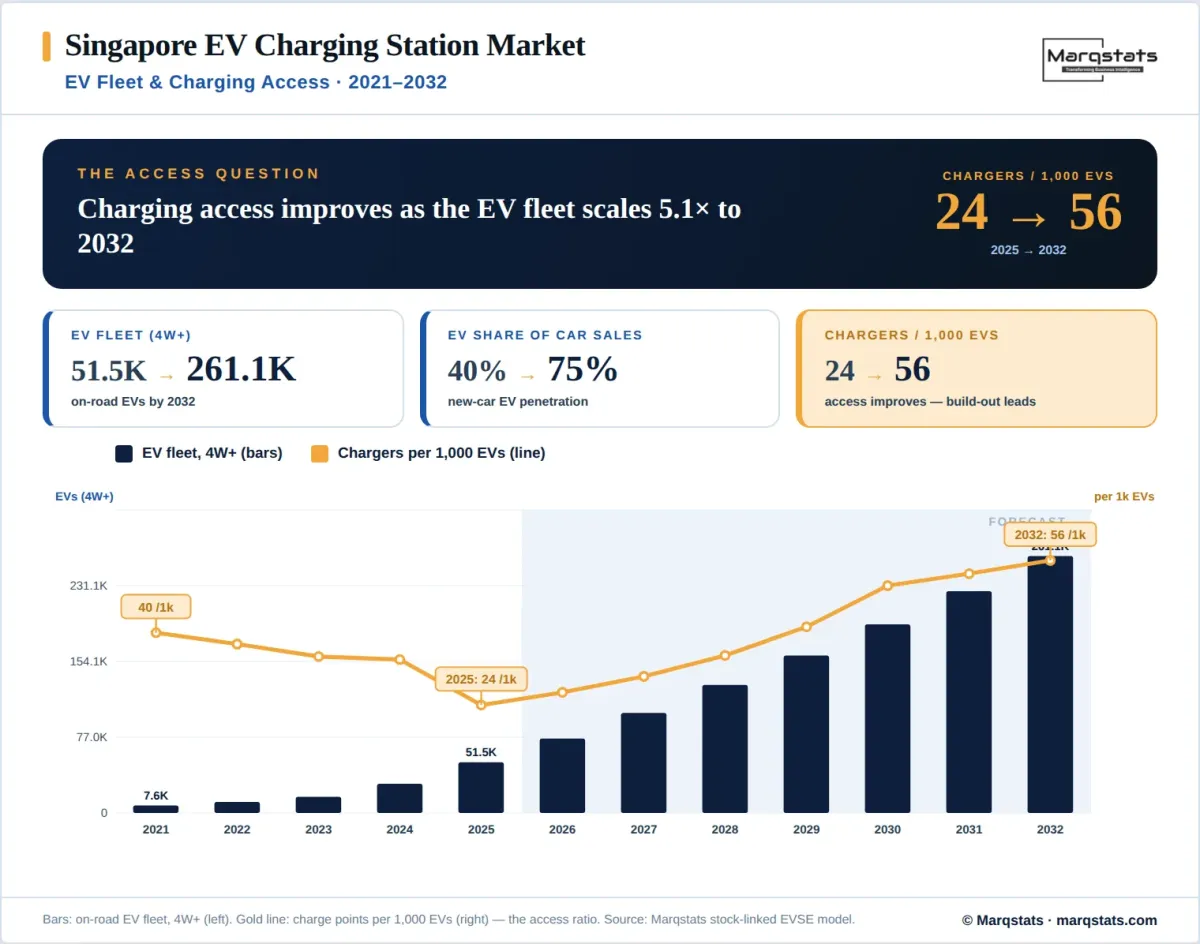
The Singapore EV charging station market sits at the intersection of transport, energy, and digital infrastructure, and is scaling rapidly within a dense, land-constrained city-state. Battery-electric adoption has accelerated sharply, with electric vehicles reaching 45% of new-car registrations in 2025 and 55% in January 2026, while registered electric vehicles passed 46,000 units by November 2025, about 7% of the vehicle population. Rising penetration is expanding the parc that depends on accessible public and residential charging. Adoption is shaped by the Certificate of Entitlement system, which caps vehicle ownership and tilts the fleet toward newer, premium models that increasingly arrive as battery-electric vehicles.
The vehicle mix is distinctive. Singapore is overwhelmingly a passenger-car and fleet market with minimal two-wheeler volume, so charging demand concentrates on four-wheel vehicles in residential car parks, workplaces, and commercial sites. Purchase incentives under the Vehicular Emissions Scheme and the EV Early Adoption Incentive can reduce upfront cost by up to S$40,000, while the RIE2025 research programme and agencies such as the Land Transport Authority and the Energy Market Authority support pilot projects and fleet electrification.
Public charging supply has scaled in parallel. The installed base advanced from roughly 2,000 points in 2021 to more than 30,500 by March 2026, past the halfway mark toward the 60,000 target set under the Singapore Green Plan 2030. The target comprises 40,000 points in public car parks and 20,000 in private premises, with every Housing and Development Board town designated an EV-ready town and around 2,000 car parks provisioned for charging.
The regulatory framework is among the most developed in the region. The Electric Vehicles Charging Act, enforced from December 2023, requires charger registration, operator licensing, and EV-ready provisioning in new developments, while Technical Reference 25 sets safety standards extending to ultra-fast charging up to 500 kW. The EV Common Charger Grant co-funds up to half of charging-infrastructure cost in non-landed private residences, and purchase incentives under the Vehicular Emissions Scheme and the EV Early Adoption Incentive lower upfront ownership cost. Every Housing and Development Board town is designated an EV-ready town, ensuring that charging provisioning advances in step with residential demand rather than lagging behind it.
Market value is built from hardware, installation, networking software, and charging-service revenue. The public car-park rollout is alternating-current-led, giving alternating-current charging the larger installed base, while direct-current fast chargers carry higher unit prices and service premiums. Growth is driven by mandatory provisioning, high battery-electric penetration, and a maturing operator market, even as grid capacity, equitable access across older estates, and charger utilization remain points of attention.
Market Dynamics
Key Drivers
Market is driven by the Singapore Green Plan 2030 target of 60,000 charging points by 2030, converting policy into sustained hardware and service demand.
Rapid battery-electric adoption supports growth, with electric vehicles reaching 45% of new-car registrations in 2025 and 55% in January 2026.
Mandatory EV-ready provisioning under the Electric Vehicles Charging Act compels charging installation in new developments and public car parks.
The EV Common Charger Grant co-funds up to half of charging cost in non-landed private residences, accelerating condominium deployment.
Purchase incentives under the Vehicular Emissions Scheme and EV Early Adoption Incentive, extended through 2026, sustain new-vehicle demand.
Key Restraints
High direct-current capital expenditure and charger utilization constrain operator returns as networks expand ahead of steady-state demand.
Grid capacity within dense estates limits high-power deployment, requiring coordinated load management and electrical upgrades.
Older Housing and Development Board estates and non-landed residences face provisioning gaps, raising equitable-access concerns.
Idle-charger congestion at popular sites has prompted idle fees, reflecting demand-supply mismatches at peak periods. Land scarcity also limits the footprint available for high-power charging plazas, channelling deployment into existing car parks and fuel-station forecourts.
Key Trends
Hardware is moving toward higher-power direct-current classes, with Technical Reference 25 enabling ultra-fast charging up to 500 kW, mirroring the upgrade cycle across the global EV DC charging station market.
Operator consolidation is accelerating, with the exit of one network owner and a proposed acquisition reshaping the charge-point operator market.
Solar generation and smart-charging management are being integrated to ease grid load and align with national decarbonization goals.
Fleet and point-to-point operators, including taxis and ride-hail vehicles, are electrifying, creating anchor demand at depots and high-throughput hubs.
Market Segmentation
Alternating-current charging holds the largest installed base and a substantial value share, anchored by the public car-park rollout where every Housing and Development Board town is provisioned for charging. Onboard chargers in mass-market models draw 7 kW to 22 kW, suited to overnight and long-dwell replenishment in residential and workplace settings where lower hardware and installation cost favors dense deployment. Public alternating-current tariffs settle near a floor of S$0.45 per kWh, keeping everyday charging affordable. The segment scales with the Housing and Development Board rollout, where each town is progressively provisioned with multiple points per car park, and with condominium deployment supported by the EV Common Charger Grant.
Direct-current charging commands higher per-unit value and is the fastest-growing segment, owing to premium hardware and faster turnaround at malls, fuel stations, and transport hubs. It serves drivers without reliable home charging and supports the rising share of commercial and fleet users that require quick replenishment between trips. The installed base is migrating toward 50 kW to 350 kW classes, with Technical Reference 25 enabling ultra-fast deployment up to 500 kW. Direct-current tariffs sit around S$0.55 to S$0.82 per kWh, reflecting the speed premium, and idle fees of S$0.50 per minute, capped at S$40 per session, have been introduced at popular sites to curb charger hogging. Manufacturer partnerships, such as bundled free-charging credits for new premium-brand owners, further shape direct-current demand.
Singapore follows the European connector standard. Type 2 serves alternating-current charging across homes, workplaces, and public car parks, while CCS2, the Combined Charging System, is the dominant direct-current connector across fast-charging networks. The single-standard environment lowers interoperability friction, allowing drivers to use any major operator with common physical connectors while payment remains app-based.
CHAdeMO holds a small and declining share tied to a handful of legacy models, while newer deployments standardize on CCS2 for direct-current charging. The consolidation around Type 2 and CCS2 simplifies hardware procurement and reduces stranded-asset risk for operators, and aligns Singapore with the connector ecosystem used across Europe and much of Southeast Asia.
Passenger cars represent the largest vehicle segment by charging demand, owing to battery-electric penetration reaching 45% of new-car registrations in 2025. A premium vehicle mix and high home-and-workplace charging reliance shape utilization across the island, and battery-electric share rose further to 55% of new-car registrations in January 2026. Manufacturer assembly, including the Hyundai Motor Group Innovation Centre in Jurong, reinforces local battery-electric supply.
Commercial vehicles, spanning taxis, point-to-point fleets, goods vehicles, and public buses, form the fastest-growing vehicle segment, supported by fleet electrification and public-transport decarbonization targets that anchor depot and high-throughput charging. The public-bus programme targets a progressively cleaner fleet, while taxi and ride-hail operators electrify to lower running cost, lifting demand for fast charging at depots and transport nodes.
Electric motorcycles and light vehicles contribute a smaller share, served by alternating-current and emerging battery-swapping solutions, with Technical Reference 25 extending provisions to motorcycle swapping. Given the limited two-wheeler base relative to neighbouring markets, this segment exerts modest pull on the public direct-current network.
Public car-park charging is the defining application, anchored by the Housing and Development Board rollout that places alternating-current points where residents already park. Commercial and workplace sites at malls, offices, and fuel stations add destination and fast-charging capacity that complements the residential network. The car-park-centric model reflects Singapore land constraints, where shared public infrastructure substitutes for the private driveway charging common in lower-density markets.
Private residential charging in condominiums scales with the EV Common Charger Grant, while fleet and bus-depot charging supports the electrification of taxis, ride-hail vehicles, and public buses. These applications convert mandatory provisioning and fleet targets into steady, predictable demand. Private residential coverage is set to widen further as the grant lifts the share of non-landed premises with charging access, narrowing the gap between landed and high-rise households.
By Geography
Central Region
The Central Region, covering the Central Business District, Tanjong Pagar, Bishan, Ang Mo Kio, and Bukit Timah, holds the largest installed base and market value, owing to the highest vehicle density, commercial site availability, and concentration of malls and offices. The region anchors fast-charging demand and destination charging across the island core, where commercial and hospitality sites host a dense cluster of direct-current hubs serving both residents and visiting drivers. Limited residential car-park capacity in the core shifts some charging toward workplace and destination sites during the day.
East Region
The East Region, spanning Bedok, Tampines, Marine Parade, and Changi, combines dense residential estates with the airport and logistics corridors. Charging investment follows mature Housing and Development Board towns and the eastern car-park tender coverage, with Tampines and Bedok forming high-volume residential charging clusters and the airport precinct supporting fleet and logistics charging.
West Region
The West Region, including Jurong, Clementi, and the Tengah eco-town, grows on industrial fleets and new EV-ready town development. Tengah, planned as a car-lite and EV-ready town, supports forward-looking deployment, while Jurong industrial estates add depot and fleet charging.
North Region
The North Region, covering Woodlands, Yishun, and Sembawang, expands on residential estate provisioning and cross-border traffic toward the causeway. ComfortDelGro ENGIE maintains substantial coverage across the northern and western estates, and proximity to the causeway adds cross-border and commercial-vehicle charging demand around Woodlands.
North-East Region
The North-East Region, anchored by Punggol, Sengkang, Hougang, and Serangoon, records the fastest regional growth, owing to newer high-density Housing and Development Board towns that are provisioned for charging at scale as they mature. Punggol and Sengkang, among the youngest estates, are being equipped with multiple points per car park, lifting installed-base growth above the island average.
How Competition Is Evolving
The Singapore EV charging station market is consolidating around a small group of well-capitalized operators, several backed by state-linked or listed parents. SP Mobility, part of SP Group, operates more than 3,300 charging points across 800-plus locations and positions itself as the largest public network. Charge+ operates extensive Housing and Development Board and condominium coverage with several thousand points, while ComfortDelGro ENGIE, a joint venture between a listed transport group and an energy major, manages over 2,000 points concentrated in the west and north. Charge+ reports several thousand points spanning Housing and Development Board estates, condominiums, and commercial buildings, competing on coverage breadth and per-kWh pricing.
Shell Recharge supplies rapid direct-current charging across fuel stations and destinations, and the Strides-linked ChargEco network covers Housing and Development Board estates in the east. The market structure shifted in 2025 when one network owner exited and transferred its points to other operators, and consolidation continued into 2026 with a proposed acquisition under competition review. Global hardware suppliers, including ABB, Schneider Electric, Siemens, Delta Electronics, and Star Charge, provide the underlying equipment. Manufacturer-operator partnerships, including bundled charging credits for new electric-vehicle buyers, add a further competitive dimension that ties hardware sales to network usage.
Competition centers on network reliability, location density, charging speed, and tariff structure. Operators differentiate through Housing and Development Board coverage, mall and fuel-station partnerships, transparent per-kWh pricing, and app-based access, while idle fees address congestion at popular sites. CCS2 standardization and interoperable apps are shifting the basis of competition toward uptime, coverage, and customer experience. Scale economics increasingly favour operators with dense Housing and Development Board footprints, as utilization and maintenance efficiency improve with network density, reinforcing the consolidation trend.
Companies Covered
Companies covered in the report include:
Recent Market Activity
Table of Contents
Coverage & Segmentation
This report provides a comprehensive analysis of the Singapore EV charging station market across the 2021–2025 historical period and the 2026–2030 forecast period, with 2025 as the base year. The study covers alternating-current and direct-current charging hardware, installation, networking software, and charging services across public car-park, private residential, commercial, and fleet applications, segmented by charging type, connector type, vehicle type, and application, with coverage of the central, east, west, north, and north-east planning regions. Market sizing is benchmarked against national deployment data and International Energy Agency charging datasets.
The study examines market size, growth, segment-level value, competitive structure, and the policy and regulatory framework, including the Singapore Green Plan 2030, the Electric Vehicles Charging Act, and the EV Common Charger Grant. Primary research includes 40+ interviews with charge-point operators, hardware manufacturers, fleet operators, utilities, and policy makers, supported by Energy Market Authority and Land Transport Authority data.