Market Snapshot
Key Takeaways
Market Overview & Analysis
Report Summary
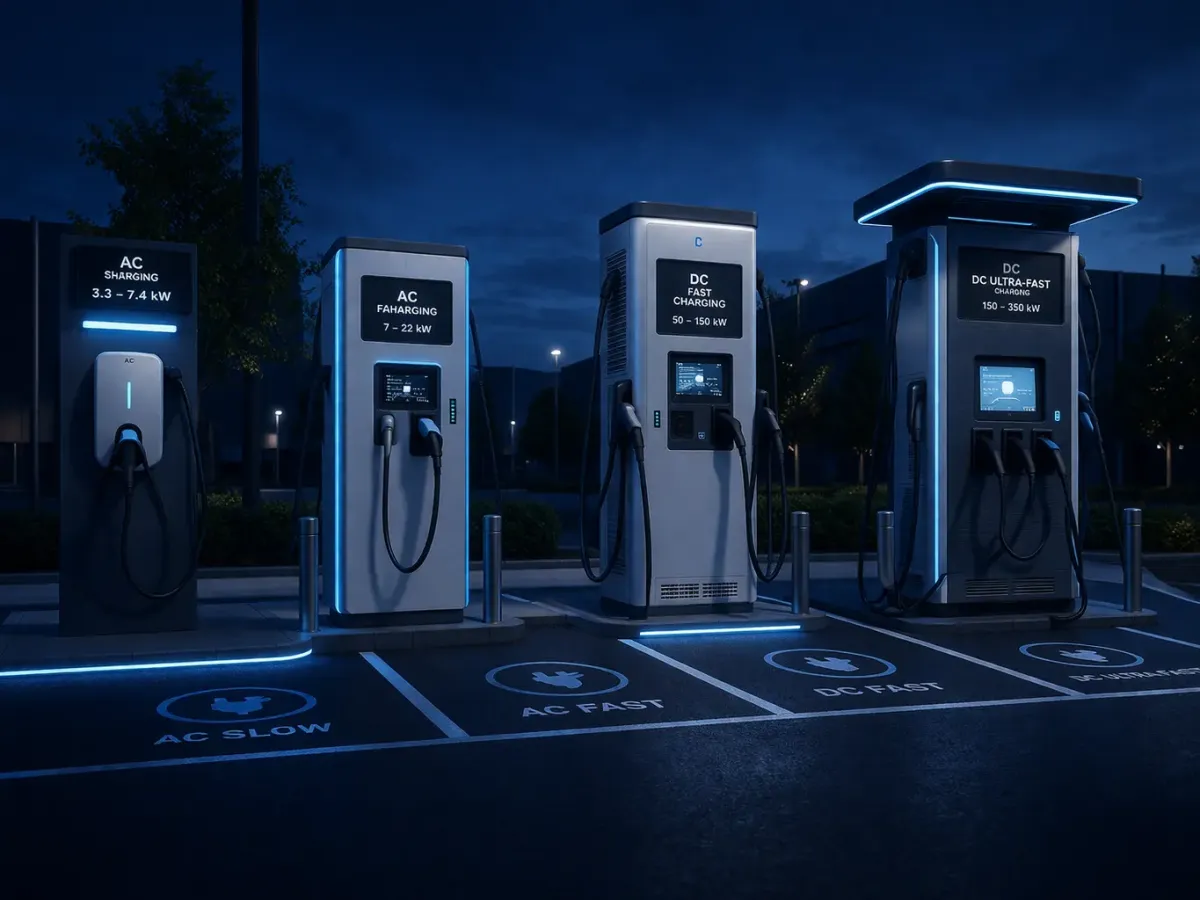
The EV DC charging station market covers direct-current fast-charging hardware, station deployment, networking software, and associated services that recharge battery-electric vehicles at speeds far above alternating-current charging. Direct-current chargers convert grid power within the station and deliver it straight to the vehicle battery, enabling charge times measured in minutes rather than hours. The category spans public roadside charging, highway corridor charging, fleet and depot charging, and destination charging across passenger and commercial vehicles.
The market reached an inflection point in 2025 as the installed base shifted from low-power direct-current units toward the 150 kW, 250 kW, and 350 kW classes. A 150 kW charger adds close to 180 km of driving range in fifteen minutes under mixed-driving assumptions, however only a limited share of vehicle models can fully exploit speeds above 250 kW today. This compatibility gap, alongside grid-connection constraints, defines the practical ceiling on how quickly ultra-fast capacity converts into usable energy throughput. Operators have responded by densifying stalls at proven sites instead of widening their location footprint.
Global electric car sales exceeded 20 million units in 2025, accounting for roughly a quarter of new car sales, which forms the underlying demand base for public DC charging. Operators across pure-play charge-point networks, automakers, oil and fuel retailers, utilities, and battery manufacturers now compete for premium sites, fleet corridors, and high-power hubs. The strategic emphasis has moved toward grid-ready locations that combine reliable power with retail, parking, and dwell-time monetisation, reframing the charging site as a commercial energy and mobility asset.
The competitive narrative has changed from network size to network quality. Reliability has become a primary metric, with uptime in mature markets rising into the 90 to 95% band, while pricing for public fast charging in established markets has stabilised at roughly USD 0.45 to 0.55 per kilowatt-hour. Operators are densifying stalls at high-traffic sites and retiring underperforming locations, owing to the central role of utilisation in charge-point economics. This quality-led phase favours operators with strong site selection, grid access, and integrated software, and it raises the importance of energy management, dynamic load balancing, and battery buffering at congested sites.
Market Dynamics
Key Drivers
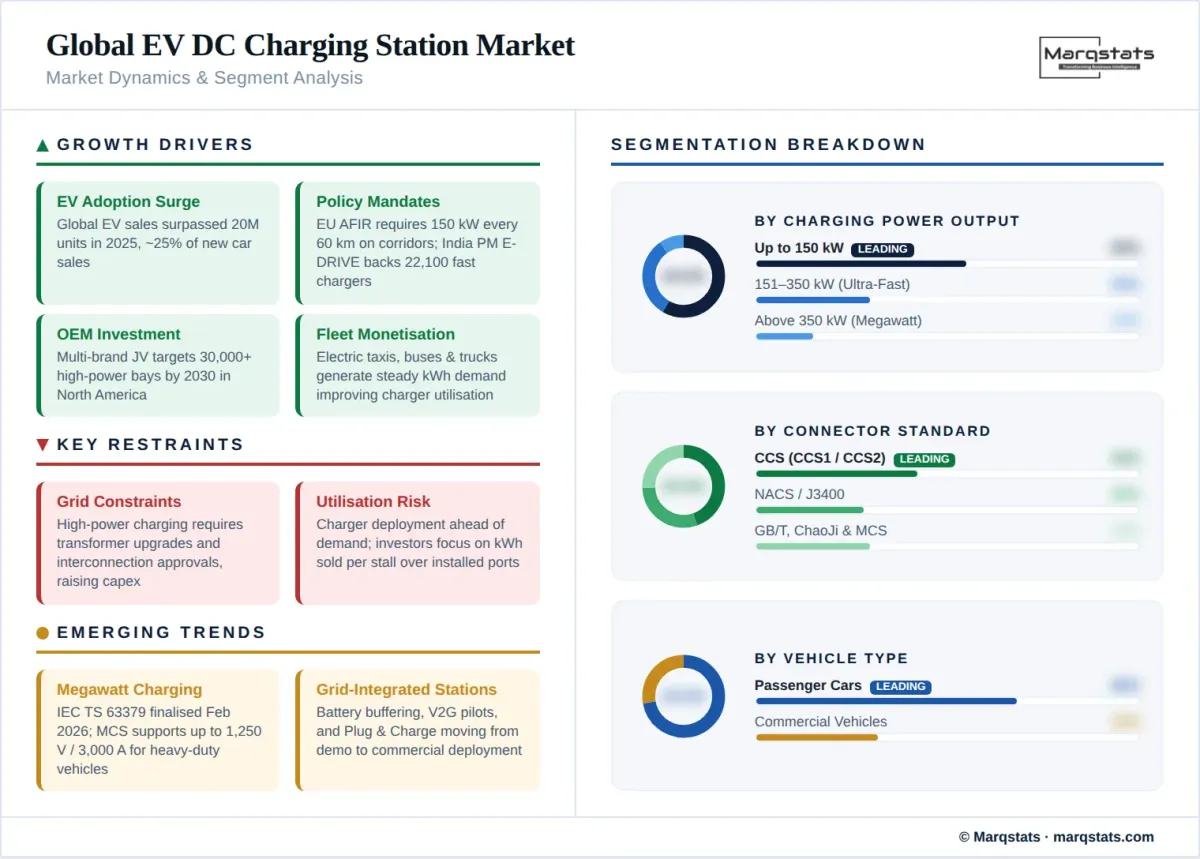
- Rapid EV adoption: global electric car sales surpassed 20 million units in 2025 at about 25% of new car sales, with China above 13 million and Europe near 4.2 million, expanding the vehicle parc that depends on public charging.
- Refuelling-parity expectations: range-anxiety and charging-time comparisons against conventional refuelling push operators toward 150 kW and 350 kW classes, owing to consumer demand for shorter charging sessions on intercity routes.
- Policy and corridor mandates: Europe's Alternative Fuels Infrastructure Regulation requires at least 150 kW charging pools every 60 km along major highway corridors, India's PM E-DRIVE supports thousands of fast chargers, and China targets 28 million charging facilities by end-2027.
- OEM-led investment: automakers now treat charging access as part of the vehicle proposition, with a multi-brand North American joint venture targeting more than 30,000 high-power bays by 2030.
- Retail and fleet monetisation: charging sites function as commercial real-estate assets, while electric taxis, buses, vans, and trucks generate steady kWh demand that improves charger utilisation and supports dedicated hubs.
Key Restraints
- Grid connection and power availability: high-power charging requires transformers, distribution upgrades, interconnection approvals, and sometimes on-site battery storage, which extends deployment timelines and raises capital intensity.
- Utilisation risk: a charger can be installed yet remain underused, shifting investor focus toward kWh sold per stall, uptime, and revenue per site rather than installed port counts.
- Vehicle compatibility gap: ultra-fast chargers are deployed faster than many vehicles can use them, owing to a limited number of models able to accept charging above 250 kW.
- Cost of public fast charging: public fast charging can be markedly more expensive than residential charging, which weakens running-cost advantages for drivers reliant on public infrastructure.
Key Trends
- The shift from fast to ultra-fast: new deployments concentrate on 150 kW, 250 kW, 350 kW, and above, with several operators already running chargers beyond 250 kW on highway corridors.
- Megawatt-class charging for heavy-duty use: the Megawatt Charging System, finalised under IEC TS 63379, supports up to 1,250 V and 3,000 A for trucks, buses, and off-highway machinery.
- Connector standardisation: North America's transition to the J3400/NACS standard reduces long-term uncertainty, however it requires dual connectors and adapters through the changeover.
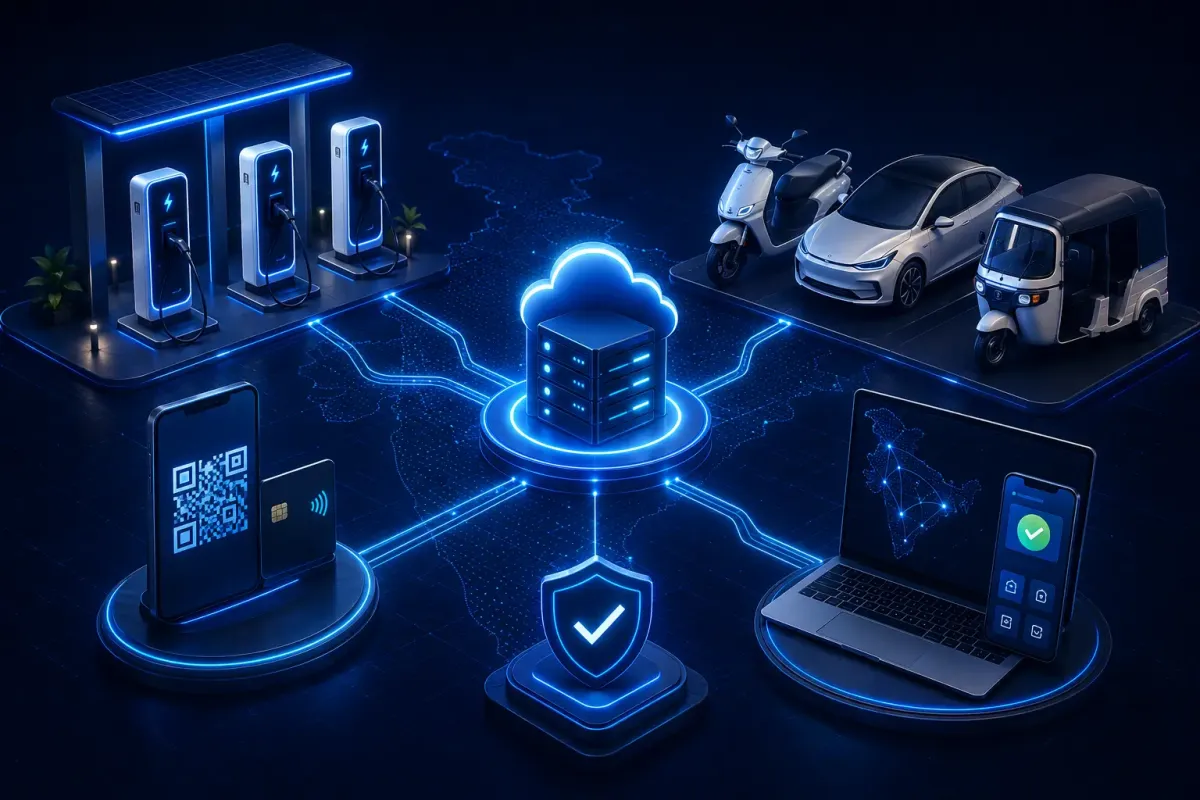
- Grid-integrated stations: battery storage, smart charging, Plug & Charge, and vehicle-to-grid pilots are moving from demonstration into commercial deployment, improving site economics and grid resilience.
Market Segmentation
This band covers legacy direct-current chargers and mid-power fast chargers suited to urban public charging, destination sites, and lighter commercial duty cycles. The segment accounted for the largest installed base historically, however its share of new deployment is declining as operators prioritise higher power. Average public charging-point speed rose toward 50 kW in 2025, reflecting the migration away from sub-50 kW units toward faster hardware.
Ultra-fast charging is the dominant segment for new installations, owing to its suitability for highway corridors, intercity travel, ride-hailing fleets, and premium vehicles. The majority of fresh stalls in mature markets now deliver above 250 kW. This band balances meaningful range addition with broad vehicle compatibility, making it the commercial centre of gravity through the forecast period and the focus of operator capital allocation.
The highest-power band extends from 350 kW passenger charging into megawatt-class systems for heavy-duty vehicles. A vertically integrated manufacturer demonstrated a 1 MW peak passenger-charging platform in 2025, while the Megawatt Charging System addresses Class 6 to 8 trucks and buses. This segment is early in adoption, however it carries strong strategic weight for long-haul freight electrification and depot operations.
CCS, in its CCS1 and CCS2 variants, remains the most widely deployed open standard across Europe and historically North America. It anchors highway high-power charging networks and is supported by most non-Tesla vehicles outside China, sustaining a large installed connector base through the forecast period.
The North American Charging Standard, formalised as SAE J3400, has been adopted by most major automakers from 2025. Federally funded chargers can include J3400 connectors while retaining CCS1 capability, which drives demand for dual-connector hardware and adapter support across the United States and Canada.
China's GB/T standard underpins the world's largest charging base, while the ChaoJi initiative targets higher power and cross-market interoperability. The Megawatt Charging System adds a dedicated heavy-duty connector, broadening the standard set beyond passenger applications into commercial and off-highway segments.
Public roadside and highway corridor charging represents the core revenue base, supported by regulation such as Europe's corridor mandates. Premium highway sites command the strongest utilisation and pricing, owing to their role in enabling intercity and long-distance travel for private and commercial drivers.
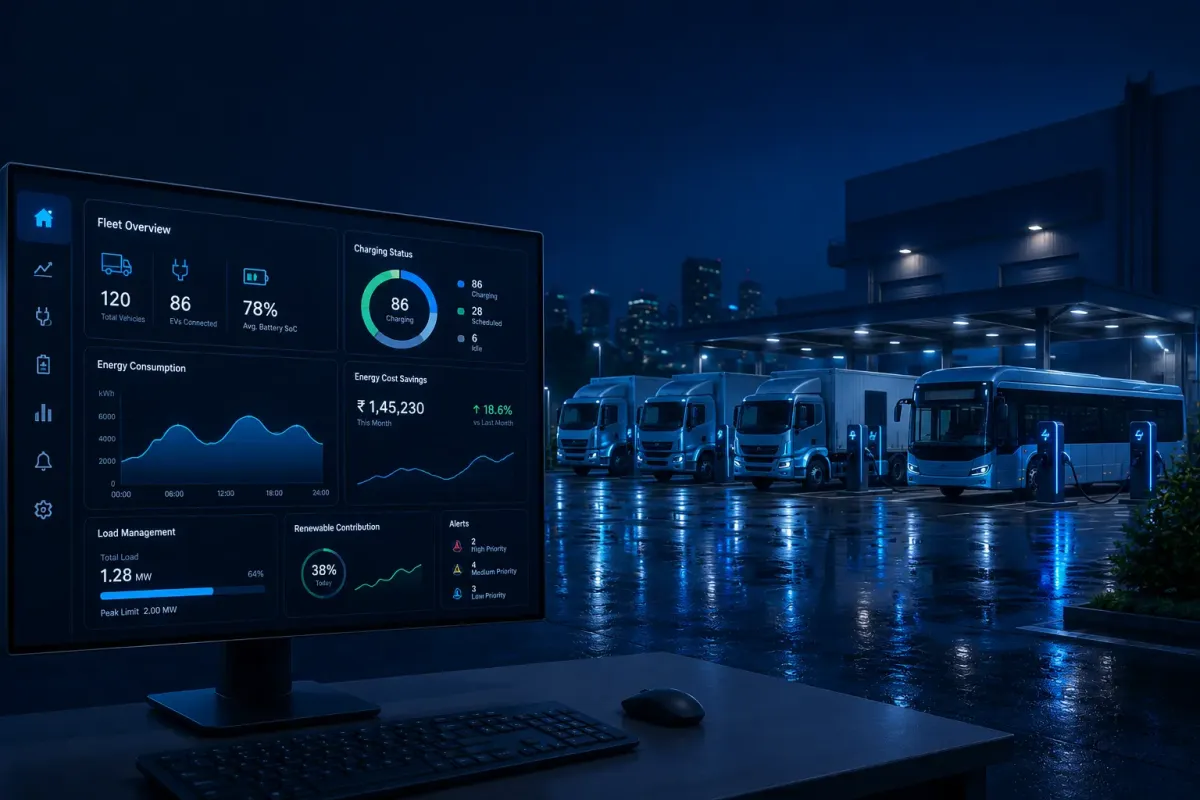
Fleet and depot charging serves electric taxis, ride-hailing vehicles, buses, vans, and trucks, generating steady high-utilisation demand that improves charger economics and supports dedicated hubs and corridor sites — a dynamic explored in our India commercial EV fleet depot energy management software analysis.
Destination charging at retail, hospitality, and convenience locations converts dwell time into charging sessions and non-fuel retail spend. Surveys indicate that most drivers purchase at least one non-fuel item per visit, reinforcing the charging site as a commercial asset rather than a standalone utility.
Passenger cars represent the largest share of DC charging demand, driven by private owners without home charging, ride-hailing drivers, and intercity travellers. This segment shapes the bulk of public and highway corridor investment and benefits most directly from the migration toward 150 kW and 350 kW charging. Charger utilisation in this segment is sensitive to site location, pricing, and reliability.
Commercial vehicles, spanning electric buses, vans, and trucks, form the fastest-growing demand pool for high-power and megawatt-class charging. Fleet duty cycles generate predictable, high-utilisation kWh demand that improves charger economics, while depot and corridor charging support logistics and transit operators. China dominates heavy-duty charging today, with the global base of dedicated truck-capable chargers still early relative to the size of the electric-truck parc.
By Geography
Asia Pacific
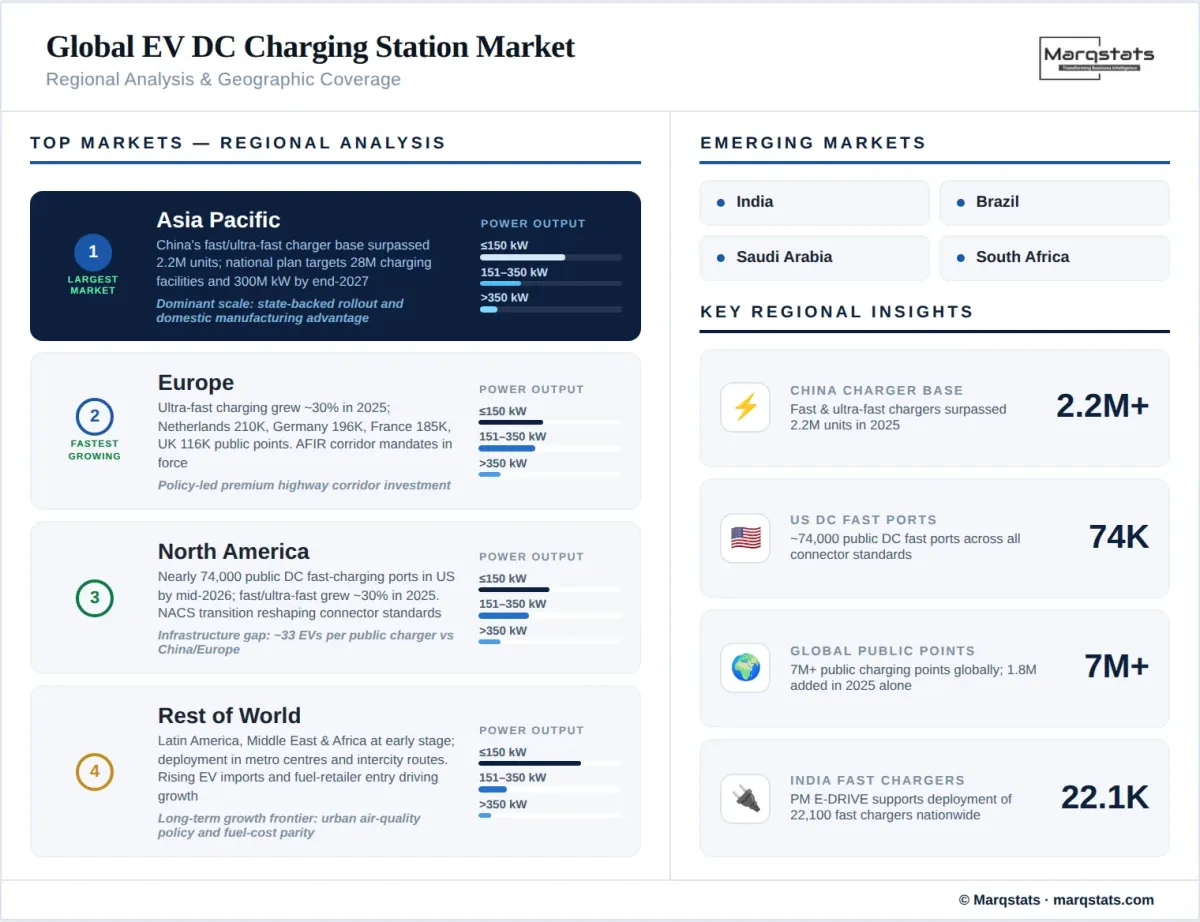
Asia Pacific anchors the global EV DC charging station market, with China accounting for the bulk of public charging growth in 2025 and a fast and ultra-fast charger base surpassing 2.2 million units. China's national plan targets 28 million charging facilities and more than 300 million kW of public charging capacity by end-2027. India's public charging base rose to roughly 88,000 points in 2025, with the PM E-DRIVE scheme supporting 22,100 fast chargers, an expansion tracked in our India EV charging analysis. Japan and South Korea contribute mature high-power networks supported by domestic manufacturing.
Europe
Europe operates a policy-led market shaped by the Alternative Fuels Infrastructure Regulation, which requires at least 150 kW charging pools every 60 km along major highway corridors of the trans-European transport network. Public charging points grew by roughly 20% in 2025, with the Netherlands near 210,000, Germany around 196,000, France about 185,000, and the United Kingdom close to 116,000 public points, the largest national networks by charger count. Ultra-fast charging points expanded by close to 30% across the year, concentrating investment on premium highway sites and cross-border interoperability. Regulatory work to integrate the Megawatt Charging System into the corridor framework is set to extend high-power obligations to heavy-duty freight routes.
North America
North America remains underbuilt relative to its vehicle stock, with the United States operating nearly 74,000 public DC fast-charging ports across all connector standards by mid-2026. Fast and ultra-fast chargers grew about 30% in 2025, however the region's vehicle-to-public-charger ratio stayed well above China and Europe at roughly 33 electric light-duty vehicles per public point, signalling a sizeable infrastructure gap. Connector standardisation around J3400/NACS and federal corridor funding shape investment priorities across the United States and Canada, while new entrants and retail partnerships are broadening the operator base beyond the established networks. Reliability and pricing have stabilised, with most public stations clustering in a narrow per-kilowatt-hour band as the market matures.
Rest of World
Latin America, the Middle East, and Africa are at an earlier stage, with deployment concentrated in metropolitan centres and along primary intercity routes. Demand is increasing owing to rising EV imports, urban air-quality policy, and fuel-retailer entry into charging, positioning these regions as a longer-term growth frontier for the global EV DC charging station market.
How Competition Is Evolving
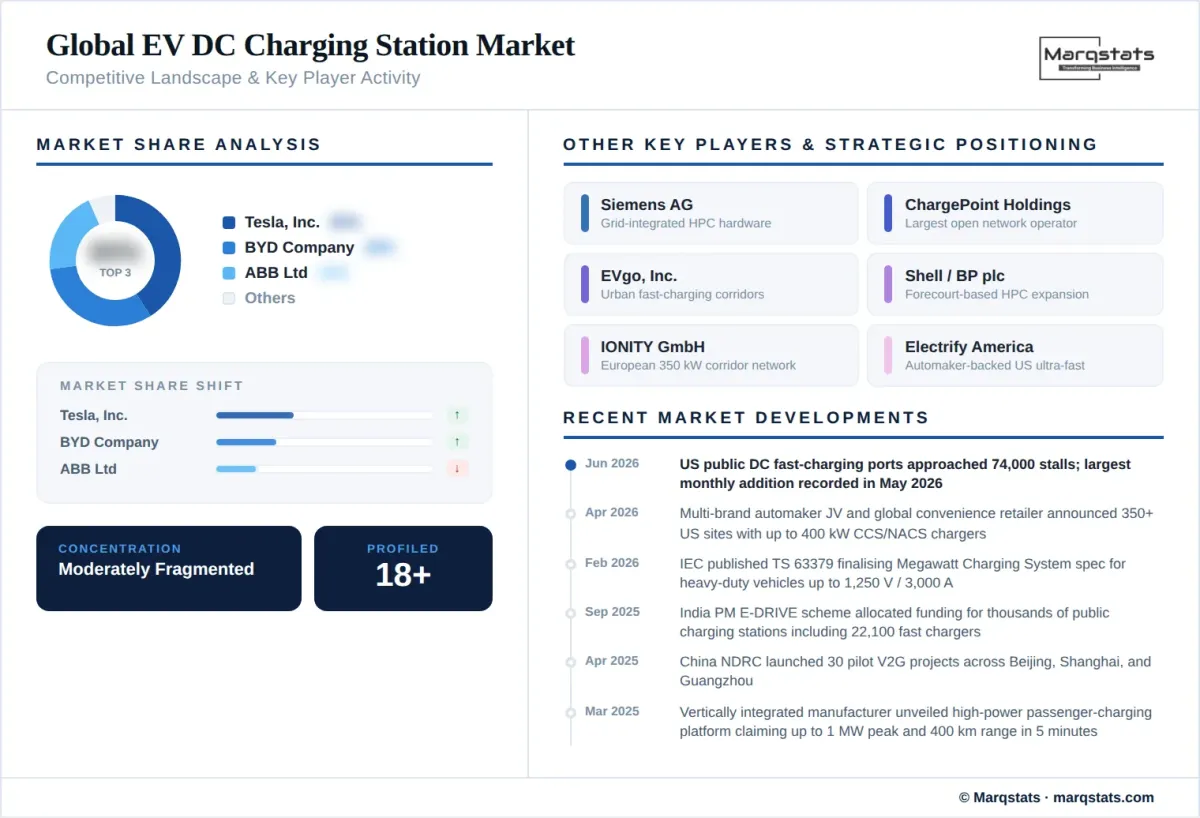
The EV DC charging station market is moderately fragmented, with competition spanning pure-play charge-point operators, automakers, oil and fuel retailers, utilities, and battery and vehicle manufacturers. No single operator controls a majority of global capacity, however a handful of networks set benchmarks for reliability, station density, and integrated payment experience. Hardware supply concentrates among established power-electronics manufacturers, while site ownership and operation remain widely distributed across regions.
Competitive strategy centres on charging speed, uptime, site quality, and the breadth of connector support. One vertically integrated vehicle and battery manufacturer set the benchmark for network density and plug-and-charge experience, while a multi-brand automaker joint venture in North America targets premium ultra-fast sites with reservations and Plug & Charge. European high-power corridor networks compete for cross-border interoperability, and fuel retailers leverage existing forecourt real estate to add high-power charging alongside convenience retail.
Station economics increasingly determine competitive position. Networks that combine high utilisation with reliable uptime are achieving stronger revenue per station, while operators consolidate stalls at proven sites rather than expanding location count. Strategic differentiation is shifting toward grid integration, battery-buffered sites, fleet contracts, and megawatt-class capability for heavy-duty corridors, which collectively raise the barriers to entry for sub-scale operators.
Distinct strategic groups are emerging. Vehicle and battery manufacturers pursue vertical integration that links the car, the battery, and the charger; oil and fuel retailers convert forecourt real estate into high-power hubs with convenience retail; utilities and independent operators compete on grid access and corridor coverage; and power-electronics manufacturers supply charging hardware across all of these channels. In the heavy-duty space, early movers are positioning around depot charging, logistics corridors, and megawatt systems, where grid capacity and long-term fleet contracts will determine winners. Across every group, software for payments, roaming, Plug & Charge, and energy management is becoming a decisive competitive layer rather than a back-office function.
Companies Covered
The report profiles 18++ companies with full strategy and financials analysis, including:
Recent Market Activity
Table of Contents
Coverage & Segmentation
This report provides a comprehensive analysis of the global EV DC charging station market across the 2021–2025 historical period and the 2026–2030 forecast period, with 2025 as the base year. The study examines market size, growth rates, and segment-level forecasts by charging power output, connector standard, and application, alongside regional analysis covering Asia Pacific, Europe, North America, and the rest of the world. Coverage includes competitive structure, station economics, connector standardisation, grid-integration trends, and the emergence of megawatt-class charging for heavy-duty vehicles.
Market sizing applies a bottom-up build validated against top-down estimates, drawing on public charging-point counts, capacity additions, vehicle parc data, and operator disclosures. Primary research includes more than 40 interviews with charge-point operators, hardware manufacturers, fleet operators, utilities, and policy stakeholders, complemented by secondary research from government databases, industry associations, and multilateral energy agencies. Forecasts are segmented by charging power output, connector standard, application, and vehicle type, and are cross-checked against regional policy targets, announced network expansions, and grid-capacity constraints to ensure internal consistency across the study.