Statistics & Highlights

Market Snapshot

Market size in USD Billion
$1.80B
2025
Base year
$2.38B
2026
Estimated
  
$7.20B
2030
Forecast
Largest market
United States
Fastest growing
Canada (Quebec)
Dominant segment
Type C/D Electric School Buses (New Vehicle Procurement)
Concentration
Moderately Fragmented
CAGR
32.00%
2026 – 2030
GROWTH
+$5.40B
Absolute
STUDY PARAMETERS
Base year2025
Historical period2021 – 2025
Forecast period2026 – 2030
Units consideredValue (USD BN), Volume (Units)
REPORT COVERAGE
Segments covered3 bus types (A/C/D) x 3 funding sources x 2 powertrain approaches (new ESB vs repower)
Companies profiled16+
Report pages265+
DeliverablesPDF, Excel, PPT
Executive Summary

Key Takeaways

Market valued at USD 1.80 billion in 2025, projected to reach USD 7.20 billion by 2030 at 32.00% CAGR — driven by EPA Clean School Bus Program (~USD 3B+ awarded), New York's 2027 all-new ZEB mandate, California's USD 2.08B school bus replacement programme, and Quebec's 65% electrification target.
U.S. electric school buses on road grew from 415 (2020) to 5,100+ (2025) with committed pipeline at 13,931 — annual ESB orders rose from 459 to 2,698 during the same period; ESBs hit ~7.5% of new U.S. school bus sales in 2024, up from ~1% in 2020, confirming the market has passed the pilot era inflection point.
Blue Bird Corporation is the unchallenged North American ESB leader — 901 EV school buses delivered in FY2025 (record), USD 1.48B total revenue, USD 80M DOE manufacturing grant, April 2026 full acquisition of Micro Bird (USD 200M) adding Type A through D portfolio consolidation.
New York's 2027 mandate and California's USD 2B+ programme are the demand certainty anchors — New York requires all new school bus purchases to be zero-emission by 2027 and full fleet by 2035 (backed by USD 500M Bond Act); California has funded 3,460 ZE school buses through May 2025 from USD 1.39B allocated.
Repowers are a distinct and growing sub-market at approximately 40–60% of new ESB cost — SEA Electric and Midwest Transit Equipment target 10,000 repowers over 5 years; indicative repower pricing ~USD 110K–180K versus USD 300K+ for new ESBs; Blue Bird-Lightning eMotors established the first factory-certified repower programme for Type C.
V2G is emerging as a revenue stream and grid resilience tool for school districts — Blue Bird, Hubject, Heliox (Siemens), and Accelera (Cummins) delivered the first ISO 15118-20 compliant commercial V2G deployment; Lion Electric's buses already eligible for Virginia's Dominion Energy V2G grid resource programme; New Mexico invested USD 6B+ in V2G and EV infrastructure proposals.
Market Insights

Market Overview & Analysis

Report Summary

The North America electric school bus market covers all battery electric school buses — Types A, C, and D — deployed across the United States and Canada, along with the depot charging infrastructure, fleet electrification planning and management services, and repower/conversion programmes that constitute the full electric school bus ecosystem. The study period is 2021–2030, with 2025 as base year. The U.S. national school bus fleet of approximately 450,000 (DOE, 2023) and Canada's fleet of approximately 45,000–50,000 define the total addressable replacement market. Market sizing includes new ESB vehicle procurement, depot charging infrastructure (which accounts for approximately 20–25% of total programme cost per the EPA Clean School Bus Program structure), fleet electrification services, and repower conversions.

North America's electric school bus market is structurally unlike any other regional ESB market globally. The U.S. school bus market — in which three OEMs (Blue Bird, Thomas Built, IC Bus) historically controlled 90%+ of annual sales through deeply entrenched dealer, parts, and compliance networks — is being electrified from above via federal grant programmes and from below via state mandates and community health advocacy. The EPA Clean School Bus Program is the most significant single public procurement programme for electric school buses in the world, having awarded nearly USD 3 billion across funding rounds since 2021 and bringing the federal government directly into school district procurement decisions. State programmes in California (USD 2.08B total, USD 1.39B for zero-emission school buses) and New York (USD 500M voucher programme, 2027 all-new ZEB mandate) have created the two most quantified and mandated ESB procurement markets globally, comparable in policy clarity to Singapore's LTA EV bus procurement or the Netherlands' zero-emission bus dominance in Europe.

Canada's market is smaller but policy-led in key provinces. Quebec's 65% school bus electrification target for 2030 — backed by the province's PETS incentive programme offering up to CAD 150,000–175,000 per ESB — represents the strongest provincial policy signal in Canada. Quebec had approximately 1,606 ESBs operating as of 2025 (representing the highest national concentration), reflecting Lion Electric's historical production base in Saint-Jérôme, Quebec — though Lion Electric's December 2024 CCAA creditor protection filing and subsequent restructuring have introduced OEM-level risk into the market. Canada's federal iMHZEV incentive programme explicitly excludes conversions and signals it 'may exclude' school buses, meaning provincial programmes (particularly Quebec's PETS) dominate the addressable incentivized ESB market for school buses in Canada.

Market Dynamics

Key Drivers

  • EPA Clean School Bus Program as the dominant federal demand accelerator: The U.S. EPA's Clean School Bus Program — created by the 2021 bipartisan Infrastructure Investment and Jobs Act — has provided the largest single sustained public funding commitment to school bus electrification in the world. The FY2022 rebate round awarded approximately USD 913 million supporting ~2,463 buses (95% electric). A January 2024 grant competition selected 67 applicants for nearly USD 1 billion supporting over 2,700 clean school buses. A May 2024 announcement for the 2023 rebate round provided nearly USD 900 million for over 3,400 clean school buses (92% electric). By mid-2024, EPA had awarded nearly USD 3 billion total, funding approximately 8,500 replacements at over 1,000 school districts. This programme is the primary driver of the U.S. ESB market's expansion from pilot to early scale — covering 40–70% of upfront bus cost and directly removing the most cited adoption barrier for risk-averse school districts.
  • New York State's 2027 all-new ZEB mandate and 2035 full fleet transition creating the clearest U.S. policy certainty window: New York State's Electric School Bus Policy — requiring all new school bus purchases to be zero-emission by 2027 and the entire fleet (approximately 45,000 buses) to be zero-emission by 2035 — is the most unambiguous long-term demand mandate for electric school buses in the United States. Backed by USD 500 million from the Environmental Bond Act through the NY School Bus Incentive Program (NYSBIP) that also funds depot charging, New York's policy eliminates the optionality that constrains procurement decisions in other states and creates a guaranteed ten-year ESB procurement programme. OEMs and charging infrastructure providers can plan capital investment and production capacity with New York as an anchor demand market.
  • California's USD 2 billion school bus replacement programme establishing the largest state-level ESB market: California's Air Resources Board has documented approximately USD 2.081 billion spent or allocated for school bus replacements, including USD 1.392 billion for zero-emission school buses and infrastructure, with approximately 3,460 ZE school buses funded through May 2025. California's ~22,300-bus fleet (public and private) and multi-agency funding approach (California Energy Commission, CARB SB 1403, HVIP programme) make it the single most invested state ESB market in the U.S. The Los Angeles Unified School District's single order of 180 Blue Bird electric school buses — the largest school district ESB order from Blue Bird to date — reflects the large-scale institutional procurement capability that California's programme architecture enables.
  • ESB economics improving through scale, battery cost reduction, and V2G grid revenue: The total cost of ownership case for ESBs has strengthened materially through 2021–2025. Average nameplate range has expanded from ~100 miles to ~100–300 miles across available models, addressing the 'range anxiety' that historically constrained superintendent procurement confidence. Daily average school bus route (~80 miles per NYSERDA data) is comfortably within range even for earlier-generation ESBs. Battery technology advances — illustrated by Coulomb Solutions (CATL authorized partner) launching 900,000-mile, 15-year warranty commercial EV battery systems — are reducing lifecycle cost risk for districts. V2G services are creating a new revenue stream: school buses dwelling at depots for 16+ hours per day represent ideal V2G assets, with New Mexico committing over USD 6 billion in proposals for V2G and EV infrastructure and Dominion Energy's Virginia V2G programme already incorporating Lion Electric buses.
  • Repower market expanding the addressable ESB ecosystem at lower cost points: The school bus repower market — removing the diesel drivetrain and installing a battery-electric system in an existing bus body — addresses districts with partial grant coverage, older bus inventory, and limited capital budgets. WRI data cites repower pricing at approximately USD 110K–180K (excluding the base used bus) versus USD 300K+ for new ESBs — a cost advantage of 40–60% that makes electrification viable where full new bus grants are unavailable. SEA Electric and Midwest Transit Equipment have announced a target of 10,000 repowers over five years. Blue Bird and Lightning eMotors (now acquired) established a factory-certified repower programme for Type C gas and propane buses. Five additional repower specialists (Unique Electric Solutions, Phoenix Motorcars, Optimal EV, Legacy EV, Bison EV Retrofits) serve Types A, C, and D platforms.

Key Restraints

  • Delivery lag of approximately 16 months between grant award and bus delivery creating execution friction: WRI's state-of-adoption data reports a mean lag of approximately 16 months between grant award and bus delivery, reflecting procurement cycles, OEM production lead times, and depot charging interconnection timelines. This delivery lag creates a persistent gap between the 'committed pipeline' metric (13,931 committed ESBs nationally by 2025) and the 'on road' metric (5,100+ by 2025) — a gap of over 8,800 buses that are awarded but not yet operating. For school district administrators and state programme managers, this lag creates fiscal year budget management challenges and undermines confidence in deployment projections.
  • Grid upgrade and interconnection timelines as the binding deployment constraint: The single most commonly cited operational barrier to ESB deployment is not bus technology or purchase cost — it is the utility interconnection and depot charging infrastructure timeline. Depot electrical upgrades to support a fleet of 30–60 ESBs typically require switchgear installation, utility service upgrades, and potentially transformer replacements that can take 12–24 months from utility application to commissioning. Rural and smaller suburban districts face more severe grid constraints than urban districts with stronger utility relationships and more grid capacity. Standardised switchgear, load management systems, and managed charging software that reduce utility engineering cycle time are explicitly identified as high-leverage opportunities for the market.
  • OEM supply chain restructuring following Lion Electric's CCAA filing introducing buyer risk: Lion Electric — once Canada's most prominent ESB OEM with a 1,590-vehicle order book worth approximately USD 420 million as of November 2024 — filed for CCAA creditor protection in December 2024 and reduced its workforce to approximately 160 employees in January 2025. The company's September 2025 Quebec school bus fire (1,200 LION buses suspended in Quebec pending investigation) compounded buyer confidence concerns. The Lion Electric restructuring voided many U.S. warranties per independent market assessments, creating procurement risk for districts with Lion-specific orders and signalling the OEM-level financial fragility that exists among newer entrants building manufacturing scale. This event has accelerated consolidation around the three incumbent OEMs (Blue Bird, Thomas Built, IC Bus) among risk-averse school districts.
  • BYD national security investigation creating procurement uncertainty for lower-cost entrant: The U.S. House Homeland Security Committee launched a formal investigation of BYD in May 2025, requesting internal documents on corporate structure, data security, U.S. contracts, and EV school bus deployments since 2018. BYD built a U.S. bus factory in Lancaster, California in 2013 and received a USD 30 million state grant in 2024 to expand for electric school bus production. The national security scrutiny — which follows similar concerns raised about Chinese-connected telecom and technology companies — creates procurement uncertainty for school districts considering BYD ESBs, potentially limiting BYD's addressable market to states without federal grant restrictions on Chinese-manufactured vehicles.

Key Trends

  • Vehicle-to-grid technology transforming school buses from cost centres to grid assets: The commercial deployment of the first ISO 15118-20 compliant V2G solution — by Blue Bird, Hubject, Heliox (Siemens), and Accelera (Cummins) — established a technical and commercial precedent for school bus V2G in North America. V2G enables ESBs dwelling at school depots overnight and on weekends to discharge energy to the grid during peak demand periods, generating utility revenue that improves school district total cost of ownership. New Mexico has invested over USD 6 billion in legislative proposals supporting V2G, and Nuvve has launched a New Mexico subsidiary specifically to scale V2G school bus programmes. As V2G scales, the economics of ESB procurement shift from a cost-reduction argument to a revenue-generation argument — a fundamental change in the procurement decision framework for school administrators.
  • Blue Bird portfolio consolidation cementing three-OEM market structure: Blue Bird's April 2026 USD 200 million acquisition of Girardin's stake in the Micro Bird joint venture — giving Blue Bird full ownership of a manufacturer offering Type A, C, and D school buses across gasoline, propane, and electric powertrains, with 960 employees in Quebec and New York — represents the single most significant North American ESB consolidation event of the decade. Blue Bird now offers the broadest school bus product portfolio in the industry and is the only OEM with full Type A, C, D electric capability under a single brand with Buy America Act-compliant manufacturing in both the U.S. (Fort Valley, Georgia; Plattsburgh, New York) and Canada (Drummondville, Quebec). This consolidation further disadvantages pure-play EV entrants and smaller specialist OEMs in competing for large district and state-level procurement.
  • Proterra battery technology proliferating across OEM platforms creating a de facto standard: Proterra's battery technology has become a de facto platform standard for North American ESB OEMs — used in Thomas Built Buses' Saf-T-Liner C2 Jouley (800-volt system, 1,000+ buses since 2018) and FCCC MT50e, under Daimler Truck North America. The second-generation Jouley launched in January 2025 uses both an 800V Proterra battery and Accelera's 14Xe eAxle — Accelera being the zero-emissions segment of Cummins. Accelera's technology is simultaneously deployed in Blue Bird's ESBs for the V2G ISO 15118-20 programme, creating a cross-OEM technology ecosystem that strengthens the overall North American ESB supply chain and reduces single-supplier risk for districts with multi-OEM fleets.
  • GreenPower's purpose-built ESB strategy and manufacturing expansion positioning as a pure-play alternative: GreenPower Motor Company is the only OEM to manufacture both a Class 4 purpose-built Type A (Nano BEAST, 118 kWh, 140-mile range, up to 24 passengers) and a Class 8 Type D (BEAST, up to 300-mile range; Mega BEAST, 387 kWh, 300-mile range — class-leading) all-electric school bus. GreenPower's January 2026 establishment of a 135,000-square-foot New Mexico manufacturing facility (340 jobs, USD 5M LEDA award, USD 4.6M JTIP) alongside existing California and West Virginia facilities positions it as the highest-capacity pure-play ESB OEM in North America. GreenPower's secured USD 18 million financing facility (supporting USD 50M+ in contracted orders) and New Mexico USD 5M pilot contract (6 buses over 2 years) demonstrate commercial momentum despite its small revenue base relative to Blue Bird or Daimler.
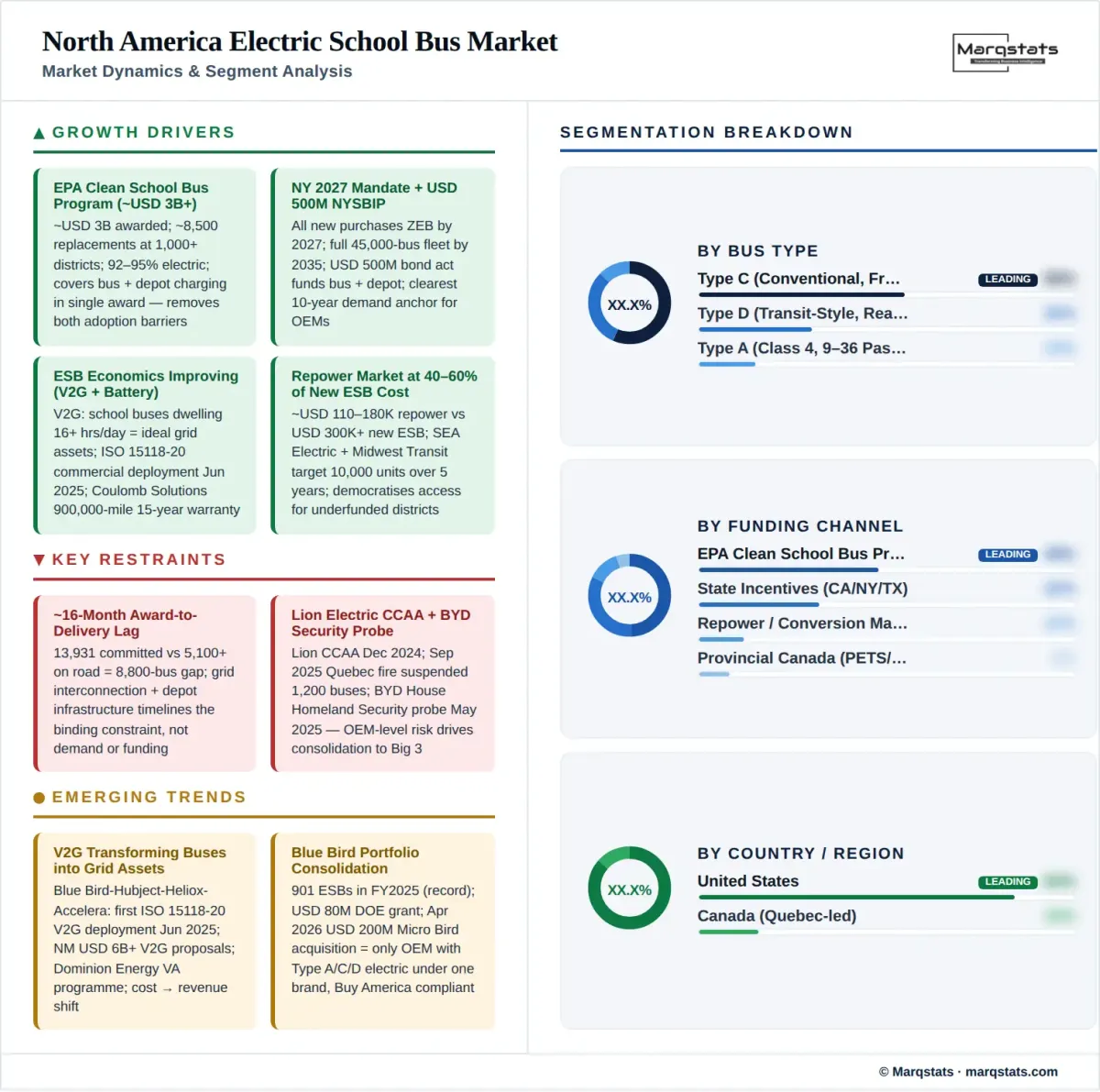
North America Electric School Bus Market Dynamics Segment Analysis Infographic
Segment Analysis

Market Segmentation

Type A Electric School Buses (Class 4, 9–36 Passengers)
Leading

Type A electric school buses — Class 4 vehicles designed for smaller student loads (9–36 passengers) typically used for special education, rural routes, and smaller capacity applications — are served by the fewest current electric OEMs but are seeing growing commercial activity. GreenPower's Nano BEAST is the primary purpose-built all-electric Type A, featuring a 118 kWh battery pack, up to 140-mile range, seamless aluminium body, and dual-port charging (Level 2 up to 19.2 kW, DC fast charging up to 60 kW). The Nano BEAST Access variant adds accessibility features for special-needs transport. Micro Bird (now wholly owned by Blue Bird) also manufactures Type A school and commercial buses in both gasoline, propane, and electric variants. Endera, with USD 49 million in 2025 funding and a 250,000-square-foot Ohio facility, is developing Class 4 electric school bus solutions targeting this segment. Type A represents the fastest growth pathway for smaller rural and suburban districts where school route profiles (fewer students, shorter routes) are well-suited to smaller-format electric vehicles and where state incentive programmes increasingly include Type A vehicles in eligibility criteria.

Type C Electric School Buses (Conventional School Bus, Front Engine)

Type C conventional school buses — the traditional front-engine school bus layout recognisable across North America — are the largest segment by existing fleet volume and the primary target for the repower conversion market. Blue Bird's Vision Electric is the market-leading Type C electric school bus, with the company having delivered over 1,500 zero-emission school buses in North America by mid-2024. The Thomas Built Buses Saf-T-Liner C2 Jouley — second-generation launched January 2025 with Accelera's 14Xe eAxle and 800V Proterra battery, produced in High Point, North Carolina — is the leading Daimler competitor in Type C. IC Bus (Navistar/International) has logged over two million all-electric miles in its yellow school bus platform and targets 50% BEV sales by 2030, 100% by 2040. The Type C repower market (Blue Bird-Lightning eMotors factory-certified programme; SEA Electric + Midwest Transit 10,000-repower programme) targets existing gas and propane Type C buses specifically as the most commercially attractive repower platform due to the high availability of serviceable used Type C bus inventory across North America.

Type D Electric School Buses (Transit-Style, Rear Engine, 71–90 Passengers)

Type D electric school buses — transit-style rear-engine buses with capacities of 71–90 students and the longest range requirements — are the highest-value per-unit segment and the primary focus of Blue Bird's USD 80 million DOE manufacturing expansion grant for its Fort Valley, Georgia facility. Blue Bird's electric All-American FE Type D is the market leader. GreenPower's BEAST — a purpose-built 40-foot Type D with up to 90-student seating, extruded aluminium body, 387 kWh (Mega BEAST) battery delivering up to 300-mile class-leading range — is the most technically distinguished Type D ESB available from a pure-play OEM. The first BEAST manufactured at GreenPower's South Charleston, West Virginia facility was delivered to Kanawha County School District (WV) in June 2024, with 37 additional Type D BEASTs in production for West Virginia. Type D is the most capital-intensive segment per unit (USD 350,000–500,000 per bus) and therefore the most dependent on EPA Clean School Bus grant coverage to make district procurement viable.

Federal EPA Clean School Bus Program
Leading

The EPA Clean School Bus Program dominates U.S. ESB procurement, having awarded nearly USD 3 billion in rebates and grants across multiple rounds since 2022. The programme's structure — providing direct district rebates of USD 20,000–375,000 per bus depending on the previous vehicle being replaced and the powertrain selected, prioritising high-need and rural districts — has democratised ESB adoption beyond wealthy suburban districts. 92–95% of funded buses under recent rounds have been electric (versus propane, CNG, or other clean options), confirming that EPA programme design is driving a near-exclusively electric procurement outcome. The programme covers bus purchase costs and depot charging infrastructure within a single award, addressing both the vehicle and infrastructure barriers simultaneously.

State Incentive Programmes (California, New York, Texas, Others)

State incentive programmes are the second funding pillar, providing district-level vouchers, grants, and low-interest financing that supplement or replace federal EPA funding. California's multi-programme approach (HVIP voucher programme, CARB SB 1403 funding, California Energy Commission grants) has allocated USD 1.39 billion for zero-emission school buses and infrastructure. New York's USD 500 million NYSBIP voucher programme provides district-level vouchers and depot charging funding within a policy framework that mandates all new bus purchases to be zero-emission by 2027. Texas, Florida, and other large-fleet states have received significant EPA Clean School Bus allocations and are increasingly building state-level co-investment programmes. The WRI State of Adoption tracker documents 1,514 districts committed to 12,167 ESBs across 26 available models, reflecting the broad geographic reach of combined federal-state programme incentives.

Provincial Incentives (Canada — Quebec PETS, Federal iMHZEV)

Canada's federal iMHZEV programme explicitly excludes conversions and signals that school buses may be excluded from federal incentive eligibility, making provincial programmes the dominant incentive channel for Canadian school bus electrification. Quebec's PETS (Programme d'aide pour l'électrification des transports scolaires) provides incentives of up to CAD 150,000–175,000 per electric school bus plus charging infrastructure support, and is the primary driver of Quebec's ~1,606 ESBs on road in 2025. Quebec's 2025–2030 climate implementation plan sets a 65% school bus electrification target for 2030 — the most ambitious provincial target in Canada. Prince Edward Island's 107-bus electric fleet from Lion Electric represents the second-most concentrated provincial ESB deployment relative to fleet size, supported by island-specific sustainability policy.

Regional Analysis

By Geography

United States

The United States is the world's largest and most comprehensively incentivised electric school bus market, with approximately 450,000 school buses representing the global ceiling for ESB conversion potential. The market's transition from pilot era to early scale is confirmed by the cumulative committed pipeline of 13,931 ESBs by 2025 (from 1,226 in 2020) and annual orders rising to 2,698 in 2024. However, the critical distinction between 'committed' and 'on road' (5,100+) reflects the systemic execution constraints — grid interconnection, depot infrastructure, and supply chain — that are the primary near-term bottlenecks rather than demand or funding shortfalls. The approximately 16-month mean lag between award and deployment (WRI data) defines the pace at which committed capital converts to operating assets.

California — Largest State Market

California is the largest individual state ESB market by fleet size (~22,300 buses), by total ZE funding invested (USD 2.081 billion), and by ZE buses funded (~3,460 through May 2025 per CARB SB 1403 reporting). The state's multi-programme architecture — HVIP, CARB SB 1403, CEC grants, and EPA awards — creates the most overlapping incentive coverage of any U.S. state, enabling near-full grant coverage of ESB procurement cost for most districts. California Air Resources Board's SB 1403 reporting provides the most rigorous state-level ESB inventory in the U.S. — the California fleet data and incentive tracking serve as the national model for state ESB programme administration. LAUSD's 180-bus Blue Bird order demonstrates that California's largest districts are moving from incremental fleet additions to fleet-scale ESB procurement.

New York — Mandate-Driven Market

New York's uniquely explicit statewide mandate — all new school bus purchases zero-emission by 2027, full fleet zero-emission by 2035 — creates the clearest long-term demand profile of any U.S. state and the most important policy environment for OEM and charging infrastructure investment planning. New York's approximately 45,000 school buses represent the second-largest fleet nationally. The USD 500 million Environmental Bond Act NYSBIP programme provides the financial mechanism to execute the mandate, with vouchers covering bus purchase and depot charging. NYSERDA's ESB technical resources (All About Electric School Buses) represent the most comprehensive public ESB technical guidance available — citing typical daily routes (~80 miles/day), depot charging specifications (6–11 hours for full charge; 2–4.5 hours for mid-day DC top-off), and nameplate range comparisons across current 26 available models. New York's combination of mandate, funding, and technical programme management makes it the standard-setter for U.S. ESB programme design.

Canada — Quebec as the Primary Province

Canada's national school bus fleet of approximately 45,000–50,000 — concentrated in Ontario (20,833), Quebec (10,650), and Alberta (8,014) — had approximately 1,930 electric school buses operating in 2025. Quebec is the most advanced provincial market, with ~1,606 ESBs on road representing approximately 15% of the provincial fleet — the highest national penetration rate — supported by the PETS incentive programme (up to CAD 175,000 per ESB) and Quebec's 2025–2030 plan targeting 65% school bus electrification. The September 2025 Quebec fire event involving a LION Electric school bus — which caused the temporary suspension of 1,200 LION buses in Quebec — highlighted the OEM-specific risk concentration in Quebec's fleet (heavily LION Electric-dependent) and the reputational and operational consequences of a major ESB safety incident. Post-Lion-Electric restructuring, Quebec's market is likely to see greater OEM diversification toward Blue Bird and Thomas Built in new procurement cycles.
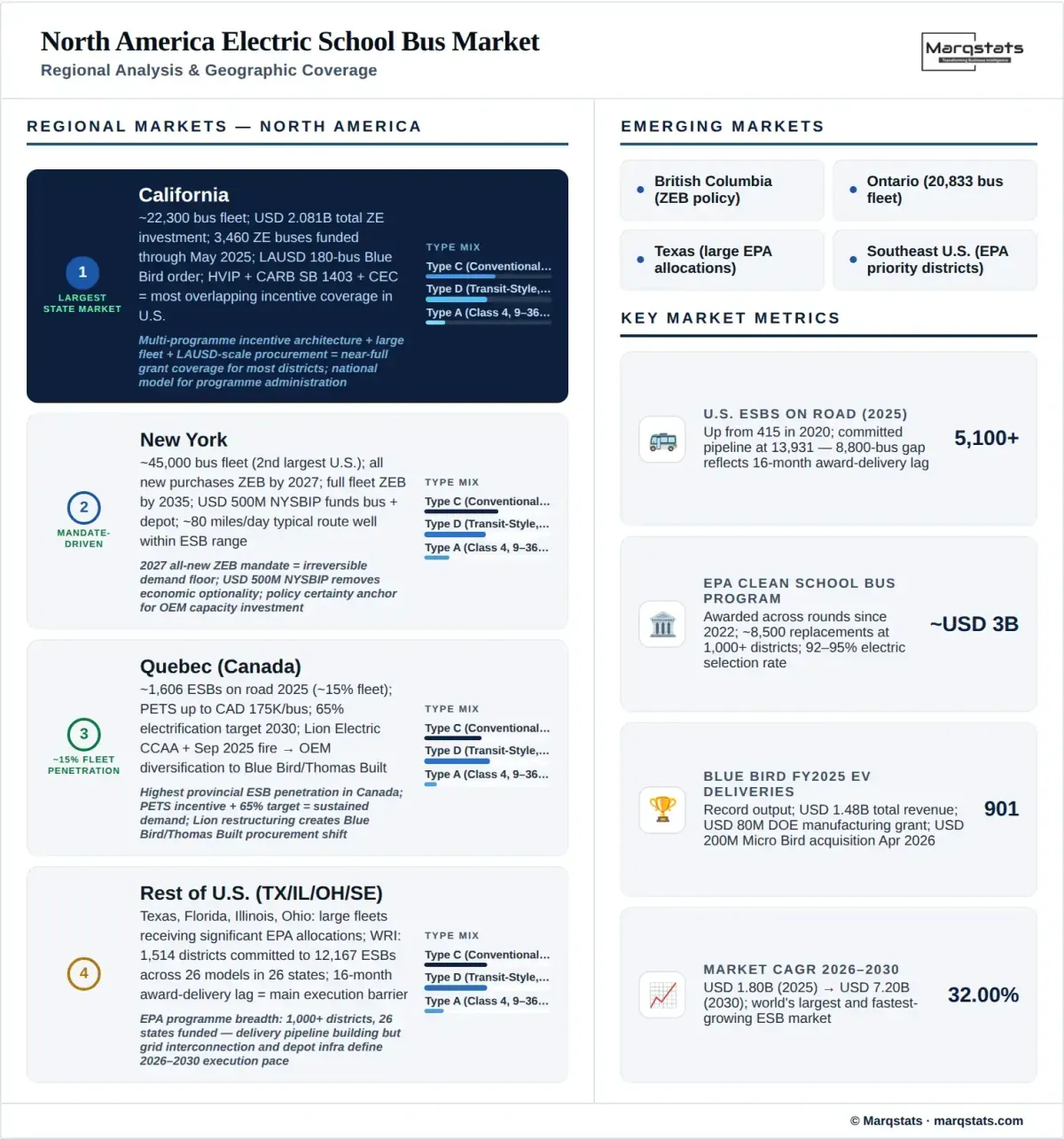
North America Electric School Bus Market Regional Analysis Infographic
Competitive Landscape

How Competition Is Evolving

The North America electric school bus competitive landscape is structured around three incumbent OEMs (Blue Bird, Thomas Built Buses, IC Bus) that together historically controlled 90%+ of total North American school bus sales and are applying their entrenched dealer networks, parts distribution, and compliance track records to ESB market leadership; a set of pure-play EV entrants (GreenPower, Endera, PhoenixEV) competing on technology specificity and purpose-built EV architecture; and a structurally distinct repower sub-market (SEA Electric, Unique Electric Solutions, Phoenix Motorcars, Optimal EV, Legacy EV, Bison EV Retrofits) targeting lower-cost electrification of existing bus bodies.

Blue Bird Corporation's competitive position has strengthened materially through 2024–2026: the USD 80 million DOE manufacturing grant, record 901 EV deliveries in FY2025, April 2026 Micro Bird acquisition (USD 200 million), and the factory-certified repower programme partnership together give Blue Bird the broadest North American school bus portfolio (Type A through D, diesel through fully electric), the largest EV delivery volume, the most advanced manufacturing investment, and the strongest Buy America Act compliance position. Thomas Built Buses maintains the strongest technology differentiation through its Accelera/Cummins eAxle and Proterra battery partnership — the second-generation Jouley's 800V architecture and 14Xe integration represent the most advanced powertrain specification available in a North American ESB platform. IC Bus (Navistar) targets 50% BEV sales by 2030 with the most explicit long-term electrification commitment among legacy OEMs. GreenPower's class-leading 300-mile range Mega BEAST differentiates on range — the primary residual concern for district procurement officers on longer rural routes — and its vertical integration (purpose-built platform, in-house assembly) supports potentially superior lifetime maintenance economics versus adapted diesel-platform EVs. Lion Electric's CCAA filing, workforce reduction to approximately 160 employees, and September 2025 bus fire collectively removed it as a near-term OEM competitor for new procurement despite its 1,455-bus order book, though a restructured Lion Electric may re-enter the market with renewed creditor backing.
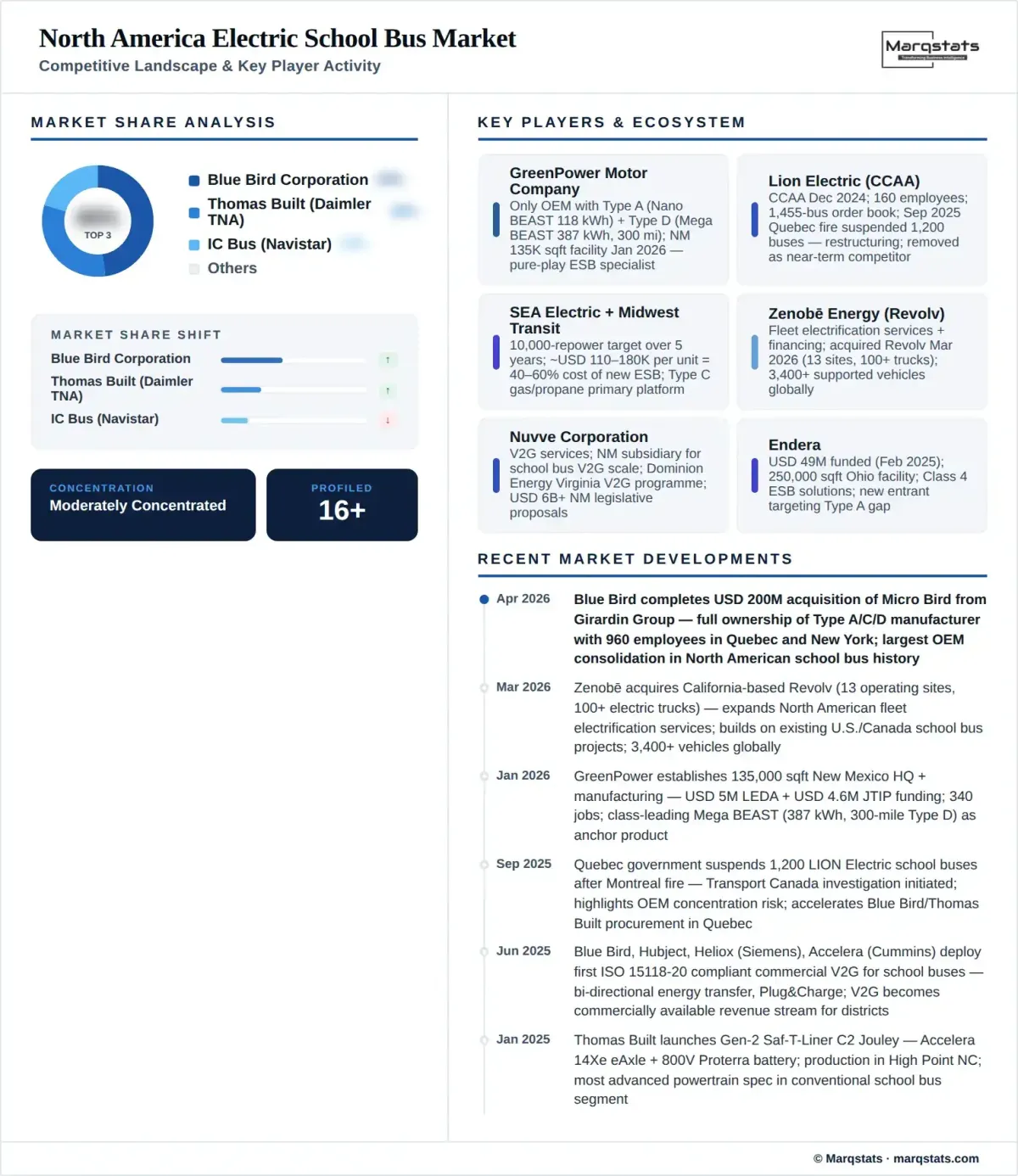
North America Electric School Bus Market Competitive Landscape Infographic
Major Players

Companies Covered

The report profiles 16+ companies with full strategy and financials analysis, including:

Blue Bird Corporation
Thomas Built Buses (Daimler Trucks North America)
IC Bus (Navistar International Corporation)
GreenPower Motor Company Inc.
Lion Electric Company
Endera
PhoenixEV (Phoenix Motor Inc.)
Micro Bird (now wholly owned by Blue Bird)
SEA Electric
Midwest Transit Equipment
Unique Electric Solutions
Legacy EV
Bison EV Retrofits
Accelera by Cummins (powertrain systems)
Zenobē Energy Ltd. (fleet electrification services)
Nuvve Corporation (V2G services)
Note: Full company profiles include revenue analysis, product portfolio, SWOT, and recent strategic developments.
Latest Developments

Recent Market Activity

Apr 2026
Blue Bird completed its USD 200 million acquisition of Girardin Group's stake in the Micro Bird joint venture, taking full ownership and consolidating its North American operations under a single brand spanning Type A, C, and D school buses across diesel, propane, and electric powertrains — the largest OEM consolidation event in North American school bus history.
Mar 2026
Zenobē announced the acquisition of California-based Revolv — adding 13 operating sites and over 100 electric trucks — to expand into North America's commercial electric fleet market, building on existing U.S. and Canadian school bus and transit projects and supporting over 3,400 vehicles globally.
Jan 2026
GreenPower Motor Company announced a new 135,000-square-foot U.S. headquarters and manufacturing facility in Santa Teresa, New Mexico — supported by USD 5 million LEDA award, USD 4.6 million JTIP funds, USD 1.36 million Rural Jobs Tax Credit, and USD 3.65 million High-Wage Jobs Tax Credit — creating more than 340 jobs and establishing New Mexico as GreenPower's primary U.S. manufacturing hub.
Jan 2025
Thomas Built Buses launched the second-generation Saf-T-Liner C2 Jouley — featuring Accelera by Cummins' 14Xe eAxle (motor, two-speed transmission, disc brakes in one rear-axle-mounted unit) and an 800-volt Proterra battery system — establishing the most advanced powertrain specification in the conventional school bus segment and entering production in High Point, North Carolina.
Sep 2025
Quebec government temporarily suspended service of 1,200 LION Electric school buses following a Montreal school bus fire — affecting service for thousands of students and demonstrating the systemic risk of high OEM concentration in a provincial fleet, with Transport Canada initiating investigation and Lion Electric deploying inspection procedures.
Jun 2025
Blue Bird, Hubject, Heliox (Siemens), and Accelera (Cummins) announced the first commercial deployment of an ISO 15118-20 compliant vehicle-to-grid (V2G) solution for electric school buses — supporting bi-directional energy transfer, load management, and Plug&Charge authentication and establishing V2G as a commercially available revenue stream for school districts.
Report Structure

Table of Contents

1. Introduction
1.1 Study Assumptions and Market Definition
1.2 Scope — U.S. and Canada ESB Market Inclusions and Exclusions
1.3 Executive Summary
1.4 Currency, Units, and Key Definitions
1.4.1 USD, CAD Currency Convention
1.4.2 School Bus Type Definitions — Type A, C, D (U.S.) / 7A, 7B, 7C (Canada)
1.4.3 Electric School Bus (ESB) vs. Hybrid vs. Repower
1.4.4 Committed vs. On-Road ESB Count Distinction
1.4.5 Buy America Act (BAA) and Buy America (Infrastructure Act) Definitions
2. Research Methodology
2.1 Analysis Framework
2.2 Primary Research — District Administrators, OEM Teams, State Officials
2.3 Secondary Research — ESB Initiative/WRI, EPA, CARB, NYSERDA
2.4 Market Estimation Approach
2.4.1 ESB Initiative/WRI Cumulative Committed Count as Primary Adoption Proxy
2.4.2 Blue Bird FY2025 901-Unit Delivery as OEM Volume Anchor
2.4.3 EPA Clean School Bus Award Rounds as Federal Procurement Benchmarks
2.4.4 CARB SB 1403 Reporting (~3,460 ZE Buses) as State Validation
2.4.5 ASP Benchmarks — USD 300K–400K Type C/D, USD 200K–300K Type A
2.4.6 Depot Charging Infrastructure at ~20–25% of Total Programme Value
2.4.7 Repower Market at USD 110K–180K per Unit (WRI Data)
2.5 Assumptions and Limitations
3. North America Electric School Bus Market Overview
3.1 U.S. Fleet Size and Electrification Status
3.1.1 Total U.S. Fleet — ~450,000 School Buses (DOE 2023)
3.1.2 ESBs on Road — 415 (2020) → 5,100+ (2025)
3.1.3 Cumulative Committed ESBs — 1,226 (2020) → 13,931 (2025)
3.1.4 Annual U.S. ESB Orders — 459 (2020) → 2,698 (2024)
3.1.5 ESBs as % of New U.S. School Bus Sales — ~1% (2020) → ~7.5% (2024)
3.1.6 1,514 Districts Committed to 12,167 ESBs — 26 Models Available
3.2 Canada Fleet Size and Electrification Status
3.2.1 Total Canadian Fleet — ~45,000–50,000 School Buses
3.2.2 Provincial Fleet Breakdown — Ontario (20,833), Quebec (10,650), Alberta (8,014)
3.2.3 Canadian ESBs on Road — ~1,930 (2025), of Which Quebec ~1,606
3.2.4 Canadian ESB Growth — ~900 (2023) to ~1,930 (2025)
3.3 ESB Deployment Execution Constraints
3.3.1 Mean 16-Month Lag Between Grant Award and Bus Delivery (WRI)
3.3.2 Grid Interconnection and Depot Upgrade Timelines — 12–24 Months
3.3.3 Committed-to-On-Road Gap — ~8,800 Buses Awarded but Not Yet Operating
3.3.4 Supply Chain and OEM Production Constraint Analysis
3.4 School Bus Route Profile and ESB Technical Fit
3.4.1 Average Daily Route ~80 Miles/Day (NYSERDA) — Within ESB Range
3.4.2 Depot Return Model — 16+ Hours Overnight Charging Available
3.4.3 Charging Time Profile — 6–11 Hours AC/Slow DC, 2–4.5 Hours Faster DC
3.4.4 Current ESB Range — ~100–300 Miles Across 26 Available Models
3.5 Market Size and Forecast 2021–2030
4. Policy and Regulatory Landscape
4.1 U.S. Federal Programmes
4.1.1 EPA Clean School Bus Program — The Primary Demand Engine
4.1.1.1 IIJA Authorisation — Up to USD 5 Billion, 2022–2026
4.1.1.2 FY2022 Round — USD 913M, ~2,463 Buses (95% Electric)
4.1.1.3 January 2024 Grant — USD 1B, ~2,700+ Buses
4.1.1.4 May 2024 Round (FY2023) — USD 900M, ~3,400 Buses (92% Electric)
4.1.1.5 Cumulative Awards — Nearly USD 3 Billion, ~8,500 Buses, 1,000+ Districts
4.1.1.6 Rebate Amount Structure — USD 20K–375K per Bus by Powertrain/District
4.1.2 U.S. Department of Energy Manufacturing Grants
4.1.2.1 Blue Bird USD 80M DOE Grant — Fort Valley, GA Facility Expansion
4.1.2.2 BYD USD 30M California Grant — Lancaster Plant EV School Bus Expansion
4.1.3 Federal Transit Administration — Low or No-Emission Programme
4.1.4 Buy America Act and Infrastructure Act BAA Compliance
4.1.4.1 BAA Requirements for Federally Funded Bus Procurement
4.1.4.2 Blue Bird Fort Valley and Plattsburgh as BAA-Compliant Facilities
4.1.4.3 BYD National Security Investigation (House Homeland Security, May 2025)
4.2 U.S. Federal Safety Regulations
4.2.1 FMVSS 305a — EV Bus Safety Standard
4.2.2 NHTSA Make-Inoperative Prohibition (49 U.S.C. §30122) — Repower Legal Framework
4.2.3 NHTSA Factory-Build Pathway for Repowers
4.2.4 Repower Legality — OEM-Certified, Manufacturer-Certified, and Independent Pathways
4.3 U.S. State Programmes and Mandates
4.3.1 New York — All-New ZEB by 2027, Full Fleet by 2035
4.3.1.1 NY School Bus Incentive Program (NYSBIP) — USD 500M Bond Act
4.3.1.2 2027 Mandate — All New School Bus Purchases Zero-Emission
4.3.1.3 2035 Target — Full Fleet Zero-Emission
4.3.1.4 NYSERDA Technical Resources — Route Profiles, Charging Specs
4.3.2 California — USD 2.08B School Bus Replacement Programme
4.3.2.1 CARB SB 1403 — USD 1.39B for ZE School Buses and Infrastructure
4.3.2.2 HVIP Voucher Programme — ZE School Bus Incentives
4.3.2.3 California Energy Commission Grants
4.3.2.4 ~3,460 ZE School Buses Funded Through May 2025 (CARB)
4.3.3 Other State Programmes — Texas, Illinois, Ohio, Virginia, New Mexico
4.3.3.1 Texas EPA Awards — Large Fleet State
4.3.3.2 Virginia — Dominion Energy V2G School Bus Infrastructure Programme
4.3.3.3 New Mexico — USD 6B+ V2G and EV Infrastructure Investment; USD 5M GreenPower Pilot
4.4 Canada — Federal and Provincial Incentive Framework
4.4.1 Federal iMHZEV Programme — School Bus Eligibility Status
4.4.2 Transport Canada Safety Standards for Electric School Buses
4.4.3 Quebec — PETS Programme (Up to CAD 150,000–175,000 per ESB)
4.4.3.1 PETS Programme Structure and Eligibility
4.4.3.2 Quebec 2025–2030 Plan — 65% School Bus Electrification Target
4.4.3.3 Quebec ESB Fleet — ~1,606 on Road (2025)
4.4.4 Ontario and British Columbia Provincial Programmes
4.4.5 Prince Edward Island ESB Deployment — 107 LION Electric Buses
5. Market Dynamics
5.1 Key Market Drivers
5.1.1 EPA Clean School Bus Program — USD 3B+ Federal Demand Catalyst
5.1.2 New York 2027 All-New ZEB Mandate — Mandate-Driven Demand Certainty
5.1.3 California USD 2B+ ZE Bus Programme — Largest State Market
5.1.4 ESB Total Cost of Ownership Improving Through Scale and Technology
5.1.5 Repower Market Expanding Electrification Access at 40–60% of New ESB Cost
5.2 Key Market Restraints
5.2.1 16-Month Committed-to-Delivery Lag Constraint
5.2.2 Grid Interconnection and Depot Upgrade 12–24 Month Timeline
5.2.3 Lion Electric CCAA Filing and Warranty Voidance — OEM Confidence Risk
5.2.4 BYD National Security Investigation — Procurement Uncertainty
5.3 Key Market Trends
5.3.1 V2G Transforming School Buses from Cost Centres to Grid Assets
5.3.2 Blue Bird Portfolio Consolidation Cementing Three-OEM Market Structure
5.3.3 Proterra/Accelera Battery Technology Proliferating Across OEM Platforms
5.3.4 GreenPower Purpose-Built ESB Strategy and Manufacturing Expansion
5.4 ESB Total Cost of Ownership Analysis
5.4.1 New ESB Purchase Cost — USD 200K–400K by Type
5.4.2 Depot Charging Infrastructure — USD 50K–200K per District Upgrade
5.4.3 Energy and Maintenance Savings vs. Diesel Benchmark
5.4.4 V2G Revenue Potential — Grid Demand Response
5.4.5 Federal and State Grant Coverage — 40–70% of Upfront Cost
5.4.6 Repower vs. New ESB Economics — USD 110K–180K vs. USD 300K+
5.5 V2G Technology and Grid Integration
5.5.1 ISO 15118-20 Standard — Bi-Directional Charging for School Buses
5.5.2 Blue Bird-Hubject-Heliox-Accelera V2G Commercial Deployment (June 2025)
5.5.3 Nuvve New Mexico V2G Programme — USD 6B+ State Investment
5.5.4 Dominion Energy Virginia V2G — Lion Electric ESBs Eligible
5.5.5 Coulomb Solutions CATL 900K-Mile Battery — V2G Lifecycle Support
6. Market Segmentation — By Bus Type
6.1 Overview and Revenue Share by Bus Type (2025 vs. 2030)
6.2 Type A Electric School Buses (Class 4, 9–36 Passengers)
6.2.1 Segment Overview — Special Education, Rural, Smaller Capacity
6.2.2 GreenPower Nano BEAST — 118 kWh, 140-Mile Range, Up to 24 Passengers
6.2.2.1 Nano BEAST Specs — Dual Port Charging (L2 19.2 kW / DC 60 kW)
6.2.2.2 Nano BEAST Access — Accessibility Configuration
6.2.2.3 New Mexico Pilot — 3 Nano BEAST Access at Las Vegas/Santa Fe Schools
6.2.3 Micro Bird (Blue Bird) Type A Electric — Drummondville and Plattsburgh
6.2.4 Endera Class 4 Electric School Bus — USD 49M Funding, Ohio Facility
6.2.5 Type A State Incentive Eligibility Expansion
6.2.6 Type A ESB Forecast 2026–2030
6.3 Type C Electric School Buses (Conventional, Front Engine)
6.3.1 Segment Overview — Largest U.S. Fleet Type, Primary EPA Award Category
6.3.2 Blue Bird Vision Electric — Market-Leading Type C ESB
6.3.2.1 Blue Bird FY2025 — 901 EV Deliveries (Record), Including Type C
6.3.2.2 Blue Bird DOE USD 80M Grant — Fort Valley GA Capacity Expansion
6.3.2.3 Blue Bird LAUSD 180-Bus Order — Largest District Order
6.3.3 Thomas Built Saf-T-Liner C2 Jouley Gen 2 (January 2025)
6.3.3.1 14Xe eAxle from Accelera by Cummins — Integrated Motor/Transmission
6.3.3.2 800-Volt Proterra Battery System
6.3.3.3 Production at High Point, North Carolina
6.3.4 IC Bus (Navistar) Type C Electric — 2M+ All-Electric Miles Logged
6.3.5 Type C Repower Market — Blue Bird-Lightning eMotors Factory-Certified Repower
6.3.6 Type C ESB Forecast 2026–2030
6.4 Type D Electric School Buses (Transit-Style, Rear Engine, 71–90 Passengers)
6.4.1 Segment Overview — Highest Value per Unit, Longest Range Requirements
6.4.2 Blue Bird All-American FE Electric Type D
6.4.2.1 Blue Bird USD 80M DOE Grant — 600K sq ft Fort Valley EV Facility
6.4.2.2 Type D as Primary Target of Manufacturing Expansion
6.4.3 GreenPower BEAST and Mega BEAST — Purpose-Built Type D
6.4.3.1 BEAST Specs — 40-Foot, Up to 90 Students, Extruded Aluminium Body
6.4.3.2 Mega BEAST — 387 kWh Battery, Up to 300 Miles (Class-Leading Range)
6.4.3.3 BEAST Manufacturing — South Charleston WV and California
6.4.3.4 First WV-Built BEAST Delivered to Kanawha County Schools (June 2024)
6.4.3.5 37 Type D BEASTs in Production for West Virginia
6.4.4 Lion LionD — 83-Student All-Electric School Bus (Under Restructuring)
6.4.5 Type D ESB Forecast 2026–2030
7. Market Segmentation — By Powertrain Approach
7.1 Overview and Revenue Share — New ESB vs. Repower (2025 vs. 2030)
7.2 New Electric School Bus Procurement
7.2.1 Segment Overview — Dominant by Value, Primary EPA and State Target
7.2.2 Blue Bird, Thomas Built, IC Bus — Incumbent OEM Platform Offering
7.2.3 GreenPower, Endera, PhoenixEV — Pure-Play ESB Alternative
7.2.4 New ESB Forecast 2026–2030
7.3 School Bus Repower / Conversion
7.3.1 Market Definition — Diesel Drivetrain Removal, Electric Motor + Battery Install
7.3.2 Repower Pricing — USD 110K–180K (Excluding Base Bus) vs. USD 300K+ New ESB
7.3.3 NHTSA Legal Framework — 49 U.S.C. §30122 and OEM-Certified Pathways
7.3.4 SEA Electric + Midwest Transit — 10,000-Repower 5-Year Programme
7.3.5 Blue Bird + Lightning eMotors — Factory-Certified Type C Repower
7.3.6 Additional Repower Providers — Unique Electric, Phoenix Motorcars, Optimal EV, Legacy EV, Bison EV
7.3.7 Repower Platform Coverage — Type A, C, D
7.3.8 Repower Forecast 2026–2030
8. Market Segmentation — By Funding Source
8.1 Overview and Revenue Share by Funding Source (2025 vs. 2030)
8.2 Federal EPA Clean School Bus Program
8.2.1 Programme Structure — Rebates and Grants
8.2.2 Priority Districts — High-Need, Rural, Tribal, and Environmental Justice Communities
8.2.3 Coverage — Bus Purchase + Depot Charging Infrastructure
8.2.4 Multi-Round Funding Pipeline — FY2022 Through FY2026
8.2.5 Federal EPA Procurement Volume Forecast 2026–2030
8.3 State Incentive Programmes
8.3.1 California (HVIP, CARB SB 1403, CEC) — USD 1.39B ZE Bus and Infrastructure
8.3.2 New York (NYSBIP) — USD 500M Voucher Programme
8.3.3 Other State Programmes (Texas, Virginia, New Mexico, Ohio)
8.3.4 State Programme Procurement Volume Forecast 2026–2030
8.4 Provincial Incentives (Canada)
8.4.1 Quebec PETS — CAD 150K–175K per ESB
8.4.2 Ontario and BC Provincial Programmes
8.4.3 Canadian Provincial Procurement Volume Forecast 2026–2030
8.5 District Self-Finance and Local Bond Measures
8.5.1 Larger District Independent Procurement (LAUSD as Benchmark)
8.5.2 Local Bond Measure Financing for ESB Procurement
8.5.3 District Self-Finance Forecast 2026–2030
9. Country and State/Province Analysis
9.1 United States — Overview
9.1.1 U.S. Market Overview — 450,000-Bus Fleet, 13,931 Committed ESBs
9.1.2 Federal Programme Architecture — EPA, DOE, FTA
9.1.3 Three-OEM Structure — Blue Bird, Thomas Built, IC Bus Incumbency
9.1.4 Pure-Play Entrants — GreenPower, Endera, PhoenixEV
9.1.5 Market Size and Forecast 2021–2030 — United States
9.2 California
9.2.1 Market Overview — Largest State, ~22,300 Buses, USD 2.08B Invested
9.2.2 CARB SB 1403 — 3,460 ZE School Buses Funded Through May 2025
9.2.3 HVIP Programme and Multi-Agency Funding Architecture
9.2.4 LAUSD 180-Bus Blue Bird Order — Benchmark Large-District Procurement
9.2.5 BYD Lancaster Factory — USD 30M State Grant and National Security Risk
9.2.6 California Market Size and Forecast 2021–2030
9.3 New York
9.3.1 Market Overview — 45,000-Bus Fleet, 2027 All-New ZEB Mandate
9.3.2 NYSBIP USD 500M Voucher Programme — Coverage and Eligibility
9.3.3 2035 Full-Fleet Zero-Emission Target
9.3.4 NYSERDA Technical Support — Route Profile, Charging, Model Comparison
9.3.5 New York Market Size and Forecast 2021–2030
9.4 Other Key U.S. States
9.4.1 Texas — Large Fleet, High EPA Award Volume
9.4.2 Virginia — Dominion Energy V2G Programme
9.4.3 New Mexico — GreenPower Pilot, Nuvve V2G, USD 6B+ State Commitment
9.4.4 Illinois, Ohio, and Midwest — Endera Ohio Facility, IC Bus Presence
9.4.5 Other States Market Size and Forecast 2021–2030
9.5 Canada — Overview
9.5.1 Canadian Market Overview — 45,000–50,000-Bus Fleet, 1,930 ESBs on Road
9.5.2 Federal iMHZEV Eligibility Gap for School Buses
9.5.3 Provincial Programme Dominance — PETS, Ontario, BC
9.5.4 Canadian Market Size and Forecast 2021–2030
9.6 Quebec
9.6.1 Market Overview — ~1,606 ESBs on Road (2025), Canada's Most Advanced Province
9.6.2 PETS Programme — Up to CAD 175,000 per ESB
9.6.3 Quebec 2025–2030 Plan — 65% School Bus Electrification by 2030
9.6.4 Lion Electric CCAA and September 2025 Bus Fire — Market Impact
9.6.5 Post-Lion OEM Diversification — Blue Bird and Thomas Built
9.6.6 Quebec Market Size and Forecast 2021–2030
9.7 Ontario, British Columbia, and Prince Edward Island
9.7.1 Ontario — 20,833-Bus Fleet, Provincial Programme Status
9.7.2 British Columbia — Provincial ZE Fleet Plans
9.7.3 PEI — 107 LION Electric Buses, Highest per-Capita ESB Fleet
9.7.4 Other Province Market Size and Forecast 2021–2030
10. OEM and Technology Landscape
10.1 Electric School Bus OEM Comparison — Type A/C/D Coverage and Specs
10.1.1 Blue Bird Corporation
10.1.1.1 Company Overview — North American ESB Volume Leader
10.1.1.2 FY2025 — 901 EV School Buses Delivered (Record), USD 1.48B Revenue
10.1.1.3 FY2024 — 704 EV Buses (Record Then), 29% YoY Growth
10.1.1.4 DOE USD 80M Manufacturing Grant — Fort Valley GA 600K sq ft EV Facility
10.1.1.5 Micro Bird Acquisition (April 2026) — USD 200M, Full Type A-D Portfolio
10.1.1.6 V2G Partnership — Blue Bird + Hubject + Heliox + Accelera (ISO 15118-20)
10.1.1.7 Fort Valley GA (School Buses, ~2,000 Employees) + Plattsburgh NY (Type A)
10.1.1.8 EV Backlog — ~680 Electric Buses in Firm Order Backlog (FY2025 End)
10.1.1.9 Recent Strategic Developments
10.1.2 Thomas Built Buses (Daimler Trucks North America)
10.1.2.1 Company Overview
10.1.2.2 Saf-T-Liner C2 Jouley Gen 2 — January 2025 Launch
10.1.2.3 Accelera 14Xe eAxle — Motor, Transmission, Disc Brakes in Rear-Axle Unit
10.1.2.4 800V Proterra Battery System — Superior Startability and Acceleration
10.1.2.5 1,000+ Thomas Built Buses Using Proterra Since 2018
10.1.2.6 Production at High Point, North Carolina
10.1.2.7 Recent Strategic Developments
10.1.3 IC Bus (Navistar International Corporation)
10.1.3.1 Company Overview
10.1.3.2 50% BEV Sales Target by 2030, 100% by 2040
10.1.3.3 2M+ All-Electric Miles in Yellow School Buses (IC Bus Platforms)
10.1.3.4 San Antonio Production Plant — Built for EV Models
10.1.3.5 USD 1M DOE Grant for Battery-Electric Snowplow Development
10.1.3.6 Quanta Services Charging Infrastructure Partnership
10.1.3.7 OnCommand Connection Fleet Telematics for ESB Fleet Management
10.1.3.8 Recent Strategic Developments
10.1.4 GreenPower Motor Company Inc.
10.1.4.1 Company Overview — Only OEM with Both Class 4 Type A and Class 8 Type D
10.1.4.2 Nano BEAST — Type A, 118 kWh, 140 Miles, Up to 24 Passengers
10.1.4.3 Nano BEAST Access — Accessibility Variant
10.1.4.4 BEAST — Type D, 40-Foot, Up to 90 Students
10.1.4.5 Mega BEAST — 387 kWh, Up to 300 Miles (Class-Leading Range)
10.1.4.6 Manufacturing — South Charleston WV, California, New Mexico (135K sq ft)
10.1.4.7 New Mexico HQ — Jan 2026, USD 5M LEDA, USD 4.6M JTIP, 340 Jobs
10.1.4.8 USD 18M Financing — Supporting USD 50M+ in Contracted Orders
10.1.4.9 New Mexico USD 5M Pilot — 3 Nano BEAST Access + 3 BEAST/Mega BEAST
10.1.4.10 Recent Strategic Developments
10.1.5 Lion Electric Company
10.1.5.1 Company Overview — Canadian ESB OEM Under Restructuring
10.1.5.2 December 2024 CCAA Filing — Creditor Protection, SISP
10.1.5.3 January 2025 Workforce Reduction — ~150 Layoffs, 160 Employees
10.1.5.4 September 2025 Quebec Bus Fire — 1,200 Buses Suspended in Quebec
10.1.5.5 November 2024 Order Book — 1,455 Buses, USD 420M Total Value
10.1.5.6 LionD Type D — 83 Students, California Deliveries Commenced Jan 2024
10.1.5.7 V2G Eligibility — Dominion Energy Virginia Programme
10.1.5.8 Restructuring Outlook and Market Position
10.1.6 Endera
10.1.6.1 Company Overview — Class 4 EV Shuttle and School Bus Specialist
10.1.6.2 USD 49M Funding (February 2025) — Magnetar-Led Equity + Credit
10.1.6.3 250,000 sq ft Ohio Production Facility
10.1.6.4 Vertically Integrated — Proprietary Powertrains and Fleet Management Software
10.1.6.5 Recent Strategic Developments
10.1.7 Micro Bird (Blue Bird — Acquired Full Ownership April 2026)
10.1.7.1 Company History — 50/50 JV Founded 2009, Blue Bird + Girardin
10.1.7.2 Plattsburgh NY Facility — Opened September 2025, USD 38M Investment, 225 Employees
10.1.7.3 Buy America Act Compliance at Plattsburgh
10.1.7.4 Drummondville QC Facility — 960 Employees, Type A School and Commercial Buses
10.1.7.5 Full Acquisition Completed April 2026 for USD 200M
10.2 Repower and Conversion Providers
10.2.1 SEA Electric + Midwest Transit Equipment
10.2.1.1 10,000-Repower 5-Year Partnership
10.2.1.2 Repower Economics and Target Market
10.2.2 Unique Electric Solutions
10.2.3 Phoenix Motorcars (PhoenixEV)
10.2.4 Optimal EV
10.2.5 Legacy EV
10.2.6 Bison EV Retrofits
10.3 Powertrain and Battery Component Suppliers
10.3.1 Accelera by Cummins
10.3.1.1 Company Overview — Zero-Emissions Business Segment of Cummins
10.3.1.2 14Xe eAxle — Used in Thomas Built Jouley Gen 2
10.3.1.3 Blue Bird V2G Partnership — ELFA Inverter in V2G School Bus
10.3.1.4 FCE300 and FCE150 Hydrogen Fuel Cell Engines
10.3.2 Proterra (Volvo Group)
10.3.2.1 Battery Technology — 800V Systems, U.S. Designed and Manufactured
10.3.2.2 Thomas Built Buses Partnership — 1,000+ Buses Since 2018
10.3.2.3 FCCC MT50e and Next-Gen Bus Battery Supply
10.3.3 Coulomb Solutions Inc. (CATL Authorized North American Partner)
10.3.3.1 Super Long Life Battery Systems — 900,000-Mile, 15-Year Warranty
10.3.3.2 Specific Energy 175 Wh/kg, Energy Density 270 Wh/L
10.3.3.3 Orders for Deliveries from September 2025
10.4 Charging Infrastructure and Fleet Services
10.4.1 Zenobē Energy Ltd.
10.4.1.1 Company Overview — UK-Based Global EV Fleet Operator
10.4.1.2 Revolv Acquisition (March 2026) — 13 Sites, 100+ Electric Trucks
10.4.1.3 U.S. and Canadian School Bus and Transit Projects
10.4.1.4 3,400+ Vehicles Supported Globally
10.4.2 Nuvve Corporation
10.4.2.1 Company Overview — V2G Technology Specialist
10.4.2.2 Nuvve New Mexico LLC — State V2G and Clean Transportation
10.4.2.3 New Mexico USD 6B+ Investment Pipeline
10.4.3 Terawatt Infrastructure
10.4.3.1 Rancho Dominguez CA Charging Hub — 20 Stalls, 7 MW
10.4.3.2 School Bus DC Fast Charging Capabilities
10.4.4 Hubject
10.4.4.1 Plug&Charge Digital Infrastructure for V2G
10.4.4.2 Blue Bird V2G ISO 15118-20 Partnership
10.4.5 Heliox (Siemens subsidiary)
10.4.5.1 DC Fast Charging for School Bus V2G Deployment
10.4.5.2 ISO 15118-20 V2G Charger Partner
11. Appendix
11.1 Research Methodology
11.2 U.S. Cumulative Committed ESB Count 2020–2025 (WRI/ESB Initiative)
11.3 EPA Clean School Bus Program Rounds Summary
11.4 NYSERDA ESB Technical Reference Data
11.5 Glossary of Key Terms
11.6 List of Tables
11.7 List of Figures
11.8 Disclaimer and Legal Notice
Study Scope & Focus

Coverage & Segmentation

This report provides a comprehensive analysis of the North America electric school bus market covering the 2021–2030 study period, with 2025 as base year. Market scope covers all battery electric school buses (Types A, C, and D) across the United States and Canada, including new vehicle procurement, depot charging infrastructure, fleet electrification planning and management services, and school bus repower conversions. Key U.S. state markets covered include California, New York, Texas, Illinois, Ohio, Pennsylvania, and the Southeast. Canada coverage includes Quebec (primary market), Ontario, British Columbia, Prince Edward Island, and national federal programme analysis. Policy analysis centres on the U.S. EPA Clean School Bus Program (all rounds), FMVSS safety standards for ESBs (including FMVSS 305a and conversion legality frameworks), New York NYSBIP mandate and voucher programme, California CARB SB 1403 and HVIP programmes, Canada's iMHZEV programme, and Quebec's PETS incentive. Primary research includes 40+ interviews with school district fleet administrators, OEM commercial teams, charging infrastructure providers, state energy programme managers, repower integrators, and V2G service providers.
Frequently Asked Questions

FAQs About the North America Electric School Bus Market

The North America electric school bus market was valued at USD 1.80 billion in 2025 and is projected to reach USD 7.20 billion by 2030 at a CAGR of 32.00%. The U.S. alone had over 5,100 electric school buses on the road in 2025 with a committed pipeline of 13,931 ESBs. The EPA Clean School Bus Program has awarded nearly USD 3 billion in total funding, making North America the world's largest and most comprehensively incentivised ESB market.
The EPA Clean School Bus Program was created by the 2021 bipartisan Infrastructure Investment and Jobs Act, authorising up to USD 5 billion through 2026. It provides school districts with rebates of USD 20,000–375,000 per bus (depending on powertrain and district type) plus depot charging infrastructure coverage. The FY2022 round awarded USD 913M (~2,463 buses), a January 2024 round awarded USD 1B (~2,700 buses), and the May 2024 round (FY2023) awarded USD 900M (~3,400 buses). 92–95% of buses funded under recent rounds are fully electric.
New York State requires all new school bus purchases to be zero-emission by 2027 and the full fleet (approximately 45,000 buses) to transition to zero-emission by 2035. Backed by USD 500 million from the Environmental Bond Act through the NY School Bus Incentive Program (NYSBIP), New York's mandate is the clearest and most binding ESB procurement mandate in the United States, creating guaranteed long-term demand that both OEMs and charging infrastructure providers can plan capital investment against.
Blue Bird Corporation is the North American ESB leader — delivering 901 electric school buses in fiscal 2025 (record) and acquiring full ownership of Micro Bird (Type A through D portfolio) in April 2026 for USD 200 million. Thomas Built Buses (Daimler) launched its second-generation Saf-T-Liner C2 Jouley with Accelera eAxle and 800V Proterra battery in January 2025. IC Bus (Navistar) targets 50% BEV by 2030. GreenPower Motor manufactures both Type A (Nano BEAST) and Type D (BEAST/Mega BEAST, up to 300-mile range). Lion Electric is under CCAA restructuring. Endera has secured USD 49M to scale its Ohio facility.
The school bus repower market involves removing a diesel powertrain and installing a battery-electric system in an existing bus body. WRI cites pricing at approximately USD 110,000–180,000 per repower (excluding the base bus), versus USD 300,000+ for a new electric school bus — a 40–60% cost advantage. SEA Electric and Midwest Transit Equipment target 10,000 repowers over 5 years. Blue Bird-Lightning eMotors established the first factory-certified repower for Type C buses. Five additional providers (Unique Electric, Phoenix Motorcars, Optimal EV, Legacy EV, Bison EV) cover Types A, C, and D platforms.
Yes. Marqstats offers customisation including state-level procurement pipeline analysis, EPA award round impact modelling, OEM fleet programme benchmarking, depot charging infrastructure cost analysis, V2G revenue model integration, and repower vs. new purchase economics by district type. Contact sales@marqstats.com for Single User, Team, and Enterprise tier options.
The report is delivered as a PDF (265+ pages), Excel data pack with ESB fleet counts by state/province, EPA award round volumes, OEM delivery history, and 2026–2030 forecasts by bus type and funding source, and a PowerPoint executive summary deck. All formats are included in every licence tier.