Market Snapshot
Key Takeaways
Market Overview & Analysis
Report Summary
The Europe electric school bus market covers all battery electric and plug-in hybrid vehicles deployed for pupil transport across European Union Member States and the United Kingdom, including electric coaches, electrically-converted intercity buses, electric minibuses, and purpose-built electric school vehicles. The study period is 2021–2030 with 2025 as base year, historical data from 2021 to 2025, and a forward-looking forecast from 2026 to 2030. Market sizing uses ACEA annual registrations of electrically-chargeable buses and coaches (>3.5t) as the primary supply-side proxy, anchored to documented school-specific programmes and tenders for demand-side validation. Because Europe-wide harmonised statistics for 'electric school buses' as a standalone segment do not exist in official EU databases, this report employs a two-layer methodology: macro-level electric bus/coach adoption trends as the market envelope, with school-specific projects (Campania's 139-unit programme, Rouen's 49-unit retrofit, Transdev's 20-vehicle Centre-Val de Loire order) as quantified anchors for the school-application layer.
Understanding the European electric school bus market requires first understanding the structural difference from North America. The iconic yellow school bus that dominates the North American market has no EU equivalent. European school transport operates within the interurban coach and bus framework: pupils are typically transported by coaches (full-size 49-seater or 53-seater vehicles) under regional service contracts, or by urban/interurban buses on school service routes, or by minibuses for smaller municipalities. Italy's Campania programme vehicles are 7.6-metre minibuses (29 seated students, or 24 with wheelchair accommodation) — a far cry from the 40-tonne North American yellow bus. France's conversion opportunity centres on the 66,000-strong coach fleet where operators are retrofitting or replacing diesel coaches under CEE financial incentive structures. This diversity of vehicle type (minibus to full coach), procurement model (public tender to private operator conversion), and funding mechanism (ERDF, national subsidy, CEE retrofit credit) means the European electric school bus market has more structural complexity than any single-country analysis captures.
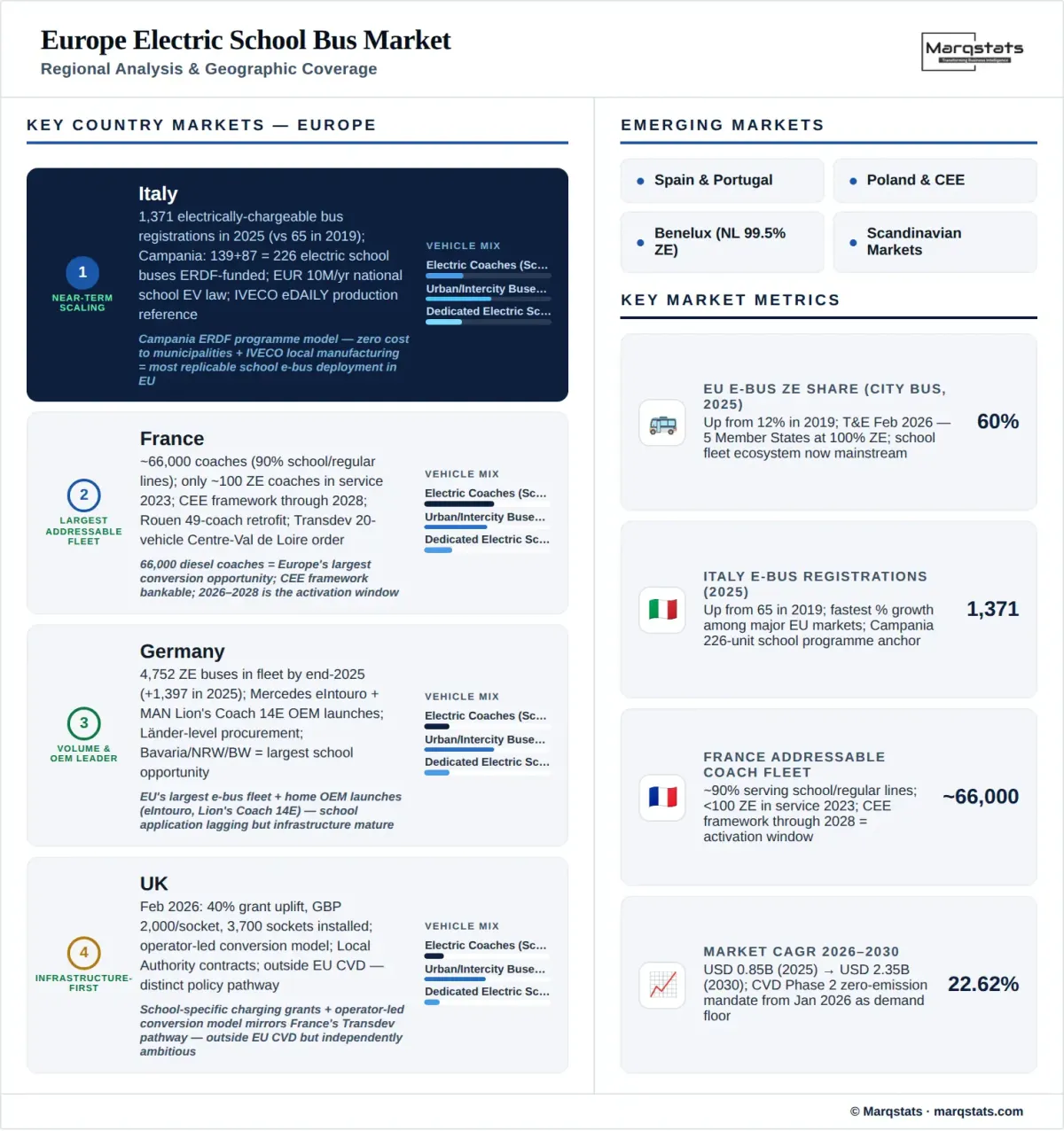
The 2025 tipping point in Europe's electric bus market has direct implications for school transport. Transport & Environment's data showing 60% ZE share of new EU city buses in 2025 (up from 12% in 2019) confirms that OEM supply chains, depot charging ecosystems, and operator procurement capability have all reached a level of maturity that was not present when Italy's and France's early school transport EV programmes were conceived. Five EU Member States recorded 100% zero-emission shares in new city bus sales in 2025. Germany added 1,397 zero-emission buses in 2025 alone, bringing its fleet to 4,752. These macro signals create the permissive conditions for school transport electrification to accelerate — as the charging infrastructure, service networks, and vehicle availability that urban transit operators have been building since 2019 become accessible to school fleet operators and regional transport authorities.
Market Dynamics
Key Drivers
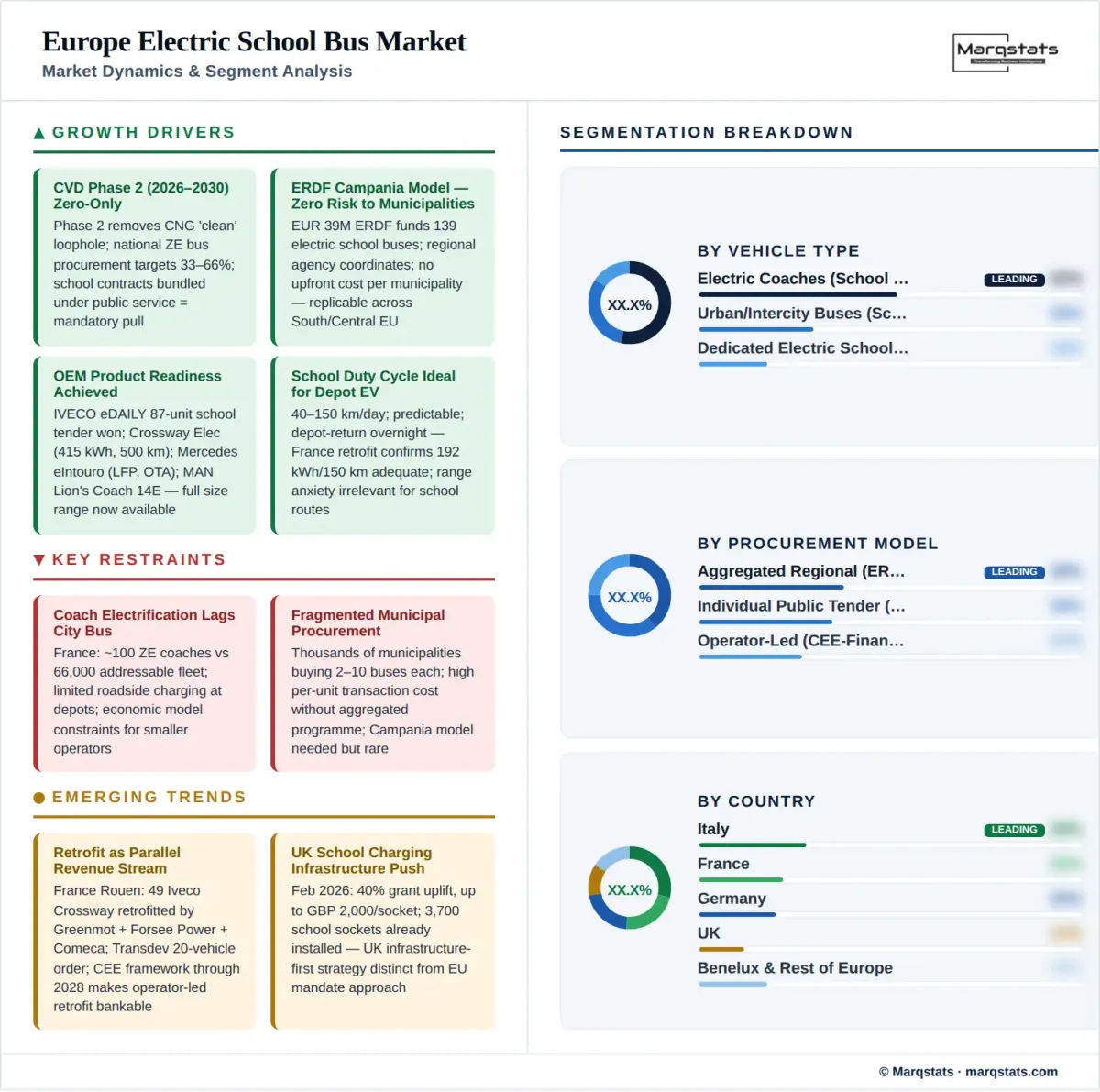
- Clean Vehicles Directive Phase 2 (2026–2030) mandating zero-emission bus procurement: The CVD's second reference period, running from January 2026 through December 2030, requires Member States to achieve national ZE bus procurement targets using only zero-emission vehicles — not the CNG/LNG 'clean' vehicles allowed in Phase 1. National targets range from 33% to 66% ZE buses in total public procurement over this five-year window. Where school transport is delivered under public service contracts or through publicly procured fleets, CVD targets directly shape school bus procurement decisions. Member States that already exceeded Phase 1 targets (Netherlands achieved 99.5% ZE in city bus sales since 2021) are now ahead of the curve; lagging markets are facing regulatory pressure to accelerate in Phase 2.
- ERDF Regional Programme funding enabling zero-risk school fleet transition for municipalities: Italy's Campania model — EUR 39 million from the ERDF 2021–2027 programme distributed to municipalities under 15,000 inhabitants to replace diesel school buses — demonstrates how EU structural funds can be channelled into school fleet electrification at programme scale with zero upfront cost to individual local authorities. The Campania programme's 139-vehicle first phase, delivered through a regional mobility agency acting as procurement coordinator, is replicable by other Italian regions and analogous EU regional programmes. With the ERDF 2021–2027 programming period running through 2027, and sustainable transport among the explicit investment priorities, the pipeline of ERDF-funded school bus programmes represents a significant and quantifiable demand signal for OEMs.
- France's 66,000-coach conversion market creating the largest single-country retrofit opportunity: France's coach fleet — approximately 66,000 vehicles with roughly 90% serving school transport and regular lines — represents Europe's largest single pool of diesel vehicles eligible for electrification under a mature financial framework. The CEE energy saving certificate framework (Arrêté of 20 December 2023) explicitly covers purchase, lease, and retrofit of electric coaches and buses through 31 December 2028, providing a standardised financial mechanism that reduces transaction cost for both operators and regional authorities. With zero-emission coach penetration at approximately 100 vehicles in service in 2023, the France conversion market has by far the largest gap between current stock and the addressable fleet, creating a multi-year revenue opportunity for retrofit integrators (Greenmot), battery suppliers (Forsee Power), and charging infrastructure providers (Comeca).
- OEM product readiness eliminating the 'no suitable model' barrier: The Busworld Europe 2025 exhibition in Brussels was the strongest single signal of European OEM readiness for school transport electrification. IVECO Bus won the ACAMIR tender for 87 eDAILY electric school minibuses in Campania — establishing a production reference for school-purpose electric minibuses. IVECO also unveiled the Crossway Elec (up to 415 kWh, up to 500 km range, available in 12m and 13m for school and intercity service). Mercedes-Benz debuted the eIntouro — with LFP batteries, over-the-air software updates, and configuration for school, shuttle, and short intercity use. MAN unveiled the Lion's Coach 14E, Europe's first fully electric long-distance coach with 330 kW motor, 480 kWh battery, and solar panels. These four new models collectively cover the full vehicle size range relevant to European school transport.
- Favourable school route duty cycles reducing the case for range extension: School transport routes are operationally well-suited for electrification because routes are predictable, mileage is moderate (typical school route of 40–150 km/day), and vehicles return to a depot or parking location for extended dwell overnight. France's retrofit experience confirms that 192 kWh battery capacity with approximately 150 km range is adequate for school route operations when depot charging discipline is in place. Italy's Campania 7.6-metre minibuses operate even shorter routes in small municipalities, making range constraints almost irrelevant. The school duty cycle advantage — predictable, depot-return, low daily distance — means school fleets are among the most technically straightforward applications for depot-charged electric vehicles.
Key Restraints
- Coach electrification lagging city bus electrification due to range, charging, and economics: Despite the strong city bus ZE momentum (60% ZE share in 2025), the interurban and coach segment where most European school transport operates has significantly lower electric penetration. France's Avere-France analysis explicitly identifies barriers including limited offer of new zero-emission coach models until recently, economic model constraints, and charging infrastructure limitations at roadside stops and depots not designed for high-power charging. While the launch of the eIntouro and Crossway Elec addresses the model availability barrier, infrastructure and economic model constraints remain real for the 2026–2030 period, particularly for smaller operators and rural regional authorities.
- Fragmented procurement across thousands of municipalities and regional authorities creating high transaction costs: Unlike urban transit (where a city or metropolitan authority procures large fleets under single tenders), school transport in Europe is organised through thousands of individual municipalities, regional transport authorities, and private operators under service contracts. Campania's regional programme model — where a mobility agency aggregates procurement on behalf of municipalities — is an explicit response to this fragmentation, but it required significant institutional coordination. In the absence of aggregated programmes, individual municipalities buying 2–10 electric school buses face disproportionate tendering, charging infrastructure, and maintenance overhead relative to fleet size.
- Depot charging infrastructure investment requirement creating upfront capital barrier: School bus operators and municipalities that have historically purchased diesel vehicles now face an entirely new infrastructure investment when transitioning to electric — depot charging systems, grid connection upgrades, smart charging management systems, and potentially grid reinforcement. For small municipalities (Campania's programme targets communes under 15,000 inhabitants), this infrastructure investment can exceed the vehicle procurement cost and is beyond the financial capability of most local authorities without dedicated programme funding. Multiple sector analyses identify infrastructure limits as the binding scaling constraint for zero-emission coaches and buses in school transport contexts.
- Policy uncertainty in school transport contracts disrupting fleet planning horizons: School transport service contracts in Europe typically run 3–7 years, with renewal uncertainty. An operator investing in electric coach conversion or new electric vehicle procurement needs confidence that the service contract will run long enough to recover the investment — a confidence that is not always provided by the current public tender structure. The CEE framework in France attempts to address this by enabling multi-year lease structures alongside retrofit, but contract duration mismatches between vehicle lifecycle (10–15 years) and service contract term (3–7 years) remain a structural barrier to electric school vehicle investment at operator level.
Key Trends
- Aggregated regional programme procurement replacing individual tender fragmentation: The Campania model — a regional agency coordinating EU-funded procurement of electric school buses for dozens of municipalities simultaneously — is the most commercially replicable procurement innovation in Europe's electric school bus market. It reduces per-municipality transaction cost to near zero, achieves volume sufficient to attract competitive OEM bids, and uses ERDF structural funds to eliminate upfront capital risk for local authorities. The Campania model is already being extended: the IVECO eDAILY tender for 87 school minibuses in Campania represents an expansion of the same procurement logic. Other Italian regions and EU Member States with active regional ERDF programmes are structurally positioned to replicate this model through the 2021–2027 programming period.
- Retrofit market establishing as a parallel revenue stream to new vehicle sales: France's Rouen tender — the first French public tender for school bus retrofit conversions, won by Greenmot with Forsee Power batteries and Comeca charging infrastructure — demonstrated that electric retrofit of diesel intercity coaches for school lines is technically certified, publicly procurable, and financeable under CEE. Transdev's 20-vehicle retrofit order for Centre-Val de Loire confirmed that major operators are adopting retrofit as a mainstream fleet conversion strategy within multi-year public service frameworks. The retrofit value chain (retrofit integrator, battery supplier, charging infrastructure, certification) creates commercial opportunities distinct from the OEM new vehicle market, particularly in France where the addressable diesel coach fleet is large and the residual vehicle value in well-maintained diesel coaches supports retrofit economics.
- V2G and grid integration moving from pilot to commercial specification in school bus procurement: The commercial deployment of an ISO 15118-20 compliant vehicle-to-grid (V2G) solution — demonstrated by Hubject, Heliox, Cummins/Accelera, and Blue Bird Corporation — establishes that school buses, with their predictable depot dwell time, are technically ideal V2G assets. While this proof-of-concept emerged in North America, the V2G technology stack (ISO 15118-20, bi-directional DC fast charging, Plug&Charge) is internationally standardised and directly applicable to European school bus depot deployments. For EU school fleet operators, V2G represents a revenue stream (selling grid services during overnight dwell periods) that can directly improve fleet economics and shorten payback on EV investment.
- UK grant uplift and school charging investment creating a distinct non-EU opportunity: The UK's February 2026 announcement of a 40% increase in EV chargepoint grant amounts — making schools eligible for up to GBP 2,000 per socket, building on 3,700 sockets already installed — positions the UK as a structurally distinct electric school transport market outside the EU CVD framework. UK school transport operators can now access charging infrastructure funding specifically calibrated to school premises, reducing the depot infrastructure barrier. Combined with the UK's broader EV policy ambition, the UK represents an incremental addressable market for electric school bus manufacturers and depot charging providers alongside the EU.
Market Segmentation
Dedicated electric school vehicles — purpose-designed minibuses and small buses specifically configured for pupil transport — represent the clearest analogue to the North American school bus concept in Europe, though the segment is small relative to coach-based school transport. Italy's Campania programme defines the segment's benchmark: 7.6-metre vehicles configured for 29 seated students (or 24 with wheelchair accommodation), combining modern safety, accessibility (including ramps), and the smaller form factor required by narrow roads in small municipalities. IVECO Bus is the segment's leading OEM following its October 2025 tender win for 87 eDAILY electric school minibuses for Campania modernisation — establishing the eDAILY as Europe's first production electric school minibus with a documented, procured reference. The eDAILY's small form factor (the eDAILY platform has been available in electric form since 2021), combined with its ability to navigate narrow municipal roads in southern Italy, makes it well-suited for school transport in small and medium-sized European municipalities. Germany's Karsan E-JEST autonomous minibus also demonstrated school-route capability at Busworld 2025. This sub-segment is expected to grow most directly through replication of the Campania procurement model — ERDF-funded regional programmes targeting municipalities under 15,000–20,000 inhabitants across Italy and analogous regions in Spain, Portugal, and Central and Eastern Europe.
The largest segment by addressable fleet opportunity is the full-size electric coach deployed on school service routes — France's dominant procurement model and the primary conversion opportunity. France's approximately 66,000 coaches — roughly 90% serving school transport and regular interurban lines — represent the largest pool of diesel vehicles requiring electrification for school transport in any European country. New vehicle deployment in this segment includes the IVECO Crossway Elec (12m and 13m, up to 415 kWh, up to 500 km range, available from 2025), the Mercedes-Benz eIntouro (LFP batteries, 12.18m and 13.09m, school and shuttle optimised), and VDL's Futura FHD-129 LHD 12.86m. Retrofit deployments include Greenmot's conversion of Iveco Crossway diesel coaches to electric for the Rouen Normandie programme (49 vehicles, through 2025) and Transdev's 20-vehicle retrofitted electric coach fleet for Centre-Val de Loire. Battery-electric coaches have been available since 2017 with range considered sufficient for school transport and select regular lines — confirming that the technical barrier is essentially resolved for depot-return school routes, and the remaining barriers are economic model constraints and infrastructure.
In many European cities and regions, school transport is delivered not by dedicated school vehicles but by standard urban or interurban bus routes with school service overlays — vehicles that serve general public routes but have school timetables as a material portion of their utilisation. In these contexts, the electrification of urban and interurban buses directly drives school transport electrification as a co-benefit. Italy's 1,371 electrically-chargeable bus registrations in 2025 (versus 65 in 2019) reflect this broader urban e-bus scaling that benefits school transport. Germany's 4,752 zero-emission buses in fleet by 2025 similarly include a school-route service component. This sub-segment benefits most from the macro CVD-driven urban bus electrification and does not require school-specific procurement programmes — it scales with the overall e-bus market and is therefore the largest sub-segment by vehicle count.
The Campania model — a regional mobility agency coordinating ERDF-funded procurement of electric school buses for multiple municipalities under a single programme — is the most scalable procurement innovation in Europe's electric school bus market. The programme's EUR 39 million budget, distributed to municipalities under 15,000 inhabitants, eliminates per-municipality tendering complexity and achieves the procurement volume needed to attract competitive OEM pricing. The IVECO eDAILY 87-unit follow-on tender (won October 2025) demonstrates that this model is already being extended beyond the first Campania phase. The ERDF 2021–2027 programming period provides a funding mechanism for analogous programmes across all EU regions eligible for Cohesion and ERDF funding — which includes most of Southern and Central/Eastern Europe where school vehicle electrification has the greatest unmet need and the lowest current penetration.
Urban transit authorities and larger regional transport agencies procure electric buses through competitive public tenders — the procurement model that has driven the majority of EU electric bus adoption since 2019. Where school services are included within broader public transport contracts, individual public tenders directly include school route electrification. IVECO Bus's Crossway Elec is designed explicitly for this procurement channel — compatible with existing fleet configurations and available in Class II and III for interurban and school-type service. The Rouen Normandie retrofit tender (49-vehicle programme, Greenmot selected) is a variant of this model where the contracting authority tendered for retrofit services rather than new vehicles, demonstrating that public procurement frameworks are capable of procuring retrofit solutions under existing tender structures.
The third procurement model — operator-led conversion financed through the French CEE energy saving certificate framework — is most developed in France and represents a commercially significant channel that is entirely separate from public procurement. Under this model, a bus operator (such as Transdev) invests in electric vehicle retrofit or new vehicle purchase within a multi-year public service contract, accessing CEE energy saving credits to offset conversion cost. Transdev's publicly confirmed order for 20 retrofitted electric coaches for Centre-Val de Loire — financed within the operator's service contract structure — is the landmark example. The CEE framework's coverage through 31 December 2028 ensures continued financial viability for operator-led conversion through the near-term, making this the primary scaling mechanism for the French school transport electrification market.
By Geography
Italy — Near-Term Scaling Market
Italy is the most advanced national market for electric school bus deployment in Europe, combining rapid electric bus registration growth (65 units in 2019 to 1,371 in 2025, the fastest percentage growth among major EU markets) with Europe's most clearly documented, quantified electric school bus deployment programme. The Campania Region's programme — 139 electric school buses funded with EUR 39 million from the ERDF Regional Programme 2021–2027, targeting municipalities under 15,000 inhabitants — is the first EU programme to deliver electric school buses at regional scale through a coordinated public programme rather than individual municipal procurements. The October 2025 IVECO Bus tender win for 87 additional eDAILY electric school minibuses for Campania demonstrates that the programme is expanding. Italy's national policy framework is supportive: legislation authorised EUR 10 million per year in 2020 and 2021 for experimental projects to implement school transport using electric or hybrid vehicles, targeting air-quality improvement in municipalities linked to infringement contexts. Italy also benefits from IVECO's manufacturing presence and the availability of the eDAILY platform — the only European OEM with a purpose-built electric school minibus in active procurement reference. Near-term scaling in Italy will come from replication of the Campania model in other regions (Puglia, Calabria, Sicily) that similarly have large numbers of small municipalities with ageing diesel school buses and access to ERDF Cohesion funding.
France — Conversion Market with Largest Addressable Fleet
France is structurally the most important medium-term market for European electric school bus and coach adoption — and simultaneously one of the most underpenetrated. The addressable fleet (approximately 66,000 coaches in operation, ~90% serving school transport and regular lines) dwarfs that of any other EU country. Zero-emission coach penetration stood at approximately 100 vehicles in service as of 2023 — less than 0.2% of the addressable fleet — confirming the scale of the conversion opportunity. France's policy architecture for closing this gap is increasingly robust: the CEE energy saving certificate framework (Arrêté of 20 December 2023) provides CEE-backed support for buying, leasing, or retrofitting electric coaches through 31 December 2028; procurement can include leasing (with conditions) relevant to multi-year school contracts; and Avere-France's industry analysis explicitly identifies the school coach segment as a priority conversion target. The Rouen Normandie retrofit tender (49 Iveco Crossway coaches converted by Greenmot, Forsee Power batteries, Comeca charging) demonstrated that retrofit is technically certified, publicly procurable, and OEM-ecosystem-supported. Transdev's 20-vehicle order for Centre-Val de Loire demonstrated operator willingness to commit to electrification within existing service contract structures. France's barrier is not technology, policy, or funding — it is activation: translating a strong incentive framework into high-volume procurement decisions. The 2026–2030 period, with CVD Phase 2 obligation and CEE coverage through 2028, is the activation window.
Germany — Electric Bus Volume Leader with Emerging School Application
Germany leads the EU in electric bus fleet size — 4,752 zero-emission buses in operation by end-2025, with 1,397 added in 2025 alone per PwC E-Bus Radar 2026. Germany has set the most ambitious ZE bus procurement targets among major EU economies under CVD Phase 1, and is a manufacturing home for key school bus-relevant OEMs (Mercedes-Benz eIntouro, MAN Lion's Coach 14E, Daimler Buses). The eIntouro — designed specifically for school, shuttle, and short intercity travel, with LFP batteries, over-the-air software capability, and two length options (12.18m and 13.09m) — was launched specifically to address the school and regional coach electrification segment where Germany's market development has lagged behind its urban bus progress. School transport in Germany is primarily organised at Länder (state) level, with each state managing its own school transport procurement and funding mechanisms. Bavaria, Baden-Württemberg, and North Rhine-Westphalia — Germany's three most populous states — together represent the largest German electric school bus opportunity.
UK — Distinct Market with School Charging Infrastructure Focus
The United Kingdom — outside the EU CVD framework post-Brexit — is pursuing its electric school transport agenda through infrastructure funding rather than procurement mandates. The February 2026 government announcement of a 40% increase in EV chargepoint grant amounts, including school-specific grants of up to GBP 2,000 per socket (building on 3,700 sockets already installed), reflects a strategy of removing the infrastructure barrier first, anticipating that fleet electrification will follow. UK school transport is primarily organised by Local Authorities through tendered contracts with private operators — a structure that makes operator-led fleet conversion (analogous to France's Transdev model) the most likely UK scaling pathway. The UK government's broader EV policy ambition, combined with school-specific charging grants, positions the UK as a meaningful market for electric school bus OEMs and depot charging providers through 2030.
Rest of Europe — CEE, Benelux, Spain, Portugal
Central and Eastern Europe (Poland, Czech Republic, Slovakia, Hungary) and Southern Europe (Spain, Portugal) represent the largest untapped opportunity for EU structural fund-financed electric school bus programmes. Solaris (Poland) is an active EU e-bus manufacturer with electric bus platforms deployable in school applications. Spain and Portugal have large rural school transport networks with small municipalities similar to Italy's Campania context, making them natural candidates for ERDF-funded aggregated school bus electrification programmes modelled on Campania. The Benelux markets — the Netherlands, Belgium, Luxembourg — have already achieved the most advanced e-bus penetration in the EU (Luxembourg, Finland, and Denmark had 2/3+ ZE share of bus market in 2024), providing the most mature electric school bus service ecosystems in Europe. Busworld Europe 2025 in Brussels confirmed Benelux's role as the innovation hub for European electric bus and coach development.
How Competition Is Evolving
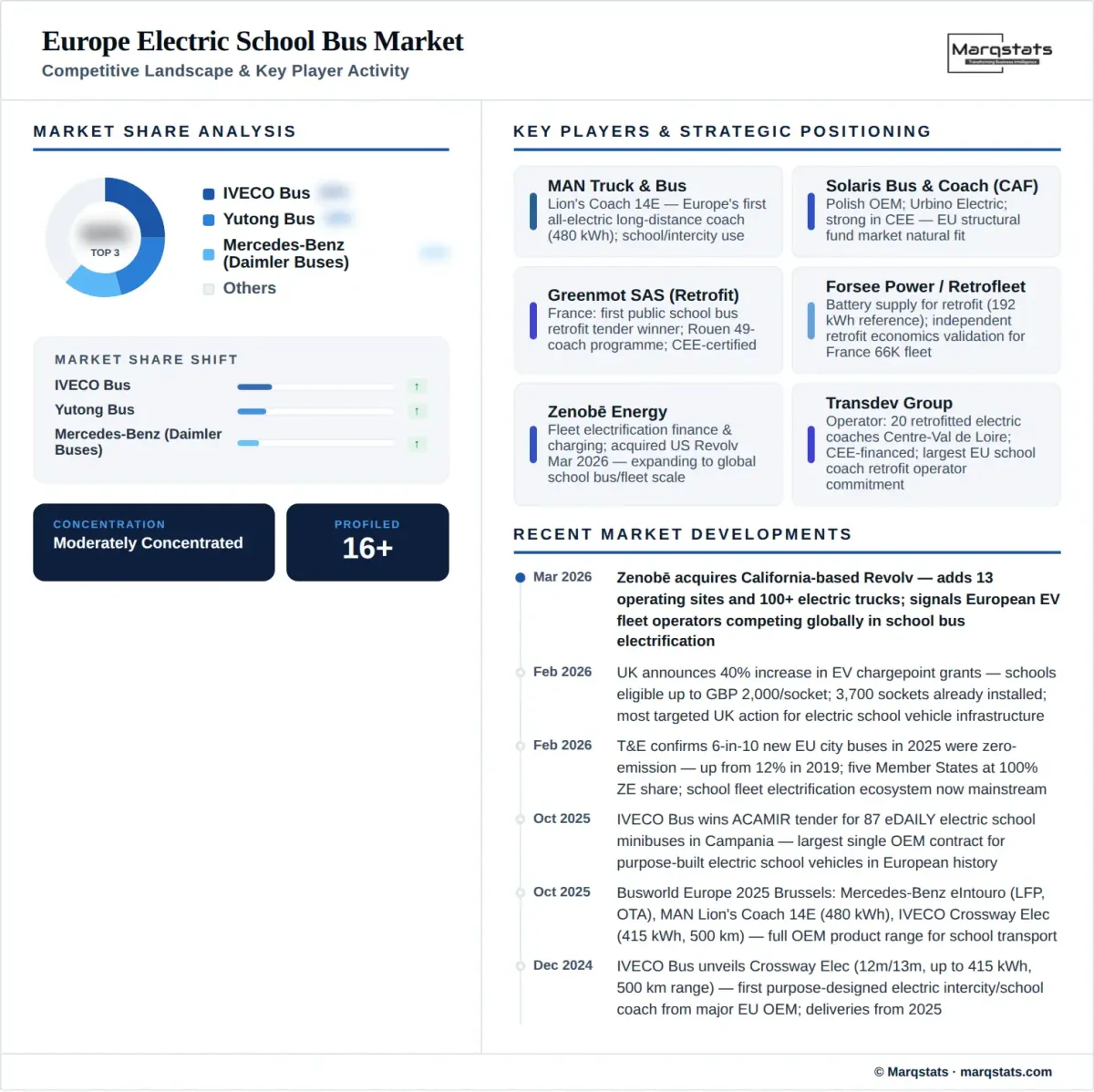
The European electric school bus competitive landscape spans three distinct value chain layers: OEMs supplying electric vehicles suitable for school transport, retrofit integrators converting diesel coaches to electric for school service, and subsystem suppliers (batteries, charging infrastructure, fleet management) supporting both new and retrofitted deployments. The competitive dynamics are shaped by the fragmented nature of school transport procurement across EU Member States — where single-country dominance is more achievable than pan-European scale, and where first-mover programme relationships (IVECO in Campania, Greenmot in Rouen) create sticky reference advantages.
At the OEM layer, Yutong leads EU zero-emission bus sales overall (20.8% share in Q2 2024 per ICCT) and Mercedes-Benz holds second position (14.8%), but school-specific positioning is more nuanced. IVECO Bus holds the strongest school-specific OEM position — with the eDAILY electric school minibus (87-unit Campania contract), the Crossway Elec (intercity and school coach, deliveries from 2025), and an established service network in Italy and France. Mercedes-Benz's eIntouro is the most precisely positioned school-route product from a German OEM, competing directly with the Crossway Elec for intercity/school coach procurement. Daimler Buses' announcement of NMC4 batteries from 2026 (higher energy density, fast charging up to 300 kW, longer lifespan) and the battery swap/upgrade capability for existing eCitaro fleets further strengthens Mercedes-Benz's lifecycle economics proposition. At the retrofit layer, Greenmot (France, first public school bus retrofit tender winner), Retrofleet (battery packs, 192 kWh retrofit coach reference), and Transdev (operator, 20-vehicle retrofit order) together define the nascent but growing retrofit segment. Independent assessments suggest that the retrofit market in France alone — addressing even 1% of the 66,000-coach addressable fleet — represents a EUR 100+ million annual opportunity at current retrofit economics.
Companies Covered
The report profiles 16+ companies with full strategy and financials analysis, including:
Recent Market Activity
Table of Contents
Coverage & Segmentation
This report provides a comprehensive analysis of the Europe electric school bus market covering the 2021–2030 study period, with 2025 as base year. Market scope covers all battery electric and plug-in hybrid vehicles deployed for school pupil transport across EU Member States and the United Kingdom, including purpose-built electric school minibuses, electric coaches on school service routes, electric intercity buses carrying school passengers under public service contracts, and diesel-to-electric retrofitted coaches operating school lines. Both new vehicle procurement and retrofit conversions are included. Geographic coverage spans Italy (primary market, Campania programme), France (primary conversion market), Germany, United Kingdom, Benelux (Netherlands, Belgium, Luxembourg), Spain, Portugal, and Central/Eastern Europe. Policy analysis is centred on the EU Clean Vehicles Directive (Phase 1: 2021–2025; Phase 2: 2026–2030), ERDF Regional Programme funding for school transport electrification, Italy's national experimental school transport electrification law, France's CEE energy saving certificate framework (through 2028), and Transport & Environment's EU zero-emission bus market analyses. Primary research includes 40+ interviews with school transport operators, regional transport authorities, OEM fleet sales teams, retrofit integrators, battery suppliers, and charging infrastructure providers across Europe's major school bus markets.