Statistics & Highlights

Market Snapshot

Market size in USD Billion
$0.12B
2025
Base year
$0.16B
2026
Estimated
  
$0.55B
2030
Forecast
Largest market
France
Fastest growing
Italy
Dominant segment
Diesel-to-Electric Powertrain Conversion
Concentration
Fragmented
CAGR
35.67%
2026 – 2030
GROWTH
+$0.43B
Absolute
STUDY PARAMETERS
Base year2025
Historical period2021 – 2025
Forecast period2026 – 2030
Units consideredValue (USD BN), Volume (Converted Units)
REPORT COVERAGE
Segments covered2 conversion types x 4 vehicle platforms x 3 procurement models
Companies profiled16+
Report pages255+
DeliverablesPDF, Excel, PPT
Executive Summary

Key Takeaways

Market valued at USD 0.12 billion in 2025, projected to reach USD 0.55 billion by 2030 at 35.67% CAGR — the fastest-growing sub-segment of the European electric school bus market, driven by France's 34,500-vehicle eligible coach fleet, CEE financial framework through 2028, and expansion of retrofit supply chains into Italy and beyond.
Conversion cost = approximately 40–50% of new electric equivalent — Retrofleet positions retrofit at 'a little less than half' the cost of a comparable new electric coach; this cost advantage, combined with the circular economy value of preserving an existing vehicle body and structure, makes conversion the most financially accessible path to school bus electrification for regional transport authorities.
REV Bus&Truck (REV Mobilities / Groupe Maurin) acquired Greenmot in June 2025 — following Greenmot's receivership, REV Bus&Truck assumed all active contracts, retained 20 employees, received a multi-million-euro investment from Groupe Maurin, and is now expanding the retrofit platform to include the Mercedes-Benz Intouro — the most significant commercial development in European bus retrofit in 2025.
Solaris launched Europe's first OEM battery retrofit programme in December 2025 — targeting 1,325 Urbino electric buses delivered 2013–2019 across Europe; 170 vehicles already contracted (BVG Berlin 105, Kraków 26, Cluj-Napoca 18, Hamburg 10); this establishes battery retrofit as a distinct, scalable commercial segment running parallel to diesel-to-electric conversion.
Retrofleet expanding certification approvals and entering Italy — Retrofleet received Euro 5/EEV Crossway approval (end 2025), has Euro 6 Crossway LE approval pending (spring 2026); first Italian conversion delivered via VAR/CBM Tuscan bus lines (May 2025); UGAP framework procurement for Ardelia (3 coaches, <6 months) demonstrates procurement speed.
French decree of March 2020 is the legal bedrock — enabling conversion without OEM approval — combined with the CEE energy saving certificate framework through December 2028 and the EDF-Retrofleet partnership for CEE bonus access, France has built the most complete policy + commercial ecosystem for school bus conversion in Europe.
Market Insights

Market Overview & Analysis

Report Summary

The Europe electric school bus conversion market covers two parallel conversion pathways — diesel-to-electric powertrain conversion and battery retrofit — across EU Member States and the United Kingdom, for vehicles used in school transport. The study period is 2021–2030 with 2025 as base year. France is the dominant national market, anchored by the French decree of 13 March 2020 (enabling conversion without OEM approval for vehicles over five years old), the CEE energy saving certificate framework (covering conversion, purchase, and lease through 31 December 2028), and the UGAP national procurement framework through which public transport authorities can procure conversion services. Italy is the emerging second national market, with Retrofleet completing the first Italian electric bus conversion operations in 2025 and with the Piedmont/Turin region actively following the circular economy conversion model. The United Kingdom and Germany represent additional medium-term opportunities as their large school transport fleets and active ZE bus procurement markets create the demand-side conditions for conversion market development.

Understanding the conversion market requires appreciating why it exists alongside the new vehicle market rather than competing with it. The fundamental economic reality is that converting a well-maintained 5–10 year old diesel coach to electric costs approximately EUR 160,000–220,000 — compared to approximately EUR 350,000–500,000 for a new electric coach of equivalent specification. For a regional transport authority operating on a tight capital budget, a conversion programme delivering zero-emission school transport at 40–50% of the procurement cost of a new electric vehicle is not a second-best option — it is the primary pathway to fleet decarbonisation. The conversion also preserves the considerable embodied value of the existing coach chassis, body, seating, and safety systems — which typically represent 30–40% of a vehicle's original procurement cost and have many remaining service years when the powertrain is replaced.

The market's institutional infrastructure is still being built. The Rouen Normandie programme (2023) was the first public tender in France for electric school bus conversion. Retrofleet's Ardelia delivery (2025) was delivered in under six months via UGAP framework procurement — demonstrating that conversions can be procured and delivered faster than comparable new electric vehicle tenders. The REV Bus&Truck acquisition of Greenmot's operations (June 2025) resolved the Greenmot receivership risk that threatened to eliminate one of only two commercial conversion integrators in France, and with Groupe Maurin's multi-million-euro backing, REV Bus&Truck is now investing in industrial process development, supply chain reliability, and platform expansion to the Mercedes-Benz Intouro — diversifying beyond the Iveco Crossway where both REV Bus&Truck and Retrofleet currently hold approvals.

Market Dynamics

Key Drivers

  • French March 2020 decree enabling conversion without OEM approval — the legal bedrock: France's decree authorising the conversion of vehicles over five years old without the original manufacturer's consent is the single most important legal enabler for the European school bus conversion market. Before this decree, any conversion technically required OEM approval — a structural barrier that gave OEMs effective veto power over retrofit competition. The March 2020 decree removed this veto, enabling independent conversion integrators (Greenmot/REV Bus&Truck, Retrofleet) to build commercial businesses without OEM dependency. France operates approximately 69,000 coaches, with half more than five years old — creating an eligible addressable fleet of approximately 34,500 vehicles and the world's most legally permissive environment for large-scale school bus conversion.
  • CEE energy saving certificate framework providing financial incentive through 2028: France's CEE (Certificats d'Économies d'Énergie) framework — formalised for electric coach conversion, purchase, and lease under the Arrêté of 20 December 2023 — provides conversion operators and transport authorities with quantified energy saving credits that offset the cost of converting diesel vehicles to electric. The CEE mechanism is particularly well-suited to conversion because diesel-to-electric conversion generates a large, measurable energy saving per vehicle — the primary metric for CEE credit calculation. The EDF-Retrofleet partnership announced in early 2025, under which EDF's CEE team works directly with Retrofleet customers to structure CEE bonus applications for coach retrofit projects, demonstrates how the financial mechanism is being commercialised alongside the technical conversion service. The CEE framework's coverage through 31 December 2028 provides a five-year financial certainty window that makes multi-year conversion programme planning viable for regional transport authorities.
  • Cost advantage of approximately 40–50% versus new electric equivalent removing the primary economic barrier: The most compelling commercial argument for conversion is the cost differential versus new electric vehicle procurement. Retrofleet explicitly positions its conversion cost at 'a little less than half' the equivalent new electric model. For a coach market where new electric vehicles cost EUR 350,000–500,000, a conversion at EUR 160,000–220,000 enables authorities with limited capital budgets to electrify two to three school routes through conversion for the same budget as one new electric procurement. This cost advantage directly addresses the most commonly cited barrier to school bus electrification in Europe — the high upfront procurement cost — while delivering equivalent or comparable zero-emission performance for school route duty cycles.
  • EU Clean Vehicles Directive Phase 2 (2026–2030) creating zero-emission mandate pressure that conversion can satisfy: The CVD Phase 2 reference period (January 2026–December 2030) requires Member States to achieve national zero-emission bus procurement targets of 33%–66% of total public bus procurement. Where conversion services are procured through public service contracts, they may count toward CVD compliance alongside new vehicle procurement — giving conversion a compliance value alongside its cost advantage. More importantly, CVD Phase 2 creates strong institutional pressure on regional transport authorities to include zero-emission options in their fleet planning, making conversion a more compelling alternative to 'do nothing until the next new vehicle tender cycle.' The CVD's second reference period therefore directly accelerates conversion market demand by making zero-emission fleet composition a regulatory obligation rather than an aspirational target.
  • Battery technology rapid evolution creating growing battery retrofit opportunity alongside diesel-to-electric conversion: The pace of improvement in EV battery technology — Solaris Urbino 12 electric battery capacity evolved from under 395 kWh pre-2022 to 520 kWh by 2025 to 600+ kWh in 2025-model vehicles — means that electric buses delivered between 2013 and 2019 now operate with batteries that are technologically obsolete by current standards. Solaris has documented 1,325 battery-equipped buses in this category across Europe, with 170 already contracted for battery retrofit (including BVG Berlin's 105-bus programme). Daimler Buses also announced battery reconditioning services for the eCitaro and, from 2026, battery upgrade to newer generations. The battery retrofit segment is a structurally growing parallel market to diesel-to-electric conversion, driven by the natural ageing of Europe's first generation of electric buses rather than by policy mandates.

Key Restraints

  • Conversion supply chain fragility — illustrated by Greenmot receivership in 2025: The Greenmot receivership — the most commercially significant event in the European bus retrofit market in 2025 — exposed the fragility of a market dependent on a small number of specialist integrators. Greenmot was France's first and most publicly documented school bus conversion integrator, with the 49-vehicle Rouen Normandie programme as its primary commercial reference. Its financial difficulties threatened both the delivery of existing contracts and the continuity of the French conversion market's primary commercial identity. The REV Bus&Truck acquisition resolved the immediate crisis, but the episode underlines that the conversion market's supply chain is still insufficiently diversified and capitalised to absorb the commercial risks of large-scale public programme delivery.
  • Homologation and certification complexity limiting vehicle type approvals: Conversion certification — the technical homologation confirming that a converted vehicle meets road safety, emissions, and operational standards — is a vehicle-specific and jurisdiction-specific process that creates a real barrier to rapid market scaling. Retrofleet's approval list illustrates this: as of early 2026, approved vehicle types include the Euro 6 Normal Floor Crossway (diesel and gas), Euro 6 Intouro, with Euro 5/EEV Crossway approval obtained by end 2025 and Euro 6 Crossway LE expected by spring 2026. Each new vehicle type approval requires separate technical development, testing, and regulatory engagement — meaning conversion integrators must prioritise the most common vehicle types in their target markets, and operators with non-approved vehicle types cannot yet access conversion services. The concentration of both REV Bus&Truck and Retrofleet approvals on IVECO Crossway and Intouro platforms reflects the dominance of these models in the French school coach fleet, but it also means large fleet segments (Daimler, MAN, Volvo) are currently unserved by independent conversion integrators.
  • UGAP and public procurement framework limitations creating slow procurement cycles for small authorities: The Ardelia three-coach conversion was notable for its UGAP framework procurement, which allowed delivery in less than six months. However, not all French transport authorities are UGAP-eligible buyers or familiar with using UGAP for conversion services, creating variable procurement timeline across the addressable fleet. For small municipalities and rural regional transport authorities — the majority of France's school bus operators — navigating public procurement for a new service category (electric bus conversion) without a reference tender can take 12–24 months. This procurement inertia is the primary reason the French addressable fleet of 34,500 eligible coaches has been converted at a rate of only approximately 100–200 vehicles per year despite the legal and financial frameworks being in place since 2020 and 2023 respectively.
  • Battery retrofit market currently limited to OEM-branded service relationships: Solaris's battery retrofit programme is explicitly positioned as a service for Solaris bus operators — using Solaris-certified service points, Solaris-compatible battery formats (LFP, NMC, LTO), and Solaris's battery management architecture. Daimler's eCitaro battery services are similarly OEM-specific. The battery retrofit market currently has no third-party, OEM-independent equivalent of the diesel-to-electric conversion integrators (REV Bus&Truck, Retrofleet) — meaning operators with Solaris buses must use Solaris, operators with Daimler buses must use Daimler, and there is no competitive market pressure on retrofit pricing or turnaround time. This OEM dependency may moderate as the battery retrofit market scales and as independent battery service providers enter the space.

Key Trends

  • REV Bus&Truck-Groupe Maurin acquisition building the first large-capitalised European school bus conversion operator: The acquisition of Greenmot's operations by REV Bus&Truck (backed by Groupe Maurin, a major vehicle distributor across France, Belgium, and Spain) represents the first entry of a well-capitalised corporate parent into the European school bus conversion market. With a multi-million-euro investment backing industrial process development, supply chain building, and platform expansion to the Mercedes-Benz Intouro, REV Bus&Truck is positioning to move the French conversion market from artisanal project-by-project delivery to industrial-scale programme execution. The Intouro platform expansion is particularly significant — it addresses a large segment of the European school coach fleet not previously served by independent conversion integrators.
  • Retrofleet Italy expansion establishing the pan-European conversion market architecture: Retrofleet's first Italian operation — converting Iveco Crossway diesel buses for VAR (CBM group subsidiary) and Tuscan bus lines, facilitated by French circular economy expertise — demonstrates that the European conversion market is beginning to internationalise beyond France. Italy's specific context (30 Euro 0 and Euro 4 vehicles required to be withdrawn from circulation by end of 2025 per European directives, with Piedmont and Turin actively following the conversion model) creates natural demand for a cost-effective diesel-to-electric conversion pathway that preserves vehicle residual value. Italy's large and relatively young coach fleet and its ERDF regional programme history make it the most structurally ready market after France for systematic school bus conversion.
  • Solaris ZEV Retrofit establishing battery retrofit as a defined commercial product category: The Solaris 'Zero-Emission Vehicle Retrofit' programme — launched formally at Busworld Europe 2025, with 170 vehicles contracted within months and a 1,325-vehicle target pool — establishes battery retrofit as a defined, scalable, and institutionally procurable product category rather than a bespoke service. The programme's geographic spread (BVG Berlin, Kraków, Cluj-Napoca, Hamburg, Jaworzno, Brussels, Warsaw within months of launch) demonstrates pan-European operator demand. Daimler's parallel battery reconditioning and planned 2026 battery upgrade programme for eCitaro validates the category at the second-largest electric bus OEM. These two parallel programmes together establish battery retrofit as a structural component of the European electric bus lifecycle — and, by extension, an increasingly important part of the school bus conversion market as European electric school fleets age.
  • Circular economy narrative accelerating public and institutional acceptance of conversion: The European Commission's circular economy strategy — and its translation into regional sustainability frameworks — provides a compelling institutional narrative for bus conversion: converting an existing vehicle to electric extends asset life, avoids the embodied carbon of new vehicle manufacturing, and generates zero-emission transport outcomes at fraction of new procurement cost. The Retrofleet-SRADDA delivery and Retrofleet-Ardelia delivery both framed conversion explicitly within circular economy sustainability objectives — a framing that resonates with elected officials and sustainability officers at regional transport authorities who are simultaneously managing capital budgets and carbon reduction commitments. This circular economy positioning differentiates conversion procurement politically as well as economically.
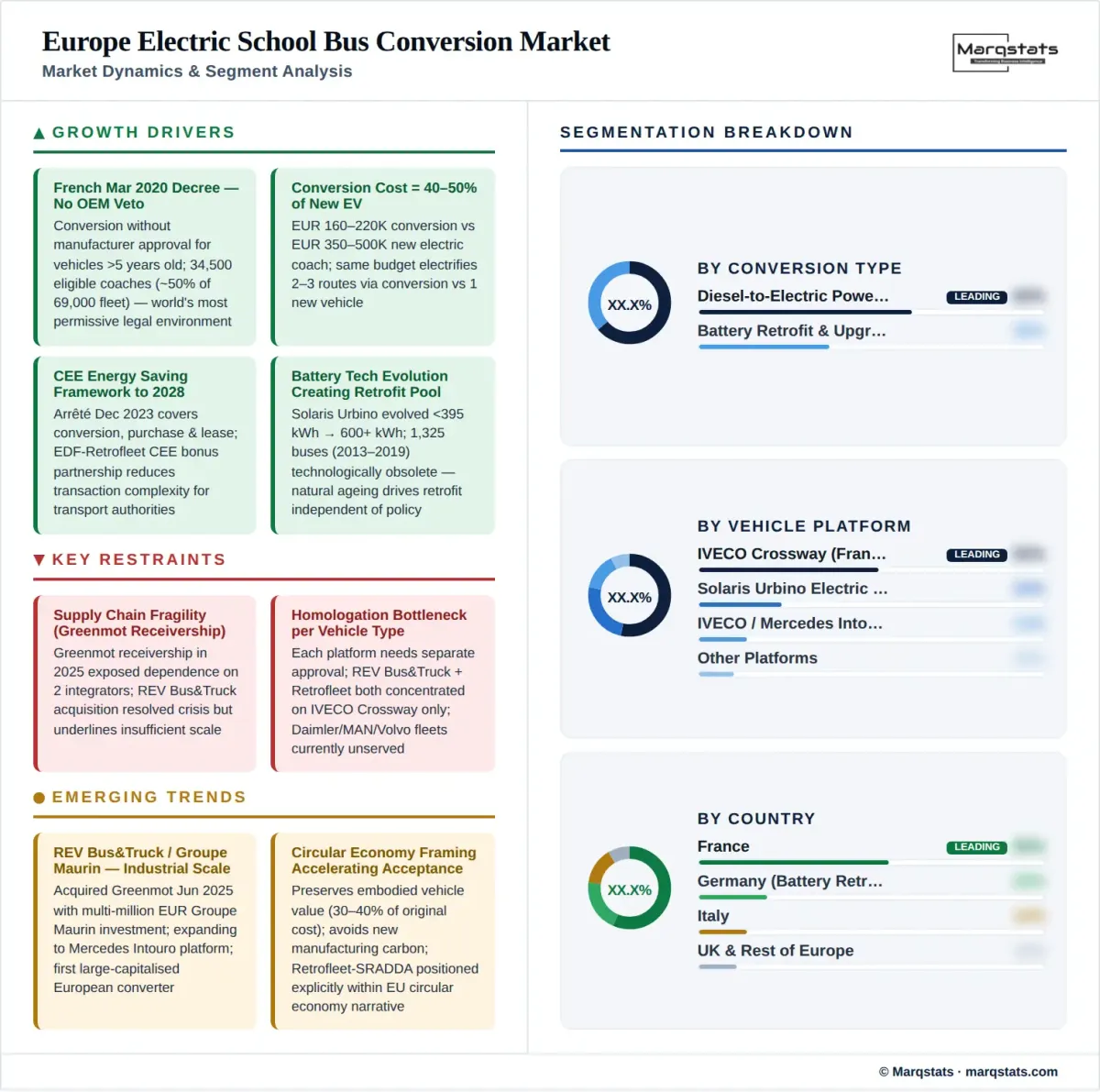
Europe Electric School Bus Conversion Market Dynamics Segment Analysis Infographic
Segment Analysis

Market Segmentation

Diesel-to-Electric Powertrain Conversion
Leading

Diesel-to-electric powertrain conversion — the removal of the internal combustion engine, fuel system, exhaust, and mechanical drivetrain of an existing diesel coach or bus, replaced by an electric motor, battery pack, power management electronics, and charging interface — is the primary and most commercially established segment of the European school bus conversion market. France is the dominant national market, accounting for the vast majority of documented conversions to date. The technical approach developed by Greenmot (now REV Bus&Truck) for the Rouen Normandie programme involves a retrofit kit factory in Villefranche-sur-Saône, Forsee Power Zen Slim battery modules (11, 16, and 21 kWh per module), and kit integration by a specialist installer (SPL Normandie) located near the operating depot. The finished conversion preserves the vehicle's Class II or III body, seating configuration, passenger access systems, and safety architecture — with electric motor and battery occupying the space previously used by the ICE engine and fuel systems. Retrofleet's technical approach for the IVECO Crossway Cursor conversion (delivered to SRADDA in 2025) similarly preserves vehicle integrity while delivering EV performance comparable to new electric equivalents. Retrofleet prices this at 'a little less than half' of an equivalent new electric model, confirming that the EUR 160,000–220,000 range is the operative commercial benchmark.

Battery Retrofit and Upgrade (Existing Electric Buses)

Battery retrofit — upgrading the battery packs and associated power management systems in existing battery-electric buses to extend vehicle service life, restore degraded performance, or upgrade to higher-capacity modern battery chemistry — is the second and fastest-growing segment of the conversion market. This segment was formally defined as a distinct commercial category by Solaris's December 2025 launch of its 'Zero-Emission Vehicle Retrofit' programme at Busworld Europe 2025. The programme targets 1,325 Solaris battery-equipped buses delivered between 2013 and 2019 — representing 22% of Solaris's total battery-electric fleet — whose batteries have experienced performance degradation or technological obsolescence relative to modern equivalents. The programme offers replacement of battery packs with LFP, NMC, or LTO chemistry options, Battery Thermal Management System (BTMS) implementation or upgrade, Battery Management System (BMS) modernisation, and optional drivetrain component upgrades. By March 2026, 170 vehicles were contracted, with BVG Berlin's 105-unit programme as the largest single order. Daimler Buses' parallel battery reconditioning service (available since spring 2025) and planned battery upgrade to the new NMC4 generation (from 2026) confirm this as an OEM-level market category. For school transport specifically, battery retrofit becomes relevant as the first generation of electric school buses — deployed from approximately 2018–2022 in the Netherlands, Germany, and France — approaches the end of their first battery warranty periods and requires investment to maintain service quality.

IVECO Crossway and Intouro Platforms (Dominant in France and Italy)
Leading

The IVECO Crossway — Europe's most widely deployed interurban and school coach — is the dominant platform for diesel-to-electric conversion, reflecting its prevalence in the French school coach fleet and the deliberate decision by both REV Bus&Truck (Greenmot legacy) and Retrofleet to prioritise this platform for their initial certification investments. The Crossway Normal Floor (Euro 6 diesel and gas, Cursor and Tector engines) and Crossway LE (Euro 6, approved by Retrofleet by spring 2026) together cover the majority of the modern French school coach fleet eligible for conversion under the March 2020 decree. The Euro 5 and EEV Crossway Normal Floor Cursor — approved by Retrofleet by end 2025 — extends the addressable fleet deeper into the pre-Euro 6 generation of vehicles. The IVECO Intouro — a medium-distance coach widely used for school and regional transport in France, Germany, and Central Europe — was also approved by Retrofleet, with REV Bus&Truck announcing plans to expand to the Mercedes-Benz Intouro platform (a variant assembled under the same model name) as a priority of its Groupe Maurin-backed investment programme.

Solaris Urbino Electric Platform (Battery Retrofit)

The Solaris Urbino electric — available in 12m solo and 18m articulated configurations — is the dominant platform for battery retrofit due to Solaris's position as Europe's largest electric bus OEM with the most extensive early-generation installed base. The 1,325 Urbino electric buses delivered between 2013 and 2019 represent the largest single cohort of ageing electric buses in Europe requiring battery retrofit services. The technical challenge is substantial: the Urbino 12 electric has evolved from under 395 kWh maximum capacity (pre-2022) to over 600 kWh in 2025-model versions, meaning earlier buses face both capacity degradation from cycle ageing and technological obsolescence against modern specifications. Solaris's retrofit service offers LFP, NMC, or LTO battery options based on operator requirements — allowing customisation for depots with different charging speeds (LTO for fast charging, LFP for cost, NMC for energy density). The BVG Berlin 105-bus programme — the world's largest known electric bus battery retrofit order — establishes a replicable blueprint for city-scale battery retrofit procurement.

Regional Analysis

By Geography

France — The Market's Origin and Dominant National Market

France is the origin and current dominant national market for European electric school bus conversion, combining the most permissive legal framework (March 2020 decree), the largest eligible diesel coach fleet (~34,500 vehicles over five years old out of ~69,000 total), the most advanced CEE financial incentive structure (through December 2028), and the only two documented public-tender-procured school bus conversion programmes in Europe to date. The Rouen Normandie 49-vehicle programme defined the market's inaugural commercial reference, and Transdev's 20-vehicle Centre-Val de Loire order confirmed that major operators are adopting conversion within multi-year service contracts. The REV Bus&Truck acquisition of Greenmot ensures that France retains a commercially viable primary conversion integrator with backing from Groupe Maurin — which also provides Retrofleet with a competitive peer as the market scales. The CEE-EDF-Retrofleet partnership makes CEE bonus access a routine part of French conversion project financing, reducing transaction complexity for regional authorities. The UGAP framework — demonstrated by Retrofleet's Ardelia delivery — provides a fast-track procurement pathway that reduces the time from decision to delivery to under six months for qualified public authorities.

Italy — The Emerging Second Market

Italy is the emerging second national market for European school bus conversion, propelled by two concurrent structural forces: the requirement to withdraw Euro 0 and Euro 4 vehicles from circulation by end 2025 (per European emissions directives, creating disposal pressure on operators), and the active interest of the Piedmont and Turin regions in the circular economy conversion model as an alternative to the capital-intensive Campania new-vehicle procurement approach. Retrofleet's first Italian operation — converting IVECO Crossway diesel buses for VAR (the Italian subsidiary of French group CBM) and Tuscan bus lines, completed in May 2025 — established Italy as a commercial market for the French retrofit supply chain. The IVECO Crossway's dominance of the Italian coach fleet (a deliberate Retrofleet certification priority given the scale of Italian Crossway deployments) means that the same platform approvals enabling France's conversion market directly address Italy's largest eligible vehicle cohort. Piedmont's EUR 30 Euro 0 and Euro 4 vehicle withdrawal requirement creates a defined fleet of vehicles needing either replacement or conversion — and at EUR 160,000–220,000 for a conversion versus EUR 400,000+ for a new electric equivalent, conversion economics are compelling for Italian regional operators.

Germany — Battery Retrofit Pioneer

Germany is the European leader in the battery retrofit sub-segment, driven by BVG Berlin's 105-unit Solaris battery retrofit order — the largest single electric bus battery retrofit programme globally as of early 2026. Germany's early and extensive adoption of Solaris Urbino electric buses (driven by Germany's ambitious zero-emission bus procurement in cities including Berlin, Hamburg, and multiple smaller municipalities) created the largest single national cohort of ageing early-generation Solaris electric buses requiring battery retrofit services. Daimler Buses' eCitaro battery reconditioning and 2026 battery upgrade programme adds a second OEM-specific retrofit stream applicable to Germany's growing eCitaro fleet. For diesel-to-electric school bus conversion specifically, Germany does not yet have the French-style March 2020 decree — conversion requires OEM cooperation or homologation via alternative technical pathways — meaning the German diesel-to-electric conversion market is less developed than its battery retrofit leadership suggests. The Mercedes-Benz eIntouro launch and MAN Lion's Coach 14E introduction at Busworld 2025 may reduce the economic logic for conversion among newer-generation German school coach operators, but the large pool of Euro 5 and Euro 6 diesel coaches in Germany's school transport fleet remains a medium-term diesel-to-electric conversion opportunity.

United Kingdom — Infrastructure-Ready but Framework Nascent

The United Kingdom's school bus conversion market is at an earlier stage than France or Italy, without a direct equivalent to the French March 2020 decree or the CEE financial framework. However, the UK government's February 2026 announcement of school-specific EV charging infrastructure grants (up to GBP 2,000 per socket, building on 3,700 sockets already installed) creates the depot infrastructure foundation upon which a conversion market can develop. UK school transport is operated primarily by private operators under Local Authority service contracts — a structure that is analogous to France's CEE-financed operator model. As the UK's zero-emission bus policy framework evolves and as REV Bus&Truck and Retrofleet consider export expansion (Retrofleet explicitly mentions export potential; Greenmot's founder specifically cited 'strong export potential' for the French retrofit sector), the UK represents a logical near-term geographic expansion market for European conversion integrators.
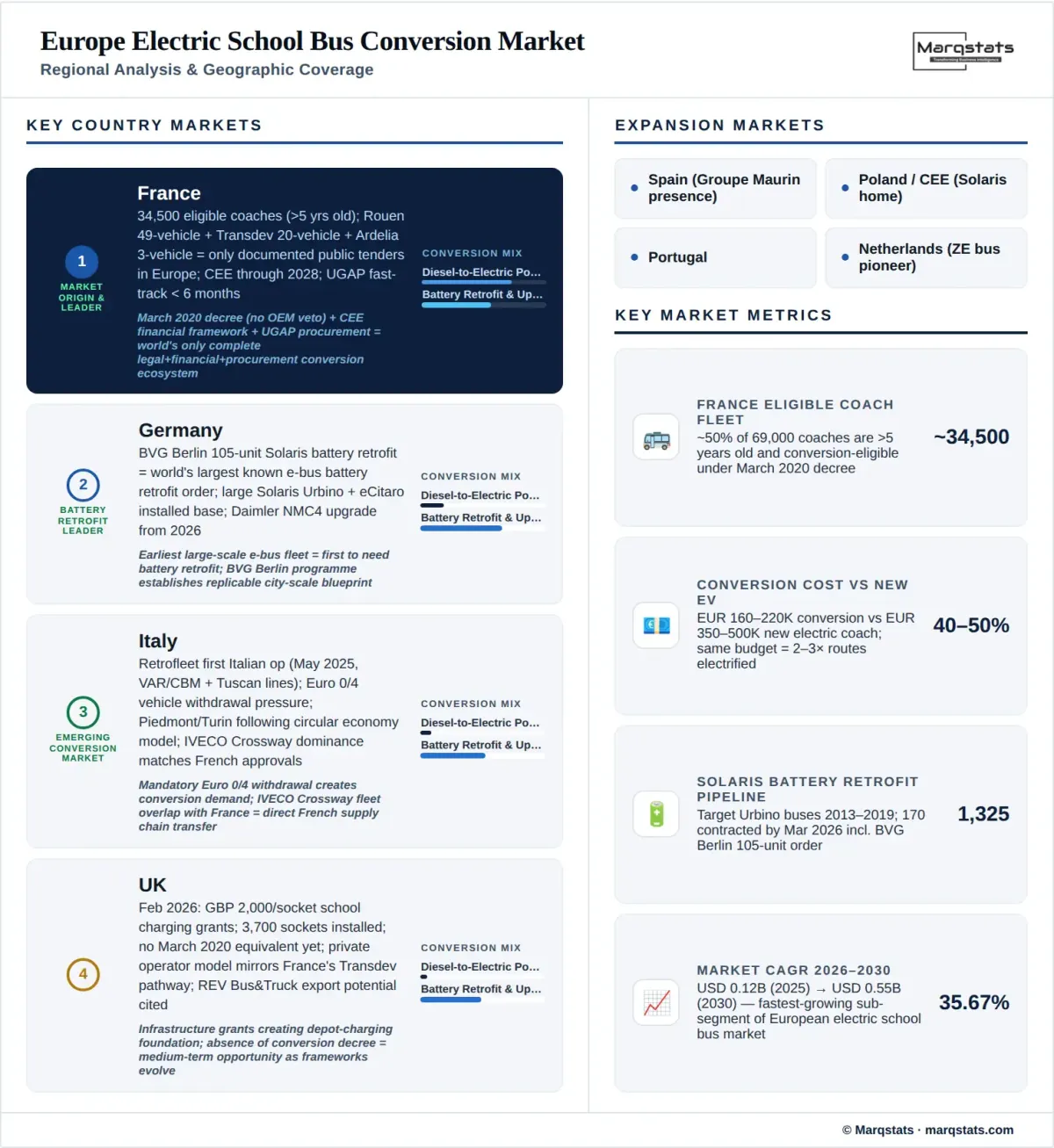
Europe Electric School Bus Conversion Market Regional Analysis Infographic
Competitive Landscape

How Competition Is Evolving

The European electric school bus conversion market's competitive landscape is defined by a small number of specialist integrators at the conversion layer, OEM-controlled services at the battery retrofit layer, and a supporting ecosystem of battery suppliers, charging infrastructure providers, and financial intermediaries. The conversion integrator layer is currently dominated by two French companies — REV Bus&Truck (operating Greenmot's legacy assets and programmes, now backed by Groupe Maurin) and Retrofleet — both of which are concentrated on the IVECO Crossway and Intouro platforms in France and Italy. There is effectively no large-scale diesel-to-electric conversion integrator operating at European scale outside France, reflecting the French legal environment (March 2020 decree, CEE framework) as the primary market enabler. The battery retrofit layer is OEM-controlled: Solaris runs the largest programme (1,325-vehicle target, 170 contracted), Daimler operates eCitaro battery services, and there is no third-party independent battery retrofit integrator serving multiple OEM platforms at scale.

The competitive dynamics are shaped by platform approvals and certification depth rather than price competition alone. Retrofleet's investment in obtaining specific type approvals (Euro 6 Crossway diesel/gas, Euro 6 Intouro, Euro 5/EEV Crossway, Euro 6 Crossway LE) is effectively a barrier-to-entry investment that limits competition on approved vehicle types until a competitor obtains equivalent approvals. REV Bus&Truck's Groupe Maurin backing gives it access to the Mercedes-Benz dealer network (Groupe Maurin distributes passenger cars and commercial vehicles across France, Belgium, and Spain) — a strategic channel advantage for accessing conversion leads through vehicle maintenance and fleet management relationships. The EDF-Retrofleet partnership for CEE bonus processing, and Comeca's integrated charging infrastructure capability (demonstrated in Rouen), represent ecosystem positions that are valuable to transport authority customers because they reduce procurement complexity. Independent assessments of the competitive landscape suggest that the conversion market in France will support two to four active conversion integrators over the 2026–2030 period as volumes scale from approximately 100–200 per year today to 500–700 per year by 2030 — with the first integrator to achieve industrial-scale production (rather than project-by-project assembly) gaining significant per-vehicle cost advantages.
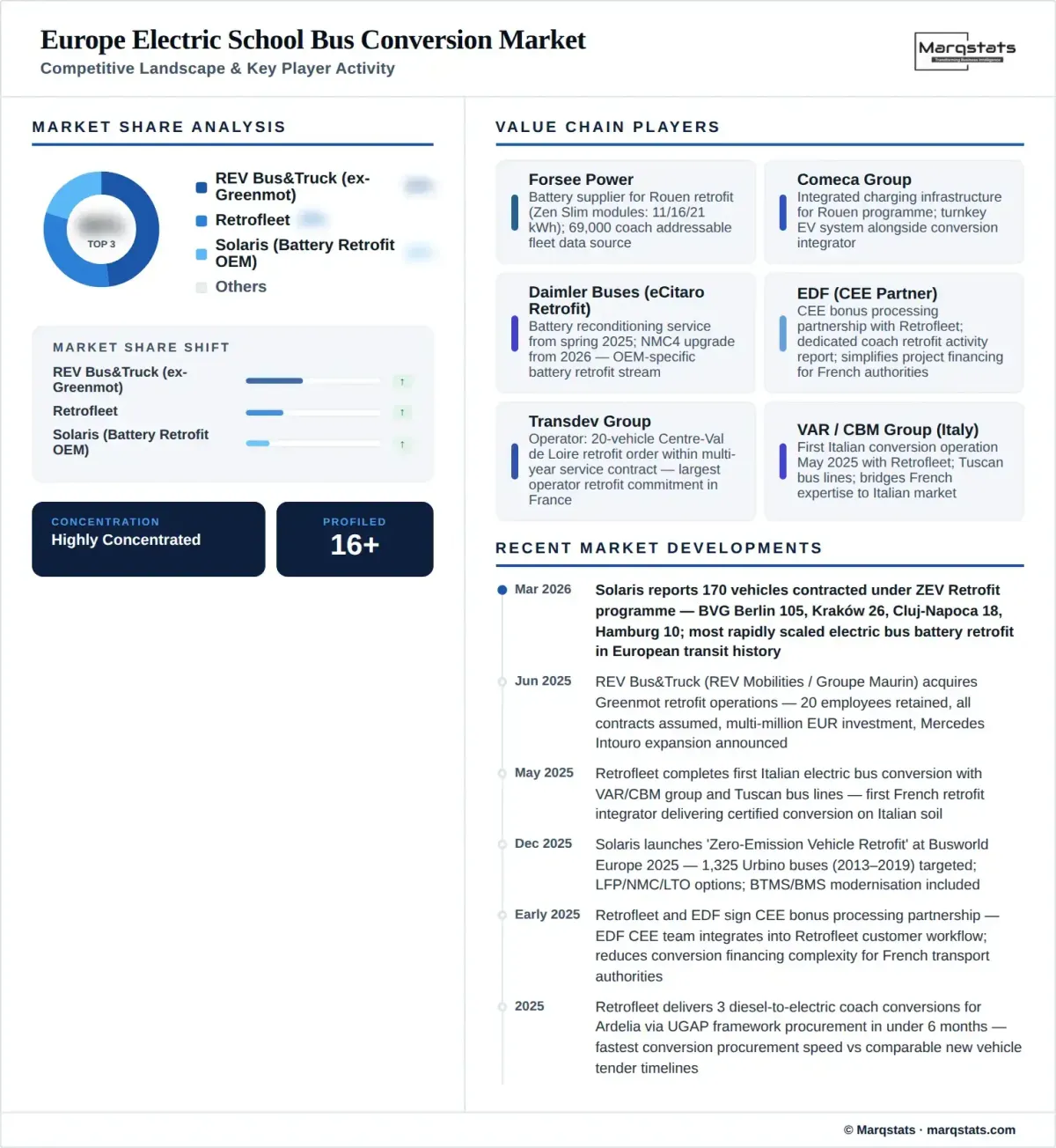
Europe Electric School Bus Conversion Market Competitive Landscape Infographic
Major Players

Companies Covered

The report profiles 16+ companies with full strategy and financials analysis, including:

REV Bus&Truck (REV Mobilities Group / Groupe Maurin) — formerly Greenmot
Retrofleet
Forsee Power S.A.
Comeca Group
SPL Normandie
Solaris Bus & Coach sp. z o.o.
Daimler Buses (Mercedes-Benz eCitaro Battery Services)
EDF (CEE Partnership with Retrofleet)
VAR / CBM Group (Italy — Retrofit Operator)
Transdev Group (Operator — Centre-Val de Loire Retrofit Programme)
Métropole of Rouen Normandie (Public Authority — First French School Bus Retrofit Tender)
Ardelia (Public Transport Authority — Retrofleet First UGAP Framework Conversion)
SRADDA (Sud Rhône-Alpes Déplacements Drôme-Ardèche — Retrofleet Crossway Cursor)
BVG Berlin (Operator — 105-Unit Solaris Battery Retrofit Programme)
MPK Kraków (Operator — First Solaris Battery Retrofit Reference, 20 Urbino Buses)
UGAP (Union des Groupements d'Achats Publics — French Procurement Framework)
Note: Full company profiles include revenue analysis, product portfolio, SWOT, and recent strategic developments.
Latest Developments

Recent Market Activity

Jun 2025
REV Bus&Truck (REV Mobilities group, backed by Groupe Maurin) acquired Greenmot's retrofit operations following Greenmot's receivership — retaining 20 employees, assuming all active commercial and supplier contracts, receiving a multi-million-euro investment, and announcing expansion to the Mercedes-Benz Intouro retrofit platform — the most significant consolidation event in European school bus conversion market history.
May 2025
Retrofleet completed the first Italian electric bus conversion operation in partnership with VAR (Italian subsidiary of French group CBM) and Tuscan bus lines — the first time a French retrofit integrator had delivered a certified diesel-to-electric coach conversion on Italian soil, marking the beginning of the pan-European export expansion of the French conversion supply chain.
Mar 2026
Solaris reported 170 vehicles contracted under its Zero-Emission Vehicle Retrofit programme (launched December 2025) — including 105 for BVG Berlin, 26 for MPK Kraków, 18 for Cluj-Napoca, 10 for Hamburg, 8 for Jaworzno, 2 for Brussels, 1 for Warsaw — representing the most rapidly scaled electric bus battery retrofit programme in European transit history.
Dec 2025
Solaris launched 'Zero-Emission Vehicle Retrofit' at Busworld Europe 2025 — targeting 1,325 Urbino electric buses delivered 2013–2019 with LFP, NMC, or LTO battery replacement options including BTMS and BMS modernisation — establishing battery retrofit as a defined commercial product category in the European zero-emission bus market.
2025
Retrofleet converted 3 diesel coaches to electric for Ardelia (Ardennes transport authority) via UGAP procurement framework in less than 6 months — demonstrating that public authority procurement of conversion services through framework agreements can be significantly faster than new vehicle tenders.
Early 2025
Retrofleet and EDF signed a partnership agreement for CEE bonus processing — with EDF's CEE sales teams visiting Retrofleet's Goussainville conversion site, preparing a dedicated coach retrofit CEE activity report, and integrating CEE bonus optimisation into Retrofleet's customer project workflow — directly reducing the financial complexity of conversion procurement for French transport authorities.
Report Structure

Table of Contents

1. Introduction and Market Definition
1.1 What is the Europe Electric School Bus Conversion Market?
1.1.1 Definition — Diesel-to-Electric Powertrain Conversion vs. Battery Retrofit
1.1.2 Conversion vs. New Vehicle Procurement — Key Structural Differences
1.1.3 Circular Economy Logic — Extending Asset Life at 40–50% of New EV Cost
1.1.4 Market Scope — Vehicle Types, Procurement Models, Geographic Coverage
1.2 Study Assumptions and Scope
1.3 Executive Summary
1.4 Currency, Units, and Key Definitions
1.4.1 Currency Convention — USD and EUR
1.4.2 Diesel-to-Electric Conversion — Technical Process Definition
1.4.3 Battery Retrofit — Technical Process Definition
1.4.4 Homologation / Type Approval — Certification Requirement for Converted Vehicles
1.4.5 CEE — Energy Saving Certificate Financial Mechanism (France)
1.4.6 UGAP — Union des Groupements d'Achats Publics (French Procurement Framework)
2. Research Methodology
2.1 Analysis Framework
2.2 Primary Research — Retrofit Integrators, Transport Authorities, Battery Suppliers
2.3 Secondary Research — Programme Documentation, Press Releases, Industry Sources
2.4 Market Estimation Approach
2.4.1 Documented Programme Volumes as Primary Anchors
2.4.2 Rouen Normandie (49 Coaches) and Transdev Centre-Val de Loire (20 Coaches)
2.4.3 Retrofleet Ardelia (3 Coaches), SRADDA (1 Crossway), Italy VAR/CBM
2.4.4 Solaris ZEV Retrofit (170 Vehicles Contracted, 1,325 Target)
2.4.5 Conversion Unit Economics — Retrofleet 'Less Than Half of New EV' Benchmark
2.4.6 France Addressable Fleet — 34,500 Coaches Eligible Under March 2020 Decree
2.5 Assumptions and Limitations
3. Market Overview — Europe Electric School Bus Conversion
3.1 Market Origin and Development Timeline
3.1.1 French Decree of 13 March 2020 — The Legal Foundation
3.1.2 ADEME PIA Funding for Greenmot Green-eBus Project — R&D Phase
3.1.3 Rouen Normandie Tender (Early 2023) — First Public School Bus Retrofit Order
3.1.4 Retrofleet Market Entry — Independent Second Integrator
3.1.5 Greenmot Receivership and REV Bus&Truck Acquisition (June 2025)
3.1.6 Solaris ZEV Retrofit Launch (December 2025) — Battery Retrofit Goes Commercial
3.1.7 Retrofleet Italy Expansion (May 2025) — First Pan-European Operation
3.2 France Addressable Fleet Analysis
3.2.1 Total French Coach Fleet — ~69,000 Vehicles
3.2.2 Half Over Five Years Old = ~34,500 Eligible Under March 2020 Decree
3.2.3 School Transport Concentration — ~90% of Coach Fleet Serving Schools
3.2.4 Fleet Age Distribution — Euro 4, Euro 5, Euro 6 Breakdown
3.2.5 Conversion Rate 2025 — ~100–200 Vehicles, ~0.3–0.6% of Eligible Fleet
3.2.6 2030 Conversion Rate Target — 500–700 Vehicles Annually Under Base Scenario
3.3 Italy Addressable Fleet Analysis
3.3.1 Euro 0 and Euro 4 Vehicle Withdrawal Mandate (End 2025)
3.3.2 Crossway Fleet Concentration in Italy — Retrofleet's Priority Platform
3.3.3 Piedmont and Turin — Active Circular Economy Conversion Interest
3.3.4 Italy Market Size and Forecast 2025–2030
3.4 European Battery Retrofit Pool Analysis
3.4.1 Solaris 1,325-Vehicle Legacy Fleet (2013–2019) — Pan-European Retrofit Target
3.4.2 Daimler eCitaro Battery Retrofit Pipeline (From 2025/2026)
3.4.3 Geographic Distribution — Germany, Poland, Belgium, Romania, Others
3.5 Market Size and Forecast 2021–2030
4. Policy and Regulatory Landscape
4.1 The French March 2020 Decree — Legal Bedrock for the Entire Market
4.1.1 Decree of 13 March 2020 — Vehicle Conversion Without OEM Approval
4.1.2 Eligibility — Vehicles Over Five Years Old
4.1.3 Scope — Weight and Vehicle Category Requirements
4.1.4 Pre-Decree Context — OEM Veto Power and Market Barrier
4.1.5 Post-Decree Commercial Emergence — Greenmot and Retrofleet Market Entry
4.1.6 Application to Italy — Retrofleet Italian Operation Under European Framework
4.2 CEE Financial Framework — Key Revenue Model Enabler
4.2.1 CEE Overview — Energy Saving Certificates for Transport Decarbonisation
4.2.2 Arrêté of 20 December 2023 — Coverage of Purchase, Lease, and Retrofit
4.2.3 CEE Duration — Through 31 December 2028
4.2.4 CEE Calculation — Energy Saving per Diesel-to-Electric Conversion
4.2.5 EDF-Retrofleet CEE Partnership (Early 2025) — Operational CEE Integration
4.2.5.1 EDF Sales Team Visit to Goussainville Conversion Site
4.2.5.2 EDF Coach Retrofit CEE Activity Report
4.2.5.3 CEE Bonus Optimisation for Retrofleet Customer Projects
4.2.6 CEE for Battery Retrofit — Applicability and Calculation
4.3 UGAP Framework Procurement — Speed-to-Delivery Enabler
4.3.1 UGAP Overview — National French Public Procurement Framework
4.3.2 Retrofleet UGAP Framework — Ardelia Delivery in Under 6 Months
4.3.3 UGAP vs. Open Tender — Speed, Cost, and Eligibility Comparison
4.3.4 UGAP Framework Expansion for Electric Bus Conversion Services
4.4 EU Clean Vehicles Directive Phase 2 (2026–2030)
4.4.1 CVD Phase 2 — Zero-Emission Only Procurement Mandate
4.4.2 Conversion as CVD Compliance Pathway — Technical and Policy Assessment
4.4.3 National ZE Targets and Pressure on School Transport Fleet Electrification
4.5 Italian Regulatory Framework for Electric Bus Conversion
4.5.1 Euro 0 and Euro 4 Vehicle Withdrawal — Conversion as Alternative to Disposal
4.5.2 Italian Framework for Vehicle Conversion Homologation
4.5.3 Piedmont/Turin Regional Programme Interest
4.6 German and UK Regulatory Context
4.6.1 Germany — No Equivalent to French March 2020 Decree
4.6.2 German Battery Retrofit Path — OEM-Authorised Services
4.6.3 UK February 2026 School EV Chargepoint Grant — Infrastructure Foundation
5. Market Dynamics
5.1 Key Market Drivers
5.1.1 French March 2020 Decree — Enabling Conversion Without OEM Approval
5.1.2 CEE Framework Through 2028 — Financial Certainty for Conversion Projects
5.1.3 40–50% Cost Advantage vs. New Electric Equivalent
5.1.4 CVD Phase 2 Zero-Emission Mandate Creating Compliance Pressure
5.1.5 Battery Technology Obsolescence — Growing Battery Retrofit Demand
5.2 Key Market Restraints
5.2.1 Conversion Supply Chain Fragility — Greenmot Receivership as Warning
5.2.2 Homologation Complexity — Vehicle Type Approval Limits Addressable Fleet
5.2.3 Procurement Inertia — Small Authorities Slow to Adopt Conversion Tenders
5.2.4 Battery Retrofit OEM Dependency — No Third-Party Multi-OEM Service
5.3 Key Market Trends
5.3.1 REV Bus&Truck-Groupe Maurin — First Large-Capitalised Conversion Operator
5.3.2 Retrofleet Italy Expansion — Pan-European Conversion Architecture Emerging
5.3.3 Solaris ZEV Retrofit — Battery Retrofit as Defined Commercial Category
5.3.4 Circular Economy Framing Accelerating Institutional Acceptance
5.4 Conversion Economics — Full Cost Model
5.4.1 Diesel-to-Electric Conversion Cost — EUR 160,000–220,000 per Vehicle
5.4.2 New Electric Coach Equivalent — EUR 350,000–500,000 per Vehicle
5.4.3 Cost Advantage — Approximately 40–50% (Retrofleet Public Benchmark)
5.4.4 CEE Credit Value — Offsetting Conversion Project Cost
5.4.5 Battery Retrofit Cost — EUR 40,000–80,000 per Vehicle (Estimated)
5.4.6 Embedded Vehicle Value Preserved — 30–40% of Original Procurement Cost
5.4.7 Total Cost of Ownership — Conversion vs. New vs. Continued Diesel
5.5 Technical Conversion Process — Step by Step
5.5.1 Vehicle Selection and Eligibility Assessment
5.5.2 ICE and Fuel System Removal
5.5.3 Electric Motor and Battery Pack Installation
5.5.4 Power Management and BMS Integration
5.5.5 Charging Interface and Depot Charging Compatibility
5.5.6 Type Approval and Homologation Certification
5.5.7 Commissioning, Testing, and Fleet Integration
6. Market Segmentation — By Conversion Type
6.1 Overview and Revenue Share by Conversion Type (2025 vs. 2030)
6.2 Diesel-to-Electric Powertrain Conversion
6.2.1 Segment Overview — France and Italy as Primary Markets
6.2.2 Conversion Kit Architecture — Motor, Battery, BMS, Charging Interface
6.2.3 Forsee Power Zen Slim Battery Modules — 11, 16, 21 kWh Building Blocks
6.2.4 Factory-Built Kit + On-Site Integration Model (Greenmot/REV Bus&Truck)
6.2.5 Dedicated Conversion Centre Model (Retrofleet — Goussainville North Paris)
6.2.6 Range Achievement — 192 kWh Reference for School Route Adequacy
6.2.7 Charging Infrastructure Per Conversion — EUR 30,000–50,000 Additional
6.2.8 Diesel-to-Electric Conversion Forecast 2026–2030
6.3 Battery Retrofit and Upgrade
6.3.1 Segment Overview — Solaris ZEV Retrofit as Category Definer
6.3.2 Technical Process — Battery Pack Replacement + BTMS + BMS Upgrade
6.3.3 Battery Chemistry Options — LFP, NMC, LTO by Operator Requirement
6.3.4 Capacity Evolution — Urbino 12 from 395 kWh to 600+ kWh (2013 vs. 2025)
6.3.5 BVG Berlin 105-Unit Programme — World's Largest Electric Bus Battery Retrofit
6.3.6 Daimler eCitaro Battery Reconditioning and 2026 NMC4 Upgrade Programme
6.3.7 OEM Dependency — No Third-Party Multi-OEM Battery Retrofit Service
6.3.8 Battery Retrofit Forecast 2026–2030
7. Market Segmentation — By Vehicle Platform
7.1 Overview and Share by Vehicle Platform (2025 vs. 2030)
7.2 IVECO Crossway (Normal Floor and LE) — Dominant Conversion Platform
7.2.1 Crossway Prevalence in French and Italian School Coach Fleet
7.2.2 REV Bus&Truck (Greenmot) Crossway Retrofit Approvals
7.2.3 Retrofleet Crossway Approvals — Euro 6, Euro 5/EEV (2025), Crossway LE (Spring 2026)
7.2.4 Crossway Conversion Volume Forecast 2026–2030
7.3 IVECO Intouro — Second Approved Platform
7.3.1 Intouro Prevalence in School and Regional Transport
7.3.2 Retrofleet Euro 6 Intouro Approval
7.3.3 REV Bus&Truck Mercedes-Benz Intouro Platform Expansion Plan
7.3.4 Intouro Conversion Volume Forecast 2026–2030
7.4 Solaris Urbino Electric — Battery Retrofit Platform
7.4.1 1,325 Urbino Buses Delivered 2013–2019 Across Europe
7.4.2 Battery Degradation Profile — 22% of Solaris Battery Fleet Now Ageing
7.4.3 Retrofit Programme Geography — Germany (Berlin), Poland, Romania, Belgium
7.4.4 Urbino Battery Retrofit Volume Forecast 2026–2030
7.5 Mercedes-Benz eCitaro — Daimler Battery Services Platform
7.5.1 eCitaro Battery Reconditioning Service (Available Spring 2025)
7.5.2 NMC4 Battery Upgrade Programme (From 2026)
7.5.3 eCitaro Battery Retrofit Volume Forecast 2026–2030
7.6 Emerging Platforms — Future Conversion Candidates
7.6.1 Mercedes-Benz Intouro (REV Bus&Truck Expansion Target)
7.6.2 MAN Coaches — Potential Future Retrofit Candidates
7.6.3 Volvo and Others — Market Development Pathway
8. Market Segmentation — By Procurement Model
8.1 Overview and Revenue Share by Procurement Model (2025 vs. 2030)
8.2 Public Tender (Open Competitive Procurement)
8.2.1 Model Overview — Rouen Normandie as Primary Reference
8.2.2 49-Vehicle Rouen Tender — Greenmot/Forsee Power/Comeca/SPL Normandie Consortium
8.2.3 Public Tender Timeline — Typically 12–18 Months from Decision to Delivery
8.2.4 Public Tender Forecast 2026–2030
8.3 UGAP Framework Procurement
8.3.1 Model Overview — Pre-Approved Framework, Fast Delivery
8.3.2 Retrofleet-Ardelia — 3 Coaches Via UGAP, Under 6 Months
8.3.3 UGAP vs. Open Tender — 50%+ Time Saving
8.3.4 UGAP Framework Expansion for Conversion Services — Growth Pathway
8.3.5 UGAP Procurement Forecast 2026–2030
8.4 Operator-Led CEE-Financed Conversion
8.4.1 Model Overview — Transdev Centre-Val de Loire Reference
8.4.2 20-Vehicle Transdev Order — Within Multi-Year Public Service Contract
8.4.3 CEE Bonus as Operator Conversion Cost Offset
8.4.4 EDF-Retrofleet Partnership — Making CEE Accessible for Smaller Operators
8.4.5 Operator-Led CEE Conversion Forecast 2026–2030
9. Country Analysis
9.1 France — Origin and Dominant Market
9.1.1 Conversion Market Overview — Most Advanced Ecosystem in Europe
9.1.2 Legal Framework — Decree 13 March 2020 and Coach Eligibility Conditions
9.1.3 Addressable Fleet — ~34,500 Coaches Eligible, ~0.3–0.6% Annual Penetration (2025)
9.1.4 Rouen Normandie Programme — 49 Iveco Crossway Coaches, Astuce School Network
9.1.5 Transdev Centre-Val de Loire — 20 Retrofitted Electric Coaches
9.1.6 REV Bus&Truck (Greenmot Acquisition, June 2025)
9.1.6.1 Acquisition Background — Greenmot Receivership and REV Mobilities Solution
9.1.6.2 Groupe Maurin Strategic Backing — Multi-Million-Euro Investment
9.1.6.3 Active Contract Continuation — Rouen Programme and Beyond
9.1.6.4 Platform Expansion to Mercedes-Benz Intouro
9.1.6.5 Industrial Process Development Plan
9.1.7 Retrofleet Operations in France
9.1.7.1 Retrofleet Company Profile — French Retrofit Specialist
9.1.7.2 Goussainville Conversion Site North of Paris
9.1.7.3 Ardelia UGAP Contract — 3 Coaches in Under 6 Months (2025)
9.1.7.4 SRADDA Drôme-Ardèche — IVECO Crossway Cursor Conversion
9.1.7.5 Transpolis Test Centre — Robustness Testing Across French and European Roads
9.1.7.6 Vehicle Type Approvals — Current and Pipeline (Euro 5/EEV by 2025, LE by Spring 2026)
9.1.8 CEE-EDF-Retrofleet Partnership Structure
9.1.9 France Market Size and Forecast 2021–2030
9.2 Italy — Emerging Second Market
9.2.1 Conversion Market Overview — Euro 0/4 Withdrawal Creating Conversion Demand
9.2.2 First Italian Operation — Retrofleet + VAR (CBM) + Tuscan Bus Lines (May 2025)
9.2.3 Piedmont and Turin — Active Follow-Up Interest
9.2.4 30 Euro 0/4 Vehicles Required Withdrawn by End 2025 (Turin/Piedmont Context)
9.2.5 Crossway Fleet Concentration — Why Italy Is Retrofleet's Priority Export Market
9.2.6 Italy Market Size and Forecast 2021–2030
9.3 Germany — Battery Retrofit Leader
9.3.1 Conversion Market Overview — Battery Retrofit Dominant, Diesel Conversion Nascent
9.3.2 BVG Berlin — 105-Unit Solaris Battery Retrofit (World's Largest Order)
9.3.3 Hamburg — 10-Unit Solaris Battery Retrofit
9.3.4 Daimler eCitaro Battery Reconditioning and NMC4 Upgrade (2026)
9.3.5 German Legal Framework — No March 2020 Decree Equivalent
9.3.6 Germany Market Size and Forecast 2021–2030
9.4 Poland — Solaris Home Market Battery Retrofit
9.4.1 MPK Kraków — 26-Unit Solaris Battery Retrofit (First Reference, 20 Initial)
9.4.2 Jaworzno — 8-Unit Solaris Battery Retrofit
9.4.3 Warsaw — 1-Unit Solaris Battery Retrofit
9.4.4 Poland Market Size and Forecast 2021–2030
9.5 Romania, Belgium, and Other CEE Markets
9.5.1 Cluj-Napoca — 18-Unit Solaris Battery Retrofit
9.5.2 Brussels — 2-Unit Solaris Battery Retrofit
9.5.3 CEE ERDF Market — Potential for Diesel-to-Electric Conversion Programmes
9.5.4 Rest of Europe Market Size and Forecast 2021–2030
9.6 United Kingdom
9.6.1 Market Overview — Framework Nascent, Infrastructure Building
9.6.2 School EV Chargepoint Grant (February 2026) — Infrastructure Foundation
9.6.3 Export Expansion Opportunity for French Conversion Integrators
9.6.4 UK Market Size and Forecast 2021–2030
10. Competitive Landscape and Company Profiles
10.1 Market Concentration — Small Number of Specialist Integrators
10.1.1 Diesel-to-Electric Layer — REV Bus&Truck and Retrofleet as Duopoly in France
10.1.2 Battery Retrofit Layer — OEM-Controlled (Solaris, Daimler Buses)
10.1.3 Supporting Ecosystem — Forsee Power (Battery), Comeca (Charging), EDF (CEE)
10.1.4 Competitive Moat — Platform Certifications and Procurement Framework Positions
10.2 Company Profiles — Diesel-to-Electric Conversion Integrators
10.2.1 REV Bus&Truck (REV Mobilities Group / Groupe Maurin)
10.2.1.1 Company Overview — Acquirer of Greenmot's Retrofit Operations (June 2025)
10.2.1.2 Acquisition Context — Greenmot Receivership, Active Contract Continuity
10.2.1.3 Groupe Maurin Strategic Backing — Multi-Million-Euro Investment
10.2.1.4 Industrial Process Development — Scaling from Project to Programme Delivery
10.2.1.5 Platform Expansion — Mercedes-Benz Intouro as Priority New Platform
10.2.1.6 Factory Location — Villefranche-sur-Saône, Retrofit Kit Assembly
10.2.1.7 Active Contracts — Rouen Normandie and Commercial Pipeline
10.2.1.8 Recent Strategic Developments
10.2.2 Retrofleet
10.2.2.1 Company Overview — French Specialist in Electric Bus and Coach Retrofits
10.2.2.2 Conversion Centre — Goussainville, North of Paris
10.2.2.3 Vehicle Type Approvals — Euro 6 Crossway, Euro 6 Intouro, Euro 5/EEV (2025), LE (2026)
10.2.2.4 Transpolis Test Centre Validation — Robustness on French and European Roads
10.2.2.5 Delivered Projects — Ardelia (3 Coaches, UGAP), SRADDA (Crossway Cursor)
10.2.2.6 Italy Expansion — First Operation with VAR/CBM (May 2025)
10.2.2.7 EDF-Retrofleet CEE Partnership — Early 2025
10.2.2.8 Busworld Europe 2025 — International Market Debut
10.2.2.9 Pricing Benchmark — 'A Little Less Than Half' of New Electric Equivalent
10.2.2.10 Recent Strategic Developments
10.3 Company Profiles — Battery Suppliers
10.3.1 Forsee Power S.A.
10.3.1.1 Company Overview — French Smart Battery System Specialist
10.3.1.2 Rouen Normandie Battery Supply — Zen Slim Modules (11/16/21 kWh)
10.3.1.3 1,600+ Electric Buses Equipped Globally
10.3.1.4 Conversion Battery Portfolio — Overnight, Fast Charge, Fuel Cell Options
10.3.1.5 Recent Strategic Developments
10.4 Company Profiles — Charging Infrastructure
10.4.1 Comeca Group
10.4.1.1 Company Overview — French Electrical Systems and EV Charging
10.4.1.2 Rouen Normandie Depot Charging — 49-Vehicle Programme Reference
10.4.1.3 Charging Infrastructure for Converted School Bus Fleets
10.4.1.4 Recent Strategic Developments
10.5 Company Profiles — Battery Retrofit (OEM Services)
10.5.1 Solaris Bus & Coach sp. z o.o.
10.5.1.1 Company Overview — Europe's Leading EV Bus OEM by Legacy Fleet
10.5.1.2 ZEV Retrofit Launch — December 2025, Busworld Europe 2025
10.5.1.3 1,325-Vehicle Target Pool — Urbino Electric (2013–2019)
10.5.1.4 170 Vehicles Contracted by March 2026 — BVG Berlin, Kraków, Cluj, Hamburg
10.5.1.5 Battery Chemistry Options — LFP, NMC, LTO
10.5.1.6 BTMS and BMS Modernisation Included
10.5.1.7 Service Points — All Solaris Certified Service Centres Across Europe
10.5.1.8 Recent Strategic Developments
10.5.2 Daimler Buses (Mercedes-Benz eCitaro Battery Services)
10.5.2.1 Company Overview
10.5.2.2 eCitaro Battery Reconditioning Service (Spring 2025)
10.5.2.3 NMC4 Battery Upgrade Programme for Older eCitaro (From 2026)
10.5.2.4 eCitaro Production Since 2018 — Fleet Age Profile
10.5.2.5 Recent Strategic Developments
10.6 Company Profiles — Fleet Operators
10.6.1 Transdev Group — Operator-Led Conversion Reference
10.6.1.1 Company Overview
10.6.1.2 Centre-Val de Loire 20-Coach Retrofit — Within Service Contract
10.6.1.3 CEE-Financed Operator Conversion Model
10.6.1.4 Recent Strategic Developments
10.6.2 BVG Berlin (Berliner Verkehrsbetriebe)
10.6.2.1 Company Overview — Europe's Largest Municipal Battery Retrofit Buyer
10.6.2.2 105-Unit Solaris Battery Retrofit — Largest Single Order Globally
10.6.2.3 Fleet Electrification Strategy and Battery Lifecycle Management
10.6.2.4 Recent Strategic Developments
10.6.3 MPK Kraków
10.6.3.1 Company Overview — First Reference for Solaris Battery Retrofit
10.6.3.2 20-Unit Initial Retrofit (17 Urbino 12 + 3 Urbino 18)
10.6.3.3 Scaling to 26-Unit Total Programme
10.6.3.4 Recent Strategic Developments
10.7 Company Profiles — Financial and Procurement Partners
10.7.1 EDF (Électricité de France) — CEE Bonus Partnership
10.7.2 UGAP — French National Procurement Framework
10.7.3 ADEME — R&D Funding for Green-eBus Project
11. Forecast — Europe Electric School Bus Conversion Market 2026–2030
11.1 Scenario Framework and Key Assumptions
11.1.1 Base Anchors — 100–200 Diesel-to-Electric Conversions/Year (2025)
11.1.2 Battery Retrofit — 170 Contracted (March 2026), 1,325 Target Pool
11.1.3 Scenario Variables — CEE Continuation, CVD Compliance Pressure, OEM Approvals
11.2 Conservative Scenario
11.2.1 Diesel-to-Electric — 300 Vehicles/Year by 2030
11.2.2 Battery Retrofit — 300 Vehicles/Year by 2030
11.2.3 Key Conditions — Procurement Inertia, Limited Platform Approvals
11.3 Base Scenario
11.3.1 Diesel-to-Electric — 500–600 Vehicles/Year by 2030
11.3.2 Battery Retrofit — 400–500 Vehicles/Year by 2030
11.3.3 Key Conditions — CEE Through 2028, UGAP Framework Growth, Italy Scaling
11.4 Aggressive Scenario
11.4.1 Diesel-to-Electric — 800–1,000 Vehicles/Year by 2030
11.4.2 Battery Retrofit — 600–700 Vehicles/Year by 2030
11.4.3 Key Conditions — French March 2020 Decree Replicated in Italy/Germany/UK
11.5 Market Value Forecast by Scenario (USD Billion, 2026–2030)
12. Appendix
12.1 Research Methodology
12.2 France Addressable Fleet Analysis — Detailed Breakdown
12.3 Vehicle Type Approval Status by Integrator and Platform
12.4 Glossary of Key Terms
12.5 List of Tables
12.6 List of Figures
12.7 Disclaimer and Legal Notice
Study Scope & Focus

Coverage & Segmentation

This report provides a comprehensive analysis of the Europe electric school bus conversion market covering the 2021–2030 study period, with 2025 as base year. The market scope covers two conversion pathways: (1) diesel-to-electric powertrain conversion of existing school coaches, intercity buses, and minibuses used for pupil transport, operated by independent retrofit integrators (REV Bus&Truck, Retrofleet) under CEE-financed public tenders or operator-led programmes; and (2) battery retrofit and upgrade of existing battery-electric school buses by OEM-authorised service operators (Solaris, Daimler Buses). Geographic coverage spans France (primary diesel-to-electric market), Italy (emerging diesel-to-electric market), Germany (battery retrofit leader), United Kingdom, and the rest of Europe as applicable. Policy analysis covers the French March 2020 conversion decree, CEE framework (Arrêté December 2023, through 2028), EU Clean Vehicles Directive Phase 2 (2026–2030), UGAP framework procurement, and EU circular economy strategy. Primary research includes 40+ interviews with retrofit integrators, battery system suppliers, charging infrastructure providers, public procurement officers, transport authority fleet managers, and fleet operators across Europe's conversion market.
Frequently Asked Questions

FAQs About the Europe Electric School Bus Conversion Market

The Europe electric school bus conversion market covers two pathways: (1) diesel-to-electric powertrain conversion, where a diesel coach's engine is replaced with an electric motor, battery, and charging system without changing the vehicle body — at approximately 40–50% of new EV cost; and (2) battery retrofit, where existing electric buses have their degraded or obsolete battery packs replaced with modern chemistry. The market was valued at USD 0.12 billion in 2025 and is projected to reach USD 0.55 billion by 2030 at a 35.67% CAGR.
France's decree of 13 March 2020 authorises the conversion of vehicles more than five years old to electric power without requiring prior approval from the original vehicle manufacturer. Before this decree, OEMs held effective veto power over independent retrofitters. The decree created the regulatory certainty that enabled Greenmot (now REV Bus&Truck) and Retrofleet to build commercial conversion businesses. France operates approximately 69,000 coaches with half over five years old, creating an addressable fleet of approximately 34,500 eligible vehicles — the largest school bus conversion market in Europe.
Greenmot — the pioneer of France's school bus retrofit market, having won the 49-vehicle Rouen Normandie public tender in early 2023 — entered receivership in 2025. REV Bus&Truck, the commercial vehicles retrofit subsidiary of REV Mobilities group backed by Groupe Maurin (a major vehicle distributor in France, Belgium, and Spain), acquired Greenmot's operations in June 2025. REV Bus&Truck retained all 20 employees, assumed all active contracts, received a multi-million-euro investment, and is expanding the retrofit platform to include the Mercedes-Benz Intouro alongside the existing IVECO Crossway approvals.
Solaris launched its Zero-Emission Vehicle Retrofit programme at Busworld Europe in December 2025, targeting 1,325 Urbino electric buses delivered between 2013 and 2019 whose batteries have degraded or become technologically obsolete. By March 2026, 170 vehicles were contracted across Europe — including BVG Berlin (105 units, world's largest electric bus battery retrofit order), MPK Kraków (26 units), Cluj-Napoca (18 units), Hamburg (10 units), Jaworzno (8 units), Brussels (2 units), and Warsaw (1 unit). The programme offers LFP, NMC, or LTO battery replacement options with BTMS and BMS modernisation.
Key conversion integrators include REV Bus&Truck (formerly Greenmot operations, backed by Groupe Maurin) and Retrofleet, both operating primarily in France with Retrofleet expanding to Italy. Key battery suppliers include Forsee Power (Rouen Normandie retrofit batteries). Key charging infrastructure providers include Comeca Group. Key battery retrofit OEMs include Solaris Bus & Coach (ZEV Retrofit programme, 1,325 target) and Daimler Buses (eCitaro reconditioning and NMC4 upgrade). Key operators include Transdev (Centre-Val de Loire 20-coach order) and BVG Berlin (105-unit battery retrofit).
Yes. Marqstats offers customisation including country-specific conversion programme pipeline analysis, vehicle platform approval mapping, CEE financial modelling for specific operator contexts, UGAP framework procurement guidance, and diesel-to-electric versus battery retrofit economics comparison. Contact sales@marqstats.com for Single User, Team, and Enterprise tier options.
The report is delivered as a PDF (255+ pages), Excel data pack with documented conversion programme inventory, addressable fleet analysis by country, conversion economics by platform, and 2026–2030 forecasts by conversion type and country, and a PowerPoint executive summary deck. All formats are included in every licence tier.