Market Snapshot
Key Takeaways
Market Overview & Analysis
Report Summary
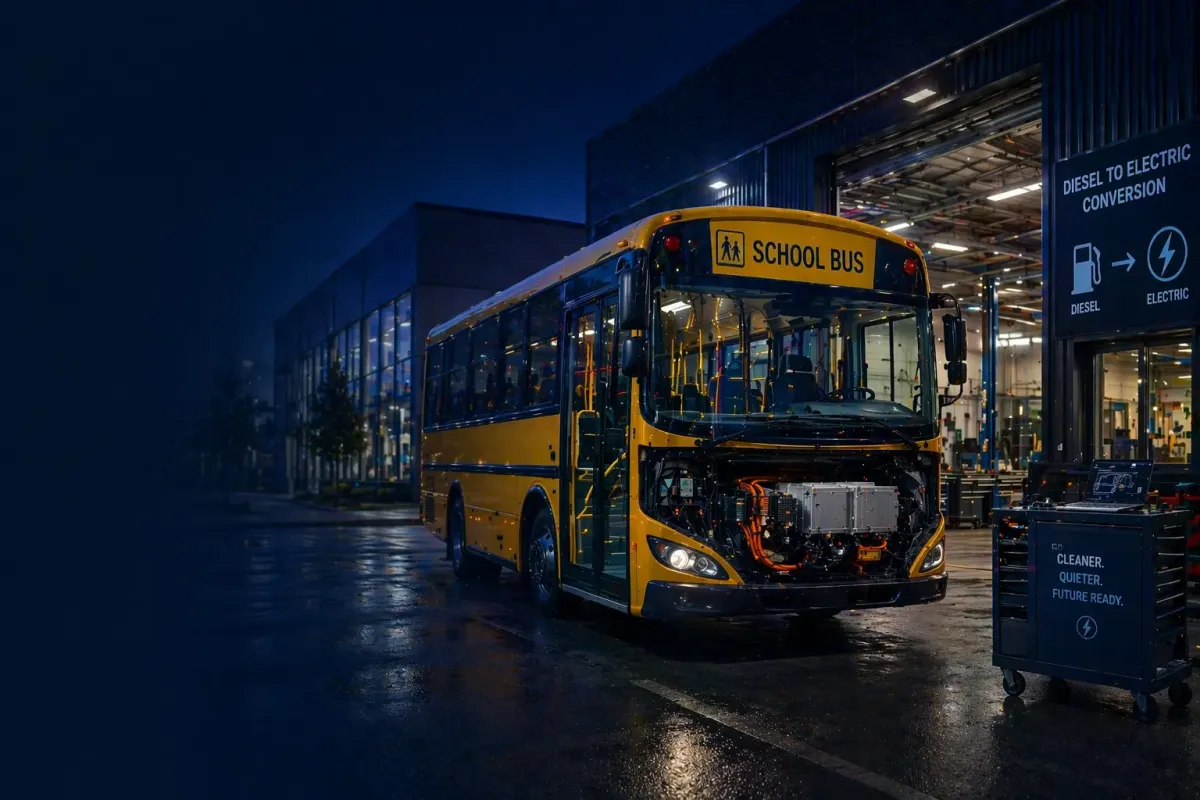
The North America electric school bus conversion market covers all commercial programmes and services involved in repowering existing diesel, gasoline, or propane school buses (Types A, C, and D) to battery-electric drivetrains across the United States and Canada. The study period is 2021–2030 with 2025 as base year. Market scope includes the repower kit or drivetrain system (the primary revenue item), associated compliance certification and engineering services, depot charging infrastructure specifically serving repowered fleets, fleet electrification planning for repower-focused programmes, and (in the U.S.) any warranty or service programmes associated with OEM-certified repower pathways. The market explicitly excludes new electric school bus procurement (covered in the companion North America Electric School Bus Market report) while including the repower ecosystem that serves as the cost-accessible complement to new ESB purchasing.
Understanding the North America repower market requires appreciating its fundamental commercial logic. A school district operating a serviceable 5–8 year old diesel Type C school bus faces three electrification choices: (1) replace the bus with a new ESB at USD 300,000–400,000, relying on EPA grant coverage of 40–70% of cost; (2) repower the existing bus at USD 110,000–180,000 (excluding base bus), with no EPA grant eligibility for the repower itself but potentially lower total cost of ownership than waiting for grant coverage; or (3) continue diesel operation. For the approximately 30–40% of U.S. school districts that are not selected in competitive EPA Clean School Bus grant rounds in any given year, and for Canadian districts where federal iMHZEV incentives exclude conversions, the repower pathway offers the only financially accessible route to fleet electrification without full dependence on government grant timing. This structural gap between the universe of districts seeking electrification and the funding available in any given year is the permanent commercial engine for the repower market.
The market's institutional infrastructure is being built around two strategic approaches. The first is the volume partnership model — a repower specialist (SEA Electric) working with a major dealer network (Midwest Transit Equipment) to achieve procurement scale that individual school districts cannot generate through standalone repower decisions. The second is the OEM-certified pathway model — an incumbent school bus OEM (Blue Bird) endorsing and supporting a specific repower drivetrain provider (Lightning eMotors) to create a factory-certified programme that gives school district administrators an OEM-accountable compliance assurance for their repower investment. Both models directly address the core market development challenge: school district administrators are risk-averse institutional buyers who require both cost clarity and compliance certainty before committing to a non-standard fleet modification. The compliance-ready kit approach — assembling repower system, certification documentation, FMVSS analysis, warranty terms, and service network into a single procurement offering — is the commercial design that converts the repower's cost advantage from an engineering concept into a procurable school district solution.
Market Dynamics
Key Drivers
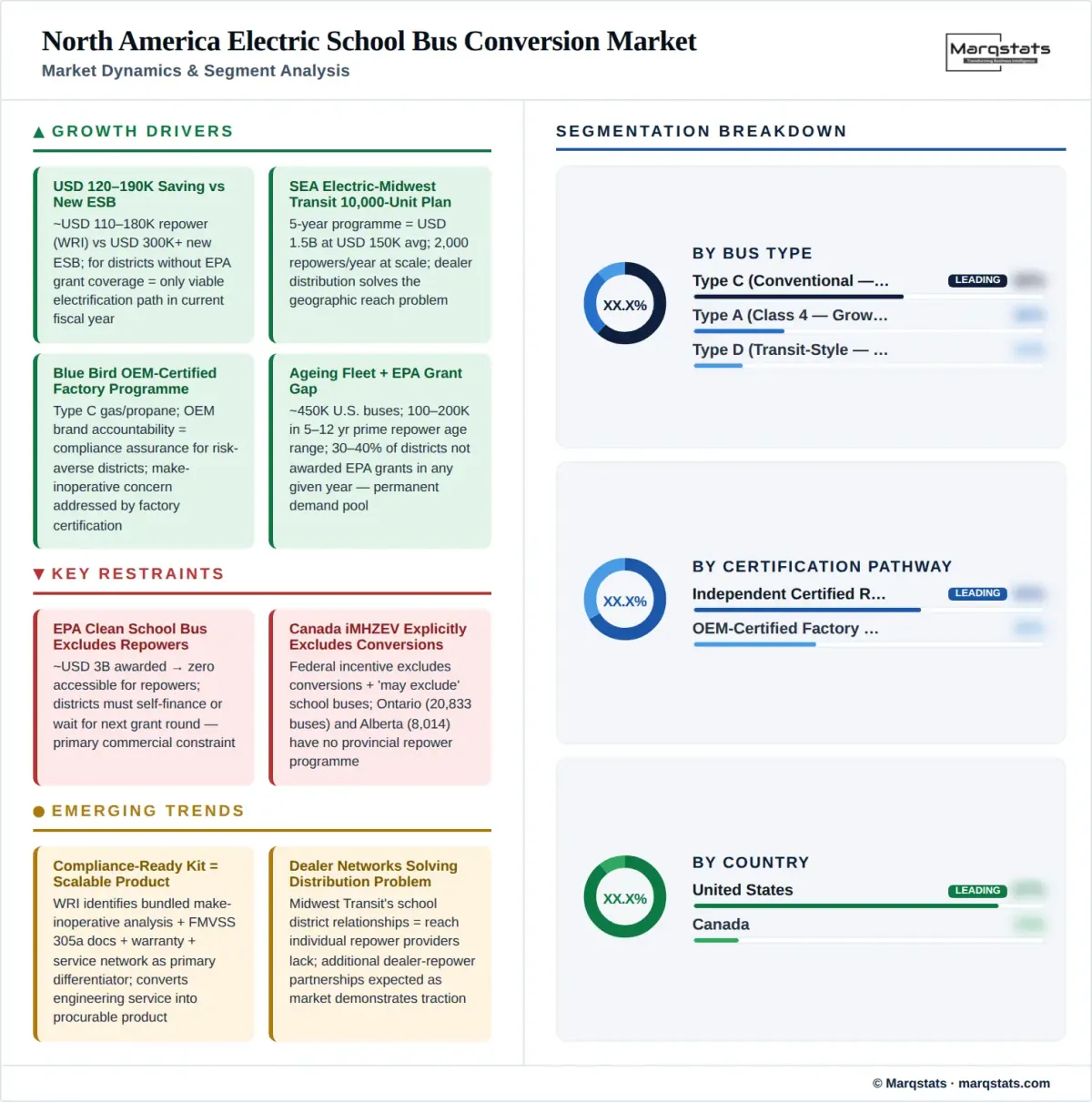
- Cost advantage of USD 120,000–190,000 per vehicle versus new ESB procurement enabling electrification without grant dependency: The repower's fundamental commercial proposition is cost-based. WRI's market study cites indicative repower pricing of approximately USD 110,000–180,000 per vehicle (excluding the base used bus cost), compared to new electric school buses priced at over USD 300,000. For a school district that is not awarded EPA Clean School Bus grant funding in a given year, a repower at USD 145,000 (midpoint) for a serviceable Type C bus they already own is the difference between fleet electrification in fiscal year 2025 and a 2–4 year wait for the next grant round. This cost advantage creates a structurally permanent demand pool that exists independent of the federal grant cycle — it grows when grant rounds are oversubscribed (creating unmet demand) and compresses when grant coverage is broad (reducing the district's incentive to self-finance a repower).
- SEA Electric-Midwest Transit 10,000-repower programme creating institutionally scaled demand signal: The public commitment by SEA Electric and Midwest Transit Equipment to target 10,000 school bus repowers over five years is the most commercially significant demand announcement in North American ESB repower history. At a conservative average repower cost of USD 150,000 per vehicle, this programme represents USD 1.5 billion in potential repower procurement over five years — USD 300 million per year — transforming the repower market from a collection of individual district decisions into an institutionally procured fleet electrification channel. The Midwest Transit dealer network — an established commercial bus dealer with school district relationships across multiple U.S. states — provides the distribution channel that individual repower technology providers lack, addressing the market development challenge of reaching thousands of geographically dispersed school districts at scale.
- Factory-certified OEM repower pathway reducing compliance uncertainty for risk-averse districts: The Blue Bird-Lightning eMotors factory-certified repower programme for Type C gas and propane school buses represents the most important structural development in North American repower market credibility. By associating the repower programme with Blue Bird's OEM brand, the programme provides school district procurement officers with an OEM-accountable compliance assurance — reducing the primary barrier to repower adoption, which is institutional concern about FMVSS compliance, warranty coverage, and insurance eligibility post-repower. Factory-certified pathways also address the nuance in U.S. repower regulations: by structuring repowers through an OEM-certified programme with appropriate compliance documentation, the factory-certified model navigates the FMVSS make-inoperative concern in a way that independent repowers cannot easily replicate for conservative district procurement.
- Large addressable installed fleet of ageing diesel school buses providing structural demand: The U.S. school bus fleet of approximately 450,000 buses includes a large cohort of serviceable diesel vehicles that are not cost-effectively replaced with new ESBs — particularly Type C and Type A buses in the 5–12 year age range where the bus body retains useful service life but the diesel drivetrain represents a stranded emissions liability. With the average U.S. school bus age approximately 9–12 years and replacement cycles of 12–15 years, there is a persistent pool of 100,000–200,000 vehicles at any given time that are in the prime candidate age range for repower (old enough to justify the modification cost, young enough to have 5+ remaining service years post-repower). Canada's fleet of 45,000–50,000 buses similarly contains a large ageing diesel cohort, concentrated in provinces (Quebec, Ontario, British Columbia) where zero-emission fleet targets create disposal pressure on older diesel vehicles.
- Depot charging infrastructure investment already underway creating repower-compatible infrastructure: One of the structural barriers to ESB deployment — depot charging grid upgrades — is being addressed at scale by federal and state programmes designed for new ESBs. As school districts invest in Level 2 and DC fast chargers at bus depots, the resulting infrastructure is equally compatible with repowered buses as with new ESBs. The approximately 13,931 committed U.S. ESBs (2025) represent depot charging infrastructure investments across over 1,500 school districts. Once a district has made the depot charging investment for a subset of new ESBs, the incremental cost of adding repowered buses to the same depot is primarily the repower kit cost — with the charging infrastructure already in place. This infrastructure-first dynamic progressively reduces the all-in cost comparison for repowers and creates a growing base of depot-ready districts that can add repowered vehicles without additional infrastructure investment.
Key Restraints
- No EPA Clean School Bus Program eligibility for repowers — the dominant federal incentive excludes the market: The most significant commercial constraint for the North American repower market is that the EPA Clean School Bus Program — which has awarded nearly USD 3 billion for ESB procurement — does not fund repowers. The programme funds the purchase of new clean school buses and associated charging infrastructure; repower conversions of existing buses are not within programme scope. This means school districts cannot use EPA Clean School Bus awards to fund repowers, limiting the repower market to self-financed district capital budgets, state incentive programmes that may include repowers, and private financing. For districts whose electrification strategy is primarily grant-dependent, this effectively walls off the repower market until non-grant capital becomes available — a significant constraint given that the EPA programme is the primary demand catalyst for the overall U.S. ESB market.
- Canada iMHZEV federal incentive explicitly excludes conversions — no federal incentive stacking in Canada: Transport Canada's iMHZEV programme, the primary Canadian federal incentive for medium and heavy-duty zero-emission vehicles, explicitly excludes conversions from eligibility. Additionally, the programme notes it 'may exclude' school buses as a vehicle category. This double exclusion (conversion category and potential school bus category) means Canadian repower programmes cannot access federal incentives and must rely exclusively on provincial-level support — which varies significantly by province. Quebec's PETS programme (the most advanced provincial ESB incentive) does not appear to explicitly cover repowers in published documentation, creating a potential incentive gap for the largest Canadian ESB market.
- FMVSS make-inoperative prohibition creating compliance engineering requirement for all repower providers: The 49 U.S.C. §30122 prohibition on knowingly disabling safety devices or elements installed to meet FMVSS creates a real compliance engineering burden for repower providers — not a prohibition on the activity, but a constraint that requires each repower programme to document that all FMVSS-required safety systems (braking, lighting, emergency exits, occupant protection, school bus-specific standards) remain fully functional post-repower. For established OEM-certified programmes (Blue Bird-Lightning eMotors), this compliance documentation is embedded in the factory certification. For independent repower providers (Unique Electric Solutions, Optimal EV, Legacy EV, Bison EV Retrofits), the compliance engineering requirement represents a programme development cost that may not be fully reflected in their cited USD 110,000–180,000 repower pricing, creating potential under-pricing risk that could affect programme financial sustainability.
- School district procurement conservatism and risk aversion limiting early adoption: School district administrators are among the most risk-averse institutional buyers in U.S. public procurement — responsible for the safety of thousands of children daily, operating under public accountability constraints, and exposed to significant reputational risk if a safety incident follows a non-standard fleet modification. The repower market's core challenge is overcoming the procurement preference for OEM-certified, warranted, and grant-funded new ESBs over independently repowered buses that may have less institutional validation. The September 2025 Quebec LION Electric school bus fire — which caused 1,200 LION buses to be temporarily suspended province-wide — while not repower-related, illustrates the existential procurement risk from ESB safety incidents and reinforces district administrators' preference for the most institutionally validated electrification pathways available.
Key Trends
- Compliance-ready kit model emerging as the primary commercial design for scalable repower programmes: The WRI market study explicitly identifies packaging repower systems as 'compliance-ready' — including make-inoperative risk analysis, FMVSS 305a validation documentation, warranty terms, and service network coverage — as the primary differentiator for repower providers competing for district procurement. This compliance-kit design shift transforms the repower from an engineering service (remove ICE, install battery) into a procurement product (certified, warranted, serviceable drivetrain replacement) that district administrators can buy with the same institutional confidence as a new OEM vehicle. Providers investing in compliance kit documentation and OEM-aligned warranty structures are progressively differentiating themselves from those offering repower services without the institutional assurance layer.
- Dealer network distribution solving the repower's market reach challenge: The Midwest Transit Equipment partnership with SEA Electric represents the first instance of a large, established commercial bus dealer network actively distributing repower services across its school district customer base. Individual repower technology providers (Unique Electric Solutions, Bison EV Retrofits, Legacy EV) lack the dealer relationships, geographic reach, and institutional credibility of established bus dealers. Dealer-repower specialist partnerships solve this distribution challenge — and Midwest Transit's 10,000-unit target signals the scale at which dealer channel economics become commercially viable for repower programmes. Additional dealer-repower partnerships are expected to follow as the market demonstrates traction.
- Financing structures bundling bus, repower, and charging enabling self-financed electrification: The EPA Clean School Bus Program's exclusion of repowers creates a financial structure gap — districts pursuing repowers must fund them through local capital budgets, municipal bonds, or private financing. Financing models that bundle the base used bus purchase, the repower drivetrain, and the depot charging infrastructure into a single per-vehicle monthly payment (comparable to a bus lease structure) can make repowers accessible to districts without large capital reserves. This financing model — analogous to the Fleet-as-a-Service approach that has enabled EV adoption in commercial delivery in other markets — is being developed by specialist fleet electrification finance providers and represents the structural complement to the compliance-ready kit model.
- Type A repower emerging as a strategically distinct segment for special education and rural districts: Type A school bus repowers — converting smaller Class 4 buses primarily used for special education, rural routes, and smaller student groups — represent a distinct repower segment with different economics and competitive dynamics from Type C and Type D. Type A repowers are cheaper per vehicle (smaller battery requirement, lower chassis cost), address districts that are less competitive for EPA grant funds (smaller fleet sizes, rural geography), and have multiple active providers (Phoenix Motorcars, Optimal EV) with Type A-specific capabilities. The GreenPower Nano BEAST's market entry as a purpose-built all-electric Type A creates competitive pressure on Type A repowers but simultaneously validates the Type A electrification market as commercially real — and repowers remain 30–50% cheaper than the Nano BEAST for districts with serviceable Type A diesel inventory.
Market Segmentation
Type C school bus repowers are the primary segment by volume potential, reflecting the Type C's dominance in the U.S. school bus fleet (the most common bus type nationally) and the Blue Bird-Lightning eMotors factory-certified programme that targets Type C gas and propane buses specifically. The factory-certified pathway is particularly significant for Type C because the majority of serviceable pre-repower diesel and propane Type C buses are Blue Bird or Thomas Built vehicles — meaning the OEM has a direct commercial interest in the repower market as an alternative to new ESB replacement, and can position the factory-certified programme as a fleet upgrade within the existing OEM service relationship. SEA Electric-Midwest Transit's 10,000-repower programme spans bus types but is expected to have heavy Type C concentration given the type's fleet dominance. WRI cites the factory-certified OEM repower model as the most compliance-robust pathway for Type C repowers, reducing the make-inoperative risk that is most acute for this large, most-regulated school bus category.
Type A school bus repowers — converting Class 4 vehicles in the 9–36 passenger range — are a growing segment with multiple dedicated providers and a distinct district profile (special education, rural, smaller capacity routes). Phoenix Motorcars and Optimal EV are the most actively cited Type A repower providers in WRI's competitive analysis, while Legacy EV and Bison EV Retrofits offer Type A alongside other bus types. Type A repower economics are favourable: smaller battery requirements reduce kit cost, shorter routes reduce range anxiety, and the special education district context often means smaller fleets with less grant competitiveness but strong community sustainability commitments. The primary competitive dynamic for Type A repowers is competition from purpose-built all-electric Type A new buses — GreenPower Nano BEAST (118 kWh, 140 miles, USD 200,000–300,000 new) — which narrows the cost advantage but does not eliminate it for districts with serviceable Type A diesel inventory.
Type D school bus repowers — converting the larger transit-style rear-engine buses (71–90 passengers) — are the highest-value per-vehicle repower segment but face the most complex compliance engineering challenge given Type D's higher safety standards and the greater complexity of rear-engine powertrain replacement. Legacy EV and Bison EV Retrofits are among the few providers offering Type D repower capability. The competitive dynamic for Type D repowers is shaped by Blue Bird's USD 80 million DOE manufacturing expansion specifically targeting Type D new ESB production: as Type D new ESB availability increases and grant coverage improves, the relative attractiveness of Type D repowers versus new Type D ESBs diminishes. However, for districts operating large Type D fleets with recent body investment but ageing powertrains, Type D repowers remain cost-competitive during the 2026–2028 period before new Type D ESB production achieves full scale.
OEM-certified factory repowers — where the modification programme is explicitly endorsed, certified, and warranted by the original school bus manufacturer — represent the most institutionally credible repower pathway and the model most likely to achieve scale through established dealer and procurement channels. Blue Bird-Lightning eMotors is the definitive North American example: Blue Bird, as the original bus OEM, endorses the Lightning eMotors drivetrain as a factory-certified upgrade for Type C gas and propane school buses within a structured programme that includes compliance documentation, warranty terms, and dealer service network support. This OEM-certified model directly addresses the school district procurement officer's primary concern — accountability — by placing the OEM brand behind the repower outcome. The commercial premium over independent repowers is justified by the compliance assurance and the reduction in district-level risk that factory certification provides.
Independent certified repowers — performed by specialist providers (Unique Electric Solutions, Phoenix Motorcars, Optimal EV, Legacy EV, Bison EV Retrofits, SEA Electric) without an OEM brand endorsement but with their own compliance and warranty frameworks — represent the majority of the current market by provider count and the highest growth pathway by volume aspiration. WRI's competitive table identifies at least seven independent repower providers active in the North American market, collectively covering Types A, C, and D platforms at pricing bands ranging from USD 110,000 to USD 180,000 (excluding base bus). The SEA Electric-Midwest Transit 10,000-unit programme is structurally an independent certified repower at scale — SEA Electric provides the drivetrain technology and compliance documentation while Midwest Transit provides dealer channel distribution. Independent certified repowers are volume-scalable in ways that OEM factory programmes (which require OEM commercial cooperation) are not, but must invest more in individual district compliance assurance to overcome procurement conservatism.
By Geography
United States — Primary Market
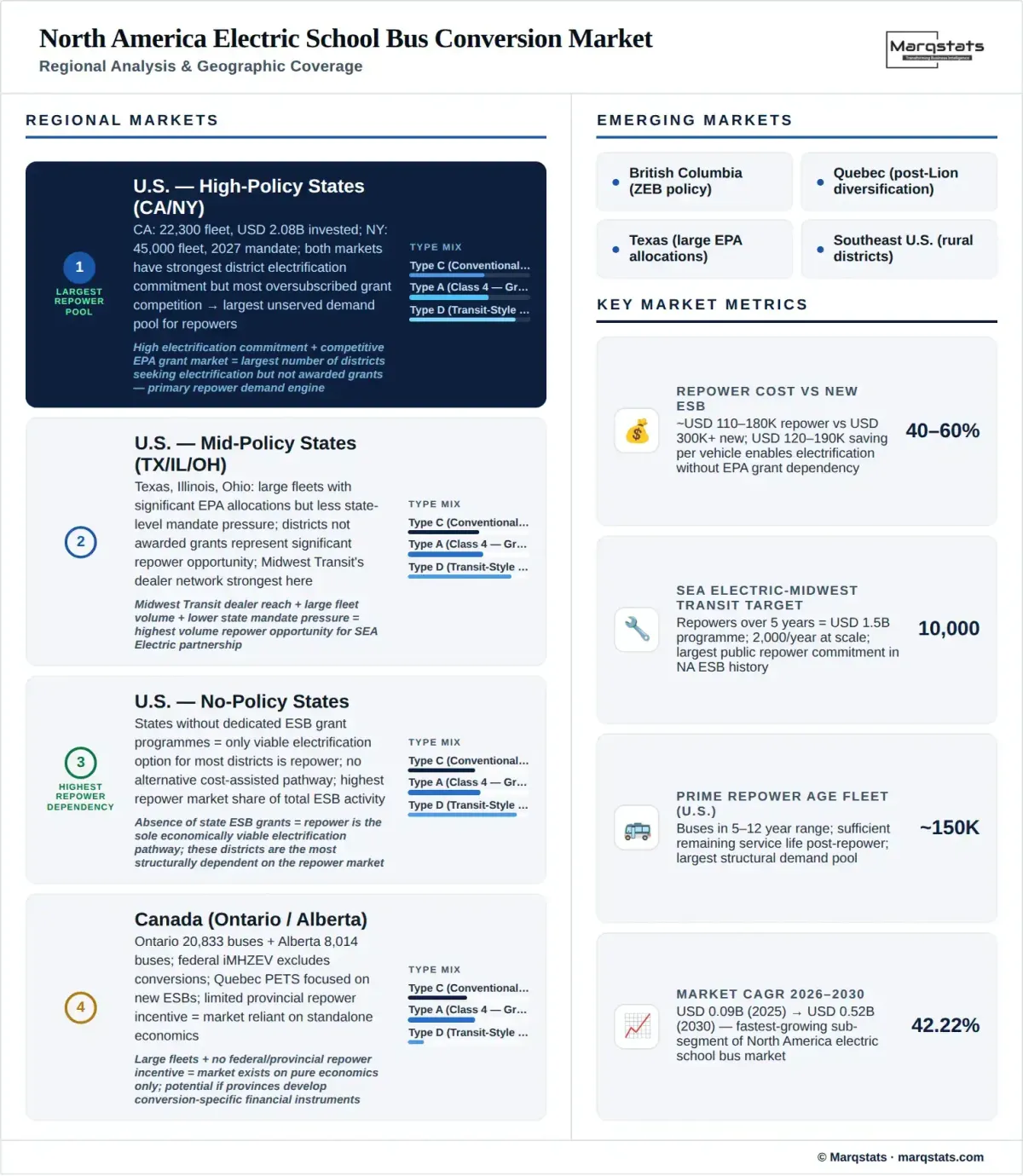
The United States is the primary market for North American school bus repowers, driven by the structural demand created by the EPA Clean School Bus Program's exclusion of repowers (creating a permanent unserved district population), the large fleet of serviceable ageing diesel school buses (~450,000 total, with a large cohort in the 5–12 year prime repower age range), and the established repower supply chain (Blue Bird-Lightning eMotors factory-certified programme; SEA Electric-Midwest Transit volume partnership; multiple independent providers). The U.S. repower market is geographically distributed across all 50 states with highest concentration in states that have active ESB policy (California, New York, Texas, Illinois) where district electrification commitment is strongest but grant competition leaves a large unserved demand pool. States without dedicated ESB grant programmes are the highest-potential repower markets because they have no alternative cost-assisted pathway to electrification — for these districts, repower is the only economically viable route to at least partial fleet electrification.
Canada — Provincial Market with Federal Incentive Gap
Canada's school bus repower market operates under a distinct structural constraint: Transport Canada's iMHZEV federal incentive programme explicitly excludes conversions from eligibility, eliminating the possibility of stacking federal ESB incentives with repower economics that has made some European conversion markets viable. Canadian repowers must therefore be justified on standalone economics or provincial programme support — and with Quebec's PETS programme focused on new ESB procurement, the provincial incentive architecture has not yet developed the conversion-specific financial instruments that would catalyse a Canadian repower market comparable to France's CEE-framework-financed coach retrofit market. Canada's near-term repower market is therefore smaller and more challenging than the U.S. market, concentrated in provinces with older diesel fleets and limited access to new ESB grant funding. The largest potential Canadian repower market is Ontario (20,833 buses, limited provincial ESB programme compared to Quebec) and Alberta (8,014 buses), where districts have the fleet volume but limited access to new ESB grants.
How Competition Is Evolving
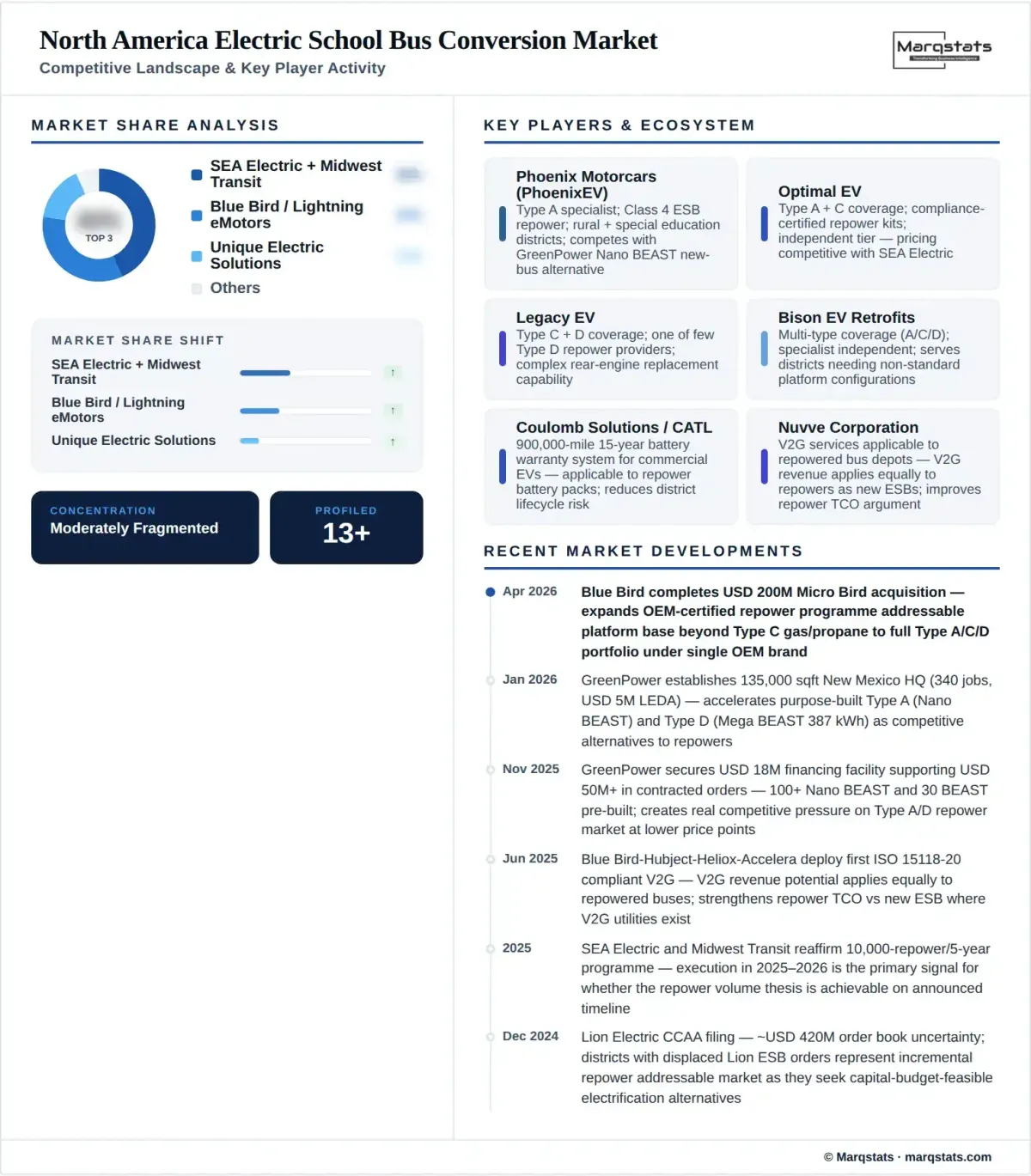
The North America electric school bus repower market's competitive landscape is organised around three tiers: the OEM-certified programme tier (Blue Bird-Lightning eMotors), the volume partnership tier (SEA Electric-Midwest Transit), and the specialist independent provider tier (Unique Electric Solutions, Phoenix Motorcars, Optimal EV, Legacy EV, Bison EV Retrofits). These three tiers differ in their compliance positioning, target district profile, pricing, and go-to-market strategy — but share the common commercial challenge of converting school district interest in lower-cost electrification into actual procurement decisions in a market still dominated by new ESB purchase through OEM dealers.
The OEM-certified tier holds the highest institutional credibility and is best positioned for conservative large-district procurement — districts that want the certainty of OEM brand accountability for their fleet modification. The volume partnership tier is best positioned for the fastest absolute volume scaling, leveraging established dealer networks to reach thousands of districts that would not seek out independent repower providers directly. The specialist independent tier offers the widest platform coverage (Types A/C/D from a single provider in some cases), the lowest pricing, and the most flexibility for non-standard bus configurations — but must invest most heavily in compliance documentation to compete for risk-averse district procurement. The competitive dynamic will likely consolidate over 2026–2030 around one or two volume-scaled programmes (SEA Electric-Midwest Transit and potentially an OEM-certified expansion of Blue Bird's programme), with specialist providers serving niche segments (Type A, unusual bus configurations, Canadian provincial markets) where volume programme terms do not fit.
Companies Covered
The report profiles 13+ companies with full strategy and financials analysis, including:
Recent Market Activity
Table of Contents
Coverage & Segmentation
This report provides a comprehensive analysis of the North America electric school bus conversion (repower) market covering the 2021–2030 study period, with 2025 as base year. Market scope covers all commercial programmes and services for repowering existing diesel, gasoline, and propane school buses (Types A, C, and D) to battery-electric drivetrains across the United States and Canada, including repower drivetrain kits and systems, compliance certification and engineering services, depot charging infrastructure specifically serving repowered bus fleets, fleet electrification planning for repower-focused programmes, and financing structures enabling repower without upfront district capital. The report explicitly addresses the regulatory status of repowers in both jurisdictions (not prohibited; regulated) and the key compliance frameworks (FMVSS 305a, 49 U.S.C. §30122 make-inoperative prohibition, 49 CFR §567.7 alterer certification, Canadian provincial inspection pathways, iMHZEV conversion exclusion). Geographic coverage includes all 50 U.S. states with focus on California, New York, Texas, Illinois, and Midwest markets; Canada with focus on Quebec, Ontario, Alberta, and British Columbia. Primary research includes 40+ interviews with repower providers, school district fleet administrators, OEM commercial teams, state energy programme managers, compliance engineers, and fleet electrification finance providers.