Market Snapshot
Key Takeaways
Market Overview & Analysis
Report Summary
The India electric bus market report provides a comprehensive analysis of the manufacturing, procurement, deployment, and operation of electrically propelled buses across intra-city, intercity, and institutional transit applications in India. The market scope covers Battery Electric Buses (BEBs)—which overwhelmingly dominate with 98%+ share—alongside nascent Fuel Cell Electric Vehicle (FCEV) pilot programmes and Plug-in Hybrid Electric Buses (PHEVs), which have no meaningful commercial presence in India as of 2025. The six-dimension segmentation framework covers propulsion type, battery chemistry (LFP vs NMC), bus length, range, battery capacity, and application (intracity vs intercity). The study period spans 2021–2030, with 2025 as the base year, historical assessment from 2021 to 2025, and India electric bus market forecast from 2026 to 2030.
India’s bus sector accounts for approximately 40% of the country’s road-based passenger travel demand measured in passenger-kilometres, and the country is the third-largest bus market globally. Within this broader ecosystem, electric buses are a small but rapidly growing segment. Cumulative e-bus registrations reached approximately 9,714 by end of CY2024, with a historical CAGR exceeding 65% since the first pilot deployment in Manali, Himachal Pradesh, in 2017. However, diesel and CNG buses still command approximately 93.5% and 4.9% respectively of total bus registrations. The India electric bus market analysis reveals a sector transitioning from subsidy-dependent early adoption to structurally self-sustaining growth, driven by favourable TCO economics, maturing domestic supply chains, and expanding manufacturing capacity among electric bus manufacturers in India.
The market reached a major inflection point in December 2025, when the PM E-DRIVE tender for 10,900 electric buses was awarded. PMI Electro Mobility and Eka Mobility (the EV arm of Pinnacle Industries) secured approximately 80% of contracts at prices 5–15% below government estimates, signalling competitive maturity in the supply side and marking a dramatic realignment from legacy OEMs to new-age manufacturers. At the Bharat Mobility Global Expo 2025, leading Indian OEMs showcased their latest electric bus innovations: Tata Motors presented the Ultra EV 9 (9-metre bus with 200 kWh battery and 180 km range) and the Intercity EV 2.0 (450 kWh battery, 400 km range); Olectra Greentech launched BYD’s Blade Battery platform promising 500 km range and 5,000+ charge cycle lifespan; JBM Electric Vehicles unveiled the Galaxy luxury coach and Xpress intercity bus; SML Isuzu debuted the Hiroi.ev electric bus; and Eka Mobility showcased India’s first stainless-steel electric luxury bus, the EKA Coach (451 kWh LFP battery, 300 km range).
Market Dynamics
Key Drivers
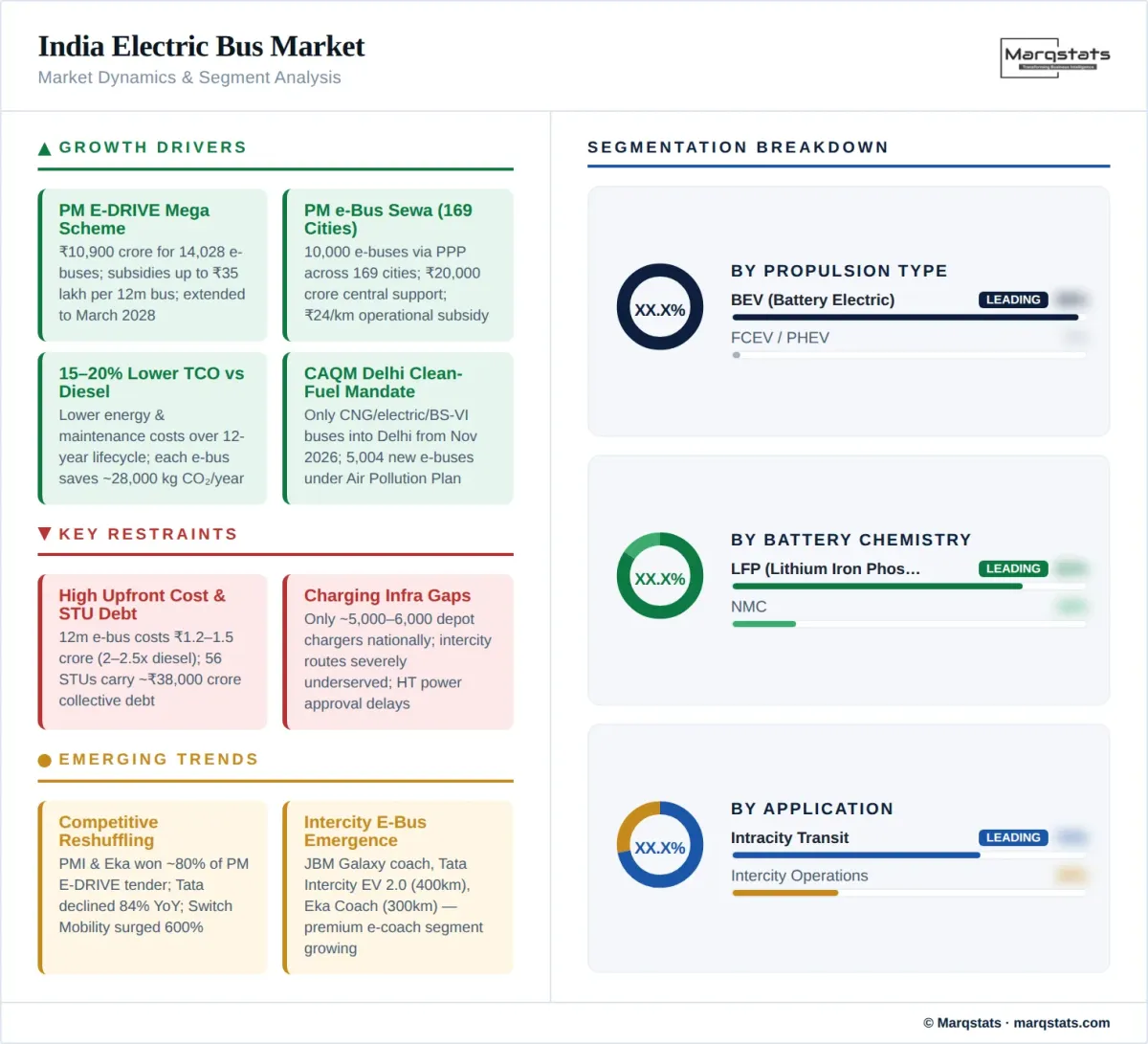
- PM E-DRIVE scheme and massive government procurement pipeline: The PM E-DRIVE (Electric Drive Revolution in Innovative Vehicle Enhancement) scheme allocates INR 4,391 crore specifically for procurement of over 14,028 e-buses by state transport undertakings, with subsidies of up to INR 35 lakh per standard 12-metre bus, INR 25 lakh for 8–10 metre buses, and INR 20 lakh for 6–8 metre buses. The scheme was extended to March 2028 with a maintained allocation of INR 10,900 crore. CESL launched a second tender in January 2026 for 6,230 electric buses (2,900 under PM E-DRIVE Tender-II and 3,330 for Delhi). Additionally, INR 2,000 crore is earmarked for 1,800 e-bus fast chargers and 48,400 fast chargers for 2-wheelers/3-wheelers nationally.
- PM e-Bus Sewa scheme targeting 10,000 e-buses across 169 cities: The PM e-Bus Sewa scheme, distinct from PM E-DRIVE, has a total estimated cost of INR 57,613 crore with central government support of INR 20,000 crore. It targets deployment of 10,000 electric buses on a PPP model across urban areas, with operational support of INR 24/km for standard 12-metre buses. Letters of Award have been issued for 4,787 buses across 67 cities, Letters of Confirmed Quantity for 6,228 buses, and concession agreements signed for 2,730 buses across 32 cities. PM e-Bus Sewa prioritises cities that lack organised bus services, ensuring coverage beyond major metros.
- Favourable electric bus total cost of ownership versus diesel: Industry analyses, including assessments by CareEdge and CEEW, indicate that AC electric buses achieve approximately 15–20% lower total cost of ownership compared to equivalent AC diesel buses over a 12-year operating lifecycle. The cost advantage is driven by lower energy costs (electricity versus diesel), significantly reduced maintenance requirements (fewer moving parts, regenerative braking reducing brake wear), and declining lithium-ion battery prices. Each e-bus additionally reduces approximately 28,000 kg of CO2 emissions per year. Electricity costs remain more stable than volatile diesel pricing, and bulk power purchase agreements provide multi-year budget certainty for fleet operators.
- CAQM Delhi clean-fuel mandate from November 2026: The Commission for Air Quality Management (CAQM) issued Statutory Direction No. 93 mandating that from 1 November 2026, only CNG, electric, or BS-VI diesel buses will be permitted to enter Delhi. This applies to all buses including those on All India Tourist Permits, contract carriage, institutional and school bus permits (except Delhi-registered buses). Delhi’s 25-point Air Pollution Mitigation Plan 2025 targets deployment of 5,004 new electric buses, and the draft EV Policy 2.0 proposes that DTC and DIMTS shall procure only electric buses for intra-city operations, positioning Delhi as a national showcase for fleet electrification.
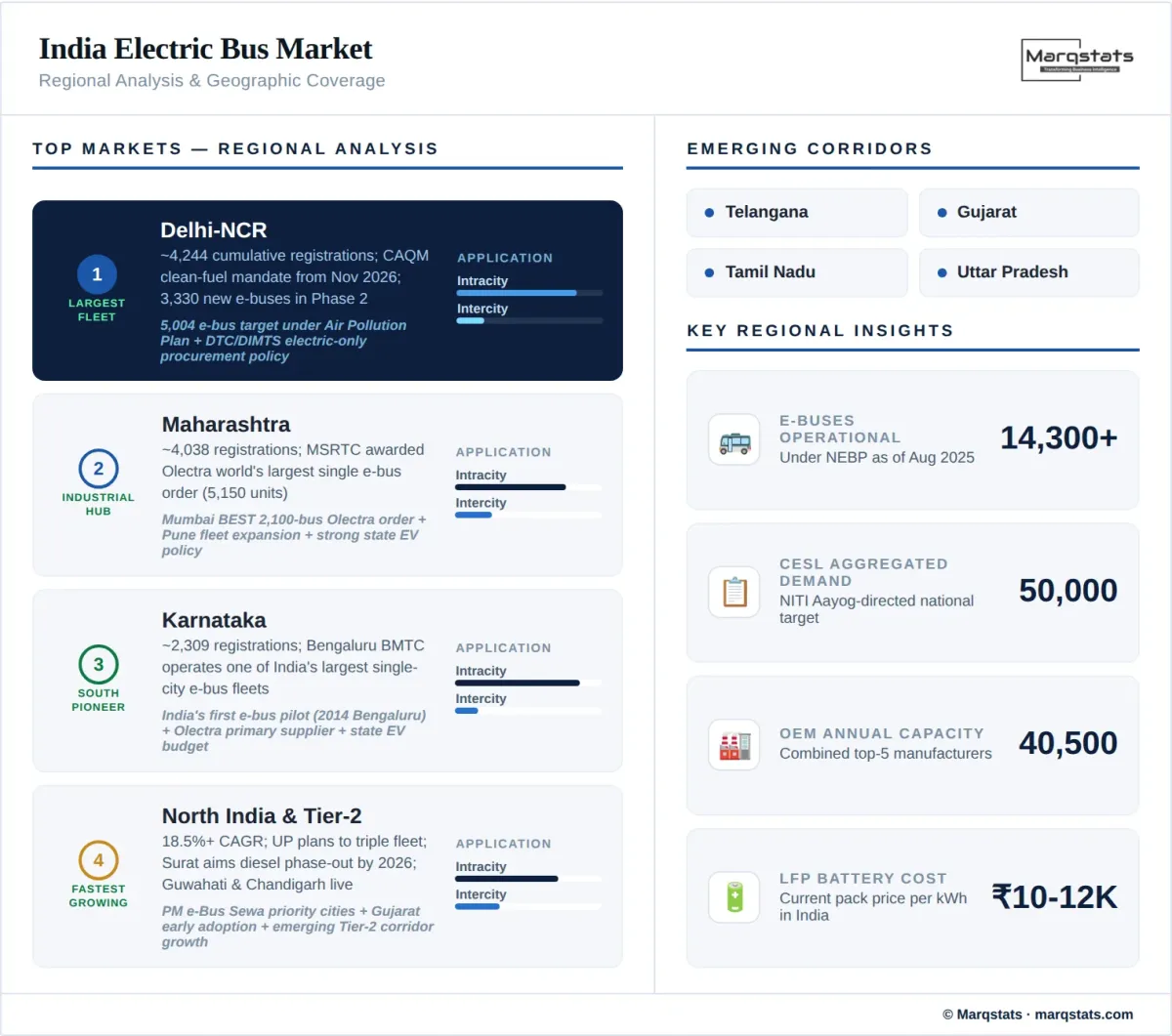
- Declining electric bus battery price India and localisation push: LFP battery packs currently cost INR 10,000–12,000 per kWh in India, down significantly from five years ago. The Union Budget 2025 extended customs duty exemptions on 35 capital goods for EV battery manufacturing. The Clean Tech Manufacturing Programme supports domestic motor, controller, and battery production. At Bharat Mobility Expo 2025, Olectra launched BYD’s Blade Battery platform offering 30% more energy storage and 5,000+ charge cycle lifespan, signalling the next generation of LFP technology for Indian e-buses.
Key Restraints
- High upfront capital costs and STU financial weakness: A standard 12-metre electric bus costs INR 1.2–1.5 crore before subsidies, roughly 2–2.5x a comparable diesel bus. India’s 56 State Road Transport Undertakings (STUs) collectively carry debt of approximately INR 38,000 crore. Delayed payments to manufacturers have been a persistent issue, discouraging some OEMs from aggressive tender participation—a factor in Tata Motors’ cautious approach to the PM E-DRIVE tender.
- Inadequate electric bus charging infrastructure India: As of early 2026, India’s electric bus depot charging infrastructure supports approximately 5,000–6,000 buses. The PM E-DRIVE scheme proposes only 1,800 fast chargers for e-buses nationally. Intercity routes remain particularly underserved with limited en-route charging availability. Behind-the-meter power infrastructure for depot charging requires high-tension (HT) power connections with lengthy approval processes, especially in tier-2 and tier-3 cities.
- LFP vs NMC battery chemistry trade-offs: LFP dominates Indian deployments due to thermal stability in tropical conditions, lower cost, and longer cycle life (3,000–5,000 cycles). However, LFP’s lower energy density (120–160 Wh/kg versus NMC’s 150–220 Wh/kg) limits range, particularly for intercity applications. NMC batteries at INR 12,000–15,000/kWh offer superior energy density but carry higher thermal management costs and shorter cycle life. The battery chemistry choice remains a key technical buying factor for fleet operators.
- Grid infrastructure limitations in emerging cities: High-power depot charging requires high-tension power connections that involve lengthy approval processes and capacity constraints in tier-2 and tier-3 cities targeted by PM e-Bus Sewa. Integrating renewable energy into depot charging remains nascent, though Olectra Greentech’s buses have clocked over 500 million green kilometres.
Key Trends
- Dramatic competitive reshuffling among electric bus companies in India: The December 2025 PM E-DRIVE tender marked the most significant competitive realignment in the market’s history. PMI Electro Mobility (5,210 buses) and Eka Mobility (3,485 buses) secured nearly 80% of the 10,900-bus order, while Tata Motors, VE Commercial Vehicles, and JBM Auto secured zero allocations. In CY2025 registrations, Switch Mobility grew approximately 600% YoY (from 136 to 950 units), while Tata Motors electric bus registrations declined 84% (from 1,462 to 223 units). New entrants like JSW Greentech received ARAI type approval for a 12-metre bus with 10,000-unit annual manufacturing capacity.
- Gross Cost Contract (GCC) model becoming the predominant procurement mechanism: The GCC operating model, mandated under FAME II and continued under PM E-DRIVE, has become the standard for over 90% of electric bus procurement in India. Under GCC, the bus operator/OEM retains vehicle ownership and handles maintenance for 12-year contract periods, while STUs pay a per-kilometre rate (approximately INR 70–77/km). The Payment Security Mechanism (PSM) ensures timely payments. This model de-risks adoption for financially stressed STUs. CAPEX/Outright Purchase models persist in some states but are declining.
- Intercity and luxury electric bus segment emergence: While intracity transit accounts for approximately 70% of deployments, the intercity segment is emerging as the fastest-growing application. At Bharat Mobility Expo 2025, JBM unveiled the Galaxy luxury coach and Xpress intercity bus, Tata Motors presented the Intercity EV 2.0 with 400 km range and 450 kWh battery, and Eka Mobility showcased India’s first stainless-steel luxury e-bus. Expanding highway charging infrastructure under PM E-DRIVE is expected to unlock significant intercity demand post-2027.
- AI-driven fleet management and telematics integration: GPS, GPRS, and real-time monitoring systems are being integrated across electric bus fleets, enabling route optimisation, predictive maintenance, and energy efficiency improvements. Switch Mobility’s proprietary SWITCH iON telematics platform provides over 50 advanced features including real-time vehicle health monitoring and fleet management. Data from these systems is being used to customise battery configurations based on actual route-specific driving patterns. AI-powered fleet management is becoming a standard feature across all major OEMs.
Market Segmentation
Battery electric buses dominate the India electric bus market with over 98% of total registrations in 2025 (approximately 98.85% as per industry estimates). This near-exclusive dominance is driven by the maturity of plug-in depot charging, strong government subsidy alignment (PM E-DRIVE subsidies are structured around battery capacity in kWh), falling LFP battery costs, and the favourable TCO profile. Most BEV deployments use LFP battery packs in the 200–350 kWh range, providing single-charge ranges of 150–250 km for intracity routes. Depot charging overnight with standard AC or fast DC chargers enables high asset utilisation within daily operational schedules. At Bharat Mobility Expo 2025, Olectra’s Blade Battery platform promised ranges up to 500 km, while Eka Mobility’s Coach offered 300 km range with a 451 kWh LFP pack.
FCEVs remain at the pilot stage in India with no meaningful commercial deployment as of 2025. Hydrogen fuel-cell bus programmes are being explored for long-range intercity routes, but the absence of hydrogen production and distribution infrastructure limits near-term viability. Tata Motors showcased the Prima H.28 hydrogen truck (not a bus) at Bharat Mobility Expo 2025, indicating early hydrogen ICE development for commercial vehicles. PHEVs have no commercially significant presence in the Indian electric bus market and are not actively promoted under current government schemes, which strongly favour zero-emission BEVs. This segmentation dimension is included for completeness and to track any future technology shifts, but the market is essentially a BEV-only market today.
LFP is the dominant battery chemistry for electric buses in India, accounting for the vast majority of deployments. LFP’s advantages in the Indian context include superior thermal stability in tropical operating conditions (critical given ambient temperatures regularly exceeding 40°C), longer cycle life (3,000–5,000 cycles versus 1,500–2,000 for NMC), lower cost (INR 10,000–12,000/kWh), and enhanced safety profile. Olectra’s partnership with BYD provides access to Blade Battery LFP technology, while Eka Mobility, Switch Mobility, and Eicher all deploy LFP packs. A typical 200 kWh LFP pack costs INR 20–24 lakh, with battery lifespan typically reaching 7–8 years.
NMC batteries offer higher energy density (150–220 Wh/kg versus LFP’s 120–160 Wh/kg), making them attractive for intercity applications requiring extended range. However, NMC’s higher cost (INR 12,000–15,000/kWh), shorter cycle life, and greater thermal management requirements in India’s climate limit widespread adoption. Some manufacturers offer NMC variants for long-range intercity coaches where energy density takes priority over cycle life. The LFP-versus-NMC battery chemistry choice is a key technical buying factor for fleet operators evaluating electric bus procurement.
The 9–14 metre category dominates the market, with the standard 12-metre configuration as the workhorse of urban transit electrification. PM E-DRIVE subsidies cap at INR 35 lakh for 10–12 metre buses, making this length the most economically attractive. At Bharat Mobility Expo 2025, Olectra showcased the X2 (12-metre, 300 kW, 350–400 km range), JBM launched the 12-metre Xpress intercity bus, and Eka presented the EKA LF low-floor city bus (12-metre, 350 kWh, 280 km range). Tata’s Intercity EV 2.0 stretches to 13.5 metres with a 450 kWh battery.
Smaller electric buses under 9 metres are gaining traction for tier-2 and tier-3 city deployments and BRTS corridors where road widths and passenger volumes favour compact vehicles. Delhi’s Phase 2 PM E-DRIVE deployment specifically targets mini and mid-size AC e-bus variants. SML Isuzu’s Hiroi.ev (9-metre, 200 kWh, 180 km range, 32-seat) debuted at Bharat Mobility Expo 2025. PM e-Bus Sewa specifically targets cities without organised bus services, many of which are smaller urban centres where midi-buses are appropriate. Subsidy caps of INR 25 lakh (8–10m) and INR 20 lakh (6–8m) enable smaller form-factor economics.
The above-14-metre segment is emerging for premium intercity and long-distance coach applications. Ashok Leyland showcased the GARUD 15-metre premium bus (India’s first multi-axle, front-engine, 15-metre fully built premium bus) at Bharat Mobility Expo 2025. Eka Mobility’s Coach measures 13.48 metres. This segment targets the growing demand for premium electric coach services that compete with railways and airlines on inter-metro corridors.
Intracity electric bus transit accounts for approximately 70% of total market value, driven by fixed-route operations with predictable daily mileage that align with depot charging schedules and current battery ranges. Delhi’s Air Pollution Mitigation Plan targets 5,004 new electric buses. Bengaluru’s BMTC has deployed over 600 electric buses from Olectra through long-term contracts. Surat’s Sitilink Ltd. aims to phase out all diesel buses by 2026 and scale its e-bus fleet to 1,300 units by 2030. The intracity segment benefits from the GCC model’s proven economics and the concentration of government subsidies on urban transit corridors.
Intercity electric bus operations represent the fastest-growing application, though from a small base. This segment requires buses with extended ranges (300+ km), larger battery capacities (400+ kWh), faster charging, and en-route highway charging infrastructure. JBM’s Galaxy luxury coach and Xpress platform, Tata’s Intercity EV 2.0 (400 km range), and Eka’s Coach (300 km range) are targeting this segment. The expansion of highway charging infrastructure under PM E-DRIVE and improving LFP energy density are expected to unlock significant intercity demand post-2027.
By Geography
Maharashtra
Maharashtra ranks among the top states for electric bus deployment with approximately 4,038 cumulative registrations as of early 2026. Mumbai and Pune anchor the state’s fleet electrification. MSRTC awarded Olectra Greentech the world’s largest single electric bus order for 5,150 units. Mumbai’s BEST secured a 2,100-bus order from Olectra. The state’s strong industrial base, large urban population, and proactive state EV policy support continued leadership in electric bus fleet deployment.
Delhi-NCR
Delhi leads India’s electric bus deployment with approximately 4,244 cumulative registrations as of early 2026 and is positioned as the single largest growth corridor for 2026–2027. The CESL Phase 2 tender for 3,330 new electric buses specifically for Delhi includes mini and mid-size AC variants. CAQM’s Statutory Direction No. 93 mandates only clean-fuel buses into Delhi from November 2026. Delhi’s 25-point Air Pollution Mitigation Plan targets 5,004 new electric buses, and the draft EV Policy 2.0 proposes that DTC and DIMTS shall procure only electric buses for intra-city operations. Delhi has already achieved approximately 12% fleet electrification.
Karnataka and South India
Karnataka has accumulated approximately 2,309 electric bus registrations as of early 2026, anchored by Bengaluru’s BMTC which operates one of the country’s largest single-city electric bus fleets with Olectra as primary supplier. Bengaluru was the site of India’s first electric bus pilot in 2014. Telangana’s TGSRTC recently awarded Olectra a 1,085-bus order worth INR 1,800 crore under PM E-DRIVE. Tamil Nadu and Kerala are expanding procurement through state-level EV policies and dedicated fleet electrification budgets.
North India and Emerging Tier-2 Cities
North India is projected to grow at the fastest CAGR, exceeding 18.5%, driven by Delhi’s massive procurement pipeline and Uttar Pradesh’s plans to triple its e-bus fleet across Lucknow, Varanasi, and Ayodhya. Gujarat led early adoption with Ahmedabad and Surat among PM e-Bus Sewa priority cities—Surat’s Sitilink aims to phase out all diesel buses by 2026. Emerging tier-2 cities including Guwahati, Chandigarh, Nagpur, and Bhavnagar commenced operations under PM e-Bus Sewa in early 2026. E-bus penetration rate by state varies: UP at approximately 15%, Karnataka at 12%, and Maharashtra at 8% of total state-level bus registrations (per older CareEdge estimates; these are approximate and evolving).
How Competition Is Evolving
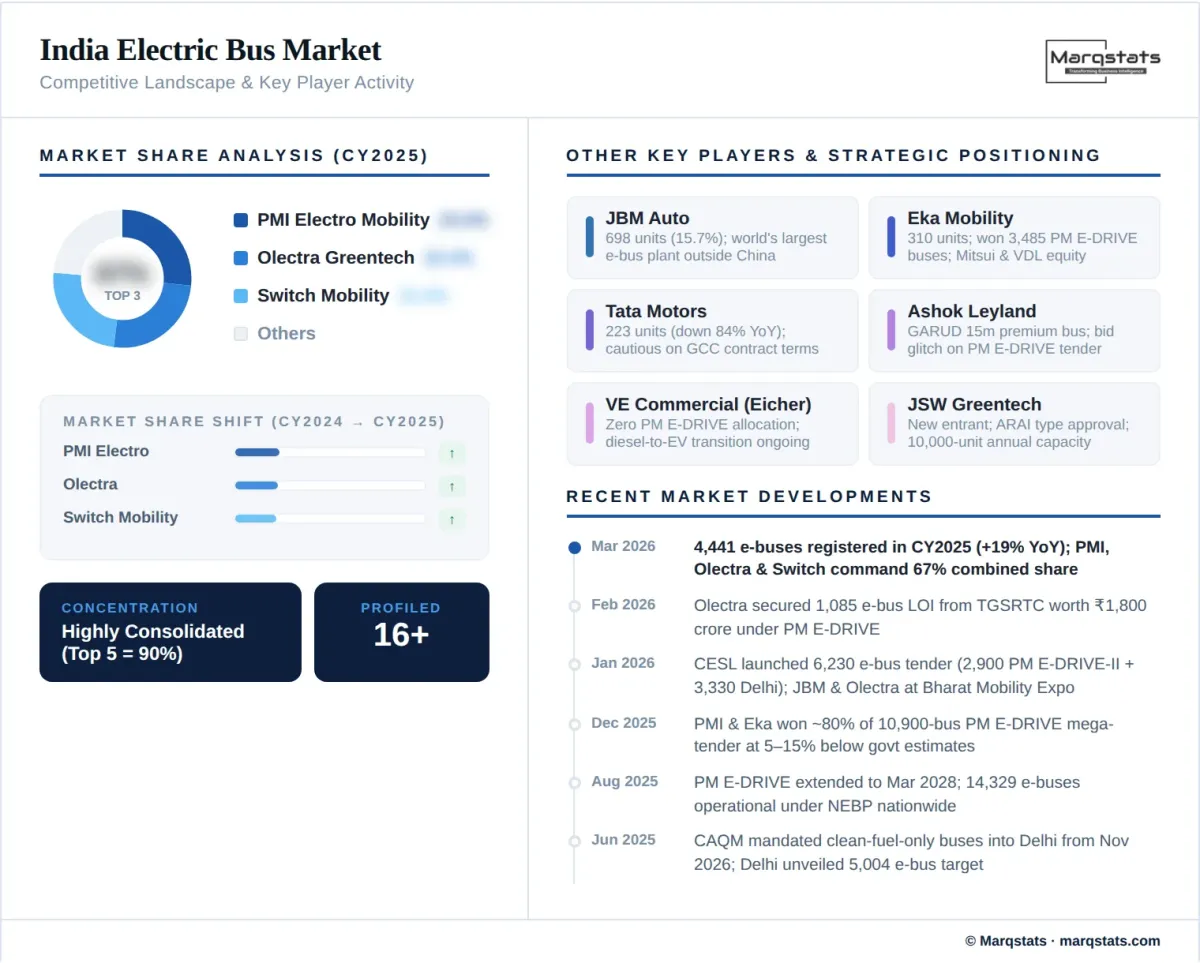
The India electric bus market is highly consolidated, with the top five electric bus manufacturers in India commanding approximately 90% of annual registrations. CY2025 data from the Vahan dashboard (as of March 2026) reveals a dramatic competitive reshuffling: PMI Electro Mobility Solutions led with 1,041 units (23.4% share), Olectra Greentech followed at 990 units (22.3%), Switch Mobility surged to 950 units (21.4%—approximately 600% growth from 136 units in 2024), JBM Auto reached 698 units (15.7%), and Pinnacle Mobility Solutions (Eka Mobility’s parent) grew to 310 units (7.0%). The Tata Motors electric bus story was the year’s most dramatic: having dominated in 2024 with 1,462 registrations and 39.2% market share, Tata declined to just 223 units (5.0%) in 2025 as it pulled back from aggressive tender participation due to concerns about contract structures and payment security.
The December 2025 PM E-DRIVE mega-tender for 10,900 buses further disrupted the competitive order. PMI Electro Mobility secured 5,210 buses (47% of tender), Eka Mobility won 3,485 buses, Olectra received 1,785 buses, and Anthony Travels consortium got 420 buses. Traditional heavyweights Tata Motors, VE Commercial Vehicles, and JBM Auto secured zero allocations, while Ashok Leyland’s bid was not submitted due to a technical glitch, prompting legal action. The results reflect pricing-driven disruption by newer players leveraging lean operations and asset-light models, with awarded prices 5–15% below government estimates. Combined manufacturing capacity among the top five players stood at approximately 40,500 electric buses annually with a collective order book of approximately 20,000 buses (as of FY2024 public reporting; these figures are evolving with new order awards).
At the Bharat Mobility Global Expo 2025, the competitive intensity was visible across the product spectrum. JBM Electric Vehicles operates the world’s largest dedicated electric bus manufacturing facility outside China (20,000 units/year capacity in Delhi-NCR) and showcased the Galaxy luxury coach, Xpress intercity bus, and e-SkyLife airport tarmac coach. Olectra Greentech, part of the MEIL Group with a strategic BYD partnership, launched the Blade Battery platform and has an order book exceeding 10,000 vehicles with 500+ million green kilometres clocked. Eka Mobility (Pinnacle Industries subsidiary with Mitsui and VDL Groep as equity partners) debuted India’s first stainless-steel luxury electric bus. New entrants SML Isuzu (Hiroi.ev) and Montra Electric (subsidiary of Murugappa Group’s TI Clean Mobility) expanded the competitive field further.
Companies Covered
The report profiles 16++ companies with full strategy and financials analysis, including:
Recent Market Activity
Table of Contents
Coverage & Segmentation
This report provides a comprehensive analysis of the India electric bus market covering the period 2021–2030, with 2025 as the base year, historical data from 2021 to 2025, and forecast projections from 2026 to 2030. The study examines market size (in USD million and unit volumes), growth trends, competitive landscape, and segment-level forecasts across six dimensions: by propulsion type (BEV, FCEV, PHEV), by battery chemistry (LFP, NMC, others), by bus length (less than 9 metres, 9–14 metres, above 14 metres), by range (less than 200 miles, more than 200 miles), by battery capacity (up to 400 kWh, above 400 kWh), and by application (intracity, intercity). The analysis encompasses the entire value chain from battery and component manufacturing through vehicle assembly, electric bus depot charging infrastructure deployment, and fleet operations under GCC and outright purchase procurement models.
Primary research draws from the Vahan registration portal (the authoritative source for electric bus registration data in India; note that Vahan is a dynamic database and figures may vary by data pull date), Ministry of Heavy Industries notifications, NITI Aayog publications, CESL tender documentation, and CAQM statutory directions. Secondary sources include CareEdge research reports, state transport undertaking annual reports, OEM investor presentations, industry body publications from SIAM and SMEV, trade publications, company filings, and e-bus sales India FY25 FY26 data from fiscal-year-aligned government databases. Competitive analysis covers all manufacturers with active electric bus registrations on the Vahan portal, with detailed profiling of 16 electric bus companies in India by market share, order book, manufacturing capacity, and technology roadmap.