Market Snapshot
Middle bar: base-year value × (1 + CAGR), rounded to two decimals. This is a calculated illustration, not a separately researched annual estimate.
The Europe electric city bus market is estimated at USD 6.07 billion in 2025 and is projected to reach USD 12.13 billion by 2030, at a CAGR of 14.84%. Battery-electric city bus registrations reached 11,607 units in 2025, up 48% on the year, and Marqstats estimates these at 42.5% of all new city buses registered in Europe. Volumes reach 24,900 units by 2030 and battery-electric penetration 84.9%; adding fuel-cell buses, which count equally toward the same target, modelled zero-emission registrations reach 90.1%. The pace is set by a regulation requiring 90% of new urban buses to be zero-emission from 2030.
Market size and forecast figures are generated using Marqstats' proprietary estimation framework, updated as of August 2026.
The most quoted number in this market is also the most misleading. Europe's automotive manufacturers' association reported that electrically chargeable vehicles took 23.8% of new bus registrations in the European Union in 2025, and that figure has been widely repeated as the rate at which Europe is electrifying its buses. It is wrong in three separate ways at once. Its numerator combines battery-electric with plug-in hybrid vehicles while excluding fuel-cell buses, which the association moved into an "others" category. Its denominator is medium and heavy buses and coaches over 3.5 tonnes, so intercity coaches sit inside it. And its geography is the European Union alone — with Bulgaria and Malta absent from the underlying table — where the equivalent figure for the Union plus EFTA and the United Kingdom is 25.9%.
Correct for all three and the picture changes completely. Coaches roughly halve the apparent electrification rate. Italy recorded 40% electric among new city buses in 2024 against 17.9% across all buses and coaches — a like-for-like comparison on the same definition, and a ratio of 2.2. Recital 35 of the European Union's own heavy-duty CO2 regulation points the same way, putting zero-emission urban buses at around a quarter of all urban buses sold in 2022 against an association figure of 12.7% for buses and coaches; that second comparison spans a definitional change and narrower country coverage, so it corroborates the direction of the coach effect rather than its magnitude. On a city-bus basis Marqstats puts battery-electric penetration at 42.5% in 2025. The published quarterly data agrees: battery-electric took 55% of new city bus registrations in the first quarter of 2026 and more than 60% in the second, and in Italy 78% of new city buses registered in the first half of 2026 were battery-electric.
What makes this market unusual is that its trajectory is legislated rather than forecast. Regulation (EU) 2024/1610, in force since 1 July 2024, obliges manufacturers to meet a 90% zero-emission share of new urban buses from 2030 and 100% from 2035. That is a per-manufacturer fleet obligation carrying penalties, not an aspiration, and it means the 2030 endpoint is largely determined. The open questions are which technology fills it, which manufacturers survive to supply it, and whether the electricity grid can be connected to the depots fast enough.
Key Takeaways
Market Overview & Analysis
Report Summary
This study covers new registrations of battery-electric city buses in Europe — urban transit buses above 8 tonnes gross vehicle weight, excluding trolleybuses. Intercity buses, long-distance coaches, school transport vehicles and minibuses below the weight threshold are out of scope, as are fuel-cell buses, which appear throughout as the comparison technology that shares the regulatory target. The geography is the European Union, the United Kingdom and the EFTA states.
That boundary is not a formality in this market; it is the analysis. European bus registration data is published for buses and coaches together, and the two behave nothing alike. In the first quarter of 2026 battery-electric took 55% of the city bus segment while interurban registrations ran 92% diesel and 5% battery-electric. Blending them produces a number that describes neither. The regulatory boundary matters just as much: interurban buses are treated as coaches for the purposes of the zero-emission mandate and are exempt from it, so a vehicle's classification rather than its actual duty cycle determines whether the 2030 obligation applies to it.
Marqstats sizes the Europe electric city bus market at USD 6.07 billion in 2025, rising to USD 12.13 billion by 2030 at a compound annual growth rate of 14.84%. In euros the market compounds at 14.22%, from EUR 5.57 billion to EUR 10.83 billion; the 0.62-point difference is a mild currency tailwind rather than the substance of the growth. Units grow faster than value, from 11,607 to 24,900 at 16.49%, because blended selling prices decline through the forecast under competitive pressure and falling battery costs. The market for city buses of all powertrains barely grows at all, at 1.41% a year — this is a substitution story running inside a flat replacement market.
The unit figures for 2024 and 2025 are published registration counts, not estimates. What this study constructs is the denominator: no source publishes the number of city buses registered in Europe separately from coaches. Marqstats derives it by applying an urban share of 55% to published total bus and coach registrations. Applied to 2022 that returns 23.2% electrically chargeable among urban buses, against Recital 35's statement that zero-emission urban buses were around a quarter — indicative rather than a validation, because the two measures are overlapping sets rather than nested ones. The share is corroborated in direction by Italian data showing urban class registrations at 59.9% of the total in the first half of 2026, but no source publishes an urban share and it remains a construction.
Market Dynamics
Key Drivers
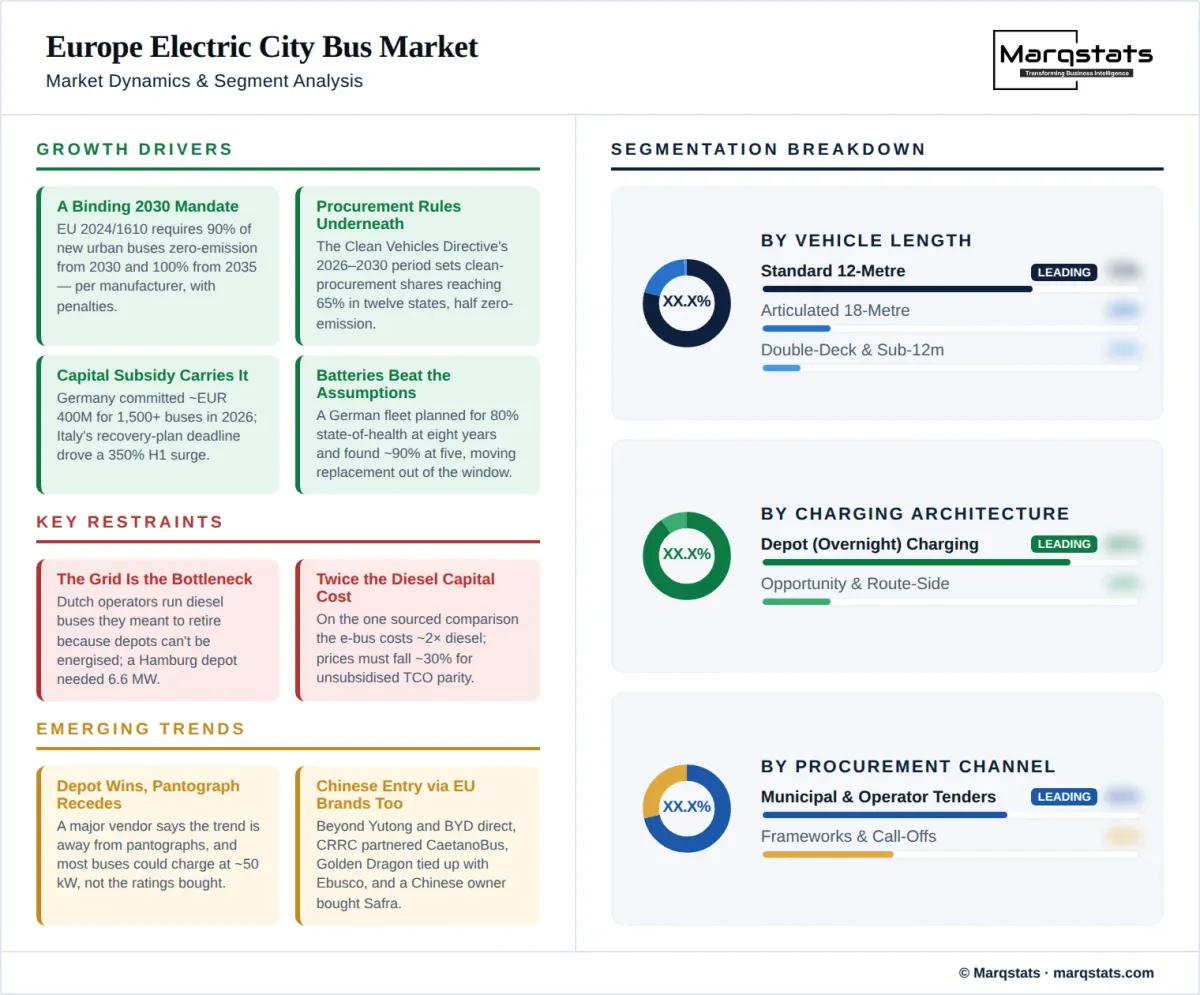
A binding legal mandate with a fixed date. Regulation (EU) 2024/1610 sets a 90% zero-emission share of new urban buses from 2030 and 100% from 2035, enforced against each manufacturer's fleet. Unlike an incentive, it cannot be exhausted or withdrawn, and it removes the technology question from operators' hands.
Public procurement obligations layered underneath. The Clean Vehicles Directive runs its second reference period from January 2026 to December 2030, setting minimum clean-vehicle procurement shares that reach 65% in twelve member states, of which at least half must be zero-emission. The obligation falls on the buyer rather than the manufacturer, so the two regimes bite from opposite ends. Clean is a wider category than zero-emission under the Directive — compressed natural gas, biomethane, biofuels and plug-in hybrids all qualify — so a member state can meet a 65% clean target with 32.5% zero-emission and the balance on gas.
Capital subsidy is carrying the deployment curve. Germany's 2026 federal round committed around EUR 400 million for at least 1,500 buses, on top of roughly EUR 1.5 billion since 2021 that approved more than 5,300 buses. Poland funded 91% of eligible costs on a recent 31-bus order through its national recovery plan, and Italy's recovery-plan deadline in June 2026 drove a 350% surge in battery-electric registrations.
Battery durability is running ahead of the industry's own planning assumptions, on the best in-service evidence available. A German operator that planned in 2020 for batteries to reach 80% state of health after eight years found roughly 90% after five, with buses delivered in 2021 retaining more than 97%. That moves mid-life battery replacement outside a normal bus depreciation window and removes a large contingency from the ownership case.
Product availability is no longer a constraint at the city bus end. A European Commission study in June 2025 counted 59 battery-electric bus models available with ranges up to 700 km, against just three coach models — the supply gap has closed for urban duty cycles while remaining wide open for long distance.
Key Restraints
Grid connection is the binding constraint, and it is already biting. Dutch operators have deployed diesel buses to cover for depot charging they cannot energise: 12 electric against 228 diesel at Qbuzz in Friesland, 40 diesel buses at EBS in Flevoland, and Arriva stating that the grid is simply overloaded. A 60-bus depot near Hamburg required 6.6 MW through a dedicated transformer station and about two years to build.
On the only sourced operator comparison, the vehicle costs roughly twice its diesel equivalent. A German municipal operator running about 100 buses put the electric bus at double the capital cost of a standard diesel and said prices would need to fall by around 30% for total-cost parity without subsidy. Running costs are lower — that operator puts electricity at about half the cost of diesel — but not yet enough to close the gap unaided.
Electricity prices vary more than any other cost lever. Non-household electricity across the European Union averaged EUR 0.1837 per kWh in the second half of 2025, but ranged from EUR 0.0748 in Finland to EUR 0.2552 in Ireland, with Germany — the largest market — at EUR 0.2264. At about 1.0 kWh per kilometre for a 12-metre bus that is a 3.4-fold spread across the Union and a threefold gap between Finland and Germany, on the largest operating cost there is.
Winter destroys the range assumption. Published consumption for a 12-metre city bus is around 0.98 kWh per kilometre as an annual planning figure, but rises to between 1.79 and 2.35 kWh per kilometre with full electric heating, and telematics data at minus ten degrees shows 2.3 to 2.5. It is the winter case, not the average, that sizes both the battery and the depot connection.
Subsidy is politically reversible in a way the mandate is not. Germany halted electric bus purchase subsidies in March 2024, and a draft 2027 budget published in July 2026 proposed cutting the programme from EUR 403 million to EUR 130 million. That draft is a proposal and has not been adopted, but it illustrates that the demand-side support carrying current volumes has no legal permanence.
Key Trends
Depot charging is winning and pantograph charging is receding. A major charging vendor stated in July 2026 that the trend is moving away from pantograph systems and that most buses could comfortably meet their schedules charging at around 50 kW rather than the far higher ratings operators have been buying. Route-side opportunity charging survives where the depot connection is the constraint rather than the vehicle.
Chinese manufacturers are entering through European brands as well as directly. Beyond Yutong and BYD selling under their own names, CRRC partnered with Portugal's CaetanoBus in June 2025, Golden Dragon signed a cooperation agreement with the Netherlands' Ebusco in July 2026, and Wanrun Mining bought France's Safra out of receivership. Ankai entered under a new brand through a newly established distributor.
Manufacturing capacity is being added in Europe, not withdrawn. BYD is expanding its Hungarian plant toward 1,250 units a year with the support of a Hungarian state grant; Daimler is investing EUR 50 million in a French site through 2030; Solaris announced a capacity expansion in June 2026. The plant closures are concentrated in the United Kingdom and in companies already in distress.
Turkey has become a production hub for the European market. Turkish bus manufacturing reached 12,425 units in 2025, up 25%, with Mercedes-Benz Türk and MAN Türkiye together accounting for more than two-thirds of national output, and Chinese exhibitor numbers at the industry's main European trade fair overtook Germany's in 2025.
Market Segmentation
The 12-metre rigid bus is the volume centre of the market and the reference vehicle for almost every published specification. Installed battery capacity clusters between roughly 350 and 500 kWh — a Mercedes eCitaro takes four to six packs to a maximum of 666 kWh, with the shorter eCitaro K offered from 392 to 589 kWh, a VDL Citea carries 490 kWh, and BYD offers 311 and 495 kWh options. Real-world range runs 250 to 400 km depending on configuration and season. This is where price competition is sharpest and where Chinese manufacturers have concentrated.
Articulated buses carry the heaviest battery loads and serve the highest-frequency corridors, which makes them the natural application for route-side charging. Capacities run to 777 kWh on a Mercedes eCitaro G and 746 kWh on BYD's articulated platform. Published testing puts an 18-metre bus at 1.65 to 1.84 kWh per kilometre without heating, against an annualised planning figure of roughly 1.0 for a 12-metre vehicle — not a like-for-like comparison, so the segment raises battery content, depot power draw and selling price together.
Double-deck buses are effectively a United Kingdom and Ireland segment, where the Clean Vehicles Directive recognises them by reducing the zero-emission sub-target from half to a quarter of the clean-vehicle obligation where they exceed 80% of procurement. Wrightbus's double-deck platform carries 442 kWh. At the other end, shorter vehicles below 12 metres serve lower-density routes and constrained street layouts; Solaris introduced a 10.5-metre electric model in late 2025 that won a European industry award for urban vehicles.
Overnight depot charging is the mainstream architecture and is consolidating its lead. It spreads energy demand across eight to ten hours, requires the least vehicle-side hardware, and is where the industry's cost reduction efforts are now concentrated. It also concentrates the entire power requirement into a single grid connection, which is precisely why it has become the sector's bottleneck. One commissioned German depot implies about 110 kW per bus, while a charging vendor argues most buses could meet their schedules at around 50 kW. No published dataset establishes typical installed power per bus, and the lower figure is a supplier's claim; if it holds, current specifications carry substantial redundant capital and grid demand.
Charging at termini and along routes reduces onboard battery size and total depot energy but concentrates very high power at a handful of points. It retains a clear niche where the depot connection is the constraint rather than the vehicle: Clermont-Ferrand selected flash charging explicitly to manage grid limits on its two busiest lines, and Berlin is rolling out twenty opportunity charging stations alongside its depot programme. A distinction worth keeping is that depot-mounted pantographs, such as those at Berlin's Treptow depot and Madrid's Carabanchel facility, are automated depot connections rather than opportunity charging.
The dominant channel, and a regulated one from a date reported as 1 July 2026. Article 3e of the heavy-duty CO2 regulation requires zero-emission urban bus contracts to be awarded on the most economically advantageous tender using best price-quality ratio, with at least two of five specified criteria and at least one relating to security of supply. Where security of supply is used as an award criterion it must carry a weighting of between 15% and 40%. One of the five criteria is explicitly the proportion of products originating in third countries.
Large framework contracts dominate the headlines and routinely overstate committed volume, because they establish a ceiling rather than an order. Deutsche Bahn's framework for around 3,300 electric intercity buses in December 2025 was reported with lot allocations but no disclosed call-offs; a Milan framework for 110 buses valued above EUR 103 million stood at a provisional ranking under administrative verification in July 2026; and tenders in Ostrava and Winterthur were both specified as up to 70 units. Ebusco's own order book is split explicitly between 80 firm orders and 118 call-offs.
By Geography
Registration data is published by country for buses and coaches together, so the country shares below are on that basis and are not city-bus-only rates. They are presented by market grouping rather than ranked by volume.
Germany
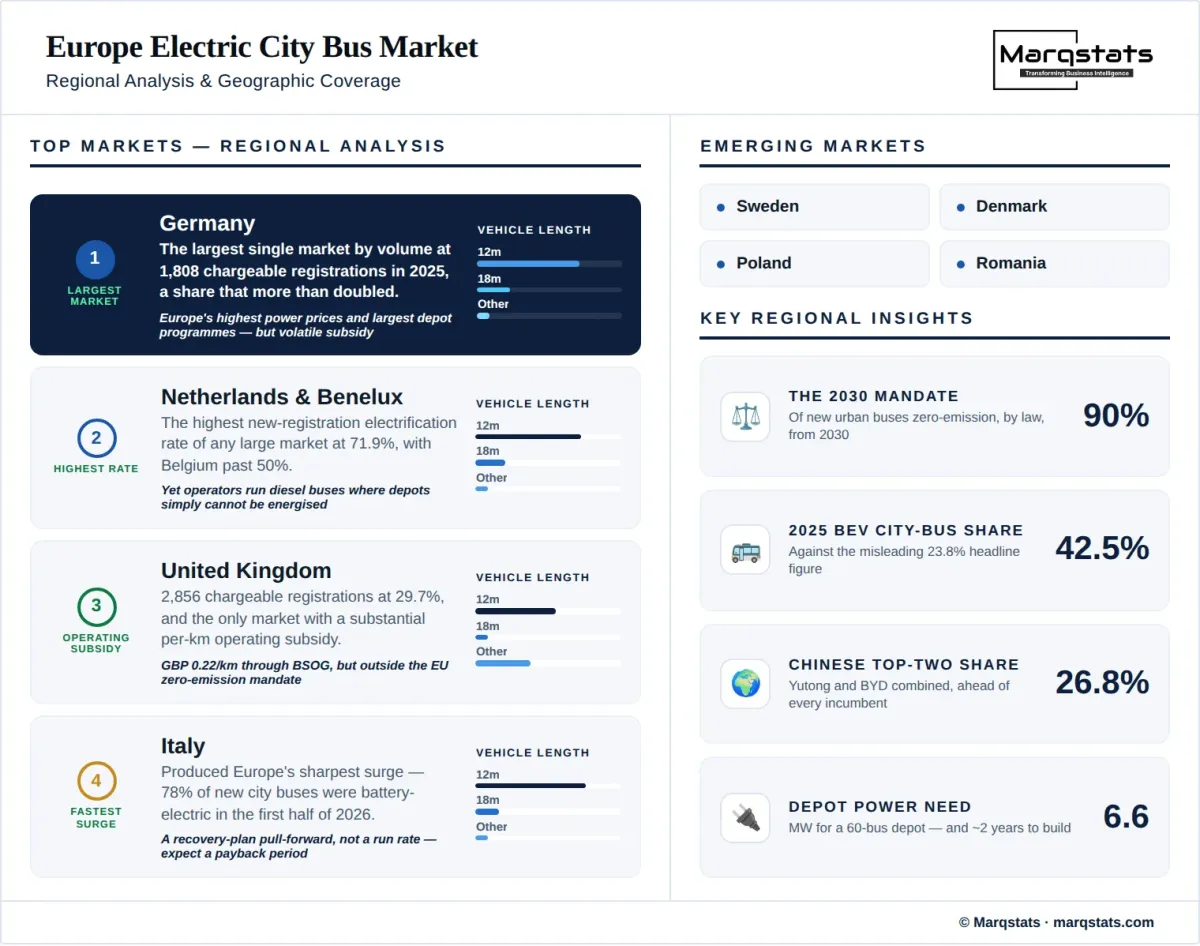
Germany is the largest single market by volume, with 1,808 electrically chargeable bus registrations in 2025 out of 6,890 total, a 26.2% share that more than doubled year on year. It is also the market where policy risk is most visible: purchase subsidies were halted in March 2024, a 2026 federal round then committed around EUR 400 million for at least 1,500 buses, and a draft 2027 budget published in July 2026 proposed a 68% cut. Germany combines Europe's highest electricity prices among major markets, at EUR 0.2264 per kWh, with its largest depot electrification programmes — Berlin's Treptow depot alone is a roughly EUR 120 million project for about 220 buses.
Italy
Italy registered 1,371 electrically chargeable buses in 2025 and then produced the sharpest surge in Europe, with battery-electric registrations up around 350% in the first half of 2026 as recovery-plan deliveries were completed before a June deadline. In that half-year 1,519 of 1,941 urban class registrations were battery-electric — 78% of new city buses — and Italy alone accounted for 1,792 of the European Union's 6,425 zero-emission bus and coach registrations in that half-year — a measure on a 3.5-tonne basis that is not directly comparable with this study's city-bus series. This is a policy pull-forward rather than a run rate, and a payback period should be expected; treating the first half of 2026 as a baseline would badly overstate 2027.
The Netherlands and Benelux
The Netherlands has the highest new-registration electrification rate of any large European market, at 71.9% in 2025, and 2,748 zero-emission buses in operation covering 26% of all bus kilometres. It is also the clearest demonstration that demand is no longer the constraint. Operators have deployed diesel buses specifically to cover for depot charging they cannot energise, across Friesland, Flevoland, Roosendaal and South Holland. Belgium reached 50.7% in 2025 on 737 units, more than trebling year on year.
The Nordics
The Nordic markets combine high electrification with the lowest electricity prices in Europe, which makes the operating case materially stronger than elsewhere. Sweden registered 898 electrically chargeable buses in 2025, a 46.1% share, up more than three and a half times on the year; Denmark reached 70.9%; and Norway, outside the European Union, ran at 60.1%. Finnish industrial electricity at EUR 0.0748 per kWh is roughly a third of the German price, which on a 12-metre duty cycle is a wider gap than any other single operating cost lever in this market.
United Kingdom
The United Kingdom registered 2,856 electrically chargeable buses in 2025, a 29.7% share, and is the only market in this study with a substantial operating subsidy: zero-emission buses in England receive GBP 0.22 per kilometre through the bus service operators grant against GBP 0.06 for the previous low-emission incentive, on rates published in 2022. Capital support runs through the ZEBRA programme, which allocated more than GBP 167 million including operator and local authority contributions for 484 buses in March 2026. Two cautions apply: the country's total bus registrations fell 36.5% in the first half of 2026, and the United Kingdom is not subject to the European Union's zero-emission mandate.
Central and Eastern Europe
Adoption in central and eastern Europe is recovery-fund driven and highly concentrated in individual tenders. Romania reached a 73.6% electrically chargeable share in 2025 on 287 units, and Lithuania 52.0% on 222 — both figures resting on bases small enough that a single municipal order moves the national rate by tens of points. Poland is the region's manufacturing centre as well as a buyer, registering 342 electrically chargeable buses in 2025 at a 12.7% share, with recent orders funded at more than 90% of eligible cost through its national recovery plan.
How Competition Is Evolving
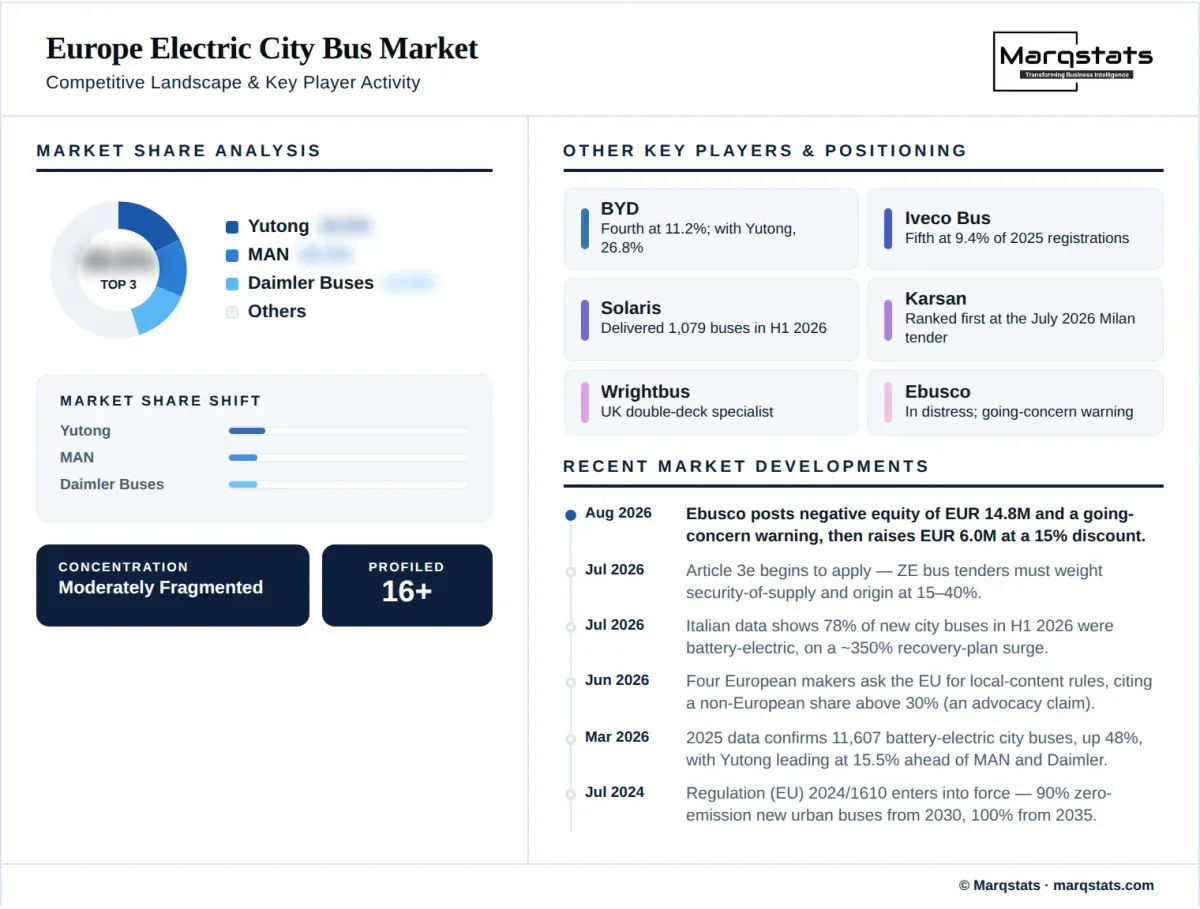
The European electric city bus market is moderately fragmented and its leadership has changed hands. On 2025 registrations of battery-electric buses above 8 tonnes, Yutong led with 1,801 units and 15.5%, followed by MAN at 1,409 and 12.1%, Daimler Buses at 1,395 and 12.0%, BYD at 1,305 and 11.2%, and Iveco Bus at 1,091 and 9.4%. Wrightbus, Solaris, Volvo, VDL, Karsan, Alexander Dennis, Irizar and Ebusco follow. The named manufacturers account for about 90% of the total; the remaining tenth is not attributed in any source and contains the smaller Chinese, Turkish, Nordic and Iberian suppliers.
Two Chinese manufacturers therefore held 26.8% of European battery-electric bus registrations in 2025 between them, including the number one position. In June 2026 four European manufacturers wrote jointly to the European institutions stating that the non-European share had risen above 30% and asking for local content requirements, European preference and further changes to procurement evaluation. That figure is an advocacy claim from interested parties rather than an official statistic, and no independently published pan-European number confirms it — though four Chinese brands did take 30.5% of Italian battery-electric registrations in the first half of 2026. The response so far is procurement-based rather than tariff-based: no European trade-defence case covers buses or coaches, while Article 3e of the CO2 regulation writes an origin test into zero-emission urban bus tendering from a reported July 2026. That the four manufacturers were asking for more two years after the regulation was adopted suggests they do not regard Article 3e as sufficient.
The competitive evidence is running ahead of the policy. At a Milan tender in July 2026 the provisional ranking placed Karsan first and BYD second, with Solaris fifth, Iveco sixth and Daimler seventh — the European incumbents last. Deutsche Bahn's December 2025 framework for intercity buses allocated a lot to BYD, prompting a public objection from the rail and transport union, whose chief sits as vice-chair of the company's supervisory board. In Scotland, Alexander Dennis stated that 51% of zero-emission buses purchased in 2025 came from overseas manufacturers.
Meanwhile the sector is consolidating through failure. Van Hool was declared bankrupt on 8 April 2024, its bus assets passing to VDL, which confirmed in July 2024 that it had not assumed warranty obligations on vehicles already delivered — a material aftermarket exposure for existing fleets. Ebusco has fallen roughly 99% from its 2021 listing price and closed the first half of 2026 with negative equity of EUR 14.8 million, EUR 2.1 million of cash, sixteen buses delivered against 47 a year earlier, and a going-concern warning, while pursuing a sale of a controlling stake in its bus operations. Alexander Dennis reversed a plan to close both Scottish sites in September 2025 after government intervention, then in March 2026 opened a revised consultation to close Falkirk and convert Larbert to chassis manufacturing. Among the survivors, VDL's bus division was loss-making in 2025 on revenue of EUR 538 million, while Solaris delivered 1,079 buses in the first half of 2026 at a 7.3% operating margin — but with an order intake of 725 buses, a book-to-bill ratio of 0.7.
Companies Covered
Companies covered in the report include:
Recent Market Activity
Table of Contents
Coverage & Segmentation
This study covers new registrations of battery-electric city buses — urban transit buses above 8 tonnes gross vehicle weight — across the European Union, the United Kingdom and the EFTA states. Trolleybuses are excluded. Intercity and interurban buses, long-distance coaches, dedicated school transport vehicles and minibuses below the weight threshold are out of scope. Fuel-cell buses are out of scope as a market but are quantified throughout as the technology that shares the regulatory target. Market value is measured at manufacturer selling price in euros and converted to United States dollars at annual average exchange rates for historical years and at assumed rates thereafter, with both series reported. The base year is 2025, the historical period 2020 to 2025 and the forecast period 2026 to 2030, all on calendar years.
Three conventions govern the figures and should be read before they are used. First, every penetration rate in this report divides battery-electric city bus registrations by total city bus registrations of all powertrains. Published European registration data does not separate city buses from coaches, and the blended figure understates city bus electrification by roughly half. Second, all volumes are new registrations, which are distinct from deliveries, from orders and from vehicles in service; framework agreements in this market frequently establish a ceiling rather than a committed volume, and are identified as such. Third, two coverage asymmetries bias the penetration rate slightly upward and should be read alongside it: the battery-electric numerator additionally covers Serbia and Ukraine, whose volumes are not separately disclosed, while the constructed denominator inherits its source table's omission of Bulgaria and Malta. Both are believed small and neither has been quantified. Fourth, the source dataset counts intercity battery-electric buses and electric coaches separately from the 11,607 figure, and a subsequent report from the same source describes the 2025 total as city buses; this study reads it as city buses on that basis, but the original wording is not explicit.
One definitional caution applies to the regulation itself. Regulation (EU) 2024/1610 does not define an urban bus in plain language; the term is established by cross-reference to a vehicle sub-group table in its annex, which could not be retrieved in full for this study. The conventional industry reading is that it corresponds to M3 Class I and Class A vehicles, and that reading is consistent with everything else found, but it is not quoted here as the legal definition. Interurban buses are treated as coaches for the purposes of the mandate and are exempt from it.