Market Snapshot
Key Takeaways
Market Overview & Analysis
Report Summary
The Middle East and Africa range-extended electric vehicle market covers passenger vehicles in which the electric motor provides all traction at the wheels and an internal combustion engine functions primarily or exclusively as a generator. The distinction from a plug-in hybrid is mechanical rather than semantic: a plug-in hybrid retains a mechanical drive path from engine to wheels, while a range-extended vehicle does not, so the driving experience remains electric at all states of charge. The regional scope excludes Türkiye and treats Egypt as part of Africa, consistent with the underlying regional vehicle framework.
The market is small in absolute terms, growing very fast, and unusually well suited to the conditions that define both regions. Range extension answers a specific problem: charging that is adequate for daily use in metropolitan areas but unreliable or absent between cities. That description fits the Gulf, where charger deployment is concentrated in a handful of urban centres across large distances, and it fits North and Southern Africa for different reasons of infrastructure maturity. In both, a battery-electric vehicle constrains the journeys an owner can take, while a range-extended vehicle constrains only the cost of the longest ones.
Treating the two regions as one market is a deliberate analytical choice and it carries a condition. The technology, the manufacturers and the underlying buyer problem are common to both, which is what justifies a combined measure. The distribution structures, price points and regulatory environments are not, which is why the study segments by distribution model and price tier rather than relying on geography alone to expose the difference. A reader who needs only the Gulf picture is better served by the Middle East study; this one exists to show how the African component behaves differently and how quickly it is arriving.
MEA Range-Extended Electric Vehicle Sales Volume and Forecast
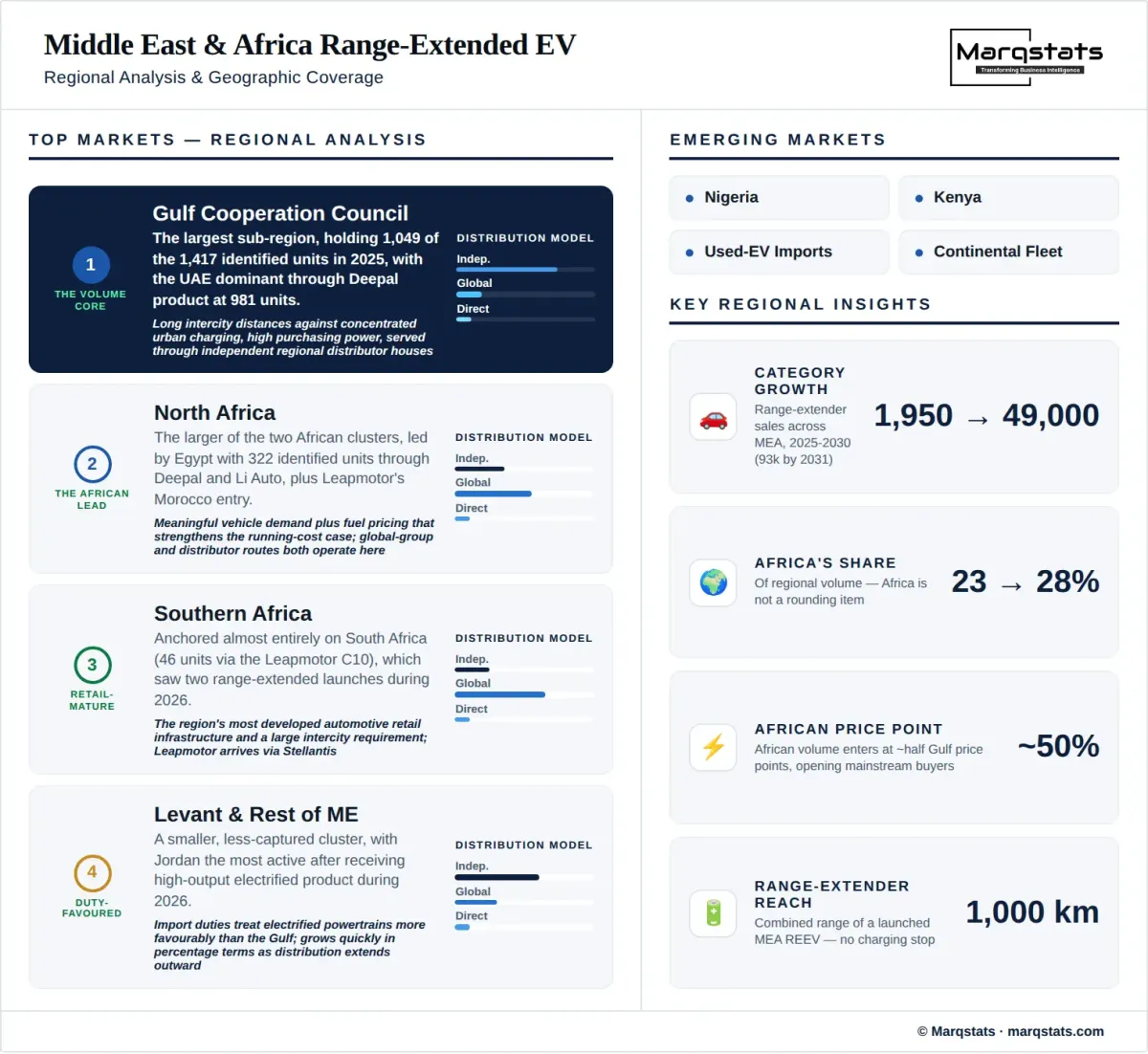
Annual range-extended vehicle sales across the Middle East and Africa rise from 1,950 in 2025 to 49,000 in 2030, a 90.56% compound annual growth rate and an absolute increase of 47,050 units. The indicative 2031 endpoint is approximately 93,000 vehicles. The regional total compounds slightly faster than the Middle East component alone because the African share rises across the period, from roughly 23% of volume in 2025 to about 28% by 2030, adding growth on top of an already steep Gulf trajectory rather than diluting it.
Retail value grows from USD 109.20 million to USD 1,911.00 million, a 77.26% compound annual growth rate. Value compounds more than thirteen points more slowly than volume because blended transaction prices fall from USD 56,000 to USD 39,000, a decline of about 6.98% each year. Two effects drive that fall and they compound. Within each region, mainstream product displaces the premium models that opened the segment. Across regions, African volume enters at materially lower price points than Gulf volume and takes a rising share, so the regional blend falls faster than either region's blend does on its own.
Confidence is low to moderate and the reasons are structural rather than correctable. Range-extended vehicles are not consistently separated from plug-in hybrids in registration data anywhere in either region, and several relevant models appear under mixed powertrain codes combining battery-electric and plug-in variants. The 1,417 identified units are a proxy built from Deepal, Leapmotor and Li Auto rows strongly associated with range-extender product lines rather than a verified count, and not every mixed row is certain to be a range-extended vehicle. Coverage across Africa beyond Egypt and South Africa is thin.
Market Dynamics
Key Drivers
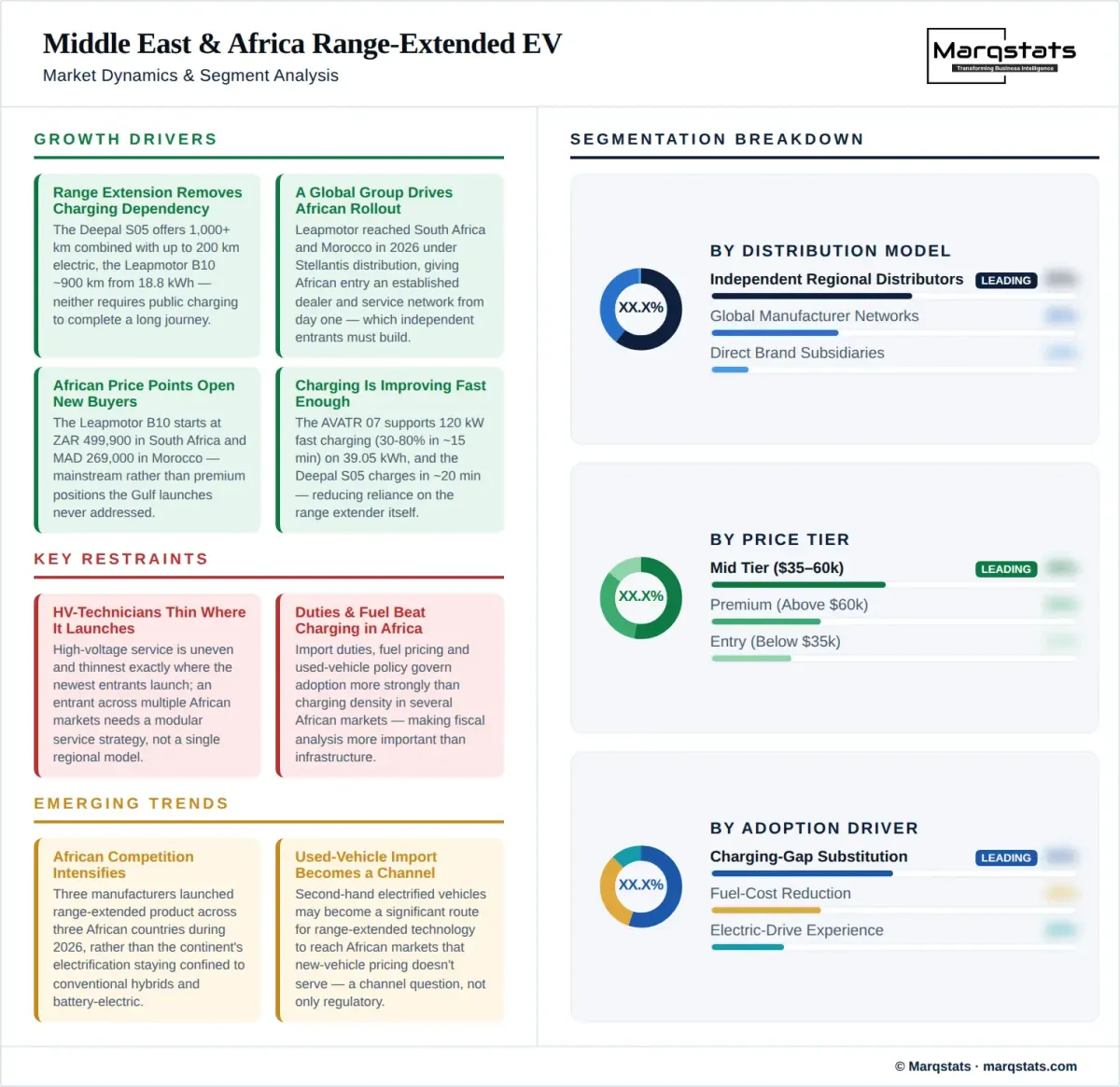
- Range extension removes the charging dependency that limits battery-electric adoption across both regions. The Deepal S05 offers more than 1,000 kilometres of combined range with up to 200 kilometres of pure-electric driving, and the Leapmotor B10 about 900 kilometres from an 18.8 kWh battery, so neither requires public charging to complete a long journey.
- A global manufacturer group is using African markets for rapid rollout of Chinese new-energy technology, with Leapmotor reaching both South Africa and Morocco during 2026 under Stellantis distribution. That gives African entry an established dealer and service network from the first day of sale, which independent entrants must build.
- Price points in Africa are opening the technology to buyers the Gulf launches never addressed, with the Leapmotor B10 starting at ZAR 499,900 in South Africa and MAD 269,000 on promotional pricing in Morocco. These are mainstream rather than premium positions.
- Charging capability is improving fast enough to reduce the reliance on the range extender itself. The AVATR 07 supports 120 kilowatt fast charging on a 39.05 kWh lithium iron phosphate battery, taking it from 30% to 80% in about fifteen minutes, and the Deepal S05 charges in roughly twenty minutes.
- Regional vehicle demand growth provides a large and expanding base, with United Nations Environment Programme analysis noting that Africa's vehicle fleet could grow four to five times by 2050, raising the significance of lower-emission technology pathways across the continent.
Key Restraints
- High-voltage technician coverage is uneven across both regions and is thinnest exactly where the newest entrants are launching. A manufacturer entering multiple African markets needs a modular service strategy rather than a single regional model, because network depth cannot be assumed outside the principal cities.
- Regulation is highly fragmented, with Gulf markets holding more developed electric vehicle standards while African countries differ widely on import age limits, emissions rules and electrification incentives. There is no regional framework to design against, so market entry is a country-by-country exercise.
- Import duties, fuel pricing and used-vehicle policy can determine adoption more strongly than charging density in several African markets, which inverts the usual electrification hierarchy and makes fiscal analysis more important than infrastructure analysis in those countries.
- Battery transport, repair and end-of-life handling rules require country-level assessment and are immature across much of the region, creating compliance exposure that is difficult to quantify at the point of market entry.
Key Trends
- Competition in African range-extended vehicles is intensifying rather than the continent's electrification remaining confined to conventional hybrids and battery-electric models, with three manufacturers launching range-extended product across three African countries during 2026.
- Used-vehicle import policy is emerging as a channel question rather than only a regulatory one, because second-hand electrified vehicles may become a significant route for range-extended technology to reach African markets that new-vehicle pricing does not serve.
- Premium and mainstream range-extended positions are separating, with the AVATR 07 offering 310 horsepower rear-wheel drive or 495 horsepower all-wheel drive in Egypt while the Leapmotor B10 addresses the mainstream at half the price in neighbouring markets.
- Battery sizes are diverging by market rather than converging, spanning 18.8 kWh in the South African Leapmotor to 39.05 kWh in the Egyptian AVATR, as manufacturers calibrate the balance between battery cost and electric range to local charging conditions and price tolerance.
Market Segmentation
Charging gap substitution is the largest adoption driver across both regions and describes buyers who want electric drive but cannot rely on charging for intercity travel. The proposition is strongest where daily charging is available at home or work while long-distance provision is thin, which characterises most Gulf markets and the principal African urban centres. This driver is also the most durable, since it weakens only as intercity charging matures.
Fuel cost reduction motivates buyers whose daily distance falls within electric range and who therefore displace most of their fuel consumption. Its strength varies sharply by market because fuel pricing does, and it is materially stronger in African markets with unsubsidised or lightly subsidised fuel than in Gulf markets where retail fuel remains inexpensive. This is the driver most sensitive to policy change rather than to technology.
A segment of buyers selects range-extended vehicles for the driving characteristics rather than for economics, since traction is fully electric at all states of charge and delivers the immediate torque and low noise of a battery-electric vehicle without its range constraint. This driver is concentrated in premium purchases and supports the higher price tiers, and it explains why premium range-extended models sell in markets where the fuel-saving case is weakest.
The entry tier is the newest and fastest-growing part of the market and it is almost entirely African at present, opened by the Leapmotor B10 at ZAR 499,900 in South Africa and MAD 269,000 promotional pricing in Morocco. Its arrival is what changes the regional volume trajectory, because it addresses mainstream buyers rather than the early premium adopters who defined the segment's first two years.
The mid tier covers mainstream range-extended sport utility vehicles and holds the largest share of current volume, led by Deepal product across the Gulf and Egypt. The tier balances battery size, range and equipment at a price mainstream buyers in both regions can reach, and it is where most manufacturers are concentrating new model entries across the forecast period.
The premium tier covers high-output and luxury range-extended vehicles including the AVATR 07 at up to 495 horsepower and Li Auto's larger models, and it opened the segment in the Gulf before mainstream product arrived. The tier retains disproportionate importance to segment value rather than volume, and it defends the regional blended price against the downward pressure the entry tier creates.
Distribution through a global manufacturer group is the defining feature of African market entry, with Leapmotor reaching South Africa and Morocco under Stellantis. The model delivers an established dealer footprint, service infrastructure and parts logistics from launch, which is decisive for a technology whose adoption depends on service confidence, and it explains why African entry has been faster than the underlying market size alone would predict.
Independent regional distributor houses dominate Gulf market entry and control the dealer networks, service capability and marketing reach that determine which manufacturers scale there. Their portfolio decisions effectively gate market access, and a manufacturer without a strong regional partner faces a structural disadvantage that product specification does not offset. Kasrawi Group's launch of the AVATR 07 in Egypt shows the model operating in North Africa as well.
Direct brand subsidiary operations remain the smallest distribution route in both regions and are used mainly by manufacturers with sufficient regional volume to justify the fixed cost. The model offers control over pricing, positioning and customer experience at the cost of slower network build, and its share is expected to grow only where a manufacturer reaches the volume threshold that makes the investment recoverable.
Range-extended vehicles offering more than 150 kilometres of electric range cover the daily distance of nearly all users on battery alone and represent the technically strongest expression of the architecture. The Deepal S05 sits here at up to 200 kilometres. The band carries the highest battery cost and therefore the highest price, and it is most attractive where electricity is inexpensive relative to fuel.
The 80 to 150 kilometre band is the volume core and includes the Leapmotor B10 at up to 86 kilometres from an 18.8 kWh battery. It balances battery cost against practical daily electric coverage and supports the entry and mid price tiers, which is why it dominates the mainstream product now reaching African markets.
Range-extended vehicles with under 80 kilometres of electric range are uncommon and declining, since a small battery undermines the architecture's central proposition by forcing frequent generator operation. The band persists mainly in high-output premium models where the electric system supplements performance rather than substituting for fuel, and it is not where regional volume growth is occurring.
By Geography
Gulf Cooperation Council
The Gulf states form the largest sub-region, holding 1,049 of the 1,417 identified units in 2025, with the United Arab Emirates dominant through Deepal product at 981 units across the S05, S07 and G318. Saudi Arabia contributes 46 identified units and Kuwait 22. Gulf adoption is driven by long intercity distances against concentrated urban charging, high vehicle purchasing power and a buyer base that adopts new nameplates quickly, and it is served through independent regional distributor houses.
Levant and Rest of Middle East
The Levant and remaining Middle Eastern markets contribute a smaller share and are less well captured in consolidated registration data. Jordan is the most active, having received high-output electrified product during 2026, and import duty structures in several of these markets treat electrified powertrains more favourably than the Gulf states do. The cluster grows quickly in percentage terms from a small base as distribution extends outward from the Gulf.
North Africa
North Africa is the larger of the two African clusters, led by Egypt with 322 identified units in 2025 through Deepal S05 and S07 product and Li Auto models. Kasrawi Group launched the AVATR 07 in Egypt in July 2026 with a 39.05 kWh lithium iron phosphate battery and 120 kilowatt fast charging, and Leapmotor entered Morocco the same month at MAD 269,000. The cluster combines meaningful vehicle demand with fuel pricing that strengthens the running-cost case.
Southern Africa
Southern Africa is anchored almost entirely on South Africa, which held 46 identified units in 2025 through the Leapmotor C10 and saw two range-extended launches during 2026. Leapmotor introduced the B10 from ZAR 499,900 in August and Changan showcased the Deepal S05 in September, establishing genuine competition in a market with the region's most developed automotive retail infrastructure and a large intercity driving requirement.
Rest of Africa
The remaining African markets contribute negligible current volume and are the least well captured in available data. Vehicle demand across these markets is substantial in aggregate and growing, with United Nations Environment Programme analysis noting the continental fleet could grow four to five times by 2050, but purchasing power, import duty structures, used-vehicle competition and thin high-voltage service capability all constrain new-vehicle range-extended adoption in the forecast period.
How Competition Is Evolving
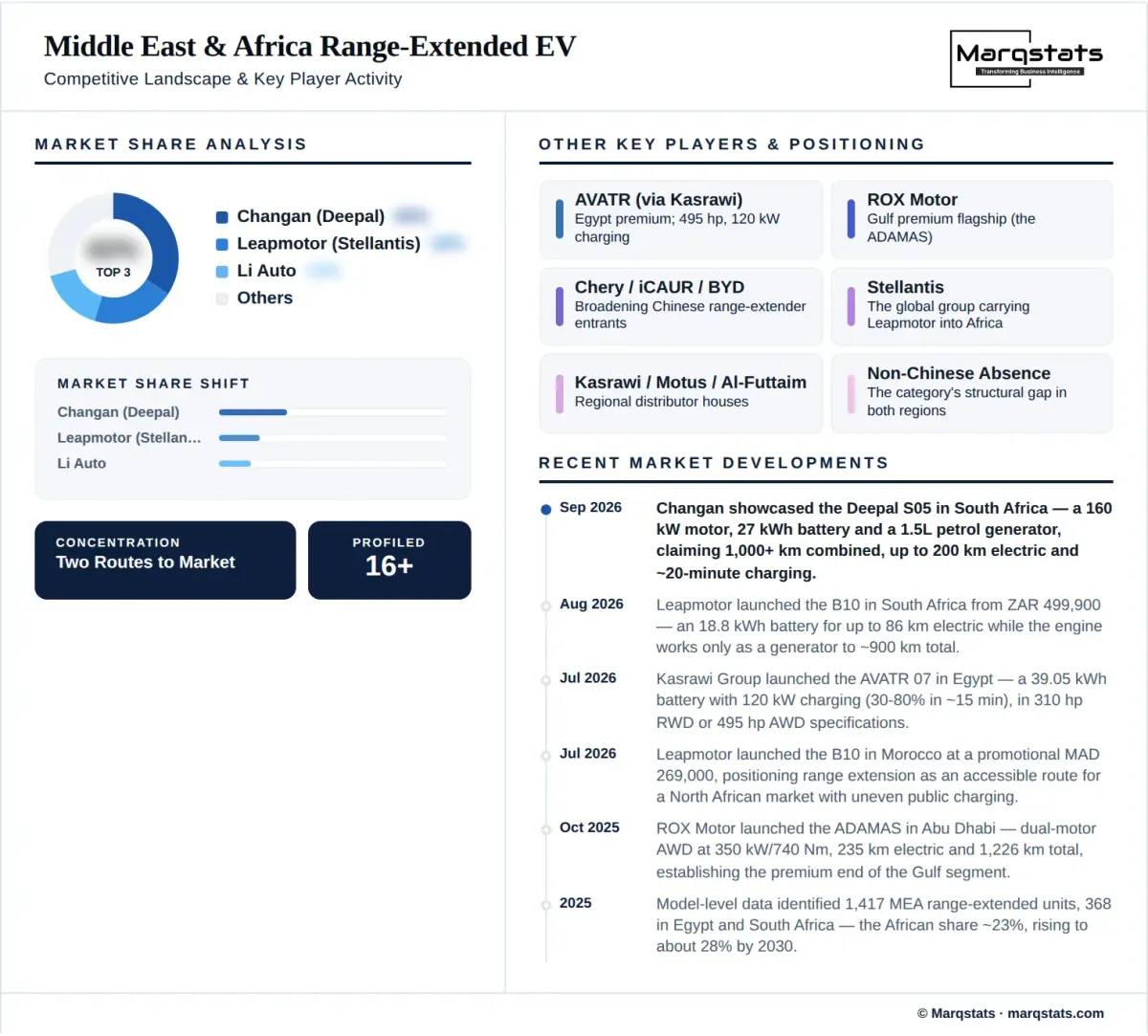
The Middle East and Africa range-extended market is concentrated among a small group of Chinese manufacturers and is fragmenting as new entrants arrive. Changan's Deepal brand holds the largest identified position, accounting for the overwhelming majority of Gulf units and a substantial share of Egyptian volume. Leapmotor holds the strongest African position through South Africa and Morocco. Li Auto appears in Egyptian model data as a premium specialist, and AVATR, ROX Motor and Chery's iCAUR brand have all entered Gulf or North African markets during 2025 and 2026.
The competitive structure differs between the two regions in a way that matters more than market share. In the Gulf, manufacturers compete for shelf space with independent distributor houses that hold the dealer networks and decide which brands scale. In Africa, the most significant entry has come through a global manufacturer group deploying Chinese technology across its existing network, which delivers dealer footprint and service infrastructure from launch rather than requiring years to build. A manufacturer planning regional entry therefore faces two distinct commercial problems and cannot solve them with one approach.
Service capability is the constraint most likely to decide outcomes and it is the least visible in product comparison. Range-extended vehicles combine a high-voltage traction system with a combustion generator, so they require technicians competent in both, and that combination is scarce across much of the region. Coverage is adequate in the principal Gulf cities and in South African metropolitan areas and thin elsewhere, which means a manufacturer's realistic addressable market is narrower than its distribution agreements suggest and expansion is gated by training capacity rather than by demand.
Companies Covered
The report profiles 16+ companies with full strategy and financials analysis, including:
Recent Market Activity
Table of Contents
Coverage & Segmentation
The study covers the Middle East and Africa with cluster-level detail for the Gulf Cooperation Council, the Levant and rest of the Middle East, North Africa, Southern Africa, and the rest of Africa. It measures annual new range-extended electric vehicle registrations and sales as the primary unit and annual retail value in United States dollars as the secondary measure. The base year is 2025, the historical period covers 2021 to 2025, and the forecast period runs from 2026 to 2030 with an indicative 2031 endpoint. Segmentation covers adoption driver, price tier, distribution model and electric range.
Three boundaries define the market. Plug-in hybrids retaining a mechanical drive path from engine to wheels are excluded, which is the architectural boundary and the one most often blurred in registration data. Conventional hybrids and battery-electric vehicles are excluded entirely. Türkiye falls outside the regional scope and Egypt is treated as part of Africa rather than the Middle East, consistent with the underlying regional vehicle framework. Regional conventions differ on both points across the industry, so the Egyptian and Turkish treatment is the first thing to confirm when these figures are set against a measure built on another framework.
One narrower study measures a component of this market at its own scale. Middle East range-extended vehicle sales cover the same architecture across the Middle East alone and represent approximately 77% of regional volume in 2025, falling to about 72% by 2030 as the African share rises, and roughly 84% of value falling to 79%. The value share exceeds the volume share throughout because Middle Eastern transaction prices are materially higher. That study is contained within this one and their figures are not additive.