Statistics & Highlights

Market Snapshot

Market size in USD Billion
$14.25B
2025
Base year
$17.71B
2026
Estimated
  
$42.18B
2030
Forecast
Largest market
Australia (86% combined share, 2025)
Fastest growing
Plug-in Hybrid segment (130.9% YoY in Australia 2025)
Dominant segment
HEV propulsion (35% of electrified mix)
Concentration
Moderately Concentrated
CAGR
24.26%
2026 – 2030
GROWTH
+$27.93B
Absolute
STUDY PARAMETERS
Base year2025
Historical period2021 – 2025
Forecast period2026 – 2030
Units consideredValue (USD Billion), Volume (Units)
REPORT COVERAGE
Segments covered5 segments
Regions covered6-region analysis
Companies profiled18 company profiles+
Report pages305+
DeliverablesPDF, Excel, PPT
Executive Summary

Key Takeaways

Market valued at USD 14.25 billion in 2025, projected to reach USD 42.18 billion by 2030 at 24.26% CAGR across Australia and New Zealand combined.
Australian PHEV sales more than doubled to 53,484 units in 2025 at 130.9% year-on-year growth; HEVs reached 199,133 units at 15.3% year-on-year growth.
Australian BEV share reached 14.6% of total sales in March 2026 with 15,839 units; BYD grew 50% year-on-year to 7,217 units in the same month.
BYD Australia grew 156.2% year-on-year in 2025; GWM grew 23.4%, Chery grew triple digits in early 2026, reshaping brand concentration.
CEFC committed AUD 60 million through Hyundai Capital for 0.5–1.0 percentage point EV loan interest rate reductions on Hyundai and Kia BEVs.
Electric Car Discount (fringe benefits tax exemption) under statutory review; ~100,000 vehicles have used the exemption since July 2022 at AUD 1.35 Bn 2025-26 cost.
Market Insights

Market Overview & Analysis

Report Summary

The Australia and New Zealand electric vehicle market comprises all electrified powertrain categories across passenger, commercial, and public transport applications. The market is segmented by propulsion type, vehicle category, country, brand origin, price band, and end-use. Australia accounts for approximately 86% of the combined market by revenue in 2025, reflecting its larger population, higher vehicle parc, and stronger SUV and pickup demand. New Zealand accounts for the remaining 14%, with a market structure anchored by used-vehicle imports and higher per-capita BEV penetration rates.

Australia’s 2025 total industry volume reached 1,209,808 units, down 0.9% year-on-year. Within this, hybrids (HEV) represented 17.8% of sales in October 2025, PHEVs 4.7%, and BEVs from all sources 7.3%. PHEV sales more than doubled across 2025 at 130.9% year-on-year growth, driven by new model availability and the practical combination of electric daily use with petrol flexibility. Toyota held market leadership with 229,000-plus annual sales, however BYD and Chery delivered the strongest growth rates at 156.2% and 84.1% respectively.

New Zealand’s EV market operates under a different structural framework. Used-vehicle imports, primarily from Japan, account for a significant share of EV registrations, while the Clean Car Standard sets CO2 emissions targets for vehicle importers and manufacturers. Vehicle registration data tracked by Waka Kotahi NZ Transport Agency shows BEV penetration exceeded 12% of new light vehicle sales in 2025. The national 10,000 public charging point target anchors infrastructure investment.

The competitive environment shifted rapidly through 2025 and into 2026. GAC launched One GAC 2.0 in Australia on November 18, 2025, introducing the AION V SUV, M8 PHEV MPV (Australia’s first plug-in hybrid MPV), and EMZOOM SUV with plans for 10+ additional models over five years and 100+ dealer outlets. The AION UT joined the Australian lineup at the April 2026 Melbourne Motor Show. Toyota Australia confirmed the all-electric C-HR BEV for mid-2027 launch. Mazda confirmed the Mazda 6e BEV for mid-2026 launch through its Changan partnership. Nissan unveiled the new Navara pickup for Q1 2026 launch across Australia and New Zealand.

Market Dynamics

Key Drivers

  • Australia’s New Vehicle Efficiency Standard (NVES) sets CO2 emissions targets for manufacturers from 2025 onward, driving accelerated BEV and PHEV model introductions. The standard is the primary policy lever shifting fleet composition toward lower-emission powertrains.
  • New Zealand’s Clean Car Standard imposes CO2 targets on vehicle importers, complemented by the 10,000 public charging point national target. The framework supports BEV adoption and charging-network scale-up across the country.
  • The Electric Car Discount in Australia provides fringe benefits tax exemption for eligible EVs below the luxury car tax threshold. Nearly 100,000 vehicles have benefited since the July 2022 introduction, with the 2025-26 program cost estimated at AUD 1.35 billion.
  • Chinese brand expansion is reshaping price and model availability. BYD, GAC, MG, GWM, Chery, and Leapmotor introduced new BEV and PHEV models in 2025 and 2026. Australia’s National Electric Vehicle Strategy targets a 30% share for new-energy vehicles by 2030.

Two policy frameworks anchor the Australian growth thesis. Australia’s New Vehicle Efficiency Standard (NVES), administered by the Department of Climate Change, Energy, the Environment and Water, sets the CO2 emissions reduction path through 2030. Separately, the Clean Energy Finance Corporation (CEFC) committed AUD 60 million in February 2026 to Hyundai Capital Australia for 0.5–1.0 percentage point interest rate reductions on Hyundai and Kia BEV loans, alongside vehicle-to-grid technology support.

Key Restraints

  • Australia’s long highway distances and regional geography constrain BEV adoption outside metropolitan corridors. Range anxiety remains a top buyer concern, particularly for fleet buyers covering large rural service territories.
  • Public charging network coverage remains below the 2030 targets in both markets. Regional and highway coverage gaps persist despite federal infrastructure funding and private operator investment.
  • The Fringe Benefits Tax exemption review creates near-term policy uncertainty. Public submissions closed on February 6, 2026, with outcomes expected later in 2026. The exemption’s future status will materially affect fleet EV procurement economics.
  • Pickup and light commercial vehicle demand continues to anchor Australian sales. Ford Ranger and Toyota HiLux remained the top two selling vehicles in 2025 and early 2026, creating an addressable-market ceiling for passenger BEVs until electric pickups achieve volume availability.

Key Trends

  • Plug-in hybrid adoption is accelerating faster than battery-electric adoption. PHEVs grew 130.9% in Australia in 2025 versus stable BEV uptake, reflecting buyer preference for powertrains that remove range anxiety while reducing fuel cost.
  • Chinese brand model pipelines are expanding. GAC plans 10+ additional models over five years, BYD introduced pickup and sedan platforms, GWM and Chery accelerated SUV launches, and MG expanded BEV and PHEV portfolios through 2026.
  • Hydrogen fuel-cell infrastructure is entering commercial operation. Hydrexia agreed in January 2026 to supply Toyota Australia with relocatable hydrogen refuelling stations, covering supply, operation, and maintenance of FCEV refuelling equipment.
  • Rare earth and battery material supply chains are localizing. Lynas Rare Earths expanded heavy rare earth output in October 2025, Sojitz commenced dysprosium and terbium imports from Mt Weld to Japan in November 2025, and Vulcan Energy signed offtake agreements with Glencore, Stellantis, Umicore, and LG Energy Solution for lithium hydroxide monohydrate.
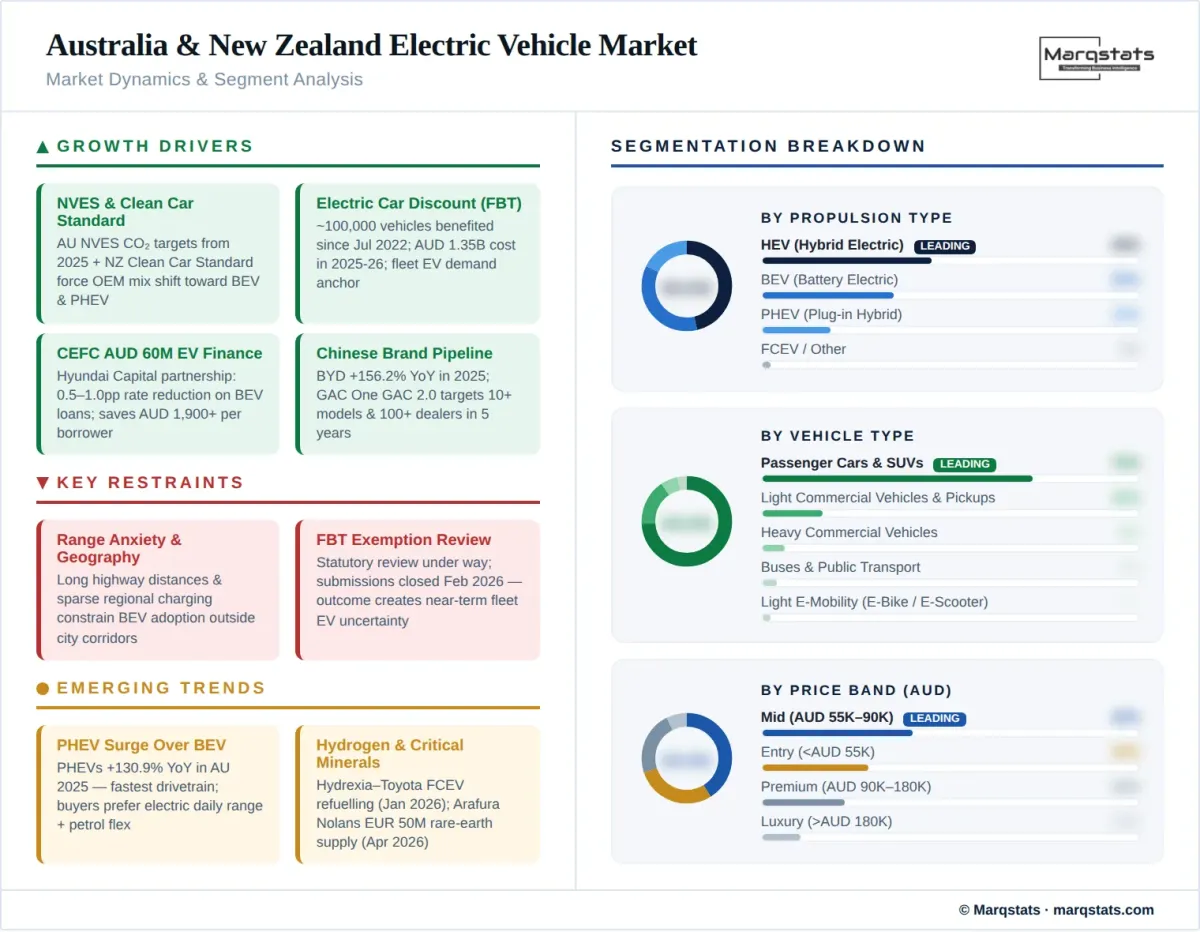
Australia New Zealand Electric Vehicle Market Dynamics Segment Analysis Infographic
Segment Analysis

Market Segmentation

Australia
Leading

Australia accounts for approximately 86% of the combined market by revenue in 2025. The Australian market reached 1,209,808 new vehicle registrations in 2025, with BEV share at 7.3%, HEV at 17.8%, and PHEV at 4.7% in October 2025. PHEV sales more than doubled to 53,484 units for the full year at 130.9% year-on-year growth. The market is dominated by SUVs (733,831 units, 60.7% of 2025 sales) and light commercial vehicles (273,229 units, 22.6%), with passenger cars declining 22.6% year-on-year.

New Zealand

New Zealand accounts for approximately 14% of the combined market by revenue in 2025. The New Zealand market operates under the Clean Car Standard, which sets CO2 emissions targets for vehicle importers. BEV penetration exceeds 12% of new light vehicle sales, supported by the 10,000 public charging point national target. Used-vehicle imports, primarily from Japan, account for a significant share of EV registrations. Auckland, Wellington, Christchurch, and Hamilton represent the primary demand clusters.

Battery Electric Vehicles (BEV)
Leading

BEVs account for approximately 45% of combined electrified vehicle volumes in 2025. In Australia, BEV share reached 14.6% of total new vehicle sales in March 2026 with 15,839 units registered. Tesla Model Y and Model 3, BYD Atto 3, Sealion 6, Seal, and Dolphin, Kia EV5, Hyundai Ioniq 5 and Ioniq 6, MG4, and Polestar 2 and 4 anchor volume segments. Toyota bZ4X and the upcoming C-HR BEV (mid-2027) expand the Japanese brand presence. Mazda 6e is confirmed for mid-2026 launch.

Plug-in Hybrid Electric Vehicles (PHEV)

PHEVs account for approximately 18% of combined electrified vehicle volumes in 2025. Australian PHEV sales more than doubled to 53,484 units at 130.9% year-on-year growth, representing the fastest-growing drivetrain category. BYD Sealion 6 DM-i, Mitsubishi Outlander PHEV, BMW 530e, Mercedes GLC 300e, Volvo XC60 and XC90 Recharge, and GAC M8 PHEV anchor the segment. The GAC M8 PHEV is positioned as Australia’s first plug-in hybrid MPV.

Hybrid Electric Vehicles (HEV)

HEVs account for approximately 35% of combined electrified vehicle volumes in 2025. Australian HEV sales reached 199,133 units at 15.3% year-on-year growth. Toyota dominates the segment through the RAV4, HiLux Hybrid, Camry, Corolla, and Kluger hybrid variants. The Toyota RAV4 ranked second among all top-selling vehicles in Australia for 2025. Honda CR-V, Lexus NX and RX, and Hyundai Tucson Hybrid expand mainstream and premium hybrid coverage.

Hydrogen Fuel-Cell Electric Vehicles (FCEV)

FCEV deployment remains at pilot scale with approximately 2% of combined electrified volumes in 2025. Toyota Mirai and Hyundai Nexo represent the primary passenger FCEV options. Hydrexia announced in January 2026 a relocatable hydrogen refuelling station agreement with Toyota Motor Corporation Australia, covering supply, operation, and maintenance. Commercial applications in heavy-duty trucking and long-haul logistics are under evaluation. FCEV share is forecast to remain below 3% through 2030.

Passenger Cars and SUVs
Leading

Passenger cars and SUVs account for approximately 72% of combined electrified volumes in 2025. SUVs dominate the four-wheeler electrified mix, anchored by Tesla Model Y, BYD Sealion 7, Atto 3, Toyota RAV4 Hybrid, Hyundai Ioniq 5, Kia EV5, GAC AION V, and the upcoming Mazda 6e and Toyota C-HR BEV. Sedan adoption is concentrated in premium segments through Tesla Model 3, BMW i4, and Mercedes EQE.

Light Commercial Vehicles and Pickups

Light commercial vehicles account for approximately 16% of combined electrified volumes in 2025. The segment is dominated by internal combustion pickups, with Ford Ranger and Toyota HiLux remaining the top two selling vehicles in Australia for 2025. Electric pickup availability is limited, however Nissan unveiled the new Navara in November 2025 for Q1 2026 launch, and BYD Shark 6 PHEV pickup is expected to enter the Australian market during 2026.

Heavy Commercial Vehicles and Trucks

Heavy commercial vehicles and trucks account for approximately 6% of combined electrified volumes in 2025. Electric truck deployment remains at pilot scale, supported by autonomous driving partnerships such as the Macnica and Applied Electric Vehicles collaboration on the Blanc Robot tabletop EV platform for last-mile logistics. Hyundai XCient Fuel Cell trucks and BYD electric prime movers serve limited commercial applications.

Buses and Public Transport

Buses and public transport account for approximately 4% of combined electrified volumes in 2025. Australian state transport authorities are electrifying metropolitan bus fleets, anchored by Transport for New South Wales and Public Transport Victoria procurement programs. New Zealand’s bus electrification is coordinated at regional council level, with Auckland Transport and Greater Wellington Regional Council anchoring deployments.

Light Electric Mobility

Light electric mobility, including e-bikes and e-scooters, accounts for approximately 2% of combined electrified volumes in 2025. The segment is concentrated in urban centres, supported by shared-mobility platforms. Regulatory frameworks for e-scooter road use vary across Australian states and New Zealand regions.

Japanese Brands
Leading

Japanese brands hold approximately 41% share of combined electrified vehicle sales in 2025, concentrated in HEV. Toyota dominates through eight or more electrified models including RAV4, Corolla, Camry, HiLux Hybrid, Kluger, and the upcoming C-HR BEV. Mazda confirmed the 6e BEV for mid-2026 launch. Honda, Lexus, Nissan, Subaru, and Mitsubishi maintain portfolios across hybrid and BEV segments.

Chinese Brands

Chinese-origin brands collectively secured approximately 28% of combined electrified vehicle sales in 2025, the fastest-growing cohort. BYD led the surge with 156.2% year-on-year growth in Australia in 2025 and 50% year-on-year growth in March 2026 at 7,217 units. GWM grew 23.4% in 2025 and 29.3% in March 2026. Chery grew 84.1% in March 2026. MG, GAC (with One GAC 2.0 strategy), Leapmotor, and Zeekr further expand Chinese brand presence.

Korean Brands

Korean brands hold approximately 15% share of combined electrified vehicle sales in 2025. Hyundai and Kia anchor the segment. Hyundai sales reached approximately 63,000 units in Australia in 2025, with strong BEV momentum through the Ioniq 5, Ioniq 6, and Kona Electric. Kia grew through the EV5, EV6, EV9, and Niro EV. The CEFC AUD 60 million Hyundai Capital partnership supports discounted financing on selected Hyundai and Kia BEVs.

European Brands

European brands hold approximately 10% share of combined electrified vehicle sales in 2025. BMW, Mercedes-Benz, Volvo, Polestar, Audi, MINI, and Porsche compete in premium BEV and PHEV segments. Volvo and Polestar anchor the mid-premium electric SUV tier. BMW i4, iX, and iX1 anchor the premium electric sedan and SUV band.

American and Other Brands

American and other brands hold approximately 6% share in 2025. Tesla heads the cohort with Model Y and Model 3 volumes. Ford maintains the Ranger and Mustang Mach-E portfolio. Isuzu, Ram, and LDV contribute commercial and SUV volumes. Tesla remains the single largest BEV brand in both markets by cumulative registered units through 2025.

Entry-Level (Below AUD 55,000 / NZD 60,000)
Leading

The entry-level band captures mass-market buyers. BYD Atto 3, Dolphin, and Seagull; MG4 and MG ZS EV; GWM Ora; and smaller Chinese BEVs compete in this segment. The band captured approximately 28% of combined electrified volumes in 2025. The Australian luxury car tax threshold (AUD 89,332 for fuel-efficient vehicles in 2024-25) materially shapes band boundaries for Electric Car Discount eligibility.

Mid-Market (AUD 55,000–AUD 90,000 / NZD 60,000–95,000)

The mid-market band captures mainstream Australian and New Zealand buyers. Tesla Model 3, Kia EV5 and EV6, Hyundai Ioniq 5, BYD Seal and Sealion 7, Volvo EX30, Polestar 2, and the upcoming Mazda 6e compete in this segment. The band is the largest revenue contributor across both markets in 2025.

Premium (AUD 90,000–AUD 180,000)

The premium band includes higher-specification BEVs and PHEVs. Tesla Model Y Long Range and Performance, BMW i4 and iX, Mercedes EQE and GLC 300e PHEV, Audi Q6 e-tron, Polestar 4, Volvo EX90, Kia EV9, and Genesis GV60 compete in this segment. Corporate and fleet acquisitions anchor segment volumes.

Luxury (Above AUD 180,000)

The luxury band serves high-net-worth buyers. Mercedes EQS, BMW i7, Porsche Taycan, Audi e-tron GT, Genesis GV80, and upcoming Chinese luxury entries such as Yangwang compete in this tier. Volume is limited, however the band anchors brand positioning and aftermarket ecosystem investment.

Regional Analysis

By Geography

New South Wales and Australian Capital Territory

New South Wales and ACT account for approximately 32% of Australian EV registrations in 2025. Sydney, the Central Coast, the Hunter Region, and Canberra host the densest charging networks. The ACT government operates one of the most progressive state-level EV policy frameworks in Australia, with stamp-duty exemptions and fleet electrification targets. NSW’s EV strategy anchors public-sector fleet procurement and charging-network investment.

Victoria

Victoria accounts for approximately 28% of Australian EV registrations in 2025. Melbourne is the primary demand cluster, supported by the April 2026 Melbourne Motor Show where GAC introduced the AION UT alongside the EMZOOM, M8 PHEV, and AION V. Victoria’s EV strategy includes public-sector fleet conversion targets and charging-network co-funding programs.

Queensland and Western Australia

Queensland and Western Australia collectively account for approximately 27% of Australian EV registrations in 2025. Brisbane, the Gold Coast, and Perth anchor urban demand. Large regional distances in both states create range-anxiety considerations, however mining-sector fleet electrification is emerging as a structural demand driver. Western Australia hosts Mt Weld, the Lynas Rare Earths mining operation supplying dysprosium and terbium heavy rare earths critical for EV traction motors.

South Australia, Tasmania, and Northern Territory

South Australia, Tasmania, and the Northern Territory collectively account for approximately 13% of Australian EV registrations in 2025. Adelaide anchors South Australian demand. The Northern Territory hosts the Arafura Rare Earths Nolans Project, which received a EUR 50 million Raw Materials Fund commitment from the German Federal Ministry for Economic Affairs and Energy in April 2026 for neodymium and praseodymium supply.

New Zealand – North Island

The North Island accounts for approximately 76% of New Zealand EV registrations in 2025. Auckland is the primary demand cluster, with Wellington and Hamilton as secondary centres. Public charging deployment is concentrated along State Highway 1 and major urban corridors. Auckland Transport anchors bus electrification programs, while private operators lead passenger vehicle charging-network build-out.

New Zealand – South Island

The South Island accounts for approximately 24% of New Zealand EV registrations in 2025. Christchurch, Dunedin, and Queenstown represent the primary demand clusters. Greater Wellington Regional Council and Environment Canterbury coordinate regional charging-network investment alongside the Energy Efficiency and Conservation Authority (EECA). Tourism-sector demand for EV rental fleets supports structural adoption in Queenstown and Milford Sound corridors.
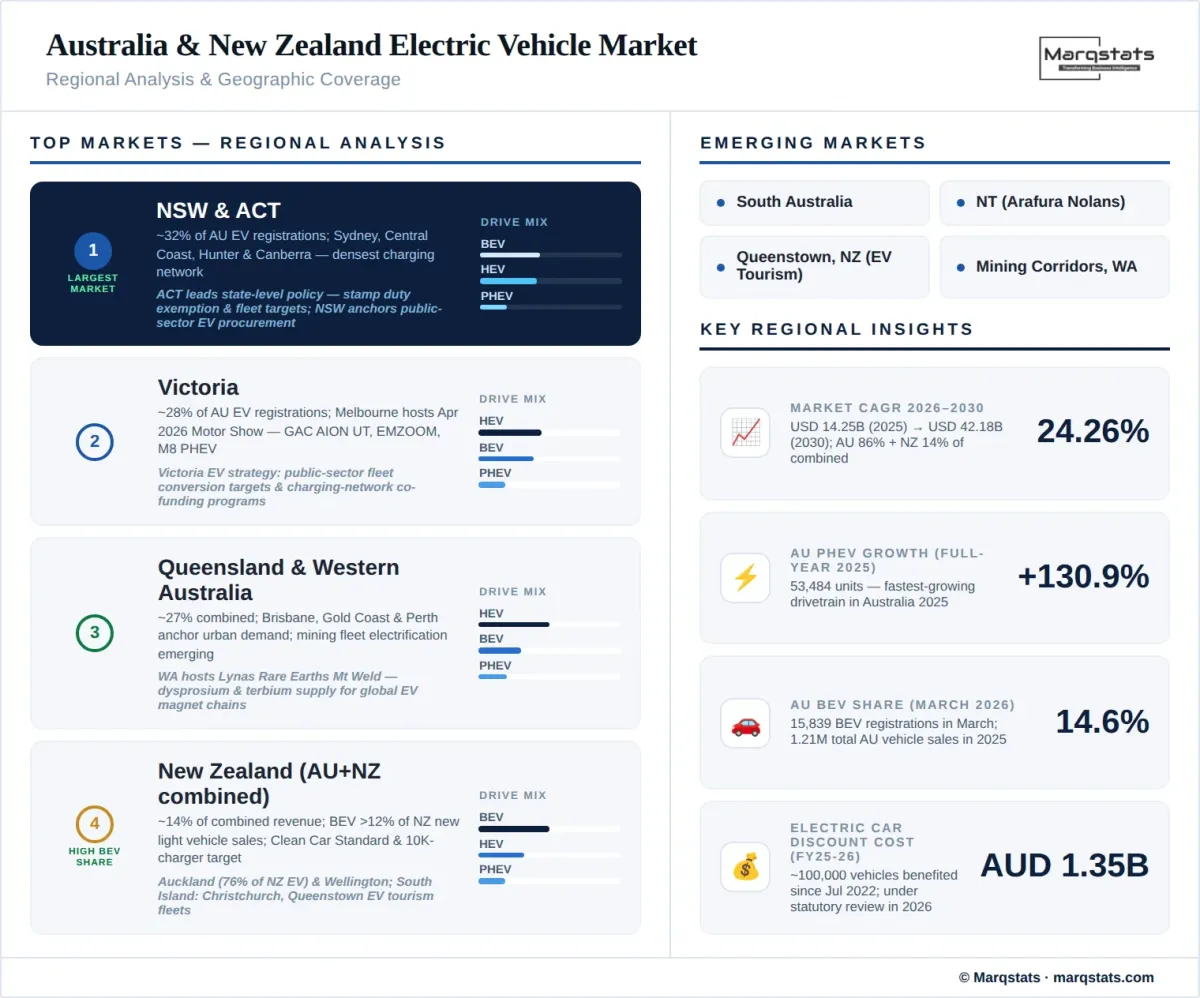
Australia New Zealand Electric Vehicle Market Regional Analysis Infographic
Competitive Landscape

How Competition Is Evolving

The competitive environment in the Australia and New Zealand electric vehicle market is moderately concentrated with rapid structural rebalancing. The top five OEM groups accounted for approximately 58% of combined electrified vehicle sales in 2025. Market structure is shifting from Japanese hybrid dominance and Tesla BEV leadership toward a multi-polar cohort, with Chinese brands capturing share across entry-level and mid-market bands, Korean brands anchoring mid-premium through Hyundai and Kia, and European brands holding the premium tier.

Toyota retains overall automotive market leadership with approximately 229,000 annual sales in Australia in 2025, dominated by HEV volumes. BYD emerged as the fastest-growing major brand, delivering 156.2% year-on-year growth in 2025 across Australia and reaching 7,217 units in March 2026 at 50% year-on-year growth. GAC launched One GAC 2.0 in November 2025 with plans for 10+ additional models and 100+ dealers over five years. Tesla remains the largest cumulative BEV brand across both markets through 2025.

Korean OEMs scaled through 2025 and 2026. Hyundai and Kia anchor the mid-premium tier, supported by the Clean Energy Finance Corporation AUD 60 million Hyundai Capital partnership providing 0.5–1.0 percentage point interest rate reductions. European premium OEMs maintain portfolio leadership in the AUD 90,000 and above band. Strategic partnerships, local dealer-network expansion, discounted financing programs, and model-pipeline commitments are the primary competitive differentiators for the 2026–2030 period.
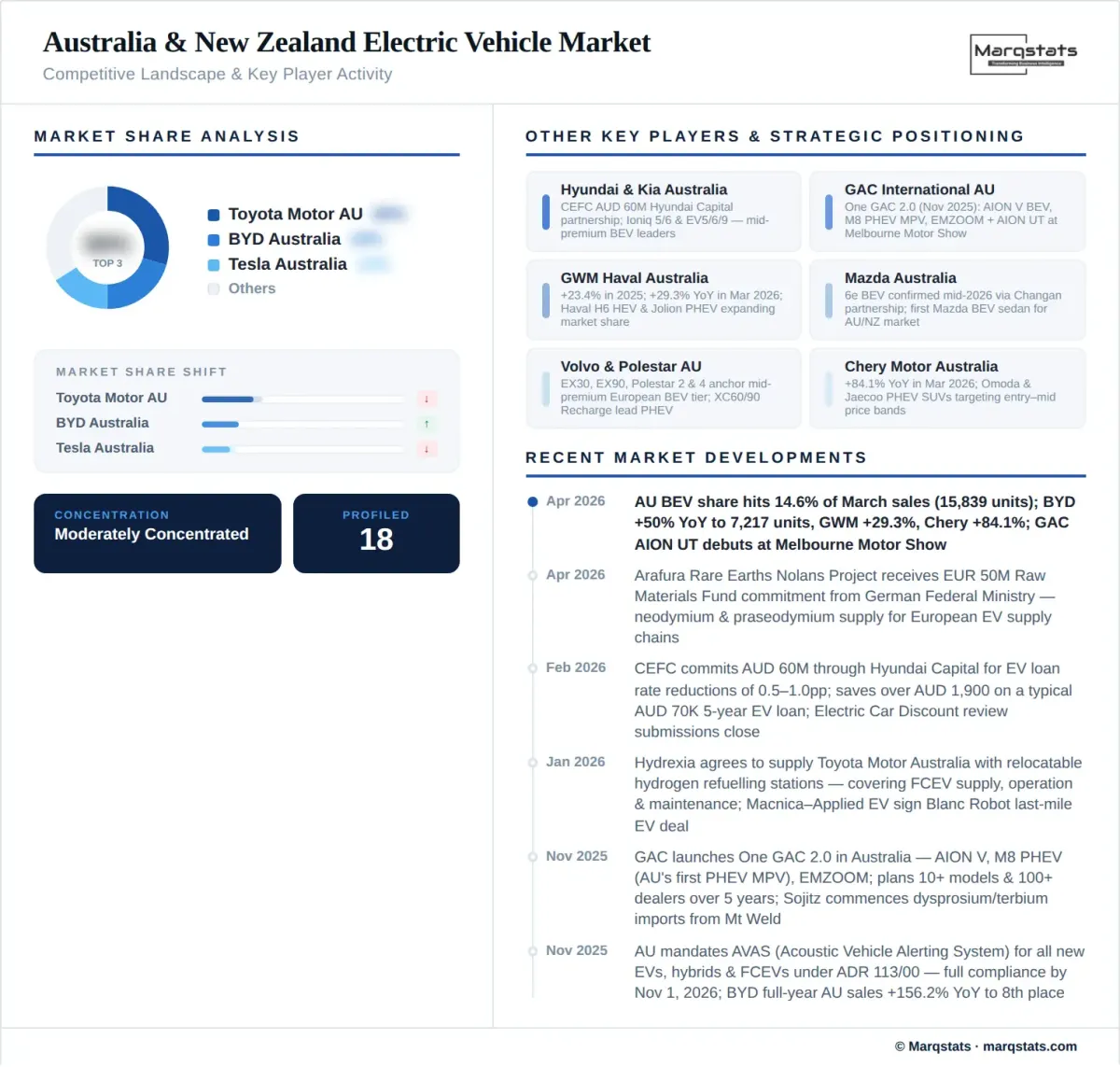
Australia New Zealand Electric Vehicle Market Competitive Landscape Infographic
Major Players

Companies Covered

The report profiles 18 company profiles+ companies with full strategy and financials analysis, including:

Toyota Motor Corporation Australia Limited
BYD Automotive Australia (EVDirect Pty Ltd)
Tesla Motors Australia Pty Ltd
Hyundai Motor Company Australia Pty Ltd
Kia Australia Pty Ltd
MG Motor Australia Pty Ltd
GWM Haval Australia
Chery Motor Australia
GAC International Australia
Mazda Australia Pty Ltd
Ford Motor Company of Australia
Mercedes-Benz Australia Pacific
BMW Group Australia
Volvo Car Australia Pty Ltd
Polestar Automotive Australia
Nissan Motor Co. Australia
Mitsubishi Motors Australia Limited
Leapmotor Australia
Note: Full company profiles include revenue analysis, product portfolio, SWOT, and recent strategic developments.
Latest Developments

Recent Market Activity

Apr 2026
GAC introduced the AION UT at the Melbourne Motor Show as part of its expanded Australian portfolio alongside EMZOOM, M8 PHEV, and AION V, covering pure electric, plug-in hybrid, and internal combustion powertrains.
Apr 2026
Australian new vehicle sales reached 105,058 units in March at 14.6% BEV share with 15,839 BEVs registered. BYD grew 50% year-on-year to 7,217 units; GWM grew 29.3%, Chery grew 84.1%.
Feb 2026
The Clean Energy Finance Corporation (CEFC) committed AUD 60 million through Hyundai Capital Australia for 0.5–1.0 percentage point EV loan interest rate reductions, saving over AUD 1,900 on a typical five-year AUD 70,000 loan.
Feb 2026
Macnica Inc. signed a strategic partnership with Applied Electric Vehicles Ltd for autonomous driving EV deployment in logistics last-mile segment using the Blanc Robot tabletop EV platform co-developed with Suzuki Motor Corporation.
Jan 2026
Hydrexia Pty Ltd agreed to supply Toyota Motor Corporation Australia with relocatable hydrogen refuelling stations for the Australian FCEV market, covering supply, operation, and maintenance.
Dec 2025
The Australian government under Prime Minister Anthony Albanese released the statutory review terms for the Electric Car Discount. Nearly 100,000 vehicles have benefited since July 2022 at AUD 1.35 billion 2025-26 cost.
Nov 2025
GAC launched One GAC 2.0 in Australia with the AION V, M8 PHEV, and EMZOOM alongside plans for 10+ additional models and 100+ dealer outlets over five years, with a Melbourne parts transit warehouse.
Nov 2025
Australia mandated Acoustic Vehicle Alerting System (AVAS) as standard equipment for all newly introduced electric, hybrid, and hydrogen fuel cell vehicles under ADR 113/00, with full compliance required by November 1, 2026.
Report Structure

Table of Contents

1. Introduction
1.1 Study Scope and Research Objectives
1.2 Study Assumptions and Definitions
1.3 Market Definition — Australia & New Zealand EV Market
1.4 Report Structure and Deliverables
1.5 Executive Summary
1.5.1 Key Findings 2025
1.5.2 Growth Forecast 2026–2030
1.5.3 Policy Inflection Points
1.5.4 Investment Themes
2. Research Methodology
2.1 Research Approach
2.1.1 Primary Research Methodology
2.1.2 Secondary Research Sources
2.1.3 Bottom-Up Market Sizing Framework
2.1.4 Top-Down Validation
2.2 Data Triangulation
2.3 Primary Interviews — 40+ Stakeholders
2.3.1 OEM Distributor Interviews
2.3.2 Charging Network Operator Interviews
2.3.3 Fleet Operator Interviews
2.3.4 Policy Stakeholder Interviews
2.4 Quality Checks and Validation
3. Market Overview
3.1 Combined ANZ EV Market Size 2021–2025
3.2 Market Size Forecast 2026–2030
3.3 Market Size by Volume (Units)
3.4 Market Size by Revenue (USD Billion)
3.5 Australia vs New Zealand Market Share Split
3.5.1 Australia 86% Revenue Share
3.5.2 New Zealand 14% Revenue Share
3.6 Australia FCAI Total Industry Volume Analysis
3.6.1 2025 TIV 1,209,808 Units
3.6.2 March 2026 Monthly Registrations
3.7 New Zealand Light Vehicle Registration Analysis
4. Market Dynamics
4.1 Market Drivers
4.1.1 Australia New Vehicle Efficiency Standard (NVES)
4.1.2 New Zealand Clean Car Standard
4.1.3 Electric Car Discount FBT Exemption
4.1.4 CEFC AUD 60 Million Hyundai Capital Partnership
4.1.5 Chinese Brand Expansion and Model Availability
4.1.6 National EV Strategy 30% by 2030 Target
4.2 Market Restraints
4.2.1 Long Highway Distance and Range Anxiety
4.2.2 Charging Network Coverage Gaps
4.2.3 Electric Car Discount Review Uncertainty
4.2.4 Pickup and LCV Market Dominance
4.3 Market Opportunities
4.3.1 Electric Pickup and Light Commercial Entry
4.3.2 Autonomous Electric Logistics
4.3.3 Hydrogen Fuel-Cell Commercial Applications
4.3.4 Mining-Sector Fleet Electrification
4.4 Market Trends
4.4.1 PHEV Sales Acceleration (130.9% YoY)
4.4.2 Chinese Brand Model Pipeline Expansion
4.4.3 Rare Earth Supply Chain Localization
4.4.4 Acoustic Vehicle Alerting System Mandate
4.5 Porter's Five Forces Analysis
4.6 PESTLE Analysis
5. Regulatory and Policy Framework
5.1 Australia New Vehicle Efficiency Standard (NVES)
5.1.1 CO2 Emissions Targets from 2025
5.1.2 Manufacturer Compliance Obligations
5.1.3 Penalty and Credit Structure
5.2 Australia Electric Car Discount
5.2.1 Fringe Benefits Tax Exemption Framework
5.2.2 Luxury Car Tax Threshold AUD 89,332
5.2.3 2026 Statutory Review Terms of Reference
5.2.4 AUD 1.35 Billion 2025-26 Program Cost
5.3 Australia National Electric Vehicle Strategy
5.3.1 30% NEV Share by 2030 Target
5.3.2 Federal Charging Infrastructure Funding
5.4 Australian Design Rule (ADR) 113/00 AVAS Mandate
5.4.1 November 2025 New Model Requirement
5.4.2 November 2026 Full Compliance Deadline
5.4.3 Forecast 68 Fatalities and 2,675 Injuries Prevention
5.5 New Zealand Clean Car Standard
5.5.1 Importer CO2 Emissions Targets
5.5.2 Vehicle Classification and Compliance
5.6 New Zealand 10,000 Charging Point Target
5.6.1 EECA-Coordinated Deployment
5.6.2 Regional Council Partnerships
5.7 Clean Energy Finance Corporation (CEFC)
5.7.1 AUD 60 Million Hyundai Capital Commitment
5.7.2 Vehicle-to-Grid Technology Support
6. Consumer and Market Factors
6.1 EV Adoption Drivers
6.1.1 Total Cost of Ownership Economics
6.1.2 Environmental Awareness and ESG
6.1.3 Fuel Price Sensitivity
6.2 EV Adoption Barriers
6.2.1 Range Anxiety (Large Geographies)
6.2.2 Charging Access Outside Metro Areas
6.2.3 Electric Pickup Availability Gap
6.3 Consumer Segments
6.3.1 Metropolitan Premium Buyers
6.3.2 Mainstream Suburban Buyers
6.3.3 Regional and Rural Buyers
6.3.4 Corporate and Fleet Buyers
6.4 Used EV Import Market (New Zealand)
6.4.1 Japan-Sourced Used EV Imports
6.4.2 Compliance and Import Certification
7. Market Segmentation — By Country
7.1 Market Size by Country 2021–2030
7.2 Australia
7.2.1 86% Combined Revenue Share
7.2.2 1,209,808 TIV in 2025
7.2.3 SUV Dominance (733,831 Units, 60.7%)
7.2.4 LCV Share (273,229 Units, 22.6%)
7.3 New Zealand
7.3.1 14% Combined Revenue Share
7.3.2 BEV Penetration Above 12%
7.3.3 Used Vehicle Import Market Structure
7.3.4 Auckland, Wellington, Christchurch Clusters
8. Market Segmentation — By Propulsion Type
8.1 Market Size by Propulsion 2021–2030
8.2 Battery Electric Vehicles (BEV)
8.2.1 45% of Electrified Mix
8.2.2 14.6% BEV Share March 2026 Australia
8.2.3 15,839 BEV Units March 2026
8.2.4 Tesla, BYD, Kia, Hyundai, MG4, Polestar Portfolio
8.3 Plug-in Hybrid Electric Vehicles (PHEV)
8.3.1 18% of Electrified Mix
8.3.2 Australian PHEV 53,484 Units (+130.9% YoY)
8.3.3 GAC M8 PHEV Australia First PHEV MPV
8.3.4 BYD Sealion 6 DM-i, Mitsubishi Outlander PHEV
8.4 Hybrid Electric Vehicles (HEV)
8.4.1 35% of Electrified Mix
8.4.2 Australian HEV 199,133 Units (+15.3% YoY)
8.4.3 Toyota RAV4 Second Top-Seller
8.4.4 Honda, Lexus, Hyundai Hybrid Portfolios
8.5 Hydrogen Fuel-Cell Electric Vehicles (FCEV)
8.5.1 Pilot-Scale Deployment (2% Share)
8.5.2 Hydrexia-Toyota Refuelling Partnership
9. Market Segmentation — By Vehicle Type
9.1 Market Size by Vehicle Type 2021–2030
9.2 Passenger Cars and SUVs
9.2.1 72% Share of Electrified Volume
9.2.2 SUV Sub-Segment Dominance
9.2.3 Sedan Sub-Segment (Premium Tesla, BMW)
9.3 Light Commercial Vehicles and Pickups
9.3.1 16% Share of Electrified Volume
9.3.2 Ford Ranger and Toyota HiLux Dominance
9.3.3 Nissan Navara Q1 2026 Launch
9.3.4 BYD Shark 6 PHEV Pickup Expected
9.4 Heavy Commercial Vehicles and Trucks
9.4.1 6% Share of Electrified Volume
9.4.2 Macnica-Applied EV Blanc Robot Partnership
9.4.3 Last-Mile Autonomous Logistics
9.5 Buses and Public Transport
9.5.1 4% Share of Electrified Volume
9.5.2 Transport for NSW and PTV Procurement
9.5.3 Auckland Transport and GWRC Deployments
9.6 Light Electric Mobility
9.6.1 E-Bike and E-Scooter Sub-Segment
9.6.2 State-Level Regulatory Variation
10. Market Segmentation — By Brand Origin
10.1 Market Size by Brand Origin 2021–2030
10.2 Japanese Brands
10.2.1 41% Market Share
10.2.2 Toyota 8+ Model Electrified Lineup
10.2.3 Mazda 6e Mid-2026 Launch
10.2.4 Toyota C-HR BEV Mid-2027 Launch
10.3 Chinese Brands
10.3.1 28% Market Share (Fastest-Growing)
10.3.2 BYD 156.2% YoY 2025 Growth
10.3.3 GAC One GAC 2.0 Strategy
10.3.4 MG, GWM, Chery, Leapmotor, Zeekr
10.4 Korean Brands
10.4.1 15% Market Share
10.4.2 Hyundai Ioniq 5, 6, Kona Portfolio
10.4.3 Kia EV5, EV6, EV9, Niro Portfolio
10.4.4 CEFC Hyundai Capital Financing
10.5 European Brands
10.5.1 10% Market Share
10.5.2 BMW, Mercedes Premium Leadership
10.5.3 Volvo, Polestar Mid-Premium
10.6 American and Other Brands
10.6.1 6% Market Share
10.6.2 Tesla Model Y and Model 3 Volumes
10.6.3 Ford Ranger and Mustang Mach-E
11. Market Segmentation — By Price Band
11.1 Market Size by Price Band 2021–2030
11.2 Entry-Level (Below AUD 55,000 / NZD 60,000)
11.2.1 28% Electrified Volume Share
11.2.2 BYD Atto 3, Dolphin, Seagull
11.2.3 MG4, MG ZS EV, GWM Ora
11.2.4 LCT Threshold Impact
11.3 Mid-Market (AUD 55,000–AUD 90,000)
11.3.1 Tesla Model 3, Kia EV5, EV6
11.3.2 Hyundai Ioniq 5, BYD Seal
11.3.3 Volvo EX30, Polestar 2, Mazda 6e
11.4 Premium (AUD 90,000–AUD 180,000)
11.4.1 Tesla Model Y LR, BMW i4, iX
11.4.2 Mercedes EQE, Audi Q6 e-tron
11.4.3 Polestar 4, Volvo EX90, Kia EV9
11.5 Luxury (Above AUD 180,000)
11.5.1 Mercedes EQS, BMW i7, Porsche Taycan
11.5.2 Chinese Luxury Entries (Yangwang)
12. Charging Infrastructure Analysis
12.1 Australia Public Charging Network
12.1.1 Evie Networks and ChargeFox
12.1.2 Tesla Supercharger Australia
12.1.3 Federal ARENA Funding Programs
12.2 Australia Home and Workplace Charging
12.2.1 AC Wallbox Installation Ecosystem
12.2.2 Corporate Fleet Charging Deployment
12.3 New Zealand 10,000 Charging Point Target
12.3.1 ChargeNet and BP Pulse NZ
12.3.2 State Highway 1 Corridor Coverage
12.4 Heavy Vehicle Charging Infrastructure
12.5 Hydrogen Refuelling Infrastructure
12.5.1 Hydrexia-Toyota Australia Partnership
12.5.2 Relocatable Refuelling Station Model
13. Rare Earth and Battery Supply Chain
13.1 Lynas Rare Earths Mt Weld Operations
13.1.1 Western Australia Mining
13.1.2 Malaysia Separation Facility Expansion
13.1.3 Sojitz Dysprosium and Terbium Japan Exports
13.2 Arafura Rare Earths Nolans Project
13.2.1 Northern Territory Operations
13.2.2 German Raw Materials Fund EUR 50 Million
13.2.3 Neodymium and Praseodymium Supply
13.3 Vulcan Energy Lithium Hydroxide
13.3.1 Phase One Lionheart Project
13.3.2 Glencore, Stellantis, Umicore, LG Offtakes
13.3.3 24,000 Tons LHM Annual Capacity
13.4 Battery Supply Chain Localization
14. Regional Analysis
14.1 New South Wales and ACT
14.1.1 32% Australian EV Share
14.1.2 Sydney, Central Coast, Canberra Clusters
14.1.3 ACT Policy Framework Leadership
14.2 Victoria
14.2.1 28% Australian EV Share
14.2.2 Melbourne Motor Show Ecosystem
14.2.3 Public-Sector Fleet Conversion Targets
14.3 Queensland and Western Australia
14.3.1 27% Combined Australian Share
14.3.2 Brisbane, Gold Coast, Perth Demand
14.3.3 Mining-Sector Fleet Electrification
14.4 South Australia, Tasmania, Northern Territory
14.4.1 13% Combined Australian Share
14.4.2 Arafura Nolans Project NT Operations
14.5 New Zealand – North Island
14.5.1 76% NZ EV Share
14.5.2 Auckland, Wellington, Hamilton Clusters
14.5.3 State Highway 1 Corridor
14.6 New Zealand – South Island
14.6.1 24% NZ EV Share
14.6.2 Christchurch, Dunedin, Queenstown Demand
15. Competitive Landscape
15.1 Market Share Analysis 2025
15.2 Brand-Level FCAI Sales Rankings
15.3 Competitive Benchmarking Matrix
15.4 Strategic Partnerships and Dealer Networks
15.5 Model Launch Pipeline 2026–2027
15.6 Chinese Brand Entry Momentum Tracker
16. Company Profiles
16.1 Toyota Motor Corporation Australia
16.1.1 Company Overview
16.1.2 229,000+ Annual Sales 2025
16.1.3 HEV Leadership (RAV4, HiLux, Camry)
16.1.4 C-HR BEV Mid-2027 Launch
16.2 BYD Automotive Australia (EVDirect)
16.2.1 156.2% YoY 2025 Growth
16.2.2 March 2026 7,217 Units
16.2.3 Atto 3, Sealion 6, Seal Portfolio
16.2.4 Shark 6 PHEV Pickup Pipeline
16.3 Tesla Motors Australia
16.3.1 Model Y and Model 3 Volumes
16.3.2 Supercharger Network Expansion
16.4 Hyundai Motor Company Australia
16.4.1 Ioniq 5, Ioniq 6, Kona Portfolio
16.4.2 CEFC Capital Partnership Beneficiary
16.5 Kia Australia
16.5.1 EV5, EV6, EV9, Niro Portfolio
16.6 MG Motor Australia
16.6.1 MG4 and MG ZS EV Volumes
16.7 GWM Haval Australia
16.7.1 23.4% 2025 Growth, 29.3% March 2026
16.8 Chery Motor Australia
16.8.1 84.1% March 2026 Growth
16.8.2 Omoda and Jaecoo Portfolio
16.9 GAC International Australia
16.9.1 One GAC 2.0 Strategy (Nov 2025)
16.9.2 AION V, M8 PHEV, EMZOOM Launch
16.9.3 AION UT Melbourne Motor Show
16.9.4 100+ Dealer Target Over 5 Years
16.10 Mazda Australia
16.10.1 6e BEV Mid-2026 Launch
16.10.2 Changan Partnership
16.11 Ford Motor Company of Australia
16.11.1 Ranger Pickup Leadership
16.11.2 Mustang Mach-E Portfolio
16.12 Mercedes-Benz Australia Pacific
16.12.1 EQ Portfolio
16.12.2 GLC 300e PHEV
16.13 BMW Group Australia
16.13.1 i4, iX, iX1 Portfolio
16.14 Volvo Car Australia
16.14.1 EX30, EX90, XC60 Recharge
16.15 Polestar Automotive Australia
16.15.1 Polestar 2 and Polestar 4
16.16 Nissan Motor Co. Australia
16.16.1 Navara Pickup Q1 2026 Launch
16.16.2 LEAF and Ariya Portfolio
16.17 Mitsubishi Motors Australia
16.17.1 Outlander PHEV Leadership
16.18 Leapmotor Australia
17. Pricing and Cost Analysis
17.1 Entry-Level EV Pricing (Below AUD 55K)
17.2 Mid-Market EV Pricing Analysis
17.3 Premium EV Pricing Analysis
17.4 Luxury EV Pricing Analysis
17.5 Total Cost of Ownership Breakdown
17.5.1 Purchase Price + Stamp Duty + Registration
17.5.2 FBT Exemption Application
17.5.3 Electricity vs Petrol Operating Cost
17.5.4 Servicing and Insurance
17.6 CEFC-Discounted Financing Calculator
18. Fleet and Autonomous Mobility Use Cases
18.1 Corporate Fleet Electrification
18.1.1 FBT Exemption Procurement Impact
18.1.2 Tesla Fleet Program
18.1.3 Hyundai and Kia Corporate Deals
18.2 Government and Public Sector Fleets
18.2.1 ACT Public-Sector EV Targets
18.2.2 NSW and VIC Procurement
18.3 Mining and Industrial Fleets
18.3.1 Western Australia Mining EV Pilots
18.3.2 Queensland Coal and Iron Ore Operations
18.4 Autonomous Electric Logistics
18.4.1 Applied EV Blanc Robot Platform
18.4.2 Macnica Integration and Deployment
18.4.3 Last-Mile Delivery Economics
18.5 Public Transport Electrification
18.5.1 Australian Metropolitan Bus Conversion
18.5.2 Auckland Transport Bus Programs
19. Market Forecast, Recommendations, and Appendix
19.1 Base Case Scenario 2026–2030
19.2 Bull Case Scenario
19.3 Bear Case Scenario
19.4 Forecast Assumptions and Sensitivities
19.5 Key Inflection Points
19.6 Recommendations for OEMs and Distributors
19.7 Recommendations for Charging Network Operators
19.8 Recommendations for Fleet Operators
19.9 Recommendations for Battery and Rare Earth Suppliers
19.10 Recommendations for Investors
19.11 Recommendations for Policymakers
19.12 Abbreviations and Glossary
19.13 List of Tables
19.14 List of Figures
19.15 Data Sources and References
19.16 About Marqstats Intelligence
19.17 Analyst Contact Details
19.18 Disclaimer
Study Scope & Focus

Coverage & Segmentation

The Australia and New Zealand Electric Vehicle Market report analyzes the combined Oceania market across propulsion type, vehicle category, country, brand origin, price band, end-use, and regional geography for the period 2021 to 2030. The report covers historical data for 2021-2025, with 2025 as the base year, and forecasts spanning 2026-2030. Market sizing is conducted in USD billions and unit volumes across both currencies. The study examines the full electrified vehicle value chain including OEM imports, local assembly considerations, battery supply, rare earth mining, charging infrastructure, fleet electrification, hydrogen infrastructure, and aftermarket service.

The scope encompasses all cleaner-energy vehicle categories including battery-electric (BEV), plug-in hybrid (PHEV), hybrid electric (HEV), and hydrogen fuel-cell (FCEV) vehicles. Vehicle categories covered include passenger cars, SUVs, light commercial vehicles, pickups, heavy commercial vehicles, buses, and light electric mobility. The study evaluates policy impact from Australia’s National Electric Vehicle Strategy, the Electric Car Discount fringe benefits tax exemption, the Australian Design Rule (ADR) 113/00 AVAS mandate, New Zealand’s Clean Car Standard, and the 10,000 public charging point target. Competitive profiling covers 18 OEM groups operating across both markets.
Frequently Asked Questions

FAQs About the Australia and New Zealand Electric Vehicle Market

The Australia and New Zealand electric vehicle market was valued at USD 14.25 billion in 2025 and is projected to reach USD 42.18 billion by 2030, expanding at a CAGR of 24.26% during 2026–2030. Australia accounts for approximately 86% of combined revenue; New Zealand accounts for 14%. The combined market comprises BEV, PHEV, HEV, and FCEV vehicles across passenger, commercial, and public transport categories.
The market is expected to grow at a CAGR of 24.26% during 2026–2030. Growth is attributed to Australia's New Vehicle Efficiency Standard (NVES), the Electric Car Discount fringe benefits tax exemption, New Zealand's Clean Car Standard, the 10,000 public charging point target, expanding Chinese brand portfolios, and accelerating plug-in hybrid demand which grew 130.9% year-on-year in Australia in 2025.
Toyota leads the overall automotive market with approximately 229,000 annual sales in Australia in 2025, dominated by HEVs. BYD emerged as the fastest-growing major brand with 156.2% year-on-year growth in 2025 and 50% year-on-year growth in March 2026 at 7,217 units. Tesla remains the largest cumulative BEV brand. Other major players include Hyundai, Kia, MG, GWM, Chery, GAC, Mazda, Ford, BMW, Mercedes-Benz, Volvo, and Polestar. Chery grew 84.1% in March 2026.
The New Vehicle Efficiency Standard (NVES) is Australia's primary EV policy lever, setting CO2 emissions targets for vehicle manufacturers from 2025 onward. Manufacturers exceeding targets earn credits; those falling short face penalties. The standard drives accelerated BEV and PHEV model introductions. It is complemented by the Electric Car Discount (FBT exemption), the National Electric Vehicle Strategy's 30% NEV share by 2030 target, and the Australian Design Rule (ADR) 113/00 AVAS mandate.
Australia's public charging network is expanding through federal Australian Renewable Energy Agency (ARENA) funding, operators including Evie Networks, ChargeFox, and Tesla Supercharger. New Zealand targets 10,000 public charging points nationally, coordinated by the Energy Efficiency and Conservation Authority (EECA). The Clean Energy Finance Corporation (CEFC) committed AUD 60 million to Hyundai Capital Australia in February 2026, supporting discounted EV financing and vehicle-to-grid infrastructure.
The Electric Car Discount, introduced in July 2022, provides fringe benefits tax (FBT) exemption for eligible EVs priced below the luxury car tax threshold (AUD 89,332 for fuel-efficient vehicles in 2024-25). Nearly 100,000 vehicles have benefited from the exemption, with the 2025-26 program cost estimated at AUD 1.35 billion. The Australian government released the statutory review terms of reference in December 2025, with public submissions closing February 6, 2026. Outcomes are expected later in 2026.
The Australia and New Zealand Electric Vehicle Market report is delivered as a 305-page PDF, an Excel data pack with editable market models and segment-level tables, and a PowerPoint summary deck. Analyst email support is included for 30 days after purchase. Customization is available on request.