Market Snapshot
Key Takeaways
Market Overview & Analysis
Report Summary
The global residential EV charger market is best understood as a four-layer product stack rather than a single hardware category. The first layer is basic Level 2 AC charging — 7 kW to 22 kW single- or three-phase AC chargers providing overnight home charging for single-family homes with dedicated parking. The second layer is smart AC charging — app-connected chargers with remote monitoring, scheduling, load management, and time-of-use tariff optimisation, required by regulation in the UK and increasingly standard across Europe, North America, and Asia-Pacific premium segments. The third layer is energy-managed charging — chargers with dynamic load balancing, solar production awareness, and whole-home energy orchestration, typified by Enphase IQ EV Charger 2 and Wallbox's Pulsar Plus with myWallbox platform integration. The fourth layer is bidirectional charging — V2H and V2G-capable hardware that allows EV batteries to supply power back to the home or grid, represented commercially by Wallbox Quasar 2, Tesla Powerwall and Powershare, and GM Energy's PowerShift Charger.
The residential charger market's value migration from hardware to software and services is the central strategic dynamic of the 2025–2030 period. IEA's Stated Policies Scenario forecasts close to two-thirds of the approximately 150 million global charging-point additions between 2025 and 2030 being home chargers, but unit-volume growth does not capture the value shift. Average selling prices for smart and bidirectional chargers are materially higher than for basic Level 2 units, recurring software subscription and energy management fees are becoming standard commercial models, and installation services — including panel upgrades, permitting support, and wiring compliance — are a growing revenue layer that hardware margins alone cannot fully capture. Wallbox's CTEP California certification for its Supernova DC fast charger (March 2025) and the broader push for regionally certified products signal how market access increasingly depends on compliance, not just technical capability.
The competitive structure is evolving from a hardware OEM market toward a three-way platform competition between EV OEM-embedded charging ecosystems (Tesla Powershare, GM Energy, Hyundai/Kia V2L and V2H platforms), independent smart-charging and energy-management platform providers (Enphase, ChargePoint, Wallbox, Eaton), and grid-integration and energy-services platforms (EnergyHub, utilities, demand-response aggregators). The May 2025 collaboration between EnergyHub and FLO to enable residential FLO charger users to participate in utility demand-response programmes directly illustrates how the residential charging market is being absorbed into the wider distributed energy resource management ecosystem.
Market Dynamics
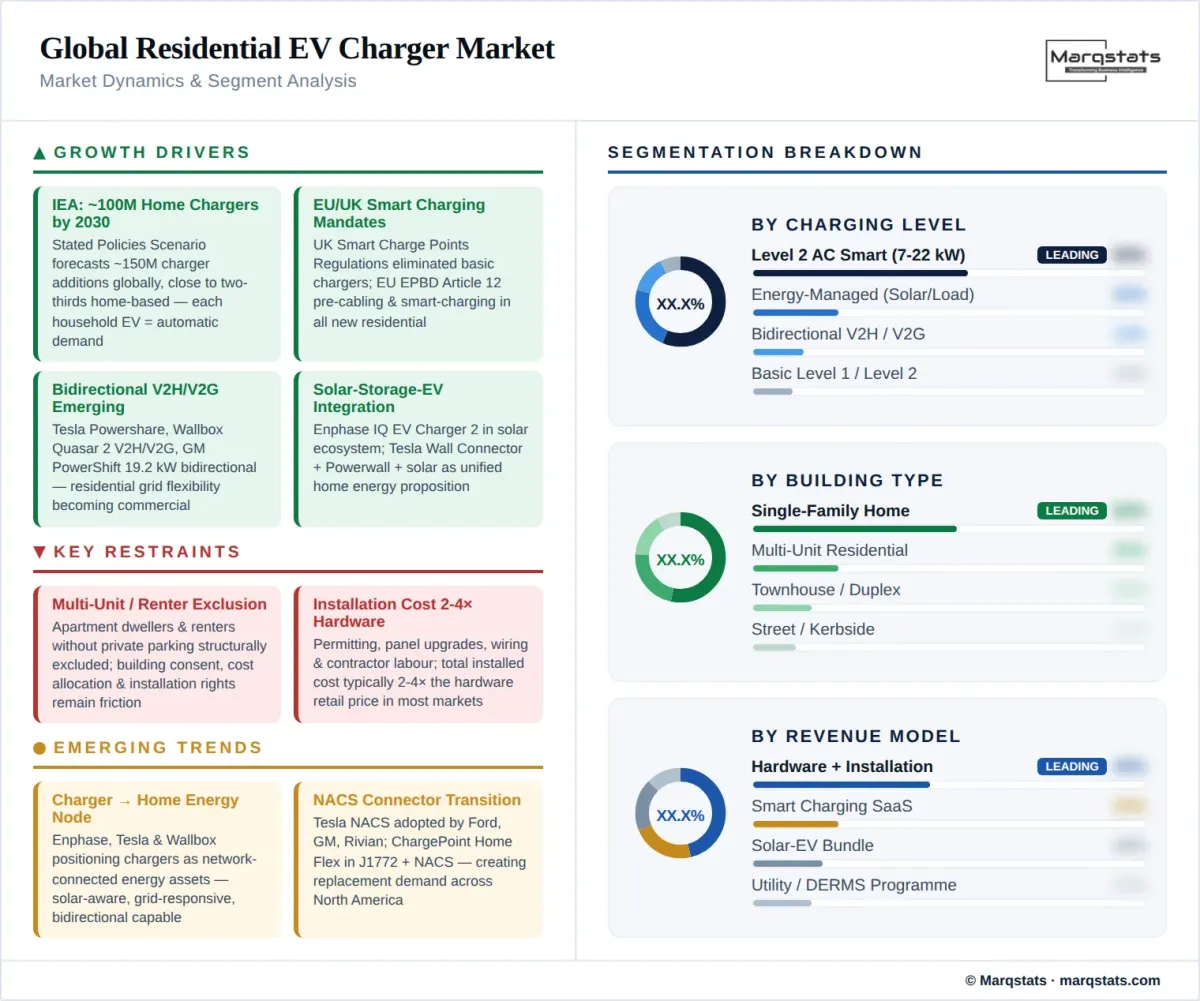
Key Drivers
- IEA Stated Policies Scenario forecasting approximately 150 million global charger additions by 2030, close to two-thirds home-based: The scale of home-charger addition implied by the IEA's baseline forecast — roughly 90–100 million home chargers added globally between 2025 and 2030 — is the single most important demand anchor for the residential charging market. Each EV sold to a household with private parking represents a near-automatic demand signal for a home charger installation, and rising EV penetration in Europe, China, North America, and Asia-Pacific all translate directly into residential charger demand. Mexico reported EV, plug-in hybrid, and range-extended EV sales rising 38.5% in 2025 to 96,636 units, with 26% growth in charging infrastructure reaching 56,726 public and private points, illustrating how EV adoption is now accelerating residential charging buildout across emerging markets.
- Smart-charging mandates in Europe driving premium product adoption: The UK's Electric Vehicles (Smart Charge Points) Regulations 2021, requiring smart functionality for all domestic charge points in Great Britain, have effectively eliminated the basic non-connected charger as a viable UK residential product, pushing buyers and installers toward connected, grid-responsive devices with time-of-use optimisation, scheduling, and renewable-energy alignment. The EU EPBD's Article 12 requirements — at least one recharging point and pre-cabling for 50% of parking spaces in new residential buildings, with smart and bidirectional-charging readiness — are embedding similar requirements into new-build housing stock across the EU from 2024 onwards, creating a structural multi-decade demand stream for compliant smart residential chargers.
- Electricity-cost optimisation providing ROI for smart-charging investment: EV owners in markets with time-of-use electricity tariffs — the UK's Octopus Energy smart tariffs, US utility off-peak EV rates, and Australia's time-variant pricing — can significantly reduce their home-charging cost by scheduling charging during off-peak or high-renewable periods. This economic incentive, which requires smart-charging hardware and software, directly justifies the premium over basic Level 2 units and creates recurring value from the software subscription and utility programme participation that platform providers monetise. The EnergyHub-FLO collaboration explicitly enables FLO charger users to earn rewards for supporting the grid through demand-response participation, illustrating how grid-economics are becoming part of the residential charger value proposition.
- Building-readiness policy creating structural installed-base demand independent of individual incentives: The EU EPBD's pre-cabling and EV-ready space requirements for new residential construction, Singapore's Land Transport Authority ECCG grant for non-landed private residences, Canada's Zero Emissions Vehicle Infrastructure Programme funding for multi-unit residences, and emerging US state and local building codes requiring EV-capable parking spaces are all creating structural demand for residential charging infrastructure that does not depend solely on consumer rebates or OEM promotion. This policy-embedded demand is more durable than incentive-dependent demand and more reliably translates into installation volumes over multi-year periods.
- V2H and V2G commercialisation creating a new residential energy-resilience value proposition: The transition from pure charging to bidirectional home-energy management — where an EV battery serves simultaneously as a transport energy source and a home backup power system — fundamentally changes the economics of residential EV charger ownership. Tesla Cybertruck's Powershare providing up to 11.5 kW and up to three days of home backup power, Wallbox Quasar 2's V2H and V2G capabilities, and GM Energy's PowerShift 19.2 kW bidirectional charger in the PG&E V2E pilot all represent commercial-stage offerings of a proposition that was experimental just two years ago. As more EV models gain bidirectional capability, the addressable market for premium residential chargers with V2H and V2G functionality will expand substantially.
Key Restraints
- Multi-unit residential buildings and renters without private parking excluded from home-charging access: The IEA explicitly notes that populations without access to home charging — apartment dwellers, renters, and residents of high-density urban areas — will continue to require public and workplace charging. In markets where apartment living is dominant — South and Southeast Asian cities, many European urban areas — the residential charger market's addressable population is structurally smaller than EV ownership numbers alone suggest. Building-level pre-cabling requirements and shared-building charging schemes (Zeplug's no-cost installation model in France, Singapore's ECCG programme) partially address this gap, but installation rights, building consent, and cost allocation remain friction points in multi-unit settings.
- Installation friction — permitting, panel upgrades, and electrical contractor availability: US DOE guidance explicitly states that home charging installations must comply with local and state codes and may require permits, electrical inspections, and potentially panel upgrades. The actual installed cost of a residential Level 2 charger — once permitting, wiring, panel upgrades, and contractor labour are included — is typically two to four times the hardware retail price, creating a total-cost-of-ownership barrier that dampens adoption in cost-sensitive segments and markets. Installer availability and training quality also vary significantly by geography, creating distribution bottlenecks that limit market access for hardware vendors unable to control the installation channel.
- Bidirectional charging limited by vehicle compatibility and grid interconnection standards: V2H and V2G residential charging depends on both the vehicle supporting bidirectional power export (still limited to specific models including Nissan Leaf, Hyundai Ioniq 5/6, Kia EV6/EV9, Ford F-150 Lightning, and select others) and the home charger having bidirectional hardware and the required grid interconnection approvals. Wallbox Quasar 2's March 2025 pre-order launch for eligible Kia EV9 users specifically, rather than all EVs, illustrates how vehicle-charger-utility compatibility constraints limit near-term V2H and V2G market scale even as the technology becomes commercially available.
Key Trends
- Residential charger evolving from wallbox hardware into home energy management node: Enphase's IQ EV Charger 2, marketed as part of its solar-storage-EV charging ecosystem with dynamic response to home solar production and grid conditions, Tesla's packaging of Wall Connector with Powerwall and solar as a unified household-energy proposition, and Wallbox's Quasar 2 around V2H, V2G, and solar-aware charging all reflect the same strategic direction: the residential charger is becoming a network-connected home energy asset, not a standalone charging appliance. This trend is reinforced by EU EPBD requirements that recharging points enable smart and bidirectional charging and by utility demand-response programmes that require charger API connectivity.
- NACS connector transition reshaping the North American residential charger market: Tesla's opening of its North American Charging Standard (NACS) to third-party use, and the subsequent adoption of NACS by major OEMs including Ford, GM, Rivian, and others, is forcing residential charger vendors in North America to address connector strategy decisions that affect product range, inventory, and installer tooling. ChargePoint's explicit offering of Home Flex in both J1772 and NACS options is a direct market response to this transition, and the connector-transition period is creating incremental hardware replacement demand as existing J1772 charger owners upgrade to NACS-compatible products.
- Southeast Asia and MENA emerging as new residential charging growth markets with local manufacturing: Malaysia's government target of 10,000 EV charging stations by 2025 under the National Energy Transition Roadmap, the Meta Bright-ChargeHere ChargeSini JV targeting mall, hotel, residential, and commercial sites, HESB-HFC's New Energy Asia JV distributing LOTUS-branded chargers from 120 kW to 450 kW in Malaysia and ASEAN, and Swift Bridge Technologies' MYR 11.2 million investment to become Malaysia's first certified EV charger manufacturer (targeting 10,000 AC units annually by 2026) collectively signal that Southeast Asia's residential and commercial charging market is localising at pace. The UAE's DEWA-Parkin partnership for public EV charging, and AUTOCRYPT's MENA cybersecurity framework for EV infrastructure, reflect similar dynamics in the Middle East.
- Grid-integration, demand response, and V2G turning residential chargers into distributed energy resources: The EnergyHub-FLO collaboration — enabling residential FLO charger owners to enrol in utility demand-response programmes and earn rewards for grid support — and GM's participation in PG&E's V2E pilot are early illustrations of a structural trend where residential EV chargers become managed distributed energy resources (DERs) that utilities and aggregators dispatch to support grid stability. As grid operators face increasing load from EV charging alongside intermittent renewable generation, managed residential charging and V2G dispatch are becoming elements of electricity system planning — creating a regulatory and commercial framework that rewards premium smart and bidirectional charger hardware.
Market Segmentation
Level 2 AC smart chargers are the dominant residential charger category by global unit volume and revenue, providing overnight home charging at 7 kW to 22 kW with app connectivity, scheduling, and time-of-use tariff optimisation. This segment is the primary beneficiary of the EU EPBD's pre-cabling and smart-charging requirements, the UK Smart Charge Points Regulations, and OEM home-charger bundling strategies. ChargePoint's Home Flex (50A, compatible with all EV brands including Tesla via both J1772 and NACS), Enphase IQ EV Charger 2, Wallbox's Pulsar Plus, and Eaton's home charging range all compete in this category. Wallbox's Supernova DC fast charger received CTEP certification for California deployment in March 2025 and is being paired with solar and battery storage in Wallbox's ENSOL partnership in Texas, Florida, and Georgia, illustrating how the residential smart-charger product range is extending upward to include DC fast charging for premium homes.
Energy-managed residential chargers — which dynamically adjust charging rate and timing based on home solar production, battery storage state of charge, whole-home load, and grid tariff signals — represent the fastest-growing value segment within residential charging. Enphase positions the IQ EV Charger 2 as central to its whole-home energy management system, enabling solar-aware charging that maximises self-consumption of rooftop solar generation and minimises grid import costs. JSW MG Motor India's MG Charge initiative, partnering with IONAGE Technologies to provide booking, monitoring, and home charging management for residents, illustrates how energy management features are being packaged into residential charger offerings even in emerging markets where the primary driver is access rather than optimisation.
Bidirectional residential chargers — capable of exporting energy from the EV battery back to the home (V2H) or to the grid (V2G) — are the highest-value and fastest-expanding premium segment, moving from experimental status to commercial availability in 2025. Wallbox Quasar 2 opened pre-orders in March 2025 for eligible Kia EV9 owners in select markets; Tesla Cybertruck's Powershare Home Backup delivers up to 11.5 kW and up to three days of home-backup power; and GM Energy's 19.2 kW PowerShift bidirectional charger is operating in PG&E's V2E pilot programme with up to USD 4,500 in incentives per household. Vehicle compatibility remains a constraint, with bidirectional support limited to specific models, but the pipeline of V2H/V2G-capable vehicles is expanding as Hyundai, Kia, Ford, and GM commit to broader bidirectional capability across their EV model families.
Single-family homeowners with dedicated parking represent the most addressable and commercially mature residential charger customer segment, accounting for the majority of current installed base globally. These customers have clear installation rights, typically have adequate electrical panel capacity for Level 2 charging, and benefit directly from overnight-charging economics and time-of-use tariff optimisation. Mobilize's partnership with Zeplug in France — offering free infrastructure installation in residential buildings with individual residents subscribing for charging at one-third the cost of public stations, and free one-year Zeplug subscriptions for new Renault and Alpine buyers — represents the OEM-channel bundling strategy targeting this segment.
Multi-unit residential buildings — apartment complexes, condominiums, and mixed-use residential properties — represent the highest-growth and most policy-targeted segment for residential EV charger investment. Singapore's LTA ECCG programme co-funding 2,000 chargers across 673 non-landed private residences, extended through December 2026 with up to SGD 3,000 per charger; Canada's ZEVIP funding for multi-unit residential buildings in Atlantic Canada; and Meta Bright-ChargeHere's ChargeSini JV targeting residential properties in Malaysia's Klang Valley (initially operating 54 chargers across 17 sites in North Kiara, Setia Eco Park, and Titiwangsa) all reflect the concentration of policy attention and commercial investment on this under-served segment.
By Geography
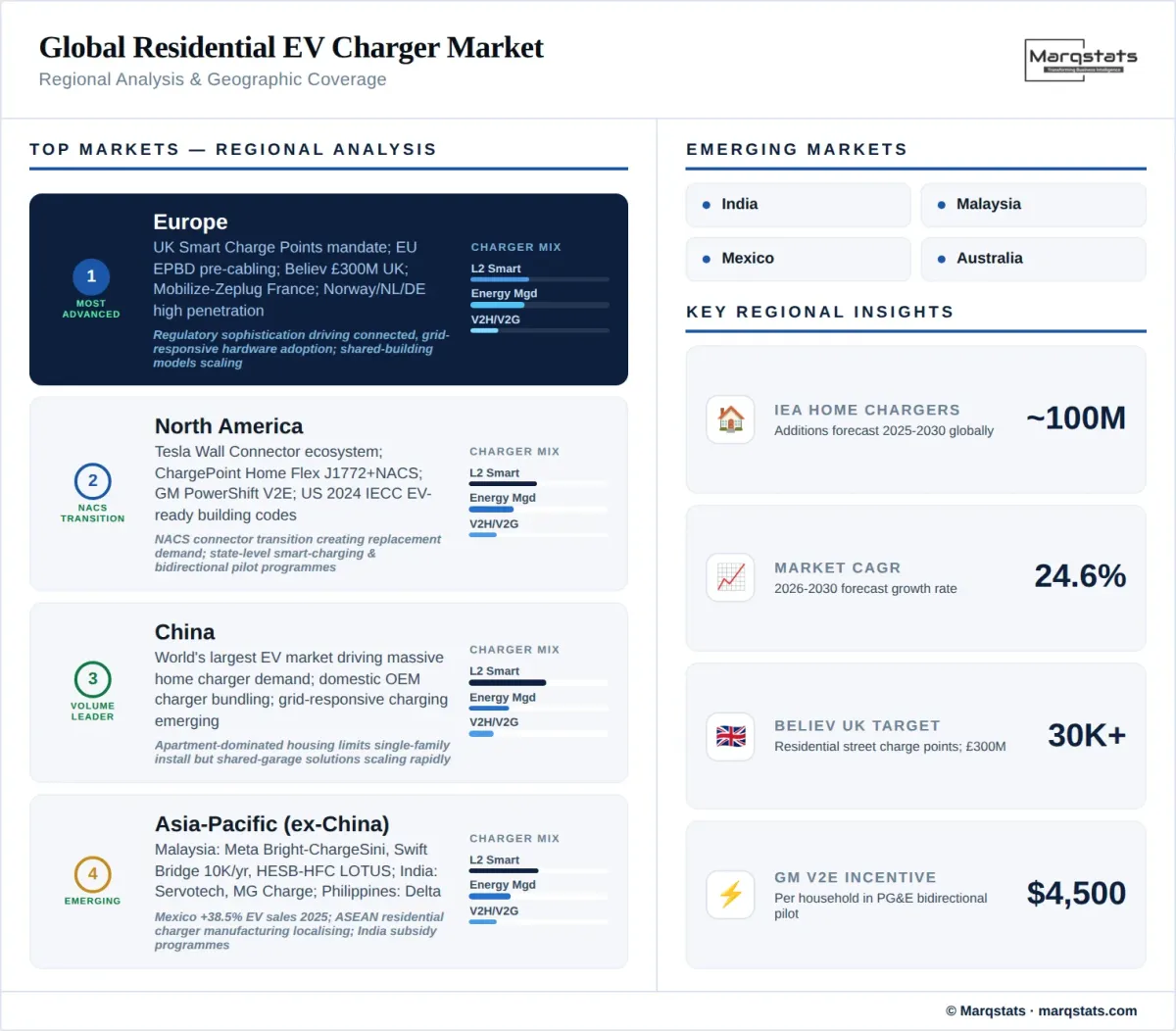
Europe
Europe is the world's most advanced residential EV charger market by regulatory sophistication, driven by the UK Smart Charge Points Regulations, EU EPBD Article 12 pre-cabling and smart-charging requirements, and high EV penetration rates in Norway, the Netherlands, Germany, the UK, and France. The UK's smart-functionality mandate has already structurally shifted the domestic market toward connected, grid-responsive hardware, and the EU EPBD's May 2024 entry into force is embedding EV-readiness into new residential construction across the EU's 27 member states. Believ secured GBP 300 million in funding from Liberty Global, Zouk Capital, Santander, ABN Amro, NatWest, and MUFG in June 2025 to deploy at least 30,000 charge points across the UK, with a significant focus on residential street charging for EV owners without private parking. France's Mobilize-Zeplug partnership targeting free installation in residential buildings with individual subscriptions at one-third the cost of public charging represents the shared-building market model that the EU EPBD's pre-cabling requirements are designed to scale.
North America
North America's residential EV charger market is being shaped by the NACS connector transition, state-level smart-charging requirements, expanding bidirectional pilot programmes, and federal incentive structures. The US 2024 IECC EV infrastructure requirements for new dwellings and widespread state building-code adoption of EV-ready parking provisions are creating structural installation demand beyond OEM-bundled home chargers. The IRS Alternative Fuel Vehicle Refueling Property Credit — 30% of cost up to USD 1,000 per charging port for individuals in eligible census tracts — provides targeted residential support, while GM's PG&E V2E pilot (offering up to USD 4,500 per household in incentives for bidirectional charger adoption) represents the first large-scale OEM utility-embedded V2G programme in the US residential market. Wallbox's March 2025 CTEP California certification and ENSOL partnership deploying Supernova DC fast chargers paired with solar across Texas, Florida, and Georgia illustrate the expanding premium residential fast-charger market alongside standard Level 2 installations. Canada's ZEVIP funding for Atlantic Canada multi-unit residential buildings reflects federal expansion of residential charging infrastructure beyond primary urban EV markets.
Asia-Pacific
Asia-Pacific is the fastest-growing residential EV charger market, driven by China's dominant EV market (the world's largest by volume), surging EV adoption in South Korea, Japan, Australia, India, and Southeast Asia, and active government infrastructure programmes. Singapore's LTA ECCG programme demonstrates how city-states with predominantly high-rise residential stock are addressing home-charging access through shared-building co-investment models. Malaysia's residential and commercial charging market is rapidly localising: Meta Bright-ChargeHere's ChargeSini JV targeting residential and commercial properties across Kuala Lumpur, Selangor, Johor, and Penang; the Proton e.MAS 7 maintaining 23.4% EV market share with over 1,100 home chargers across 390 residential properties via 10 charging-network partnerships; and Swift Bridge Technologies' MYR 11.2 million investment in Malaysia's first certified AC and DC charger manufacturing facility all reflect a market transitioning from import dependency to local ecosystem development. India's JSW MG Motor MG Charge initiative targeting 5,000 housing societies by 2028 with IONAGE Technologies represents the residential charging infrastructure strategy for India's rapidly growing EV market.
Middle East and Africa
The Middle East is an emerging residential and public EV charger market, driven by government net-zero commitments, high vehicle ownership rates, and rapidly expanding EV model availability. The UAE's October 2025 DEWA-Parkin partnership deploying 100 EV chargers across residential communities, shopping malls, leisure destinations, and public areas in Dubai — with a broader rollout planned — represents the Gulf's move from pilot installations to network-scale EV charging deployment. AUTOCRYPT's November 2025 announcement of a comprehensive MENA cybersecurity framework spanning vehicle manufacturing and charging infrastructure in 2026 signals that the region is building the secure connected-vehicle and EV-charging infrastructure ecosystem that will underpin long-term residential and fleet charging adoption.
Latin America
Latin America is an early-growth residential EV charger market, with Mexico as the region's most advanced market. Mexico's charging infrastructure grew 26% in 2025 to 56,726 public and private charging points, with fast-charging infrastructure growing over 86%, and EV sales (including PHEVs and range-extended EVs) rising 38.5% to 96,636 units. Private networks account for more than 52,600 chargers, confirming that residential and workplace installation is the primary growth driver, consistent with global patterns. Brazil, Chile, and Colombia represent significant medium-term growth markets as EV adoption accelerates and local charging infrastructure policies develop.
How Competition Is Evolving
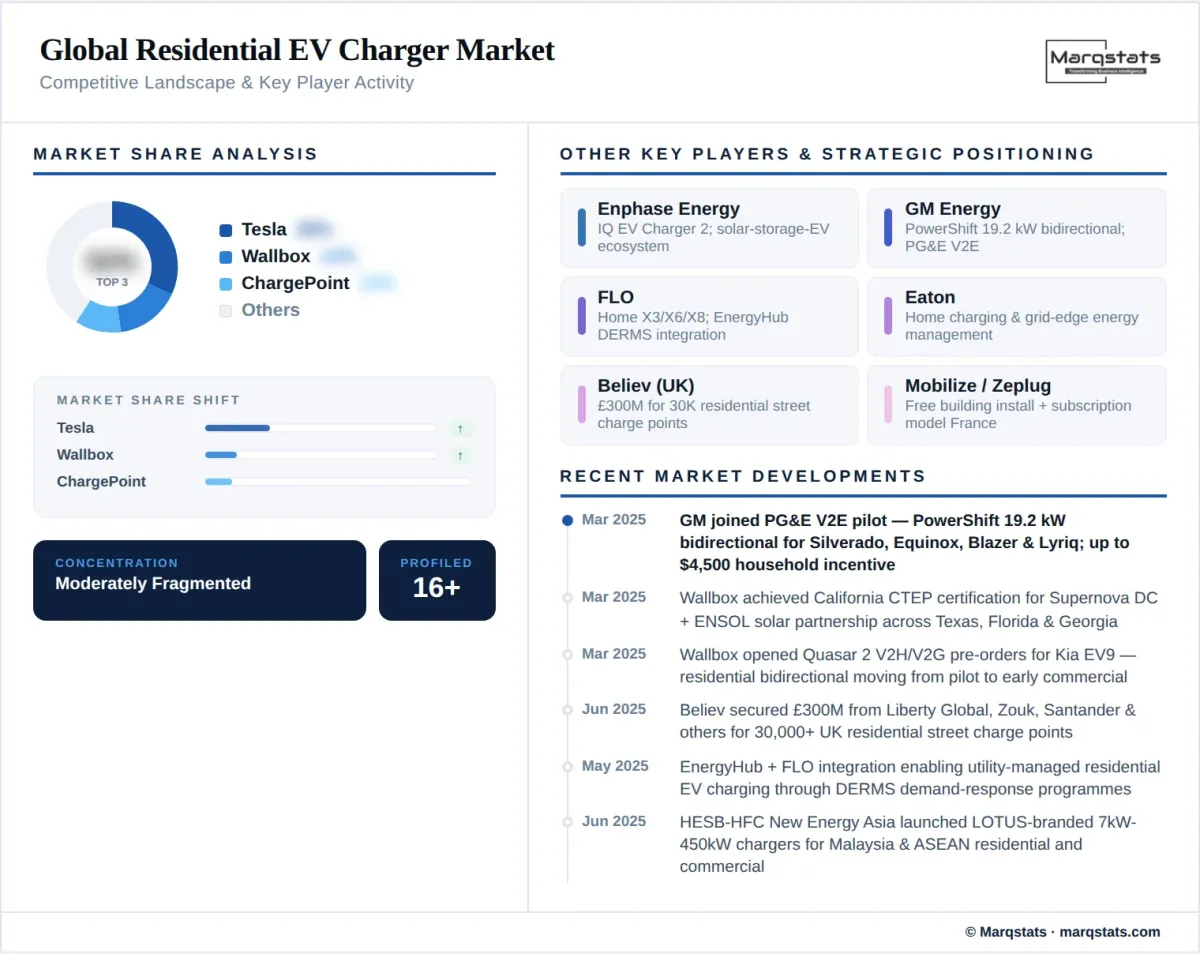
The global residential EV charger market is moderately fragmented at the hardware level, with increasing consolidation at the platform and ecosystem level. The competitive dynamic is shifting from competition on charging amperage and hardware reliability toward platform breadth, software features, energy management capability, installer network depth, and V2H/V2G functionality. Four distinct competitive archetypes are defining the market: EV OEM ecosystem players (Tesla, GM Energy, Hyundai Home Energy), independent smart-charging platform providers (ChargePoint, Wallbox, Enphase, Eaton), utility-embedded demand-response platforms (EnergyHub, FLO, ChargePoint Enterprise), and regional market leaders in high-growth geographies (Meta Bright/ChargeSini in Malaysia, Servotech in India, Swift Bridge Technologies in Malaysia).
Tesla's residential charging ecosystem — integrating Wall Connector hardware, Powershare bidirectional capability, Powerwall battery storage, and solar roof and panel systems — represents the most vertically integrated residential energy management proposition in the market. The commercial success of Cybertruck Powershare Home Backup, providing up to 11.5 kW of home backup power, establishes Tesla not merely as a charger hardware vendor but as a household energy company competing with utilities and home storage providers. Enphase's IQ EV Charger 2 positions the competing solar-storage-EV-charging ecosystem strategy: whole-home energy orchestration where the EV battery is one node in a coordinated residential energy management architecture.
Wallbox is the clearest pure-play residential charging innovator, with the widest bidirectional product portfolio of any independent vendor. Quasar 2's V2H, V2G, solar, and home-backup capabilities — combined with the Supernova DC fast charger's CTEP California certification for commercial-residential applications and the ENSOL partnership in Texas, Florida, and Georgia — position Wallbox as the technology leader across the premium residential and semi-commercial charger market. ChargePoint's Home Flex, available in both J1772 and NACS, competes as the most connector-universal residential smart charger for the North American market's NACS transition period.
Companies Covered
The report profiles 16+ companies with full strategy and financials analysis, including:
Recent Market Activity
Table of Contents
Coverage & Segmentation
This report provides a comprehensive analysis of the global residential EV charger market covering the 2021–2030 period, with 2025 as the base year. The study covers Level 2 AC smart chargers (7 kW–22 kW), energy-managed residential chargers with solar and load integration, bidirectional V2H and V2G residential chargers, residential charger software platforms and energy management systems, installation services (including panel upgrades, permitting, and compliance), and utility-embedded demand-response and DERMS integration programmes. Regulatory coverage spans the UK Smart Charge Points Regulations 2021, EU Energy Performance of Buildings Directive 2024, US 2024 IECC EV infrastructure requirements, IRS Alternative Fuel Vehicle Refueling Property Credit, Singapore ECCG programme, Canada ZEVIP, Malaysia NETR, and Malaysia SIRIM certification framework. Geographic coverage spans Europe, North America, Asia-Pacific (China, South Korea, Japan, India, Southeast Asia), Middle East, and Latin America, with country-level analysis for the UK, France, Germany, United States, Canada, Malaysia, Singapore, India, UAE, and Mexico.
Primary research included 40+ interviews with residential EV charger product managers, installation channel partners and electricians, utility demand-response programme managers, OEM home-energy integration leads, property developer EV-infrastructure procurement teams, and residential charging market regulators across Europe, North America, and Asia-Pacific. Secondary research drew from IEA Global EV Outlook 2025, UK Smart Charge Points Regulations official text, EU EPBD official guidance, US DOE AFDC installation requirements, IRS tax credit guidance, Singapore LTA ECCG programme pages, Canada Natural Resources ZEVIP announcements, Malaysia Bursa filings, and company press releases and investor materials.