Market Snapshot
Key Takeaways
Market Overview & Analysis
Report Summary
The GCC range-extended electric SUV market covers sport-utility vehicles in which the wheels are driven electrically at all times and an onboard combustion engine acts solely as a generator to replenish the battery. That architecture distinguishes them from conventional plug-in hybrids, where the combustion engine can drive the wheels directly, and from battery electric vehicles, which carry no generator. The distinction matters commercially rather than only technically, because the driving experience is electric while the refuelling behaviour is conventional.
Gulf conditions favour the architecture more strongly than almost any other market. Charging networks are under construction rather than complete, intercity routes cross long distances with sparse infrastructure, and ambient heat both degrades battery performance and increases auxiliary load. A vehicle carrying its own generator addresses all three without requiring the network to exist first, and it does so while preserving the electric drive quality that buyers who have considered a battery electric vehicle are looking for.
The category is concentrated in sport-utility vehicles by design rather than by accident, and it stays there across the forecast. Range extension adds a generator, a fuel system and their associated packaging to an electric drivetrain, which suits a large body style and is difficult to justify in a compact one. Gulf buyer preference for large vehicles and the region's family-vehicle demand pattern make the sport-utility configuration the natural and probably the only viable home for the technology in this market.
Range-Extended Electric SUV Sales Volume and Forecast
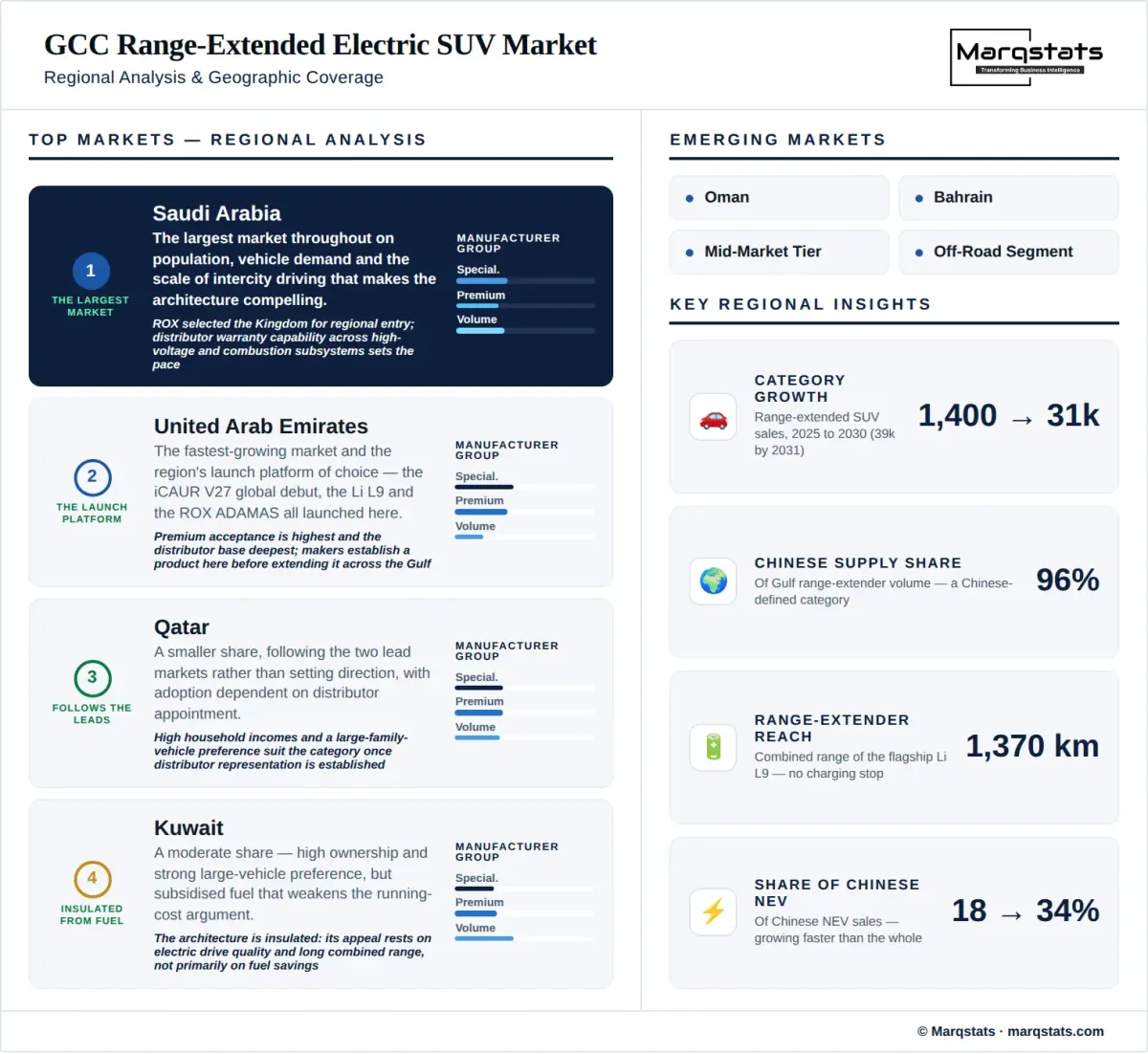
Range-extended electric sport-utility vehicle sales across the six Gulf states rise from 1,400 units in 2025 to 31,000 by 2030, an 85.80% compound annual growth rate, with an indicative 2031 volume near 39,000 units. Growth is steepest in the first two forecast years as announced launches reach showrooms, and the category adds its largest absolute volumes in the closing years as mid-market products broaden the addressable price range.
Chinese manufacturers account for approximately 96% of that volume throughout, which makes the category almost a subset of Chinese new energy vehicle sales in the region. Measured against Gulf Chinese new energy vehicle volume, range-extended sport-utility vehicles represent about 18% of units in 2025 rising to roughly 34% by 2030. The category therefore grows faster than Chinese electrified sales as a whole without becoming the dominant Gulf electrification architecture, which remains battery electric on a units basis across the forecast.
Blended transaction value falls from approximately USD 62,000 to USD 44,000 per vehicle, a 6.63% annual decline, which is why sales value compounds at 73.48% against 85.80% growth in units. Early volume is heavily weighted toward flagship products positioned above the segment average, and the composition shifts as volume manufacturers and premium sub-brands introduce products at accessible price points. The decline is steeper than in the broader Chinese new energy vehicle category because the range-extender base is more premium-skewed to begin with.
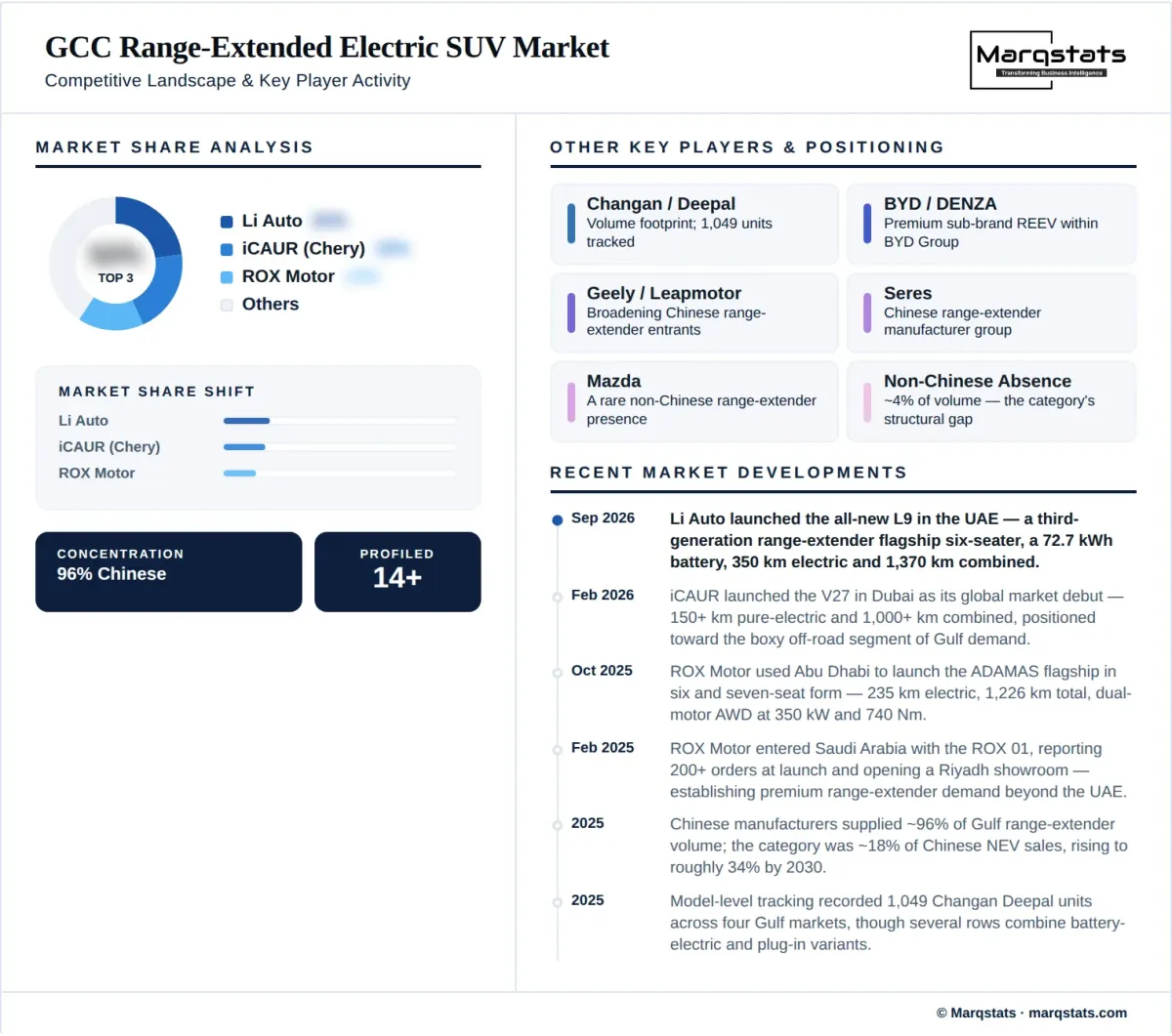
Estimates are reconciled working figures rather than a direct count. Model-level tracking records 1,049 Changan Deepal units across Saudi Arabia, the United Arab Emirates, Kuwait and Oman in 2025, but several rows combine battery electric and plug-in variants and the exact range-extender split is unavailable. Specialist deliveries and orders from brands including ROX Motor are not fully represented in that file, and Qatar and Bahrain fall outside its coverage. The base is therefore assembled from launch records, order disclosures and brand-level positioning rather than summed from the dataset.
Market Dynamics
Key Drivers
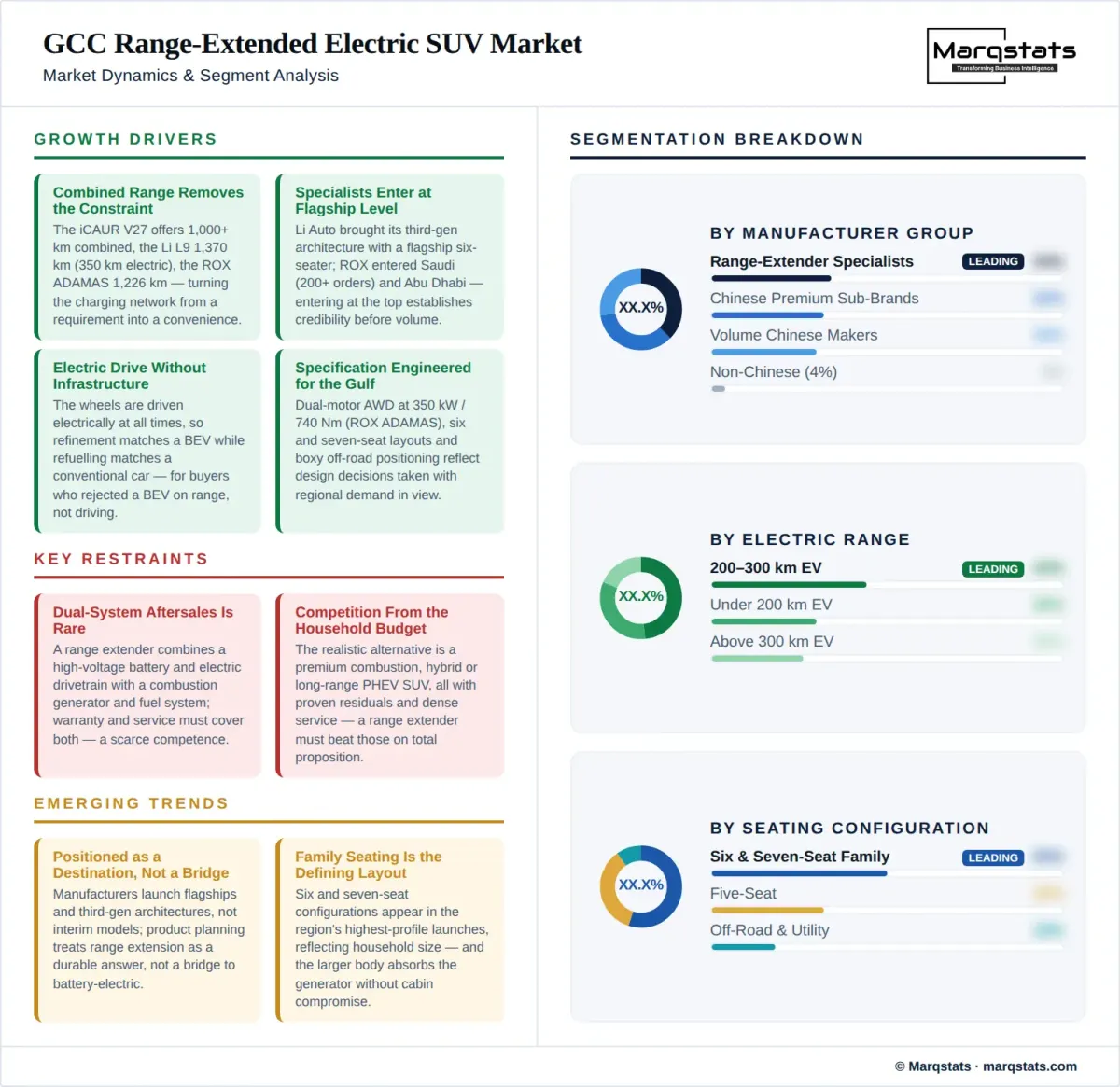
- Combined range figures that remove the intercity constraint outright. The iCAUR V27 offers more than 1,000 kilometres combined, the Li Auto L9 reaches 1,370 kilometres on a 72.7 kWh battery with 350 kilometres in electric-only operation, and the ROX ADAMAS delivers 1,226 kilometres total with 235 kilometres electric. Figures at that level convert the charging network from a requirement into a convenience, which is the single largest barrier to Gulf electrification removed.
- Specialist manufacturers entering at flagship level rather than testing the market. Li Auto brought its third-generation range-extender architecture to the United Arab Emirates with a flagship six-seat product, and ROX Motor entered Saudi Arabia in February 2025 with a luxury sport-utility vehicle, opened a Riyadh showroom, planned a second flagship outlet and took the ADAMAS to Abu Dhabi in October. Entering at the top establishes the technology's credibility before volume products arrive beneath it.
- Electric drive quality without dependence on public infrastructure. The wheels are driven electrically at all times, so acceleration, refinement and noise behaviour match a battery electric vehicle while refuelling behaviour matches a conventional one. That combination appeals to buyers who have considered a battery electric vehicle and rejected it on range or charging grounds rather than on driving preference.
- Product specification engineered for Gulf use rather than adapted to it. Dual-motor all-wheel drive delivering 350 kW and 740 Nm in the ROX ADAMAS, six and seven-seat family configurations, and the boxy off-road positioning of the iCAUR V27 reflect design decisions taken with regional demand in view. Manufacturers are matching the technology to Gulf vehicle preference rather than exporting a home-market specification.
- Homologation through existing frameworks rather than a new approval regime. Range-extended vehicles are approved through established passenger vehicle safety, emissions and type-approval processes rather than a separate category, which removes the regulatory delay that has slowed genuinely novel vehicle types elsewhere. Market entry timing depends on distributor readiness rather than on legislation.
Key Restraints
- Dual-system aftersales capability that few distributors yet hold. A range extender combines a high-voltage battery and electric drivetrain with a combustion generator and fuel system, and warranty and service capability must cover both. Distributor competence across the two domains will shape market confidence more than product specification, and it is the capability least visible to a buyer at the point of purchase.
- Residual values with no regional precedent. Neither the architecture nor most of the brands carrying it have a Gulf resale record, and lease and fleet economics depend on residual assumptions that cannot yet be validated. Buyers financing a premium vehicle carry that uncertainty directly, and corporate and fleet purchasers, who would otherwise accelerate adoption, are the segment most exposed to it.
- Competition from the same household budget rather than the same powertrain. The realistic alternative purchase is a premium combustion, conventional hybrid or long-range plug-in hybrid sport-utility vehicle, all of which are established in the Gulf with proven residuals and dense service networks. A range extender must beat those on total proposition, not merely outperform battery electric vehicles on range.
- Conformity treatment that is more complex than for either pure architecture. Fuel and emissions labelling and import conformity have to accommodate a vehicle that combines battery and combustion systems, and charging interface compatibility remains relevant because these vehicles can use public charging even though the generator reduces dependence on it. Neither issue blocks entry, but both add administrative work that a single-architecture vehicle avoids.
Key Trends
- Range extension positioned as a destination rather than a transition. Manufacturers are launching flagship products and third-generation architectures rather than interim models, and product planning treats the technology as a durable answer to Gulf conditions. That framing differs sharply from markets where range extension is presented as a bridge to battery electric, and it shapes how the category should be forecast.
- Family seating emerging as the defining Gulf configuration. Six and seven-seat layouts appear in the region's highest-profile range-extender launches, reflecting household size and multi-generational travel patterns that a five-seat product serves poorly. The configuration also suits the architecture, since a larger body accommodates the generator and fuel system without compromising cabin space.
- Electric range figures escalating as a competitive metric. Pure-electric range among launched Gulf products runs from more than 150 kilometres to 350 kilometres, and the upper figures now approach the total range of some battery electric vehicles sold in the region. As that number rises the vehicle behaves as an electric car for a growing share of journeys, which changes the ownership experience rather than only the specification sheet.
- Marketing shifting from battery size to electric-drive experience. The commercially effective argument is that the vehicle drives electrically all the time and never requires a charging stop on a long journey, not that it carries a particular battery capacity. Manufacturers emphasising capacity compete on a metric where battery electric vehicles win; those emphasising experience and flexibility compete where the architecture is genuinely differentiated.
Market Segmentation
Range-extended vehicles offering more than 300 kilometres of pure-electric operation occupy the top of the market and grow fastest in value terms, exemplified by the Li Auto L9 at 350 kilometres on a WLTC basis. At this level the combustion generator becomes a long-journey provision rather than a routine part of operation, and the vehicle functions as a battery electric car for most weekly use while retaining unlimited touring capability.
The 200 to 300 kilometre band is the segment's commercial centre and includes the ROX ADAMAS at 235 kilometres WLTC. Electric range at this level covers daily and most weekly driving without recourse to the generator, while keeping battery cost and mass below the level required for the top tier. The band is expected to hold the largest share of volume across the forecast.
Vehicles offering under 200 kilometres of electric range, including the iCAUR V27 at more than 150 kilometres, prioritise combined range and price over electric-only capability. The band grows fastest in unit terms as mid-market products enter, because a smaller battery is the most direct route to a lower transaction price while retaining the architecture's core advantage of long combined range.
Six and seven-seat configurations are the defining Gulf layout for the category and carry the highest transaction values, with both the Li Auto L9 and the ROX ADAMAS offered in that form. Household size, multi-generational travel and long intercity journeys with full occupancy all favour the configuration, and the architecture accommodates it because a larger body absorbs the generator and fuel system without cabin compromise.
Five-seat range-extended sport-utility vehicles serve buyers prioritising vehicle size and electric drive over passenger capacity, and the segment grows as mid-market products arrive at price points where a seven-seat configuration would be uneconomic. It is the configuration most directly exposed to competition from battery electric sport-utility vehicles, which are widely available in five-seat form.
Off-road and utility-oriented range extenders address Gulf demand for desert capability and rugged positioning, with the boxy iCAUR V27 targeting that segment explicitly. The architecture suits the application well, since electric drive delivers instant torque for low-speed traction while the generator removes the range concern that makes remote-area use impractical in a battery electric vehicle.
The premium tier holds the largest share of both volume and value across most of the forecast and is where the category's competitive contest actually occurs, against established premium combustion, hybrid and long-range plug-in hybrid sport-utility vehicles. Products entering this band must offer a total ownership proposition rather than a range advantage alone, because the alternatives carry proven residuals and dense service networks.
The luxury tier carries a disproportionate share of value relative to volume and includes the flagship products with which specialist manufacturers established the category in the region. Its strategic function exceeds its commercial scale: demonstrating that Chinese range extenders can be sold at genuine luxury price points is what makes the premium and mid-market propositions beneath them credible.
The mid-market tier is smallest in 2025 and grows fastest across the forecast as volume manufacturers introduce products at accessible price points, and it is the principal reason blended transaction value declines. Delivering the architecture below this threshold requires a smaller battery, which is why mid-market products concentrate in the under-200-kilometre electric range band.
Range-extender specialists led the category into the Gulf and hold the strongest premium positions, comprising manufacturers whose product strategy is built entirely around the architecture rather than offering it alongside other powertrains. Li Auto brought its third-generation architecture to the United Arab Emirates and ROX Motor established in Saudi Arabia and Abu Dhabi, both entering with flagship products and dedicated retail rather than through existing multi-brand networks.
Volume Chinese manufacturers including Changan through its Deepal line supply the broadest model-level footprint in Gulf tracking data, with 1,049 Deepal units recorded across four markets in 2025 on coding that combines battery electric and plug-in variants. These manufacturers convert established combustion customer bases and distributor networks rather than building new ones, which gives them the faster route to volume and the slower route to premium positioning.
Chinese premium sub-brands, including iCAUR within Chery Group and Denza within BYD Group, occupy the space between specialists and volume manufacturers, carrying parent-group manufacturing scale with distinct retail identities. The iCAUR V27 global launch staged from Dubai in February 2026 illustrates the approach, presenting a sub-brand rather than a parent marque as the regional proposition.
Non-Chinese manufacturers account for roughly 4% of Gulf range-extender volume and represent the category's clearest structural gap. Established Japanese, Korean, European and American brands hold the distributor networks, service capability and residual value credibility that Chinese entrants lack, and their absence from the architecture is what allows Chinese manufacturers to define the category in the region unopposed.
By Geography
Saudi Arabia
Saudi Arabia is the largest market throughout on population, vehicle demand and the scale of intercity driving that makes the architecture compelling. ROX Motor selected the Kingdom for its regional entry in February 2025, reporting more than 200 orders around the launch and opening a Riyadh showroom with a further flagship outlet planned. Distributor warranty capability across both high-voltage and combustion subsystems is the principal determinant of how quickly the market develops beyond the launch phase.
United Arab Emirates
The United Arab Emirates is the fastest-growing market and the region's launch platform of choice, with the iCAUR V27 staging its global debut in Dubai in February 2026, the Li Auto L9 arriving in September 2026 and the ROX ADAMAS launching in Abu Dhabi in October 2025. Premium acceptance is highest, the distributor base is deepest, and manufacturers consistently select the country to establish a product before extending it across the Gulf.
Qatar
Qatar holds a smaller share and follows the two lead markets rather than setting direction, with adoption dependent on distributor appointment and service capability rather than on demand conditions, which resemble those of the larger Gulf states. High household incomes and a preference for large family vehicles suit the category once representation is established.
Kuwait
Kuwait holds a moderate share, combining high vehicle ownership and strong large-vehicle preference with subsidised fuel that weakens the running cost argument. The architecture is comparatively well insulated from that weakness, since its appeal rests on electric drive quality and long combined range rather than primarily on fuel savings, but the economic case is nonetheless less compelling than elsewhere in the region.
Oman and Bahrain
Oman and Bahrain together hold the smallest share and sit outside the model-level coverage that anchors the rest of the estimate, making their contribution the least precisely measured. Both follow distributor appointment rather than independent demand development, and Oman's long intercity distances and mountainous terrain suit the architecture particularly well once representation exists.
How Competition Is Evolving
The category is fragmented among Chinese entrants and effectively uncontested by anyone else, which is the structural fact that defines it. Range-extender specialists, volume manufacturers and premium sub-brands compete against one another for a market that reached an estimated 1,400 units across six countries in 2025, while established Japanese, Korean, European and American manufacturers are largely absent from the architecture in this region. Chinese manufacturers are therefore defining the category's positioning, price expectations and specification benchmarks without external reference points.
The competitive contest that matters is not among range extenders at all. A buyer considering one of these vehicles is realistically choosing between it and a premium combustion, conventional hybrid or long-range plug-in hybrid sport-utility vehicle for the same household budget, and those alternatives carry proven residual values, dense service networks and decades of brand familiarity in the Gulf. Winning that comparison requires a total ownership proposition, and the specification advantage that dominates the marketing addresses only part of it.
Aftersales capability is where the category's competitive position will be settled over the forecast period. A range extender requires warranty and service competence across a high-voltage battery and electric drivetrain and a combustion generator and fuel system simultaneously, and few Gulf distributors currently hold both at depth. The manufacturers investing in dual-domain service capability alongside showroom expansion are building the asset that determines retention, and the ones treating retail footprint as the priority are building the one that determines only the first sale.
Companies Covered
The report profiles 16+ companies with full strategy and financials analysis, including:
Recent Market Activity
Table of Contents
Coverage & Segmentation
The study covers the six Gulf Cooperation Council states with country-level detail for Saudi Arabia, the United Arab Emirates, Qatar, Kuwait, and Oman and Bahrain combined. It measures new range-extended electric sport-utility vehicle sales in units as the primary measure, with annual sales value in United States dollars as the secondary measure. The base year is 2025, the historical period covers 2024 to 2025, and the forecast period runs from 2026 to 2030 with an indicative 2031 endpoint. Segmentation covers electric range, seating configuration, price tier and manufacturer group.
Four boundaries define the market. Conventional plug-in hybrids are excluded, because their combustion engine can drive the wheels directly and the ownership proposition differs accordingly. Battery electric vehicles are excluded, as are conventional hybrids without external charging. Non-sport-utility body styles are excluded, which removes very little volume in practice since the architecture is concentrated almost entirely in that body style across the region. Used and re-exported vehicles are excluded.
Chinese manufacturers supply approximately 96% of the volume measured here, which makes the category close to a subset of Gulf Chinese new energy vehicle sales. Measured against that wider market, range-extended sport-utility vehicles account for roughly 18% of units in 2025 and about 34% by 2030, so the two measures describe a category and the market containing it rather than two populations that combine.