Market Snapshot
Key Takeaways
Market Overview & Analysis
Report Summary
The global low-speed electric vehicle market comprises battery-electric four-wheel vehicles limited to roughly 45–70 km/h, spanning golf-cart-style personal and utility vehicles, neighborhood electric vehicles, closed-cabin microcars and quadricycles, and specialty low-speed variants used across campuses, resorts, gated communities, and municipal and commercial fleets. This study segments the market by vehicle type, battery type, and application, with a 2025 base year, historical coverage from 2021 to 2025, and forecasts to 2030. Market size is stated as new-vehicle sales revenue in United States dollars.
China remains the largest single market by unit volume, a position built over more than a decade of low-cost lead-acid golf-cart and utility vehicle production for rural and lower-tier city buyers who use these vehicles as an affordable alternative to a first car. National standards tightened progressively from 2019, curbing the unregulated growth that characterised the market through 2018, and pushing manufacturers toward compliant, better-specified vehicles rather than the lowest-cost models that previously dominated volume. This regulatory transition has been the single largest structural event in the market's recent history, and its pace continues to determine whether Chinese unit volume stabilises, resumes growth, or continues to moderate over the forecast period.
Outside China, the market is shaped by two distinct regulatory traditions: North America's neighborhood electric vehicle classification, which permits low-speed vehicles on roads posted up to 35 miles per hour, and the European Union's L6e and L7e quadricycle categories, which allow younger and restricted-license drivers to operate a fully enclosed four-wheel vehicle without a standard driving licence in several member states. Both frameworks have created durable, if geographically concentrated, demand pools that are less exposed to the policy swings affecting the Chinese market.
The competitive and regulatory separation between these three regions is unusually clean for a global automotive category: a Chinese golf-cart manufacturer, a European quadricycle specialist, and a North American neighborhood electric vehicle maker rarely compete for the same buyer, since each operates within a distinct vehicle-classification regime that effectively defines its addressable market. This report therefore models each region's demand independently rather than treating low-speed electric vehicles as a single homogeneous global product category.
Market Dynamics
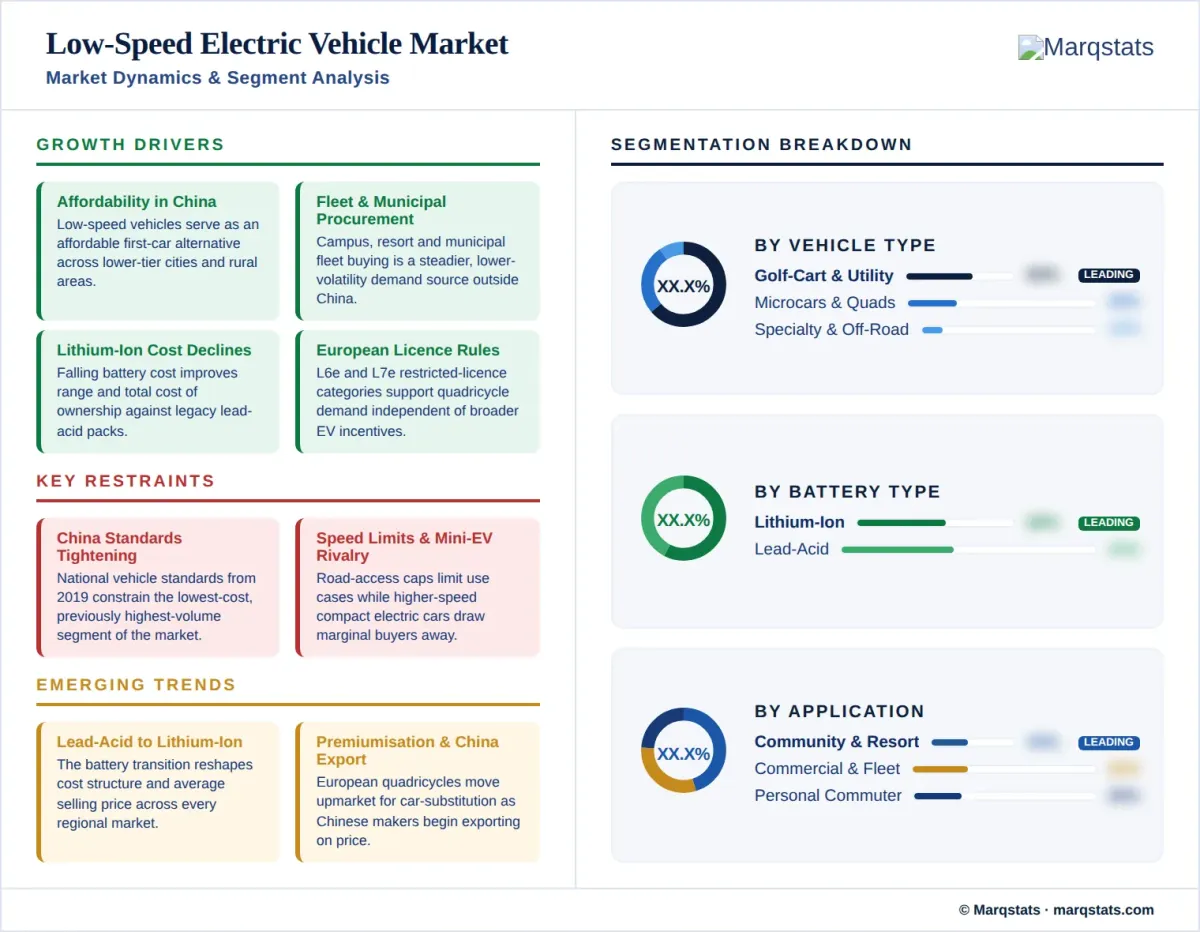
Key Drivers
- Affordability relative to conventional passenger vehicles continues to drive first-time buyer adoption in China's lower-tier cities and rural areas.
- Municipal, campus, and resort fleet procurement is expanding steadily as a lower-volatility demand source outside China.
- Lithium-ion battery cost declines are improving range and reducing total cost of ownership relative to legacy lead-acid packs.
- European restricted-licence and youth-mobility regulations continue to support quadricycle demand independent of broader EV incentives.
- Last-mile delivery and micro-logistics applications are opening a new commercial demand pool for compact utility variants.
Key Restraints
- Chinese national vehicle standards continue to constrain the lowest-cost, previously highest-volume segment of the market.
- Speed and road-access restrictions limit low-speed vehicles to posted-speed-limited roads in most jurisdictions, capping addressable use cases.
- Rising consumer interest in higher-speed compact electric cars, such as China's mini-EV segment, is drawing marginal buyers away from true low-speed vehicles.
Key Trends
- Lead-acid to lithium-ion battery transition is reshaping cost structure and average selling price across every regional market.
- Municipal and campus security, maintenance, and last-mile delivery fleets are professionalising procurement away from ad hoc purchasing.
- European quadricycle manufacturers are introducing higher-specification models targeting urban car-substitution rather than only youth mobility.
- Chinese manufacturers are beginning limited export activity into Southeast Asia and Africa, extending their affordability-led domestic playbook internationally.
Market Segmentation
Golf-cart-style and utility low-speed vehicles remain the dominant vehicle-type segment by both unit volume and revenue, spanning personal community vehicles, resort and hospitality fleets, and municipal and campus utility applications. This category is the most price-sensitive of the three vehicle types and shows the closest correlation to lead-acid-to-lithium-ion battery transition economics. Within this segment, personal community vehicles remain the largest sub-category by unit count, while commercial and institutional fleet variants command higher average selling prices owing to added utility features such as cargo beds, enclosed cabs, and fleet telematics. Replacement demand within existing communities and resorts, rather than first-time adoption in new locations, increasingly drives this segment in mature North American markets.
Closed-cabin microcars and quadricycles, including the European L6e and L7e categories, represent the fastest-growing vehicle-type segment, driven by restricted-licence eligibility, urban parking advantages, and rising interest from buyers using them as a primary rather than supplementary vehicle. Average selling prices in this category run well above golf-cart-style vehicles, giving it an outsized contribution to value growth relative to its unit share. Manufacturers are increasingly differentiating on cabin comfort, infotainment, and range rather than price alone, a shift that mirrors the broader premiumisation trend running through this market and that is gradually narrowing the specification gap between quadricycles and entry-level conventional city cars.
Specialty low-speed vehicles, including security and patrol variants, agricultural and industrial utility carts, and off-road field vehicles, form a smaller, stable segment tied closely to institutional and commercial fleet budgets rather than consumer demand cycles. Replacement cycles in this segment are typically longer than in personal-use categories, since institutional buyers prioritise durability and total cost of ownership over upfront price or styling, and procurement is usually governed by multi-year budget cycles rather than discretionary purchase timing.
Lead-acid batteries remain common in China's lower-cost golf-cart and utility segment, where upfront cost sensitivity outweighs the range and lifespan advantages of lithium-ion packs, though this share is declining as national standards push toward better-specified vehicles. Lead-acid packs typically cost less than half of an equivalent lithium-ion pack on an upfront basis, which explains their persistence in the most price-sensitive buyer segments despite materially shorter service life and heavier weight.
Lithium-ion batteries dominate the North American and European market and are gaining share rapidly in China's compliant, better-specified vehicle segment, offering longer range, lighter weight, and materially longer service life than lead-acid alternatives despite a higher upfront cost. Fleet buyers in particular increasingly specify lithium-ion as standard, since the total-cost-of-ownership advantage over a multi-year fleet lifecycle outweighs the higher purchase price, a calculation less relevant to individual consumer buyers making a one-time purchase decision.
Community, resort, and campus applications represent the largest single application category, spanning gated-community personal mobility, hospitality guest transport, and higher-education and corporate campus circulation. Demand in this category is closely tied to real-estate development cycles in master-planned communities and resort destinations, particularly across the warm-climate states that dominate North American demand.
Commercial and municipal fleet applications, including security patrol, parks and public-works maintenance, and last-mile micro-logistics, represent the fastest-growing application category as procurement professionalises and budgets shift from ad hoc replacement to planned fleet programmes. Fleet buyers increasingly specify lithium-ion battery packs and telematics integration as standard requirements, accelerating the broader battery-transition trend running through the market.
Personal commuter use, concentrated in China's lower-tier cities and rural areas and in Europe's quadricycle segment, remains the largest application by unit volume even as its share of total value continues to narrow relative to fleet and commercial applications. This divergence between volume leadership and value share is the clearest expression of the broader premiumisation trend documented throughout this report, and it is expected to persist through the forecast period as fleet and commercial buyers continue outgrowing personal-use demand on a value basis even where unit counts move more slowly.
By Geography
China
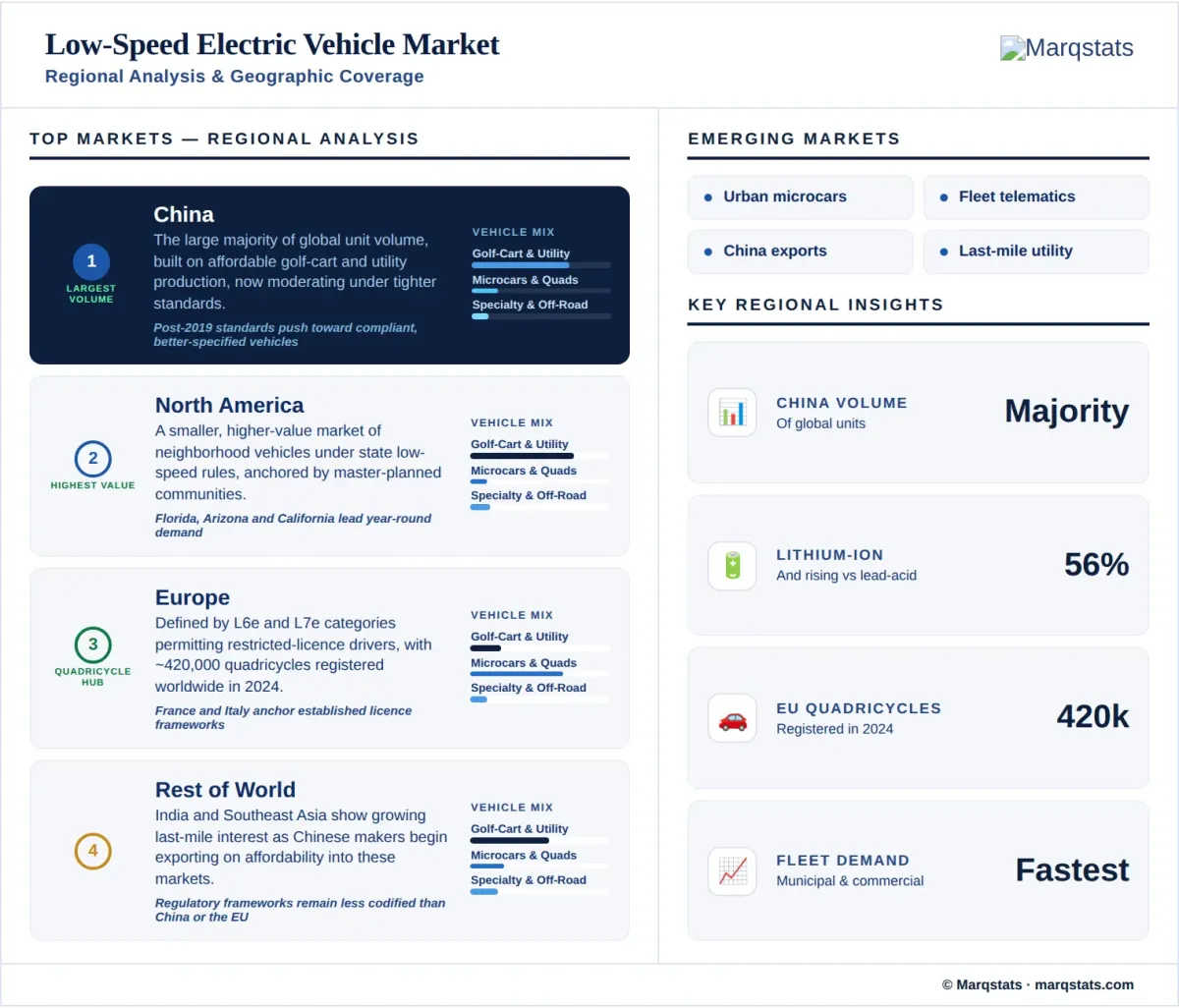
China accounts for the large majority of global unit volume, built on more than a decade of affordable golf-cart and utility vehicle production for rural and lower-tier city buyers. National standards tightened from 2019 have constrained the unregulated low end of the market, shifting production toward compliant, better-specified vehicles and moderating unit growth even as average selling prices rise. Regional demand remains concentrated in rural provinces and lower-tier cities where these vehicles function as an affordable substitute for a first car, a buyer motivation that differs fundamentally from the community and fleet-driven demand seen in North America and Europe.
North America
North America is a comparatively small, higher-value market, concentrated in neighborhood electric vehicles operating under state-level low-speed-vehicle regulations permitting use on roads posted up to 35 miles per hour. Demand is anchored by master-planned and retirement communities, campus and resort fleets, and a growing municipal and commercial fleet segment, with lithium-ion battery packs standard across most new models sold. Florida, Arizona, California, Georgia, and Nevada account for the large majority of regional demand, reflecting a concentration of large master-planned communities and warm-climate resort destinations where low-speed vehicles see year-round use.
Europe
Europe is defined by the L6e and L7e quadricycle categories, which permit restricted-licence and, in several member states, younger drivers to operate a fully enclosed low-speed vehicle. Registrations reached roughly 420,000 units worldwide in 2024, with the substantial majority in Europe, and manufacturers are increasingly positioning higher-specification models for urban car-substitution demand beyond the traditional youth-mobility buyer base. France and Italy anchor regional demand on the strength of established restricted-licence frameworks, while several additional member states have introduced or expanded youth-mobility quadricycle eligibility in recent years, widening the addressable buyer base.
Rest of World
India and Southeast Asia show growing interest in low-speed electric vehicles for last-mile logistics and rural mobility, though data quality remains weaker than in China, North America, or Europe, and Chinese manufacturers have begun limited export activity into these markets alongside African markets, replicating the affordability positioning that built their domestic volume base. Regulatory frameworks in these markets remain less codified than China's national standards or Europe's quadricycle categories, creating both opportunity and uncertainty for manufacturers evaluating market entry.
How Competition Is Evolving
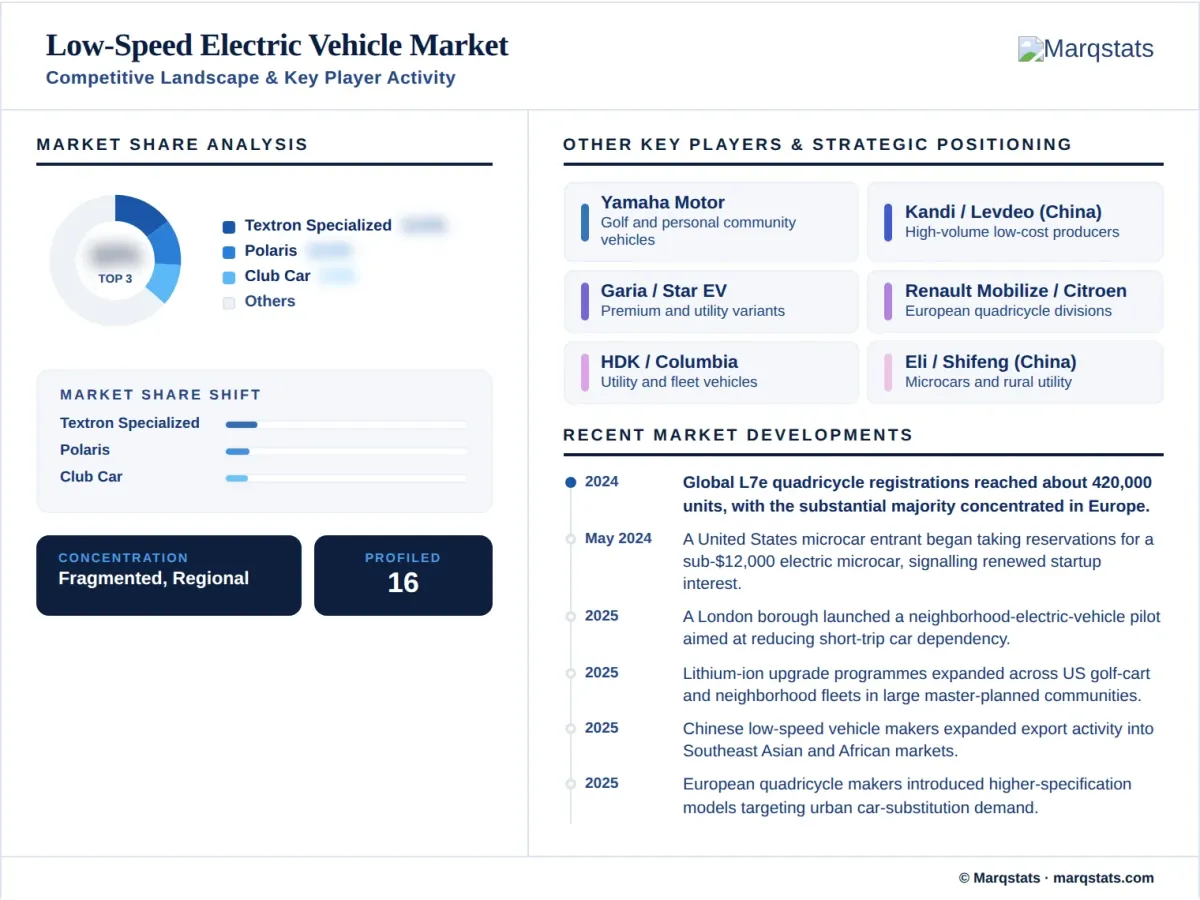
The market is fragmented, with regional specialists dominating their home markets rather than any manufacturer holding meaningful global share. North American golf-cart and neighborhood electric vehicle manufacturers, European quadricycle specialists including divisions of major automakers, and Chinese low-speed vehicle producers compete in largely separate regional markets with limited cross-regional overlap, reflecting the fragmented regulatory environment that defines vehicle eligibility in each region. The clearest exception is the small, growing group of Chinese manufacturers now exporting into Southeast Asia and Africa, the first sign of meaningful cross-regional competitive contact in this otherwise regionally siloed market. Consolidation activity has been limited to date, since the regulatory segmentation between regions gives an acquirer little synergy beyond shared battery and component sourcing.
Competitive strategy centers on battery transition, with manufacturers across all regions racing to offer lithium-ion options that improve range and reduce total cost of ownership relative to legacy lead-acid models. European manufacturers are additionally competing on design and specification to broaden quadricycles beyond youth-mobility positioning, while Chinese manufacturers are beginning to compete on export price in Southeast Asia and Africa, extending the domestic playbook that built their scale in China. North American manufacturers compete increasingly on fleet-management software and telematics integration as commercial and municipal buyers professionalise procurement, a dimension of competition largely absent from the personal-use segment that still dominates China's market and that is likely to become a more meaningful differentiator as fleet buyers grow as a share of total demand.
Companies Covered
The report profiles 16+ companies with full strategy and financials analysis, including:
Recent Market Activity
Table of Contents
Coverage & Segmentation
This report provides a comprehensive assessment of the global low-speed electric vehicle market across a 2025 base year, historical data from 2021 to 2025, and forecasts spanning 2026 to 2030. Market size is stated as new-vehicle sales revenue in United States dollars. Segmentation covers three dimensions: vehicle type, battery type, and application, alongside regional analysis spanning China, North America, Europe, and the rest of world.
The scope is confined to four-wheel, battery-electric low-speed vehicles including golf-cart-style personal and utility vehicles, neighborhood electric vehicles, microcars and quadricycles, and specialty low-speed variants. The study excludes electric two- and three-wheelers, conventional passenger electric vehicles including higher-speed compact city cars, and internal-combustion low-speed vehicles, each of which Marqstats covers separately. The distinction between a true low-speed vehicle and a higher-speed compact electric car matters increasingly at the margin, as several manufacturers now offer models that exceed traditional low-speed classification thresholds while retaining a similar form factor; this report applies the regulatory speed and classification threshold in each region as the determining test, not vehicle size or price alone. Country-level detail beyond the four-region split covered here is available under customization, alongside deeper cuts by vehicle type, battery chemistry, or application.