Market Snapshot
Key Takeaways
Market Overview & Analysis
Report Summary
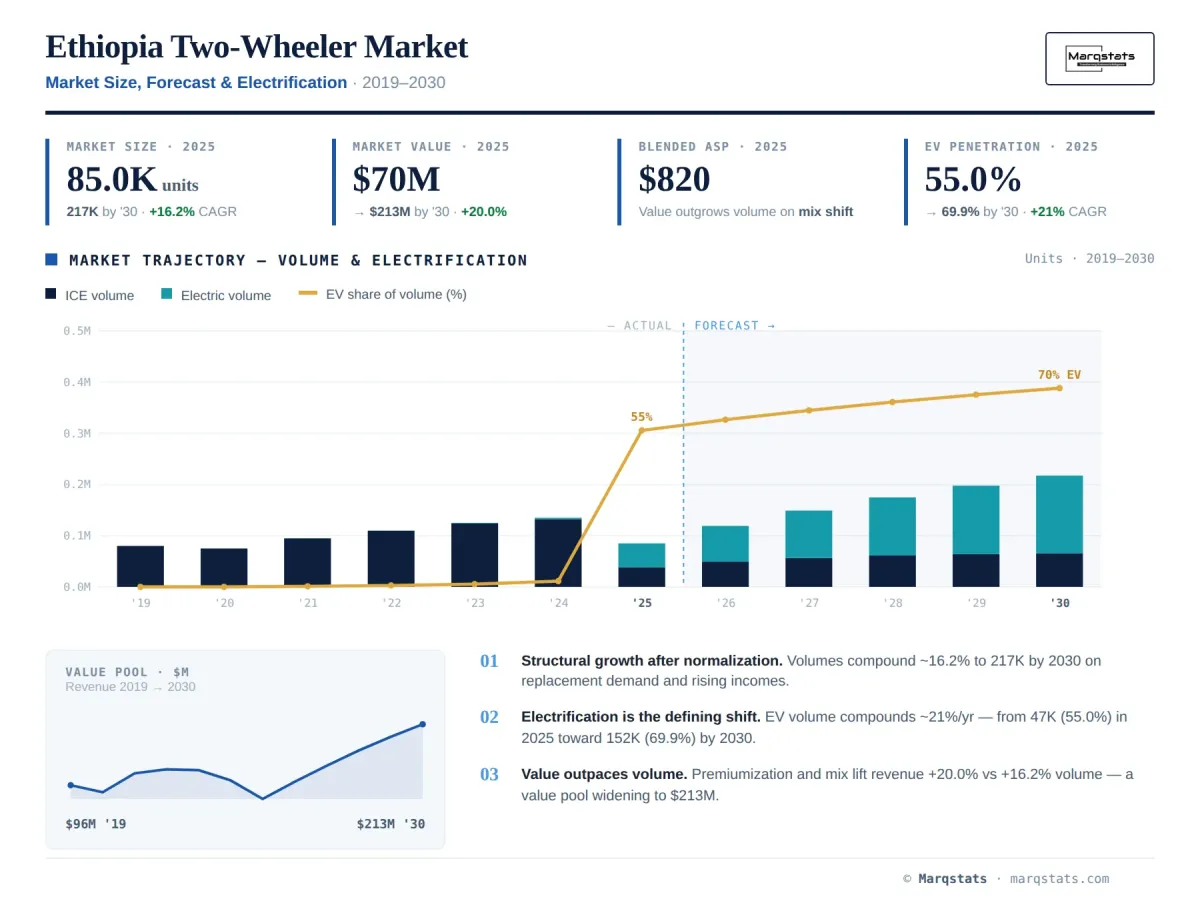
The Ethiopia two-wheeler market is an electric-majority market shaped by a decisive policy shift. Ethiopia became the first country in the world to ban imports of internal combustion engine vehicles in early 2024, and the government extended the restrictions to knocked-down kits and to combustion two- and three-wheelers, reorienting the market toward electric machines. Electric two-wheelers rose from a small share to about 55% of the market by 2025, an extraordinary transition rarely seen at national scale, and the market generated USD 69.7 million in revenue on about 85,000 units.
The shift is driven by economics as much as environment. Ethiopia spent billions of US dollars a year on imported fuel, straining foreign-exchange reserves, and the government has moved to conserve currency and use domestically generated electricity for transport. More than 90% of the country electricity comes from renewable sources, mainly hydropower, so electrification is both clean and aligned with energy independence. For riders, electric machines cut running costs sharply, and local assembly of electric motorbikes has begun to develop around the policy.
The transition is coordinated through national policy, and the Ethiopia E-Mobility Strategy and Implementation Plan targets around 500,000 electric vehicles by 2030 alongside charging-infrastructure and local-manufacturing measures. Bajaj Auto leads the market by revenue on legacy combustion demand, while Chinese electric brand Yadea and Ethiopian electric assembler Dodai are among the fastest-rising players, illustrating how quickly the brand mix is changing.
The scale of the shift is striking. Electric vehicles rose from a few thousand in 2023 to more than 60% of new vehicle registrations in 2024, and national EV stocks tripled over the same period, placing Ethiopia among the fastest-growing electric markets worldwide. For two-wheelers specifically, this meant electric machines overtook combustion within a single year, an inversion of the propulsion mix that few markets have experienced. The 2025 dip in total volume reflects the timing mismatch between the rapid contraction of combustion supply and the slower ramp of electric assembly and imports.
Local assembly is central to the emerging structure. Because the import policy applies lower tariffs to knocked-down kits than to finished machines, and because it exempts electric vehicles, companies that assemble electric two-wheelers in Ethiopia gain both cost and regulatory advantages. A Japanese-founded assembler builds electric motorbikes in Addis Ababa with a predominantly Ethiopian workforce, and local conglomerates have entered electric-vehicle assembly, signalling the beginnings of a domestic electric-mobility industry rather than a purely import-led market.
Market Dynamics
Key Drivers
- The ban on combustion vehicle imports reorients demand decisively toward electric two-wheelers across the market.
- A near-fully renewable electricity grid, mainly hydropower, makes electric running both clean and low-cost.
- The drive to conserve foreign exchange and cut fuel imports underpins strong government support for electrification.
- Electric machines lower running costs sharply, improving affordability of ownership for personal buyers.
Key Restraints
- Charging and battery-swap infrastructure remains limited, constraining adoption outside the main urban areas.
- Uneven electricity access and periodic power interruptions complicate reliable electric operation.
- Consumer financing is limited, and unclear licensing procedures have slowed registration of electric machines.
- The transition caused a temporary fall in total volume as combustion supply contracted ahead of electric scaling.
Key Trends
- Electric adoption accelerates, reaching about 55% of the market in 2025 and growing fastest at a 25.33% CAGR.
- Local assembly of electric two-wheelers develops around the import policy, supported by knocked-down kit imports.
- Battery-swapping networks expand in Addis Ababa to address charging gaps and rider uptime.
- Online retail expands fastest among channels at a 36.73% CAGR, though physical dealers still handle most value.
Market Segmentation
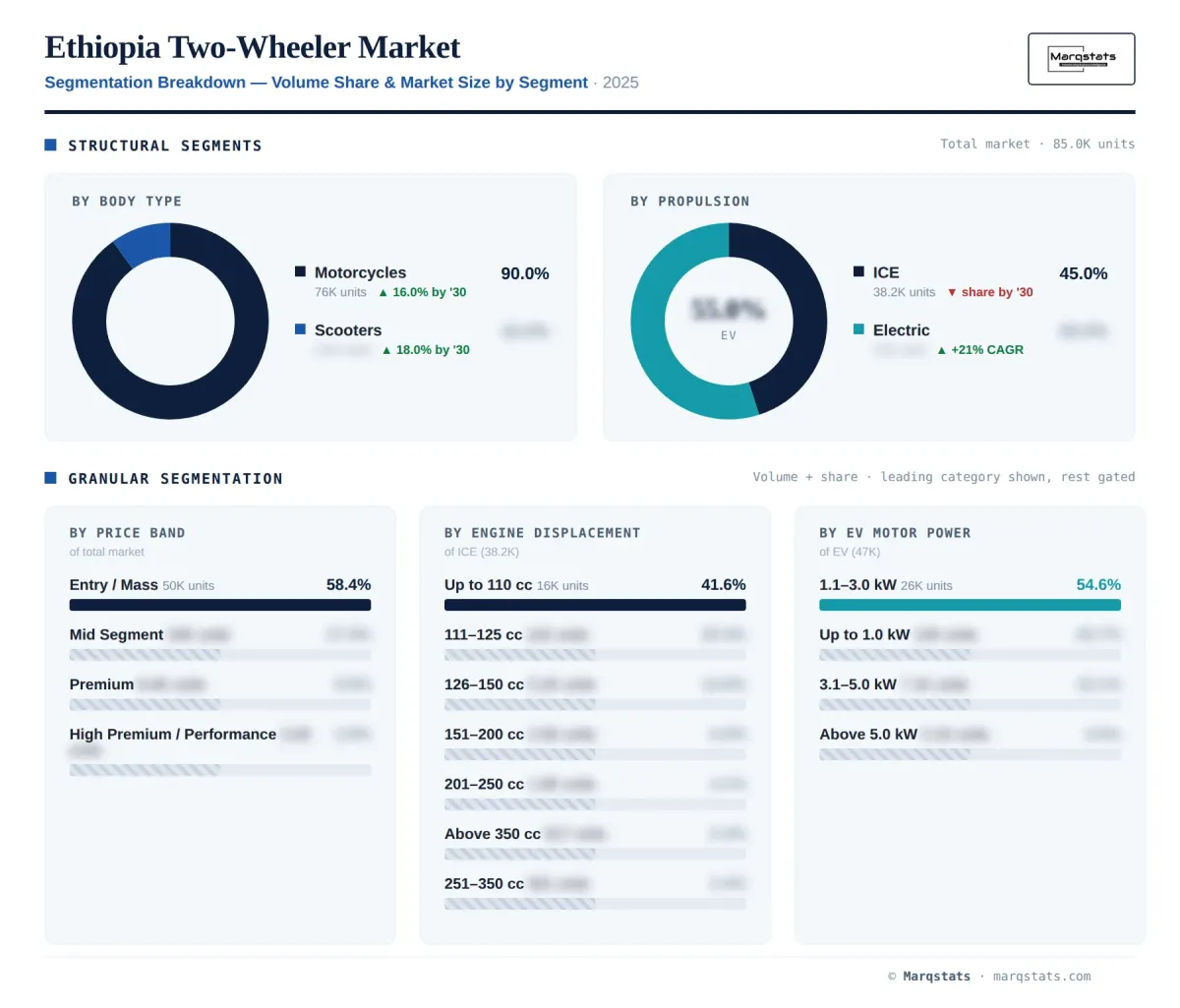
Electric is the majority propulsion category and the fastest-growing, expanding from USD 38.3 million in 2025 to USD 148.9 million by 2030 at a 25.33% CAGR, already accounting for about 55% of the market. Growth is driven by the import policy, low running costs, and a renewable grid, and it mirrors the momentum visible in other electric two-wheeler markets tracked by Marqstats. Chinese electric brands and Ethiopian assemblers lead the segment, with the mid-power bands accounting for most demand, and both fixed-battery and swappable-battery models are being deployed. Fixed-battery machines suit personal buyers with a place to charge and a preference for longer range, while swappable-battery models serve riders who need maximum uptime, and the two approaches create natural segmentation within the electric category as the market matures.
Internal combustion engine models fell to a minority of the market in 2025, generating USD 31.4 million, about 45% of revenue, and growing more slowly to USD 64.3 million by 2030 at a 10.94% CAGR. Combustion demand rests on legacy machines and the stock in circulation, since new combustion imports are restricted by policy. The combustion share continues to decline over the forecast period as electric machines take an ever-larger part of new sales, and combustion demand increasingly reflects replacement and servicing of existing machines rather than new acquisition. A large installed base of combustion motorcycles remains in use, so parts, maintenance, and second-hand activity sustain the segment even as new combustion supply is curtailed by the import restrictions.
Motorcycles dominate the vehicle-type segment, generating USD 62.7 million in 2025, about 90% of market revenue, and rising to USD 190.0 million by 2030 at a 19.81% CAGR. The segment spans both combustion machines and the growing range of electric motorbikes, and it serves personal transport above all. Bajaj and TVS supply legacy combustion demand, while electric brands including Yadea and Dodai account for a fast-rising share, reflecting the broader shift in propulsion. The motorcycle segment therefore sits at the centre of the electric transition, since the largest pool of demand is where combustion machines are being displaced most quickly by new electric models.
Scooters and mopeds generated USD 7.0 million in 2025, about 10% of revenue, and grow to USD 23.0 million by 2030 at a 21.90% CAGR, the faster-growing vehicle type. The segment is closely tied to electrification, since many early electric models take a scooter form, and urban buyers adopt light, easy-to-ride machines for commuting. Scooter growth outpaces motorcycles in percentage terms as electric adoption advances, though motorcycles remain the larger segment by both value and volume.
Within the electric segment, demand is led by the 1.1 to 3.0 kW band at USD 20.9 million in 2025, the typical power class for urban electric two-wheelers, followed by the up-to-1.0 kW band at USD 9.8 million. The higher-power bands are smaller yet expand fastest, with the above-5.0 kW band growing at a 33.30% CAGR as more capable machines enter the range. The electric motor-power mix reflects the personal, urban use case that defines most demand in Addis Ababa.
Within the shrinking combustion segment, entry displacements dominate. The up-to-110 cc band is the largest combustion tier by revenue at USD 13.1 million in 2025, followed by the 111 to 125 cc band at USD 9.2 million; together these entry classes represent about 71% of combustion revenue. Larger displacements above 250 cc remain very small, and combustion demand across all classes declines in share as the import policy channels new acquisition toward electric machines over the forecast period.
The entry and mass price band dominates the market, generating USD 40.7 million in 2025, about 58% of revenue, followed by the mid segment at USD 19.4 million; together the two lower tiers account for roughly 86% of the market, underscoring its affordability-driven character. The premium and high-premium bands are smaller yet grow faster, at 21.27% and 24.88% CAGR respectively, partly reflecting higher-specification electric machines. The high-premium and performance band, at USD 2.6 million in 2025, is the fastest-expanding price tier, though it remains a minor share of overall demand. As electrification advances, the price-band mix shifts gradually toward higher tiers, since electric machines can carry higher upfront prices offset by lower running costs, even as affordable entry machines continue to anchor the volume base.
The B2C segment overwhelmingly dominates the Ethiopia two-wheeler market, generating USD 66.3 million in 2025, about 95% of revenue, and growing at a 19.87% CAGR, reflecting a market built on personal ownership. Commercial demand is small: the B2B and fleet segment reached USD 3.4 million, within which delivery and logistics accounted for USD 2.1 million and government and institutional demand USD 1.2 million, while ride-hail and passenger services remained minimal. The dominance of personal ownership reflects restrictions on commercial passenger-carrying by motorcycle in Addis Ababa and distinguishes Ethiopia from markets where motorcycle taxis drive demand.
Offline dealers overwhelmingly dominate the channel mix, handling USD 66.9 million of revenue in 2025 and growing at an 18.87% CAGR, owing to the direct-sales approach that electric brands use to build trust in a nascent market and to the service and registration support that purchases require. Online sales expand fastest at a 36.73% CAGR, rising from USD 2.8 million as digital channels gain share. The channel shift is gradual, and physical dealers and brand showrooms retain the large majority of value through the forecast period, supported by the importance of demonstration and after-sales support for electric machines. Because the market is still building trust in electric two-wheelers, direct sales through brand showrooms and assembler outlets are central to educating buyers, arranging financing, and handling registration, which keeps most transactions in physical channels for now.
By Geography
Addis Ababa
Addis Ababa is by far the largest market and the centre of electrification. Most of the country registered vehicles are in the capital, and the city has moved to license electric motorcycles specifically, making it the focal point for electric adoption. Addis Ababa hosts the assembly operations, showrooms, and battery-swap and charging infrastructure of the main electric brands, and it anchors both demand and the build-out of the electric ecosystem. As a city of several million people with combustion imports curtailed, it is effectively the proving ground for the national electric transition.
Regional Cities
Regional cities such as Bahir Dar, Hawassa, Dire Dawa, and Gondar form a second tier of demand, where charging infrastructure is beginning to develop and electric adoption is expanding from a smaller base. Demand in these cities reflects personal transport needs and growing commercial activity, and the extension of charging networks beyond the capital is a determinant of how quickly electric machines spread across the country. Early charging-pile construction in cities such as Bahir Dar and Gondar marks the first steps of this wider rollout.
Rural Areas
Across rural areas, two-wheeler demand is constrained by limited electricity access and charging infrastructure, which slows the shift to electric machines. Combustion machines and their servicing retain a role where grid access is uneven, and the pace of rural electrification and off-grid charging solutions will shape how far the electric transition reaches beyond the main urban centres over the forecast period. Solar-powered charging and battery-swap models designed for rural roads are being explored, and lease-and-pay options aimed at agribusiness users point to how the electric shift may eventually extend into the countryside as infrastructure develops.
How Competition Is Evolving
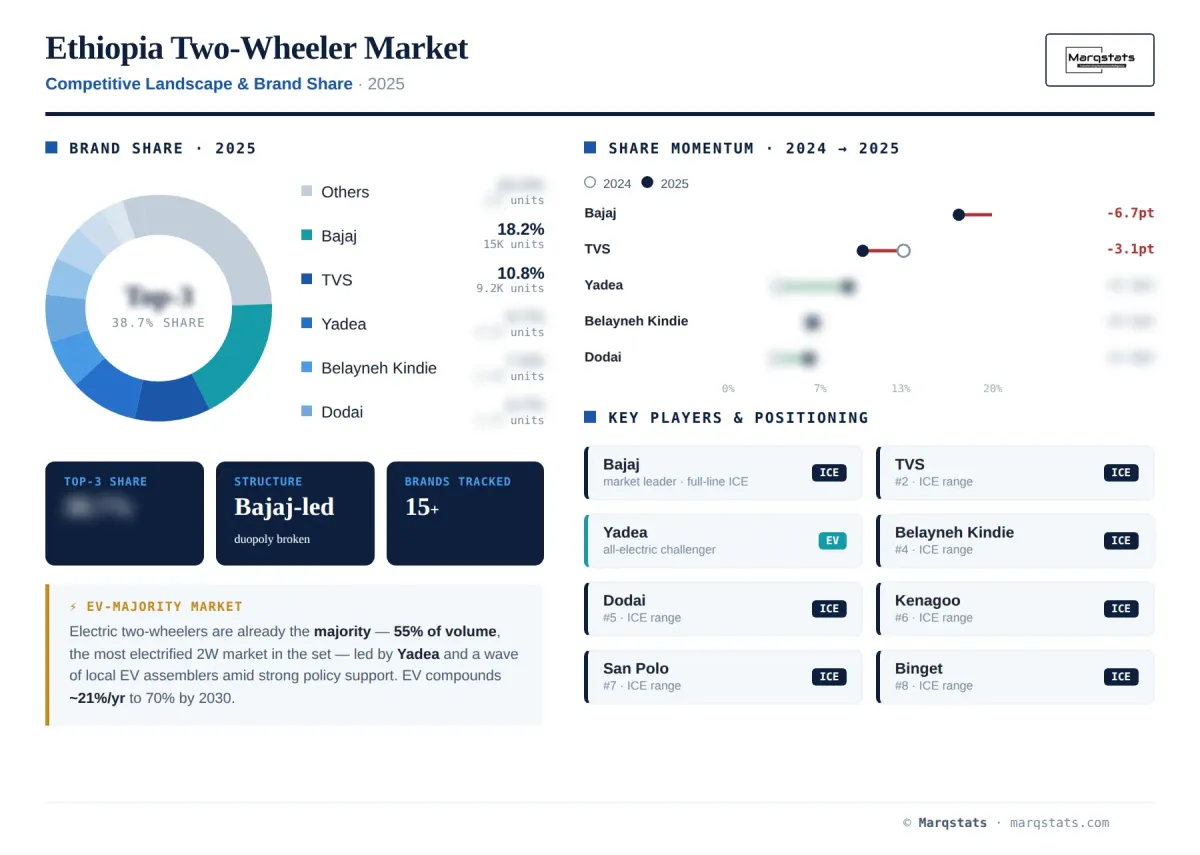
The Ethiopia two-wheeler market is fragmented and undergoing rapid change in its brand mix. Bajaj Auto leads at about 18% of revenue in 2025 on legacy combustion demand, followed by TVS at about 11%, while Chinese electric brand Yadea holds about 10% and Ethiopian electric assembler Dodai about 7%. A group of local and international brands, including Belayneh Kindie, Kenagoo, San Polo, Binget, and Marathon Motor, and electric maker Tommi E-bike, complete the field, and a large share of the market sits with a long tail of smaller brands.
Competition is being reshaped by electrification and local assembly. Combustion brands such as Bajaj and TVS retain positions built on installed base and servicing, while electric companies compete on running-cost savings, battery-swap convenience, and models adapted to local conditions. Ethiopian assembler Dodai builds electric motorbikes locally from knocked-down kits using lithium-ion batteries, differentiating on quality and local employment, while imported electric brands compete on price and product range.
Local assembly is a growing competitive theme. The import policy favours knocked-down kits over finished machines, so companies that assemble in Ethiopia gain cost and regulatory advantages, and local conglomerates have moved into electric-vehicle assembly. Battery-swapping infrastructure, financing access, and the ability to register machines under evolving rules are decisive factors, and companies that combine local assembly with charging and swap networks are positioned to lead the electric segment.
The competitive field is likely to shift further toward electric brands through the forecast period. Combustion incumbents hold declining positions tied to legacy demand, while electric companies expand share rapidly from a growing footprint. The pace of infrastructure build-out, the development of consumer financing, and the clarity of registration and licensing rules will determine which brands scale fastest, and the electric segment will increasingly define competition in the Ethiopian market.
Companies Covered
The report profiles 16+ companies with full strategy and financials analysis, including:
Recent Market Activity
Table of Contents
Coverage & Segmentation
This report provides a comprehensive analysis of the Ethiopia two-wheeler market for the 2021 to 2025 historical period and the 2026 to 2030 forecast period, with 2025 as the base year. The study quantifies market size in revenue terms and in unit volume, and segments the market by vehicle type, propulsion type, engine displacement and motor power, price band, end user, sales channel, and brand. It examines the drivers, restraints, and trends shaping demand, and profiles the competitive structure of the market.
The study focuses on registered two-wheelers, spanning combustion and electric motorcycles, scooters, and mopeds. Coverage addresses the electric-majority character of the Ethiopian market and the policy-driven shift that produced it, the transitional fall in volume as combustion contracted, the roles of the import ban, the renewable grid, and foreign-exchange pressures, and the emergence of local electric assembly. Values are reported in USD MN, and regional demand is examined across Addis Ababa, the regional cities, and rural areas.