Market Snapshot
Key Takeaways
Market Overview & Analysis
Report Summary
The Iraq two-wheeler market comprises motorcycles, scooters and mopeds sold for personal and commercial use across internal combustion and electric propulsion. Iraq is a mid-sized regional market by volume and remains structurally import-dependent: domestic production is minimal, and supply is dominated by imported Chinese brands and motorcycles assembled in neighbouring Iran and re-exported into Iraqi channels. Motorcycles serve primarily as affordable personal transport and as working assets for delivery riders, informal couriers and small traders, particularly in dense urban centres where two-wheelers navigate congestion more efficiently than cars.
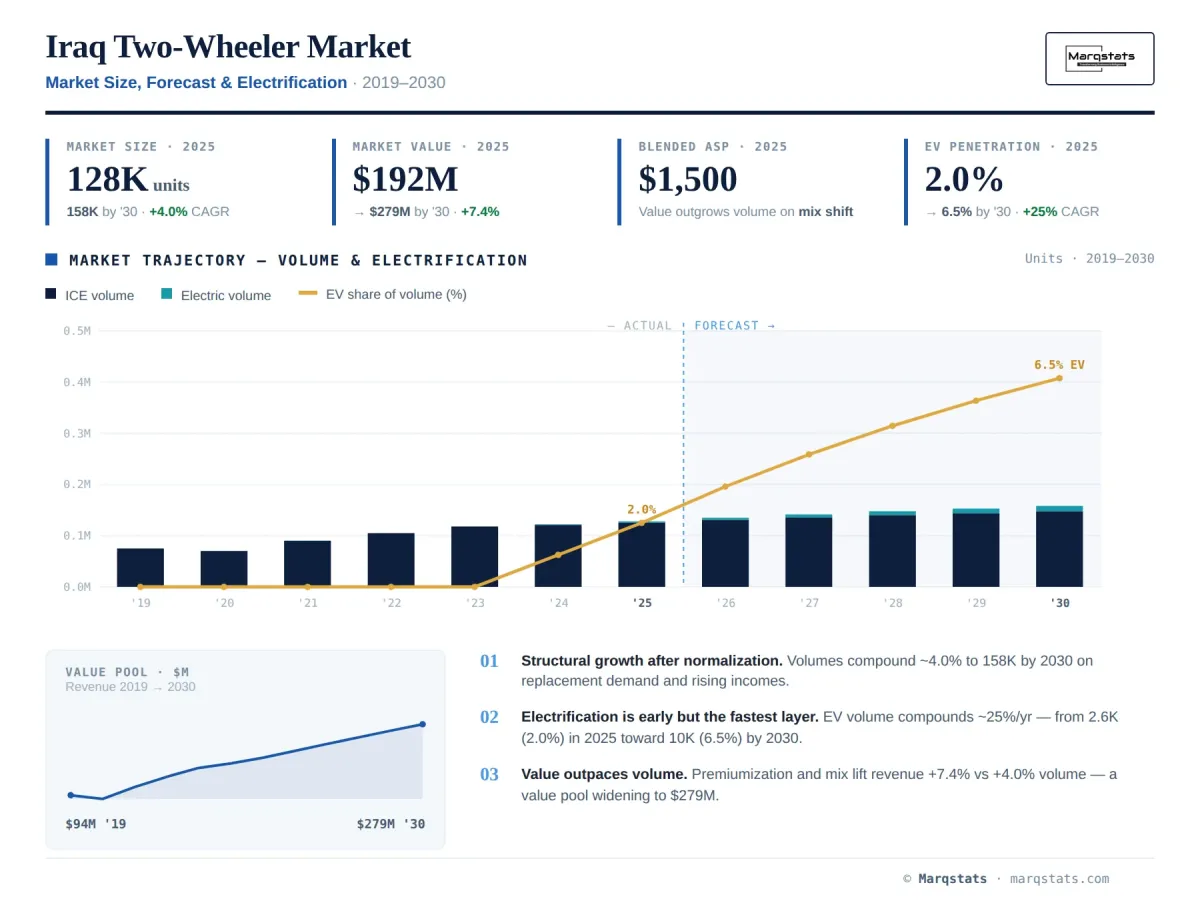
Between 2021 and 2025 the market recovered from pandemic-era disruption and currency pressure, with volumes rising from 90 thousand units in 2021 to 128 thousand units in 2025. Growth over the forecast period is steadier than the post-pandemic rebound, reflecting a maturing base, gradual income recovery, and the expansion of organised delivery services. The value pool grows faster than volume because buyers are moving toward higher-displacement commuter and premium machines, and because electric models carry higher unit prices than the sub-125cc bikes that dominate entry demand.
Iraq's supply structure mirrors other Chinese-OEM-led emerging markets such as the Africa two-wheeler market, where affordable Chinese and Indian brands dominate a delivery-heavy, import-reliant demand base. Electrification in Iraq remains nascent, constrained by unreliable grid supply and thin charging access, however policy signals — customs relief for electric and hybrid vehicles and a domestic assembly initiative — are beginning to lower barriers for battery-powered two-wheelers.
Iraq's macroeconomic backdrop shapes demand in three ways. First, oil-linked public spending and post-conflict reconstruction support incomes and the movement of goods, which lifts both personal ownership and commercial two-wheeler use. Second, dinar volatility and reliance on imported units transmit exchange-rate swings directly into showroom prices, making demand sensitive to currency and customs conditions in any given year. Third, a persistent electricity deficit — with many households receiving fewer hours of grid power per day than demand requires — slows electric adoption outside the Kurdistan Region and pushes early electric use toward fleet operators that can manage charging or battery swapping centrally. These conditions produce a market that grows steadily rather than sharply, with volume gains concentrated in affordable commuter machines and value expansion driven by premiumisation and early electrification.
Market Dynamics
Key Drivers
- Market is driven by a young demographic profile, with more than 60% of the population under 25 fuelling first-time two-wheeler ownership across Baghdad, Basra and Erbil.
- Demand is increasing owing to a rapidly expanding e-commerce and quick-commerce economy, which raised delivery and logistics two-wheeler use to about 12 thousand units in 2025.
- Growth is attributed to the affordability of sub-125cc commuter motorcycles, which remain the lowest-cost motorised mobility option amid fuel-price sensitivity and constrained public transit.
- Rising urbanisation, expected to approach 73% by 2030, is increasing congestion and pushing commuters and small businesses toward compact, manoeuvrable two-wheelers.
- Customs duty and tax relief for electric and hybrid vehicles under Cabinet Resolution No. 23055 is lowering the entry cost for electric two-wheelers and supporting early adoption.
Key Restraints
- Unreliable grid supply and frequent power outages constrain electric two-wheeler charging, keeping ICE propulsion at close to 98% of 2025 volume.
- Regulatory fragmentation across provinces, with inconsistent customs application and licensing norms, complicates dealer planning and formal vehicle registration.
- A significant share of two-wheeler and parts trade flows through informal, unregistered channels, weakening after-sales support and product traceability.
- Currency volatility and import dependence expose retail prices to exchange-rate movements, dampening demand during periods of dinar weakness.
Key Trends
- Electric two-wheeler adoption is rising owing to battery-swap fleet models entering Baghdad that address grid instability and high summer temperatures for commercial riders.
- Demand is shifting upmarket as premium and high-premium classes grow at 5.13% and 8.11% CAGRs, outpacing the entry segment and lifting revenue faster than volume.
- Online purchasing is expanding at a 17.10% CAGR as social commerce and dealer digital channels formalise a historically offline distribution model.
- A domestic assembly push is emerging, with the Iraqi Military Industry Board advancing local electric vehicle production and CKD/SKD incentives targeting import substitution.
Market Segmentation
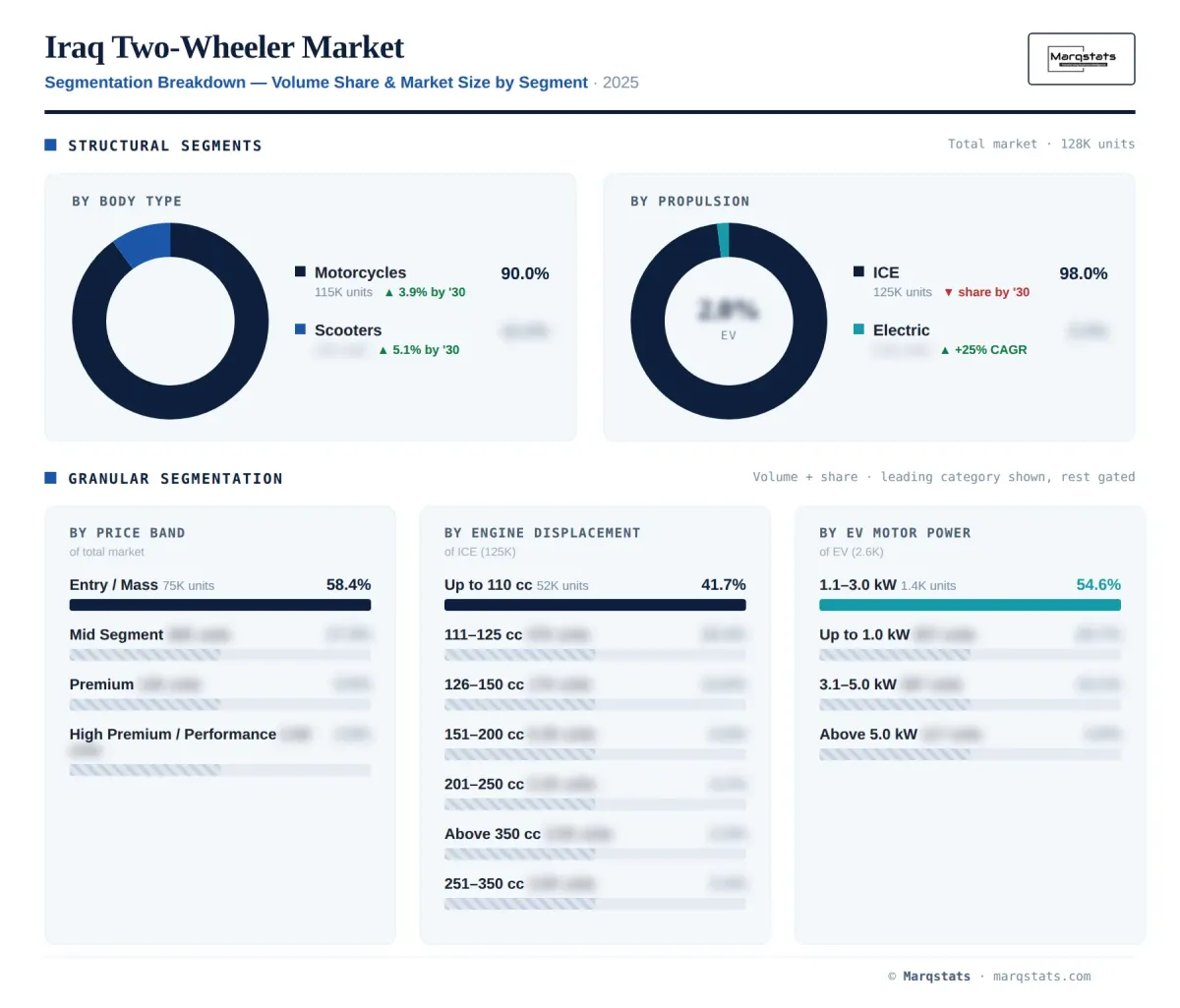
Motorcycles accounted for about 90% of 2025 volume, at 115 thousand units, and are forecast to reach 141 thousand units by 2030 at a 3.89% CAGR. Standard commuter and utility motorcycles anchor demand, serving personal commuting, informal courier work and small-trade transport. The category's dominance reflects Iraq's price-sensitive, delivery-oriented demand base and the wide availability of low-cost Chinese and Iranian-assembled models.
Scooters and mopeds accounted for roughly 10% of 2025 volume, at 13 thousand units, growing to 17 thousand units by 2030 at a faster 5.10% CAGR. Uptake is increasing owing to urban last-mile delivery use and rising female and youth ridership in city centres, where automatic transmissions and lighter frames suit short, frequent trips. The segment remains smaller than in scooter-led ASEAN markets, however its growth outpaces motorcycles as urban usage patterns broaden.
ICE two-wheelers supplied close to 98% of 2025 volume, at 125 thousand units, and are forecast to reach 148 thousand units by 2030 at a 3.09% CAGR. Petrol commuter motorcycles remain the default choice owing to established fuelling infrastructure, low purchase prices and rider familiarity, even as their share erodes gradually toward the end of the forecast period.
Electric two-wheelers accounted for about 2% of 2025 volume, at 2.6 thousand units, expanding to 10.3 thousand units by 2030 at a 24.92% CAGR — the fastest-growing propulsion class. Adoption is increasing owing to customs and tax relief, falling battery costs, and commercial battery-swap deployments that mitigate grid instability. Growth is constrained by unreliable electricity supply and limited charging access, however delivery fleets are emerging as the earliest concentrated demand.
Within ICE machines, the up-to-110cc class was the single largest displacement band in 2025 at about 52 thousand units, followed by the 111–125cc class at roughly 37 thousand units; together these entry commuter categories accounted for close to 71% of ICE volume. Mid-displacement 126–150cc and 151–200cc classes are growing faster as riders upgrade, while larger 251–350cc and above-350cc machines expand at 7.33% and 7.21% CAGRs owing to premiumisation among affluent urban buyers. Across electric motor-power bands, the 1.1–3.0 kW class leads volume and the above-5.0 kW category grows fastest, reflecting a shift toward more capable delivery-grade electric machines.
The displacement mix reinforces the market's value story. Because the sub-125cc bands dominate volume, average selling prices remain low, however the faster growth of 150cc-plus classes steadily lifts the blended price and helps explain why revenue expands at nearly double the volume CAGR. Larger machines also carry higher parts and service revenue over their lifecycle, deepening the value pool available to dealers and after-sales networks. On the electric side, motor-power upgrades track the delivery use case: fleet operators favour machines with enough sustained power for loaded, all-day duty cycles, which pulls demand toward the higher kilowatt bands even as small commuter e-bikes seed early personal adoption.
The entry and mass band dominated 2025 volume at about 75 thousand units, or roughly 58% of the market, expanding at a 3.72% CAGR as affordability anchors first-time demand. The mid segment accounted for about 36 thousand units and grows at 3.60%, while the premium and high-premium/performance bands, though smaller at 13 thousand and 5 thousand units respectively, grow faster at 5.13% and 8.11% CAGRs. This upward price migration is the primary reason revenue expands faster than volume across the forecast period.
The B2C segment accounted for about 87% of 2025 volume, at 111 thousand units, and grows at a 3.88% CAGR as personal ownership widens. Commercial demand is expanding faster: delivery and logistics use reached about 12 thousand units in 2025 and grows at a 5.21% CAGR owing to e-commerce and quick-commerce density in major cities, while B2B and fleet demand grows at 4.89%. Government, institutional and other use adds a further 4 thousand units, and ride-hail, rental and tourism use remains a small, roughly flat category.
Offline dealerships and informal traders retained about 95% of 2025 volume, at 122 thousand units, and continue to grow at a 3.01% CAGR, reflecting the importance of physical inspection, financing relationships and after-sales service in Iraq's market. Online channels, though only about 5% of volume at 6 thousand units, grow fastest at a 17.10% CAGR as social commerce and dealer digital storefronts formalise distribution and reach younger buyers.
By Geography
Two-wheeler demand in Iraq concentrates in the three largest urban economies — Baghdad, Basra and Erbil — which together account for the majority of both personal and commercial volume, while provincial centres add a broad, almost entirely ICE-based base of commuter demand. Regional differences are shaped by economic activity, electricity reliability and logistics intensity, and these factors determine where electric two-wheelers and delivery fleets first take hold.
Baghdad
Baghdad is the largest demand centre, concentrating population, commerce and the densest delivery activity in the country. The capital anchors both personal commuter demand and the fastest-growing commercial fleets, and it is the first location for commercial battery-swap electric two-wheeler deployments that target heat resilience and grid outages. Baghdad's congestion and trade centrality make it the primary market for both entry motorcycles and emerging electric models.
Basra
Basra, as Iraq's principal port city, functions as a logistics and import gateway and a growing centre of two-wheeler demand. Its role in trade and its industrial-zone investment position it as a focal point for CKD/SKD assembly incentives, and its logistics needs support delivery and fleet two-wheeler use. Southern demand is increasing owing to reconstruction activity and expanding commercial services.
Erbil and the Kurdistan Region
Erbil and the wider Kurdistan Region combine relative economic stability with rising disposable incomes and comparatively stronger electricity reliability, which supports earlier electric-mobility interest. Chinese-made electric vehicles are visible in regional traffic, and grid-reliability programmes underway in the region improve the feasibility of battery-powered two-wheelers relative to the rest of the country.
Other Provinces
Demand across Mosul, Najaf, Karbala and other provincial centres is driven by affordable commuter motorcycles and small-trade use. These markets remain almost entirely ICE-based and offline in distribution, and their growth is attributed to urbanisation, road-infrastructure improvement and the spread of delivery services beyond the three primary cities.
How Competition Is Evolving
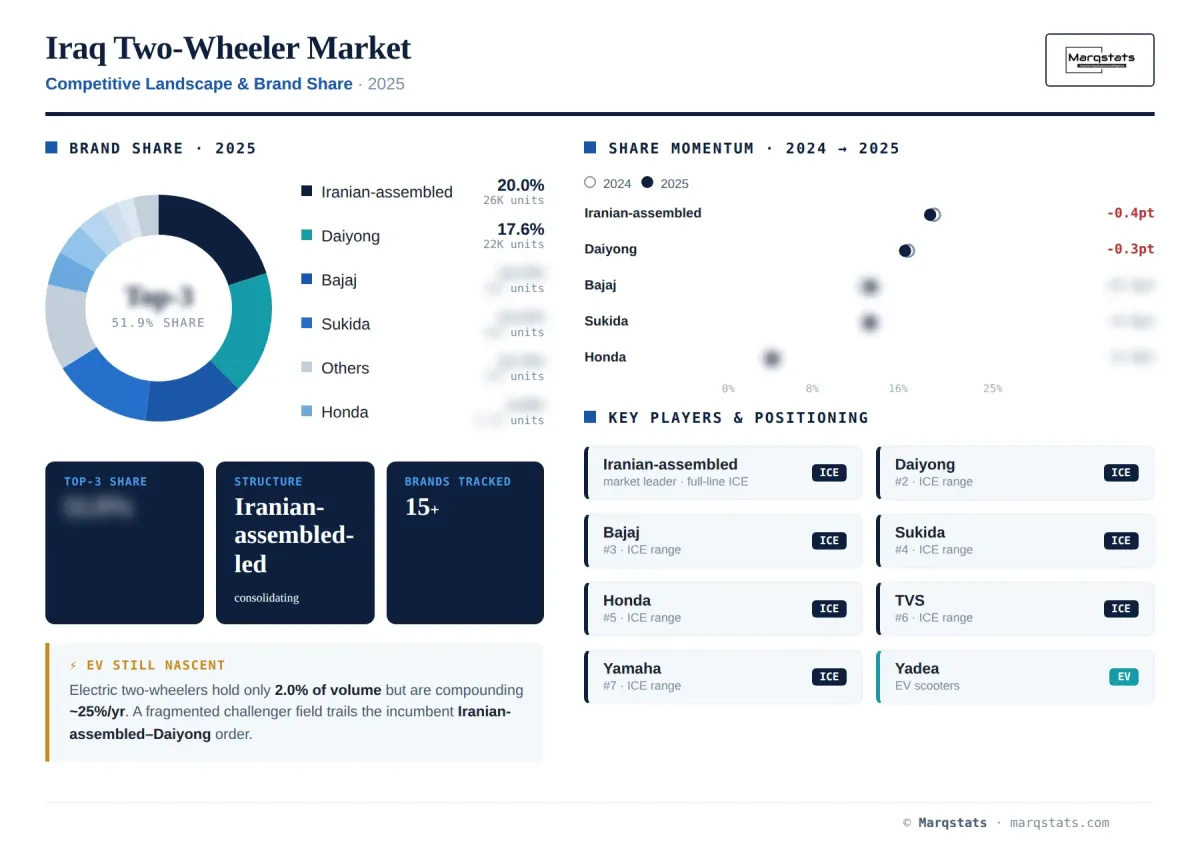
The Iraq two-wheeler market is moderately fragmented and supply-led, shaped by imported Chinese brands, motorcycles assembled in neighbouring Iran, and established Indian and Japanese manufacturers. No single brand controls the market; instead, Iranian-assembled models and Chinese brands such as Daiyong and Sukida hold the largest single-brand volumes, while Indian manufacturers led by Bajaj compete strongly in the value commuter classes. Competition centres on price, parts availability, dealer reach and financing terms rather than technology differentiation.
Chinese OEMs compete primarily on affordability and rapid model turnover, supplying the entry and mass bands that dominate Iraqi demand. Indian brands such as Bajaj and TVS have expanded owing to durable value-commuter positioning and growing dealer and service networks, with Bajaj recording one of the stronger brand growth rates through the forecast period. Japanese manufacturers occupy mid and premium tiers where brand trust and resale value support higher prices. Electric competition is led by Chinese brands such as Yadea, which grows quickly from a small base, alongside emerging battery-swap fleet operators targeting commercial riders.
At the brand level, Iranian-assembled models held the largest single-brand volume in 2025 at about 26 thousand units, reflecting the proximity, low cost and established re-export channels of Iranian assembly, though their growth is slower than the market as buyers diversify. Daiyong and Sukida followed at roughly 23 thousand and 18 thousand units, competing on price and dealer availability. Bajaj, at about 18 thousand units, grows fastest among the volume leaders at a 6.79% CAGR, gaining share owing to durable value positioning and expanding service coverage, while TVS and Honda hold mid-tier positions. In the electric niche, Yadea grows at a 24.2% volume CAGR and Sonlink also expands quickly, positioning both to lead as battery-powered demand scales.
The competitive structure is influenced by informal distribution, where unregistered traders move a meaningful share of units, and by exposure to currency and customs conditions that shift landed costs. Brands that combine competitive pricing with reliable parts supply and expanding after-sales coverage are positioned to gain share as distribution gradually formalises and delivery-fleet demand concentrates purchasing. Over the forecast period, the balance is expected to tilt gradually toward brands that pair affordability with parts reliability and, in the electric niche, toward operators that solve charging and uptime for commercial riders.
Companies Covered
The report profiles 16+ companies with full strategy and financials analysis, including:
Recent Market Activity
Table of Contents
Coverage & Segmentation
This report provides a comprehensive analysis of the Iraq two-wheeler market across a 2025 base year, historical data from 2021 to 2025, and forecasts spanning 2026 to 2030. The study sizes the market in both volume (thousand units) and value (USD million) and segments it by vehicle type (motorcycles, scooters and mopeds), propulsion type (internal combustion engine, electric), engine displacement and motor power, price band, end user, and sales channel. Brand-level analysis covers the Chinese, Iranian-assembled, Indian and Japanese manufacturers that shape Iraqi supply.
The study examines market drivers, restraints and trends, segment-level growth, regional demand across Baghdad, Basra, Erbil and other provinces, competitive structure, and forward catalysts including electrification policy, domestic assembly and delivery-economy expansion. All market estimates represent Marqstats-reconciled figures derived from a bottom-up methodology validated against top-down benchmarks, using national and independent trade indicators rather than any single external source.
The report is designed for two-wheeler manufacturers, importers and distributors, fleet and delivery operators, component and battery suppliers, financing providers, and policymakers assessing Iraq's mobility and electrification path. It supports market-entry sizing, brand and channel benchmarking, and scenario planning around currency, customs and electricity conditions. Volume and value forecasts are provided at segment level for the 2026–2030 window, with 2021–2025 historical context, enabling comparison against adjacent regional markets and Iraq's own recovery since 2021.