Market Snapshot
Middle bar: base-year value × (1 + CAGR), rounded to two decimals. This is a calculated illustration, not a separately researched annual estimate.
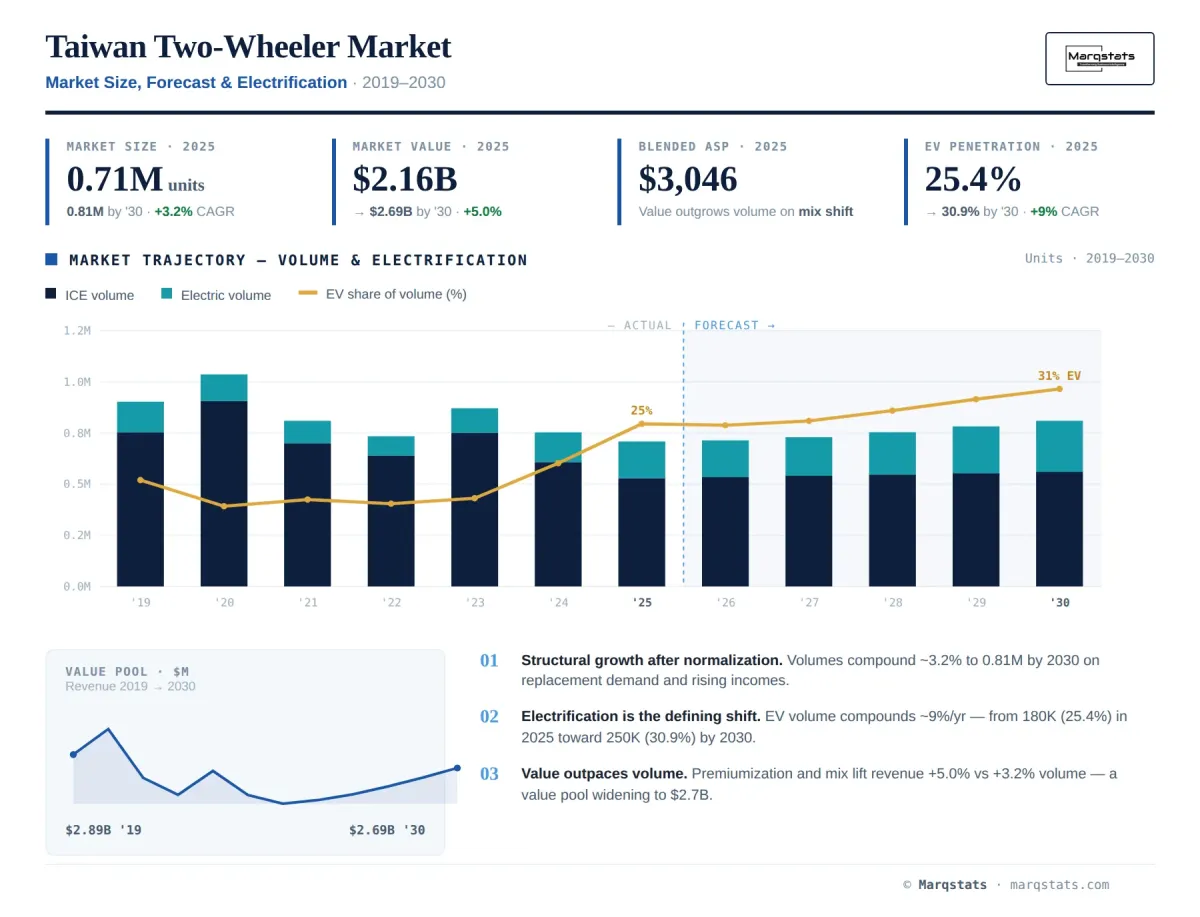
The Taiwan two-wheeler market reached 708 thousand units in 2025 and is projected to reach 809 thousand units by 2030, expanding at a 3.20% CAGR across the 2026–2030 forecast period; in value terms the market rises from USD 2.16 billion to USD 2.69 billion. Taiwan is the world's most scooter-dependent market, with more than 14 million scooters serving 23 million people and about 73% of licensing-age adults owning one. It is also the global pioneer of two-wheeler electrification, though the electric segment has entered a post-subsidy correction.
Electric two-wheelers held about 8% of 2025 sales, having fallen roughly 30% year-on-year as purchase incentives waned, even as total volume recovered. The market remains defined by battery swapping: more than 5,000 swap stations now exceed the island's gas stations, anchored by Gogoro's network of over 665,000 subscribers. Government policy still frames the direction, with a target for all newly sold scooters to be electric by 2035 and cars by 2040.
Competitively, incumbent scooter giants SYM and KYMCO hold roughly 70% of unit sales and are taking the electric lead from pioneer Gogoro, whose own-brand sales have collapsed. The Taiwan two-wheeler market is therefore mature, saturated, and slow-growing by volume, yet strategically pivotal as a proving ground where electrification, battery swapping, and near price parity are being tested at national scale.
Key Takeaways
Market Overview & Analysis
Report Summary
The Taiwan two-wheeler market comprises motorcycles, scooters, and mopeds sold for personal and commercial use across internal combustion and electric propulsion. This study segments demand by vehicle type, propulsion type, engine displacement and motor power, price band, end user, sales channel, and brand, with a 2025 base year, historical coverage from 2021 to 2025, and forecasts to 2030. The scooter is the defining vehicle of Taiwanese daily life, functioning for many households as a primary car replacement across dense cities and dispersed towns.
The market is mature and saturated. Annual sales have hovered around 700,000 to 800,000 units, well below the one-million level of earlier years, and demand is sensitive to economic cycles and incentive schemes. Total volume dipped in 2024 before recovering, while the electric segment moved in the opposite direction, contracting sharply in 2025 as subsidies became less generous. This divergence, overall demand rebounding while electric adoption weakened, defines the current phase and separates Taiwan from earlier assumptions of uninterrupted electrification.
Behind the headline figures lies an installed base of more than 14 million gasoline scooters, each a candidate for eventual electric replacement, which underpins both the country's energy-import dependence and its electrification opportunity. Roughly 73% of licensing-age adults own a scooter, and the average household owns more than two, so replacement demand rather than first-time buying drives most sales. This saturation caps volume growth at a low-single-digit rate, shifting the market's commercial logic away from unit expansion and toward premiumisation, electrification, and the recurring revenue of battery-swap subscriptions.
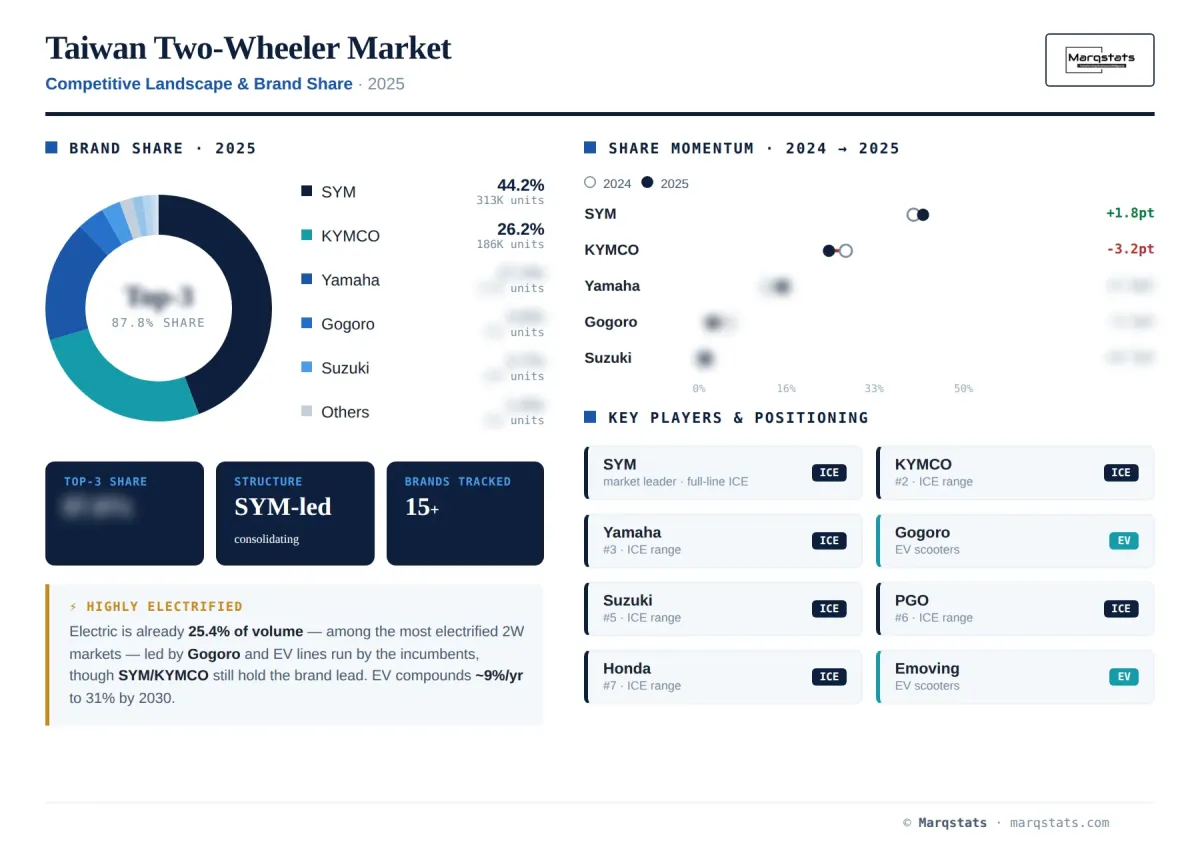
Supply is led by two domestic scooter giants. Sanyang, under the SYM brand, holds about 44% of unit sales, followed by Kwang Yang, under KYMCO, at roughly 26%, with Yamaha third. Electric is contested by Gogoro, whose brand sales have fallen to a fraction of their 2020 peak even as it retains the dominant swap network, alongside KYMCO's Ionex platform and Yamaha's swap-compatible models. Taiwan's transition offers a benchmark comparable to the Thailand electric two-wheeler market for how battery swapping and incentives shape adoption.
Market Dynamics
Key Drivers
- Growth is driven by structural scooter dependence, with more than 14 million scooters in use and about 73% of licensing-age adults owning one, sustaining steady replacement demand.
- Battery-swap infrastructure supports electrification, as over 5,000 swap stations, exceeding the island's roughly 2,500 gas stations, remove range and charging anxiety for electric riders.
- Government subsidies remain influential, with the Ministry of Environment offering up to about NT$16,000 per replacement and municipalities stacking incentives worth tens of thousands of additional NT dollars.
- Narrowing price parity supports adoption, as the cost gap between electric and comparable gasoline scooters has fallen to under about US$330, lowering the barrier for mainstream buyers.
Key Restraints
- Subsidy sensitivity destabilises demand, as electric sales fell about 30% in 2025 when incentives eased, exposing how dependent adoption remains on public support.
- Battery-rental economics deter some riders, with annual swap fees of around US$250 exceeding the roughly US$117 fuel cost of a typical gasoline scooter.
- Market saturation limits volume growth, as Taiwan's high ownership and aging population cap headline expansion at a low-single-digit CAGR.
Key Trends
- Policy is shifting from short subsidy bursts toward durable targets, with a draft plan proposing about US$4.25 billion over five years to lift electric-scooter sales toward 35% by 2030, complementing the 2035 all-electric scooter goal.
- Incumbents are seizing the electric lead, as SYM electrifies selectively and KYMCO scales its Ionex platform with a LiveWire-developed maxi-scooter, displacing pioneer Gogoro at the brand level.
- Premiumisation lifts value, as larger-displacement and performance models grow while entry commuter classes shrink, raising average selling prices in a flat-volume market.
- Digital retail expands, with the online channel growing at a 12.56% CAGR alongside Taiwan's dense dealer and service network.
Market Segmentation
Scooters overwhelmingly dominate at 96.5% of 2025 volume, about 684,000 units, growing at a 3.04% CAGR. Taiwan is the most scooter-oriented market in the world, with automatic scooters serving as the primary personal vehicle for most households. Nearly all electric two-wheelers also take the scooter form, making this category the centre of both combustion and electric competition. The dominance is cultural and structural: dense urban form, limited parking, and decades of scooter-first infrastructure make the automatic scooter the default mode of private transport, and the market's evolution therefore plays out almost entirely within this single body style.
Conventional motorcycles account for about 25,000 units in 2025, roughly 3.5% of volume, yet grow faster at a 7.21% CAGR. Demand concentrates in sport, cruiser, and large-displacement machines bought by enthusiasts, a small yet rising and high-value niche. Liberalised access to larger-capacity motorcycles over the past decade has expanded this enthusiast segment, and although its unit share stays modest, it contributes meaningfully to value growth and supports a premium dealer and aftermarket ecosystem.
Mopeds register negligible sales across the study period and do not form a material commercial segment in Taiwan, where the automatic scooter fills the affordable-commuter role that mopeds occupy in some other markets, leaving the market effectively a two-category structure of scooters and larger motorcycles.
Combustion models hold about 92% of 2025 volume, roughly 653,000 units, and grow only marginally at close to a 1% CAGR. Combustion remains entrenched through affordability, dense service networks, and rider familiarity, and while its share slowly cedes ground to electric, absolute volumes stay broadly stable across the forecast period. The persistence of combustion reflects both the maturity of the gasoline-scooter supply chain and the operational-cost frictions that still weigh on electric ownership, so the transition is gradual rather than abrupt, with combustion continuing to serve the price-sensitive and rural majority through 2030.
Electric two-wheelers held about 8% of 2025 volume, roughly 55,000 units, after registrations fell about 30% from 2024 as subsidies eased. On a Marqstats-reconciled basis anchored to national registration data, the segment recovers to near 10% of volume by 2030 at an 8.4% CAGR, supported by battery swapping, incumbent electric platforms, and narrowing price parity, though annual battery-rental costs and consumer-confidence frictions temper the pace. Gogoro leads the segment yet has ceded ground to KYMCO's Ionex and other swap-compatible brands.
The reconciliation matters because Taiwan's electric segment is often overstated. National registrations recorded about 78,800 electric scooters in 2024 and near 80,000 in 2023, roughly a tenth of new sales, before the 2025 correction pulled the figure lower. Within that segment Gogoro remained the single largest brand, yet its own-brand volumes have fallen far from the 2020 peak, and incumbents have absorbed much of the balance. The forecast recovery assumes gradual normalisation as price parity approaches and new incentive frameworks take effect, rather than a return to subsidy-era growth rates.
The 111–125cc class is the largest combustion band at about 329,000 units in 2025, essentially flat to slightly declining, while the up-to-110cc class collapses at roughly a -22% CAGR as buyers abandon the cheapest machines. These commuter classes define mainstream combustion demand even as their mix shifts toward higher specification.
Displacement classes above 250cc grow at high-single to low-double-digit rates, reflecting enthusiast big-bike demand, while the 201–250cc band expands from a small base. Within electric, higher-power classes dominate the segment, as Taiwanese electric scooters are specified for genuine car-replacement performance rather than low-speed use. This preference for capable, higher-output machines, on both the combustion and electric sides, reinforces the market's premium and mid-tier character and supports value growth even where unit volumes are flat.
The mid segment is the market core at about 415,000 units in 2025, roughly 59% of volume, growing at a 2.99% CAGR. The entry and mass band is smaller at about 151,000 units, underscoring that Taiwan is a quality-focused market where buyers favour well-specified scooters over the cheapest models. This mid-market centre of gravity distinguishes Taiwan sharply from the entry-dominated markets of Indonesia and Malaysia, and it reflects both higher incomes and a mature replacement cycle in which buyers upgrade rather than minimise cost.
Premium volumes grow at a 4% CAGR, while the high-premium and performance band, though small in units, expands fastest at about a 13% CAGR on the strength of large-displacement and imported machines. This upmarket shift steadily lifts average selling prices even as total volume grows slowly.
Private consumers account for about 89% of 2025 volume, sustaining the commuter and premium scooter segments in line with incomes, replacement cycles, and incentive availability across Taiwan's cities and towns. Because ownership is near-universal, private demand is dominated by replacement rather than first purchase, which makes it responsive to subsidy timing and model refreshes, and gives manufacturers a predictable yet slow-growing base to defend.
Commercial demand grows faster than private use. Delivery and logistics expands at an 8.15% CAGR as food-delivery platforms scale, while B2B and fleet demand and shared-mobility services add steady volume and are prominent early adopters of electric models.
Physical dealerships dominate, handling the large majority of sales and providing financing, registration, and after-sales service. Dense dealer and swap-station coverage is central to the competitive strength of SYM, KYMCO, and Gogoro alike.
The online channel is the fastest-growing route to market at a 12.56% CAGR, as digital platforms support research, configuration, and booking. Online activity complements the dealer network, particularly for electric models where subscription and swap plans are managed digitally, and app-based account management is intrinsic to the battery-swap experience, giving digitally native brands an advantage in customer relationships.
By Geography
Northern Taiwan (Taipei & New Taipei)
Greater Taipei is the most electrified region, with electric models reaching roughly a quarter of new two-wheeler sales in Taipei City, the highest of any municipality. High incomes, dense swap infrastructure, and aggressive municipal subsidies, including New Taipei incentives stacking to about NT$39,600, make the north the national leader in electrification. Taipei has articulated an ambition to move its scooter fleet fully electric over time, and its combination of compact geography, high subsidy budgets, and strong swap-station density gives it a structural advantage that the rest of the island has yet to match, so the capital region effectively sets the pace for national adoption.
Central Taiwan (Taichung)
Central Taiwan, centred on Taichung, combines large urban demand with manufacturing employment. Scooter density is high and electrification is advancing, and the region is highlighted in policy discussion as an electricity-abundant area well suited to targeted two-wheeler electrification.
Southern Taiwan (Kaohsiung & Tainan)
Southern Taiwan sustains heavy scooter use across Kaohsiung and Tainan, with strong commuter and commercial demand. Electrification lags the north yet is a policy priority, given the region's air-quality challenges and energy-resilience considerations. Analysts have highlighted central and southern Taiwan as electricity-abundant regions where targeted two-wheeler electrification, coupled with microgrid-integrated swap infrastructure, can both cut emissions and strengthen resilience, making the south a focus for the next phase of incentive design and a large latent opportunity for manufacturers as adoption broadens beyond the capital.
Eastern Taiwan & Outlying Islands
Eastern counties and outlying islands rely on scooters for basic mobility across dispersed populations. Kinmen offers the country's highest local electric-scooter subsidy at up to NT$20,000, illustrating how island jurisdictions use incentives to accelerate adoption from a small base.
How Competition Is Evolving
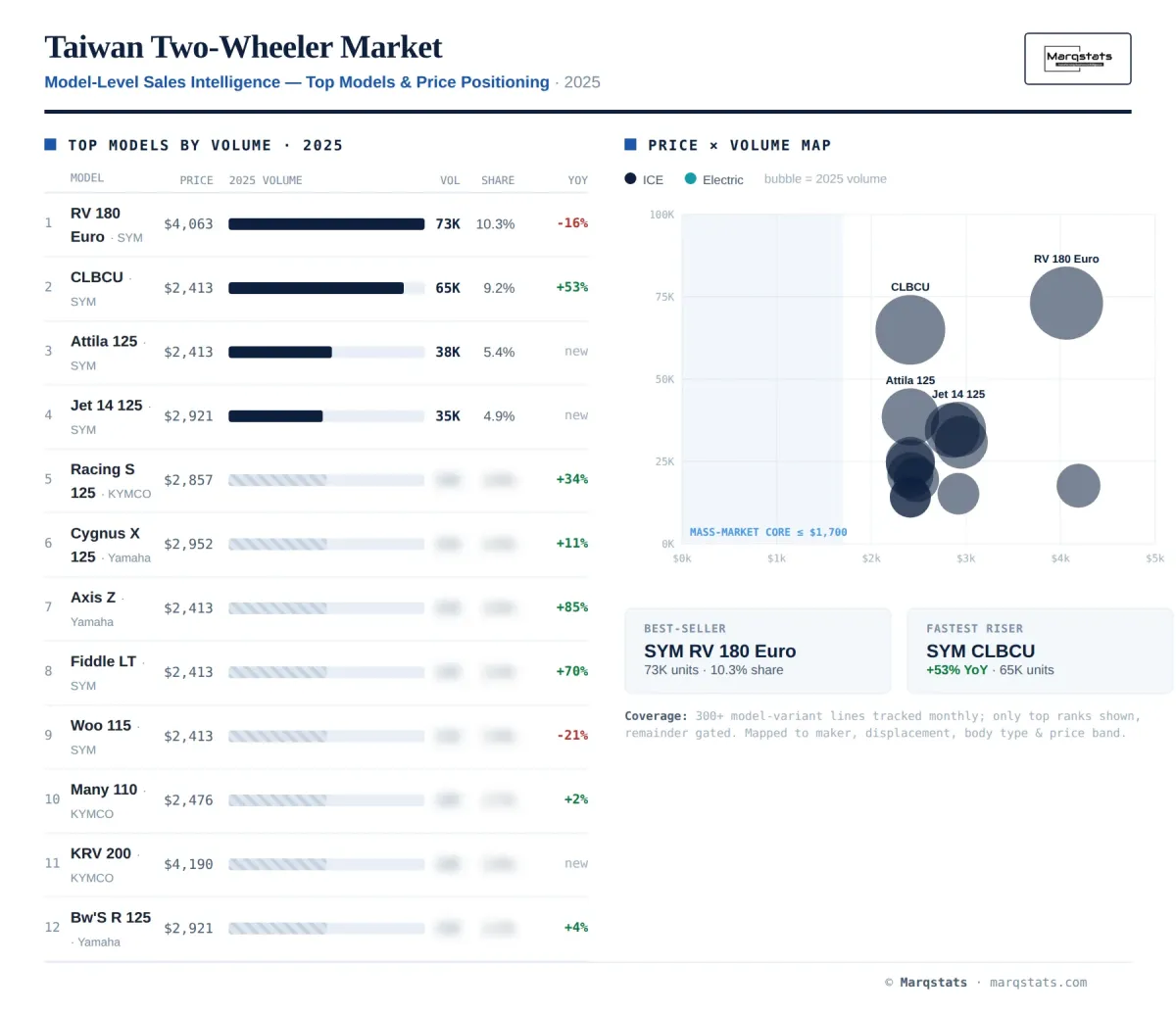
The Taiwan two-wheeler market is highly concentrated around domestic scooter manufacturers. SYM leads with about 44% of 2025 unit sales, having gained share strongly, followed by KYMCO at roughly 26% and Yamaha at about 17%, giving the top three brands close to 88% of the market. Both SYM and KYMCO built their positions over decades in combustion scooters and are now central to the electric transition.
The electric story is one of incumbent ascendancy over the pioneer. Gogoro, which peaked near 125,000 units in 2020, has seen brand sales collapse to a fraction of that level and now operates under financial restraint following restructuring, even as it retains the dominant battery-swap network and more than 665,000 subscribers. KYMCO's Ionex platform, reinforced by a LiveWire partnership and a planned maxi-scooter, has emerged as the most aggressive challenger, while Yamaha, Aeon, PGO, and eMoving compete partly through swap-network collaboration. The distinction between owning the vehicle and owning the energy network is now central: Gogoro's strength lies in the swap infrastructure that many rivals depend on, even as its vehicle sales decline, creating an unusual structure in which the segment leader by network is no longer the leader by unit sales.
Competition centres on model cadence, dealer and service reach, and battery-swap coverage. Growth is attributed to brands that pair combustion scale with credible electric roadmaps, moreover rewarding those able to control both vehicles and the underlying energy network. The coming years will test whether Gogoro can stabilise as a network operator while manufacturers such as SYM and KYMCO capture the vehicle economics of electrification.
Companies Covered
Companies covered in the report include:
Recent Market Activity
Table of Contents
Coverage & Segmentation
This report provides a comprehensive assessment of the Taiwan two-wheeler market across a 2025 base year, historical data from 2021 to 2025, and forecasts spanning 2026 to 2030. Market sizing is presented in unit-volume terms and complemented by value analysis in United States dollars, with segmentation by vehicle type, propulsion type, engine displacement and motor power, price band, end user, sales channel, and brand. Brand-level shares, segment growth rates, and competitive positioning are quantified to support commercial and investment decisions.
The scope covers demand drivers, restraints, and structural trends, with particular focus on the post-subsidy electric correction, the battery-swap ecosystem, the competitive shift from pioneer Gogoro to incumbents SYM and KYMCO, and the saturation dynamics of a mature market. The electric segment is presented on a Marqstats-reconciled basis anchored to national registration data. An extended forecast to 2035 is available under customization for subscribers requiring a longer planning horizon, alongside deeper cuts by region, brand, or channel on request.