Market Snapshot
Key Takeaways
Market Overview & Analysis
Report Summary
The India EV wire harness market covers electrical wiring assemblies used in battery-electric, plug-in hybrid, and fuel-cell vehicles across two-wheeler, three-wheeler, passenger car, commercial vehicle, and bus platforms. The market is segmented by voltage class, material, application, vehicle type, and sales channel. High-voltage traction harnesses (above 60V DC) represent the highest-value sub-segment, while low-voltage body and lighting harnesses continue to account for the largest unit volume. The segment is shaped by rapid content-per-vehicle growth, rising electromagnetic compatibility (EMC) requirements, and the ongoing copper-to-aluminum material transition.
India sold over 1.97 million electric vehicles in FY25, including 1.15 million electric two-wheelers, nearly 700,000 electric three-wheelers, and more than 100,000 electric passenger cars. Indian passenger car production reached 4.2 million units in 2024, with each unit requiring three to five distinct sub-harnesses. High-voltage EV harnesses typically command two to four times the average selling price of equivalent ICE harnesses, owing to thicker conductor cross-sections, advanced insulation, and EMI shielding requirements.
Tier-1 suppliers are aggressively expanding Indian capacity. Yazaki inaugurated a 316,000 square foot plant at Chengalpattu Industrial Park, Tamil Nadu, in April 2025 with Horizon Industrial Parks, employing more than 2,000 workers. In October 2025, Yazaki announced an additional manufacturing facility in Pune dedicated to EV wiring harnesses, targeting approximately 1,000 jobs. MSWIL commissioned three greenfield plants across Pune (EV and ICE powertrain), Navagam (Gujarat, EV-focused), and Kharkhauda (Haryana, ICE) between FY25 and early FY26. For further detail on the adjacent EV battery supply chain, the India Three-Wheeler Battery Market report on Marqstats provides chemistry-level and capacity-level data.
Regulatory compliance acts as a primary supply-side filter. Amendment 1 to AIS 156 defines any circuit operating above 30V AC or 60V DC as a high-voltage bus, bringing virtually all modern EV harnesses under strict scrutiny. Required test parameters include IPx7 water ingress protection per IEC 60529, active parallel circuit resilience, EMC testing under AIS 004, and thermal propagation reporting. Only capital-rich Tier-1 suppliers with ISO 9001 certification and automotive-grade quality audits can consistently meet CMVR Type Approval thresholds.
Market Dynamics
Key Drivers
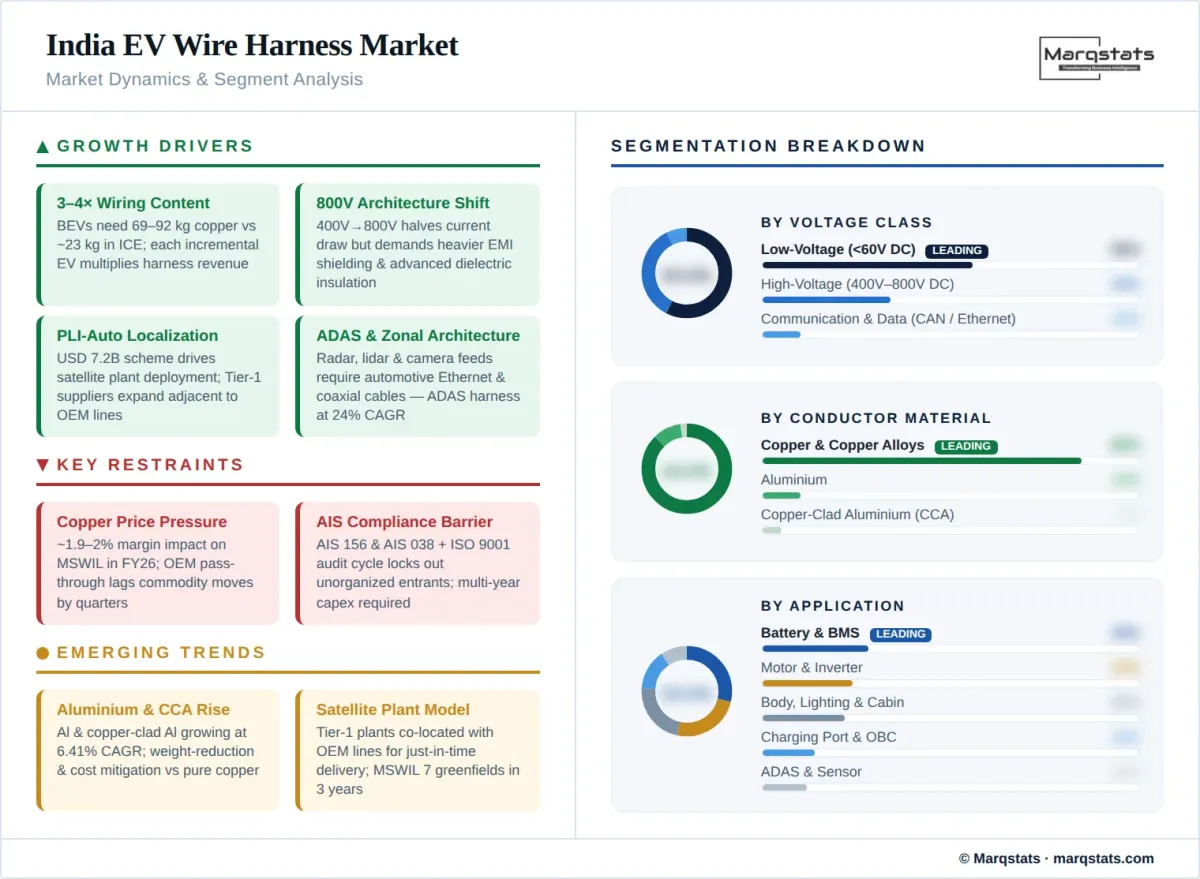
- Rising EV production volumes create direct pull for EV-specific wiring harnesses. India sold 1.97 million electric vehicles in FY25, growing at 16.9% year-on-year. Every incremental EV unit adds three to four times the copper wiring content of a comparable ICE vehicle.
- The 400V-to-800V high-voltage architecture transition increases average selling prices per harness. 800V systems halve the current required for equivalent power output, however mandate stronger dielectric insulation, heavier EMI shielding, and advanced connector sealing.
- PLI-Auto scheme incentives of approximately USD 7.2 billion accelerate localized production. Tier-1 suppliers are establishing satellite plants adjacent to OEM assembly lines to honor tight takt-time requirements and reduce logistics costs.
- Premiumization trends across passenger vehicles raise content per vehicle. ADAS integration, high-speed camera feeds, SMART antennas, and zonal architecture adoption expand harness complexity beyond the traditional 12V loom.
- Strategic partnerships between OEMs and Tier-1 harness suppliers deepen integration. MSWIL reported a 6% year-on-year volume growth outperformance owing to favourable EV product mix, while EV share of total revenue rose from 4% (Q4 FY25) to 6.7% (Q2 FY26).
Key Restraints
- Sustained upward pressure on copper commodity prices compresses margins. MSWIL reported an approximate 1.9 to 2% margin impact from copper price inflation during FY26, with a time lag before OEM pass-through adjustments.
- Aluminum substitution is constrained by engineering hurdles. Aluminum offers lower conductivity than copper, requires thicker cable gauges, and is highly susceptible to galvanic corrosion when mated with copper terminals. Masterful alloy engineering is required before aluminum secures dominant high-voltage share.
- Regulatory compliance acts as a severe barrier for new entrants. AIS 156 and AIS 038 certification, combined with ISO 9001 automotive-grade audits, requires multi-year capital investment that unorganized suppliers cannot absorb.
- Greenfield plant ramp-up weighs on short-term profitability. MSWIL absorbed approximately INR 32 crore in incremental expansion costs during Q3 FY25, with similar drag reported through Q1 FY26 as the Navagam and Kharkhauda facilities scaled.
Key Trends
- High-voltage wire harness platforms are becoming a strategic category. Aptiv PLC introduced a next-generation 800V high-voltage wiring harness system achieving a 25% weight reduction while improving thermal performance and energy efficiency.
- Satellite plant deployment adjacent to OEM assembly lines is accelerating. Tier-1 suppliers establish localized units to honor just-in-time logistics, reduce scrap, and meet stringent takt-time windows.
- Special-purpose harnesses for ADAS and zonal architectures are emerging as a distinct product line. Samvardhana Motherson International introduced cable assemblies engineered for automotive Ethernet, safety, and multimedia applications supporting high-speed data transmission.
- Lightweight material adoption is rising. Aluminum and copper-clad aluminum (CCA) are forecast to grow at 6.41% CAGR owing to weight-reduction and copper-cost mitigation pressure. Copper alloys retain dominance for critical high-voltage power lines at 800V.
Market Segmentation
Low-voltage harnesses connect body, lighting, cabin, infotainment, and ancillary 12V systems. The segment accounts for approximately 56% of EV harness market share by volume in 2025. The category remains the largest volume contributor across electric two-wheelers, three-wheelers, and entry-level passenger EVs. Typical conductor cross-sections range between 0.5 and 6 sq mm. Unit pricing is significantly lower than high-voltage harnesses, however the sheer volume per vehicle sustains overall revenue contribution.
High-voltage harnesses handle power distribution from the battery to the motor, inverter, on-board charger, and DC fast-charging port. The segment is the fastest-growing voltage category, advancing at 5.26% CAGR through 2030. High-voltage harnesses operate at 400V to 800V, with heavy commercial and bus platforms exploring 1000V architectures. Conductor cross-sections range from 25 to 95 sq mm. Heavy EMI shielding, silicone-based dielectric insulation, and IPx7-certified connectors are standard requirements. Aptiv’s 800V high-voltage wiring harness system represents the technology benchmark.
Communication harnesses support CAN, LIN, FlexRay, and automotive Ethernet protocols for Battery Management System (BMS) communication, motor controller signaling, and ADAS sensor feeds. The segment is advancing at 7.8% CAGR, supported by zonal architecture adoption and ADAS penetration in mid-segment EVs. Ethernet-capable cable assemblies for camera, radar, and lidar integration are an emerging sub-category.
Copper dominates the EV wire harness market with an approximate 85% share in 2025. Copper offers unmatched electrical conductivity, high tensile strength, and thermal reliability. Copper alloys achieve up to 98% conductivity efficiency at 800V, cementing their role in high-performance traction harness applications. Rising copper prices have generated sustained margin pressure across Tier-1 suppliers.
Aluminum holds approximately 10% share in 2025 and is forecast to reach 16% by 2030. Aluminum is significantly lighter and cheaper than copper. The transition requires thicker cable gauges owing to lower conductivity. Galvanic corrosion when mated with copper terminals is a persistent challenge, resolved through advanced crimping technologies and hybrid connector designs.
Copper-clad aluminum represents an emerging hybrid material, combining copper’s surface conductivity with aluminum’s core weight advantage. The segment is advancing at 6.41% CAGR alongside pure aluminum. CCA deployment is concentrated in low-voltage body and lighting harnesses where absolute conductivity is less critical.
Battery harnesses connect individual cell modules to the Battery Management System and the high-voltage bus. The segment accounts for approximately 28% of the EV harness market by value in 2025. Thermal management cable harnesses for liquid-cooled battery packs represent a growing sub-category.
Motor and inverter harnesses transmit high-voltage DC power and three-phase AC power between the battery, inverter, and traction motor. The segment accounts for approximately 24% share in 2025. EMI shielding is critical owing to high-frequency inverter switching. PMSM motor deployments in L5 cargo three-wheelers and e-buses expand this category.
Charging harnesses connect the charging port to the on-board charger and to the battery pack. The segment is advancing at 18% CAGR owing to DC fast-charging rollouts. Type-6 interface adoption for light EVs under IS 17017 standard, pioneered by Ultraviolette and Bolt.Earth, drives specialized harness designs for two-wheeler and three-wheeler applications.
ADAS harnesses support radar, lidar, camera, and ultrasonic sensor integration. The segment is the fastest-growing by value, advancing at 24% CAGR. Automotive Ethernet, coaxial shielded cables, and high-frequency connectors are standard requirements. Tata Motors Passenger Vehicles integrated Excelfore’s eSync OTA platform in its April 2026 Sierra SUV launch, expanding data-harness complexity across ECU domains.
Body and lighting harnesses connect exterior and interior lighting, HVAC controls, power windows, and cabin sensors. The segment accounts for approximately 22% of EV harness revenue in 2025. Although lower-margin than high-voltage categories, the sheer volume per vehicle sustains revenue contribution.
Electric two-wheelers account for approximately 32% of the Indian EV harness market by volume in 2025. Hero Electric partnered with Dhoot Transmission for 3D-designed wiring harness solutions. OEM captives including Ola Electric, TVS Motor, and Ather Energy increasingly develop harnesses in-house for integrated battery-motor architectures.
Electric three-wheelers contribute approximately 18% share in 2025. L3 passenger e-rickshaws use simpler low-voltage harnesses, while L5 cargo three-wheelers require higher-voltage assemblies for 6 to 12 kWh battery packs and 5 to 10 kW motors. The PMI Electro Mobility Rajasthan plant, announced in October 2025 with an INR 12 billion investment, integrates in-house wire harness production alongside battery and motor manufacturing.
Electric passenger cars represent the highest-value segment per unit, holding approximately 28% market share by revenue in 2025. MSWIL supplies harnesses to Maruti Suzuki (e Vitara), Tata Motors (Nexon EV, Punch EV, Sierra EV), and Mahindra Electric. High-voltage traction harnesses for 400V platforms dominate current deployments, with 800V platforms emerging from 2026.
Electric commercial vehicles and buses account for approximately 22% share in 2025. Tata Motors launched the Prima E.55S electric prime mover in April 2026 with a 450 kWh battery pack, requiring heavy-duty 800V harnesses. PMI Electro Mobility, EKA Mobility, and Olectra Greentech represent primary bus OEM customers.
OEM channel accounts for approximately 92% of market revenue in 2025. Tier-1 suppliers maintain long-term supply contracts aligned with vehicle program lifecycles of five to seven years. Satellite manufacturing plants adjacent to OEM assembly lines dominate the channel architecture.
Aftermarket contributes approximately 8% share in 2025. Replacement wiring harnesses for aging e-rickshaw fleets represent the largest aftermarket sub-segment. Unorganized aftermarket channels remain price-competitive, however AIS 156 compliance is driving gradual formalization.
By Geography
Southern India
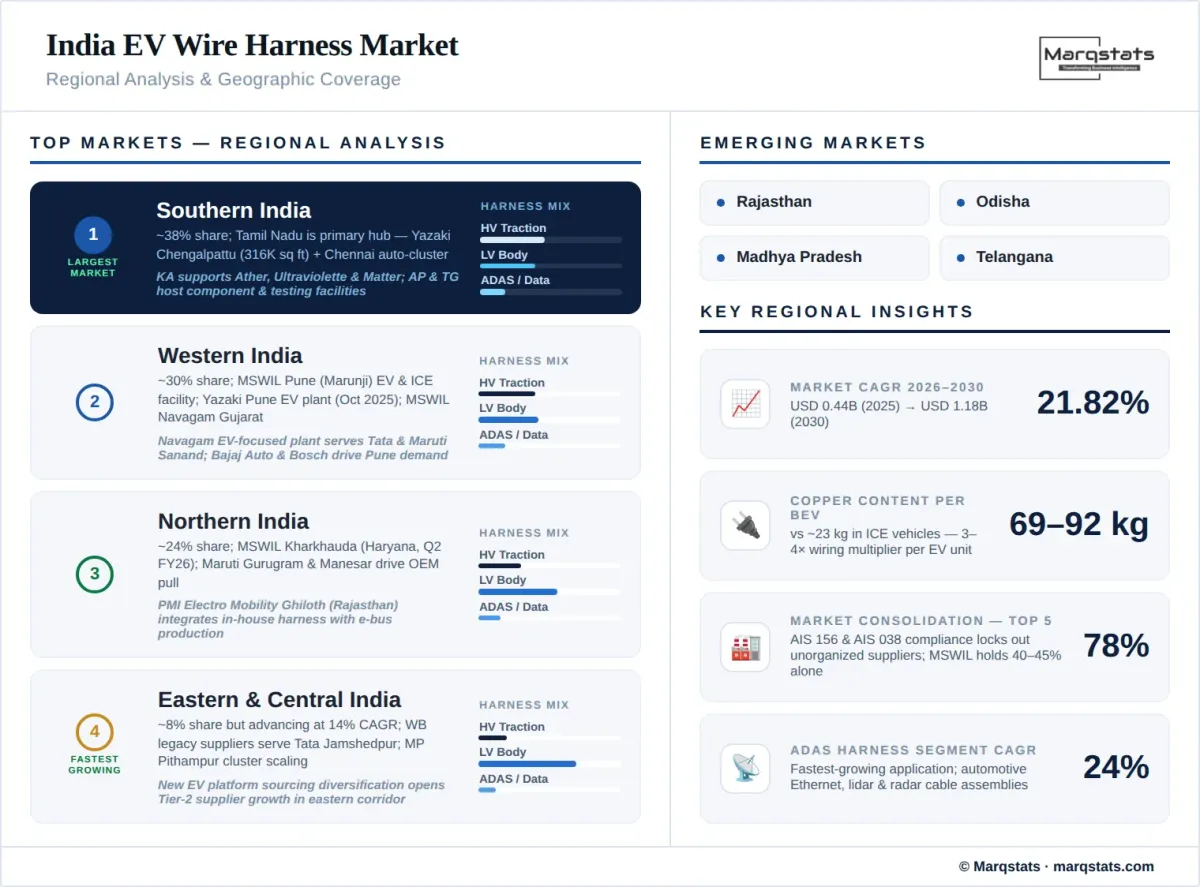
Southern India hosts the largest concentration of wire harness manufacturing, accounting for approximately 38% share in 2025. Tamil Nadu is the primary production hub, anchored by Yazaki’s Chengalpattu plant (316,000 square feet, operational from April 2025) and Chennai’s broader auto-component cluster. Karnataka supports Bengaluru-based OEM startups including Ather Energy, Ultraviolette, and Matter Motor Works. Andhra Pradesh and Telangana host supporting component facilities.
Western India
Western India holds approximately 30% share in 2025. Maharashtra is the primary cluster, with MSWIL’s Pune (Marunji) greenfield facility serving both EV and ICE powertrain programs. Yazaki’s October 2025 Pune facility dedicated to EV wiring harnesses will add approximately 1,000 jobs. Gujarat hosts MSWIL’s Navagam EV-focused plant, commissioned in Q1 FY26, supporting Tata Motors and Maruti Suzuki’s Sanand operations.
Northern India
Northern India accounts for approximately 24% share in 2025. Haryana is the anchor state, hosting MSWIL’s Kharkhauda ICE facility, scheduled for Q2 FY26 launch. Maruti Suzuki’s Gurugram and Manesar plants, along with Hero MotoCorp and Mahindra facilities, drive supply demand. Delhi-NCR and Rajasthan are emerging clusters, with the PMI Electro Mobility Ghiloth Industrial Area plant adding wiring-harness capacity integrated into bus production.
Eastern and Central India
Eastern and Central India hold approximately 8% combined share in 2025. West Bengal hosts legacy component suppliers serving Tata Motors’ Jamshedpur operations. Madhya Pradesh’s Pithampur and Dewas industrial corridors support emerging Tier-2 suppliers. The region is advancing at 14% CAGR through 2030 as new EV platforms diversify sourcing geographies.
How Competition Is Evolving
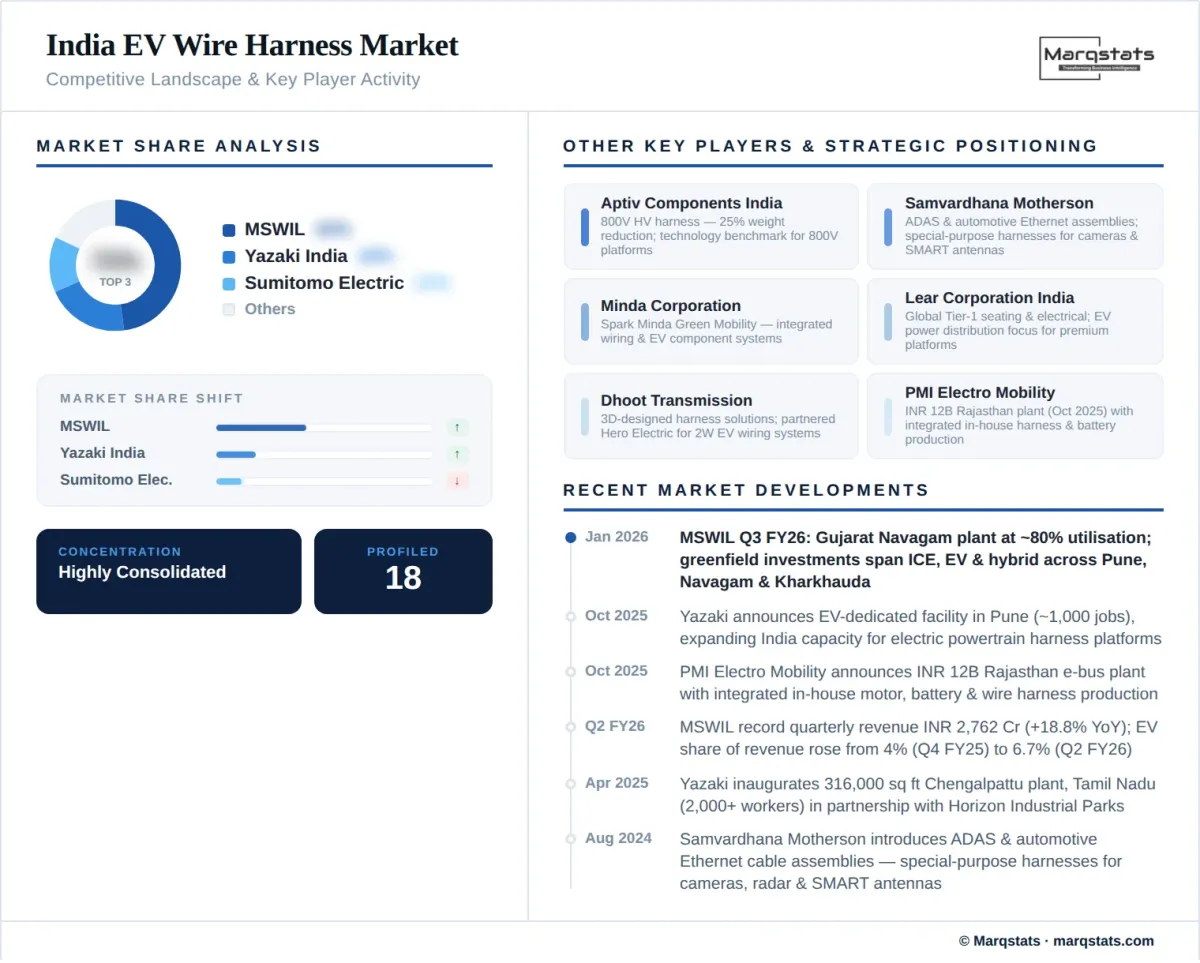
The competitive environment in the India EV wire harness market is highly consolidated. The top five organized players account for approximately 78% of revenue in 2025. Market concentration is sustained by steep regulatory barriers under AIS 156 and AIS 038, long OEM qualification lifecycles, and capital-intensive high-voltage tooling requirements. Unorganized suppliers are progressively excluded from formal supply chains, consolidating market power into well-capitalized Tier-1 giants.
Motherson Sumi Wiring India Limited (MSWIL) is the undisputed market leader, holding approximately 40 to 45% share. The company operates through a joint venture with Sumitomo Wiring Systems and runs 30 facilities across India. MSWIL reported Q2 FY26 revenue of INR 2,762 crore (18.8% year-on-year growth) and EBITDA of INR 280 crore (12.1% growth). The company launched seven greenfield projects over the last three years, including EV and ICE powertrain facilities at Pune (Marunji), Navagam (Gujarat), and Kharkhauda (Haryana). EV share of MSWIL total revenue rose from 4% (Q4 FY25) to 6.7% (Q2 FY26).
Global Tier-1 suppliers are aggressively scaling Indian capacity. Yazaki inaugurated a 316,000 square foot Chengalpattu plant in April 2025 employing more than 2,000 workers, followed by a Pune EV-dedicated facility in October 2025 creating approximately 1,000 additional jobs. Aptiv PLC introduced an 800V high-voltage wiring harness system achieving a 25% weight reduction. Sumitomo Electric Industries, Lear Corporation, Minda Corporation, Uno Minda, Dhoot Transmission, Furukawa Electric, Leoni, and Kyungshin represent the additional organized cohort. Strategic partnerships focused on high-voltage system integration, lightweight material engineering, and AIS-certified manufacturing are the primary competitive differentiators for the 2026–2030 period.
Companies Covered
The report profiles 18 company profiles+ companies with full strategy and financials analysis, including:
Recent Market Activity
Table of Contents
Coverage & Segmentation
The India EV Wire Harness Market report analyzes the market across voltage class, material, application, vehicle type, sales channel, and regional geography for the period 2021 to 2030. The report covers historical data for 2021-2025, with 2025 as the base year, and forecasts spanning 2026-2030. Market sizing is conducted in USD billions and unit volumes. The study examines the full harness value chain, including raw material sourcing, conductor and insulation manufacturing, terminal and connector supply, pack assembly, BMS integration, and aftermarket service.
The scope encompasses all EV powertrain categories, including battery-electric, plug-in hybrid, and fuel-cell vehicles. Vehicle categories covered include L1 and L2 electric two-wheelers, L3 passenger and L5 cargo three-wheelers, M1 electric passenger cars, N1 light commercial vehicles, N2/N3 electric trucks, and M3 electric buses. The study evaluates policy impact from the PLI-Auto scheme, SPECS programme, PM E-DRIVE, AIS 156 and AIS 038 safety standards, and the Phased Manufacturing Programme. Competitive profiling covers 18 harness manufacturers operating in India. The report includes pricing analysis, segmental forecasts, value-chain margins, and capacity expansion schedules.