Market Snapshot
Key Takeaways
Market Overview & Analysis
Report Summary
The United States neighborhood electric vehicle and low-speed vehicle market covers all battery-electric four-wheeled vehicles with speed capability of more than 20 mph but not more than 25 mph that meet FMVSS No. 500 requirements for street-legal operation on roads posted 35 mph or below. The scope includes personal/community LSVs (neighborhood mobility, lifestyle vehicles, local errands), commercial/fleet LSVs (campus, resort, municipality, facility management, micro-distribution, food service, security, EMS), utility LSVs (grounds work, maintenance, cargo, towing), and the lithium-ion battery upgrade aftermarket replacing lead-acid systems. Non-street-legal golf carts and personal transport vehicles (PTVs) are excluded from the core scope but referenced for market context because buyer confusion between categories remains a competitive issue.
The US market exists because there is a real gap between a golf cart and a full automotive vehicle. AYRO says its Vanish addresses the space “between full-size trucks and golf and utility carts.” GEM says its vehicles fill the gap between golf carts and highway vehicles with EVs engineered for local streets. Club Car Urban targets public sector, facility management, leisure, and last-mile delivery applications. The market grows through three mechanisms: channel expansion (GEM on BestBuy.com), product specialisation (AYRO Vanish for micro-distribution, GEM eX for commercial all-terrain), and premiumisation of safety/comfort (Club Car Onward LSV with DOT glass, cameras, AVAS, reinforced occupant protection).
Market Dynamics
Key Drivers
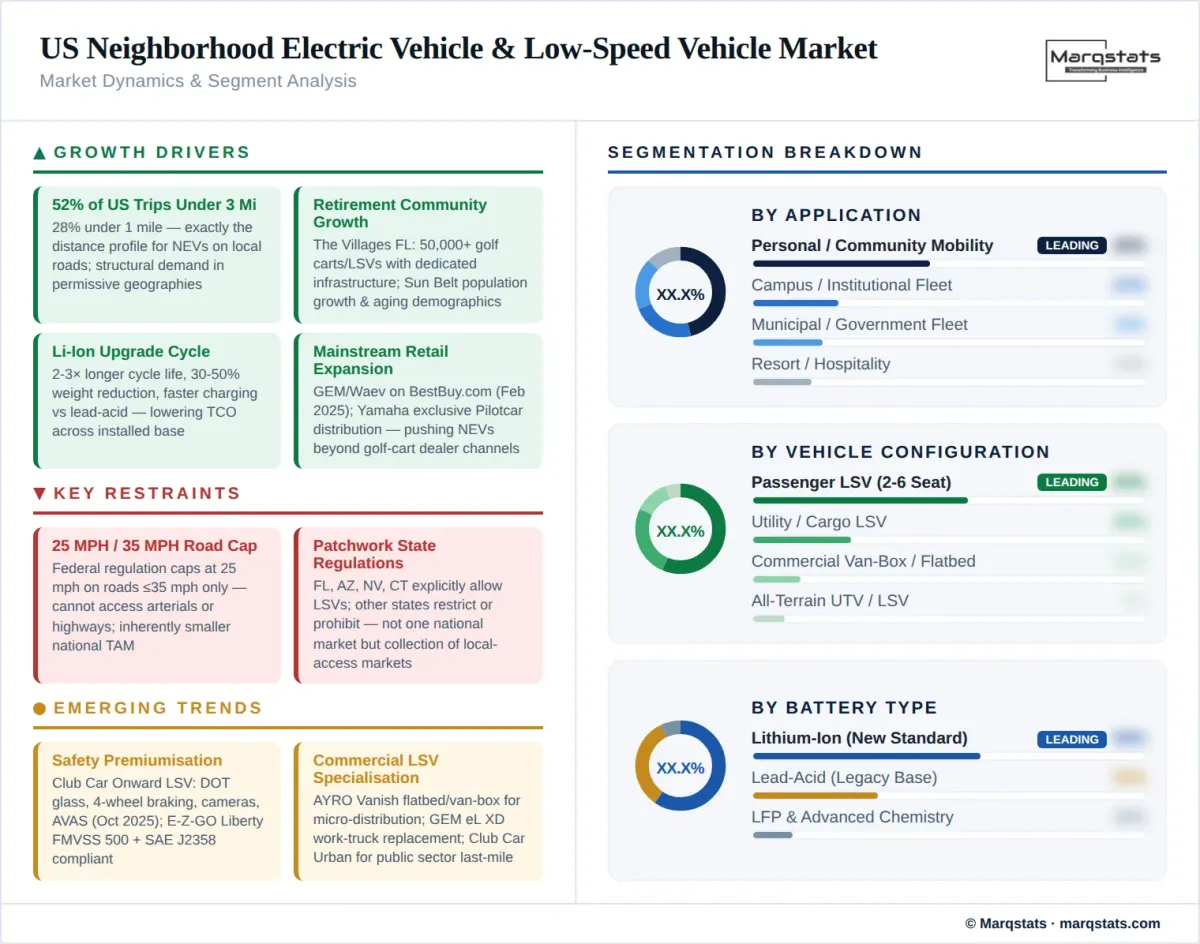
- 52% of US trips under 3 miles creating structural demand for local-street mobility: DOE data shows 28% of all trips are under one mile. This distance profile is exactly what NEVs and LSVs are designed for: local errands, neighbourhood commuting, community transport, and campus mobility. In permissive geographies (Florida, Arizona, Nevada, beach towns, master-planned communities), these short trips are being served by LSVs rather than passenger cars.
- Retirement and master-planned community expansion driving personal NEV adoption: The Villages, Florida—the largest retirement community in the US—operates an estimated 50,000+ golf carts and LSVs with dedicated infrastructure including LSV lanes, parking, and trail systems. Sun Belt population growth, aging demographics, and community design that accommodates low-speed vehicles create a structural demand base. Similar adoption patterns exist in Peachtree City (Georgia), beach communities in South Carolina and North Carolina, and resort towns in Arizona and Nevada.
- Lithium-ion battery upgrade cycle improving performance and lowering TCO: The transition from lead-acid to lithium-ion batteries delivers 2–3x longer cycle life, 30–50% weight reduction, faster charging, consistent power delivery throughout discharge, and lower total cost of ownership over the vehicle’s lifetime. The installed base of lead-acid NEVs and golf carts represents a substantial battery upgrade aftermarket. Major OEMs including Club Car, GEM, E-Z-GO, and Yamaha are transitioning their lineups to lithium-ion as standard or premium options.
- Campus, resort, and municipal fleet right-sizing replacing oversized vehicles: Club Car markets LSVs and utility vehicles to campuses for grounds work, security, events, and EMS, emphasising lower operating cost versus small trucks or vans. AYRO targets campus mobility, last-mile delivery, micro-distribution, education, government, hotels, resorts, and food/merchandise with the Vanish. Waev targets municipalities and commercial fleets across GEM, Taylor-Dunn, and related brands. Right-sizing from a pickup truck or cargo van to an LSV reduces fuel, maintenance, insurance, and parking costs while improving campus accessibility.
- Low charging complexity versus highway EVs reducing infrastructure barriers: GEM vehicles charge from 110 V, 240 V, and J1772 equipment. WiTricity demonstrated wireless charging for NEVs and golf carts at CES 2024, showing that even inductive charging is technically feasible at this power level. Standard household outlets or basic Level 1/2 infrastructure is sufficient—eliminating the DC fast charging dependency, grid upgrade requirements, and infrastructure investment that constrain larger EV adoption.
Key Restraints
- 25 mph speed cap and 35-mph road restriction limiting addressable geography: Federal regulation caps LSVs at 25 mph and limits operation to roads posted 35 mph or below (with crossing exceptions). This confines the market to neighbourhoods, campuses, beach towns, resort areas, master-planned communities, and local municipal districts. A product that cannot access ordinary suburban arterials or highways has an inherently smaller national TAM than a passenger EV.
- Patchwork state and local regulations creating uneven market access: Florida, Arizona, Nevada, and Connecticut explicitly allow LSV operation on ≤35 mph roads with specific crossing rules. But regulations vary significantly across states, counties, and municipalities. Some jurisdictions restrict or prohibit LSV use on public roads entirely. This patchwork means the market is not one uniform national market—it is a collection of local-access markets shaped by municipal acceptance and state roadway law.
- Category confusion between golf carts, PTVs, LSVs, and micro-utility EVs: Many buyers blur golf carts, personal transport vehicles, and street-legal LSVs together. E-Z-GO explicitly distinguishes its federally compliant Liberty LSV from more basic PTVs. This confusion affects consumer expectations, dealer practices, local enforcement, and pricing perception. Manufacturers must invest in consumer education to differentiate street-legal, safety-equipped LSVs from non-compliant recreational vehicles.
Key Trends
- Premiumisation of safety and comfort for shared-road acceptance: Club Car’s Onward LSV features touchscreen, four-wheel braking, reinforced occupant protection, DOT-approved glass windshield, mirrors, turn signals, backup camera, and AVAS (October 2025). E-Z-GO Liberty LSV follows both FMVSS 500 and voluntary SAE J2358. Because LSVs share roads with full-size vehicles, premium safety features improve both regulatory compliance and mainstream buyer confidence.
- Mainstream retail channel expansion beyond golf-cart dealer networks: GEM/Waev launched sales on BestBuy.com (February 2025)—the first major LSV brand to enter mainstream consumer electronics retail. This move pushes the NEV category beyond traditional golf-cart/dealer channels toward mainstream retail discovery. Yamaha’s exclusive North American distribution of Pilotcar LSVs (January 2025) similarly broadens channel access through an established dealer network.
- Commercial LSV specialisation: micro-distribution, last-mile, campus utility: AYRO’s Vanish offers adaptable flatbed, pickup-bed, and van-box variants for last-mile delivery, campus mobility, and micro-distribution. GEM’s eL XD targets work-truck replacement in local service areas. Club Car Urban targets public sector, facility management, and last-mile delivery with pickup-bed and van-box configurations. The US market is fragmenting into personal LSVs, shuttle LSVs, and utility/delivery LSVs—each with distinct product and pricing strategies.
- Wireless and smart charging technology for NEV fleets: WiTricity demonstrated wireless charging for NEVs and golf carts at CES 2024, showing automated inductive charging applicable to fleet depots, campuses, and community parking. Smart charging scheduling and fleet management software are entering campus and municipal NEV operations. Low-power charging requirements (110 V/240 V) make NEV fleets among the easiest commercial EV segments to deploy from an infrastructure perspective.
Market Segmentation
Neighbourhood commuting, beach-town transport, retirement-community mobility, master-planned community errands, campground transport, and lifestyle use. The Villages (50,000+ units) is the largest single-market proof point. Club Car Onward LSV, E-Z-GO Liberty LSV, Yamaha/Pilotcar, GEM personal models, and Bintelli serve this segment. Premiumisation (DOT glass, cameras, enclosed cabs, premium seating) is the dominant competitive strategy for this use case.
Universities, corporate campuses, hospitals, military bases, large facility complexes, and theme parks. Club Car targets grounds work, security, events, and EMS applications. LSVs replace small trucks and vans with lower operating cost, better campus accessibility, and zero emissions. Campus fleets are often the first step toward broader municipal NEV adoption.
City and county government operations including parks maintenance, meter enforcement, facility management, and community policing. Waev targets municipalities across GEM, Taylor-Dunn, and related brands. Club Car Urban serves public-sector utility and last-mile delivery tasks. Government fleet procurement provides predictable, multi-year demand with budget-cycle purchasing.
Hotels, resorts, golf communities, amusement parks, and outdoor recreation destinations. Guest shuttle services, staff transport, luggage/cargo movement, and facility maintenance. Club Car (with Garia and Melex acquisitions) serves this segment with premium and compact utility offerings. Resort environments provide controlled, low-speed settings ideal for LSV operations.
Urban micro-delivery, campus food/merchandise distribution, and local logistics. AYRO Vanish targets last-mile delivery, campus mobility, and micro-distribution with adaptable flatbed, pickup-bed, and van-box variants. GEM eL XD substitutes for a work truck or cargo van in local service areas. This application overlaps with the broader electric last-mile delivery van market but operates at a smaller scale and lower speed for hyper-local routes.
The growth segment. Lithium-ion delivers 2–3x longer cycle life, 30–50% weight reduction, faster charging, and lower lifetime cost. All major OEMs are transitioning to lithium as standard or premium. New LSV models (Club Car Onward LSV, GEM eX, AYRO Vanish) are lithium-native. Lithium-ion NEVs command higher initial price but deliver significantly better total cost of ownership for fleet and personal buyers.
Still present in the installed base and in entry-level pricing. Lead-acid systems are cheaper upfront but heavier, shorter-range, slower to charge, and more expensive over the vehicle lifetime. The lead-acid to lithium-ion upgrade aftermarket is a significant revenue stream for dealers and battery suppliers. This segment is declining as lithium-ion cost and availability improve.
By Geography
Florida
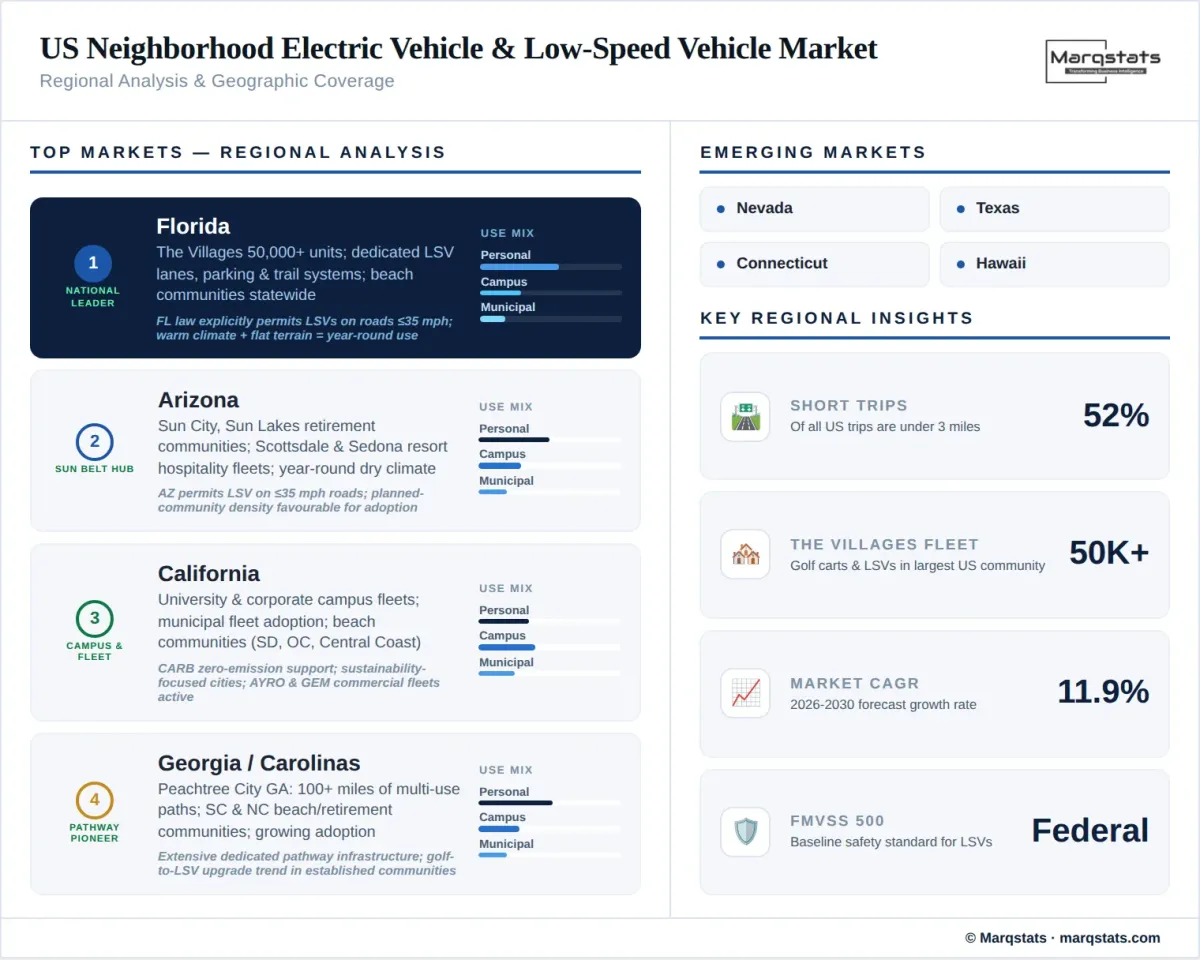
The undisputed national leader in NEV/LSV adoption. The Villages operates 50,000+ golf carts and LSVs with dedicated infrastructure. Florida law explicitly permits LSV operation on roads posted 35 mph or below. Beach communities, retirement destinations, and master-planned developments across the state drive sustained demand. Florida’s warm climate, flat terrain, and outdoor-lifestyle culture are structurally favourable for year-round NEV use.
Arizona
Second-largest NEV/LSV market. Arizona permits LSV operation on roads ≤35 mph with specific rules. Sun City, Sun Lakes, and other retirement communities drive personal NEV adoption. Resort towns (Scottsdale, Sedona, Tucson) support hospitality fleet demand. Arizona’s dry climate and planned-community density are favourable for LSV operations year-round.
California
Strong campus and commercial fleet demand. University and corporate campuses drive institutional NEV fleets. Municipal fleet adoption in sustainability-focused cities. Beach communities (San Diego, Orange County, Central Coast) support personal NEV use. CARB and California air quality regulations support zero-emission local vehicle adoption.
Georgia / Carolinas
Peachtree City, Georgia operates one of the most extensive LSV/golf-cart pathway systems in the US (100+ miles of multi-use paths). South Carolina and North Carolina beach and retirement communities (Hilton Head, Kiawah, Pinehurst) support personal NEV adoption. Georgia is also a hub for small-vehicle manufacturing and distribution.
Nevada / Southwest
Las Vegas resort corridor and planned communities drive both personal and commercial/hospitality NEV demand. Nevada law permits LSV operation on roads ≤35 mph. Southwest retirement and resort communities in Utah, Colorado, and New Mexico represent emerging markets.
Northeast and Midwest
Seasonal use limits year-round adoption. Cape Cod, Martha’s Vineyard, and Nantucket in Massachusetts, plus Hampton communities in New York, support summer-season personal NEV use. University campuses across the Northeast and Midwest drive institutional fleet demand year-round. Connecticut explicitly allows LSV operation on ≤35 mph roads.
How Competition Is Evolving
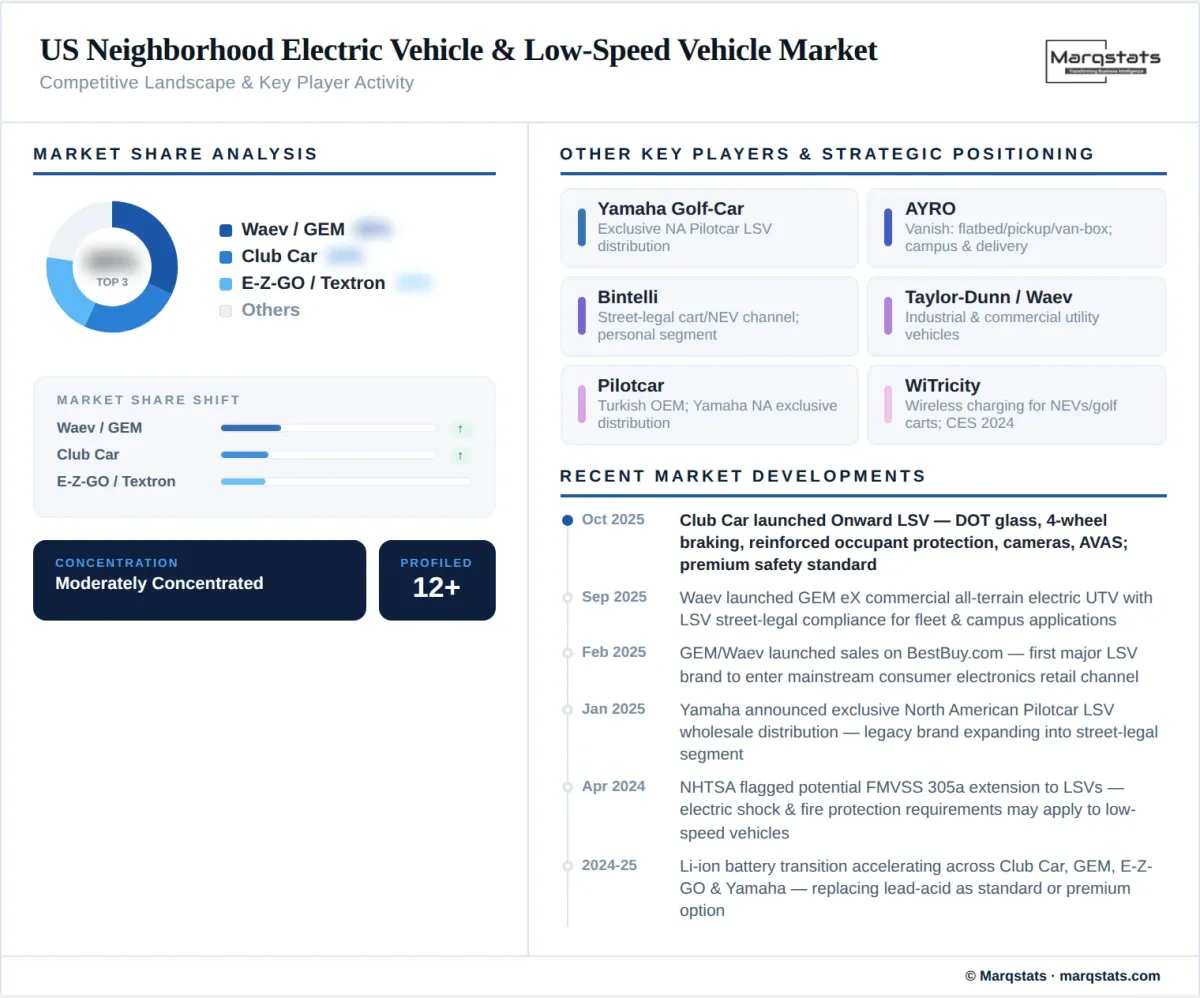
The personal/community segment is led by golf-cart-heritage brands pushing into street-legal LSVs. Club Car (Onward LSV: touchscreen, four-wheel braking, reinforced protection, DOT glass, cameras, AVAS, October 2025; acquired Garia and Melex for expanded compact utility) is premiumising the neighbourhood mobility experience. E-Z-GO/Textron (Liberty LSV: FMVSS 500 + SAE J2358 compliant, federal street-legal) competes on safety compliance and established dealer network. Yamaha Golf-Car (exclusive North American Pilotcar LSV distribution, January 2025) leverages its existing dealer infrastructure. Bintelli maintains an active presence in the street-legal cart/NEV channel.
The commercial/fleet segment is strategically more dynamic. Waev/GEM has the broadest commercial LSV story: GEM has been the US LSV market leader since 1998 and the first commercially produced street-legal LSV. Current models span people movers and utility vehicles (eL XD, eX all-terrain commercial, September 2025). Waev also operates Taylor-Dunn for industrial/commercial work. GEM expanded to BestBuy.com retail (February 2025). AYRO targets the “between a golf cart and a small pickup” niche with the Vanish for last-mile delivery, campus mobility, micro-distribution, and food/merchandise applications—offering adaptable flatbed, pickup-bed, and van-box variants. Club Car Urban targets public sector, facility management, leisure, and last-mile delivery.
The competitive ecosystem is differentiating along two axes simultaneously: street-legality/safety (FMVSS 500 compliance, SAE J2358, DOT glass, AVAS, cameras) and job-specific configuration (personal lifestyle, shuttle, cargo, towing, micro-delivery). The market is not collapsing into one commodity format—it is fragmenting into distinct personal, shuttle, and utility/delivery LSV sub-categories, each with different pricing, features, and distribution strategies.
Companies Covered
The report profiles 12+ companies with full strategy and financials analysis, including:
Recent Market Activity
Table of Contents
Coverage & Segmentation
This report provides a comprehensive analysis of the United States neighborhood electric vehicle and low-speed vehicle market covering the historical period (2021–2025) and forecast period (2026–2030), with 2025 as the base year. The study examines market size in USD and volume across application (personal/community, campus/institutional, municipal/government, resort/hospitality, micro-distribution/last-mile), battery technology (lithium-ion vs lead-acid), and geography covering 10 state/regional clusters with permissive LSV regulation. Company profiling covers 12+ players across personal LSV manufacturers, commercial/fleet LSV brands, and technology providers. Regulatory analysis covers FMVSS No. 500, NHTSA FMVSS 305a potential application, SAE J2358, and state-by-state LSV roadway permission.
Research methodology combines bottom-up modelling from manufacturer shipment data, dealer network counts, community-level NEV density estimates (The Villages 50,000+, Peachtree City path systems), lithium-ion battery upgrade volumes, and campus/municipal fleet procurement tracking. Primary research encompasses 40+ interactions with LSV manufacturers, golf-cart and NEV dealers, master-planned community managers, campus fleet operators, municipal procurement directors, resort/hospitality fleet managers, and lithium-ion battery upgrade suppliers across Florida, Arizona, California, Georgia, and Nevada.