Statistics & Highlights

Market Snapshot

Market size in USD Billion
$2.15B
2025
Base year
$2.71B
2026
Estimated
  
$6.87B
2030
Forecast
Largest market
Klang Valley (52% share, 2025)
Fastest growing
Entry-Level BEV segment (Below MYR 100,000)
Dominant segment
BEV propulsion; Chinese brand origin (60% share)
Concentration
Moderately Fragmented
CAGR
26.18%
2026 – 2030
GROWTH
+$4.72B
Absolute
STUDY PARAMETERS
Base year2025
Historical period2021 – 2025
Forecast period2026 – 2030
Units consideredValue (USD Billion), Volume (Units)
REPORT COVERAGE
Segments covered5 segments
Regions covered6-region analysis
Companies profiled18 company profiles+
Report pages295+
DeliverablesPDF, Excel, PPT
Executive Summary

Key Takeaways

Market valued at USD 2.15 billion in 2025, projected to reach USD 6.87 billion by 2030 at 26.18% CAGR.
BEV and PHEV registrations reached 30,848 units in 2025, doubling from 14,766 in 2024 at 109% year-on-year growth.
CKD tax exemptions extend through December 2027, anchoring Proton, Perodua, BMW, Volvo, GWM, and Leapmotor local assembly pipelines.
Chinese OEMs hold approximately 60% brand share in 2025, led by BYD with 11,870 registrations across six models.
Charging network reached 5,360 public chargers by November 2025; DC fast chargers exceed the revised 1,500-unit target.
Prasarana targets 1,350 electric buses under a MYR 1.9 billion Finance Ministry allocation, with 250 units deployed by 2027.
Market Insights

Market Overview & Analysis

Report Summary

The Malaysia electric vehicle market covers battery-electric, plug-in hybrid, and hybrid electric vehicles across passenger cars, two-wheelers, commercial vehicles, and buses. The market is segmented by propulsion type, vehicle category, battery chemistry, price band, and sales channel. Malaysia’s EV transition is state-led, anchored by the Low Carbon Mobility Blueprint 2021–2030, which targets 10,000 public chargers by 2025 and 20% xEV share of new vehicle sales by 2030.

Malaysia’s 2025 total industry volume reached 820,752 units, up 0.5% year-on-year. BEV and PHEV share rose from 1.81% in 2024 to 3.76% in 2025. Proton led the EV charts after launching the e.MAS 7 (a rebadged Geely EX5), which recorded 8,677 registrations for the full year. BYD secured 11,870 cumulative registrations across the Sealion 7, Atto 3, Atto 2, M6 MPV, Seal, and Seal 6. Tesla registered 5,467 units led by Model Y (4,401) and Model 3 (2,880). Additional entrants include Zeekr, XPeng, Denza, GWM, Chery Omoda, iCaur, Leapmotor, Dongfeng, Wuling, and Smart.

Local CKD assembly is accelerating. Proton commissioned a 20,000 vehicle-per-year dedicated EV plant at Tanjung Malim in September 2025, scalable to 45,000 units. Perodua launched the QV-E on December 1, 2025, priced at MYR 80,000 (battery-leased) with a production ramp from 500 units per month to 3,000 by Q3 2026. BMW commissioned Asia-Pacific’s first CKD i5 eDrive40 in January 2026 (priced from MYR 368,800), while Volvo launched the ES90 with local assembly in Shah Alam at MYR 339,888. TQ Wuling commenced CKD production of the Bingo EV at Tan Chong’s Segambut facility in January 2026 at MYR 67,800. GWM began CKD production of the WEY G9 PHEV at EP Manufacturing’s Pegoh plant, Melaka.

Battery cell manufacturing is emerging as a parallel industry layer. Samsung SDI operates its second cylindrical cell plant at Seremban, producing 21700-format cells with mass production from 2024. EVE Energy opened a 680-million-unit cylindrical cell plant in 2025 and committed to a 10–15 GWh phase-two expansion for energy storage. Highstar Power will commission a 2.5 GWh cell plant in Johor in April 2026. Lynas Rare Earths announced a MYR 500 million heavy rare earth separation facility expansion in October 2025, reinforcing Malaysia’s upstream critical-mineral position.

Market Dynamics

Key Drivers

  • Import duty and excise tax exemptions accelerate BEV and PHEV adoption. CBU exemptions applied through December 2025. CKD exemptions continue through December 2027 across import duty, excise tax, and sales tax, providing a multi-year runway for local assembly programmes.
  • Local CKD assembly expansion is accelerating. Proton’s Tanjung Malim EV plant (20,000 units per year), Perodua’s Smart Mobility Plant (3,000 units per month target), BMW Shah Alam i5 CKD, Volvo ES90 Shah Alam assembly, TQ Wuling Bingo, and GWM WEY G9 at Pegoh collectively expand domestic capacity.
  • Chinese OEM entry has intensified. Chinese-origin brands secured approximately 60% of EV registrations in 2025, led by BYD, Zeekr, XPeng, Chery, GWM, Leapmotor, iCaur, Dongfeng, Wuling, Denza, and Smart. The Global EV Leaders Initiative permits 100% foreign ownership for qualifying entities.
  • Charging infrastructure is expanding. Licensed public chargers rose to 5,360 by November 2025. DC fast chargers already exceed the revised 1,500-unit target. Streamlined licensing cut approval times from 60 to 30 days under the Energy Commission (ST).
  • Public transport electrification creates stable demand. The Finance Ministry allocated MYR 1.9 billion for procurement of 1,660 buses including 1,350 electric buses. Prasarana targets 250 electric buses by 2027 across Klang Valley (175) and Penang (75), expanding to 1,600 by 2031.

Key Restraints

  • CBU EV tax exemptions expired on December 31, 2025. The Ministry of Finance projects an additional MYR 300 million in 2026 revenue owing to expiry. Prices of fully imported EVs are expected to rise from January 1, 2026, moderating import-brand volumes.
  • Targeted fuel subsidies for RON95 petrol priced at MYR 1.99 per litre reduce the total cost of ownership gap versus internal combustion engine vehicles. Budget 2026 maintained the subsidy, weighing on new EV adoption momentum among price-sensitive buyers.
  • Charging network coverage remains below the 10,000-unit Low Carbon Mobility Blueprint target. AC charger rollout has lagged, prompting a revised target of 8,500 units by Q3 2026. Highway and East Malaysia coverage remains sparse.
  • Apartment and high-density housing charging access is limited. Many urban buyers lack dedicated parking for home charging installations, constraining urban BEV adoption despite the MYR 2,500 home-charger tax rebate that runs through 2027.

Key Trends

  • 800V architecture entry is accelerating. Smart #5 launched in November 2025 as Malaysia’s first 800V EV with 10–80% DC charging in 15 minutes. Volvo ES90 also adopted 800V architecture in January 2026 with 350 kW DC charging.
  • Battery-as-a-Service (BaaS) models are gaining traction. Perodua’s QV-E introduced battery leasing separating vehicle and battery ownership, reducing upfront cost. The model is expected to extend to other Malaysian OEMs targeting price-sensitive buyers.
  • Plug-in hybrid momentum is building. Proton launched the e.MAS 7 PHEV on February 4, 2026, at MYR 109,800 with electric ranges of 83 km (standard) and 146 km (Premium Plus). GWM commenced CKD production of the WEY G9 PHEV at Pegoh in January 2026.
  • Kedah hosts ASEAN’s first international EV test centre. The Bandar Baharu facility, operated by Focus Applied Technologies, supports testing across passenger cars, heavy commercial vehicles, and two- and three-wheelers with a MYR 3 million initial investment and a further MYR 4 million expansion planned through 2027.
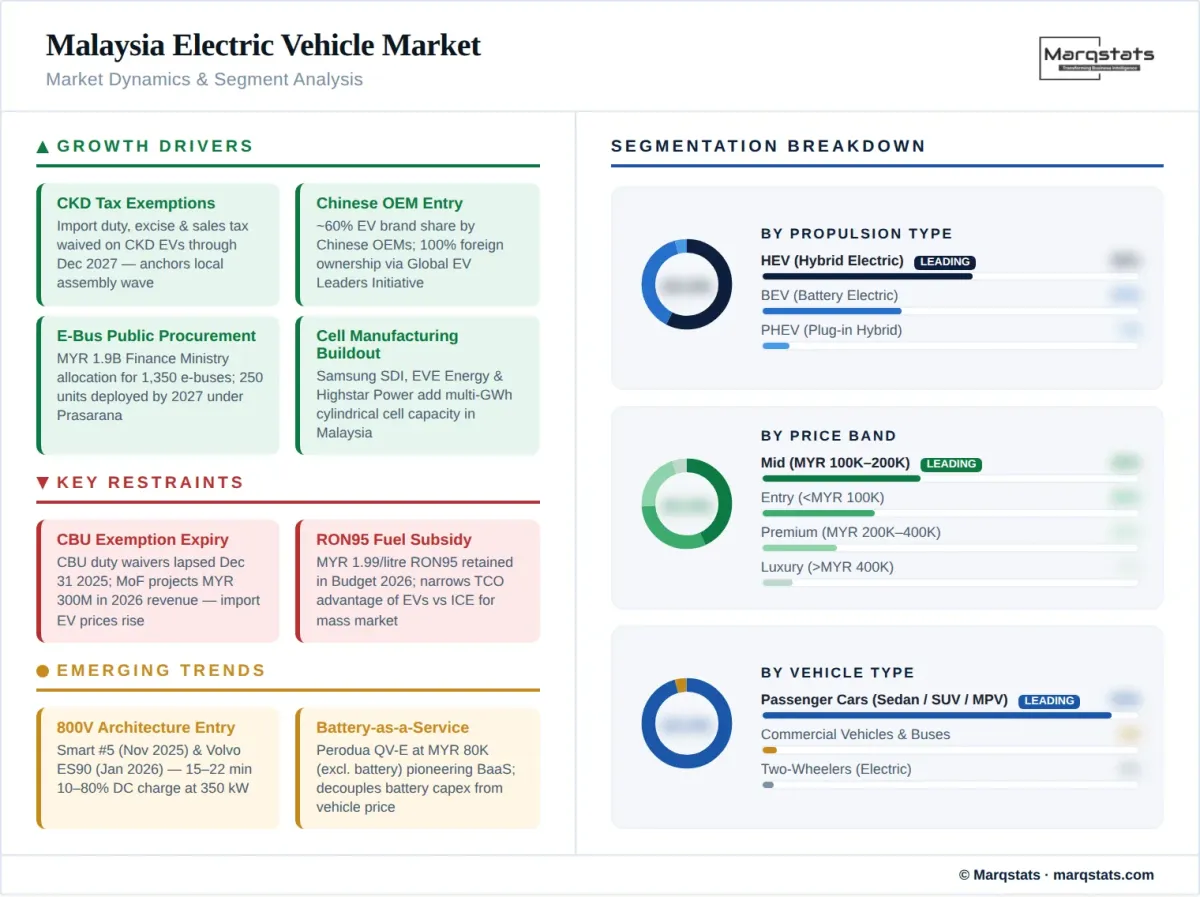
Malaysia Electric Vehicle Market Dynamics Segment Analysis Infographic
Segment Analysis

Market Segmentation

Battery Electric Vehicles (BEV)
Leading

BEVs accounted for the majority of the plug-in segment in 2025. Top-selling models include Proton e.MAS 7 (8,677 units), BYD Sealion 7 (4,454), Tesla Model Y (4,401), BYD Atto 3 (4,069), and Tesla Model 3 (2,880). Entry-level BEV pricing dropped to MYR 59,800 with the Proton e.MAS 5 launch in October 2025 and MYR 67,800 for the TQ Wuling Bingo in December 2025. BEV adoption is supported by road tax exemptions through end-2025 and a revised road tax structure from January 2026 at approximately 15% of equivalent ICE rates.

Plug-in Hybrid Electric Vehicles (PHEV)

PHEV volumes remain a smaller share of the electrified mix, however product launches accelerated in early 2026. Proton e.MAS 7 PHEV launched in February 2026 starting at MYR 109,800, offering 83 to 146 km of electric range and 943 to 996 km combined range. GWM WEY G9 PHEV MPV entered CKD production in January 2026 at MYR 269,800 with 170 km EV range. BYD Shark 6 PHEV pickup is expected to enter the market during 2026.

Hybrid Electric Vehicles (HEV)

HEVs registered 38,515 units in 2025, representing 4.7% of total industry volume. Toyota and Honda lead this segment through the Corolla Cross Hybrid, HR-V Hybrid, CR-V Hybrid, and Vellfire Hybrid. Nissan Serena e-POWER launched in March 2026 at MYR 154,800, introducing ProPILOT driver assistance. Toyota launched three BEV models in April 2026 (bZ4X, Hilux BEV, Urban Cruiser EV), signalling a strategic pivot from hybrid-only positioning.

Passenger Cars
Leading

Passenger cars dominate the Malaysia electric vehicle market, accounting for over 95% of BEV and PHEV registrations in 2025. Sedans, SUVs, and MPVs comprise the category. C-segment SUVs lead volume, reflected in BYD Sealion 7, Tesla Model Y, BYD Atto 3, Proton e.MAS 7, and Leapmotor C10 sales. MPV adoption is rising, led by BYD M6 (1,683 units) and Denza D9 (1,200 units).

Two-Wheelers

Two-wheeler electrification remains nascent. Approximately 3,838 electric motorcycles were registered as of 2023, representing 0.02% of Malaysia’s 16.7 million registered motorcycles. Purchase rebates of up to MYR 2,400 for e-bicycles (motor up to 250W, battery up to 400Wh) and MYR 500 to MYR 1,000 for electric motorcycles support gradual adoption. The segment is forecast to advance at 42% CAGR through 2030 from a small base.

Three-Wheelers

Three-wheeler vehicles are not common in Malaysia. Minimal deployment exists in last-mile delivery pilots. The segment remains below 0.1% of total vehicle registrations and is not a material contributor to market revenue through 2030.

Commercial Vehicles and Buses

Electric commercial vehicles comprise buses, vans, and pickups. Prasarana targets 250 electric buses by 2027 and 1,600 by 2031. HI Mobility secured 262 electric bus orders for delivery between December 2025 and early 2026. Jenhoo CAM EV48 electric van is scheduled for launch in early 2026 at MYR 150,000. Tata Motors Prima E.55S-equivalent and BYD Shark pickup platforms are expected to expand the commercial segment.

Chinese Brands
Leading

Chinese-origin brands collectively secured approximately 60% of Malaysia’s EV market in 2025. BYD led with 11,870 registrations across six models. Zeekr contributed 1,718 units, XPeng 1,334, Denza 1,002, Chery 629, iCaur 565, MG 534, Leapmotor 437, GWM 361, Dongfeng 157, and Neta 156. Chinese brands gain share through competitive pricing, rapid model introduction cycles, and local CKD partnerships.

Malaysian National Brands

Proton and Perodua represent Malaysia’s national EV champions. Proton e.MAS 7 led the EV charts in 2025 with 8,677 units, supported by the October 2025 e.MAS 5 launch (5,000+ bookings within 30 days). Proton targets 330,000 annual sales by 2030, with 30% derived from exports and 30% from electrified vehicles. Perodua QV-E launched in December 2025 with 500 units per month capacity scaling to 3,000 by Q3 2026, supported by 52 Malaysian suppliers and 50% localization target by early 2026.

American and European Brands

Tesla registered 5,467 units in 2025 (Model Y and Model 3), operating directly under the Global EV Leaders Initiative. BMW Group Malaysia delivered 2,700+ BEV units in 2025 (25% of total BMW/MINI/Motorrad volumes), anchored by the locally assembled i5 eDrive40. Volvo commissioned CKD assembly of the ES90 in Shah Alam in January 2026 at MYR 339,888. Porsche Taycan recorded 421 units in 2025.

Japanese and Korean Brands

Japanese brands focused on HEVs through 2025, however Toyota entered the BEV segment in April 2026 with bZ4X, Hilux BEV, and Urban Cruiser EV launches. Nissan launched the Serena e-POWER (hybrid MPV) in March 2026. Korean brands including Hyundai and Kia maintain limited EV presence. Japanese and Korean combined BEV share remained below 5% in 2025.

Entry-Level (Below MYR 100,000)
Leading

The entry-level band opened in October 2025 with the Proton e.MAS 5 at MYR 59,800. TQ Wuling Bingo EV followed at MYR 67,800 in December 2025. Perodua QV-E at MYR 80,000 (excluding battery) and Dongfeng Vigo EV at MYR 108,888 (approximately MYR 100,000 with rebate) further expanded this segment. The entry-level band is forecast to drive volume growth through 2030.

Mid-Market (MYR 100,000 to MYR 200,000)

The mid-market segment anchors mainstream BEV adoption. Proton e.MAS 7 BEV and PHEV variants, BYD Atto 2 and Atto 3, Leapmotor B10 and C10, iCaur 03 and V23, and Chery Omoda E5 compete in this band. The segment captured the largest share of 2025 registrations by unit volume and is expected to sustain share through 2030.

Premium (MYR 200,000 to MYR 400,000)

The premium band serves higher-specification BEVs including Tesla Model Y, BMW i5 eDrive40 CKD (MYR 368,800), Volvo ES90 (MYR 339,888), smart #5 (MYR 199,800–249,800), and GWM WEY G9 PHEV (MYR 269,800). Toyota bZ4X (MYR 220,000) and Hilux BEV (MYR 226,300) expanded the segment in April 2026.

Luxury (Above MYR 400,000)

The luxury band includes Porsche Taycan (421 units in 2025), Mercedes-EQ models, BMW iX, and Denza D9 premium variants. Toyota Vellfire Hybrid at MYR 549,900 competes in the luxury hybrid MPV sub-segment. Luxury volume is stable, with limited upside beyond the current Chinese premium imports.

Regional Analysis

By Geography

Klang Valley (Kuala Lumpur and Selangor)

Klang Valley is the primary EV demand cluster, accounting for approximately 52% of Malaysia’s EV registrations in 2025. The region hosts the densest charging network, anchored by TNB Electron, ChargEV (YTL), JomCharge, Gentari, and Shell Recharge stations. Prasarana’s 175 electric buses target Klang Valley deployment by 2027. The region also hosts Proton Tanjung Malim EV plant operations and Volvo’s Shah Alam CKD facility.

Penang

Penang contributes approximately 14% of national EV registrations in 2025. The region is a secondary premium-EV demand cluster, supported by the urban population in George Town and industrial corridors. Prasarana plans 75 electric buses for Penang by 2027. Charging network density in Penang ranks second nationally.

Johor

Johor holds approximately 12% of national EV registrations in 2025. The state is positioned as a battery manufacturing cluster, anchored by Highstar Power’s 2.5 GWh cell plant scheduled for April 2026 commissioning. Johor’s proximity to Singapore and the Kuala Lumpur–Singapore economic corridor supports premium EV demand.

Perak and Northern States

Perak contributes approximately 8% of national EV registrations in 2025, anchored by Proton’s Tanjung Malim production base and the Automotive High Tech Valley (AHTV) development. Kedah hosts ASEAN’s first international EV test centre at Bandar Baharu, commissioned in December 2025, and Leapmotor’s planned CKD operations at the Stellantis Gurun plant.

Negeri Sembilan and Melaka

Negeri Sembilan hosts Samsung SDI’s cylindrical battery plant at Seremban (21700-format cells) and EVE Energy’s cylindrical cell facility. Melaka hosts EP Manufacturing’s Pegoh plant producing the GWM WEY G9 PHEV. Combined EV registrations in the two states represent approximately 7% of the national total in 2025.

East Malaysia (Sabah and Sarawak)

Sabah and Sarawak collectively hold approximately 7% of national EV registrations in 2025. Charging infrastructure coverage remains sparse, constraining adoption beyond urban centres such as Kota Kinabalu and Kuching. Public-sector EV procurement and shared-mobility e-scooter deployments represent the primary growth vectors through 2030.
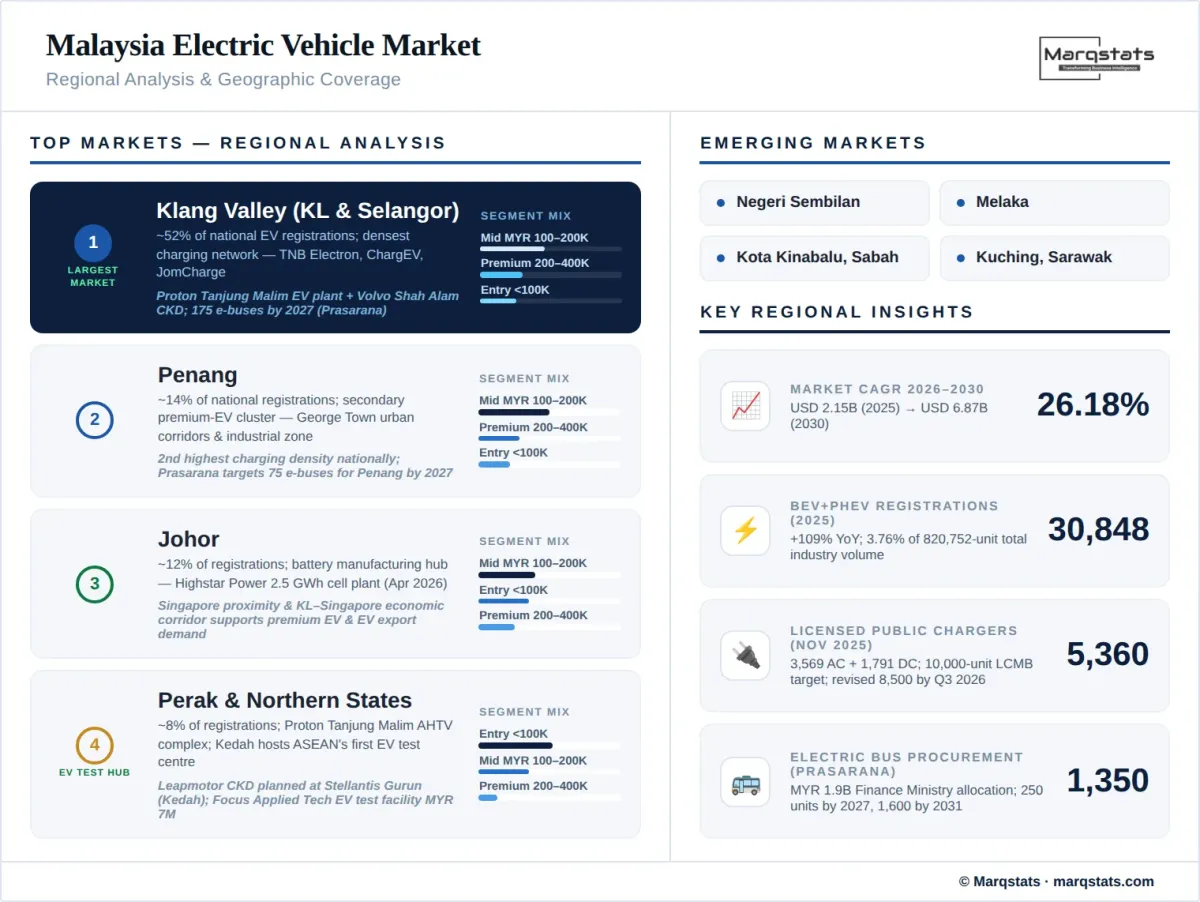
Malaysia Electric Vehicle Market Regional Analysis Infographic
Competitive Landscape

How Competition Is Evolving

The competitive environment in the Malaysia electric vehicle market is moderately fragmented with an accelerating concentration trend. The top five OEM groups accounted for approximately 62% of BEV and PHEV registrations in 2025. Market concentration is driven by the expiry of CBU exemptions (December 2025) and the three-year runway of CKD exemptions (through December 2027), favouring OEMs with committed local assembly pipelines.

BYD Sime Motors secured brand leadership with 11,870 registrations across the Sealion 7, Atto 3, Atto 2, M6 MPV, Seal, and Seal 6. Proton recorded 8,677 e.MAS 7 and 134 e.MAS 5 registrations for 2025, supported by the Tanjung Malim plant and Geely’s 49.9% strategic partnership. Tesla registered 5,467 units (Model Y and Model 3) under the Global EV Leaders Initiative framework. Perodua entered the segment in December 2025 with the QV-E at MYR 80,000 and is expected to capture substantial entry-level share through 2030.

Emerging challengers include Zeekr, XPeng, Denza, Chery Omoda, iCaur, Leapmotor, GWM, Dongfeng, Wuling, Smart, and Neta. BMW and Volvo anchor the premium CKD segment with local i5 and ES90 assembly respectively. Toyota re-entered the BEV segment in April 2026 with three simultaneous model launches. Strategic partnerships, CKD assembly commitments, battery-as-a-service models, and 800V architecture adoption are the primary competitive differentiators for the 2026–2030 period.
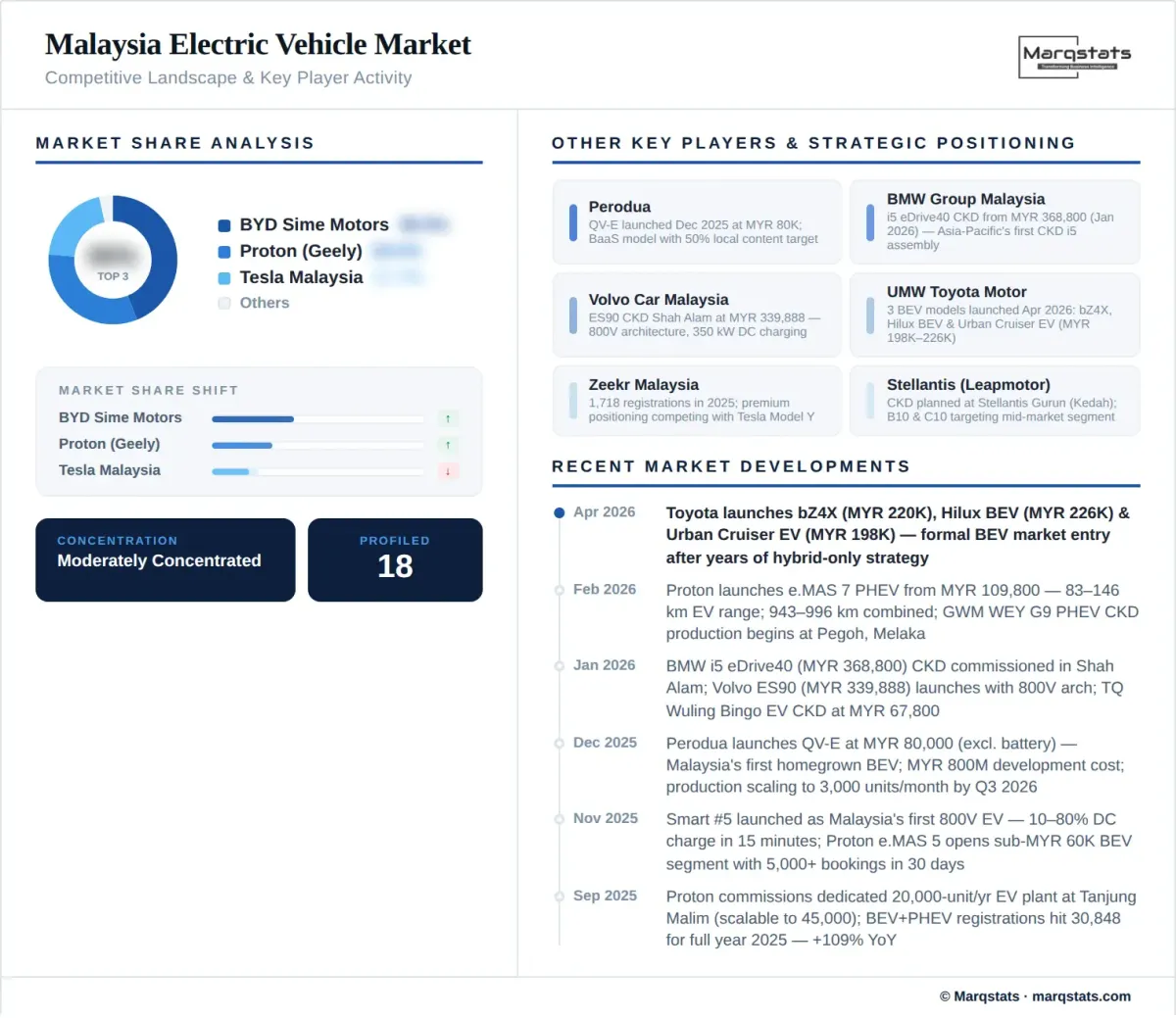
Malaysia Electric Vehicle Market Competitive Landscape Infographic
Major Players

Companies Covered

The report profiles 18 company profiles+ companies with full strategy and financials analysis, including:

Proton Holdings Berhad (DRB-Hicom / Geely JV)
Perusahaan Otomobil Kedua Sendirian Berhad (Perodua)
BYD Sime Motors Sdn Bhd
Tesla Malaysia Sdn Bhd
BMW Group Malaysia
Volvo Car Malaysia Sdn Bhd
UMW Toyota Motor Sdn Bhd
Edaran Tan Chong Motor Sdn Bhd (Nissan)
Great Wall Motor (GWM) Malaysia
Chery Malaysia Sdn Bhd (Omoda and Jaecoo)
Zeekr Malaysia Sdn Bhd
XPeng Malaysia Sdn Bhd
Stellantis Malaysia Sdn Bhd (Leapmotor)
TQ Wuling (Tan Chong and SAIC-GM-Wuling JV)
iCaur Malaysia
Volt Auto Sdn Bhd (Dongfeng)
Smart Malaysia (Geely-Mercedes-Benz JV)
Mercedes-Benz Malaysia Sdn Bhd
Note: Full company profiles include revenue analysis, product portfolio, SWOT, and recent strategic developments.
Latest Developments

Recent Market Activity

Apr 2026
UMW Toyota Motor officially launched three BEV models (bZ4X at MYR 220,000, Hilux BEV at MYR 226,300, Urban Cruiser EV at MYR 198,000), marking Toyota’s formal entry into Malaysia’s BEV segment.
Feb 2026
Proton launched the e.MAS 7 PHEV starting at MYR 109,800, featuring 83 to 146 km electric range and 943 to 996 km combined range across Prime, Premium, and Premium Plus variants.
Jan 2026
BMW Group Malaysia commissioned the locally assembled BMW i5 eDrive40 at MYR 368,800, marking Asia-Pacific’s first CKD i5. The 400V EV extends WLTP range from 582 km to 627 km through silicon carbide converter upgrades.
Jan 2026
Volvo Car Malaysia launched the ES90 at MYR 339,888 with local assembly in Shah Alam, using 800V architecture and achieving 10–80% DC charging in 22 minutes at 350 kW.
Dec 2025
Perodua launched the QV-E at MYR 80,000 (excluding battery), Malaysia’s first fully homegrown BEV. Development cost MYR 800 million. Production starts at 500 units per month scaling to 3,000 by Q3 2026.
Sep 2025
Proton commissioned its first dedicated EV plant at Tanjung Malim with 20,000 units per year capacity, scalable to 45,000 units, supporting local assembly of the e.MAS 7 and e.MAS 5.
Report Structure

Table of Contents

1. Introduction
1.1 Study Scope and Research Objectives
1.2 Study Assumptions and Definitions
1.3 Market Definition — Malaysia Electric Vehicle Market
1.4 Report Structure and Deliverables
1.5 Executive Summary
1.5.1 Key Findings 2025
1.5.2 Growth Forecast 2026–2030
1.5.3 Policy Inflection Points
1.5.4 Investment Themes
2. Research Methodology
2.1 Research Approach
2.1.1 Primary Research Methodology
2.1.2 Secondary Research Sources
2.1.3 Bottom-Up Market Sizing Framework
2.1.4 Top-Down Validation
2.2 Data Triangulation
2.3 Primary Interviews — 40+ Stakeholders
2.3.1 OEM Procurement Team Interviews
2.3.2 Dealer Principal Interviews
2.3.3 Charging Network Operator Interviews
2.3.4 Policy Stakeholder Interviews
2.4 Quality Checks and Validation
3. Market Overview
3.1 Malaysia EV Market Size 2021–2025
3.2 Market Size Forecast 2026–2030
3.3 Market Size by Volume (Units)
3.4 Market Size by Revenue (USD Billion)
3.5 Total Industry Volume (TIV) Analysis
3.5.1 MAA Registration Data 2025 (820,752 units)
3.5.2 BEV/PHEV Share Progression
3.5.3 HEV Share Progression
3.6 Monthly Registration Trends
3.7 JPJ Registration Analysis
4. Market Dynamics
4.1 Market Drivers
4.1.1 CBU and CKD Import Duty and Excise Exemptions
4.1.2 Local CKD Assembly Expansion
4.1.3 Chinese OEM Market Entry Acceleration
4.1.4 Charging Infrastructure Expansion
4.1.5 Public Transport Electrification Procurement
4.2 Market Restraints
4.2.1 December 2025 CBU EV Exemption Expiry
4.2.2 RON95 Fuel Subsidy Impact
4.2.3 Charging Network Coverage Gaps
4.2.4 Apartment Charging Access Constraints
4.3 Market Opportunities
4.3.1 800V Architecture Platform Commercialization
4.3.2 Battery-as-a-Service (BaaS) Models
4.3.3 PHEV Segment Expansion
4.3.4 Local Battery Cell Manufacturing
4.4 Market Trends
4.4.1 Entry-Level BEV Pricing War
4.4.2 Chinese Brand CKD Assembly Migration
4.4.3 Toyota Multi-Pathway BEV Strategy Entry
4.4.4 Rare Earth Supply Chain Localization
4.5 Porter's Five Forces Analysis
4.6 PESTLE Analysis
5. Regulatory and Policy Framework
5.1 Low Carbon Mobility Blueprint 2021–2030
5.1.1 10,000 Public Charger Target
5.1.2 20% xEV Sales Target by 2030
5.1.3 50% Government Fleet EV Target
5.2 EV Tax Exemption Framework
5.2.1 CBU EV Exemption (2022–December 2025)
5.2.2 CKD EV Exemption (Through December 2027)
5.2.3 Road Tax Structure 2026 Onwards
5.3 Budget 2022 through Budget 2026 Provisions
5.3.1 Budget 2026 CBU Non-Extension
5.3.2 Critical Minerals Duty Exemption
5.4 Global EV Leaders Initiative (EVGLI)
5.5 Income Tax Rebates and Investment Allowances
5.5.1 MYR 2,500 Home Charger Tax Relief (Through 2027)
5.5.2 100% Investment Tax Allowance for EV Manufacturing
5.5.3 Green Investment Tax Allowance for CPOs
5.6 National Automotive Policy (NAP) Framework
5.7 Two-Wheeler Rebate Programme
6. Consumer and Market Factors
6.1 EV Adoption Drivers
6.1.1 Total Cost of Ownership Analysis
6.1.2 Environmental Awareness and ESG
6.1.3 Government Incentive Perception
6.2 EV Adoption Barriers
6.2.1 Price Premium Concerns
6.2.2 Range Anxiety
6.2.3 Charging Access Limitations
6.2.4 Resale Value Uncertainty
6.3 Consumer Segments
6.3.1 Early Adopters
6.3.2 Mainstream Buyers
6.3.3 Price-Sensitive Buyers
6.3.4 Fleet and Corporate Buyers
6.4 Financing and Ownership Models
7. Market Segmentation — By Propulsion Type
7.1 Market Size by Propulsion 2021–2030
7.2 Battery Electric Vehicles (BEV)
7.2.1 Market Size and Forecast
7.2.2 Top-Selling BEV Models 2025
7.2.3 Entry-Level BEV Pricing Benchmarks
7.3 Plug-in Hybrid Electric Vehicles (PHEV)
7.3.1 Market Size and Forecast
7.3.2 Proton e.MAS 7 PHEV Launch Impact
7.3.3 GWM WEY G9 PHEV CKD Production
7.4 Hybrid Electric Vehicles (HEV)
7.4.1 Market Size — 38,515 Units in 2025
7.4.2 Toyota and Honda Hybrid Dominance
7.4.3 Nissan Serena e-POWER Entry
8. Market Segmentation — By Vehicle Type
8.1 Market Size by Vehicle Type 2021–2030
8.2 Passenger Cars
8.2.1 Sedan Segment Analysis
8.2.2 SUV Segment Analysis
8.2.3 MPV Segment Analysis
8.2.4 95%+ Share of BEV/PHEV Volume
8.3 Electric Two-Wheelers
8.3.1 Installed Base 3,838 Units (2023)
8.3.2 MYR 2,400 E-Bicycle Rebate Programme
8.3.3 Electric Motorcycle Market Emergence
8.4 Electric Commercial Vehicles
8.4.1 Jenhoo CAM EV48 Van Launch
8.4.2 BYD Shark 6 PHEV Pickup Opportunity
8.5 Electric Buses
8.5.1 Prasarana 1,350 Electric Bus Target
8.5.2 MYR 1.9 Billion Finance Ministry Allocation
8.5.3 HI Mobility Procurement Orders
9. Market Segmentation — By Brand Origin
9.1 Market Size by Brand Origin 2021–2030
9.2 Chinese Brands
9.2.1 60% Market Share in 2025
9.2.2 BYD Leadership (11,870 Registrations)
9.2.3 Zeekr, XPeng, Denza, GWM, Leapmotor Volumes
9.2.4 iCaur, Dongfeng, Wuling, Smart, Neta Volumes
9.3 Malaysian National Brands
9.3.1 Proton e.MAS 7 and e.MAS 5 Portfolio
9.3.2 Perodua QV-E First Homegrown EV
9.3.3 Proton 2030 Strategy Roadmap
9.4 American and European Brands
9.4.1 Tesla Direct-Sales Under EVGLI
9.4.2 BMW Group Malaysia Premium EV Leadership
9.4.3 Volvo ES90 CKD Assembly
9.5 Japanese and Korean Brands
9.5.1 Toyota Multi-Pathway Strategy Entry
9.5.2 Nissan e-POWER Hybrid Strategy
9.5.3 Hyundai and Kia Limited Presence
10. Market Segmentation — By Price Band
10.1 Market Size by Price Band 2021–2030
10.2 Entry-Level (Below MYR 100,000)
10.2.1 Proton e.MAS 5 at MYR 59,800
10.2.2 TQ Wuling Bingo at MYR 67,800
10.2.3 Perodua QV-E at MYR 80,000
10.3 Mid-Market (MYR 100,000 – MYR 200,000)
10.3.1 Proton e.MAS 7 BEV and PHEV
10.3.2 BYD Atto 2 and Atto 3
10.3.3 Leapmotor B10 and C10
10.3.4 Chery Omoda E5, iCaur 03 and V23
10.4 Premium (MYR 200,000 – MYR 400,000)
10.4.1 Tesla Model Y and Model 3
10.4.2 BMW i5 eDrive40 CKD
10.4.3 Volvo ES90 and smart #5
10.4.4 Toyota bZ4X and Hilux BEV
10.5 Luxury (Above MYR 400,000)
10.5.1 Porsche Taycan and Mercedes-EQ
10.5.2 Toyota Vellfire Hybrid
11. Market Segmentation — By Sales Channel
11.1 Franchised Dealer Network
11.2 Direct Sales (Tesla, EVGLI Entities)
11.3 Online Sales Channels
11.4 Fleet and Corporate Sales
11.5 Used EV Market Emergence
12. Charging Infrastructure Analysis
12.1 Public Charger Network (5,360 Units, Nov 2025)
12.1.1 AC Charger Count (3,569)
12.1.2 DC Fast Charger Count (1,791)
12.1.3 10,000 Charger Target Progress
12.2 Charging Point Operators
12.2.1 TNB Electron
12.2.2 ChargEV (YTL)
12.2.3 JomCharge and Gentari
12.2.4 Tesla Supercharger Network
12.3 Home Charging Ecosystem
12.3.1 MYR 2,500 Tax Rebate Impact
12.3.2 AC Wallbox Adoption
12.4 Highway Fast-Charging Hubs
12.4.1 Seremban R&R Hub Plan
12.4.2 Swift Bridge Local Charger Manufacturing
13. Local Manufacturing and Battery Supply Chain
13.1 OEM CKD Assembly Plants
13.1.1 Proton Tanjung Malim EV Plant
13.1.2 Perodua Smart Mobility Plant (QV-E)
13.1.3 BMW Shah Alam i5 CKD
13.1.4 Volvo Shah Alam ES90 CKD
13.1.5 Tan Chong Segambut (TQ Wuling Bingo)
13.1.6 EP Manufacturing Pegoh (GWM WEY G9)
13.1.7 Stellantis Gurun (Leapmotor Planned CKD)
13.2 Battery Cell Manufacturing
13.2.1 Samsung SDI Seremban 21700 Cells
13.2.2 EVE Energy Cylindrical Cell Plant
13.2.3 Highstar Power Johor 2.5 GWh Plant
13.3 Rare Earth and Critical Minerals
13.3.1 Lynas Heavy Rare Earth Expansion
13.3.2 Samarium, Dysprosium, Terbium Output
13.4 Component Supply Chain
13.4.1 MACPMA Supplier Ecosystem
13.4.2 Automotive High Tech Valley (AHTV)
13.4.3 Local Content Targets (Perodua 50% to 70%)
13.5 EV Testing Infrastructure
13.5.1 Kedah EV Test Centre (INVICTA)
14. Regional and State-Level Analysis
14.1 Klang Valley (Kuala Lumpur and Selangor)
14.1.1 52% National EV Registration Share
14.1.2 Densest Charging Network
14.1.3 Prasarana 175 Electric Bus Deployment
14.2 Penang
14.2.1 14% National Share
14.2.2 75 Electric Bus Procurement
14.3 Johor
14.3.1 12% National Share
14.3.2 Highstar Power 2.5 GWh Cell Plant
14.3.3 Kuala Lumpur–Singapore Economic Corridor
14.4 Perak and Northern States
14.4.1 Proton Tanjung Malim AHTV Anchor
14.4.2 Kedah EV Test Centre and Leapmotor Gurun
14.5 Negeri Sembilan and Melaka
14.5.1 Samsung SDI and EVE Energy Operations
14.5.2 EP Manufacturing Pegoh GWM Production
14.6 East Malaysia (Sabah and Sarawak)
14.6.1 7% National Share
14.6.2 Infrastructure Coverage Gaps
15. Competitive Landscape
15.1 Market Share Analysis 2025
15.2 Brand-Level Registrations (JPJ Data)
15.3 Competitive Benchmarking Matrix
15.4 Strategic Developments and Partnerships
15.5 CKD Assembly Commitment Tracker
15.6 Model Launch Pipeline 2026–2027
16. Company Profiles
16.1 Proton Holdings Berhad
16.1.1 Company Overview and Financials
16.1.2 DRB-Hicom and Geely JV Structure
16.1.3 Tanjung Malim EV Plant (20,000 units/year)
16.1.4 e.MAS 7 and e.MAS 5 Product Portfolio
16.1.5 2030 Strategy Roadmap (330K units)
16.2 Perodua
16.2.1 Company Overview
16.2.2 QV-E Launch and Battery-as-a-Service
16.2.3 MYR 800 Million R&D Investment
16.2.4 52 Malaysian Suppliers, 50% Localization
16.3 BYD Sime Motors Sdn Bhd
16.3.1 11,870 Registrations in 2025
16.3.2 Sealion 7, Atto 3, Atto 2, M6, Seal Portfolio
16.4 Tesla Malaysia
16.4.1 EVGLI Framework Operation
16.4.2 Model Y and Model 3 Sales
16.4.3 V4 Supercharger Network
16.5 BMW Group Malaysia
16.5.1 2,700+ BEV Units in 2025
16.5.2 i5 eDrive40 CKD Asia-Pacific First
16.5.3 2,000+ Charging Points Network
16.6 Volvo Car Malaysia
16.6.1 ES90 Shah Alam CKD Assembly
16.6.2 800V Architecture Platform
16.7 UMW Toyota Motor
16.7.1 Three BEV Model April 2026 Launch
16.7.2 Multi-Pathway Strategy
16.8 Edaran Tan Chong Motor (Nissan)
16.8.1 Serena e-POWER Launch
16.8.2 Segambut Assembly Facility
16.9 Great Wall Motor (GWM) Malaysia
16.9.1 WEY G9 PHEV CKD Launch
16.9.2 40.05% Localization Rate
16.10 Chery Malaysia (Omoda and Jaecoo)
16.11 Zeekr Malaysia
16.12 XPeng Malaysia
16.13 Stellantis Malaysia (Leapmotor)
16.13.1 Gurun Plant Planned CKD
16.13.2 B10 and C10 Product Portfolio
16.14 TQ Wuling
16.14.1 Tan Chong and SGMW Partnership
16.14.2 Bingo EV CKD Launch
16.15 iCaur Malaysia
16.16 Volt Auto (Dongfeng)
16.17 Smart Malaysia
16.17.1 Smart #5 800V Platform
16.18 Mercedes-Benz Malaysia
17. Pricing and Cost Analysis
17.1 Entry-Level BEV Pricing (Below MYR 100K)
17.2 Mid-Market EV Pricing Analysis
17.3 Premium EV Pricing Analysis
17.4 CBU vs CKD Price Differential
17.5 Total Cost of Ownership Analysis
17.6 Post-CBU-Exemption Price Adjustments 2026
17.7 Battery-as-a-Service Pricing Models
18. Investment and Fleet Use Cases
18.1 OEM Manufacturing Investment Pipeline
18.2 Charging Infrastructure Investment
18.3 Battery Cell Capacity Investment
18.4 Public Transport Fleet Electrification
18.4.1 Prasarana Procurement Plan
18.4.2 HI Mobility Expansion
18.5 Ride-Hailing EV Deployment (Grab)
18.6 Government and GLC Fleet EV Targets
18.7 Corporate Fleet Electrification Trends
19. Market Forecast, Recommendations, and Appendix
19.1 Base Case Scenario 2026–2030
19.2 Bull Case Scenario
19.3 Bear Case Scenario
19.4 Forecast Assumptions and Sensitivities
19.5 Key Inflection Points
19.6 Recommendations for OEMs
19.7 Recommendations for Charging Operators
19.8 Recommendations for Battery Manufacturers
19.9 Recommendations for Investors
19.10 Recommendations for Policymakers
19.11 Abbreviations and Glossary
19.12 List of Tables
19.13 List of Figures
19.14 Data Sources and References
19.15 About Marqstats Intelligence
19.16 Analyst Contact Details
19.17 Disclaimer
Study Scope & Focus

Coverage & Segmentation

The Malaysia Electric Vehicle Market report analyzes the market across propulsion type, vehicle category, brand origin, price band, and regional geography for the period 2021 to 2030. The report covers historical data for 2021-2025, with 2025 as the base year, and forecasts spanning 2026-2030. Market sizing is conducted in USD billions and unit volumes. The study examines the full EV value chain, including OEM production, CKD assembly, battery manufacturing, rare earth supply, charging infrastructure, and aftermarket service.

The scope encompasses all electrified powertrain categories including battery-electric (BEV), plug-in hybrid (PHEV), and hybrid electric (HEV) vehicles. Vehicle categories covered include passenger cars (sedans, SUVs, MPVs), electric two-wheelers, electric commercial vehicles, and electric buses. The study evaluates policy impact from the Low Carbon Mobility Blueprint 2021–2030, Budget 2022 through Budget 2026, the Global EV Leaders Initiative, and the National Automotive Policy (NAP) framework. Competitive profiling covers 18 OEM groups operating in Malaysia.
Frequently Asked Questions

FAQs About the Malaysia Electric Vehicle Market

The Malaysia electric vehicle market was valued at USD 2.15 billion in 2025 and is projected to reach USD 6.87 billion by 2030, expanding at a CAGR of 26.18% during 2026–2030. Malaysia registered 30,848 BEV and PHEV units in 2025, doubling from 14,766 in 2024, alongside 38,515 HEV units.
The market is expected to grow at a CAGR of 26.18% during 2026–2030. Growth is attributed to CKD tax exemptions through December 2027, expanding local assembly by Proton and Perodua, accelerating Chinese OEM entry, and rising public-sector bus electrification backed by a MYR 1.9 billion Finance Ministry allocation.
Proton e.MAS 7 led 2025 registrations with 8,677 units, followed by BYD Sealion 7 (4,454), Tesla Model Y (4,401), BYD Atto 3 (4,069), and Tesla Model 3 (2,880). BYD secured brand leadership with 11,870 cumulative registrations, followed by Proton (7,784 across e.MAS 7 + e.MAS 5) and Tesla (5,467). Other notable brands include Zeekr, XPeng, Denza, BMW, and Porsche.
Import duty and excise tax exemptions applied for CBU EVs through December 2025 and continue for CKD EVs through December 2027. BEV road tax was exempted through end-2025, with a revised structure at approximately 15% of equivalent ICE rates from January 2026. A MYR 2,500 home-charger tax rebate runs through 2027. Companies qualify for 100% Investment Tax Allowance on EV manufacturing projects through 2032.
Malaysia had 5,360 licensed public chargers by end-November 2025, comprising 3,569 AC chargers and 1,791 DC fast chargers. The Low Carbon Mobility Blueprint targets 10,000 public chargers by 2025. DC fast chargers have exceeded the revised 1,500-unit target. Major operators include TNB Electron, ChargEV (YTL), JomCharge, Gentari, and Tesla Supercharger.
Major players include Proton, Perodua, BYD Sime Motors, Tesla, BMW Group Malaysia, Volvo Car Malaysia, UMW Toyota, Edaran Tan Chong (Nissan), GWM Malaysia, Chery (Omoda and Jaecoo), Zeekr, XPeng, Stellantis Malaysia (Leapmotor), TQ Wuling, iCaur, Volt Auto (Dongfeng), Smart Malaysia, and Mercedes-Benz Malaysia. The report profiles 18 OEM groups.
The Malaysia Electric Vehicle Market report is delivered as a 295-page PDF, an Excel data pack with editable market models and segment-level tables, and a PowerPoint summary deck. Analyst email support is included for 30 days after purchase. Customization is available on request.