Why Isn't Perodua a Connected Car Company Yet?
In brief: Perodua sold more cars than any other brand in Malaysia in 2025, and it is the least connected of the country's four largest carmakers by embedded fitment. It relies on a smartphone-mirroring app, not a factory modem, across most of its range. Its own digital partnership with TM One is real, but it targets an EV range that has not yet shipped at volume, not the combustion vehicles that carry Perodua's actual sales today.
The Volume Leader Chose a Different Architecture
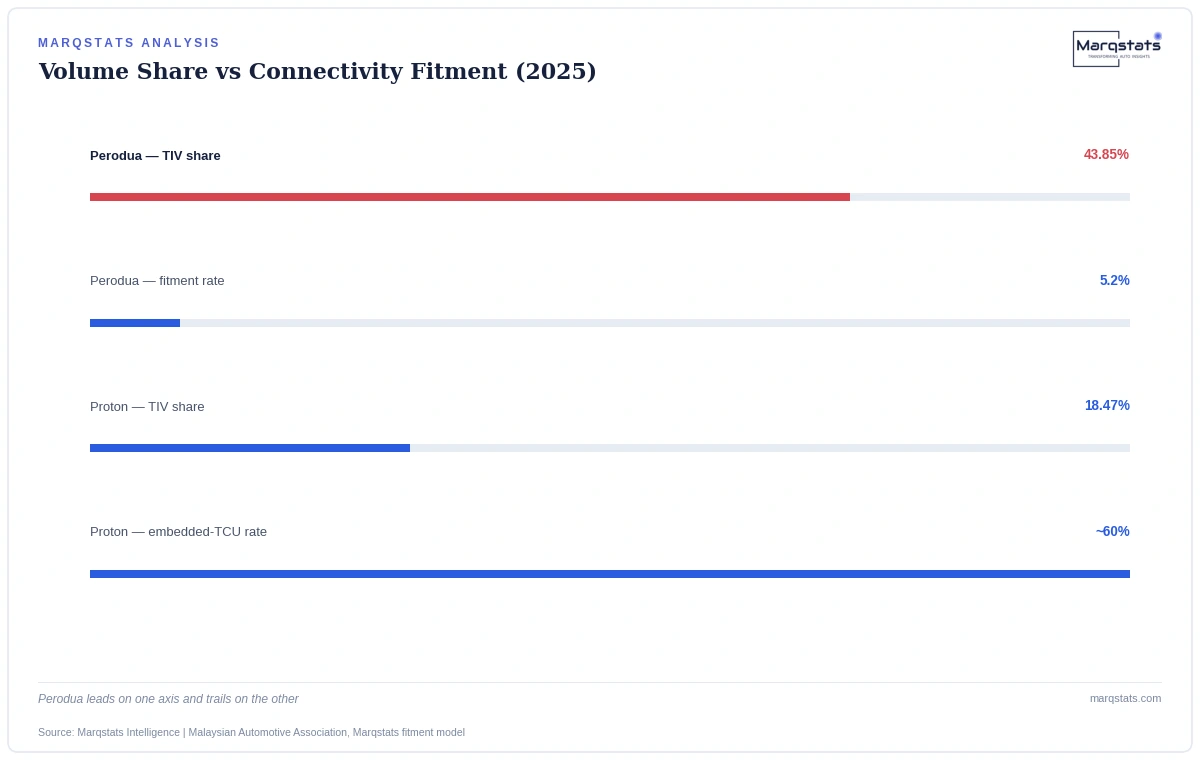
Perusahaan Otomobil Kedua Sdn Bhd (Perodua) sold 359,904 vehicles in 2025, a new company record and 43.85% of Malaysia's 820,752-unit total industry volume — more than Proton, UMW Toyota Motor and Honda Malaysia combined. Across the rest of the market, embedded connectivity is the default architecture for anything above entry-level pricing. Perodua chose a different path: Perodua Smart Link, an Android-based smartphone-mirroring application developed by Wuhan CARBIT Information Co., Ltd., which projects navigation and media from a driver's own handset rather than an onboard modem.
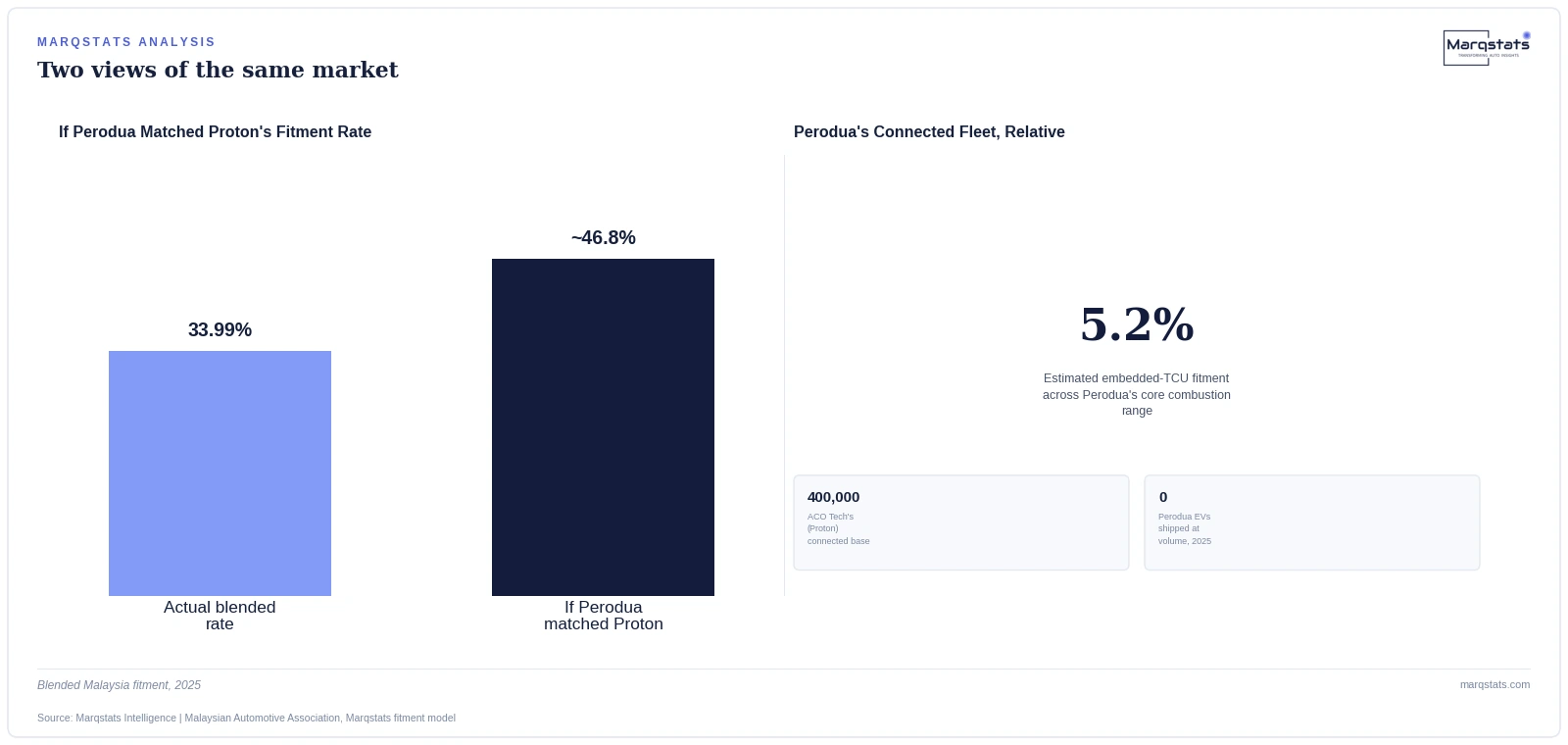
That is a rational engineering decision for a company whose products compete overwhelmingly on price. It is also the reason Marqstats' fitment model puts factory-embedded connectivity across Perodua's core range at roughly 5.2% once normalised to 2025's verified shipment total — the lowest of any major Malaysian brand, embedded in the very models that make Perodua the market's volume leader.
The Company Everyone Else Is Chasing Isn't Perodua's
ACO Tech Sdn Bhd, Proton's connected-cockpit joint venture with Altel Communications and ECARX, operates the largest single connected-vehicle installed base in Malaysia: 400,000 vehicles running its ATLAS operating system, up from 300,000 in August 2024. UMW Toyota Motor's Vehicle Telematics System and Honda Malaysia's Honda CONNECT trail it. Perodua's own connectivity investment — a November 2024 partnership with Telekom Malaysia's enterprise arm, TM One, targeting private 5G manufacturing connectivity and cloud infrastructure — is real, but it is scoped to Perodua's upcoming electric-vehicle range and the P-Circle lifestyle superapp, not to the Axia, Bezza and Myvi that generate the bulk of its 2025 volume.
The brand that sells more cars than anyone else in Malaysia is, by a wide margin, the country's least-connected major carmaker.
— Marqstats Analyst Team
What Perodua's Absence Costs the Connected-Car Market
Perodua's scale means its architecture choice sets a ceiling on how fast Malaysia's overall connectivity fitment rate can rise. Marqstats estimates Malaysia's blended new-vehicle fitment rate at 33.99% for 2025. If Perodua's fitment rate matched Proton's roughly 60% embedded-TCU rate on comparable models, Malaysia's blended 2025 fitment rate would sit measurably higher — the single largest lever on the market's headline penetration number belongs to a company that has not yet pulled it.
Three Reasons the Gap Persists
Unit cost discipline. Perodua's core range is priced to compete on the ringgit against Proton's Geely-backed platforms, and a hardwired telematics control unit adds bill-of-materials cost a smartphone-mirroring licence does not.
No regulatory floor. JPJ has not extended UN R155 or UN R156 cybersecurity type-approval compliance across domestic completely knocked-down production lines, so there is no mandate forcing embedded hardware onto entry-segment models the way there is in Japan or South Korea.
The connectivity investment is EV-scoped. TM One's partnership with Perodua is built around the brand's next-generation electric platform, which had not shipped at volume as of the 2025 base year this analysis is anchored on — so its effect on Perodua's fitment rate is a 2026-and-later story, not a 2025 one.
The Counter-Case: Perodua May Not Need to Move First
It is a fair objection that Perodua's strategy could be entirely rational rather than a gap to be closed. A national carmaker whose core competitive advantage is price does not automatically benefit from adding cost its most price-sensitive buyers may not value. Toyota and Honda's bundled-trial model, discussed in the companion piece linked below, has not obviously produced a durable paid-subscription business either — no distributor discloses a renewal rate, so embedded connectivity has not yet proven itself as a Malaysian revenue line rather than a cost centre. Perodua's caution may be reading the market correctly rather than lagging it.
What Perodua's Own Numbers Say About Its Priorities
Perodua's public statements support a reading of deliberate sequencing rather than neglect. The brand's November 2024 partnership announcement with TM One was framed explicitly around "smart manufacturing, private 5G connectivity and connected cloud infrastructure" for its EV ecosystem, language that describes a plant and platform investment, not a retrofit programme for existing combustion models. Perodua also launched P-Circle, a lifestyle and mobility superapp, in October 2024 — a digital-services move that runs on customer smartphones rather than requiring embedded vehicle hardware, which is consistent with a company building its digital relationship with customers before it builds the hardware relationship.
Seen this way, Perodua is not ignoring connectivity. It is sequencing it: smartphone-based digital services first, embedded hardware second, timed to arrive with the electric-vehicle platform where the unit economics of adding a modem are least damaging to the price position that built the brand's 43.85% share in the first place.
How This Compares to Proton's Path
Proton took the opposite sequence, and its ownership structure explains why. Proton Holdings Berhad's majority shareholder, Zhejiang Geely Holding Group, brought a connected-platform capability to the joint venture that became ACO Tech Sdn Bhd, alongside Altel Communications and ECARX — giving Proton access to embedded-connectivity engineering years before its own volumes required it. Perodua's ownership, split between UMW Holdings Berhad and Daihatsu Motor Co., Ltd., carries no equivalent existing connected-platform asset to draw on, so building one requires a purpose-built partnership rather than an inherited capability — which is a plausible, if partial, explanation for why Proton moved first despite selling fewer cars.
The Used-Car Market Will Feel This Gap First
The connectivity gap between Perodua and its rivals will show up in Malaysia's used-vehicle market before it shows up in any new-car statistic. A five-year-old Toyota Vios or Honda City with an embedded telematics control unit carries a verifiable service history, geofencing logs and, in principle, a stolen-vehicle recovery capability a buyer can value at resale. A five-year-old Perodua Axia or Bezza carries none of that by default, because the vehicle was never connected to begin with. As embedded connectivity becomes a more visible feature line in used-vehicle listings over the 2026–2030 forecast window, Perodua's resale positioning — not just its new-car positioning — will increasingly be shaped by a decision made at the factory rather than by the used-car dealer.
A Named Comparison Worth Watching
Malaysia is not the only market where a price-led national carmaker has lagged its more technology-forward domestic rival on embedded connectivity, and the pattern elsewhere is instructive. Chinese entrants including BYD, Chery and Geely-affiliated Omoda | Jaecoo have made digital cockpits standard equipment across their Malaysian ranges from launch, arriving with no legacy smartphone-mirroring installed base to unwind. Perodua does not have that option — it is retrofitting a connectivity strategy onto a product line built around Smart Link, while its Chinese-brand competitors are building connectivity in from the first model. That asymmetry is part of why Marqstats treats Connected Cockpit & Infotainment as the fastest-growing of the four application layers in this market at a 20.60% segment CAGR through 2030: the growth is disproportionately coming from brands that never had to make Perodua's transition in the first place.
Outlook: One Trigger, Not Three
This market does not support a three-scenario outlook. The single evidenced trigger is Perodua's own electric-vehicle launch timeline under the TM One partnership: once that range ships at volume, Perodua's blended fitment rate should rise mechanically, because Marqstats' own price-tier model already shows 98.77% fitment in the premium and electrified tier Perodua's EVs will sit in. Until that range reaches meaningful volume, Perodua's combustion-engine core — the vehicles actually driving its 43.85% share — has no comparable trigger pointed at it.