Which Malaysia EV Number Should You Trust: 45,562 or 30,848?
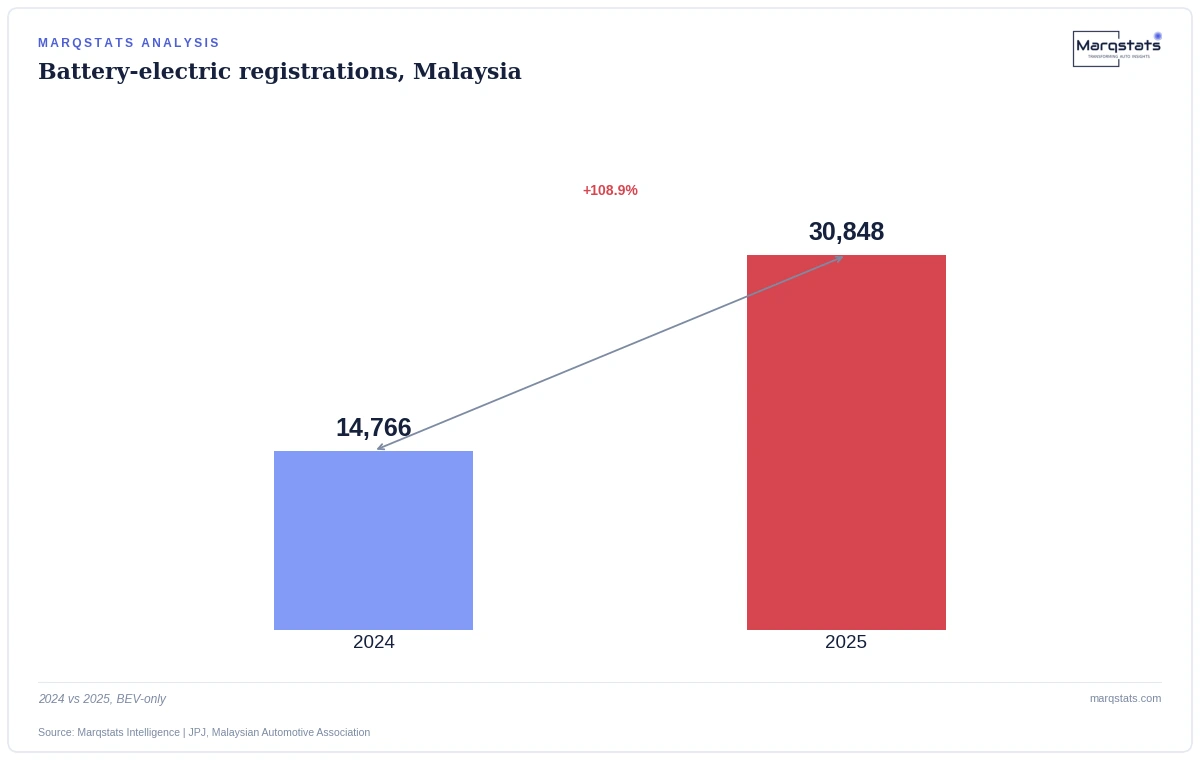
Use the 30,848-unit figure if you mean battery-electric cars only. The 45,562-unit number that circulates for Malaysia's 2024 "electrified vehicle" sales blends battery-electric and plug-in hybrid registrations, two powertrains with different duty treatment, different connectivity profiles and different buyer economics. On a battery-electric-only basis, Malaysian registrations were 30,848 units in 2025, up 108.9% from 14,766 in 2024 — a real, verifiable and much faster-growing number than the blended one suggests.
The 45,562 Figure Has Never Been a Battery-Electric Count
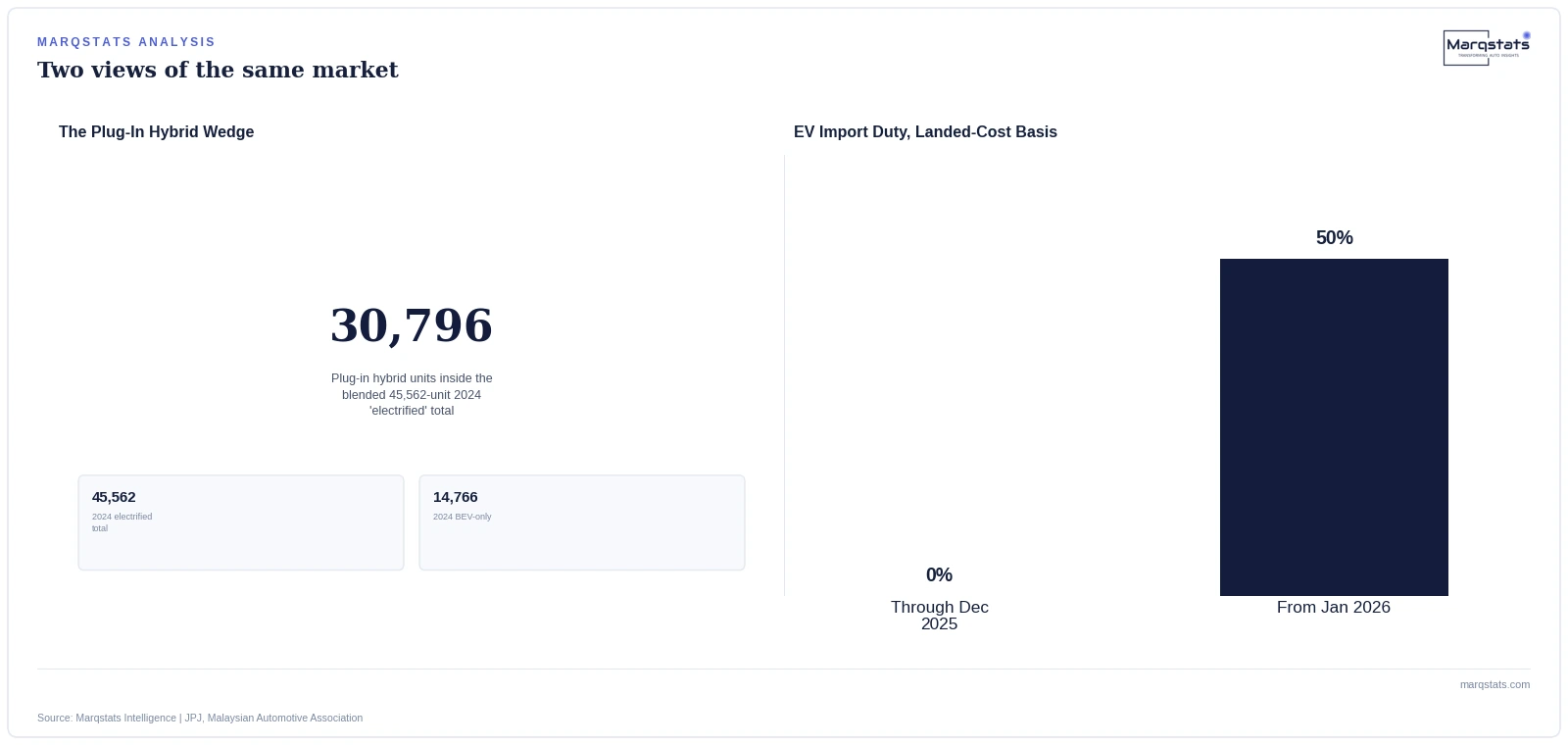
The 45,562-unit figure for 2024 has been repeated across market commentary as shorthand for Malaysia's electric-vehicle sales, and it is easy to see why: it is round, it is dated, and it appears in connection with the December 2025 expiry of Malaysia's completely built-up (CBU) import and excise duty exemption on electric vehicles. What the figure actually measures is broader. It is a count of "electrified" passenger vehicles — battery-electric cars and plug-in hybrids added together — and the two powertrains do not behave the same way.
Separately reported 2025 registration data puts battery-electric-only sales at 30,848 units, up from 14,766 in 2024. Subtract that 2024 battery-electric count from the 45,562-unit "electrified" total and the remainder — 30,796 units — is plug-in hybrid volume the blended figure never separates out. A market planner who reads 45,562 as "EV sales" is, in effect, counting two different products as one.
The Duty Exemption Expiry Pulled Forward One Powertrain, Not Both
The distinction matters because Malaysia's tax treatment of the two powertrains diverged sharply through the transition the market was already bracing for. The import and excise duty exemption on completely built-up battery-electric vehicles expired on schedule at the end of December 2025. From January 2026, imported electric vehicles carry a 30% import duty, a 10% excise duty and a 10% sales tax — a landed-cost change with no equivalent shift for plug-in hybrids, which were never covered by the same CBU exemption in the first place.
That is exactly the condition under which a pull-forward shows up cleanly in one powertrain and not the other. Battery-electric registrations rose 108.9% in 2025 — buyers with a genuine reason to act before a tax change acted. Plug-in hybrid demand had no equivalent deadline pulling it forward the same year, so a blended "electrified" figure understates how concentrated the 2025 surge actually was in one powertrain.
Why a Connected-Car Forecast Cannot Use the Blended Number
Every battery-electric and plug-in hybrid vehicle sold in Malaysia ships with embedded cellular connectivity as a design default — Tesla, BYD, Chery and Proton's own e.MAS range all fit a factory modem regardless of powertrain, so on that specific point the distinction between battery-electric and plug-in hybrid does not matter for a connected-vehicle count. It matters for everything else a forecaster does with the number: duty modelling, landed-cost sensitivity, and any attempt to project 2026 volume now that the exemption has actually expired rather than merely being scheduled to.
A model built on the 45,562-unit blended figure will systematically overstate how much of Malaysia's electric-vehicle growth was exposed to the CBU duty change, because a third of that figure was plug-in hybrid volume the exemption never applied to in the same way. A model built on the 30,848-unit battery-electric figure isolates the powertrain the policy shift actually hit.
The Counter-Case: Why the Blended Figure Still Gets Used
There is a reasonable case for the blended figure, and it is worth stating plainly. Plug-in hybrids and battery-electric vehicles both count toward Malaysia's xEV adoption target and both carry a cellular modem, so for a policy-maker tracking electrification broadly, or for this report's own connected-vehicle count, the powertrain split genuinely does not change the answer. The distinction matters specifically for duty modelling, landed-cost forecasting and any claim about how much of 2025's growth was a policy-driven pull-forward — not for every use of the number.
The Custody Chain Behind Both Numbers
Both figures ultimately trace to the same statutory process. New vehicles are registered with the Road Transport Department (JPJ), and the Malaysian Automotive Association aggregates brand- and model-level sales into its published totals. Neither body breaks its headline releases out by powertrain type in the way this reconciliation requires — the battery-electric-only figure used in this piece comes from a separate registration-data pull that isolates BEV model codes from the broader electrified category, a distinction the routine MAA press release does not make.
That gap in routine reporting is precisely why the 45,562-unit figure has had such a long shelf life. It was the number MAA-adjacent commentary could cite without additional work, and once a number is repeated enough times in trade coverage, it stops being checked against its own definition. The Royal Malaysian Customs Department's duty schedule, by contrast, is powertrain-specific by necessity — a customs tariff code cannot be ambiguous about whether a vehicle is a battery-electric import or a plug-in hybrid one, which is exactly why the January 2026 duty change is a cleaner signal of the battery-electric segment alone than the sales figure most commentary reaches for.
What the Model-Level Data Shows
The powertrain split is visible below the headline number too. BYD's Malaysian range, together with Tesla's Model Y and Model 3, accounted for the majority of 2025's battery-electric volume, while Proton's locally assembled e.MAS 7 represented the largest domestically built contribution to the same battery-electric count. None of those models carries a plug-in hybrid variant in the Malaysian market, which is part of why isolating the BEV-only figure is straightforward at the model level even though it is not straightforward at the headline-statistic level. Perodua's own first mass-market electric vehicle, expected under its TM One-backed digital and manufacturing partnership, had not shipped at volume within the 2025 base year this reconciliation covers.
What This Means for a Sizing or Sourcing Model
Anyone building a Malaysia EV or connected-car model off a single headline figure should ask, first, which powertrains it includes, and second, which policy window it sits inside. A figure spanning 2024 and one spanning 2025 are not interchangeable this year, because the duty regime changed between them. The full battery-electric-versus-electrified reconciliation, alongside the connected-vehicle fitment coefficients it feeds into, is set out in the Marqstats analysis linked below.
Related reportMalaysia Connected Car Market Size, Share & Forecast 2026 – 2030