Toyota VTS or Honda CONNECT: Which Costs Less After the Free Trial Ends?
Honda CONNECT is the cheaper hardware option and Toyota's Vehicle Telematics System is the cheaper ongoing package once the promotional pricing is set aside — but neither distributor discloses what happens to renewal rates once the free trial period actually ends, which is the number that should matter most to a buyer deciding whether embedded connectivity is worth paying for out of pocket.
What Each System Costs Up Front
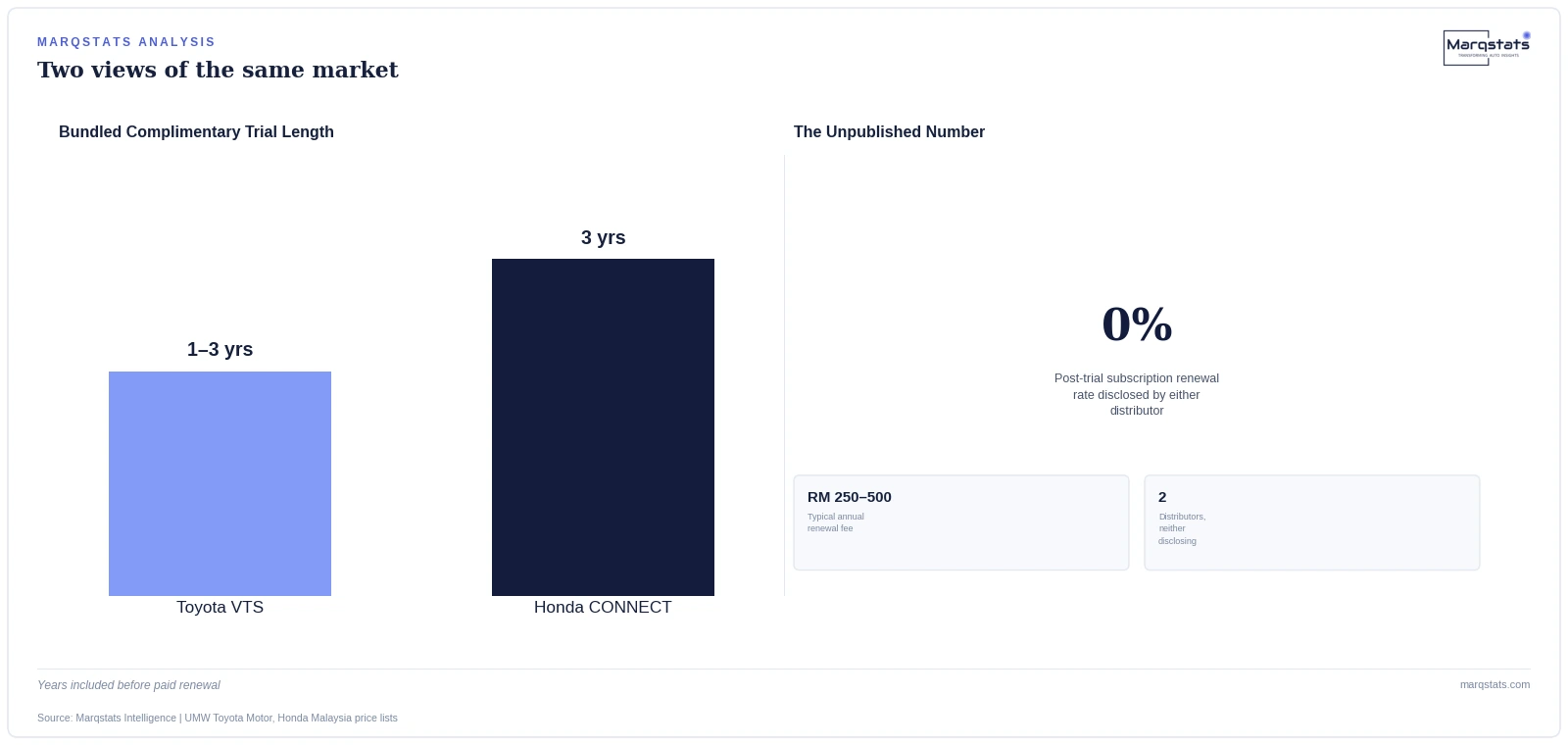
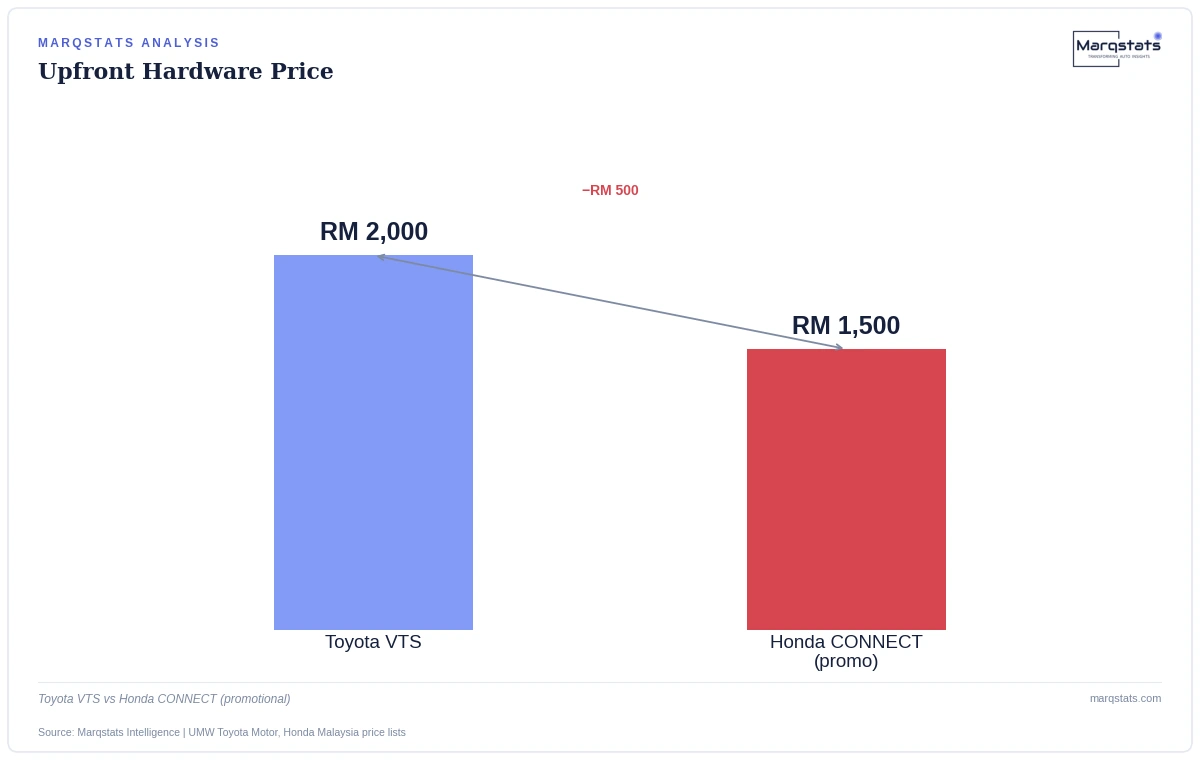
UMW Toyota Motor Sdn Bhd retails its Vehicle Telematics System (VTS) as a standalone accessory at RM 2,000, bundled with a complimentary subscription period of one to three years depending on the model and grade. Honda Malaysia Sdn Bhd prices Honda CONNECT at a promotional RM 1,500 against a list price of RM 2,450, with three years of bundled connectivity included on qualifying purchases. On sticker price alone, Honda's promotional rate undercuts Toyota's flat RM 2,000 by RM 500.
What Standard Equipment Actually Includes
The two systems are not identical products at those prices. Toyota's VTS is offered as standard equipment on upper variants — including the Veloz, Fortuner VRZ/SRZ, Corolla Cross Hybrid, Camry and GR series — and as a dealer-installed accessory on others, providing 24-hour command-centre tracking, automated incident alerts and emergency roadside coordination. Honda CONNECT is standard on RS and e:HEV grades of the City, Civic, HR-V and CR-V, and bundles emergency call assistance, remote air-conditioning activation, vehicle health reports and geofencing alerts. A buyer comparing the two should compare trim-for-trim, not headline price against headline price.
The Number Neither Distributor Publishes
Once a complimentary trial period lapses, both systems ask owners to pay out of pocket — typically RM 250 to RM 500 a year, based on Marqstats' review of dealer terms. Neither distributor discloses what share of owners actually renew. That is not a small gap. A hardware price difference of RM 500 matters far less over a five-year ownership period than a renewal rate that determines whether the connected features work at all in years three through five.
How to Actually Decide
For a buyer planning to keep a vehicle past the bundled trial period, the honest answer is that published pricing alone cannot settle which system costs less over time, because the renewal-rate gap is unpublished by both companies. What can be compared: the length of the bundled trial (Toyota's runs one to three years depending on model; Honda's runs three years on qualifying grades), and whether the specific trim under consideration gets the system as standard equipment or as a paid accessory. A buyer should ask the dealer directly what the actual renewal fee has been for existing customers — a question neither company's published price list answers.
A Third Option: Skip the Debate Entirely
For a buyer who mainly wants navigation and music rather than emergency-call and stolen-vehicle tracking, the comparison between Toyota VTS and Honda CONNECT may be the wrong comparison to run at all. Both Toyota and Honda vehicles also support tethered smartphone-mirroring through Apple CarPlay and Android Auto on most trims, at no additional hardware cost and no subscription. That route gives up the safety-and-security layer — automated crash notification, remote roadside coordination and stolen-vehicle recovery — which is the actual product either embedded system is selling. A buyer who only wants the infotainment layer is, in effect, being asked to pay RM 1,500 to RM 2,000 for a safety feature set bundled with the media features they could get for free.
That framing also explains why Marqstats' own market model treats Safety, Security & Asset Tracking as the largest of Malaysia's four connected-service revenue layers at 44.10% of 2025 value: the willingness to pay tracks the emergency-response feature set specifically, not the navigation and streaming features a free smartphone app already covers.