Market Snapshot
Key Takeaways
Market Overview & Analysis
Report Summary
The Malaysia automotive contract assembly market exists in its current form because of a policy design that almost nobody intended. Malaysia set out to attract foreign manufacturers to build plants, attached conditions strict enough that building a plant stopped making sense for any brand whose demand is domestic, and simultaneously closed the import route for everything below the premium price band. The result is a national assembly industry where the fastest-growing participants own no brands and the largest own no plants they did not already have.
The measure is the value of vehicle assembly performed in Malaysia, covering third-party contract assemblers, manufacturer-owned CKD plants and the national producers, priced at the value the assembly operation adds rather than at the value of the finished vehicle. Assembly is counted wherever it happens and by whoever owns the line, because the policy conditions that now shape this industry apply to the operation rather than to its owner. Motorcycle assembly, component-only manufacturing and aftermarket conversion are excluded.
The analysis is written for assemblers sizing capacity against a policy-created demand curve, brands deciding between importing, building and renting, component suppliers whose local content obligations are set by the assembly scope rather than by the brand, and policymakers who need to know whether an industrial policy aimed at factories produced factories.
Malaysia Automotive Contract Assembly Market Size and Forecast
Assembly output is estimated at 747,780 units in 2025, 752,000 in 2026 and 900,000 by 2030, an increase of 152,220 units a year. Market value moves from USD 1,032.34 million through USD 1,072.60 million in 2026 to USD 1,583.60 million, on assembly value added rising from USD 1,380.50 to USD 1,759.60 per unit, or MYR 5,798 to MYR 7,390 at a constant MYR 4.20 per USD.
Two growth rates apply and both are modest against the policy noise around them. The five-year value rate connecting 2025 and 2030 is 8.93%; the four-year rate connecting 2026 and 2030 is 10.23%. The 1.30-point gap reflects a flat 2026 in which output rises only 0.56% and value 3.90%, because the import thresholds took effect on 1 July and their conversion effect lands in 2027 rather than immediately.
Value compounds 5.15 points ahead of volume at 8.93% against 3.78%, and the mechanism is mandated process depth rather than pricing power. Approval for local assembly now requires body welding, painting and final assembly to occur in Malaysia, and painting is among the highest value-added operations in vehicle manufacturing, so a unit assembled under current rules carries materially more plant content than one assembled under the previous ones. Across the narrower window output compounds at 4.59% against a 10.23% value rate.
The conversion pool makes the forecast assessable. Malaysia registered 820,752 vehicles in 2025 against production of 747,780, leaving 72,972 units supplied from imports, equal to 8.89% of sales. National production in January to July 2026 reached 432,436 units, up 1.9%, with July output of 75,490 units, up 5.2%, the highest in thirty months, so the base is stabilising before the conversion arrives.
A sizing range is published rather than a point. The 2030 figure sits within a band of USD 1,310.00 million to USD 1,880.00 million against 820,000 to 980,000 units, corresponding to rates of 4.887% and 12.72%, and the spread turns almost entirely on whether the electric vehicle tax exemption is extended beyond 31 December 2027.
Three Doors Into Malaysian Volume and Two Are Closing
A brand that wants volume in Malaysia has three routes and policy has narrowed them deliberately. Importing fully built-up electric vehicles requires a declared value of at least MYR 200,000 and a motor output of at least 180 kW from 1 July 2026, which after duty and distribution removes almost every mass-market model from the route.
The second door costs more than it appears. A vehicle assembly project approved after 1 September 2025 carries a minimum local price of MYR 100,000, an obligation to export at least 80% of output with domestic sales capped at the remaining 20%, and a requirement that welding, painting and final assembly all happen locally. For a brand whose Malaysian demand is domestic and whose export capacity already exists elsewhere in the region, that structure converts a plant from an asset into a liability.
A separate deferral is worth watching because it moves the arithmetic for everyone already inside. Revised open market value excise rules for locally assembled vehicles were deferred to 31 December 2026, which postpones a change in how CKD vehicles are taxed at exactly the point when new entrants are committing to lines. Assemblers are therefore quoting against a tax basis with a known expiry and no announced successor.
BYD Walked Through the Second Door and Came Back Out
The clearest test of the policy happened in public over thirteen months. BYD announced a CKD plant at Tanjong Malim in August 2025, encountered the 80% export condition against manufacturing capacity it already operates elsewhere in the region, and in September 2026 cancelled the plant in favour of localising through an established Malaysian contract assembler, with documentation described as at an advanced stage and the partner to be named on completion.
The policy position hardened around the outcome rather than against it. The Ministry of Investment, Trade and Industry said in August 2026 that it had received no official confirmation from BYD on the Tanjong Malim investment, while reiterating that CKD electric vehicles remain eligible for import duty, excise duty and sales tax exemptions until 31 December 2027 subject to the Customs Regulations 1988 conditions. The message to a brand weighing the two doors was that the exemption follows the assembly, not the ownership.
Others read the same signal and moved faster. Zeekr has confirmed CKD from 2027 at the earliest, which would be its first assembly hub outside China; Dongfeng, Changan, Hongqi and Foton are planning or studying Malaysian CKD, with Foton targeting Johor in the fourth quarter of 2026; and Xiaomi has posted a Malaysian government relations role explicitly covering both CBU and CKD matters, which is the earliest possible signal a brand gives before committing.
Paint Capacity Is Where the Policy Becomes Physical
The requirement that welding, painting and final assembly all happen locally turned paint from a process into a gate, and the industry responded with capital. Inokom opened Paint Shop 3 at Kulim on 11 August 2026, a MYR 300 million facility adding 50,000 painted bodies a year with 32 painting and sealant robots operated by a fully Malaysian workforce, lifting the site's total paint capacity to 100,000 units a year.
EP Manufacturing committed in the same window. Construction began in June 2026 on a paint facility at Pegoh sized for up to 30,000 vehicles a year, at a plant already running above 1,000 units a month for Great Wall Motor, BAIC, SAIC MG and XPeng with exports reaching Thailand. Between them the two sites carry 130,000 units of painting capacity, equal to 17.38% of national vehicle production.
The financial return on that capital is already visible. EP Manufacturing reported second-quarter 2026 revenue of MYR 212.68 million against MYR 127.70 million a year earlier, a rise of 66.55%, with first-half revenue of MYR 372.87 million and net profit of MYR 6.70 million. Contract assembly in Malaysia has stopped being an accommodation and started being a growth business with published results.
Localisation Runs From 75% to 40.05%, and the Decimal Matters
Local content in Malaysian assembly spans a band wide enough that two vehicles built in the same state can have almost nothing in common industrially. The national makers, Proton with Geely and Perodua with Daihatsu, run above 75% localisation and account for 63% of local sales across more than 700,000 jobs. The Mazda CX-5 targets 60% local content with 16 Malaysian suppliers enrolled through a vendor development programme, moving to CKD at Inokom within 12 to 16 months of its 8 October 2026 launch.
At the other end of the band, the number is engineered rather than achieved. The Great Wall Motor WEY G9 assembled at Pegoh carries a localisation rate of 40.05%, which clears the 40% ASEAN trade area threshold by five hundredths of a percentage point, against a target of 5,000 domestic and 5,000 export units a year. Jetour targets localisation above 40% on a MYR 841 million commitment creating more than 3,200 jobs, and the Proton e.MAS 7 plug-in hybrid launched at 30%.
The spread is what determines whether Malaysian assembly builds a Malaysian supply base or merely a Malaysian address. Proton's local purchase value exceeded MYR 17 billion across 2021 to 2025 and is projected at MYR 30 billion by 2030, which is the scale of procurement a 75% localisation rate generates. A 40.05% rate on comparable volume generates a fraction of it, and the policy currently rewards both identically.
The Fastest Growth Is at Assemblers Who Own No Brands
Jetour registered 5,048 units in the first half of 2026, up 1,165% year on year, every one of them assembled at Berjaya Assembly in Tampoi. That growth rate belongs to a brand with no Malaysian plant of its own, using a contract line, and it is the single clearest demonstration that the asset-light route works commercially rather than merely legally.
The client mapping across the contract sites shows how broad the model has become. Inokom at Kulim assembles BMW, MINI, Porsche, Mazda, Hyundai and Chery; EP Manufacturing at Pegoh assembles the GWM WEY G9, MG S5 EV, XPeng G6 and BAIC models; Berjaya Assembly at Tampoi assembles all Jetour models; Tan Chong at Segambut assembles the TQ Wuling Bingo EV and the GAC GS3 Emzoom for left-hand-drive export to Vietnam; and HICOM at Pekan assembles the Mitsubishi Xforce, Volkswagen Golf R and Isuzu trucks, of which more than 100,000 have been produced.
Manufacturer-owned sites are expanding on a different logic and at a different scale. Chery topped out the MYR 2.2 billion first phase of its Smart Auto Industrial Park at Lembah Beringin in June 2026, on 200 acres of a 1,280-acre site with initial capacity of 100,000 units expandable to 300,000 and operations expected in 2027. Proton's Tanjong Malim vehicle plant carries up to 250,000 units of annual capacity, and its dedicated new energy vehicle line expanded from 20,000 to 42,000 units on MYR 37 million with 391 personnel.
Powertrain Localisation Is Moving Upstream of the Assembly Line
Malaysia's assemblers are beginning to make what goes into the vehicle rather than only putting it together, and the national producer is furthest ahead. Proton's Tanjong Malim powertrain hub runs a design capacity of 240,000 engines a year rising to 400,000 by 2028, on more than MYR 121 million invested since 2022, with 16 suppliers of which eight are Malaysian and more than 500 staff, and it produces dedicated hybrid transmissions and electric drive units alongside engines.
Battery assembly has arrived on the same principle. Toyota's Bukit Raja plant operates a hybrid battery line with capacity for up to 30,000 batteries a year at 97% locally sourced components, which is a localisation rate far above anything achieved on the vehicles themselves and shows what is possible when a manufacturer commits to a single component category.
New dedicated capacity is being built for electrified assembly specifically. The Careplus new energy vehicle manufacturing hub at Chembong carries a total cost of MYR 150 million across 73.34 acres, with Phase 1A at MYR 60 million and 93% complete and a further MYR 60 million Phase 2 from 2027. Stellantis at Gurun holds 60,000 units of annual capacity across 140 acres with more than 400 personnel on investment above MYR 25 million, and added Leapmotor on EUR 5.3 million of localisation spending.
Export Is the Condition, and It Is Starting to Produce Volume
The 80% export obligation on new plants pushes every greenfield approval toward export by construction, and the established sites are already shipping. Stellantis plans 280,000 vehicles to 20 markets by 2028 from Gurun, on a EUR 1.5 million plant upgrade plus EUR 5 million for Leapmotor production, and exports the Peugeot 408 to Thailand, Cambodia and Taiwan while adding Kia Sportage and Carnival assembly from the third quarter of 2026.
Chinese brands are using Malaysia as a right-hand-drive and left-hand-drive base at once. Great Wall Motor ships CKD WEY G9 units to Thailand, Chery exports the Jaecoo J7 to Vietnam and Brunei, MG plans left-hand-drive S5 EV exports to South America, and Tan Chong builds the GAC GS3 Emzoom in left-hand drive for Vietnam. The MG S5 EV itself runs at 120 to 180 units a month toward 1,500 to 2,000 units in 2026, against MG first-quarter 2026 Malaysian sales of 807 units.
The national producer's export book is smaller but moving. Proton exported 6,059 units in January to August 2026 against 6,000 for the whole of 2025, which is a full-year volume achieved in eight months. Inokom has exported more than 24,500 units since 2021 from output that rose from 20,500 units that year to more than 31,800 in 2025 across six brands with more than 2,700 employees.
Market Dynamics
Key Drivers
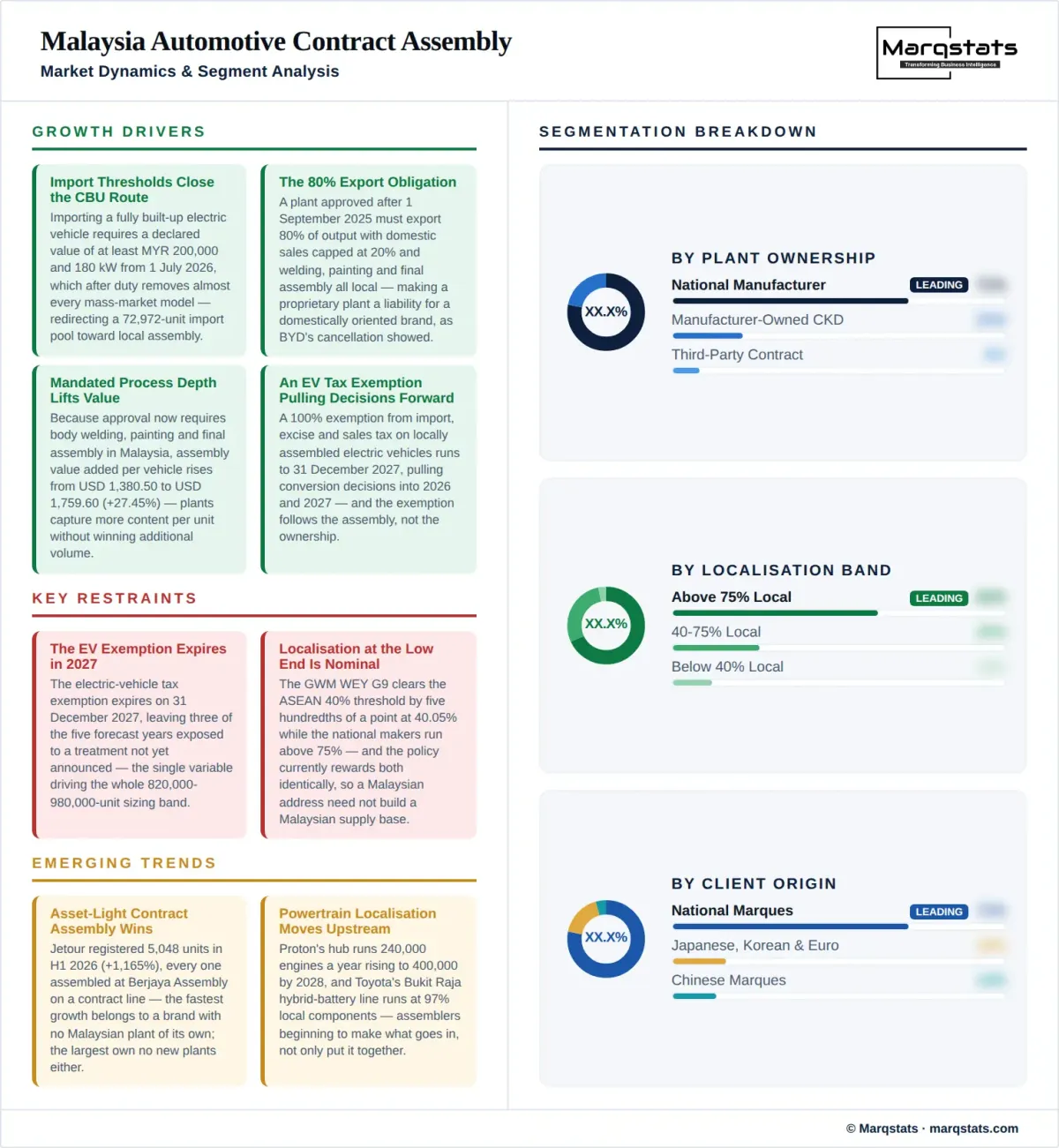
- Import thresholds of MYR 200,000 declared value and 180 kW from 1 July 2026 close the fully built-up route for essentially every mass-market model, redirecting a 72,972-unit import pool toward local assembly.
- The 80% export obligation and mandatory local welding, painting and final assembly on plants approved after 1 September 2025 make proprietary manufacturing uneconomic for domestically oriented brands, as BYD's September 2026 cancellation demonstrated.
- Mandated process depth lifts assembly value added per vehicle from USD 1,380.50 to USD 1,759.60, up 27.45%, so plants capture more content per unit without winning additional volume.
- A 100% exemption from import duty, excise duty and sales tax on locally assembled electric vehicles runs to 31 December 2027, pulling conversion decisions forward into 2026 and 2027.
- National production is stabilising ahead of the conversion, reaching 432,436 units in January to July 2026, up 1.9%, with July output of 75,490 units the highest in thirty months.
Key Restraints
- The electric vehicle tax exemption expires on 31 December 2027, leaving three of the five forecast years exposed to a treatment that has not been announced and driving the whole 820,000 to 980,000 unit sizing band.
- Revised open market value excise rules for locally assembled vehicles were deferred to 31 December 2026, so assemblers are quoting against a tax basis with a known expiry and no announced successor.
- National vehicle production fell 5.4% to 747,780 units in 2025, and the national makers who hold 63% of local sales are already producing near their practical capacity.
- Localisation at the lower end is nominal, with the GWM WEY G9 at 40.05% clearing the ASEAN threshold by five hundredths of a point while the national makers run above 75%.
Key Trends
- Contract assembly is becoming the default entry route rather than a transitional one, with Jetour registering 5,048 units in the first half of 2026, up 1,165%, entirely from Berjaya Assembly at Tampoi.
- Paint capacity is the constraint being built out, with Inokom's MYR 300 million Paint Shop 3 lifting its total to 100,000 units from 11 August 2026 and EP Manufacturing adding 30,000 from June 2026.
- Powertrain localisation is moving upstream, with Proton's hub at 240,000 engines a year rising to 400,000 by 2028 and Toyota's Bukit Raja hybrid battery line at 97% local components.
- Chinese brands are queuing for CKD capacity, with Zeekr confirmed from 2027 at the earliest as its first hub outside China and Dongfeng, Changan, Hongqi and Foton planning or studying entry.
Market Segmentation
National manufacturer plants account for an estimated 530,000 units in 2025, or 70.87% of assembly output, across Proton at Tanjong Malim and Perodua at Rawang and Serendah. The two groups hold 63% of local sales, run localisation above 75% and support more than 700,000 jobs, and Proton's Tanjong Malim vehicle plant alone carries up to 250,000 units of annual capacity.
Manufacturer-owned CKD plants account for an estimated 156,580 units in 2025, or 20.94%, covering Chery at Shah Alam, Stellantis at Gurun, Volvo at Shah Alam and Toyota at Bukit Raja. The segment is expanding fastest through Chery's MYR 2.2 billion Lembah Beringin park, topped out in June 2026 at 100,000 units expandable to 300,000, with operations expected in 2027.
Third-party contract assemblers account for an estimated 61,200 units in 2025, or 8.18%, the smallest ownership model and the fastest-growing. Inokom, EP Manufacturing, Berjaya Assembly, Tan Chong and HICOM carry it, and the segment absorbs almost all new brand entry because a plant approved after 1 September 2025 carries an 80% export obligation that a contract line does not.
Assembly above 75% local content accounts for an estimated 530,000 units in 2025, or 70.87%, and is entirely the national makers. Proton's local purchase value exceeded MYR 17 billion across 2021 to 2025 and is projected at MYR 30 billion by 2030, which is the procurement scale a rate of this level generates and the benchmark every other band is measured against.
Assembly between 60% and 75% local content accounts for an estimated 62,000 units in 2025, or 8.29%, and is where established non-national platforms with long Malaysian histories sit. The Mazda CX-5 targets 60% with 16 Malaysian suppliers enrolled through a vendor development programme, moving to CKD at Inokom within 12 to 16 months of its 8 October 2026 launch.
Assembly between 40% and 60% local content accounts for an estimated 108,000 units in 2025, or 14.44%, and this is where the incoming Chinese volume is landing. Jetour targets localisation above 40% on a MYR 841 million commitment creating more than 3,200 jobs, and the GWM WEY G9 sits at 40.05%, clearing the ASEAN threshold by five hundredths of a point.
Assembly below 40% local content accounts for an estimated 47,780 units in 2025, or 6.39%, and is mostly early-stage electrified programmes that have not yet qualified suppliers. The Proton e.MAS 7 plug-in hybrid launched at 30% local parts, which shows that even the national maker starts below the threshold on a new electrified platform before the supply base catches up.
Internal combustion vehicles account for an estimated 612,000 assembled units in 2025, or 81.84%, and remain the volume base that carries the fixed cost of weld and paint capacity. The segment is not growing, but its stability is what allows assemblers to justify facilities like Inokom's MYR 300 million paint shop against electrified volumes that have not yet arrived.
Hybrid and mild hybrid vehicles account for an estimated 78,000 assembled units in 2025, or 10.43%, and carry the deepest component localisation of any electrified segment. Toyota's Bukit Raja hybrid battery line runs up to 30,000 batteries a year at 97% locally sourced components, a rate no vehicle programme in Malaysia matches.
Plug-in hybrids and range extenders account for an estimated 31,000 assembled units in 2025, or 4.15%, and are the configuration most brands use to enter local assembly. Proton's e.MAS 7 plug-in hybrid launched at 30% local parts from a dedicated line that expanded from 20,000 to 42,000 units on MYR 37 million with 391 personnel.
Battery electric vehicles account for an estimated 26,780 assembled units in 2025, or 3.58%, the smallest powertrain segment and the one carrying the most policy weight. It is the direct beneficiary of the import thresholds and the direct casualty of the tax exemption expiring on 31 December 2027, and it includes the Leapmotor C10 and B10 at Gurun priced at MYR 125,000 and MYR 118,800.
National marques account for an estimated 530,000 assembled units in 2025, or 70.87%, through Proton with Geely and Perodua with Daihatsu. The pair hold 63% of local sales, and Proton exported 6,059 units in January to August 2026 against 6,000 for the whole of 2025, which is a full-year export volume achieved in eight months.
Chinese marques account for an estimated 96,000 assembled units in 2025, or 12.84%, and are the origin group driving essentially all forecast growth. Chery, GWM, SAIC MG, XPeng, Leapmotor, BAIC, Jetour, GAC and TQ Wuling all assemble in Malaysia today, and Zeekr, Dongfeng, Changan, Hongqi and Foton are confirmed, planning or studying entry.
Japanese and Korean marques account for an estimated 78,000 assembled units in 2025, or 10.43%, spanning Toyota at Bukit Raja, Mazda and Hyundai at Kulim, Mitsubishi and Isuzu at Pekan and Kia at Gurun from the third quarter of 2026. The group's Malaysian commitment is deepening selectively rather than broadly, with the Mazda CX-5's 60% localisation target the clearest example.
European marques account for an estimated 43,780 assembled units in 2025, or 5.85%, the smallest origin group and the highest value per unit. BMW, MINI and Porsche assemble at Kulim, Volkswagen at Pekan, Volvo at Shah Alam and Peugeot at Gurun, and Stellantis exports the Peugeot 408 from Gurun to Thailand, Cambodia and Taiwan.
Domestic supply accounts for an estimated 683,000 assembled units in 2025, or 91.34%, and is what the import thresholds directly convert. The concentration is the market's foundation and its exposure at once, because national vehicle production fell 5.4% in 2025 and the national makers who dominate domestic supply are already producing near practical capacity.
Export supply accounts for an estimated 64,780 assembled units in 2025, or 8.66%, and rises sharply because the 80% export condition pushes every new plant approval into this column by construction. Stellantis targets 280,000 vehicles to 20 markets by 2028 from Gurun, Inokom has exported more than 24,500 units since 2021, and the GWM WEY G9 targets 5,000 export units a year alongside 5,000 domestic.
By Geography
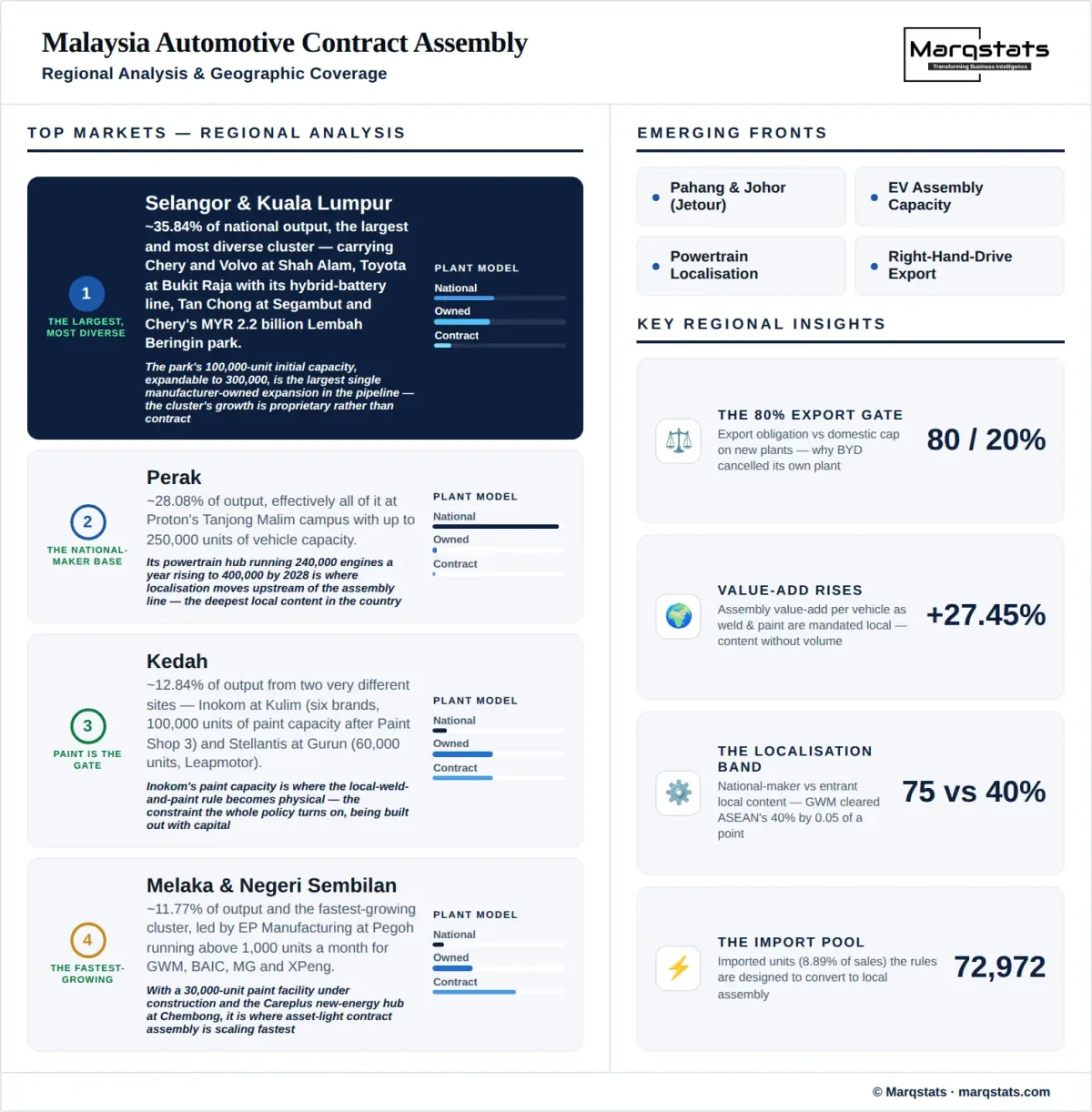
Selangor and Kuala Lumpur
Selangor and the federal territory account for an estimated 268,000 assembled units in 2025, or 35.84% of national output, the largest cluster and the most diverse. It carries Chery at Shah Alam, Volvo at Shah Alam, Toyota at Bukit Raja with its 30,000-battery hybrid line, Tan Chong at Segambut, and Chery's MYR 2.2 billion Lembah Beringin park on 200 acres of a 1,280-acre site.
Perak
Perak accounts for an estimated 210,000 assembled units in 2025, or 28.08%, effectively all of it at Proton's Tanjong Malim campus. The site carries up to 250,000 units of vehicle capacity, a new energy vehicle line expanded from 20,000 to 42,000 units, and a powertrain hub running 240,000 engines a year rising to 400,000 by 2028 on more than MYR 121 million invested since 2022.
Kedah
Kedah accounts for an estimated 96,000 assembled units in 2025, or 12.84%, from two sites of very different design. Inokom at Kulim assembled more than 31,800 units across six brands in 2025 from 20,500 in 2021, with more than 2,700 employees and 100,000 units of paint capacity after Paint Shop 3 opened on 11 August 2026, while Stellantis at Gurun holds 60,000 units across 140 acres with more than 400 personnel.
Melaka and Negeri Sembilan
Melaka and Negeri Sembilan account for an estimated 88,000 assembled units in 2025, or 11.77%, and form the fastest-growing cluster. EP Manufacturing at Pegoh runs above 1,000 units a month for Great Wall Motor, BAIC, SAIC MG and XPeng with a 30,000-unit paint facility under construction from June 2026, and the Careplus new energy vehicle hub at Chembong carries MYR 150 million across 73.34 acres.
Pahang and Johor
Pahang and Johor account for an estimated 85,780 assembled units in 2025, or 11.47%. HICOM at Pekan assembles the Mitsubishi Xforce, Volkswagen Golf R and Isuzu trucks of which more than 100,000 have been produced, while Berjaya Assembly at Tampoi builds every Jetour model sold in Malaysia, a brand that registered 5,048 units in the first half of 2026 on growth of 1,165%.
How Competition Is Evolving
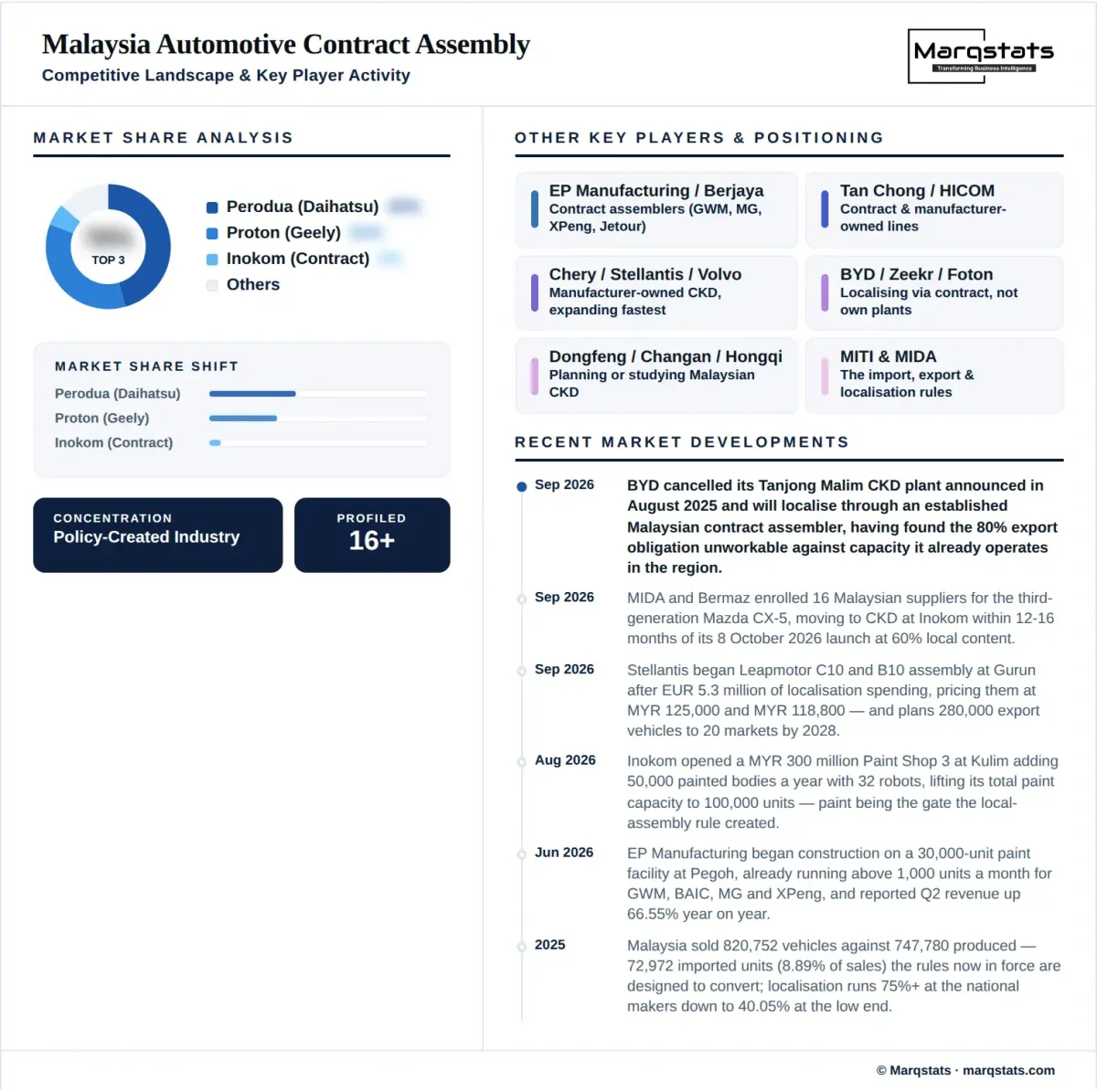
Malaysian vehicle assembly is concentrated by ownership and fragmented by client, and reading either alone misleads. The national makers hold an estimated 70.87% of assembly output and 63% of local sales through two groups, which looks like a duopoly until the non-national 29.13% is examined, where more than twenty brands are assembled across eight sites under three different ownership models. The competitive contest is happening entirely inside that minority share.
Competition among assemblers runs on process scope, capacity and certification rather than on rate. An assembler that can weld and paint can take work an assembler that cannot is now barred from, which is why paint became the industry's binding constraint and why Inokom committed MYR 300 million and EP Manufacturing began construction within two months of each other. Flexibility carries similar weight: HICOM at Pekan runs internal combustion, mild hybrid, hybrid, plug-in hybrid and battery electric platforms across more than twenty marques, which is worth more to a brand hedging its transition than a dedicated line would be.
The client relationships are lengthening into industrial partnerships, and the financial evidence is now public. EP Manufacturing reported second-quarter 2026 revenue of MYR 212.68 million against MYR 127.70 million a year earlier, a rise of 66.55%, on first-half revenue of MYR 372.87 million and net profit of MYR 6.70 million. The counter-current is graduation, with Chery moving from Inokom assembly to a MYR 2.2 billion park of its own and Zeekr heading for Tanjong Malim, so contract assemblers compete for clients who may become competitors, and the conditions imposed after 1 September 2025 are what now slow that graduation.
Companies Covered
The report profiles 15+ companies with full strategy and financials analysis, including:
Recent Market Activity
Table of Contents
Coverage & Segmentation
This analysis measures the value of completely knocked-down vehicle assembly performed in Malaysia from 2021 to 2030, with 2025 as the base year and 2026 to 2030 as the forecast period, priced at the value the assembly operation adds through welding, painting, trimming and validation rather than at the value of the finished vehicle. Coverage spans third-party contract assemblers, manufacturer-owned CKD plants and the national producers, together with their associated paint, body and powertrain capacity, localisation ratios, CKD exports and the policy framework governing CKD and CBU vehicles. The retail value of the vehicles assembled belongs to the vehicle markets that carry them and is never added to this panel. Motorcycle assembly, component-only manufacturing and aftermarket conversion are excluded. Assembly value is expressed in USD at a disclosed constant MYR 4.20 per USD.
Coverage spans three plant ownership models, four localisation bands, four powertrains, four client origin groups and two output destinations, with five state clusters analysed on installed assembly capacity rather than on vehicle demand. Assembled output is carried as the volume series at 747,780 units in 2025 and assembly value added per vehicle as a derived series at USD 1,380.50, and both are published alongside the value panel because a market created by a change in permitted process scope moves in value per unit as well as in volume. Fifteen entities are profiled across Malaysian assemblers, national producers and the manufacturer clients that buy their capacity.