Market Snapshot
Key Takeaways
Market Overview & Analysis
Report Summary
The Egypt automotive battery manufacturing market covers automotive starting batteries and emerging locally assembled lithium battery packs and management systems for vehicles. The measure is manufacturing output value produced in Egypt, not the broader battery sales market, and traction cell capacity is excluded unless physically manufactured in the country. That exclusion matters because Egypt currently has no lithium cell production and every announcement to date concerns pack assembly, management systems or feasibility study rather than cell manufacture.
Four distinct products sit inside this measure and their economics have almost nothing in common. A lead-acid starter battery is a commodity produced at scale and traded at around USD 52 a unit. A low-voltage electric vehicle pack is an assembly of imported cells with local management electronics, worth above USD 1,000. A traction pack is a different engineering problem again. A battery management system is essentially electronics and software. Treating them as one market produces a figure that answers no commercial question, which is why the segmentation here separates them explicitly.
The base year is modelled rather than reported, and the trade data is the strongest available anchor. Egypt exported 422,605 lead-acid automotive batteries worth USD 22.0 million in 2024, which establishes a real manufacturing and export base rather than an assumed one. Domestic production consumed locally is added to that export figure, and because company-level production data is incomplete the result is explicitly a working estimate. Confidence is graded moderate and the published range runs from USD 35 million to USD 55 million for 2025.
Automotive Battery Manufacturing Output in Egypt
Output value rises from USD 45.00 million in 2025 to USD 105.90 million in 2030, an 18.67% compound annual growth rate and an absolute increase of USD 60.90 million. The indicative 2031 endpoint is approximately USD 124.75 million. The 2026 estimate of USD 55.00 million reflects battery pack and management system localisation signals entering production, while deliberately not assigning output to the Mansour and Tianneng memorandum before an operating plant exists. Growth then steadies at 17.80% from 2026 to 2030, close enough to the five-year rate that this market avoids the two-phase reading problem carried by Egypt's electrified vehicle categories.
Unit output tells a different story and both series belong on the page. Production rises from approximately 865,000 batteries in 2025 to 1.33 million in 2030, a compound rate of 8.99% against 18.67% for value. Blended value per unit therefore rises from about USD 52 to USD 80, an increase of roughly 8.89% a year. The entire difference is mix: lead-acid units still account for the large majority of the 1.33 million batteries produced in 2030, while lithium packs and management systems account for around a third of the value.
That mix shift is the single most important thing to understand before sizing an opportunity here. A supplier of lead casings, separators or plate material should work from the unit series, because those inputs are consumed by battery count. An investor assessing revenue or an acquirer valuing a plant should work from the value series. Applying the 18.67% value rate to a unit-driven input business overstates demand by more than double across the forecast period, and applying the 8.99% unit rate to a revenue projection understates it by the same margin.
The scope boundary against Egypt's other component measures is the tightest in the cluster because this market straddles two of them. Egypt's automotive components market counts domestic component demand at USD 2.10 billion in 2025 and excludes export manufacturing output, so the replacement and original equipment portions of this market sit inside that figure while the USD 22.0 million of export output sits outside it. Egypt's hybrid and range-extended vehicle market counts finished electrified vehicles, into which locally assembled packs would be an input rather than a share. At roughly USD 45 million, battery manufacturing is around 2% of Egypt's domestic component demand.
Two structural facts about Egypt's electrified base bound what any lithium project can assume. Egypt's hybrid and range-extended vehicle market runs at 2,100 units in 2025 rising toward 26,100 by 2030, and its range-extended subset at 320 units rising toward 11,600. Even valuing every one of those vehicles at a substantial pack content, domestic electrified demand cannot underwrite cell manufacture within the forecast period. That is why the achievable sequence runs lead-acid, then low-voltage packs and management systems, then traction packs, and why any cell project would depend on export or stationary storage demand rather than on Egyptian vehicles.
Market Dynamics
Key Drivers
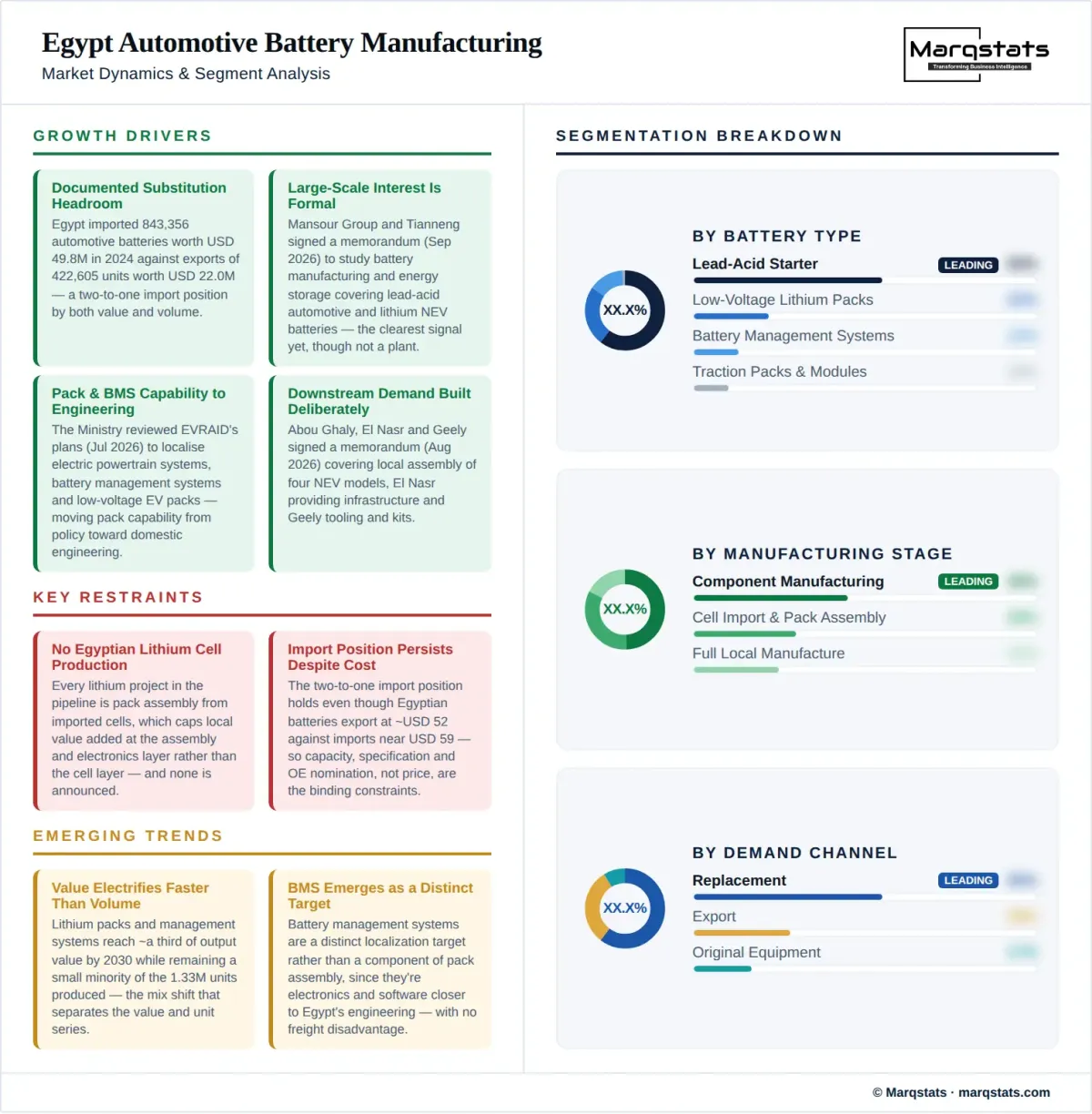
- Import substitution headroom is documented rather than assumed, with Egypt importing 843,356 automotive batteries worth USD 49.8 million in 2024 against domestic exports of 422,605 units worth USD 22.0 million, a two-to-one import position by both value and volume.
- Large-scale investment interest is now formal, with Mansour Group and Tianneng Battery Group signing a memorandum in September 2026 to study battery manufacturing and energy storage investment covering both lead-acid automotive batteries and lithium batteries for new-energy vehicles.
- Pack and management system capability is moving from policy to engineering, with the Ministry of Investment and Foreign Trade reviewing EVRAID's plans in July 2026 to localise electric powertrain systems, battery management systems and low-voltage electric vehicle packs.
- Downstream vehicle demand is being built deliberately, with Abou Ghaly Motors, El Nasr Automotive and Geely signing a memorandum in August 2026 covering local assembly of four new-energy vehicle models with El Nasr providing manufacturing infrastructure and Geely supplying tooling and assembly kits.
- Lithium batteries are specifically named among eligible activities in Egypt's investment incentive frameworks, and Automotive Industry Development Programme and new-energy vehicle localisation incentives can improve local pack economics where genuine local value-added steps are performed.
Key Restraints
- No Egyptian lithium cell production exists and none is announced, so every lithium project in the pipeline is pack assembly from imported cells, which caps local value added at the assembly and electronics layer rather than the cell layer.
- The Mansour and Tianneng agreement is a memorandum to study rather than a commitment to build, and no production is assigned to it in this forecast until an operating plant exists, consistent with the treatment applied across Egypt's component cluster.
- Lithium projects carry hazardous material, thermal safety and transport compliance requirements that lead-acid manufacturing does not, alongside battery recycling and end-of-life obligations that belong in any long-term plant feasibility study.
- The two-to-one import position persists despite Egyptian batteries exporting at around USD 52 a unit against imports landing near USD 59, indicating that capacity, specification and original equipment nomination rather than price are the binding constraints.
Key Trends
- Value is electrifying faster than volume, with lithium packs and management systems reaching around a third of output value by 2030 while remaining a small minority of the 1.33 million units produced.
- The technology partner base is broadening beyond China, with Egypt's Minister of Industry and the United Kingdom Ambassador discussing cooperation in electric vehicle batteries, green manufacturing and technology localisation in March 2026.
- Battery management systems are emerging as a distinct localisation target rather than a component of pack assembly, since they are electronics and software rather than chemistry and sit closer to Egypt's existing engineering capability.
- Sequencing matters more than scale in this category, and the near-term opportunity is pack assembly and lead-acid localisation rather than immediate large-scale lithium cell manufacturing, which requires vehicle offtake or energy storage customers secured before scale-up.
Market Segmentation
The established base and the large majority of unit output throughout the forecast, running at roughly 1.30 million units by 2030 at around USD 55 each. It is a genuine manufacturing and export business rather than an assumption, evidenced by 422,605 units worth USD 22.0 million exported in 2024, and it remains the segment where import substitution against 843,356 imported units is most immediately achievable.
The fastest-growing segment by value and the one EVRAID is targeting directly, at a unit value above USD 1,000 against roughly USD 52 for a starter battery. Packs are assembled from imported cells with locally added management electronics, enclosure and thermal systems, which places the achievable local value added at the assembly layer rather than the chemistry layer.
The segment with the largest potential value per unit and the least Egyptian activity, dependent on the four new-energy vehicle models covered by the August 2026 Geely, El Nasr and Abou Ghaly memorandum reaching production. Traction packs are a different engineering problem from low-voltage packs, with higher voltage, thermal and safety requirements, and no Egyptian producer currently holds the qualification.
The segment closest to Egypt's existing engineering capability, since a management system is electronics and software rather than chemistry, and the one EVRAID names alongside packs and powertrain systems in its July 2026 localisation plans. It carries high value density relative to weight, which removes the freight disadvantage that shapes the economics of every other segment here.
The largest channel by unit volume, tied to Egypt's installed vehicle parc rather than to assembly output and therefore growing on a steadier curve than the 15.64% at which locally assembled vehicle output expands. Starter battery replacement is routine at three to five year intervals, which is what sustains the roughly 1.30 million lead-acid units produced in 2030.
A proven channel rather than an aspiration, with 422,605 units worth USD 22.0 million shipped in 2024 at an average of about USD 52 a unit. Egyptian lead-acid batteries compete on cost in regional markets, and the export base is what establishes that this is a manufacturing market rather than an assembly-and-import operation.
The smallest channel by volume but the one carrying the lithium opportunity, tied to local vehicle assembly of about 99,600 units in 2025 rising toward 206,000 by 2030. It is also the channel where nomination requirements are most demanding, which is part of why Egypt imports 843,356 batteries a year despite holding a cost-competitive export position.
The deepest local stage and the one lead-acid production already occupies, covering plates, casings, separators and assembly within Egypt. It generates the highest local value added of any current stage and underpins the USD 22.0 million of 2024 exports, but it applies almost entirely to lead-acid rather than to lithium chemistry.
The stage every announced lithium project occupies, assembling imported cells into packs with locally added management electronics and enclosures. It is where EVRAID's low-voltage pack plans sit and where the Mansour and Tianneng study would most plausibly begin, and it captures perhaps a third of a pack's value against a unit price above USD 1,000.
A stage that does not yet exist for lithium and is not announced, since no Egyptian lithium cell production is planned and the market definition excludes traction cell capacity unless physically manufactured in Egypt. For lead-acid it is the current norm and accounts for essentially all of the 422,605 units worth USD 22.0 million exported in 2024, which is the clearest illustration of how differently the two chemistries sit in Egypt's industrial base.
The application supporting essentially all current output and the majority through the forecast, covering starter batteries for the internal combustion fleet that still dominates Egypt's parc. It sustains roughly 1.30 million of the 1.33 million units produced in 2030, even as its share of the USD 105.90 million output value falls toward two thirds.
The application driving value growth from a negligible base, tied to Egypt's hybrid and range-extended vehicle market rising from 2,100 units in 2025 toward 26,100 by 2030 and to the four new-energy models in the Geely and El Nasr programme. Each electrified vehicle carries battery content worth twenty or more times a starter battery, which is why a small unit base moves the value series materially.
By Geography
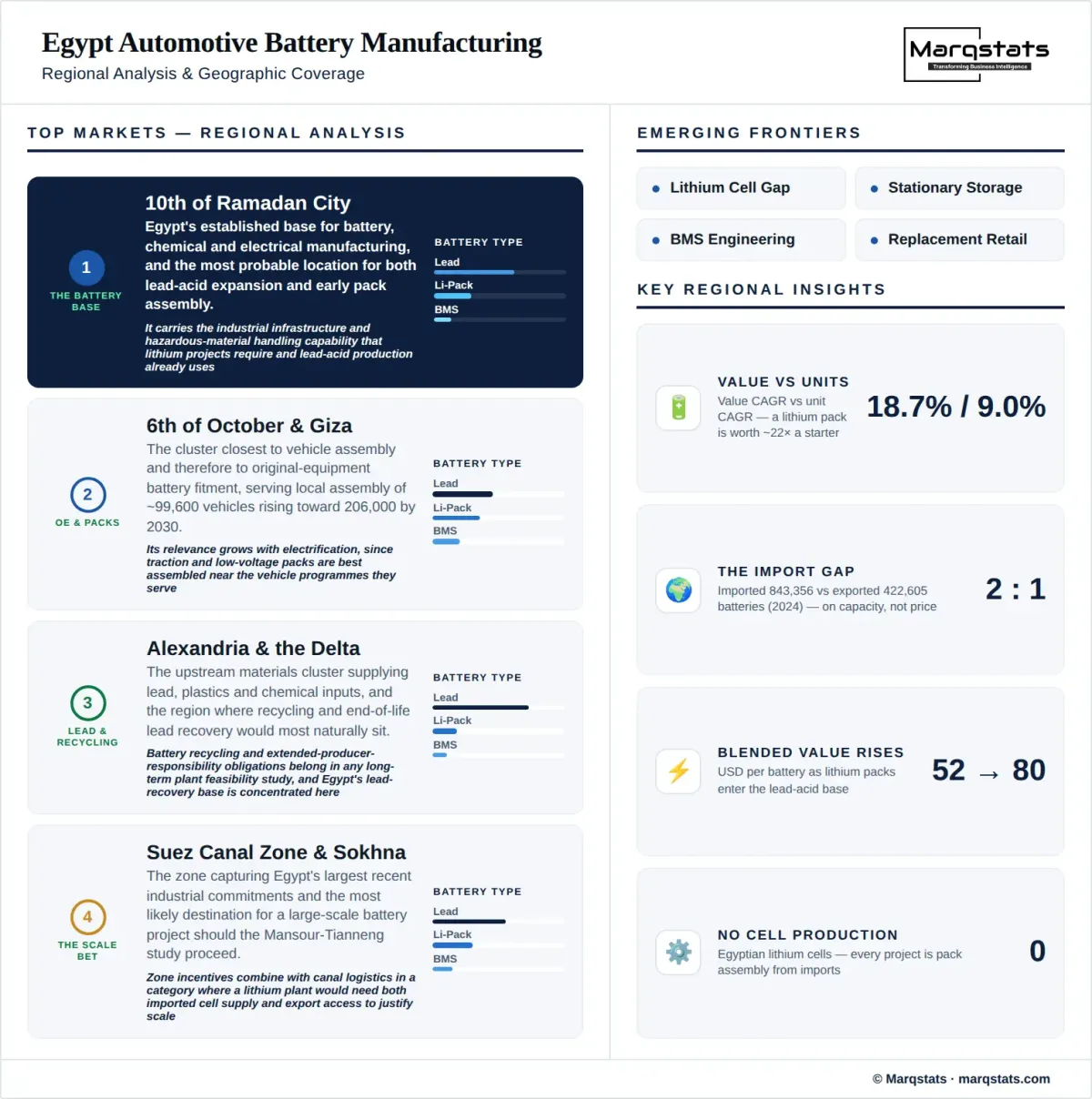
10th of Ramadan City
Egypt's established base for battery, chemical and electrical manufacturing and the most probable location for both lead-acid expansion and early pack assembly. It carries the industrial infrastructure and hazardous material handling capability that lithium projects require and lead-acid production already uses.
6th of October City and Giza
The cluster closest to vehicle assembly and therefore to original equipment battery fitment, serving local assembly of about 99,600 vehicles in 2025 rising toward 206,000 by 2030. Its relevance grows with electrification, since traction and low-voltage packs are best assembled near the vehicle programmes they serve.
Alexandria and the Delta
The upstream materials cluster supplying lead, plastics and chemical inputs into battery manufacture, and the region where recycling and end-of-life lead recovery capacity would most naturally sit. Battery recycling and extended producer responsibility obligations belong in any long-term plant feasibility study, and Egypt's existing lead recovery base is concentrated here.
Suez Canal Economic Zone and Sokhna
The zone capturing Egypt's largest recent industrial commitments and the most likely destination for a large-scale battery project should the Mansour and Tianneng study proceed. Zone incentives combine with canal logistics in a category where a lithium plant would need both imported cell supply and export access to justify scale.
Rest of Egypt
Covering distribution and the replacement channel infrastructure that reaches Egypt's vehicle parc, which is where the majority of the roughly 1.30 million lead-acid units produced in 2030 are consumed. Battery replacement is a dispersed retail business rather than an industrial one, and its network sits outside the manufacturing clusters entirely.
How Competition Is Evolving
Egypt has an established lead-acid manufacturing base and no lithium manufacturing at all, and the competitive landscape divides cleanly along that line. Existing Egyptian producers demonstrated real capability by exporting 422,605 units worth USD 22.0 million in 2024, competing on cost in regional markets at around USD 52 a unit. Against them sit imports of 843,356 units worth USD 49.8 million, landing at roughly USD 59 a unit. On the lithium side there is no incumbent: Mansour Group and Tianneng signed a memorandum to study in September 2026, EVRAID is pursuing pack and management system localisation, and neither has an operating plant.
The most useful observation for a client is that the import position is not explained by price. Egyptian batteries export at a lower unit value than imports land at, so a straightforward cost disadvantage does not account for imports running twice exports by both value and units. The plausible explanations are capacity constraint, specification and size range coverage, original equipment nomination held by international brands, and channel preference in the replacement market. Each implies a different entry strategy, and a feasibility study that treats import substitution as a pricing exercise will misdiagnose the opportunity.
On lithium the sequencing question matters more than the scale question. The near-term achievable position is pack assembly from imported cells with locally added management electronics, enclosures and thermal systems, which is precisely what EVRAID describes and what a Mansour and Tianneng project would most plausibly begin with. Full cell manufacture requires vehicle offtake or energy storage customers secured before scale-up, and Egypt's electrified vehicle base of 2,100 units in 2025 rising toward 26,100 by 2030 cannot underwrite a cell plant on its own. The realistic path runs lead-acid, then low-voltage packs and management systems, then traction packs, with cell manufacture dependent on export or storage demand rather than on Egyptian vehicles.
The commercial question this page is built to answer is which of four businesses a client is entering, because they share a name and almost nothing else. Lead-acid manufacturing is a commodity business at roughly USD 52 a unit competing on cost against imports landing at USD 59, where the constraint is capacity and nomination rather than price. Low-voltage pack assembly is an electronics and integration business at above USD 1,000 a unit where the cells are imported and the value added is local engineering. Traction packs are a qualification business with no Egyptian incumbent and no current programme volume. Battery management systems are a software and electronics business with no freight disadvantage at all. A feasibility study that sizes the USD 45 million headline without choosing among these four is sizing the wrong thing.
Companies Covered
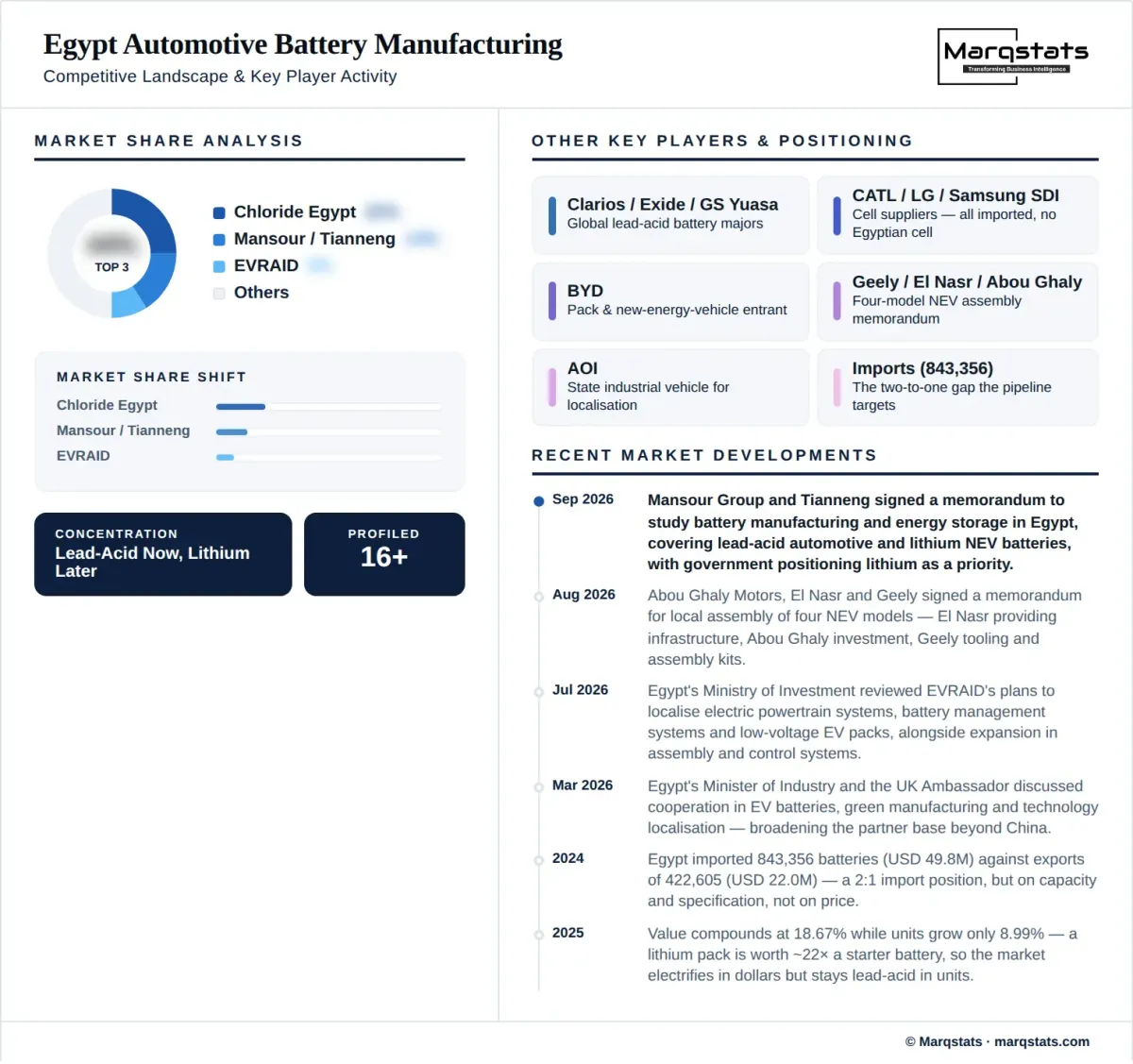
The report profiles 16+ companies with full strategy and financials analysis, including:
Recent Market Activity
Table of Contents
Coverage & Segmentation
The study covers automotive starting batteries and locally assembled lithium battery packs and management systems for vehicles, manufactured in Egypt, across the 2021 to 2025 historical period and the 2026 to 2030 forecast period, with 2025 as the base year and an indicative 2031 endpoint of approximately USD 124.75 million. The measure is manufacturing output value rather than the broader battery sales market. Traction cell capacity is excluded unless physically manufactured in Egypt, which at present means excluded entirely, since no Egyptian lithium cell production exists or is announced.
Sizing works outward from trade-verified export data. Egypt's 2024 exports of 422,605 lead-acid batteries worth USD 22.0 million establish a documented manufacturing base, to which domestic production consumed locally is added using local demand assumptions. Company-level production data is incomplete, so the result is explicitly modelled rather than reported, and the published sizing range runs from USD 35 million to USD 55 million for 2025 and USD 90 million to USD 170 million for 2031. Memoranda of understanding are treated as investment signals and are not credited with output before an operating plant exists.