Market Snapshot
Key Takeaways
Market Overview & Analysis
Report Summary
Morocco EV battery manufacturing is a market brought into existence by one project rather than one that grew from an installed base. No large-scale cell or pack plant operated in the country through 2025, and the entire 2026 to 2031 forecast rests on the commissioning sequence of the Gotion Power Morocco gigafactory at Kenitra and on whatever follows it. That structure changes what diligence means: the central question is not the size of the market but the execution of a single industrial programme.
The analysis separates three layers that are routinely conflated in coverage of this project. Announced capacity is what the project is designed for, ultimately 100 GWh. Commissioned capacity is what has been built and accepted, 20 GWh by end-2026 on the Gotion scope. Realized output is what the lines actually produce, roughly 1 GWh during the 2026 commissioning period. Treating any of the three as another produces a market size wrong by an order of magnitude.
The audience is battery and materials investors, European manufacturers assessing supply options, component suppliers evaluating adjacency, and policy analysts tracking Africa's first integrated battery value chain. The commercial framing throughout is Morocco as an export-oriented battery hub tied to European and regional vehicle production, not as a market sized by domestic electric-vehicle demand.
Morocco EV Battery Manufacturing Market Size and Forecast
Commissioned cell and pack capacity is estimated at 20,000 megawatt-hours in 2026, rising to 80,000 megawatt-hours by 2031 at a 31.95% compound annual growth rate over five years. The published sizing range is zero operational capacity for 2025, 10 to 20 GWh for 2026 depending on whether the financed tranche or the full Phase I design is used, and 60 to 100 GWh for 2031. Confidence is graded medium.
The base year is 2026 rather than 2025, which is a departure from every other page in this cluster and is forced by the data. Morocco's operating capacity baseline for 2025 is zero, and a growth rate calculated from zero is undefined rather than large. Stating a 2025 base of zero and then publishing a CAGR from it would produce exactly the artificial rate the underlying research explicitly warns against.
The 2031 base case of 80 GWh sits below the project's 100 GWh ultimate design. That gap is deliberate and it is the forecast's main judgement: phased execution, line-by-line commissioning and market absorption all argue against assuming full design capacity within five years. An investor testing the upside case should use the published 60 to 100 GWh range rather than the point estimate alone.
Cumulative committed capital investment provides the value reference for the capacity series. Gotion's disclosed Phase I economics of approximately USD 1.28 billion for 20 GWh imply roughly USD 64 million per GWh. Applying a lower marginal rate of approximately USD 50 million per GWh to subsequent phases, reflecting shared infrastructure and site services already built, gives cumulative investment near USD 4.28 billion by 2031. The declining marginal capital intensity is the single modelled input on this page.
The Gotion Kenitra Project and Its Phase Scopes
Gotion Power Morocco lists a Phase I designed for 20 GWh of capacity with USD 1.28 billion-equivalent investment, 156 hectares, 100,000 tonnes of materials and more than 2,000 direct jobs. The full project is designed to reach 100 GWh of battery and pack capacity with 400,000 tonnes of materials across more than 500 hectares. Those are company project-profile figures describing design intent.
The African Development Bank's July 2026 financing describes a different Phase I. Its approval covers a 10 GWh initial cell-and-pack tranche with more than 600 direct jobs and a 70% local industrial integration rate, located in the Rabat-Salé-Kénitra free zone and powered primarily by renewable energy. The Bank approved a EUR 100 million loan and plans to mobilize up to EUR 141 million in additional financing, for total project financing of approximately EUR 241 million.
The two descriptions differ by a factor of two on capacity and more than three on jobs. The most consistent reading is that the financed tranche sits inside the larger design rather than replacing it, and both scopes are kept visible rather than forced to agree. A diligence exercise should establish which scope any given commitment, permit or offtake agreement actually attaches to before treating a figure as the project.
Construction has been progressing through documented stages. The project moved from site preparation into infrastructure construction in May 2025 after completing phase-one leveling, completed the regulatory environmental and social impact assessment process and received an Environmental Acceptability Certificate in September 2025, and reached financing approval in July 2026. Production was expected to begin in October 2026 with line-by-line ramp-up.
Cell Capacity Against Pack Capacity
The project is described throughout as integrated cell and pack manufacturing, which means the 20 GWh figure covers both stages on the same site rather than two separable capacities. Where a single line runs cell production through to pack assembly, counting cell capacity and pack capacity separately would double-count the same 20 GWh of installed equipment.
The distinction still matters commercially because the two stages have different economics and different customers. Pack assembly can serve vehicles built from imported cells, so pack capacity can in principle run ahead of cell capacity, while cell manufacturing carries the capital intensity, the environmental permitting burden and the materials dependency that make this project strategically significant.
For measurement purposes the market is stated as combined cell and pack capacity, consistent with how both Gotion and the African Development Bank describe it. Cathode and anode precursor production is excluded from the capacity figure entirely and tracked separately in tonnes, because materials plants feed cell lines rather than constituting them and adding the two would overstate the market.
LFP Chemistry and Its Morocco Rationale
The Kenitra plant is an integrated lithium iron phosphate gigafactory, described by the African Development Bank as Africa's first. LFP carries lower energy density than nickel-based chemistries but better cost, thermal stability and cycle life, which suits volume passenger vehicles and stationary storage rather than premium long-range applications.
Morocco's chemistry choice has a resource logic behind it. LFP cathode requires phosphate, and Morocco holds the world's largest phosphate reserves, making forward integration from a domestic mineral into a battery cathode a genuinely differentiated industrial position rather than a generic assembly play. That argument does not depend on the Gotion project alone and would survive a change of operator.
The materials ecosystem being built alongside it is not exclusively LFP, however. COBCO's 40,000 tonnes a year of commissioned capacity at Jorf Lasfar is NMC precursor cathode active material, a nickel-based chemistry serving different cell customers. Morocco is therefore building capability across more than one chemistry, and a supplier assessing offtake should establish which chemistry a given materials plant actually serves.
Capacity Against Commissioned Output
Nameplate capacity and realized output diverge sharply across the forecast and the gap is the most commercially important number on this page. Against 20 GWh of end-2026 nameplate, output during the commissioning period is approximately 1 GWh, an implied utilization of about 5%. By 2031, output of roughly 50 GWh against 80 GWh of commissioned capacity implies approximately 63%.
That ramp is normal for a first-of-its-kind facility and it is why a growth rate calculated on output rather than capacity would be meaningless. Compounding from a three-month partial commissioning year produces rates above 100% a year that describe an accounting artifact rather than an industrial trajectory, and the underlying research explicitly warns against publishing one.
The practical consequence for anyone modelling this market is that capacity and revenue move on different schedules. A cell line accepted in one year may not reach qualified volume production for customers until the next, because automotive cell qualification requires sample approval, process validation and customer audit before nomination volumes flow. Capacity is a leading indicator of output by one to two years, not a proxy for it.
The Upstream Materials Ecosystem
Morocco's battery materials base is further advanced than its cell capacity and predates it. COBCO, the Al Mada and CNGR venture, inaugurated the first phase of its lithium-ion battery-materials complex at Jorf Lasfar in June 2025, commissioning 40,000 tonnes a year of NMC precursor cathode active material on a site of more than 200 hectares intended to supply value chains in Europe, North America and the wider region.
BTR New Material Group's cathode project and a second planned anode-material plant at Mohammed VI Tanger Tech City were reviewed by Morocco's investment ministry in January 2025. The two projects represent more than MAD 6 billion of investment, are expected to create over 1,100 skilled jobs, and were targeted for completion by 2026. Falcon Energy Materials adds graphite qualification and pilot activity relevant to anode supply.
Materials tonnage and cell capacity are tracked as separate layers throughout and are never added. Gotion's own Phase I pairs 20 GWh of capacity with 100,000 tonnes of materials, and the full project pairs 100 GWh with 400,000 tonnes, so the two scale together within one integrated investment. Counting the cathode plant and the cell plant as separate markets would double-count the same industrial programme.
Investment Economics and Capital Intensity
Phase I economics are disclosed with unusual clarity for a project at this stage: approximately USD 1.28 billion for 20 GWh across 156 hectares, implying roughly USD 64 million per GWh of installed capacity. That ratio is the most useful single number for anyone benchmarking a competing project or testing whether announced budgets are credible.
Marginal capital intensity should fall as the project scales, because land, power connection, water, effluent treatment, logistics and site services are largely committed in Phase I. Applying approximately USD 50 million per GWh to capacity beyond the first phase gives cumulative committed investment of roughly USD 4.28 billion by 2031, growing at 27.30% a year against capacity growth of 31.95%.
The gap between those two rates is the investment case in one comparison. Capacity grows faster than the capital required to build it, which is what industrial scale economics are supposed to deliver and what a purely linear extrapolation of Phase I costs would miss. The declining marginal rate is a modelled assumption rather than a disclosed figure and should be tested against actual Phase II budgets when they are published.
Financing structure matters as much as total cost at this stage. The African Development Bank's EUR 100 million loan with up to EUR 141 million of additional mobilization demonstrates multilateral appetite, and development-finance participation typically brings environmental, social and governance conditions that shape construction and operating practice well beyond the loan tenor.
Regulation, Permitting and EU Compliance
Battery projects can access Morocco's automotive and industrial investment support, free-zone structures and customized ecosystem incentives subject to project eligibility. The Ministry of Industry lists automotive ecosystem support including investment and local-integration incentives that can reach up to 30% of investment under applicable schemes, which is material against a Phase I cost near USD 1.28 billion.
Environmental permitting is a distinct and demanding layer. Gotion Phase I completed the regulatory environmental and social impact assessment process and received an Environmental Acceptability Certificate in September 2025, and the African Development Bank describes the facility as powered primarily by renewable energy. For a cell plant, power sourcing is not only a cost question but a compliance one.
Cells and packs destined for Europe face requirements that do not originate in Morocco at all. Evolving EU battery carbon-footprint, traceability and battery-passport rules apply to the product rather than the producer, and they interact directly with power sourcing, materials provenance and record-keeping. An export-oriented plant that satisfies Moroccan environmental and hazardous-material rules has met a necessary but not sufficient condition for its principal market.
Market Dynamics
Key Drivers
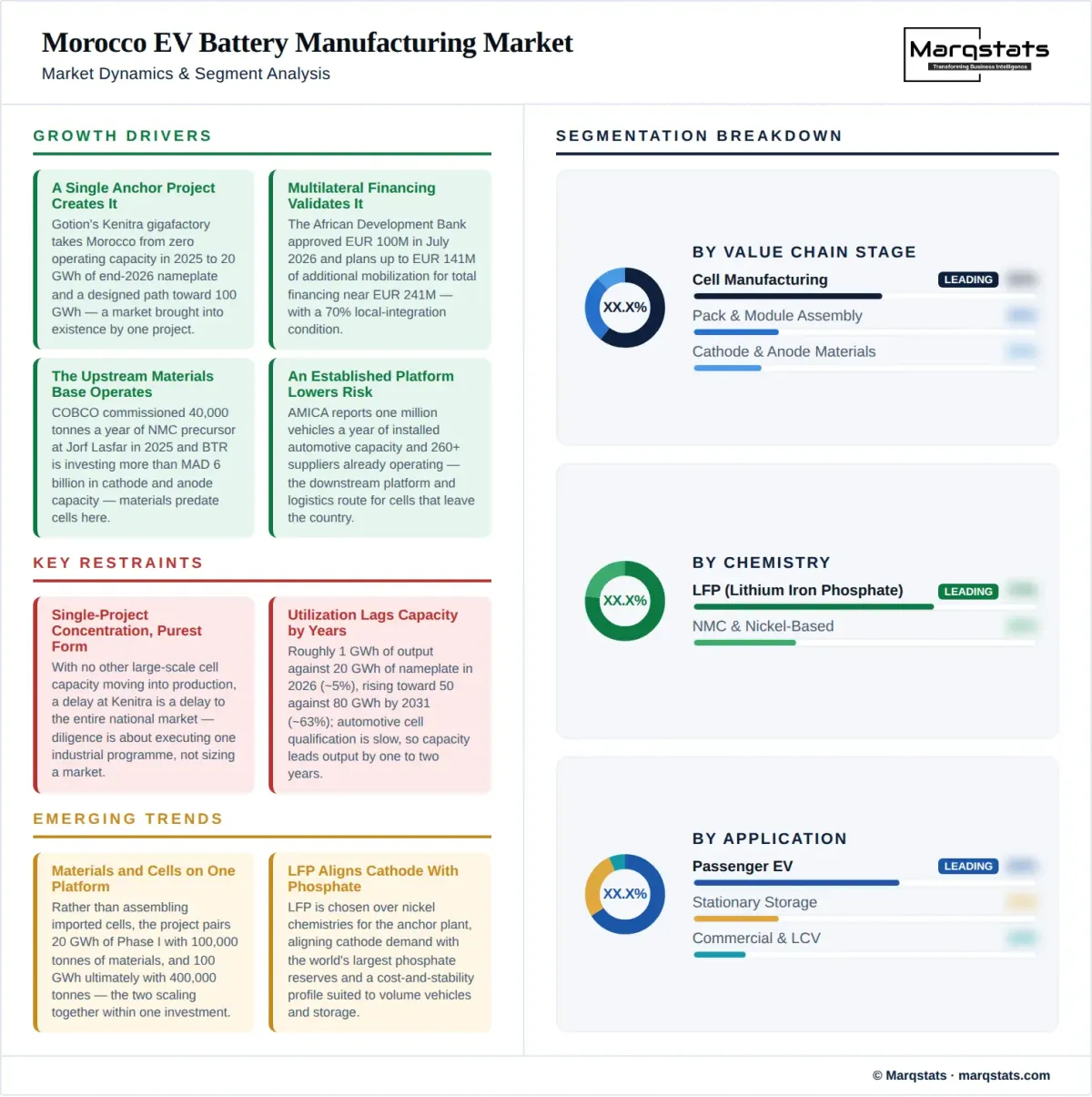
- A single anchor project creates the market outright, with Gotion's Kenitra gigafactory taking Morocco from zero operating capacity in 2025 to 20 GWh of end-2026 nameplate and a designed path toward 100 GWh.
- Multilateral financing validates the programme, with the African Development Bank approving EUR 100 million in July 2026 and planning up to EUR 141 million of additional mobilization for total financing near EUR 241 million.
- The upstream materials base is already operating, with COBCO commissioning 40,000 tonnes a year of NMC precursor at Jorf Lasfar in 2025 and BTR investing more than MAD 6 billion in cathode and anode capacity.
- An established industrial platform lowers execution risk, with AMICA reporting one million vehicles a year of installed automotive capacity and more than 260 suppliers already operating in the country.
- Local integration is a condition of the financing rather than an aspiration, with the African Development Bank citing a 70% local industrial integration rate for the financed tranche.
Key Restraints
- The market has single-project concentration risk in its purest form. With no other large-scale cell capacity moving into production, a delay at Kenitra is a delay to the entire national market.
- Utilization lags capacity by years, with roughly 1 GWh of output against 20 GWh of nameplate in 2026, so capacity milestones do not translate into revenue on the same schedule.
- Automotive cell qualification is slow and customer-controlled, requiring sample approval, process validation and audit before nomination volumes flow, which is why capacity leads output by one to two years.
- European compliance requirements sit outside Moroccan control, with evolving EU carbon-footprint, traceability and battery-passport rules applying to the product and interacting with power sourcing and materials provenance.
Key Trends
- Morocco is integrating materials and cells on one platform rather than assembling imported cells, pairing 20 GWh of Phase I capacity with 100,000 tonnes of materials and 100 GWh ultimately with 400,000 tonnes.
- LFP is being chosen over nickel chemistries for the anchor plant, aligning cathode demand with the world's largest phosphate reserves and a cost-and-stability profile suited to volume vehicles and storage.
- Renewable power is becoming a specification rather than a preference, with the financed facility described as powered primarily by renewable energy in a market where carbon footprint determines European access.
- Development finance is shaping the sector's standards, with a EUR 241 million financing package bringing environmental, social and governance conditions that outlast the loan itself.
Market Segmentation
Cell manufacturing carries the capital intensity, permitting burden and materials dependency that define this market, and it is the stage the African Development Bank's 10 GWh financed tranche explicitly covers. Cell lines require sample approval, process validation and customer audit before nomination volumes flow, which is why 20 GWh of 2026 nameplate supports only about 1 GWh of commissioning-period output.
Pack and module assembly is less capital-intensive and can in principle run on imported cells, so pack capacity is not structurally tied to the 20 GWh cell figure. Both Gotion and the African Development Bank describe the Kenitra project as integrated cell and pack manufacturing, which is why the two are stated as a combined capacity rather than added together.
Where a single line runs cell production through to pack assembly, counting cell capacity and pack capacity separately would double-count the same installed equipment. This is the structure at Kenitra across all 20 GWh of Phase I design, and it is also what gives the project its logistics advantage: cells do not leave the site before becoming packs.
LFP is the anchor chemistry and the whole of the 20 GWh Phase I design, described by the African Development Bank as Africa's first LFP gigafactory. Lower energy density is traded for cost, thermal stability and cycle life, suiting volume passenger vehicles and stationary storage, and the cathode requirement aligns with Morocco's position as holder of the world's largest phosphate reserves.
Nickel-based chemistries are present in the materials layer rather than in cell capacity, with COBCO's commissioned 40,000 tonnes a year at Jorf Lasfar producing NMC precursor cathode active material for customers outside the Kenitra project. Morocco is therefore building across more than one chemistry, and a supplier assessing offtake should establish which chemistry a given plant actually serves.
Passenger vehicles are the primary intended application for the 80 GWh of capacity forecast by 2031, tied to European and regional vehicle production rather than to Moroccan domestic electric-vehicle demand. Morocco's one million vehicles a year of installed automotive capacity and 260-plus supplier base provide the downstream platform and the logistics route for cells that leave the country.
Commercial applications represent a secondary demand stream whose requirements differ on duty cycle, pack sizing and service life, and LFP's cycle-life advantage is more valuable here than in passenger cars. No separate capacity allocation is published for this application, because the project describes combined cell and pack capacity of 20 GWh without a customer-segment split.
Stationary storage is the application where LFP's cost and cycle-life profile is strongest and energy density matters least, and it provides an outlet for cells that do not meet automotive qualification thresholds. Against 80 GWh of forecast 2031 capacity, storage offtake is a material flexibility rather than a rounding item, particularly during the years when automotive qualification is still being completed.
Cathode capacity is the most advanced stage of Morocco's battery value chain and the only one with commissioned tonnage, with COBCO running 40,000 tonnes a year of NMC precursor at Jorf Lasfar on a site exceeding 200 hectares since June 2025 and BTR building further cathode capacity at Mohammed VI Tanger Tech City.
Anode capacity is the least developed stage, with BTR's second planned plant at Mohammed VI Tanger Tech City forming part of a MAD 6 billion investment expected to create over 1,100 skilled jobs, and Falcon Energy Materials contributing graphite qualification and pilot activity. An integrated cell plant that imports its anode material has a different cost and compliance profile from one that does not.
Cell manufacturing moves from zero operating capacity in 2025 to 20 GWh of end-2026 nameplate and 80 GWh by 2031, and it is the stage that defines the market's size. It is also the stage carrying approximately USD 64 million per GWh of capital intensity, which is why the commissioning sequence rather than the announced headline is the central diligence issue.
Pack assembly sits closest to the customer and is where Morocco's existing automotive ecosystem of more than 260 suppliers and one million vehicles a year of assembly capacity is most directly relevant. It is integrated into the same 20 GWh Phase I scope at Kenitra rather than operating as a separate capacity layer.
By Geography
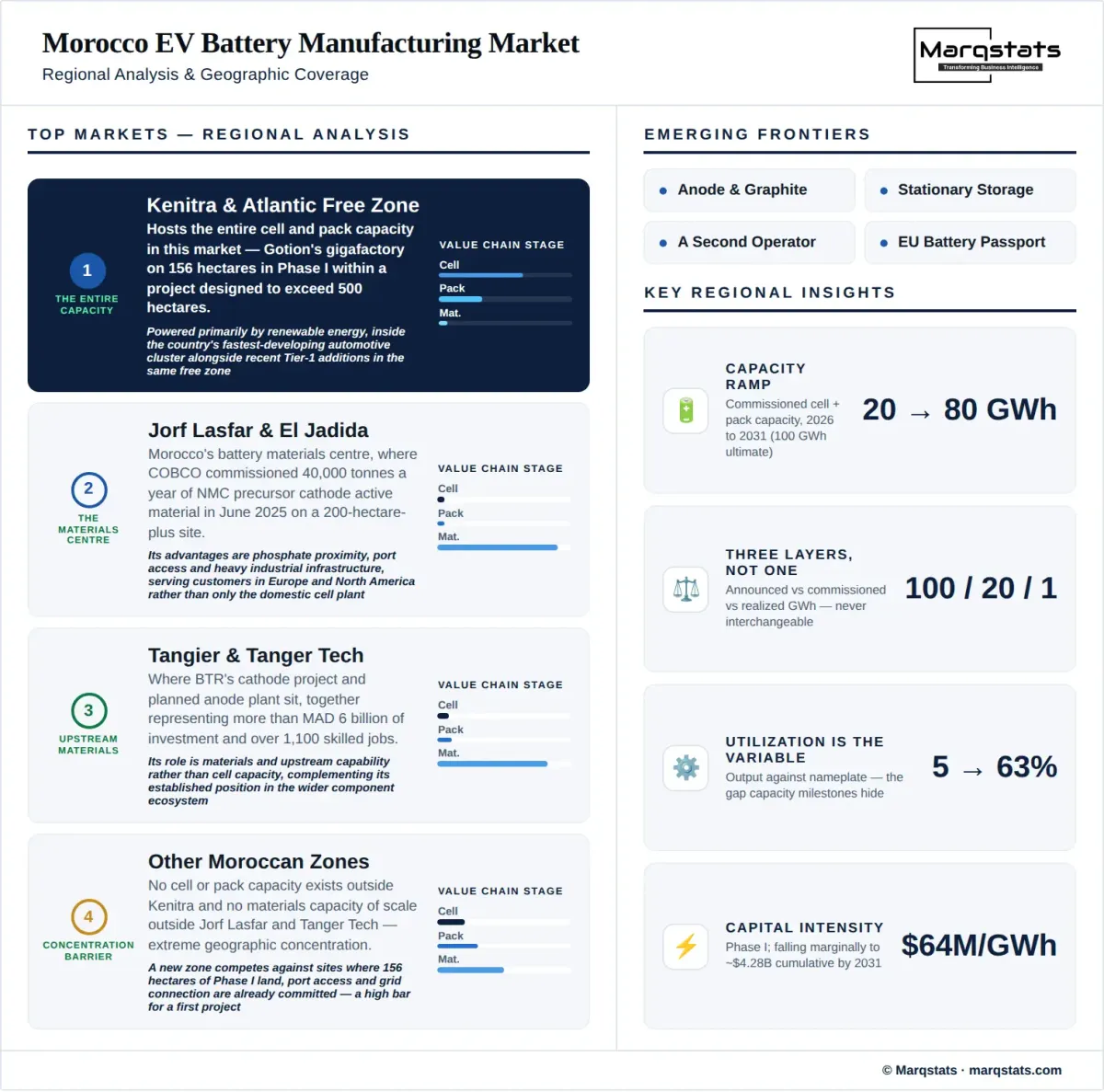
Kenitra and the Atlantic Free Zone
Kenitra hosts the entire cell and pack capacity in this market. The Gotion gigafactory occupies 156 hectares in Phase I within a project designed to exceed 500 hectares, sits in the Rabat-Salé-Kénitra free zone, and is described as powered primarily by renewable energy. Its location also places it inside the country's fastest-developing automotive cluster, alongside recent Tier-1 additions in the same Atlantic Free Zone.
Jorf Lasfar and the El Jadida Corridor
Jorf Lasfar is Morocco's battery materials centre, where COBCO commissioned 40,000 tonnes a year of NMC precursor cathode active material in June 2025 on a site of more than 200 hectares. The corridor's advantages are phosphate proximity, port access and heavy industrial infrastructure, and it serves customers in Europe and North America rather than only the domestic cell plant.
Tangier and Mohammed VI Tanger Tech
Mohammed VI Tanger Tech City is where BTR New Material Group's cathode project and planned anode plant sit, together representing more than MAD 6 billion of investment and over 1,100 skilled jobs. Tangier's role in this market is materials and upstream capability rather than cell capacity, complementing its established position in the wider component ecosystem.
Other Moroccan Industrial Zones
No cell or pack capacity exists outside Kenitra and no materials capacity of scale outside Jorf Lasfar and Tanger Tech, so the market is geographically concentrated in a way few national markets are. Any zone seeking battery investment competes against sites where 156 hectares of Phase I land, port access and grid connection are already committed, which is a high bar for a first project.
How Competition Is Evolving
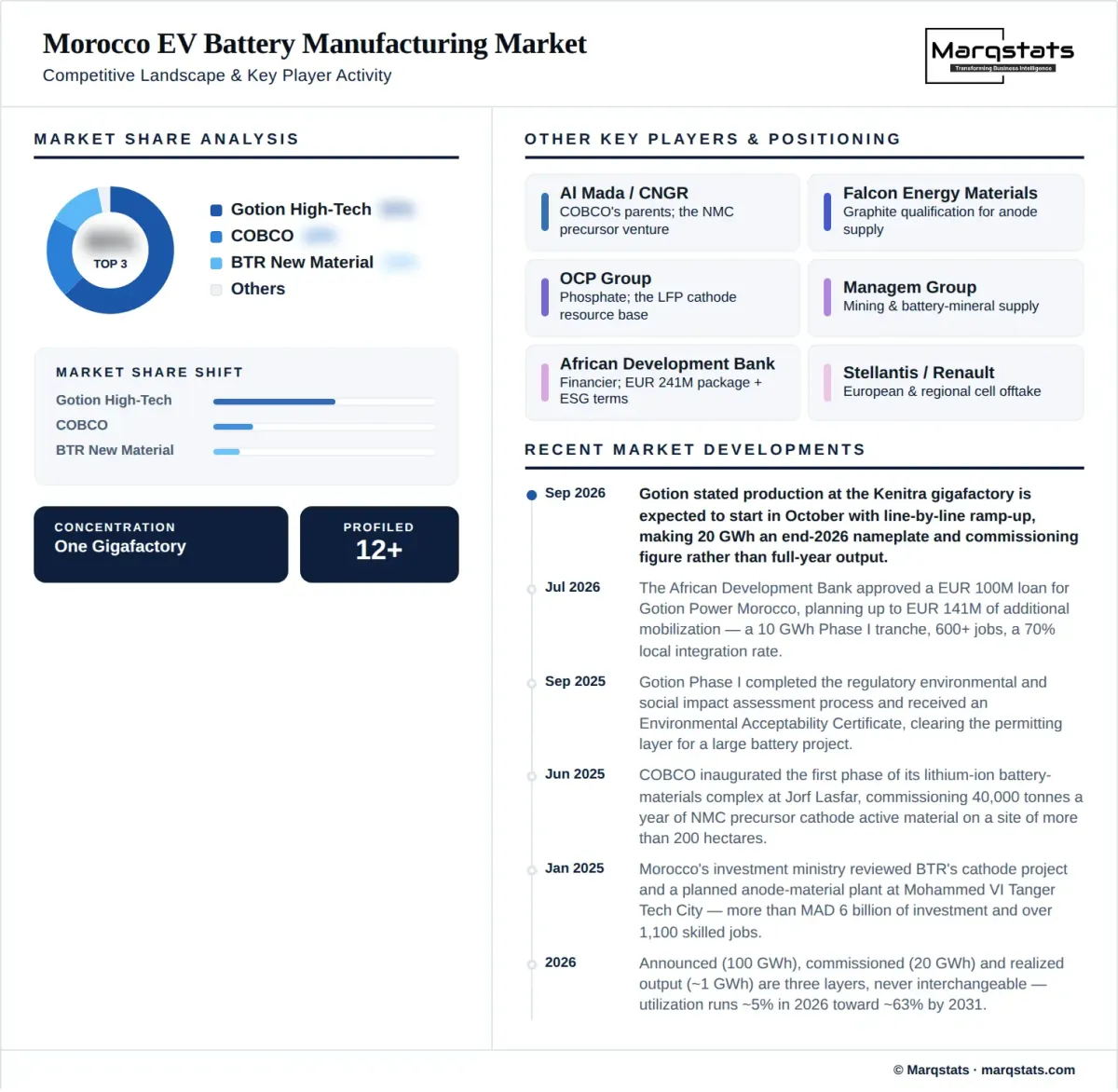
This is a single-operator market at the cell stage. Gotion Power Morocco is the only large cell capacity moving into production, and its 20 GWh of end-2026 nameplate constitutes the entire national figure. No share table is published or estimated, because a market with one producer does not have shares in any useful sense.
Competition is more meaningful one stage upstream. COBCO, the Al Mada and CNGR venture, operates commissioned cathode precursor capacity at Jorf Lasfar serving Europe, North America and the wider region, while BTR New Material Group is building cathode and anode capacity at Mohammed VI Tanger Tech City and Falcon Energy Materials works on graphite qualification for anode supply. These are different chemistries serving different customers rather than direct rivals.
The competitive question that matters commercially is not who else makes cells in Morocco but whether the project achieves customer qualification. Automotive cell nomination requires sample approval, process validation and audit, and a plant without qualified customers has capacity rather than a business. The central diligence issue is the commissioning sequence, offtake, utilization and export qualification of each line, not the announced 100 GWh headline.
Materials-to-cell integration is the strategic differentiator and also the principal execution risk. Pairing 20 GWh with 100,000 tonnes of materials reduces logistics and tariff exposure, but it also means a materials delay becomes a cell delay. Power cost, renewable-energy sourcing and European compliance are the constraints most likely to determine whether the integrated model outperforms importing cells.
Downstream, Morocco's established vehicle manufacturers and export ecosystem provide the offtake and logistics platform rather than the competition. An assembly base of one million vehicles a year of installed capacity and more than 260 suppliers is the reason a cell plant located here can reach European programmes efficiently, and it is the asset no greenfield battery location elsewhere in Africa can replicate quickly.
Companies Covered
The report profiles 12+ companies with full strategy and financials analysis, including:
Recent Market Activity
Table of Contents
Coverage & Segmentation
The study covers Morocco with a 2026 base year and forecasts to 2031, with historical analysis from 2021 to 2025 during which operating cell and pack capacity was zero throughout. The base year is 2026 rather than 2025 because a compound growth rate cannot be calculated from a zero base. The quantified measure is commissioned cell and pack manufacturing capacity in megawatt-hours, with cumulative committed capital investment carried as the value reference.
Coverage spans battery cells, packs and integrated cell-to-pack lines; lithium iron phosphate and other lithium-ion chemistries; passenger, commercial and stationary storage applications; and the cathode, anode, cell and pack stages of the value chain. Cathode and anode precursor production is excluded from the capacity measure and tracked separately in tonnes, and announced capacity, commissioned capacity and realized output are maintained as three distinct layers.
The analysis addresses investment appraisal, offtake assessment, supplier adjacency and policy tracking. Stakeholder questions include why two primary sources describe Phase I at 20 GWh and 10 GWh, how far realized output lags commissioned capacity through the ramp, what capital intensity per GWh a competing project should benchmark against, and which European compliance requirements apply to the product rather than to the producer.