Market Snapshot
Key Takeaways
Market Overview & Analysis
Report Summary
Algeria is rebuilding a vehicle manufacturing industry from a near standstill, and it is doing so while its domestic market moves violently. Sales fell 42.76% in 2025 and are recovering in 2026, production rose more than threefold at a single plant over the same period, and the policy framework shifted from counting assembled units to measuring local value added. Those three movements are not synchronised, and the gaps between them are where the risk sits.
The market is measured here as annual vehicles domestically manufactured or assembled in Algeria, spanning passenger cars, light commercial vehicles, heavy trucks and buses. It counts output rather than announced nameplate capacity, and projects are included only where land, construction, tooling or start of production milestones support an operating assumption rather than an intention.
The analysis is written for component suppliers assessing localisation opportunities under the integration framework, manufacturers evaluating plant feasibility, investors screening supplier-network exposure rather than vehicle assembly, and policy and development institutions tracking industrial value addition. It stress-tests utilisation rather than accepting capacity, because the difference between the two is this market's principal variable.
Algeria Automotive Manufacturing Market Size and Forecast
National production is estimated at approximately 56,000 vehicles in 2025, rising to about 100,000 in 2026 and 260,000 by 2031. The 2025 figure is built upward from the 53,000 vehicles Stellantis reported at Tafraoui, with a modest allowance for smaller and returning commercial vehicle assembly programmes rather than treating one plant as the entire country.
Two growth rates apply and both are published. The six-year rate connecting 2025 and 2031 is 29.16%. The five-year rate connecting 2026 and 2031 is 21.06%, and the 8.10-point gap exists because 2026 itself carries a step of roughly 44,000 units driven almost entirely by Tafraoui moving from 53,000 toward its 90,000-vehicle target.
The 2026 estimate adds cautious contributions from MAN, JAC with Emin Auto, Tirsam with SINOTRUK and other projects to the Stellantis target, and deliberately does not assume announced capacities run at full utilisation. On that basis Stellantis would account for approximately 90% of national output in 2026, which is a concentration risk rather than a forecast strength.
The 2031 estimate assumes several currently announced passenger and commercial vehicle projects reach commercial scale. It is a scenario rather than a capacity sum, and plant utilisation together with local integration compliance remain the main uncertainties. Announced nameplate capacity across the visible pipeline already exceeds the 2031 figure, which is why the forecast is capped below it.
Ex-works production value moves from approximately USD 784 million to USD 4,160 million across the forecast, on a per-vehicle convention rising from about USD 14,000 to USD 16,000. Value therefore compounds at 32.07% against 29.16% for units, because the mix shifts toward heavy commercial vehicles and because deeper local integration raises the value added at the factory gate.
Production Is Outrunning the Domestic Market
Algeria sold 102,651 vehicles in 2025 after 179,332 in 2024, a contraction of 42.76%, and year-to-date sales through July 2026 reached 70,031 units, up 22.3% year on year. Annualising that run rate suggests roughly 120,000 units for the full year, which is a strong recovery and still a third below 2024.
Set against production, the ratios move faster than either series alone. Domestic output covered approximately 9.48% of national sales in 2024, 54.55% in 2025 and an estimated 83.30% in 2026. A country that imported nine vehicles in ten two years ago will build roughly four in five within another year.
That conversion is the achievement and the exposure simultaneously. Import substitution of this speed removes the foreign exchange and licensing constraints that suppressed supply, but it also transfers the entire demand risk onto domestic plants. A market that fell 42.76% in one year is now the sole outlet for capacity being built to serve it.
The arithmetic becomes uncomfortable at the plant level. Stellantis targets 135,000 vehicles a year at Tafraoui by 2028, which is 131.51% of everything Algeria sold in 2025 and would absorb most of a recovered market on its own. Every other project in the pipeline is competing for demand above that line.
The Export Question the Pipeline Depends On
Export access is the obvious answer to a capacity pipeline larger than the domestic market, and it is not yet confirmed by the operator that matters most. Stellantis management has described the Algerian operation as serving Algerian demand, stating that the group sells in Algeria what it produces in Algeria and that the industrial ecosystem is not in competition with the European one.
That framing is about Europe rather than about Africa, and African export ambitions remain an available lever rather than a demonstrated one. Continental market access could materially improve scale economics for a 260,000-unit industry, but certification, homologation, logistics and aftersales obligations apply to every destination and none of them has yet been demonstrated from an Algerian plant.
The practical consequence for a feasibility model is that exports should be modelled as an upside case rather than as a base case. A plant sized on domestic demand can add export volume later; a plant sized on export assumptions that do not materialise carries fixed cost against a market that fell 42.76% within living memory of its own investment committee.
Tafraoui and the Concentration Problem
The Fiat plant at Tafraoui opened in December 2023 and has scaled faster than any comparable project in the region. Output moved from 17,000 vehicles in 2024 to 53,000 in 2025, an increase of 211.76%, with new stamping and paint lines becoming operational in September 2025 and a further expansion announced on 7 April 2026 covering stamping, assembly and a new paint shop.
The expansion carries more than 1,000 new direct and indirect jobs and an agreement with an Algerian company for multiple stamping parts, which is the first visible movement from assembly toward domestic component manufacture at the site. Three models are in production, with the Grande Panda joining the Doblò through a complete knock-down programme that deepens local integration rather than adding a badge.
The concentration this creates is the market's defining structural feature. One plant was 94.64% of national production in 2025 and would be approximately 90% in 2026, which means Algeria's manufacturing statistics are effectively a single company's operating report until the commercial vehicle pipeline reaches scale.
For a supplier the implication is direct rather than abstract. Qualifying with one customer currently means access to almost the whole market, which is unusually efficient, and losing that customer means losing almost the whole market, which is unusually dangerous. Supplier strategy in Algeria is therefore a concentration decision before it is a capability decision.
The Commercial Vehicle Pipeline
MAN Truck and Bus restarted complete knock-down production with Maghreb Truck Company at the Blida plant in July 2026, with two lines capable of assembling up to eight vehicles per day and a stated medium-term target of around 1,500 locally assembled vehicles annually. That is a deliberately modest ramp against a theoretical capacity near 2,000 units on a 250-day year.
Tirsam Group and SINOTRUK launched a heavy truck welding line project at Tirsam's Batna plant in August 2026, alongside an announcement that local production had reached a milestone of 3,000 heavy trucks. A welding line moves the operation from assembly toward localised body and structural processes, which is precisely the value addition the integration framework is designed to reward.
Batna authorities reported progress in April 2026 on the Sokon Algeria vehicle plant, designed to assemble cars, trucks and buses across three production lines with full planned capacity reported at about 60,000 vehicles annually and more than 450 permanent plus around 900 temporary jobs expected. It is the largest single addition to the pipeline after Tafraoui.
Stellantis and Opel advanced plans in July 2026 for a full-scale vehicle and engine manufacturing plant, which would broaden the passenger vehicle pipeline and create engine-level component demand. Announced projects of this kind must be tracked by land, construction, tooling and start of production milestones before being counted as output, and none of that sequence is complete.
Local Integration and the New Reference Framework
Executive Decree 22-384 of 17 November 2022 governs the conditions and modalities for vehicle manufacturing activity and sets the integration schedule the industry is being built against: minimum local integration of 10% at the end of year two, 20% at the end of year three and 30% at the end of year five from accreditation, with a preferential tax regime for eligible inputs and components.
In February 2026 the Prime Minister installed a multisectoral group to create a national integration reference framework used to calculate achieved localisation rates and determine access to preferential benefits. That is the decisive administrative development in this market, because a percentage requirement without an agreed measurement method is unenforceable in either direction.
Industrial policy has therefore moved toward measurable local value addition and a national supplier network rather than assembly volume alone. A manufacturer can no longer satisfy the framework by increasing units; it must document component origin, and a supplier can no longer win on price alone without the documentation that makes its content count.
The commercial consequence falls on suppliers more heavily than on manufacturers. Qualification, traceability and documentation become revenue-determining rather than administrative, and a component that cannot be evidenced as locally integrated is worth less to a manufacturer than one that can, regardless of its price or quality.
Why Utilisation Rather Than Capacity Is the Variable
Announced nameplate capacity across the visible pipeline already exceeds the 260,000-unit 2031 estimate, which is why the forecast is capped below it. Tafraoui at 135,000 by 2028, Sokon at approximately 60,000, SNVI and Tirsam heavy vehicle activity, MAN at around 1,500 and further announced projects sum beyond a market that has never exceeded 179,332 units in recent years.
A plant feasibility model in Algeria should therefore stress-test utilisation, import kit availability, foreign exchange and customs exposure, local supplier qualification and actual demand after a 2023 to 2026 sales cycle that included a 42.76% single-year contraction. Each of those is capable of holding a plant below capacity independently of the others.
Production should not be forecast from historical retail demand alone either, because the relationship between the two has inverted within three years. Demand no longer determines supply in this market; licensing, kit availability and plant commissioning do, and a demand-driven production forecast would have missed the 211.76% increase at Tafraoui entirely.
Where the Investable Opportunity Actually Sits
The investable opportunity is supplier localisation around operating plants rather than announced vehicle nameplate capacity. A plant that reaches 90,000 units in 2026 creates immediate, documented, framework-relevant demand for stampings, trim, wiring, glass, seats and fasteners, and the first Algerian stamping agreement at Tafraoui demonstrates the entry point is already open.
That opportunity is also better shaped than vehicle assembly for most investors. Supplier capability qualifies once and serves every subsequent programme at the same plant, and under the integration framework it becomes more valuable as the required percentage rises from 10% to 20% to 30% rather than less.
The risk is the mirror image of the concentration that creates the opportunity. A supplier qualified to a single plant carries that plant's utilisation risk in full, and with one manufacturer accounting for roughly 90% of 2026 national output there is currently no diversification available inside the country.
Market Dynamics
Key Drivers
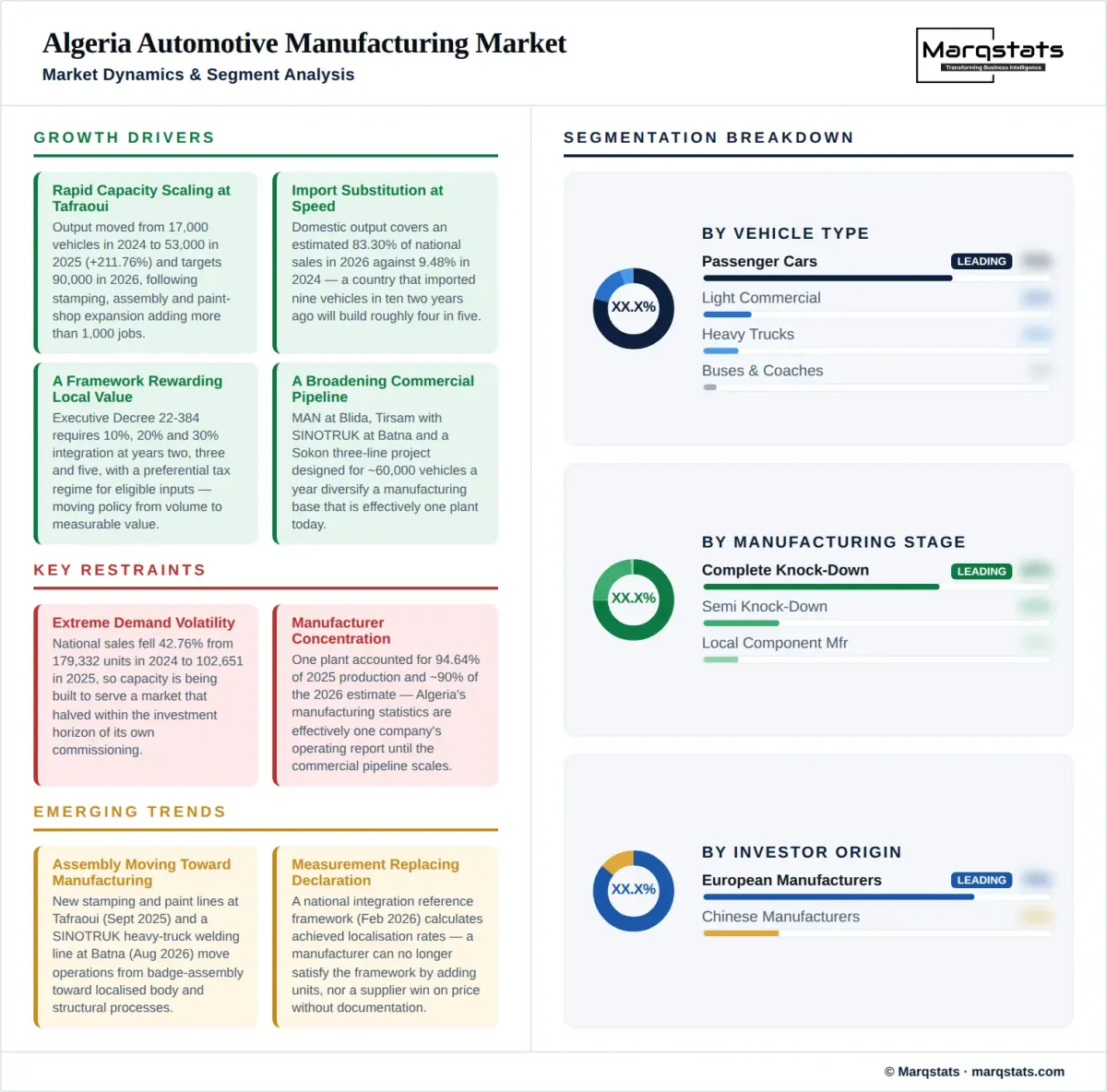
- Rapid capacity scaling at Tafraoui, from 17,000 vehicles in 2024 to 53,000 in 2025 and a 90,000-unit target for 2026 following stamping, assembly and paint shop expansion.
- Import substitution, with domestic output covering an estimated 83.30% of national sales in 2026 against 9.48% in 2024.
- A regulatory framework rewarding local value, with Executive Decree 22-384 requiring 10%, 20% and 30% integration at years two, three and five and a preferential tax regime for eligible inputs.
- A broadening commercial vehicle pipeline spanning MAN at Blida, Tirsam with SINOTRUK at Batna and a Sokon three-line project designed for approximately 60,000 vehicles annually.
- Market recovery, with year-to-date sales through July 2026 at 70,031 units, up 22.3%, annualising near 120,000.
Key Restraints
- Extreme demand volatility, with national sales falling 42.76% from 179,332 units in 2024 to 102,651 in 2025.
- Manufacturer concentration, with one plant accounting for 94.64% of 2025 production and approximately 90% of the 2026 estimate.
- Announced capacity exceeding plausible demand, with a single plant targeting 135,000 units by 2028 against total national sales of 102,651 in 2025.
- Unconfirmed export access, with Stellantis management describing the Algerian operation as serving Algerian demand rather than as an export base.
Key Trends
- Movement from assembly toward manufacturing, shown by new stamping and paint lines at Tafraoui from September 2025 and a SINOTRUK heavy truck welding line at Batna from August 2026.
- Measurement replacing declaration, with a national integration reference framework commissioned in February 2026 to calculate achieved localisation rates.
- Value per vehicle rising faster than units, at 32.07% against 29.16%, as the mix shifts toward heavy commercial vehicles and local content deepens.
- Domestic supplier agreements emerging, including an arrangement with an Algerian company for multiple stamping parts at Tafraoui.
Market Segmentation
The dominant category by volume, driven almost entirely by Tafraoui, where three models are in production including the Doblò and a Grande Panda complete knock-down programme, and where output reached 53,000 units in 2025. Passenger car manufacturing is where the 90,000-unit 2026 target and the 135,000-unit 2028 target both sit.
A category expanding through JAC with Emin Auto and through multi-line projects such as Sokon's Batna plant, which is designed for cars, trucks and buses across three lines at approximately 60,000 vehicles annually at full capacity. Light commercial output is currently a small share of the 56,000-unit national estimate.
The segment showing the clearest movement from assembly to manufacturing, with Tirsam Group announcing a local production milestone of 3,000 heavy trucks and launching a SINOTRUK welding line at Batna in August 2026. MAN's Blida restart targets around 1,500 locally assembled vehicles annually on two lines.
The smallest category in current output and part of the Sokon three-line design at Batna alongside cars and trucks. Bus manufacturing benefits disproportionately from the integration framework because body construction is labour intensive and locally performable, which raises achievable content against the 30% year-five threshold.
The entry stage for most projects and the basis of MAN's July 2026 Blida restart, running two lines at up to eight vehicles per day. It satisfies the earliest integration milestone of 10% at the end of year two but cannot on its own reach the 30% required by year five.
An intermediate stage carrying more pre-assembled modules and less local operation, used where volumes do not yet justify full knock-down tooling. It is the least favoured stage under a framework that measures achieved local value rather than units, and the February 2026 reference framework makes that disadvantage explicit and calculable.
The stage that converts an assembly operation into a manufacturing one, demonstrated by Tafraoui's stamping lines operational from September 2025 and expanded in the 7 April 2026 announcement, and by the SINOTRUK heavy truck welding line at Batna from August 2026. Stamping generates the largest single step in documented local content.
Capital intensive and rarely localised early, which is why the new paint shop in Tafraoui's April 2026 expansion is a significant marker rather than a routine upgrade. Paint capacity is typically the binding physical constraint on a plant scaling from 53,000 toward 135,000 vehicles a year.
The scaled position, held by Stellantis through Tafraoui at 53,000 units in 2025 and by MAN through the Blida restart at around 1,500 vehicles annually, with an Opel full-scale vehicle and engine plant advanced in July 2026. European investors account for the overwhelming majority of current output.
The pipeline position rather than the operating one, spanning Sokon's approximately 60,000-vehicle three-line Batna project, JAC with Emin Auto and SINOTRUK's welding line partnership with Tirsam. Chinese projects are concentrated in commercial and multi-segment manufacturing rather than in passenger cars.
Domestic partners carrying the local side of most joint arrangements, including Tirsam Group with its 3,000 heavy truck milestone, Maghreb Truck Company with MAN and the Algerian company contracted for multiple stamping parts at Tafraoui. Their role grows mechanically as the integration requirement rises from 10% to 30%.
Projects in their first accreditation years, which must reach 10% local integration by the end of year two under Executive Decree 22-384. New entrants including the most recently announced Batna and Blida programmes sit here, and the February 2026 reference framework determines how their content will be counted.
The band where a manufacturer must move from imported kits toward domestically produced components to satisfy the 20% threshold at the end of year three. It is where supplier qualification demand is most intense, because the gap must be closed with documented parts rather than with additional volume.
The mature band required by the end of year five, reachable only through stamping, body manufacturing and substantial component sourcing of the kind Tafraoui began with its Algerian stamping parts agreement. Reaching 30% is what converts a preferential tax position from temporary to durable.
Facilities producing vehicles today, dominated by Tafraoui at 53,000 units in 2025 and including Tirsam's heavy truck operation with its 3,000-unit milestone and MAN's Blida lines from July 2026. These account for essentially all of the 56,000-unit national estimate.
Projects with land, construction or tooling milestones demonstrably in progress, including the Sokon Batna plant reported by provincial authorities in April 2026 at approximately 60,000 vehicles of planned capacity. These contribute to the 2031 scenario but not to current output.
Intentions without completed milestones, including the Stellantis and Opel full-scale vehicle and engine plant advanced in July 2026. They are excluded from production estimates entirely, because announced capacity in this market has historically exceeded delivered capacity by a wide margin.
By Geography
Oran and the Western Industrial Zone
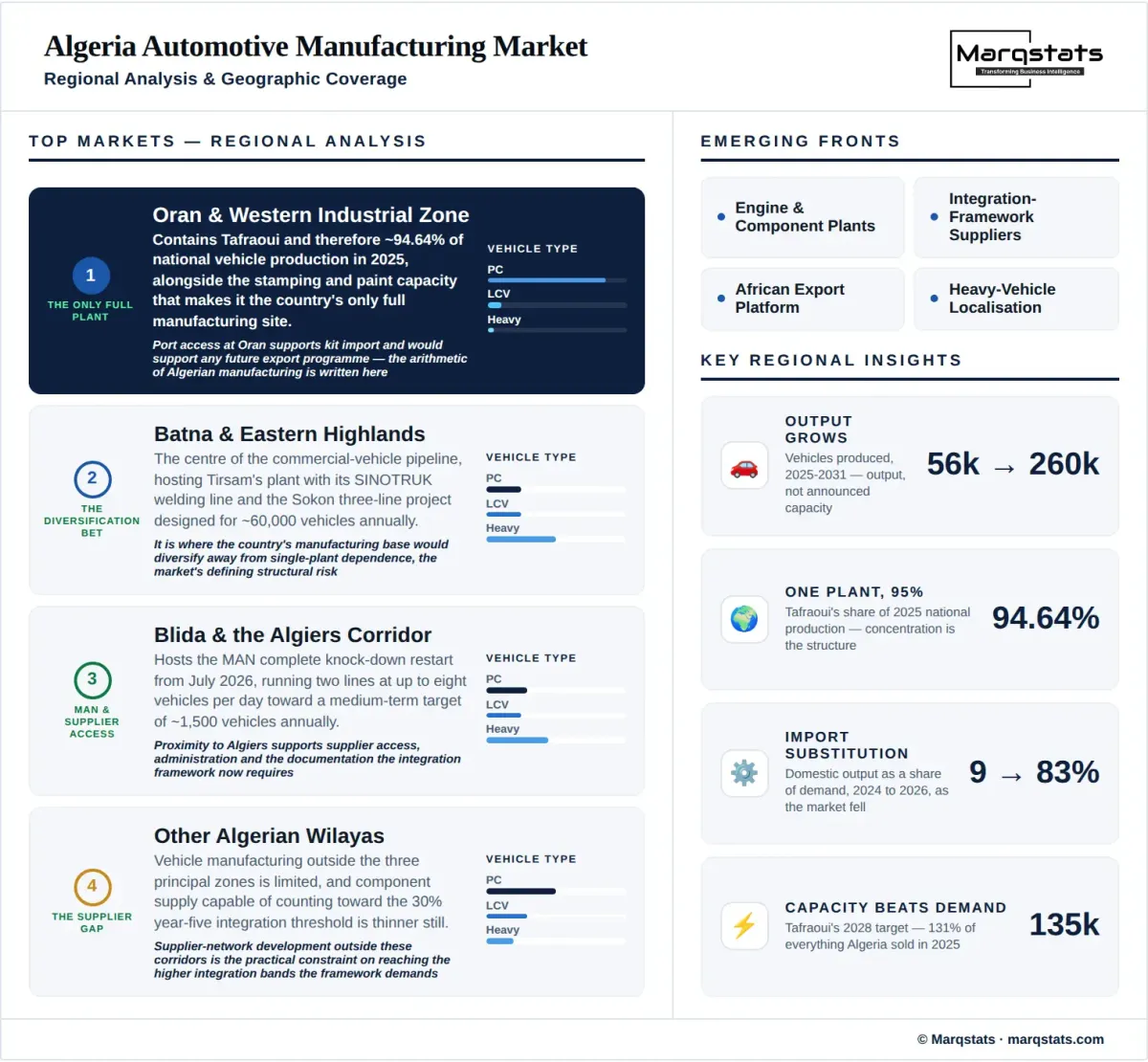
Oran contains Tafraoui and therefore approximately 94.64% of national vehicle production in 2025, alongside the stamping and paint capacity that makes it the country's only full manufacturing site. Port access at Oran supports kit import and would support any future export programme.
Batna and the Eastern Highlands
Batna is the centre of the commercial vehicle pipeline, hosting Tirsam's plant with its SINOTRUK welding line from August 2026 and the Sokon three-line project designed for approximately 60,000 vehicles annually. It is where the country's manufacturing base would diversify away from single-plant dependence.
Blida and the Algiers Corridor
Blida hosts the MAN complete knock-down restart from July 2026, running two lines at up to eight vehicles per day toward a medium-term target of around 1,500 vehicles annually. Proximity to Algiers supports supplier access, administration and the documentation the integration framework now requires.
Other Algerian Wilayas
Vehicle manufacturing outside the three principal zones is limited, and component supply capable of counting toward the 30% year-five integration threshold is thinner still. Supplier network development outside these corridors is the practical constraint on reaching the higher integration bands.
How Competition Is Evolving
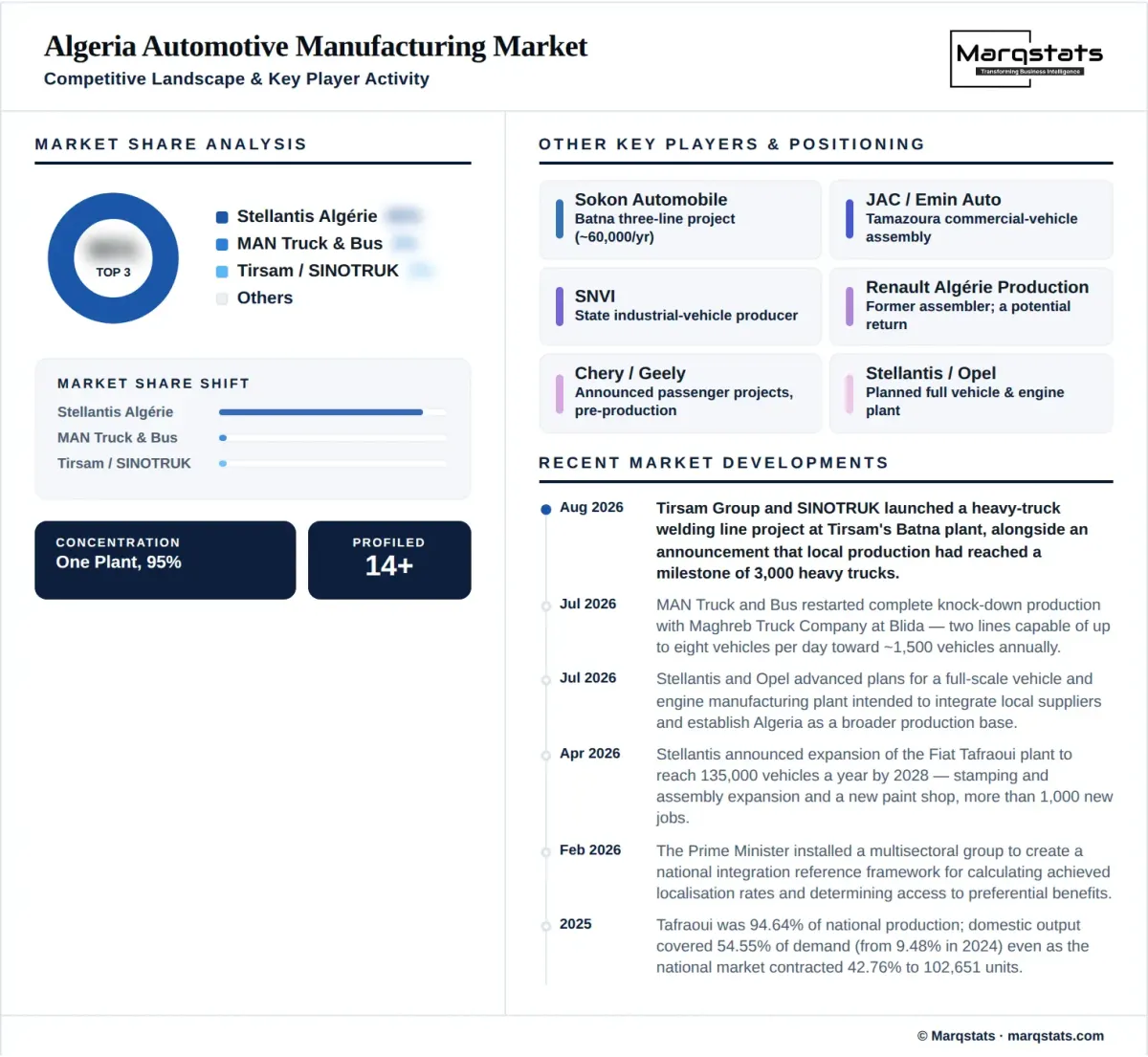
Algeria's vehicle manufacturing sector is the most concentrated in this research programme. Stellantis produced 53,000 of an estimated 56,000 national vehicles in 2025, or 94.64%, and would account for approximately 90% of the roughly 100,000-unit 2026 estimate. National production statistics are effectively one company's operating report.
The competitive question is therefore not market share but pipeline conversion. Sokon's approximately 60,000-vehicle Batna design, the Opel full-scale vehicle and engine plan, JAC with Emin Auto and Tirsam with SINOTRUK all represent potential challenges to that concentration, and each depends on land, construction, tooling and start of production milestones rather than on competitive positioning.
European and Chinese investors have taken different routes into the same market. European manufacturers hold the operating passenger car and heavy truck positions through Stellantis and MAN; Chinese groups hold the largest additions to the pipeline through Sokon, JAC and SINOTRUK, concentrated in commercial and multi-segment manufacturing.
Algerian industrial groups occupy a position that strengthens automatically as policy advances. Tirsam, Maghreb Truck Company and the stamping supplier contracted at Tafraoui become more valuable to their partners as the integration requirement rises from 10% toward 30%, because their content is what counts toward it.
For an investor, the decisive question is whether exposure is to a plant or to the framework. Vehicle assembly exposure is concentrated, utilisation-sensitive and dependent on a market that fell 42.76% in one year. Supplier exposure under the integration framework is qualified once, applies across programmes and becomes more valuable as the required percentage rises.
Companies Covered
The report profiles 14+ companies with full strategy and financials analysis, including:
Recent Market Activity
Table of Contents
Coverage & Segmentation
This study measures annual vehicles domestically manufactured or assembled in Algeria from 2021 to 2031, with 2025 as the base year and 2026 to 2031 as the forecast period, spanning passenger cars, light commercial vehicles, heavy trucks and buses. It counts output rather than announced nameplate capacity, and includes projects only where land, construction, tooling or start of production milestones support an operating assumption.
Coverage spans four vehicle types, four manufacturing stages, three investor origins, three local integration bands and three project statuses, alongside four regional clusters analysed on plant location, port access and supplier density rather than quantified share. Ex-works production value is carried as a reference series in USD on a disclosed per-vehicle convention. Fourteen entities are profiled across manufacturers, joint venture partners and Algerian industrial groups.