Market Snapshot
Key Takeaways
Market Overview & Analysis
Report Summary
The Egypt automotive manufacturing and localization market covers vehicles assembled or manufactured within Egypt for domestic sale and for export. The measure uses locally assembled vehicle sales as its primary quantity, because published plant-by-plant production is incomplete across the manufacturer base, and cross-checks that figure against reported production, installed plant capacity and disclosed localization rates. Completely built-up imports are excluded entirely, which is the boundary that separates manufacturing from the wider vehicle market.
Egypt's manufacturing base is substantial by regional standards and shallow by industrial ones. The Automotive Information Council records 99,598 locally assembled units in 2025, a volume that exceeds any Gulf state's vehicle production, but most of that output is completed-knocked-down assembly in which the majority of component value arrives imported. The Automotive Industry Development Programme sets targeted local industrial content rising from at least 20% toward 35%, and local value addition of 60%, which is an explicit acknowledgement that current depth sits well below the ambition.
The market therefore has two distinct quantities that are easily conflated and should not be. Vehicle output measures how many units leave Egyptian plants, and it is growing. Manufacturing depth measures how much of each vehicle's value is created in Egypt, and it is the variable the policy framework actually targets. A plant that doubles its assembly volume without raising local content has increased the first quantity and left the second unchanged, which is precisely the outcome the August 2026 industrial strategy is designed to prevent.
Vehicles Manufactured and Assembled in Egypt
Annual locally manufactured vehicle output rises from 99,600 units in 2025 to 206,000 in 2030, a 15.64% compound annual growth rate and an absolute increase of 106,400 units. The indicative 2031 endpoint is approximately 235,000 vehicles, consistent with the Ministry of Industry's stated intention to double production within five years. The 2026 estimate of roughly 122,000 units is anchored on observed data rather than projected, since Egypt recorded 98,829 total vehicle sales in the first half of 2026 alone, an annualised pace some 14% above the 2025 full-year figure.
Manufacturing output value grows from USD 1,543.80 million to USD 3,605.00 million across the same period, a 18.48% compound annual growth rate. That series applies an ex-factory value per vehicle rising from approximately USD 15,500 to USD 17,500, reflecting a mix shift toward larger bodies and electrified programmes rather than price inflation alone. The value series compounds faster than the unit series because both quantity and unit value increase, which is the opposite of the pattern in mature assembly markets where volume growth typically comes with price erosion.
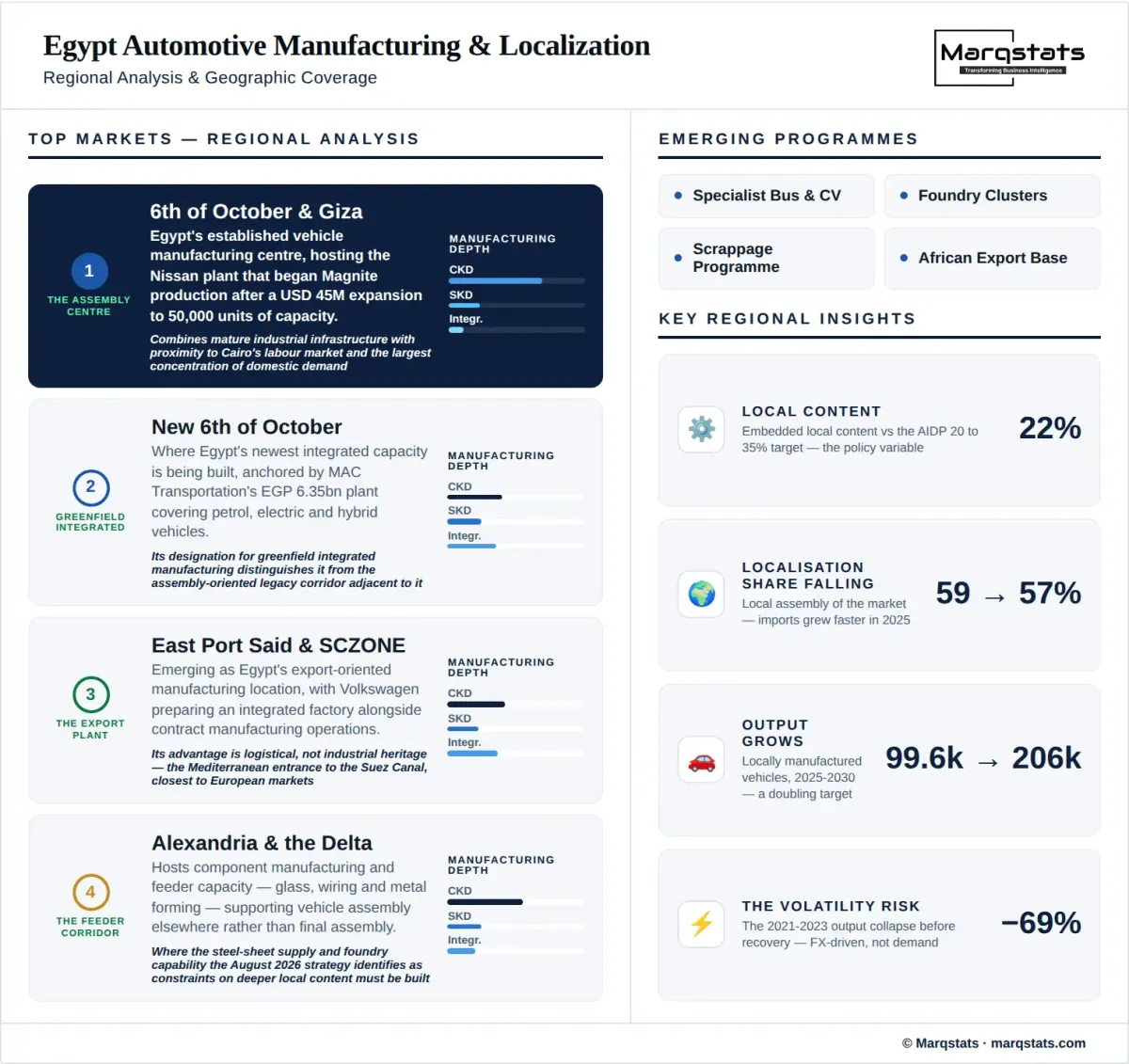
Output value is the correct denominator for assessing localization progress, and the arithmetic reconciles closely with the policy target. Component value embedded locally in Egypt-assembled vehicles is estimated at roughly USD 340 million in 2025, which is 22.0% of the USD 1,543.80 million output value. The Automotive Industry Development Programme requires targeted local industrial content of at least 20% rising toward 35%, so Egypt currently sits just inside the entry threshold with the substantive work still ahead.
Historical volatility is the other feature a forecast has to absorb. The model-level series records 290,846 vehicles in 2021, 184,771 in 2022, 90,359 in 2023, 102,249 in 2024 and 173,731 in 2025, a swing in which the market lost roughly 69% of its volume across two years and then recovered most of it across the following two. That pattern reflects foreign exchange availability and import financing rather than underlying demand, and it means a five-year forecast built on a single base year carries more risk in Egypt than in a market with steadier supply conditions.
Market Dynamics
Key Drivers
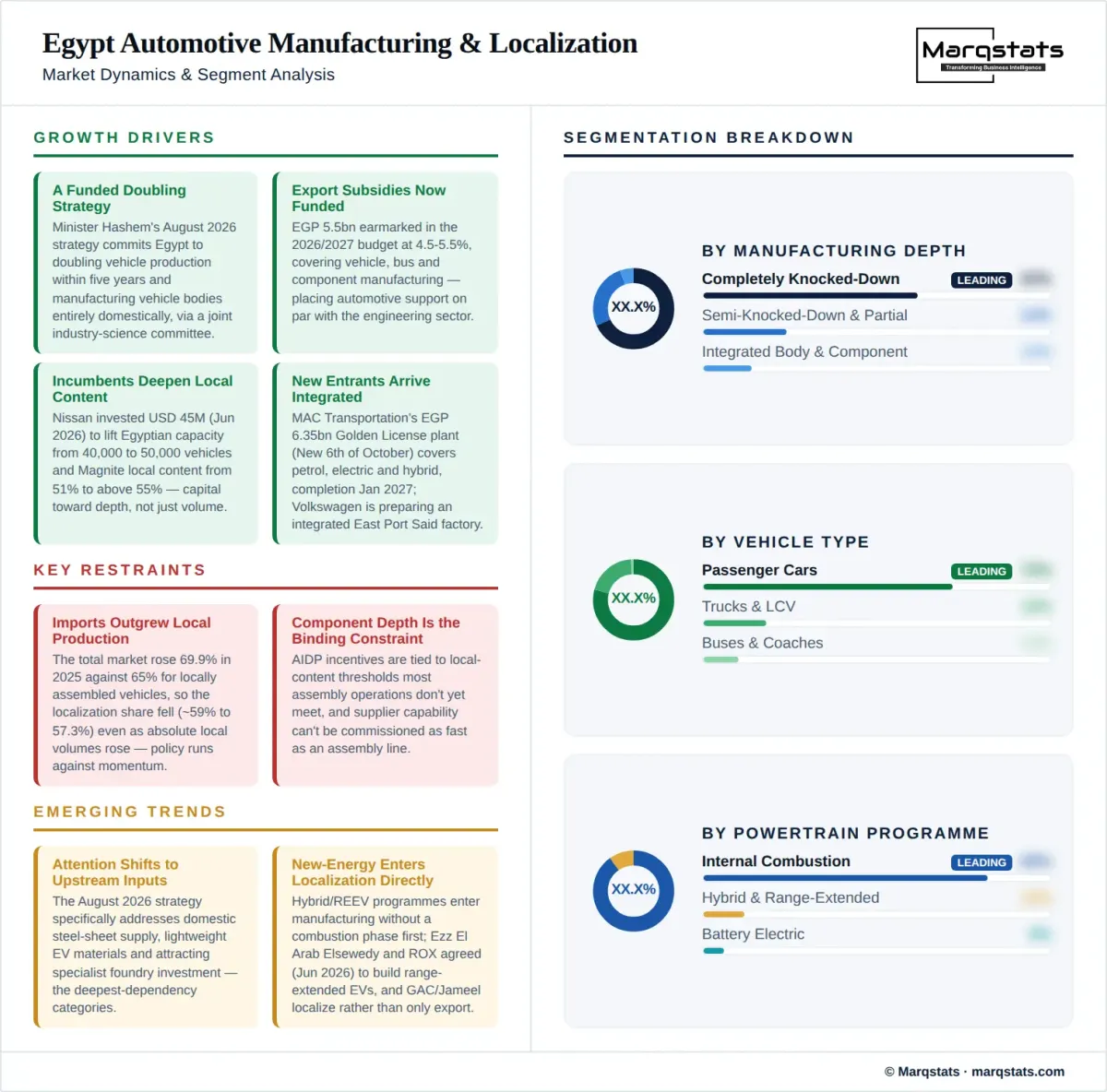
- The August 2026 industrial strategy set out by Minister of Industry Khaled Hashem commits Egypt to doubling vehicle production within five years and to manufacturing vehicle bodies entirely domestically, supported by a joint committee spanning the Ministry of Industry, the Presidential Advisory Council of Egyptian Scientists and vehicle manufacturers.
- Export subsidies are now funded rather than proposed, with EGP 5.5 billion earmarked in the 2026/2027 budget at rates of 4.5 to 5.5% covering vehicle manufacturing, bus production and component manufacturing, placing automotive support on par with the engineering sector.
- Established manufacturers are committing capital to deeper local content, with Nissan investing USD 45 million to lift Egyptian capacity from 40,000 to 50,000 vehicles and Magnite local content from 51% to above 55% in June 2026.
- New entrants are arriving with integrated rather than assembly-only propositions, including MAC Transportation's EGP 6.35 billion Golden License plant in New 6th of October City covering petrol, electric and hybrid passenger vehicles with completion targeted for January 2027.
- Egypt's free-trade access, labour cost base and proximity to European and African markets support export-oriented economics, and Volkswagen Group is preparing contract manufacturing alongside an integrated factory at East Port Said.
Key Restraints
- Imports outgrew local production in 2025, with the total market rising 69.9% against 65% for locally assembled vehicles, so the localization share declined even as absolute local volumes rose sharply. The policy framework is working against momentum rather than with it.
- Component depth remains the binding constraint, since Automotive Industry Development Programme incentives are tied to local industrial content thresholds that most assembly operations do not yet meet, and supplier capability cannot be commissioned as quickly as an assembly line.
- Foreign exchange availability, customs lead times and import financing continue to affect component supply chains, and an assembly operation dependent on imported kits carries currency exposure on the majority of each vehicle's value.
- Programme qualification thresholds are demanding for smaller entrants, requiring at least 10,000 units annually and 5,000 per model for conventional vehicles, which effectively restricts full incentive capture to manufacturers operating at genuine scale.
Key Trends
- Policy attention is shifting from vehicle assembly toward upstream inputs, with the August 2026 strategy specifically addressing domestic steel sheet supply, lightweight materials for electric vehicles and attracting specialist foundry investment.
- New-energy programmes are entering the localization pipeline directly rather than following combustion, as shown by the June 2026 agreement between Ezz El Arab Elsewedy Investment Group and ROX Motor to produce range-extended electric vehicles at existing Egyptian facilities.
- Chinese manufacturers are localizing rather than only exporting, with GAC Group and Jameel Motors signing a technology-cooperation agreement in August 2026 to localize entry-level SUV production and use Egypt as a regional base serving Africa.
- Compliance pathways widened during 2026 when Egypt admitted FMVSS-compliant United States vehicles, changing the competitive balance between imported and locally produced product in segments where American specification models compete.
Market Segmentation
Passenger cars dominate Egyptian vehicle manufacturing and the wider market, accounting for 133,973 of the 173,763 units sold in 2025. Local assembly concentrates here because volumes support the Automotive Industry Development Programme's 5,000-unit-per-model threshold more readily than commercial segments do. The Nissan Magnite programme, at above 55% local content, represents the current depth benchmark for the segment.
Buses accounted for 11,343 units in 2025 and represent Egypt's most established deep-manufacturing capability, with domestic producers building complete bodies rather than assembling imported kits. Bus manufacturing is explicitly named within the EGP 5.5 billion export subsidy programme alongside vehicle and component production, reflecting an existing export position that passenger car manufacturing has yet to establish.
Trucks accounted for 28,447 units in 2025, and the segment combines local assembly of light commercial platforms with substantial imported completely built-up supply in heavier classes. MAC Transportation's Golden License plant explicitly covers light transport vehicles alongside passenger cars, indicating that new integrated capacity is being designed to serve both segments from shared tooling.
Completely knocked-down assembly is the dominant mode and the one the policy framework is designed to move beyond. Vehicles arrive as component kits and are assembled locally, generating employment and some component demand while leaving the majority of each vehicle's value created abroad. At roughly 22% local industrial content across the base, most Egyptian assembly currently sits just above the Automotive Industry Development Programme's 20% entry threshold.
Semi-knocked-down operations import larger pre-assembled modules and perform less local work than full completely knocked-down assembly, so they generate lower local content per unit. The segment is contracting as a share because programme incentives are explicitly weighted toward local industrial content, making the mode progressively less economic as thresholds rise toward 35%.
Integrated manufacturing covers body stamping, welding, painting and local component integration, and it is the destination the August 2026 strategy names explicitly in committing to manufacture vehicle bodies entirely in Egypt. The segment is small today and carries the highest value capture per vehicle, which is why upstream steel sheet supply and foundry investment feature in the strategy alongside vehicle plants themselves.
Internal combustion programmes account for the overwhelming majority of the roughly 99,600 vehicles manufactured in Egypt in 2025 and carry the Automotive Industry Development Programme's stricter qualification thresholds of 10,000 units annually and 5,000 per model. The segment grows in absolute terms across the forecast while declining as a share as electrified programmes commission.
Hybrid and range-extended programmes are entering Egyptian manufacturing directly rather than after a combustion phase, with the June 2026 Ezz El Arab Elsewedy and ROX Motor agreement establishing range-extended electric vehicle production at existing facilities. MAC Transportation's plant covers hybrid alongside petrol and electric passenger vehicles, indicating that new capacity is being specified for mixed powertrain output from commissioning.
Battery electric programmes benefit from materially lower qualification thresholds, with Automotive Industry Development Programme participation starting from 1,000 units and expected to rise toward 7,000 by the end of the programme period, against 10,000 for conventional vehicles. That gap is a deliberate policy instrument, lowering the scale barrier for electrified manufacturing entry while conventional programmes face the full threshold.
Domestic sale absorbs the majority of Egyptian vehicle output, with locally assembled units taking 57.3% of a 173,763-unit market in 2025. Domestic demand provides the volume base that makes programme qualification thresholds achievable, and the relationship runs both ways since local assembly has been credited with moderating vehicle price inflation relative to imported alternatives.
African export is the destination the policy framework most actively encourages, supported by EGP 5.5 billion in export subsidies at 4.5 to 5.5% and by Egypt's free-trade access across the continent. GAC Group's stated intention to use Egypt as a regional manufacturing base serving Africa illustrates the proposition, and Nissan's capacity expansion was reported with African export markets explicitly in view.
Regional and European export leverages Egypt's proximity advantage and its trade agreements with European markets, and it demands higher compliance and quality standards than African destinations. The EGP 5.5 billion export subsidy programme applies at 4.5 to 5.5% across all export destinations, so the incentive is neutral between African and European markets while the compliance cost is not. Volkswagen Group's planned integrated factory at East Port Said sits within the Suez Canal Economic Zone precisely because that location optimises for export logistics rather than domestic distribution.
By Geography
6th of October City and Giza
The 6th of October City industrial corridor is Egypt's established vehicle manufacturing centre and hosts the country's most significant assembly operations, including the Nissan plant that began Magnite production in June 2026 following a USD 45 million expansion to 50,000 units of annual capacity. The cluster combines mature industrial infrastructure with proximity to Cairo's labour market and to the largest concentration of domestic demand.
New 6th of October City and West Cairo
New 6th of October City is where Egypt's newest integrated capacity is being built, anchored by MAC Transportation's EGP 6.35 billion Golden License plant covering petrol, electric and hybrid passenger vehicles and light transport vehicles, with roughly 1,000 jobs and completion targeted for January 2027. The zone's designation for greenfield integrated manufacturing distinguishes it from the assembly-oriented legacy corridor adjacent to it.
East Port Said and the Suez Canal Economic Zone
East Port Said is emerging as Egypt's export-oriented manufacturing location, with Volkswagen Group preparing an integrated automotive factory there alongside contract manufacturing operations. The zone's advantage is logistical rather than industrial heritage, placing production at the Mediterranean entrance to the Suez Canal and therefore closest to European markets and to the shipping lanes that serve them.
Alexandria and the Delta Corridor
The Alexandria and Delta corridor hosts component manufacturing and feeder industry capacity that supports vehicle assembly elsewhere, including established operations in glass, wiring and metal forming. Its role in the localization architecture is upstream rather than final assembly, which matters because the August 2026 strategy identifies domestic steel sheet supply and foundry capability as the constraints on deeper local content.
Rest of Egypt
Manufacturing activity outside the principal corridors is limited and concentrated in specialist commercial vehicle and bus operations serving regional demand. The government's stated intention to attract specialist foundry investment creates the possibility of new upstream clusters, though these would serve the existing vehicle plants rather than establish independent manufacturing centres.
How Competition Is Evolving
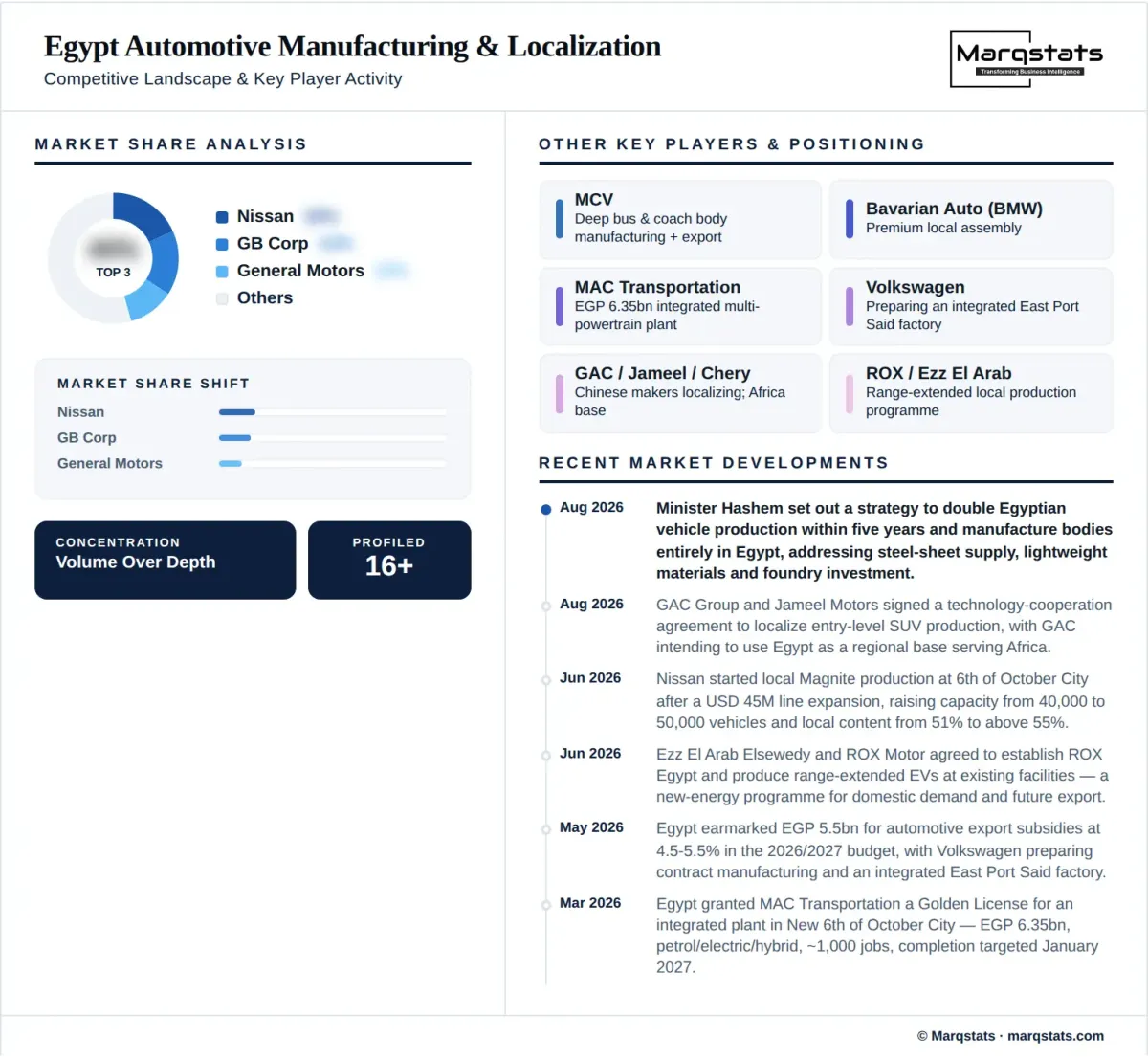
Egypt's vehicle manufacturing base is moderately concentrated among a small group of established assemblers and is opening rapidly to new entrants. Nissan operates the most visible programme following its June 2026 capacity expansion to 50,000 vehicles and its move above 55% local content on the Magnite. GB Corp maintains the broadest assembly and distribution base, General Motors holds a long-standing local manufacturing platform, and El Nasr Automotive represents state-linked infrastructure being repositioned for new-energy and localized programmes.
The competitive dynamic that matters is not share of current output but position on the manufacturing depth curve. Under the Automotive Industry Development Programme, incentives attach to local industrial content and production scale rather than to volume alone, so a manufacturer at 55% local content on 50,000 units occupies a materially stronger position than one assembling comparable volumes at 25%. That structure rewards capital commitment to component integration over capacity announcements, and it explains why the disclosed local-content percentage has become the metric manufacturers publicise.
New entrants are arriving with propositions shaped by that incentive structure rather than by conventional assembly economics. GAC Group and Jameel Motors signed a technology-cooperation agreement in August 2026 targeting localized entry-level SUV production with Egypt as an African base. Ezz El Arab Elsewedy and ROX Motor are establishing range-extended electric vehicle production at existing facilities. Volkswagen Group is preparing an integrated factory at East Port Said. Each of those is a deeper commitment than the completely knocked-down assembly model that has characterised the market, which suggests the policy framework is changing entry behaviour even where it has not yet changed aggregate local content.
Scale requirements shape which of these participants can capture the full incentive structure. The Automotive Industry Development Programme requires at least 10,000 units annually and 5,000 per model for conventional vehicles, thresholds that Egypt's largest assemblers meet comfortably and that smaller operations do not. Electric vehicle programmes qualify from 1,000 units rising toward 7,000 by the end of the programme period, so an entrant can reach full participation on electrified volumes an order of magnitude below the conventional requirement. That asymmetry is the clearest signal in the framework about which technology the state intends to attract, and it is why several 2026 entry announcements have led with hybrid or range-extended programmes rather than combustion.
Companies Covered
The report profiles 16+ companies with full strategy and financials analysis, including:
Recent Market Activity
Table of Contents
Coverage & Segmentation
The study covers Egypt with cluster-level detail for 6th of October City and Giza, New 6th of October City and West Cairo, East Port Said and the Suez Canal Economic Zone, Alexandria and the Delta corridor, and the remainder of the country. It measures annual locally assembled and manufactured vehicle volume as the primary unit and annual manufacturing output value in United States dollars as the secondary measure. The base year is 2025, the historical period covers 2021 to 2025, and the forecast period runs from 2026 to 2030 with an indicative 2031 endpoint. Segmentation covers vehicle type, manufacturing depth, powertrain programme and output destination.
Three boundaries define the market. Completely built-up imports are excluded entirely, which accounted for 74,165 units in 2025 and represents the competitive alternative rather than part of the manufacturing base. Locally assembled vehicle sales are used as the volume proxy where plant-by-plant production disclosure is incomplete, and that substitution is stated rather than presented as production data. Component value created in Egypt is measured separately, so the output value reported here is total vehicle value and not the localized portion of it.
One adjacent measure overlaps this market and the two are not additive. Component value embedded locally in Egypt-assembled vehicles represents approximately USD 340 million in 2025, which is 22.0% of the USD 1,543.80 million manufacturing output value reported here rather than a separate quantity to be added to it. Broader domestic component demand is a third measure again, covering parts consumed by both local assembly and the aftermarket, and it exceeds the localized value by a wide margin.