Market Snapshot
Key Takeaways
Market Overview & Analysis
Report Summary
The global automotive axle market comprises complete front and rear axle assemblies, spanning conventional driven and non-driven configurations alongside integrated electric axle units, sold to passenger vehicle, light commercial vehicle, medium and heavy truck, and bus and coach original equipment manufacturers, plus aftermarket replacement demand. This study segments the market by axle type, drive configuration, and vehicle type, with a 2025 base year, historical coverage from 2021 to 2025, and forecasts to 2030. Market size is stated as complete axle assembly sales revenue in United States dollars, built from a unit-based model applying vehicle production by type, axle-system content, and outsourcing rate rather than a single blended per-vehicle assumption. Aftermarket axle replacement demand is tracked as a distinct component from original equipment fitment given its different customer relationship and typically lower average transaction value per unit relative to original equipment supply.
Captive versus outsourced axle production represents a significant, if often underappreciated, factor shaping this market's addressable scope: several large vehicle manufacturers produce a meaningful share of their own axle assemblies in-house rather than purchasing from independent suppliers, meaning total vehicle production substantially overstates the addressable market available to third-party axle suppliers specifically. This report's supplier-market figures account for this captive-production share rather than assuming all vehicle production translates directly into third-party purchased volume. Platform-level sourcing decisions, including dual-source arrangements where an OEM splits axle supply between two suppliers for a single vehicle platform, add a further layer of complexity this report's primary research programme specifically investigates rather than assuming a single-source relationship throughout.
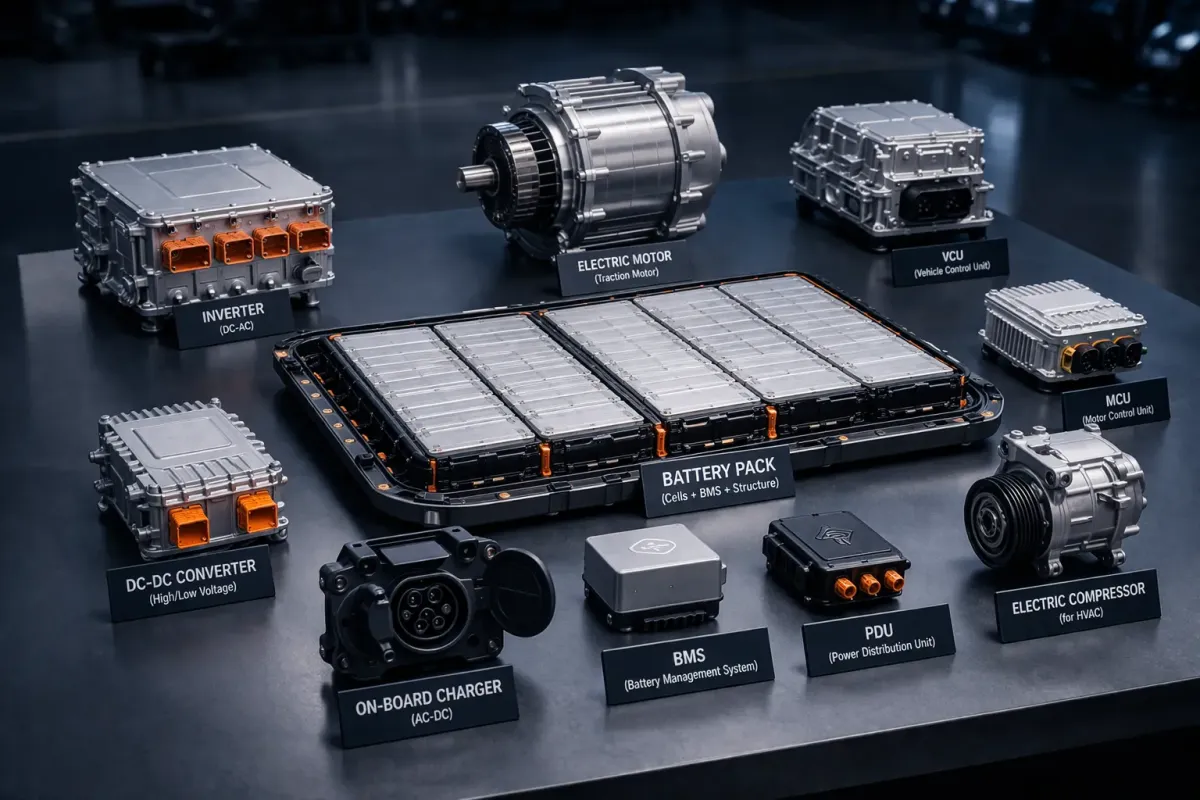
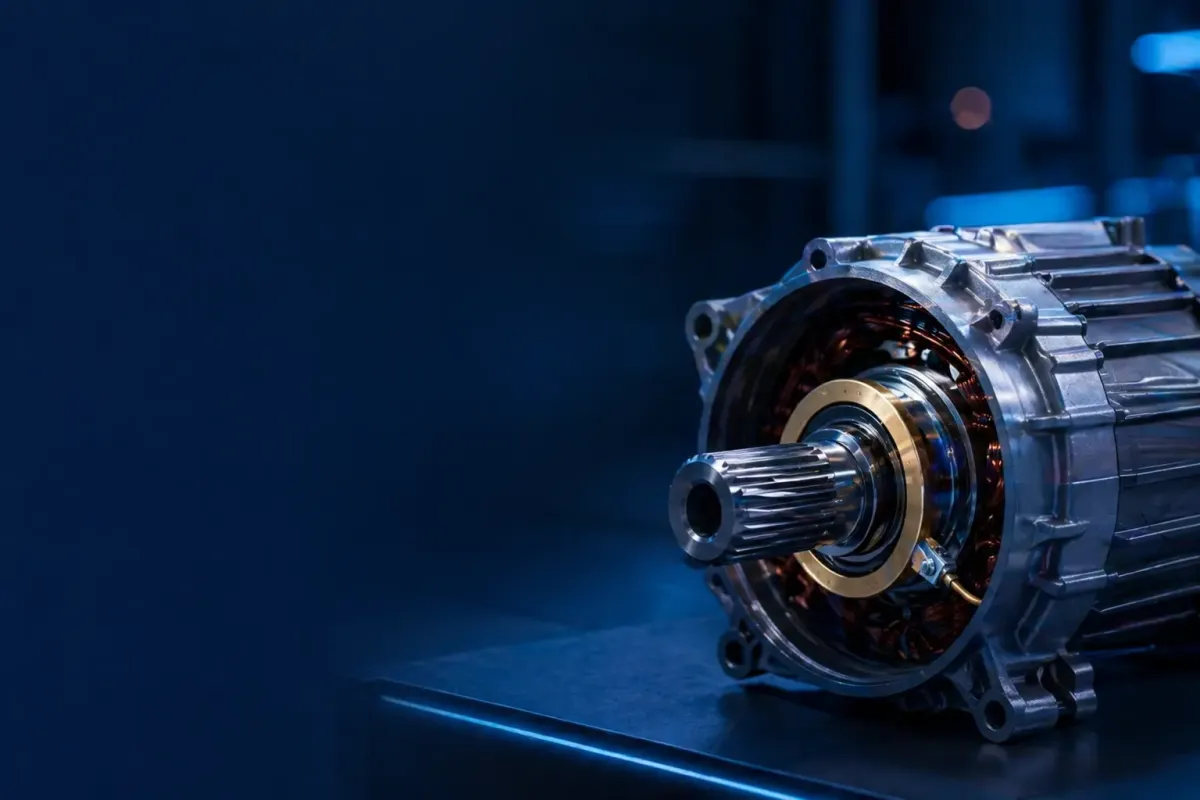
Electric axle, or e-axle, adoption represents this market's most significant structural transition, integrating electric motor, inverter, and transmission functions directly into the axle assembly in a configuration that has no direct equivalent in conventional internal-combustion vehicle architecture. Under a scenario where e-axle penetration reaches 20% of global vehicle production, this would correspond to roughly 19 million vehicle sets globally, a scale that illustrates both the structural opportunity this transition represents for suppliers with strong e-axle capability and the corresponding pressure on suppliers whose product portfolio remains weighted toward conventional axle technology alone. This report models e-axle penetration across a range of scenarios specifically, given the genuine uncertainty in how quickly electric and plug-in hybrid vehicle production will scale across different regions and vehicle segments over the forecast period.
Market Dynamics
Key Drivers
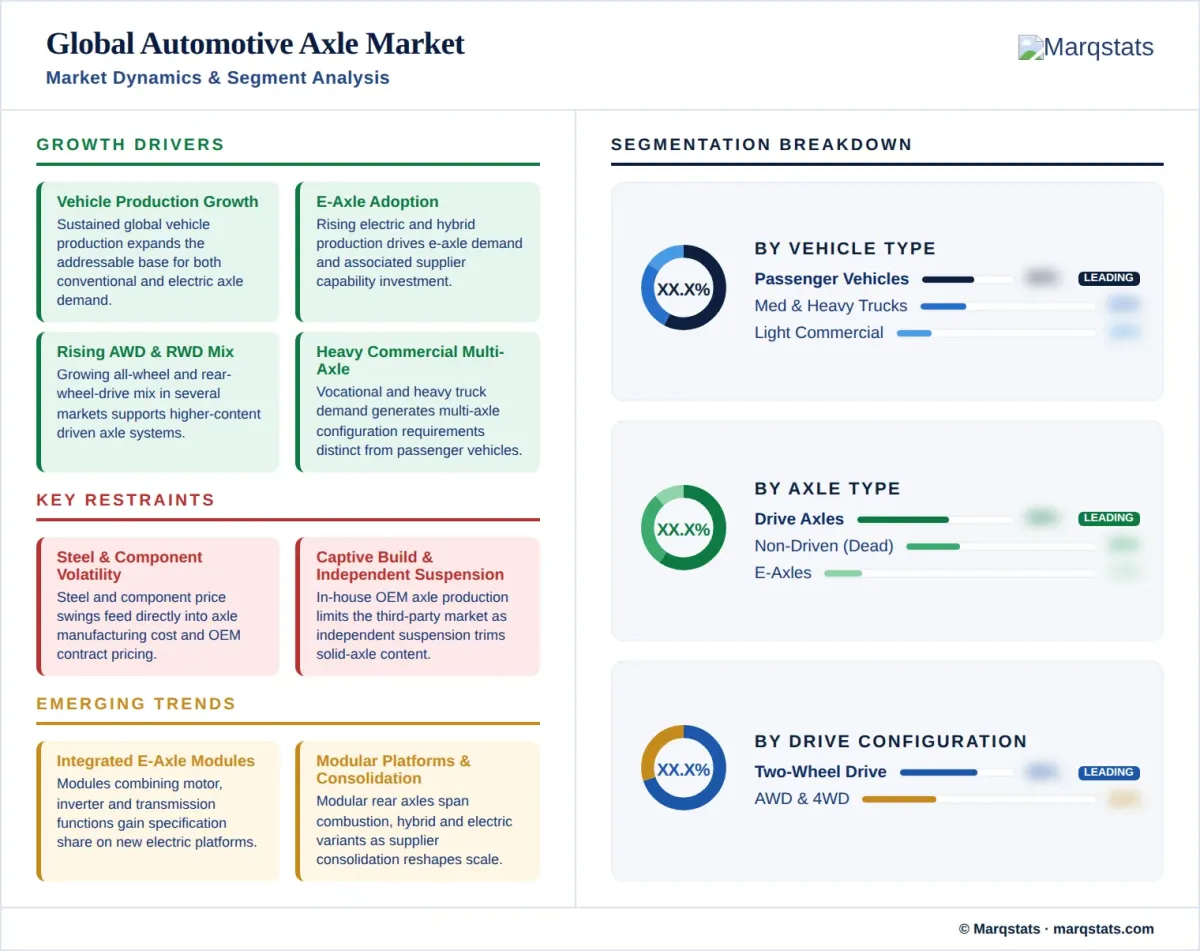
- Sustained global vehicle production growth directly expands the addressable base for both conventional and electric axle demand.
- Rising electric and hybrid vehicle production is directly driving e-axle adoption and associated supplier capability investment.
- Increasing all-wheel-drive and rear-wheel-drive vehicle mix in several major markets is supporting demand for higher-content driven axle systems.
- Heavy commercial vehicle and vocational truck demand continues generating multi-axle configuration requirements distinct from passenger vehicle demand.
- Lightweighting and modular axle platform development are supporting supplier differentiation as OEMs seek efficiency gains across ICE, hybrid, and EV architectures.
Key Restraints
- Steel and component price volatility directly affects axle manufacturing cost and OEM contract pricing.
- Captive OEM axle production continues limiting the third-party addressable market available to independent suppliers for a meaningful share of global vehicle production.
- Passenger vehicle architecture trends toward independent suspension continue reducing traditional solid-axle content in several vehicle segments.
Key Trends
- Integrated e-axle modules combining motor, inverter, and transmission functions continue gaining specification share on new electric vehicle platforms.
- Modular rear axle platforms designed for compatibility across internal-combustion, hybrid, and electric architectures continue expanding across OEM product lines.
- Lightweight material adoption, including composite and advanced high-strength steel content, continues expanding across new axle assembly designs.
- Industry consolidation among major driveline suppliers continues, reshaping competitive scale and electrification capability across the supplier base.
Market Segmentation
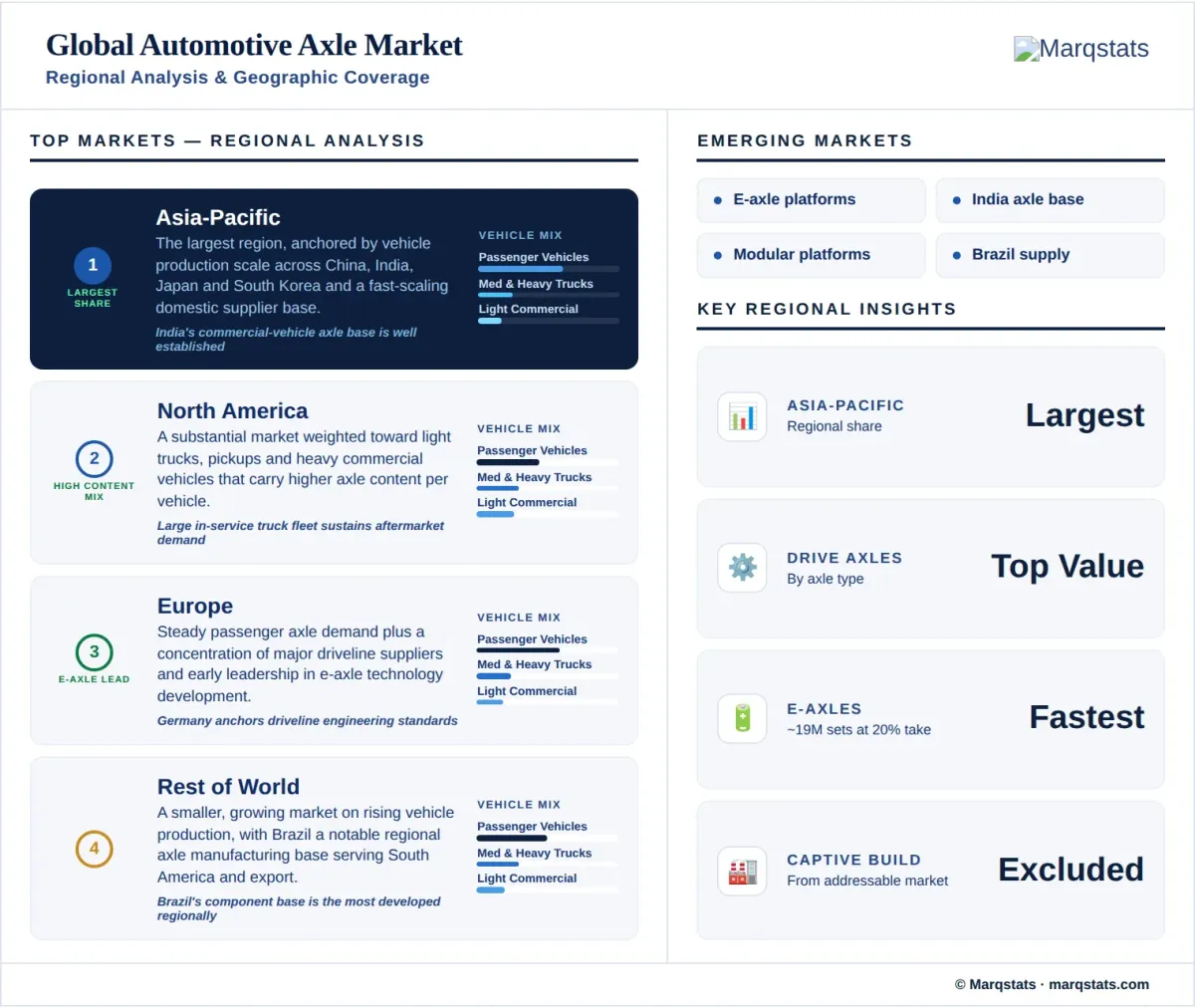
Drive axles represent the largest axle-type category by value, reflecting the additional differential, driveshaft interface, and load-bearing component content a driven axle requires relative to a non-driven counterpart. This category spans front-wheel-drive, rear-wheel-drive, and all-wheel-drive vehicle architectures, each requiring distinct axle system configurations suited to their specific drivetrain layout. Rear drive axles in particular command a meaningful value premium in rear-wheel-drive and all-wheel-drive passenger vehicles, given the additional engineering required to package differential and driveline hardware within the rear axle assembly specifically.
Non-driven axles, sometimes referred to as dead or lift axles, serve load-bearing and steering functions without transmitting drivetrain power, common on the non-driven end of two-wheel-drive vehicles and on additional axle positions in multi-axle heavy trucks and trailers specifically added for load distribution rather than traction. Lift axles specifically can be raised when unloaded to reduce tyre wear and improve manoeuvrability, an increasingly common specification on multi-axle commercial vehicles operating across variable load conditions.
E-axles, integrating electric motor, inverter, and transmission functions directly into the axle assembly, represent the fastest-growing axle-type category, tied directly to battery-electric and plug-in hybrid vehicle production growth. Front, rear, and dual-motor e-axle configurations each serve distinct vehicle architecture requirements, with dual-motor configurations enabling all-wheel-drive capability without the mechanical driveshaft connection a conventional AWD system requires. This integrated architecture also simplifies vehicle assembly relative to a conventional driveline, since a single pre-assembled e-axle module replaces what would otherwise require separate motor, transmission, and differential integration steps on the assembly line.
Two-wheel-drive vehicles require a single driven axle assembly, either front or rear depending on architecture, alongside a non-driven axle at the opposite end, representing the simplest and most common axle configuration across global passenger vehicle production. Front-wheel-drive architecture dominates this category globally, reflecting its cost and packaging advantages for the compact and mid-size vehicle segments that represent the bulk of global passenger vehicle production volume.
All-wheel-drive and four-wheel-drive vehicles require driven axle assemblies at both ends, representing higher axle-system content per vehicle and correspondingly higher revenue per unit for suppliers serving this vehicle segment, with demand supported by both passenger vehicle AWD adoption trends and traditional four-wheel-drive light truck and utility vehicle demand. Rising AWD specification on mainstream passenger vehicle segments, beyond the traditional premium and performance vehicle categories where AWD was historically concentrated, represents a meaningful incremental demand driver within this configuration category specifically.
Passenger vehicles represent the largest vehicle-type category by unit volume, though average axle-system content per vehicle varies considerably by drivetrain architecture and vehicle segment, from compact front-wheel-drive vehicles with comparatively simple axle requirements through larger AWD-equipped vehicles with substantially higher content. Electric passenger vehicles are gradually shifting this category's average content profile as e-axle adoption expands, since even a relatively simple single-motor electric vehicle typically carries higher axle-system value than an equivalent conventional front-wheel-drive vehicle.
Light commercial vehicles, including vans and pickup trucks, often specify heavier-duty axle assemblies than comparable passenger vehicles given their load-carrying and towing requirements, with four-wheel-drive variants representing a meaningful share of demand within this vehicle category specifically. Fleet and commercial buyers within this vehicle category frequently specify axle ratings and configurations tailored to specific duty cycles, adding a further layer of specification variation beyond what typical retail passenger vehicle demand generates.
Medium and heavy trucks and buses require axle configurations ranging from 4x2 through 6x2, 6x4, and 8x4 and vocational applications, each specifying a different number and arrangement of driven and non-driven axle positions. This vehicle category commands substantially higher per-unit axle system value than passenger vehicles given both the number of axle positions larger configurations require and the load-bearing capacity each individual axle assembly must provide. Vocational vehicles, including construction and refuse applications, often specify further customised axle configurations beyond standard highway-duty specifications, adding another layer of segment-specific demand this report's methodology accounts for explicitly.
By Geography
Asia-Pacific
Asia-Pacific holds the largest regional share, anchored by the region's scale of global vehicle production across China, India, Japan, and South Korea. China's domestic axle supplier base has scaled substantially alongside the country's vehicle production growth, while India's axle manufacturing base, anchored by long-established domestic specialists, continues expanding to serve both domestic demand and growing export activity. India's commercial vehicle segment specifically supports a well-established domestic axle manufacturing base with decades of operating history, distinct from the more recently developed passenger vehicle supply chain the country's growing car production has attracted, and Japan and South Korea both contribute substantial regional demand tied to their own established domestic vehicle production bases.
North America
North America represents a substantial market, with demand shaped by the region's significant light truck, pickup, and heavy commercial vehicle production mix, vehicle categories that typically specify higher axle-system content than the global passenger vehicle average. The region's major axle suppliers maintain extensive domestic manufacturing and engineering capability supporting both OEM and aftermarket channels. The region's well-established heavy-duty trucking industry, requiring frequent axle replacement and maintenance across a large in-service commercial vehicle fleet, also supports a substantial and steady aftermarket demand base distinct from OEM fitment.
Europe
Europe combines steady passenger vehicle axle demand with a concentration of major global driveline suppliers headquartered within the region, reflecting the continent's long-established automotive engineering base and its early leadership in electric vehicle and e-axle technology development specifically. Germany specifically anchors both substantial domestic vehicle and component production and the headquarters of several of the industry's largest global driveline groups, giving the country an outsized role in shaping industry technology standards.
Rest of World
Latin America, the Middle East, and Africa represent a smaller, growing market, with demand shaped by rising vehicle production and ownership, and a notable regional axle manufacturing presence in Brazil specifically, serving both domestic South American demand and export activity. Brazil's established automotive component manufacturing base, built over decades of domestic vehicle production, gives the country a more developed regional axle supply chain than most other markets within this broader region.
How Competition Is Evolving
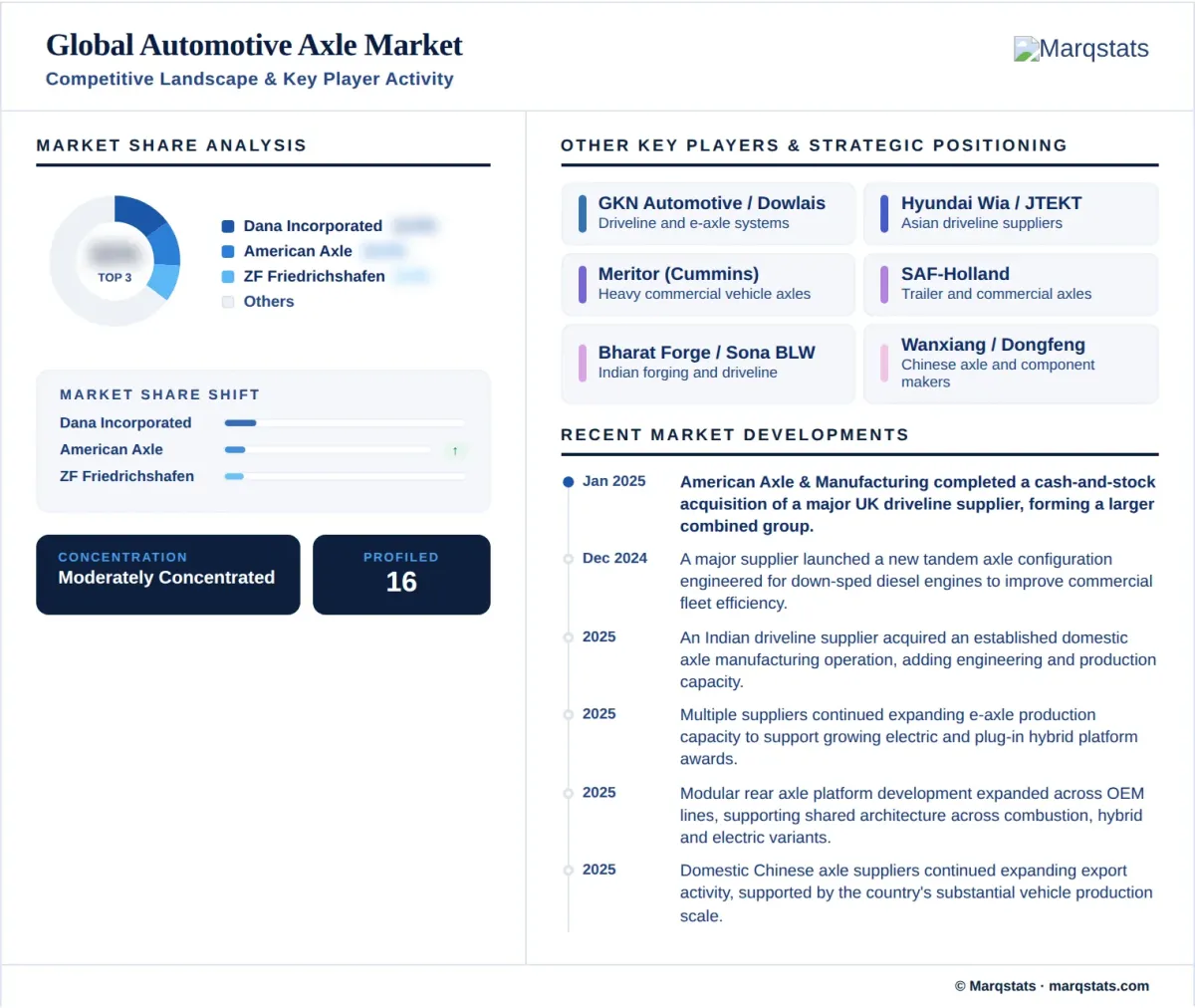
The market is moderately concentrated among a group of large global driveline suppliers, several of which have grown their current scale substantially through recent acquisition activity, including a major 2025 transaction that combined two established suppliers into a considerably larger combined driveline group. This consolidation trend reflects the capital intensity of e-axle development specifically, favouring suppliers with the scale to fund parallel investment across conventional and electric axle technology. Regional Indian consolidation activity has similarly reshaped the domestic supplier base, with acquisition activity adding manufacturing and engineering capacity to established domestic component groups seeking to strengthen their driveline capability.
Competitive strategy centers on e-axle technology capability and platform-level sourcing relationships, since OEMs increasingly award both conventional and electric axle content to suppliers able to support a vehicle platform across its full internal-combustion, hybrid, and electric variant range. Regional manufacturing footprint and captive-versus-outsourced production dynamics further shape competitive positioning, given how significantly OEM in-house axle production affects the addressable third-party market in a given region or vehicle segment. Suppliers with established heavy commercial vehicle axle expertise hold a further differentiated position, since this vehicle category's engineering and durability requirements differ substantially from passenger vehicle axle design, limiting how easily passenger-vehicle-focused suppliers can extend into this higher-value segment.
Companies Covered
The report profiles 16+ companies with full strategy and financials analysis, including:
Recent Market Activity
Table of Contents
Coverage & Segmentation
This report provides a comprehensive assessment of the global automotive axle market across a 2025 base year, historical data from 2021 to 2025, and forecasts spanning 2026 to 2030. Market size is stated as complete axle assembly sales revenue in United States dollars, built using a unit-based model applying vehicle production, axle-system content, and outsourcing rate by vehicle type. Segmentation covers three dimensions: axle type, drive configuration, and vehicle type, alongside regional analysis spanning Asia-Pacific, North America, Europe, and the rest of world.
The scope covers complete front and rear axle assemblies, including driven, non-driven, and integrated electric axle configurations, for passenger vehicles, light commercial vehicles, medium and heavy trucks, and buses and coaches. The study excludes standalone differentials sold separately from a complete axle assembly, propeller shafts and driveshafts not integrated within the axle system itself, and broader driveline or powertrain component categories, each of which some published axle market figures inconsistently include; this report holds to the complete-axle-assembly boundary throughout to avoid the scope inconsistency that affects much of the publicly available data on this category. Country-level detail beyond the four-region split covered here is available under customization, alongside deeper cuts by axle type, vehicle segment, or drive configuration.