Market Snapshot
Key Takeaways
Market Overview & Analysis
Report Summary
The global automotive upholstery market comprises interior surface coverings and trim materials for vehicle cabins, spanning seat fabrics and leathers, headliners, door panel coverings, dashboard and console surfaces, and flooring, across passenger cars, commercial vehicles, and specialty vehicles. This study segments the market by material type, application, and sales channel, with a 2025 base year, historical coverage from 2021 to 2025, and forecasts to 2030. Market size is stated as material and finished-component sales revenue in United States dollars, covering both original equipment fitment and aftermarket replacement and customization. Commercial and specialty vehicles, including heavy trucks and buses, follow a somewhat different material specification logic than passenger cars, typically prioritising durability and ease of cleaning over the premium aesthetic considerations that dominate passenger vehicle material selection.
Material selection in this market reflects a persistent trade-off between cost, durability, and perceived quality that varies systematically by vehicle price segment: mass-market vehicles favour woven and non-woven synthetic textiles for their cost and durability, while premium and luxury vehicles specify natural leather and advanced synthetic alternatives such as Alcantara to signal quality and justify higher price points. This segmentation by vehicle tier is as important to understanding material demand as the underlying application area, since a luxury sedan's seat material choice follows a fundamentally different purchasing logic than a mass-market hatchback's. Mid-market vehicles occupy an increasingly contested middle ground, where automakers use partial leather trim, leather-look synthetic alternatives, or premium textile weaves to approximate a higher-tier interior experience at a lower material cost than full natural leather would require.
Electric vehicles are beginning to influence material specification in ways distinct from a simple continuation of existing trends: minimalist EV interior design philosophies have prompted experimentation with new material combinations, including wood accents and fabric-finished dashboards, alongside a stronger emphasis on lightweight, recyclable materials that support overall vehicle range. While electric vehicles remain a modest share of total global production, their disproportionate influence on interior design trends is shaping material innovation priorities across the wider industry, including in vehicles that are not themselves electric. Vehicle textile consumption per unit has also been rising even as some individual materials get lighter, since richer feature sets, including additional seating rows with premium finishes and expanded soft-touch surface coverage, have partially offset the weight savings individual lightweight materials deliver.
Market Dynamics
Key Drivers
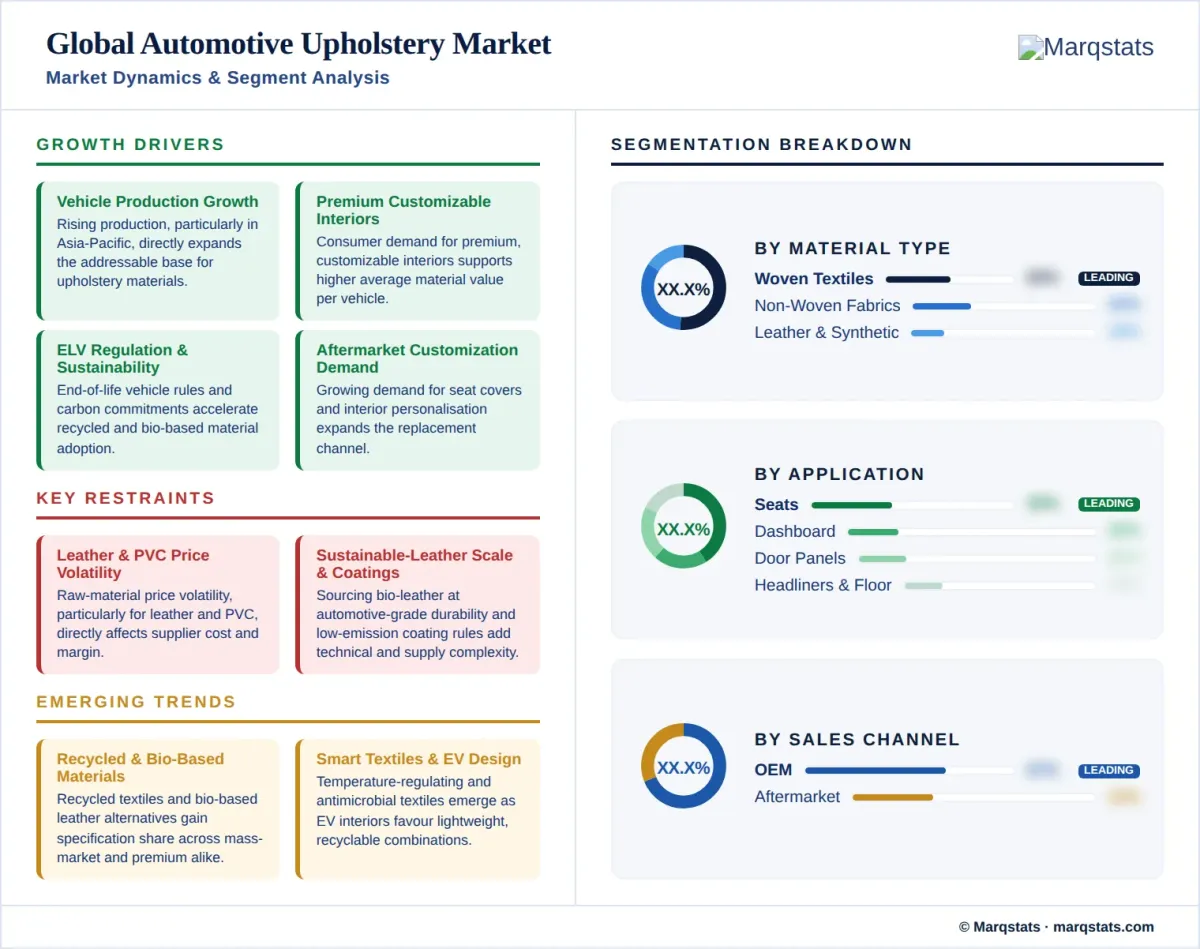
- Rising global vehicle production, particularly in Asia-Pacific, is directly expanding the addressable base for upholstery materials.
- Consumer demand for premium, customizable interiors is supporting higher average material value per vehicle.
- End-of-life vehicle regulation and corporate sustainability commitments are accelerating recycled and bio-based material adoption.
- Lightweighting requirements for fuel economy and electric vehicle range are favouring thinner, lighter-weight textile constructions.
- Growing aftermarket demand for seat covers and interior customization is expanding the replacement and personalization channel.
Key Restraints
- Raw material price volatility, particularly for leather and PVC, directly affects supplier cost and margin.
- Sourcing sustainable leather alternatives at automotive-grade durability and scale remains a persistent technical and supply-chain challenge.
- Low-emission adhesive and coating requirements to meet interior air-quality standards add cost and formulation complexity.
Key Trends
- Recycled textiles and bio-based leather alternatives are gaining specification share across mass-market and premium vehicle segments alike.
- Smart textiles with temperature regulation and antimicrobial properties are emerging as a premium differentiator.
- Electric vehicle interior design is favouring lightweight, recyclable materials and new material combinations such as wood-accented fabric dashboards.
- Aftermarket interior customization continues to expand as consumers personalise vehicles beyond factory specification.
Market Segmentation
Woven textiles account for roughly 58% of the market, the largest material category, valued for durability and cost-effectiveness across mass-market vehicle seat and door trim applications. Polyester remains the dominant fibre within this category, though demand for alternative fibres offering improved strength-to-weight characteristics is gradually increasing. Weave pattern and finish treatment innovation within this broadly mature material category continues to be a meaningful differentiator, since suppliers compete on stain resistance, colourfastness, and tactile quality within what remains fundamentally a cost-optimised material choice for automakers. Recycled polyester derived from post-consumer plastic bottles has moved from a niche sustainability claim to a mainstream specification option within this category, as automakers seek recycled-content credentials without sacrificing the durability and cost profile woven textiles have long provided.
Non-woven fabrics represent approximately 42% of the market, concentrated in headliner and select door panel and flooring applications, where their manufacturing process offers cost and weight advantages over woven alternatives for surfaces that do not require woven fabric's specific aesthetic or texture. This category has also become the primary entry point for recycled-content materials, since non-woven manufacturing processes can more readily incorporate recycled fibre inputs than woven textile production without compromising the finished material's performance in its typical application. Sound-absorbing and insulating properties are a secondary but commercially important characteristic of many non-woven constructions, giving this material category a functional role beyond its visible surface covering purpose in headliner and flooring applications specifically.
Natural leather and synthetic leather alternatives, including PU and PVC-based materials, represent a smaller, higher-value material category concentrated in premium and luxury vehicle segments, where perceived quality and tactile experience justify a substantial price premium over textile alternatives. Bio-based and recycled synthetic leather alternatives are the fastest-growing sub-category within this material group, as suppliers work to replicate natural leather's tactile and visual qualities without the environmental and animal-welfare concerns increasingly relevant to premium-brand purchasing decisions. Suede-like microfibre materials such as Alcantara occupy a distinct premium niche within this category, valued specifically for applications including steering wheels and select trim accents where natural leather's slicker surface is less desirable from a grip and tactile perspective.
Seats represent the largest application at roughly 40% of upholstery material use, reflecting both the surface area seating covers and the premium materials and construction techniques increasingly applied to seating specifically, including active-comfort features such as heating, cooling, and massage that require more complex upholstery engineering than a standard seat covering. Multi-piece seat covers combining different materials across bolsters, inserts, and headrests are increasingly common even in mid-market vehicles, a construction approach that raises material complexity and cost relative to a single-material seat covering. Seat upholstery must also satisfy more demanding durability and flammability testing than most other interior surfaces, given seats' direct and prolonged occupant contact, a requirement that further differentiates seat-grade materials from otherwise similar materials used on lower-contact surfaces.
Dashboards and door panels each represent roughly a fifth of upholstery material use, with both surfaces increasingly specified in soft-touch vinyl or PU coatings that automakers use to differentiate interior quality perception beyond what harder plastic trim alone can achieve. The extent of soft-touch surface coverage on the dashboard specifically has become a widely used shorthand for perceived interior quality among reviewers and consumers, giving automakers a direct incentive to expand soft-touch material coverage even on vehicles positioned below the premium segment.
Headliners, floor coverings, and other interior surfaces represent the remaining application share, with headliners in particular increasingly integrating ambient lighting and acoustic insulation functions alongside their traditional covering role. This functional integration is turning the headliner from a purely cosmetic covering into a component that must be engineered jointly with electrical and acoustic teams, a shift that is gradually raising the material and engineering complexity of what remains, on paper, one of the simplest upholstery applications.
Original equipment fitment accounts for roughly two-thirds of market revenue, reflecting automaker preference for materials validated and warrantied as part of the vehicle build process, with material selection increasingly treated as a brand-differentiation decision made early in vehicle platform development. Material qualification for a new vehicle platform typically spans a multi-year development cycle, during which suppliers must demonstrate durability, flammability, and emissions compliance well before the vehicle reaches production.
Aftermarket sales, spanning seat cover replacement, interior customization kits, and reupholstery services, represent the remaining market share, supported by a healthy replacement cycle in markets with older vehicle fleets and by growing consumer interest in personalisation beyond factory specification. Markets with older average vehicle age and a strong culture of vehicle personalisation show disproportionately higher aftermarket upholstery demand relative to their new-vehicle production volume, making vehicle parc age as relevant a demand indicator for this channel as production figures alone.
By Geography
Asia-Pacific
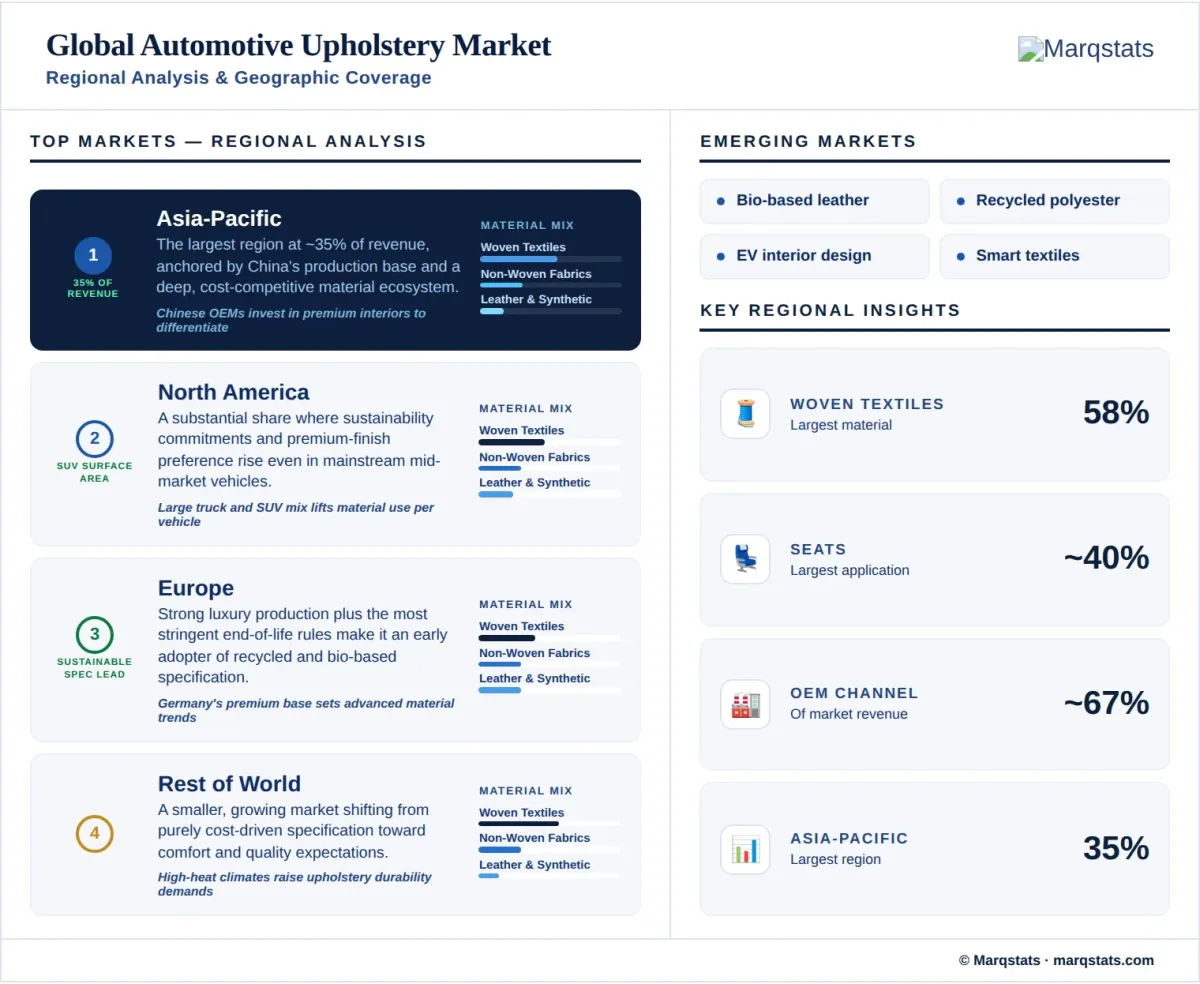
Asia-Pacific holds roughly 35% of global revenue, the largest of any region, anchored by China's vehicle production base alongside significant production volume in India, Japan, and South Korea. The region combines the world's largest vehicle production base with a deep, cost-competitive textile and leather-alternative manufacturing ecosystem, giving Asia-Pacific suppliers a structural advantage in serving both domestic and export-oriented automotive material demand. Chinese domestic automakers in particular have invested heavily in premium interior specification as a competitive differentiator against established international brands, lifting average material value per vehicle faster in this segment than broader regional vehicle production growth alone would suggest.
North America
North America represents a substantial share of global demand, with material specification trends increasingly shaped by domestic automaker sustainability commitments and growing consumer preference for premium interior finishes even in mainstream mid-market vehicle segments. The region's large truck and SUV segment, which typically specifies larger interior surface area than comparable sedans, contributes to above-average material consumption per vehicle relative to markets with a smaller-vehicle production mix.
Europe
Europe combines strong luxury and premium vehicle production with the world's most stringent end-of-life vehicle and sustainability regulation, making the region an early adopter of recycled textile and bio-based leather alternative specification well ahead of regulatory requirements taking effect elsewhere. Germany's concentration of premium and luxury automakers gives the country an outsized influence on advanced material specification trends that frequently cascade to other regional and global vehicle programmes over subsequent product cycles.
Rest of World
Latin America, the Middle East, and Africa represent a smaller, growing market, with demand shaped by rising vehicle ownership and a gradual shift from purely cost-driven material specification toward the comfort and quality expectations more established in mature automotive markets. Climate conditions in several of these markets, particularly extended exposure to high heat, place additional durability demands on upholstery materials relative to more temperate markets, a factor that shapes material selection independent of price-tier considerations alone.
How Competition Is Evolving
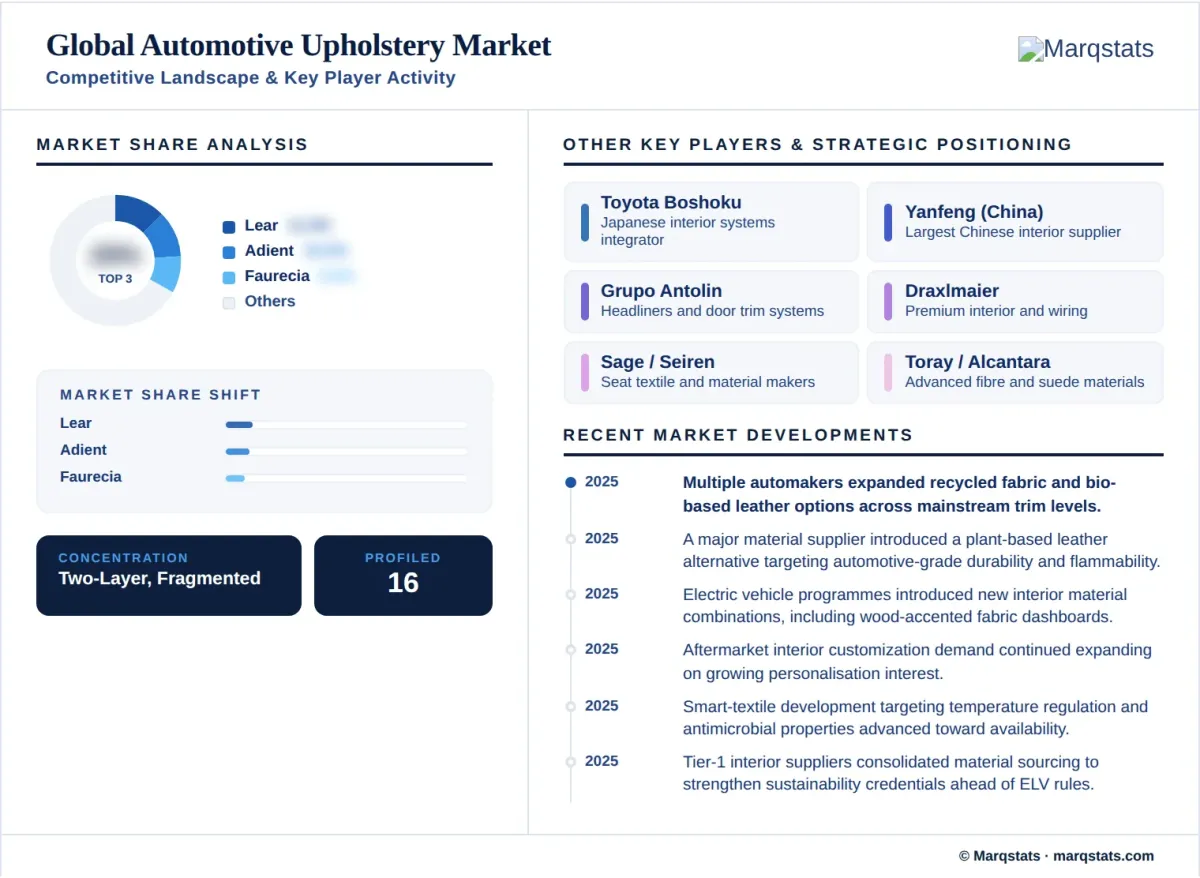
The market is moderately fragmented, with a group of large, globally distributed Tier-1 interior suppliers competing alongside specialised material manufacturers who supply textiles, leather alternatives, and trim components to those Tier-1 integrators. This two-layer structure means automakers typically contract with a Tier-1 interior supplier for complete seating and trim systems, while that Tier-1 supplier in turn sources specific materials from specialised textile and leather-alternative manufacturers. Long-standing relationships between Tier-1 suppliers and their material sub-suppliers are common, since qualifying a new material source for automotive-grade durability and safety compliance requires meaningful lead time that discourages frequent supplier switching once a working relationship is established.
Competitive strategy among Tier-1 interior suppliers centers on design and engineering capability, particularly for complex seating systems incorporating comfort and climate features, alongside sustainability credentials that increasingly factor into automaker supplier selection. Material suppliers compete on innovation in recycled and bio-based alternatives, durability performance, and the ability to meet automotive-grade flammability, fogging, and emissions standards that consumer-textile suppliers do not typically need to satisfy. Consolidation activity has been a recurring feature among material suppliers specifically, as scale advantages in raw-material sourcing and automotive-standard compliance testing make larger, more diversified suppliers structurally advantaged over smaller regional competitors serving a single material category.
Companies Covered
The report profiles 16+ companies with full strategy and financials analysis, including:
Recent Market Activity
Table of Contents
Coverage & Segmentation
This report provides a comprehensive assessment of the global automotive upholstery market across a 2025 base year, historical data from 2021 to 2025, and forecasts spanning 2026 to 2030. Market size is stated as material and finished-component sales revenue in United States dollars. Segmentation covers three dimensions: material type, application, and sales channel, alongside regional analysis spanning Asia-Pacific, North America, Europe, and the rest of world.
The scope covers seat fabrics and leathers, headliners, door panel coverings, dashboard and console surfaces, and floor coverings, across woven textiles, non-woven fabrics, natural leather, and synthetic leather materials. The study excludes seat cushioning foam, seat frame structures, in-cabin electronics, and structural interior plastic panels beyond door trim covering, each of which Marqstats treats as a separate automotive component category. This scope choice keeps the reported figure focused on surface and touch materials specifically, distinct from the broader automotive interiors category that spans structural components, electronics, and lighting alongside surface coverings. Country-level detail beyond the four-region split covered here is available under customization, alongside deeper cuts by material type, application, or vehicle price segment.