Market Snapshot
Key Takeaways
Market Overview & Analysis
Report Summary
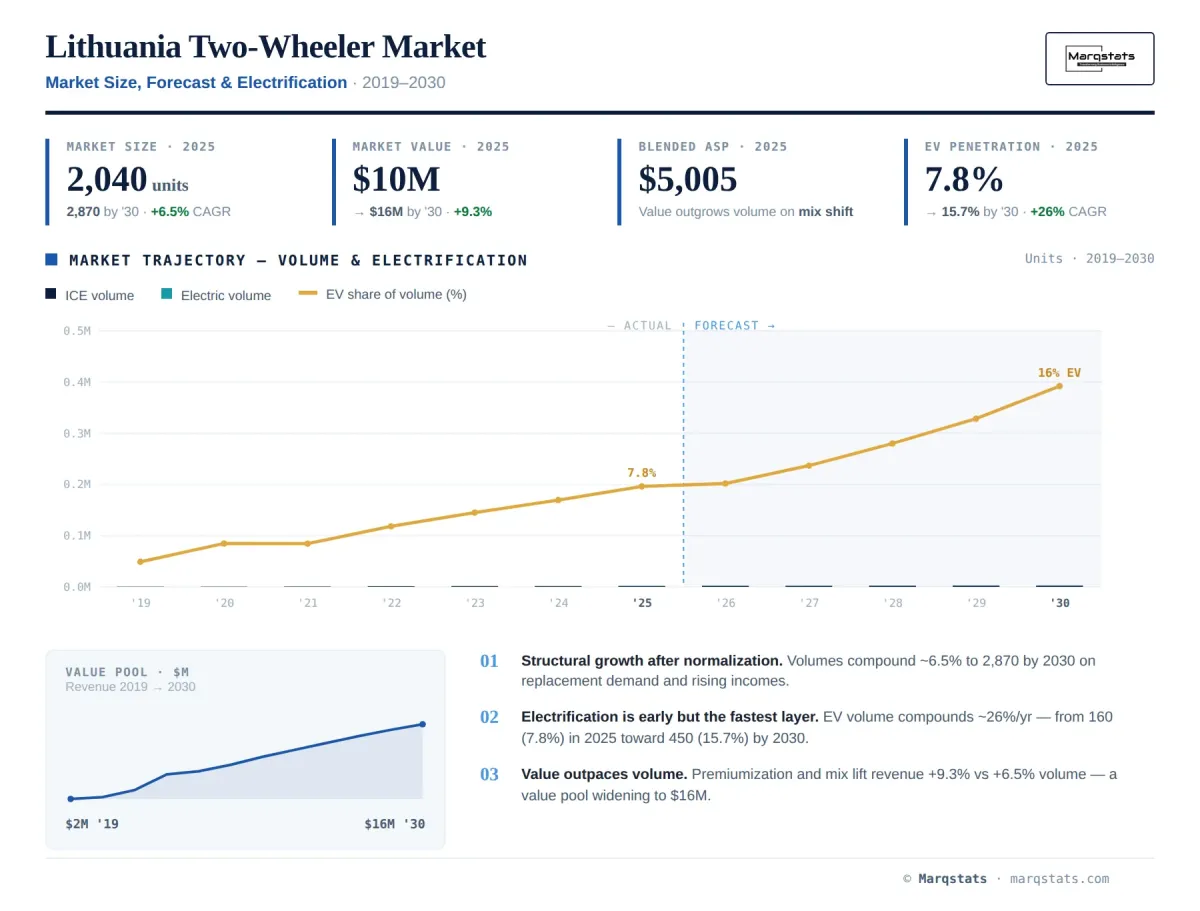
The Lithuania two-wheeler market comprises motorcycles, scooters and mopeds registered for personal and commercial use across internal combustion and electric propulsion, measured on a new-registration basis for machines above 50cc. Lithuania is a small Baltic market of about 2.8 million people, however it stands apart from its neighbours for the pace of its expansion: unit volume rose from about 510 units in 2019 to about 2,040 units in 2025, a near-quadrupling that reflects rising incomes, urban mobility demand around Vilnius and Kaunas, and broadening brand availability.
Between 2021 and 2025 the market climbed steadily from about 890 units to about 2,040 units, briefly moderated by the European Union's Euro 5+ transition, and it is forecast to keep growing through 2030 as motorcycles, scooters and electric models all expand. Unlike the flat, mature markets elsewhere in the region, Lithuania combines genuine volume growth with value growth, as riders trade up to premium and larger-displacement machines and as electrification accelerates from a small base.
Lithuania's demand is anchored by premium European and Japanese OEMs — Honda, Yamaha, BMW Motorrad, KTM and Piaggio — the same brands central to the intelligent connected two-wheeler market, where European Union safety rules increasingly mandate rider-assistance and connectivity features on new machines. Electrification is advancing from a small base, supported by Ministry of Environment scrappage-and-subsidy grants and expanding charging access, and moderated by the higher upfront cost of electric two-wheelers relative to the mid-priced machines that anchor demand.
Three forces explain Lithuania's growth. First, income and mobility: rising disposable incomes and urban commuting demand around Vilnius and Kaunas have converted two-wheelers from a niche purchase into a mainstream mobility and leisure choice, lifting first-time ownership. Second, brand availability: the arrival of value entrants such as CFMoto and Bajaj alongside the established premium marques has widened the price ladder, opening the entry and mid tiers to buyers previously priced out. Third, policy: recurring Ministry of Environment schemes that reward scrapping older polluting cars for electric scooters, mopeds and motorcycles have seeded electric adoption and pulled new riders into the market. Together these forces make Lithuania a genuine growth market rather than a replacement-driven one, with volume and value expanding in tandem through the forecast period.
Market Dynamics
Key Drivers
- Market is driven by strong recent expansion around Vilnius and Kaunas, where rising incomes and urban mobility demand have nearly quadrupled volumes since 2019.
- Demand is increasing owing to premiumisation, as riders trade up to premium and larger-displacement machines that lift average prices and value faster than volume.
- Growth is attributed to electrification, with electric two-wheelers expanding at a 25.74% CAGR as Ministry of Environment scrappage grants reward switching to electric scooters, mopeds and motorcycles.
- Widening brand availability, including value entrants such as CFMoto and Bajaj alongside premium marques, is broadening choice and supporting first-time ownership.
- Rising online retail, growing at a 25.74% CAGR, is extending access beyond the traditional dealer footprint to younger urban riders.
Key Restraints
- Total volume remains small on a population base of about 2.8 million, capping absolute market size despite fast percentage growth.
- The Euro 5+ emissions standard, in full effect from January 2025, raised compliance costs and narrowed entry-level model availability, moderating ICE demand.
- The higher upfront cost of electric two-wheelers relative to mid-priced ICE machines slows electric adoption despite subsidy support.
- Cold-climate seasonality concentrates riding into warmer months, capping annual utilisation and replacement demand.
Key Trends
- Electric adoption is rising owing to recurring scrappage-and-subsidy schemes that channel grant funding toward electric scooters, mopeds and motorcycles.
- Scooters are the fastest-growing vehicle type at a 7.46% CAGR, gaining share for urban commuting even as motorcycles remain the largest category.
- Premiumisation is deepening, as premium and high-premium classes grow at 7.03% and 9.00% CAGRs and larger-displacement machines gain share.
- European Union safety rules are embedding rider-assistance and connectivity features into new two-wheelers, moreover lifting average content and value per unit.
Market Segmentation
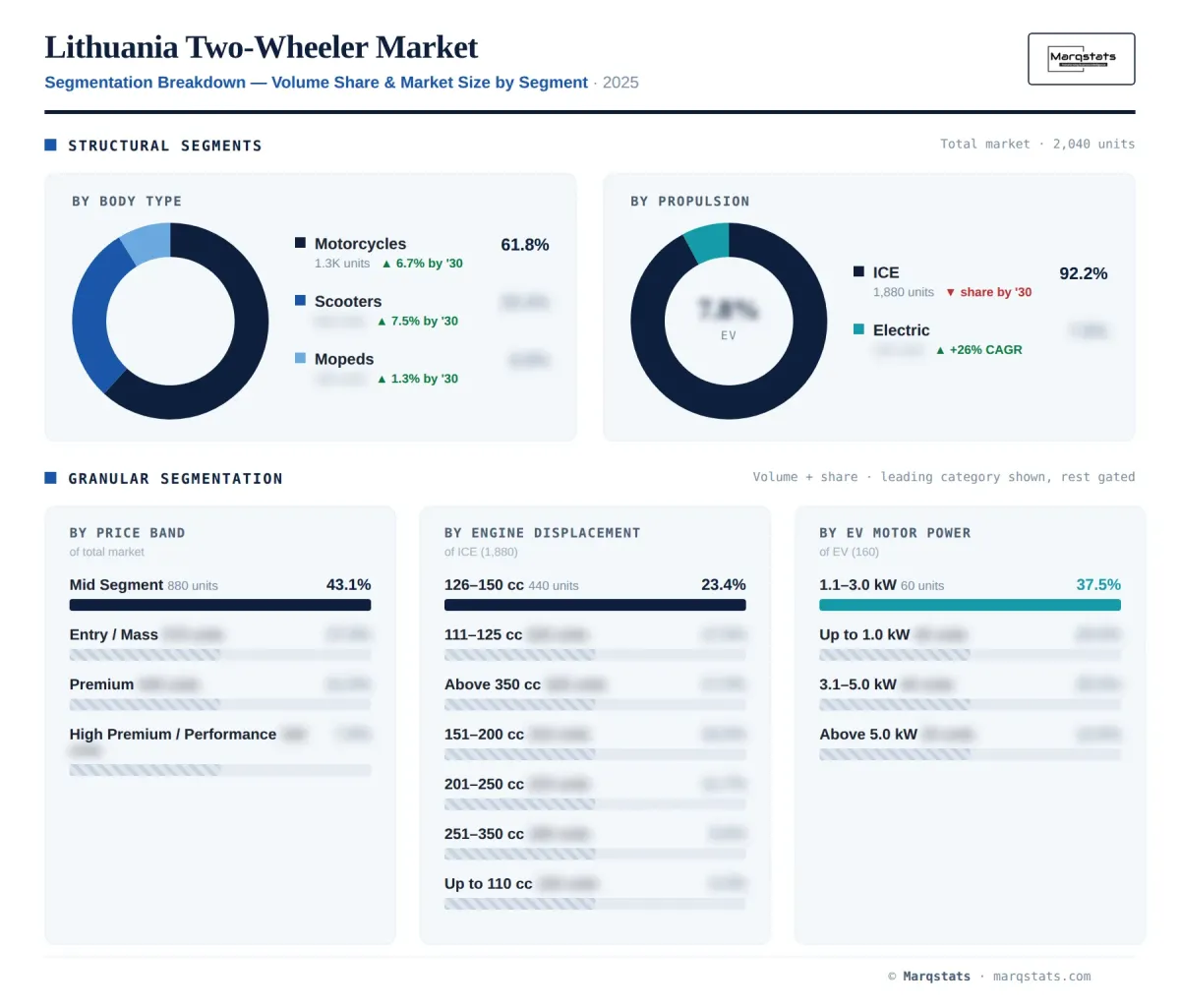
Motorcycles accounted for about 62% of 2025 volume, at roughly 1.26 thousand units, and are forecast to reach about 1.79 thousand units by 2030 at a 6.72% CAGR. Demand spans commuting, touring and leisure riding, and skews toward mid and larger-displacement machines owing to Lithuania's premium European and Japanese brand preference. Motorcycles anchor the market and drive much of its absolute growth.
Scooters accounted for about 29% of 2025 volume, at roughly 0.6 thousand units, growing to about 0.88 thousand units by 2030 at a 7.46% CAGR — the fastest-growing vehicle type. Uptake is increasing owing to urban commuting around Vilnius and Kaunas and the appeal of automatic, easy-to-park machines, and the 125cc class benefits from car-licence eligibility.
Mopeds accounted for about 9% of 2025 volume, at roughly 0.18 thousand units, and grow slowly at a 1.29% CAGR to about 0.2 thousand units by 2030. The segment is the weakest performer as riders shift toward more capable scooters and motorcycles and as tighter emissions rules reduce the appeal of small low-power machines.
ICE two-wheelers supplied about 92% of 2025 volume, at roughly 1.88 thousand units, and continue to grow to about 2.41 thousand units by 2030 at a 4.13% CAGR. Petrol motorcycles and scooters remain the default owing to established refuelling infrastructure and lower purchase prices, however their share erodes gradually as electric substitution accelerates.
Electric two-wheelers accounted for about 8% of 2025 volume, at roughly 0.16 thousand units, expanding to about 0.45 thousand units by 2030 at a 25.74% CAGR — the fastest-growing propulsion class. Adoption is increasing owing to scrappage-and-subsidy grants, widening charging access and European Union climate policy, and is moderated by higher upfront prices and cold-climate range considerations.
Within ICE machines, the 126–150cc class was the largest displacement band in 2025 at about 0.44 thousand units — the commuter and maxi-scooter core — followed by the 111–125cc class and the above-350cc touring and adventure category. The 251–350cc band grows fastest at a 9.73% CAGR as riders trade up, while smaller sub-125cc classes grow more slowly under Euro 5+. Across electric motor-power bands, the 1.1–3.0 kW class leads volume and the above-5.0 kW category grows fastest at a 27.79% CAGR, reflecting demand for more capable electric machines.
The displacement mix reinforces the market's value story. Because premium and larger machines carry higher prices, the blended average selling price rises even faster than unit volume, which is why revenue grows at a 9.33% CAGR against a 6.51% volume CAGR. Larger and premium machines also generate higher parts and service revenue over their lifecycle, deepening the value available to dealers and after-sales networks. On the electric side, motor-power upgrades track both commuter and light-commercial demand, with higher-kilowatt models seeding adoption beyond entry-level e-scooters.
The mid segment dominated 2025 volume at about 0.88 thousand units, or roughly 43% of the market, and grows at a 5.57% CAGR. The entry and mass band followed at about 0.57 thousand units and grows at 7.14%, while the premium and high-premium/performance bands, at about 0.44 thousand and 0.16 thousand units, grow faster at 7.03% and 9.00% CAGRs. This upward price migration, concentrated in premium and larger machines, is the primary reason value expands faster than volume across the forecast period.
The price-band pattern reflects two demand streams growing at once. At the entry and mass end, value brands such as CFMoto and Bajaj are widening access and lifting first-time ownership, which sustains healthy growth in the lower bands. At the premium and high-premium end, established European and Japanese marques capture riders trading up to touring, adventure and performance machines, generating a disproportionate share of value. Because both ends expand while the mid segment holds the largest share, the market broadens rather than polarises, and the blended average price rises steadily through the forecast period.
The B2C segment accounted for about 75% of 2025 volume, at roughly 1.53 thousand units, and grows at a 4.37% CAGR as personal ownership widens. Commercial demand grows faster: B2B and fleet use expands fastest at a 16.89% CAGR, delivery and logistics use, at about 0.19 thousand units, grows at 9.33%, and ride-hail, rental and tourism use grows at 9.50% owing to Vilnius urban services and seasonal visitor activity. Government and institutional use, though small, expands quickly from a low base.
This end-user pattern captures the market's underlying shift. Personal ownership remains the backbone of demand and grows steadily as first-time buyers enter the market, however the fastest momentum sits with commercial buyers — delivery operators, corporate fleets and rental services concentrated in Vilnius and Kaunas — whose utilisation rates and cost sensitivity make scooters and, increasingly, electric machines attractive working assets. As urban delivery and shared-mobility services scale, commercial channels are expected to account for a rising share of both volume and electric adoption.
Offline dealerships retained about 90% of 2025 volume, at roughly 1.84 thousand units, and grow at a 3.22% CAGR, reflecting the continued importance of test rides, trade-ins and servicing in a premium-skewed market. Online channels, though only about 10% of volume at roughly 0.2 thousand units, grow fastest at a 25.74% CAGR as digital storefronts, omnichannel reservations and direct-to-consumer electric brands reach younger urban buyers.
By Geography
Two-wheeler demand in Lithuania concentrates in the largest urban economies — Vilnius, Kaunas and Klaipeda — which contain the bulk of population, commercial activity and commuting. Regional differences are shaped by urban density, income and electricity access, and these factors determine where scooters, electric models and commercial fleets are most prevalent.
The market's growth is also geographically concentrated. The near-quadrupling of volume since 2019 has been led by the Vilnius and Kaunas corridor, where incomes are highest, dealer and charging density is greatest, and urban congestion makes two-wheelers a practical commuting choice. Electric adoption and the fast-growing online channel are similarly weighted toward these cities, while smaller towns and rural areas continue to rely on affordable ICE machines. This concentration means that national growth is effectively driven by a handful of urban centres, and that policy measures and infrastructure investment focused on those cities have an outsized effect on the market as a whole.
Vilnius & the Capital Region
Vilnius is the dominant demand centre, concentrating urban commuting, delivery activity and the densest dealer and charging networks. The capital anchors both motorcycle and scooter demand and the earliest electric two-wheeler adoption, and it is the focal point for commercial and rental use and for the fast-growing online retail channel that reaches younger riders.
Kaunas & Central Lithuania
Kaunas, the second city and an industrial and logistics hub, adds a strong secondary base of commuter, leisure and fleet demand. Its manufacturing and distribution activity supports delivery and B2B two-wheeler use, and improving road links to Vilnius reinforce the central corridor as a core demand region.
Klaipeda & Other Regions
Klaipeda, the principal port city, and other regional centres contribute coastal, seasonal and commuter demand, with tourism around the coast lifting rental and short-trip scooter use in warmer months. Demand across smaller towns and rural areas is thinner and almost entirely ICE-based, and growth is attributed to rising incomes and the gradual spread of urban services.
How Competition Is Evolving
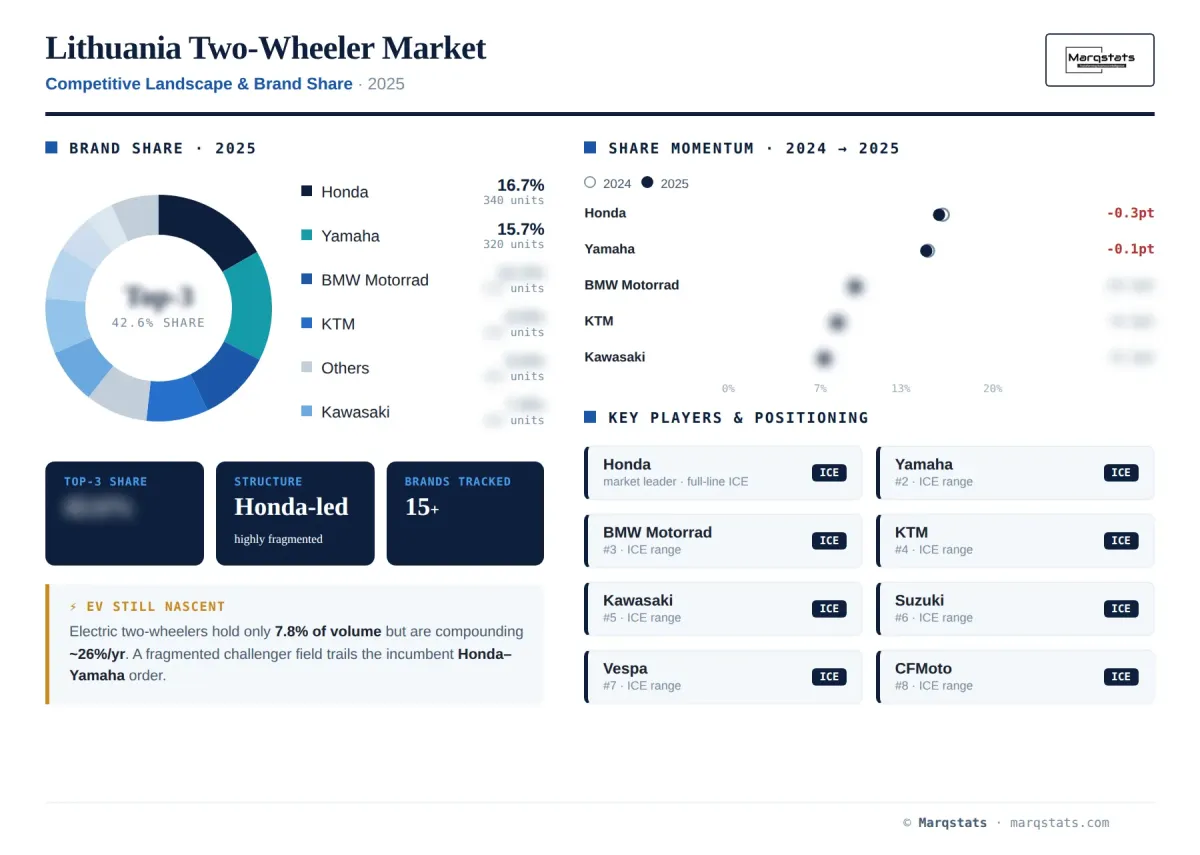
The Lithuania two-wheeler market is moderately fragmented and premium-skewed, shaped by European and Japanese OEMs alongside emerging Chinese and Indian value entrants. Honda held the largest single-brand volume in 2025 at about 17%, followed by Yamaha, BMW Motorrad and KTM, with a long tail of premium and niche marques. Competition centres on brand trust, dealer and service coverage, model breadth and resale value, increasingly complemented by electric ranges and connected features.
Japanese brands such as Honda and Yamaha anchor the mid and commuter tiers with broad motorcycle and scooter ranges, while European premium marques including BMW Motorrad, KTM, Piaggio and Ducati compete in touring, adventure and lifestyle segments where heritage and technology support higher prices. Chinese challenger CFMoto is expanding on competitive pricing, and Bajaj adds an Indian value option, broadening access at the entry and mid tiers. Electric-focused brands including NIU, Yadea and Zero contest the fast-growing yet still small electric niche, with growth tied closely to subsidy support and charging access.
At the brand level, Honda's lead rests on its motorcycle and scooter breadth, while Yamaha holds a close second position on a comparable portfolio. BMW Motorrad and KTM anchor the premium and adventure tiers, supported by strong resale value and heritage that sustain higher price points. Kawasaki, Suzuki and Piaggio occupy focused sport, commuter and scooter niches, while CFMoto and Bajaj gain ground on value positioning. Over the forecast period the balance is expected to tilt toward brands that pair reliable service networks with credible electric and connected ranges as the mix continues to premiumise and electrify.
Companies Covered
The report profiles 16+ companies with full strategy and financials analysis, including:
Recent Market Activity
Table of Contents
Coverage & Segmentation
This report provides a comprehensive analysis of the Lithuania two-wheeler market across a 2025 base year, historical data from 2021 to 2025, and forecasts spanning 2026 to 2030. The study sizes the market in both volume (thousand units, on a new-registration basis for machines above 50cc) and value (USD million), and segments it by vehicle type (motorcycles, scooters and mopeds), propulsion type (internal combustion engine, electric), engine displacement and motor power, price band, end user, and sales channel. Brand-level analysis covers the premium European and Japanese manufacturers that shape Lithuanian supply, alongside emerging Chinese and Indian value entrants.
The study examines market drivers, restraints and trends, segment-level growth, regional demand across Vilnius, Kaunas and the wider country, competitive structure, and forward catalysts including Euro 5+ regulation, scrappage-and-subsidy schemes, electrification and charging-infrastructure expansion. All market estimates represent Marqstats-reconciled figures derived from a bottom-up methodology validated against top-down benchmarks, using national registration indicators and European Union statistics rather than any single external source.
The report is designed for two-wheeler manufacturers, importers and distributors, fleet and delivery operators, component and battery suppliers, and policymakers assessing Lithuania's urban-mobility and electrification path. It supports market sizing, brand and channel benchmarking, and scenario planning around regulation, electrification and seasonal demand. Volume and value forecasts are provided at segment level for the 2026–2030 window, with 2021–2025 historical context, enabling comparison against neighbouring Baltic and European markets.