Market Snapshot
Key Takeaways
Market Overview & Analysis
Report Summary
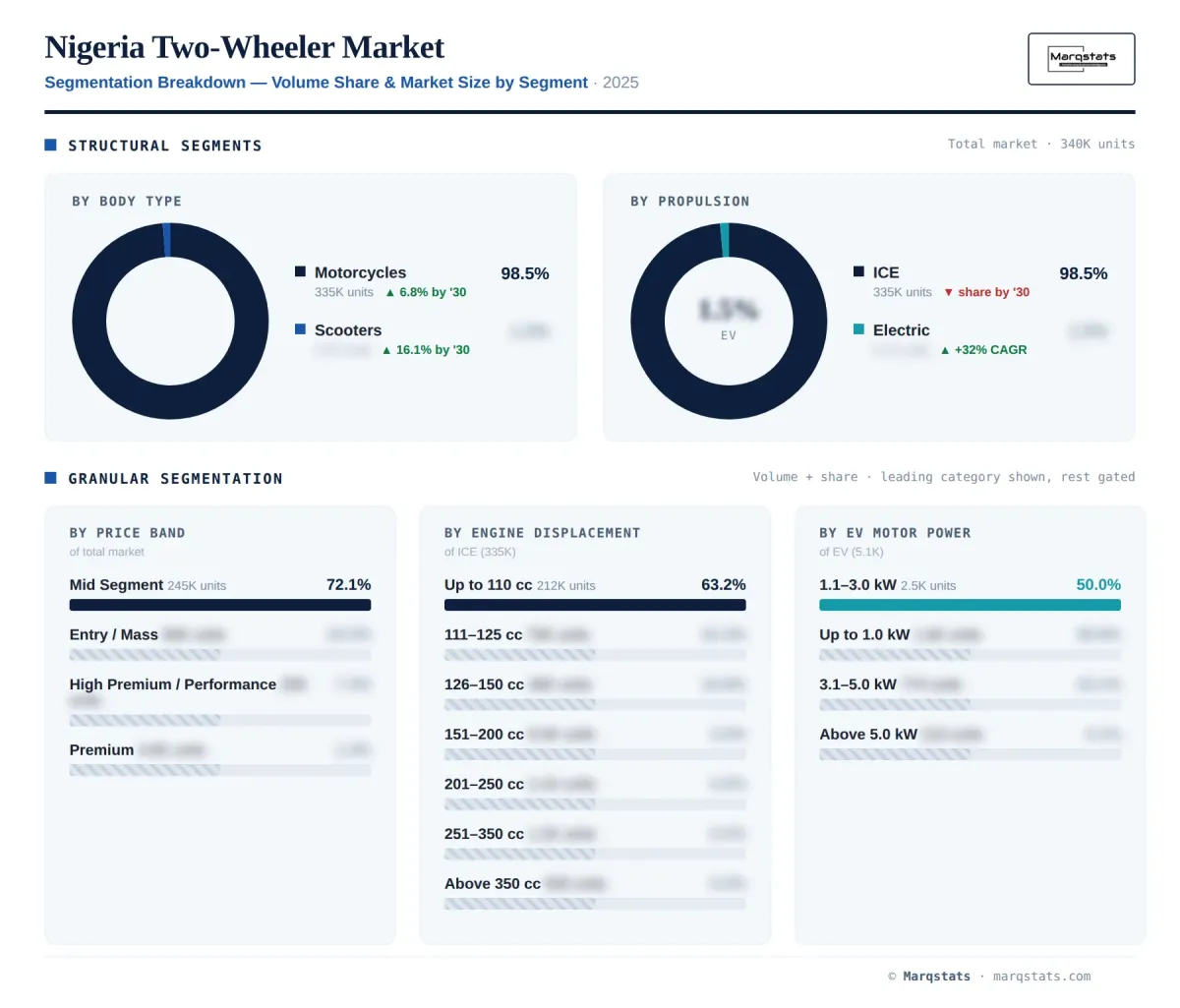
The Nigeria two-wheeler market covers motorcycles, scooters, and mopeds sold for private, commercial, and institutional use. The study measures demand in unit volumes and revenue across 2021 to 2025 historical years and 2026 to 2030 forecast years, with 2025 as the base year. Coverage spans propulsion type, engine displacement and motor power, price band, end user, sales channel, and brand.
Nigeria is defined by its okada economy. Motorcycles are transport infrastructure rather than a discretionary purchase, and they support commuting, ride-hail, and last-mile delivery for a large population. Small-displacement commuter models carry almost all volume, and average selling prices remain low. Buyers weigh purchase price, fuel economy, durability, and parts availability above brand prestige.
Import dependence is near total. Nigeria assembles a growing share of motorcycles, however most units and components arrive from Asia. Landed cost tracks the naira exchange rate and freight conditions, so retail prices move with currency cycles. A sharp devaluation raised prices through 2024, while relative stabilization since has lowered some model prices and improved affordability for commercial buyers.
Growth is attributed to a large and urbanizing population, commercial rider demand, and the renewal of an aging fleet. Nigeria sits within the broader Africa two-wheeler market, and it carries one of the largest commercial motorcycle bases on the continent. Revenue grows faster than units owing to currency-driven price movements and a gradual shift toward higher-value and electric models.
Market Dynamics
Key Drivers
- A large and urbanizing population sustains high demand for affordable commercial transport and last-mile delivery.
- The okada and delivery economy supports steady motorcycle demand for commuting, ride-hail, and logistics.
- Fuel-subsidy removal raised petrol prices sharply, which strengthens the economic case for fuel-efficient and electric models.
- Battery-swap operators lower the entry barrier for electric motorcycles, owing to leasing and swap-station models.
- Naira stabilization lowered some model prices from their 2024 peaks, which improved affordability for commercial buyers.
Key Restraints
- Commercial okada restrictions in major cities, including Lagos, limit private motorcycle-taxi use, however delivery use remains permitted.
- Currency depreciation raises import costs, owing to near-total reliance on imported units and components.
- High inflation and limited consumer credit constrain purchasing power in a cash-driven market.
- Weak charging and grid infrastructure constrains electric adoption outside battery-swap networks.
Key Trends
- Electric two-wheelers grow rapidly from a small base, led by battery-swap operators serving commercial riders.
- Online retail scales from a small base, however dealerships remain the dominant channel through the forecast period.
- Local assembly expands, supported by policy that encourages domestic content and electric-vehicle incentives.
- Value brands consolidate the commuter tier, owing to parts availability, resale value, and durability.
Market Segmentation
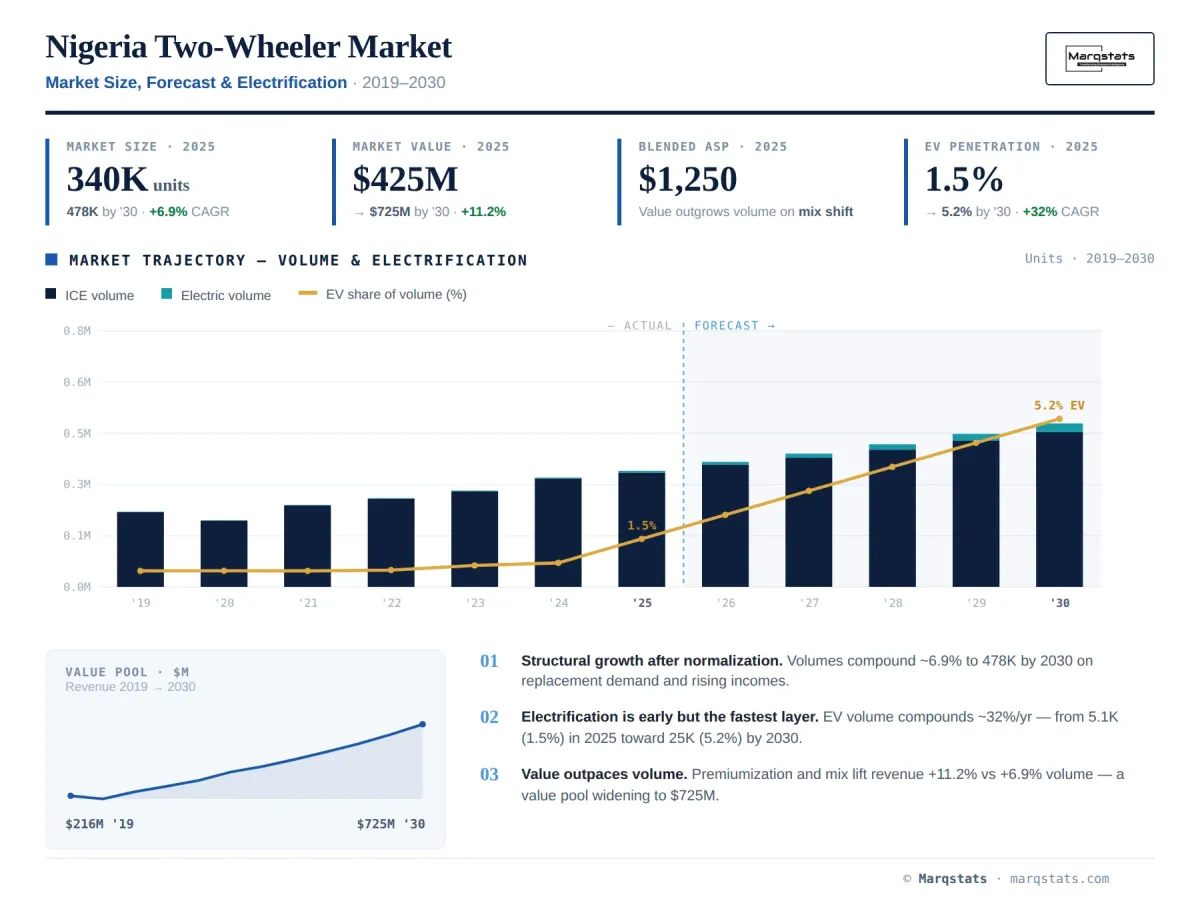
Motorcycles overwhelmingly dominate, at about 99% of unit sales in 2025. Volumes reach 335.07 thousand units in 2025 and are projected to reach 468.1 thousand units by 2030, a 6.8% CAGR. Small commuter and commercial models drive volume, supported by okada, ride-hail, and delivery use. This dominance is among the highest of any market.
Within motorcycles, low-cost commuter models built for durability and easy repair carry most volume. Riders prioritize fuel economy, parts availability, and resale value, which favors established value brands. Commercial riders cover high daily mileage, which drives a shorter replacement cycle and steady renewal demand.
Scooters form a very small yet fast-growing category, at about 1% of units in 2025. Volumes rise from 4.42 thousand units in 2025 to 10.26 thousand units by 2030, a 16.08% CAGR, the fastest-growing vehicle type. Urban commuters and delivery riders drive incremental demand, and electric scooters add to this category.
Scooter demand grows from a low base as urban commuting and delivery expand, and as riders seek simple, automatic transport. Electric scooters are a growing part of this category, supported by battery-swap access in major cities.
Mopeds are a negligible and declining category. Volumes fall from 0.51 thousand units in 2025 to 0.12 thousand units by 2030, a negative 28.14% CAGR. Buyers favor more capable and better-supported motorcycles, which steadily erodes moped demand across the forecast period.
Combustion models held about 98% of units in 2025. Volumes move from 334.9 thousand units in 2025 to 453.36 thousand units by 2030, a 6.1% CAGR. Combustion remains the base of the market through the forecast period, owing to low prices, refueling access, and established parts networks.
Electric two-wheelers are the fastest-growing propulsion type from a small base. Volumes rise from 5.1 thousand units in 2025 to 25.12 thousand units by 2030, a 32.18% CAGR, and revenue expands at a 34.32% CAGR. Growth is led by battery-swap operators serving commercial riders, supported by high fuel costs and policy incentives. Electric share of units is projected to reach about 5% by 2030.
Battery-swap models suit commercial riders, owing to daily mileage that rewards low running costs and quick swaps that avoid charging downtime. Operators lease batteries and swap access, which lowers the upfront barrier against a higher purchase price. Adoption remains constrained by grid and charging infrastructure outside swap networks, however high fuel costs and policy incentives support rapid growth from a low base.
Small-displacement models anchor the market. Up to 110 cc volumes reached 211.71 thousand units in 2025, close to 63% of combustion units. Low prices, fuel economy, and easy servicing make these models the core of the commercial fleet. Commuter and okada riders sustain this base.
The concentration in sub-110 cc models is a defining feature of the market. It reflects the commercial okada and delivery orientation rather than recreation, and it keeps the average selling price low. Demand is highly price-sensitive, and small differences in purchase price and running cost shape brand choice.
The 111 to 125 cc band reached 74.52 thousand units and the 126 to 150 cc band 36.1 thousand units in 2025. These models serve riders seeking more power for heavier loads and longer routes. The 126 to 150 cc band grows at a 9.51% CAGR, faster than the entry tier.
This mid band benefits from delivery operators and riders seeking more power for heavier loads and longer routes. It grows faster than the entry tier as the commercial fleet upgrades and as delivery work expands across the major cities.
Larger motorcycles form a small unit share. The 151 to 200 cc band reached 8.44 thousand units in 2025 and grows at a 14.56% CAGR, the fastest combustion band, owing to delivery and rising rider aspirations. Above 350 cc remains a niche premium tier, concentrated among a small aspirational base in the largest cities.
Within electric two-wheelers, the 1.1 to 3.0 kW band is the largest in 2025, while higher-power bands grow fastest, with the above 5.0 kW class expanding at a 46.65% volume CAGR. Most electric demand serves commercial delivery and ride-hail.
The entry and commuter tiers serve okada and delivery demand and anchor the market. Value brands hold strong positions here, owing to affordability, parts availability, and resale value. These tiers grow fastest through the forecast period as the commercial fleet renews and expands.
Higher price tiers serve a smaller base of aspirational and premium buyers. The price-band classification was revised during the historical period, so tier shares are stated on a reconciled basis. Premium demand remains limited in a budget-driven market, however it grows from a small base.
The value and higher tiers therefore serve very different buyers. Commercial and commuter demand concentrates in the entry tiers, while a small aspirational segment supports higher-priced models. This balance keeps the market firmly budget-driven, with growth concentrated in affordable commercial models.
Private consumers are the dominant end user, at roughly 96% of demand with 328.1 thousand units in 2025. This base includes owner-operators who use motorcycles commercially for okada and delivery work. It grows at a 6.65% CAGR through the forecast period, driven by commercial okada and delivery ownership across a large, young population.
Commercial and fleet demand grows faster than private demand. Delivery and logistics is the largest formal commercial use at 8.34 thousand units, growing at a 12.95% CAGR, and ride-hail, rental, and tourism use expands at a 16.25% CAGR. Fleet operators and delivery platforms drive much of this growth, and electric models concentrate here.
Formal fleets remain a small share of a market dominated by individual owner-operators, however they grow quickly and lead electric adoption. Ride-hail and delivery platforms increasingly procure motorcycles directly, which supports both fleet and online channels.
Dealerships and physical retailers held about 88% of units in 2025 with 300.35 thousand units. Offline volumes grow modestly at a 2.48% CAGR and remain the dominant channel through the forecast period. Physical dealers retain value for service, financing, and regional reach across a large country.
Online retail is the fastest-growing channel from a small base. Volumes rise from 39.65 thousand units in 2025 to 136.33 thousand units by 2030, a 25.03% CAGR, and revenue grows at a 29.95% CAGR. Online share approaches a third of unit volume by 2030, owing to digital platforms and fleet procurement.
Online growth reflects rising digital adoption and fleet procurement by delivery and ride-hail operators. Platforms bundle financing and delivery, which lowers friction for buyers in a cash-driven market. Dealerships retain a central role for service, financing, and regional reach, and they remain the majority channel through the forecast period.
By Geography
Lagos and the South-West
Lagos and the South-West form a large commercial and delivery hub, owing to concentration of population, commerce, and logistics activity. Economic and population data from the national statistics bureau (nigerianstat.gov.ng) records the largest urban base here. Commercial okada restrictions limit motorcycle-taxi use in parts of Lagos, however delivery and courier demand remains strong, and the region leads electric two-wheeler deployment.
Northern Nigeria
Northern Nigeria, including Kano and Kaduna, shows the highest motorcycle dependence in the country. Motorcycles serve commuting, trade, and rural mobility, and okada use is central to daily life. Small-displacement, low-cost models are most common, and demand is highly price-sensitive.
The North combines dense cities with extensive rural districts, where motorcycles are often the only practical transport. Trade, agriculture, and commuting sustain steady replacement demand and a large aftermarket for parts and repair across the region.
South-East and South-South
The South-East and South-South, including Onitsha, Aba, and Port Harcourt, add strong commercial demand. The region hosts local assembly and a large trade in motorcycles and parts. Commuting, delivery, and small-business use sustain demand.
The South-East is a major hub for motorcycle trade and local assembly, and it supplies dealers across the country. Commercial demand, small-business activity, and a strong repair economy underpin sales, and local brands hold visible positions here.
Abuja and North-Central
Abuja and the North-Central region add demand around the capital and Middle Belt cities. Institutional, government, and delivery demand grows in and around the capital, and durable commuter models suit mixed terrain and longer distances between towns across the Middle Belt.
How Competition Is Evolving
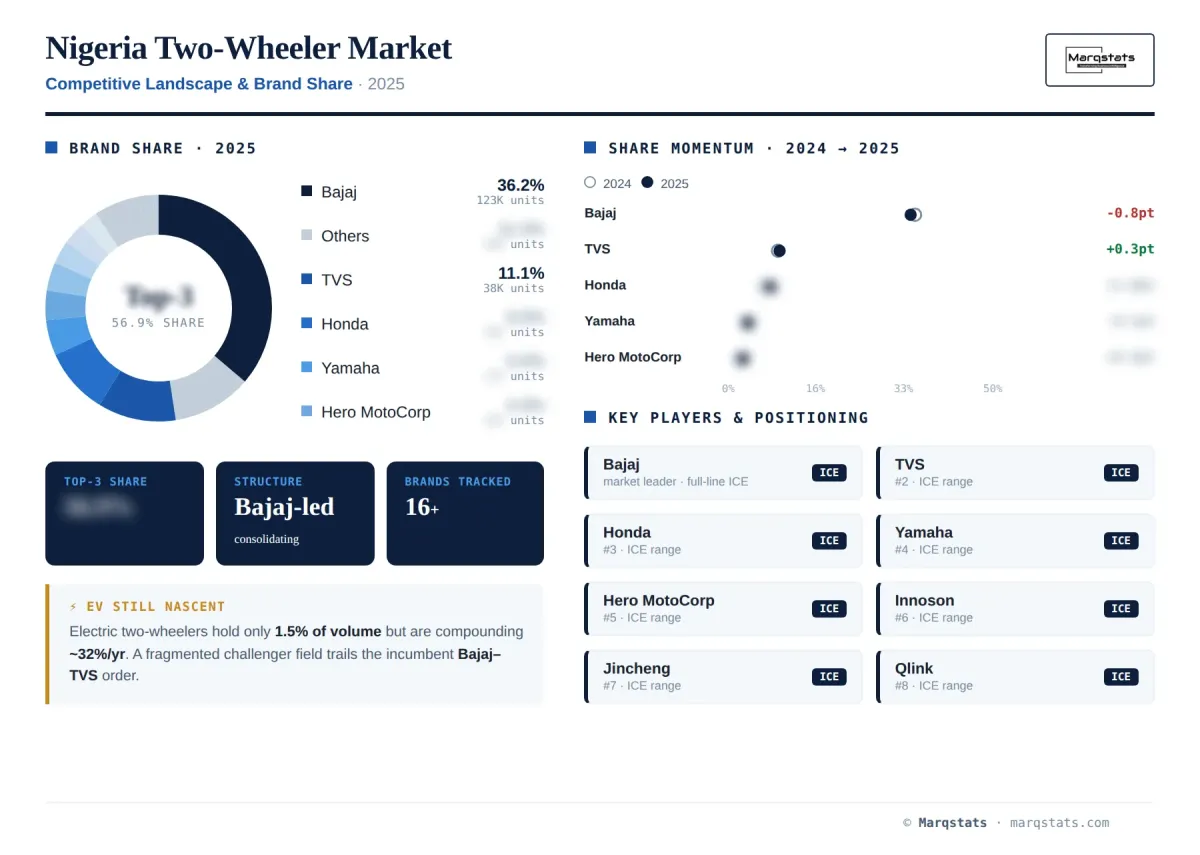
The Nigeria two-wheeler market is moderately concentrated, and a single brand leads by a wide margin. Bajaj held about 36% of unit volume in 2025, ahead of TVS at about 11% and Honda at about 9%. The five largest brands held close to 66% of volume, and value brands hold most of the commercial tier.
Competition centers on price, parts availability, resale value, durability, and dealer coverage. Bajaj leads on brand trust, widely available parts, and strong resale value, and its models are established across the commercial okada and delivery fleet nationwide. TVS and Honda compete strongly in delivery and commuter use. Local and Chinese value brands compete on price and availability, and local assembly supports some players and lowers exposure to import costs.
Electrification is reshaping competition. Battery-swap operators lead the electric segment, owing to leasing models that suit commercial riders, and they compete on running cost rather than purchase price. Distribution strategy also favors brands that build online sales and fleet-procurement channels. Parts and service availability remain decisive across a large and dispersed market.
Brand strategy also reflects the shift toward electric models and online distribution. Value brands defend share through parts networks, resale value, and dealer coverage, while battery-swap operators build fleets and swap infrastructure. Brands that pair affordable pricing with reliable parts supply hold share most effectively during periods of currency depreciation.
Companies Covered
The report profiles 16+ companies with full strategy and financials analysis, including:
Recent Market Activity
Table of Contents
Coverage & Segmentation
This report provides a comprehensive analysis of the Nigeria two-wheeler market across 2021 to 2030, with 2025 as the base year and 2026 to 2030 as the forecast period. The study measures market size in unit volumes and revenue, and it segments demand by vehicle type, propulsion type, engine displacement and motor power, price band, end user, sales channel, and brand.
The report examines demand drivers, restraints, and trends, along with competitive structure and brand positioning. Regional coverage spans Lagos and the South-West, Northern Nigeria, the South-East and South-South, and Abuja and the North-Central region. The analysis integrates registration and import data, automotive policy, and primary interviews to reconcile brand-level and category-level estimates into a single market view. The price-band series reflects a reclassification during the historical period and is stated on a reconciled basis.
The study also assesses fuel-cost and currency effects, early electrification, local assembly, and the balance between private and commercial demand. Forecasts are built at the segment level and reconciled to the total market, so that vehicle type, propulsion, displacement, price band, end user, and channel views remain internally consistent across the historical and forecast periods.