Market Snapshot
Key Takeaways
Market Overview & Analysis
Report Summary
The intelligent connected two-wheeler market covers the full intelligence stack applied to motorcycles, electric scooters, mopeds, and powered two-wheelers: (1) smart cluster and HMI hardware/software for rider interaction; (2) embedded telematics including TCU, cellular connectivity, GPS, cloud backend, and remote diagnostics; (3) software-defined intelligence including OTA update platforms, energy management, personalisation, and subscription services; and (4) advanced rider assistance systems (ARAS) including radar, camera, sensor fusion, and future IoV/V2X communication. The scope covers both OEM-embedded systems (factory-installed intelligence) and aftermarket connectivity solutions, across electric and ICE two-wheelers, for passenger/personal and commercial/fleet applications. Electric bicycles exceeding 25 km/h that fall under UNECE cybersecurity regulation are included in the regulatory analysis; standard pedal-assist e-bikes below 25 km/h are excluded.
This market is moving through the same broad arc that connected cars followed, but with two-wheeler-specific dynamics. The first wave is connectivity and telematics at scale—vehicle tracking, anti-theft, diagnostics, navigation, and OTA. The second wave is software-defined UX and subscription-linked services—voice, personalisation, charging control, and app-linked features. The third wave is ARAS and eventually V2X/IoV—radar/camera warning systems and vehicle-to-everything communication. Electric scooters and electric motorcycles accelerate all three waves because they naturally benefit more from OTA, app control, battery intelligence, and continuous software improvement than legacy two-wheelers.
Market Dynamics
Key Drivers
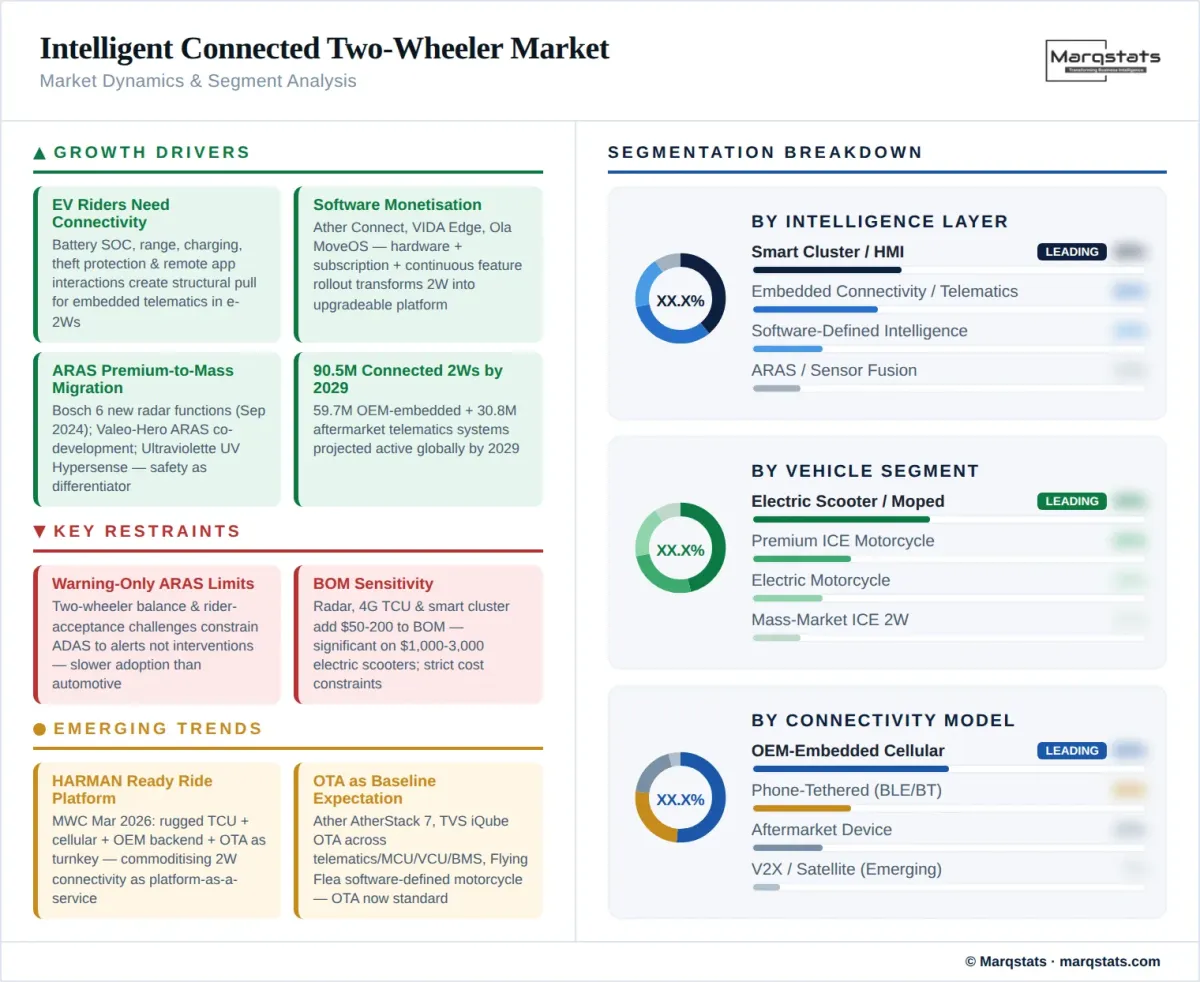
- Electric two-wheelers naturally benefiting more from connectivity than ICE: EV riders care about battery SOC, remaining range, charging location, thermal behaviour, vehicle health, theft protection, and remote app interactions far more frequently than a typical ICE commuter. This creates a structural pull for embedded telematics, connected clusters, and app ecosystems. Industry analysis explicitly identifies the increasing interest in electric two-wheelers as a major catalyst for telematics adoption. India’s 14+ lakh e-2W sales in FY2025–26 and China’s massive electric scooter fleet create the volume base for connected feature deployment at scale.
- Software monetisation and lifecycle extension creating recurring revenue: The market is moving from one-time hardware sale to hardware + subscription + continuous feature rollout. Ather Connect uses an in-built 4G SIM for dashboard navigation, OTA upgrades, ride statistics sync, Find My Scooter, and call/music control. VIDA sells a separate VIDA Edge connectivity plan. Ola’s MoveOS layers range prediction, proximity unlock, geofencing, ride controls, and remote app functions. Flying Flea positions its motorcycle as something that “grows with you” through OTA. This software-as-service model transforms the two-wheeler from a depreciating asset to an upgradeable platform.
- ARAS safety differentiation driving premium-to-mass migration: Bosch announced six new motorcycle radar-based assistance functions in September 2024 (blind-spot detection, forward collision warning, riding distance assist, emergency brake assist, rear distance warning, rear collision warning, group ride assist), with KTM as the first production user. In January 2026, Valeo and Hero MotoCorp announced ARAS co-development for both entry-level and premium motorcycles and scooters, including Hero’s VIDA EV range. Ultraviolette’s X-47 markets radar-based rear collision warning, lane change assist, overtake alert, and blind-spot monitoring as headline features. This signals motorcycle ADAS is transitioning from European touring-bike premium to Asian mass-market two-wheelers.
- Cybersecurity regulation extending to two-wheelers in UNECE markets: UNECE confirmed in January 2024 that its cybersecurity regulation would extend to motorcycles, scooters, and electric bicycles exceeding 25 km/h. As motor control, battery management, charging, and connected services become software-defined, manufacturers need secure architectures and compliance-ready electronics. NXP’s motorcycle cybersecurity guidance makes clear that connected two-wheelers must meet the same security standards as connected cars. This regulatory push creates compliance-driven demand for intelligent connected hardware and software stacks.
- China’s GB 17761-2024 mandating intelligence in electric bicycles: China’s new electric-bicycle safety standard, released December 2024 and effective September 2025, includes BeiDou positioning, communication, and dynamic safety monitoring within the standard scope. This makes intelligence partly compliance-driven in China’s massive light-EV ecosystem, accelerating connected feature adoption across NIU, Yadea, Segway-Ninebot, and Sunra’s product lines.
Key Restraints
- Two-wheeler ARAS limited to warning functions, not autonomy: Unlike cars, motorcycles and scooters face tougher rider-balance, lane-positioning, rider-acceptance, and false-alert tolerance challenges. Current motorcycle ADAS is warning-heavy—blind-spot alerts, rear-distance warnings, crash detection—rather than intervention-heavy like automotive ADAS. More active control functions will spread more slowly because they demand tighter system integration, stronger safety validation, and better rider trust.
- BOM sensitivity constraining intelligence content on mass-market two-wheelers: Two-wheelers operate at much lower price points than cars, making every dollar of added intelligence content a meaningful percentage of vehicle cost. Radar modules, 4G TCUs, and advanced smart clusters can add USD 50–200 to BOM, which is significant on a USD 1,000–3,000 electric scooter. Near-term winners must deliver intelligence within strict BOM constraints—which is why phone-tethered solutions (Bluetooth/BLE smartphone integration) coexist with fully embedded cellular systems.
- Aftermarket fragmentation and interoperability gaps: The 30.8 million aftermarket connected systems projected by 2029 face fragmentation challenges: non-standardised APIs, limited OEM integration depth, varying data security, and inconsistent user experience versus factory-embedded solutions. Aftermarket devices typically cannot access deep vehicle bus data, limiting their intelligence to GPS tracking, basic diagnostics, and app notifications rather than full software-defined UX or ARAS integration.
Key Trends
- HARMAN Ready Ride commoditising two-wheeler connectivity as a platform: Launched at MWC March 2026, HARMAN’s Ready Ride packages a rugged two-wheeler TCU, cellular connectivity, software stack, OEM backend, and OTA support as a turnkey solution. This signals that two-wheeler connectivity is commoditising from custom Tier 1 development to platform-as-a-service, reducing time-to-market for OEMs and lowering the barrier for mid-tier manufacturers to offer connected features.
- Sensor-to-software intelligence supply chain emerging for two-wheelers: No analyst report currently covers the full intelligence supply chain for two-wheelers—from radar/camera sensors (Bosch, Valeo) through processors (Qualcomm Snapdragon, NXP MCUs, Infineon) to OS/middleware (HARMAN, Sibros, Pioneer Ride Connect) to cloud/app ecosystems (Ather Connect, MoveOS, VIDA Edge). This “from sensor to software” stack is the differentiated scope of this report, filling a gap between generic e-bike market reports and automotive ADAS reports that ignore two-wheelers.
- OTA update capability becoming a baseline expectation for electric two-wheelers: Ather’s AtherStack 7 OTA roadmap adds proactive voice, pothole alerts, crash alert, ParkSafe, LockSafe, remote control, and multi-language support. TVS iQube delivers OTA across telematics, MCU, VCU, and BMS. Ola’s MoveOS layers features continuously. Flying Flea was explicitly designed as a software-defined motorcycle at CES 2025. Two-wheeler OTA update capability is transitioning from premium differentiator to mass-market baseline, particularly for electric models where software governs the entire vehicle experience.
- Pioneer Ride Connect signalling phone-first software-upgradable motorcycle UX: Pioneer’s December 2024 partnership with HERE Technologies and its CES 2025 showcase of Smart Display and Ride Recorder for two-wheelers frame the next step as a motorcycle-specific connected UX platform built around smartphone integration, crash detection, eCall, and generative AI analytics. Pioneer’s May 2025 Bengaluru R&D centre inauguration dedicated to automotive vision, ADAS, digital cockpits, and connected solutions for two-wheelers confirms long-term commitment.
Market Segmentation
The display, input, UI, and phone-integration layer. TVS iQube advertises a fully connected TFT experience with navigation, incoming call/SMS alerts, and 118+ connected features. Flying Flea C6 positions its display as a command centre. Minda Corporation developed indigenous cockpit domain controllers (hardware and software), TFT clusters above 10 inches, and mobile-connected clusters with real-time vehicle data. Infineon markets smart connected console solutions for light electric vehicles and two-wheelers. This layer is the entry point for intelligence adoption and the most widely deployed across both electric and ICE two-wheelers.
The always-on connected layer: cellular TCU, GPS, cloud backend, app ecosystem, theft alerts, stolen-vehicle tracking, and remote diagnostics. Approximately 16.7 million OEM-embedded telematics systems were active in 2024, projected to reach 59.7 million by 2029, plus 30.8 million aftermarket systems. HARMAN’s Ready Ride (March 2026) provides a rugged, scalable platform. TVS iQube ST lists OTA for telematics, MCU, VCU, and BMS via GSM connectivity. Kinetic Watts & Volts partnered with Jio Things (December 2025) for IoT-based connected vehicle technology across all upcoming EV models. Greaves/Ampere integrated Sibros’ Deep Connected Platform for real-time data logging, OTA, and predictive maintenance.
Where ride quality, energy management, personalisation, and UX evolve after the sale through OTA. Ola’s MoveOS includes range prediction, advanced regen, cruise control, proximity unlock, geofence/timefence controls, and live location sharing. Ather’s AtherStack 7 adds proactive voice, pothole alerts, crash alert, ParkSafe, LockSafe, and multi-language dashboard support. Flying Flea’s official CES 2025 positioning describes the motorcycle as something that can “grow with you” through OTA. This layer transforms the two-wheeler from a depreciating hardware product into a software-upgradeable intelligent vehicle.
The step from “connected” to genuinely “intelligent.” Bosch’s current two-wheeler radar stack includes blind-spot detection, forward collision warning, rear warning, emergency brake assist, riding distance assist, and adaptive cruise control stop-and-go—with KTM as first production user (2025). Valeo and Hero MotoCorp are pairing radar with smart cameras for FCW, distance warning, lane change assist, blind-spot detection, rear collision warning, pedestrian detection, and traffic sign recognition across entry-level to premium models. Ultraviolette’s X-47 UV Hypersense package includes radar-based rear collision warning, lane change assist, overtake alert, and dashcam module. Ducati’s C-V2X demonstrations with Audi/Qualcomm show intersection collision warning and sudden-braking alerts. The Connected Motorcycle Consortium’s 5GAA technical report reinforces that two-wheeler C-V2X use cases include V2V, roadside infrastructure, and network-enabled computing.
The fastest-growing segment for intelligent connected features. India’s 14+ lakh e-2W sales (FY2025–26), China’s NIU/Yadea/Segway-Ninebot ecosystem, and Europe’s shared e-scooter platforms create massive volume for smart electric scooter connectivity. Ather, TVS iQube, Ola, VIDA, and Ampere all compete on connected features as primary purchase differentiators alongside range and price.
Premium positioning with deepest intelligence content. Flying Flea C6 with Qualcomm Snapdragon QWM2290 is designed as a software-defined electric motorcycle. Ultraviolette F77/X-47 lead on radar-based ARAS marketing. Zero Motorcycles integrates connected features as standard. Electric motorcycles offer the highest per-vehicle software and ARAS content, creating premium ASP for the intelligence stack.
The installed-base upgrade opportunity. BMW Motorrad, KTM, Ducati, and Royal Enfield lead connected feature deployment on ICE platforms. Bosch’s radar ARAS stack is primarily deployed on ICE premium motorcycles today. Aftermarket telematics (30.8 million units by 2029) serves the massive global ICE motorcycle parc that cannot be upgraded to factory-embedded connectivity.
By Geography
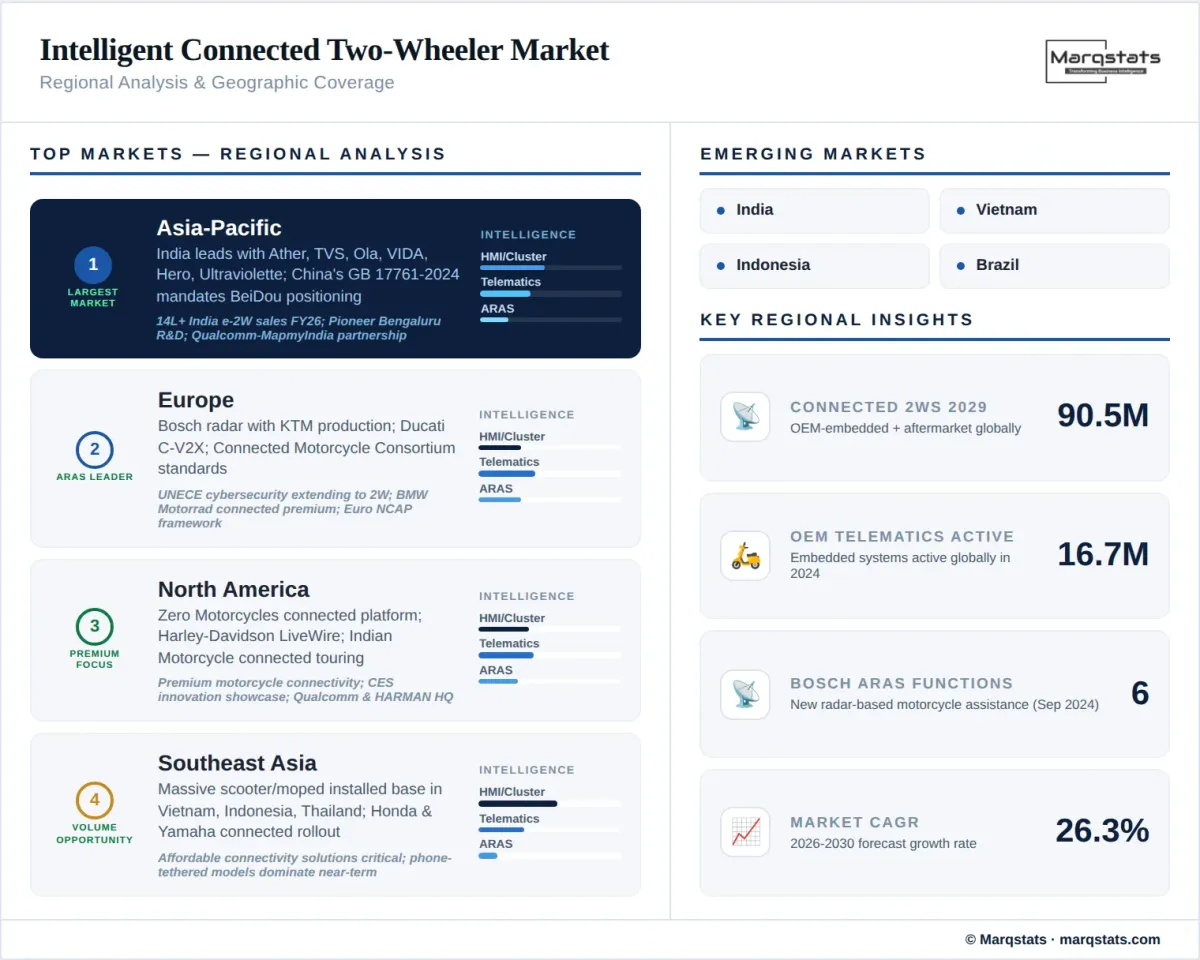
Asia-Pacific (India and China)
The largest market by connected-unit volume. India leads with Ather, TVS, Ola, VIDA, Hero/Flying Flea, and Ultraviolette all competing on smart electric scooter and connected electric motorcycle features. Valeo’s January 2026 ARAS partnership with Hero MotoCorp signals motorcycle ADAS arriving at mass-market scale in India. China’s GB 17761-2024 makes BeiDou positioning and dynamic safety monitoring mandatory for electric bicycles, creating compliance-driven intelligence adoption across NIU, Yadea, Segway-Ninebot, and Sunra. Qualcomm’s January 2025 partnership with MapmyIndia for automotive connectivity further strengthens India’s intelligence supply chain. Pioneer’s May 2025 Bengaluru R&D centre dedicated to two-wheeler connected solutions confirms Tier 1 commitment to the Indian market.
Europe
Leadership in premium motorcycle ARAS and V2X standards. Bosch’s radar-based ARAS with KTM production entry, Ducati’s C-V2X demonstrations, and the Connected Motorcycle Consortium’s standards work are predominantly European. UNECE cybersecurity regulation extending to two-wheelers creates compliance-driven demand for secure connected architectures. Euro NCAP’s 2026 safety update, while primarily automotive, sets the framework for two-wheeler safety technology evolution. BMW Motorrad remains Europe’s highest-profile connected motorcycle brand.
North America
Market driven by premium motorcycle connectivity and emerging electric motorcycle brands. Harley-Davidson/LiveWire, Zero Motorcycles, and Indian Motorcycle lead connected feature deployment. HARMAN’s Ready Ride launch at MWC 2026 and its satellite-enabled voice calling demonstration with Viasat signal North American Tier 1 investment in two-wheeler connectivity platforms. Qualcomm’s Silicon Valley base anchors the semiconductor supply chain for connected two-wheeler SoCs.
Rest of World
Southeast Asia represents the next growth frontier, with Indonesia, Vietnam, and Thailand as major two-wheeler markets transitioning to electric. HERE Technologies and Pioneer’s connected two-wheeler devices debuted at Bharat Mobility 2025 targeting Asia-Pacific expansion. Africa’s emerging electric two-wheeler market (covered in the Marqstats Africa two-wheeler market report) presents a long-term opportunity for basic telematics and fleet management.
How Competition Is Evolving
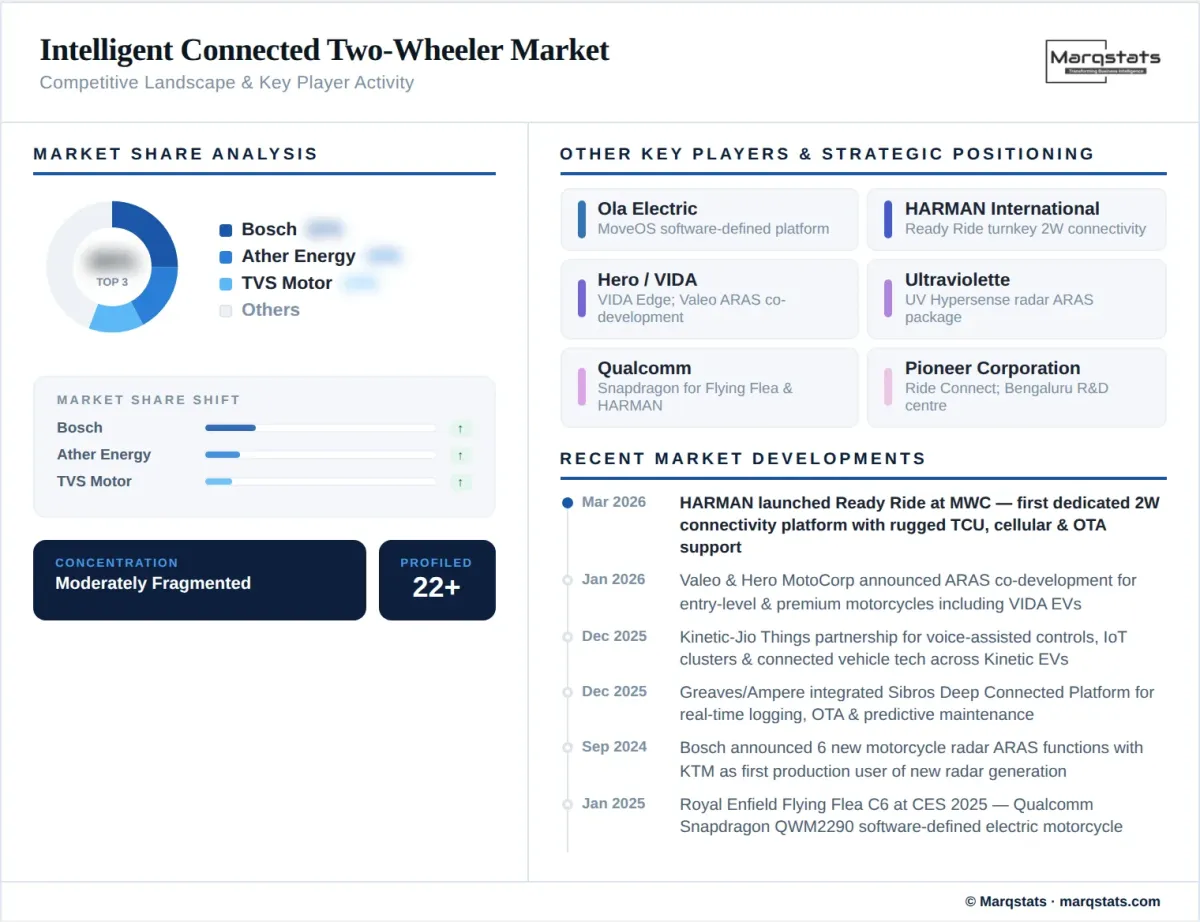
The intelligent connected two-wheeler market features four competitive layers. First, OEMs and brands competing on intelligence as a core product differentiator: Ather (AtherStack 7, Ather Connect 4G), TVS (iQube SmartXonnect, 118+ features), Ola (MoveOS), Hero/VIDA (VIDA Edge, Flying Flea Qualcomm-powered), Ultraviolette (UV Hypersense radar package), BMW Motorrad, KTM (first Bosch radar ARAS production user), Royal Enfield, NIU, Yadea, Segway-Ninebot, Sunra, Zero Motorcycles, and LiveWire. India’s electric scooter OEMs are competing on connected features as aggressively as on range and price, making the Indian market the world’s most intense battleground for two-wheeler intelligence.
Second, Tier 1 and platform suppliers providing the intelligence infrastructure: Bosch (motorcycle radar ARAS, six new functions for KTM), Valeo (Hero MotoCorp ARAS partnership, radar + smart camera), HARMAN (Ready Ride turnkey connectivity platform), Continental, Panasonic, Cerence AI (Kawasaki voice partnership), and Sibros (Greaves/Ampere Deep Connected Platform). Third, silicon and E/E suppliers: Qualcomm (Snapdragon for Flying Flea, HARMAN Ready Ride, MapmyIndia automotive connectivity), NXP (cybersecure motorcycle processors), Infineon (smart connected console for light EVs), and semiconductor ecosystems supporting embedded telematics. Fourth, cloud/app/software ecosystems creating the recurring-revenue retention layer: Ather Connect, VIDA Edge, Ola MoveOS, Pioneer Ride Connect, TVS SmartXonnect, and Flying Flea’s cloud-connected platform.
The competitive dynamic is shifting from “who has the best drivetrain” to “who has the best software-defined intelligence platform.” OEMs that can combine embedded connectivity, strong app/cloud execution, cybersecure E/E architecture, and selective ARAS innovation without exceeding mass-market BOM constraints will capture the most value. In the medium term, the market’s centre of gravity should shift from “connected scooter” to “software-defined intelligent two-wheeler,” with ARAS and IoV gradually becoming mainstream once the connectivity base is large enough.
Companies Covered
The report profiles 25+ companies with full strategy and financials analysis, including:
Recent Market Activity
Table of Contents
Coverage & Segmentation
This report provides a comprehensive analysis of the global intelligent connected two-wheeler market covering the historical period (2021–2025) and forecast period (2026–2030), with 2025 as the base year. The study examines market size in USD across four intelligence layers (smart cluster/HMI, embedded telematics, software-defined intelligence, ARAS/IoV), by vehicle type (electric scooter, electric motorcycle, ICE motorcycle), by connectivity model (OEM-embedded, aftermarket, phone-tethered), and by geography. The report uniquely covers the full “from sensor to software” intelligence supply chain—radar/camera sensors, processors/SoCs, OS/middleware, cloud/app ecosystems—filling a gap between generic e-bike market reports and automotive ADAS reports that ignore two-wheelers. Company profiling covers 25+ players across OEMs, Tier 1 suppliers, silicon vendors, and cloud/app ecosystems. Standards analysis covers UNECE cybersecurity extension to two-wheelers, China GB 17761-2024, ISO 26262 applicability, and AIS 156 safety certification.
Research methodology combines bottom-up unit modelling from telematics installed-base forecasts (90.5M connected units by 2029), OEM product feature analysis, Tier 1 supplier platform disclosures, and semiconductor shipment estimates. Primary research includes interactions with connected two-wheeler OEMs, ARAS system suppliers, telematics platform providers, and cybersecurity specialists. The Marqstats India electric two-wheeler battery market report, Africa two-wheeler market report, and automotive AI box market report provide complementary coverage of the battery, geographic, and compute layers intersecting with two-wheeler intelligence.