Market Snapshot
Key Takeaways
Market Overview & Analysis
Report Summary
The Qatar two-wheeler market comprises motorcycles, scooters and mopeds sold for personal transport, leisure riding, commercial delivery and commuting across internal combustion and electric propulsion. Qatar is among the highest-income nations in the world, with a population of about 3 million dominated by expatriate residents, and its two-wheeler demand reflects affluence, a large delivery workforce and an emerging recreational riding culture rather than mass commuting. Demand concentrates in Doha and its surrounding municipalities, which contain most of the population and commerce.
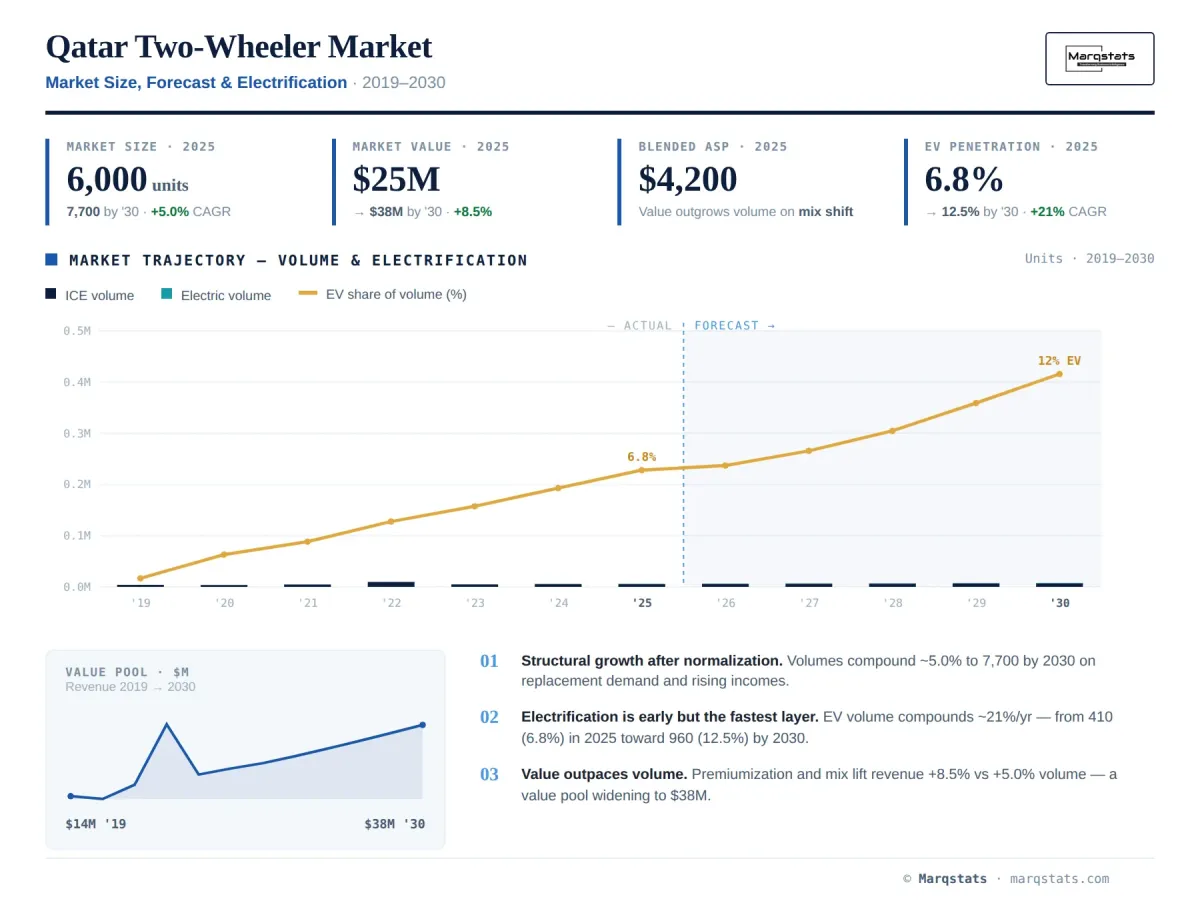
The market's history includes a pronounced one-off surge. Two-wheeler volumes spiked in 2022 during the FIFA World Cup, when a build-up of delivery fleets, event logistics and tourism temporarily lifted demand well above trend, before normalising from 2023. Setting that event aside, the underlying market has grown steadily. Its defining feature is a premium tilt: unlike affordability-led markets, Qatar is centred on mid and premium price bands and larger-displacement machines, with the smallest commuter classes in gentle decline. Growth over the forecast period combines steady unit expansion with a continued shift up the value curve and rapid electrification from a small base.
Qatar's premium brand mix aligns it with the intelligent connected two-wheeler market, where premium international OEMs such as BMW Motorrad, Piaggio, Honda and Yamaha lead demand and higher-value, feature-rich machines set the pace. Electrification is advancing owing to rising environmental awareness, premium electric models and expanding urban charging, and is moderated by limited charging infrastructure, hot-climate conditions and the higher upfront cost of electric machines in a small market.
Two features define Qatar's market. First, it is affluent and premium-tilted: the largest price band is the mid segment, premium and high-premium tiers grow fastest, and larger-displacement machines outpace the smallest commuter classes, reflecting riders buying for lifestyle and leisure as much as for transport. Second, it is brand-diverse and premium-oriented: no single brand dominates, and the field spans Japanese majors, a strong scooter-premium presence, an Indian value tier, and European premium marques, giving Qatar a balanced and aspirational brand profile.
The 2022 surge deserves context because it shapes any read of the trend. Qatar's hosting of a major global sporting event drew millions of visitors and a rapid, temporary expansion of last-mile delivery and logistics capacity, which pulled forward two-wheeler purchases and inflated that year's volume. As the event passed, demand reverted toward its structural level, so the 2023 figure represents a return to trend rather than a decline in the underlying market. Treating 2022 as an exceptional data point is essential to reading Qatar's steady, premium-led growth accurately, and this report sizes the market on that reconciled basis.
Market Dynamics
Key Drivers
- Market is driven by a large expatriate delivery workforce that sustains commercial demand for commuter motorcycles and scooters.
- Rising incomes support premium and larger-displacement machines bought for leisure as well as transport.
- Leisure and touring interest is growing, supported by tourism and desert and coastal riding.
- A balanced field of premium Japanese and European brands widens choice and lifts average value across the market.
- Rising online retail, growing at a 24.90% CAGR, is extending access and comparison beyond traditional dealers.
Key Restraints
- The market is very small in absolute terms, limiting economies of scale for importers and dealers.
- High car ownership and a hot climate cap the role of two-wheelers in everyday mobility.
- Limited charging infrastructure and hot-climate battery performance slow electric adoption.
- Import dependence exposes pricing to tariffs, logistics and exchange-rate movements.
Key Trends
- Riders are trading up to larger-displacement machines, with 200cc-plus classes growing fastest as leisure use expands.
- Premiumisation is lifting the premium and high-premium price bands above the entry and mid tiers.
- Electric adoption is rising from a small base, moreover concentrated in premium urban models in Doha.
- Delivery demand is maturing at a 1.80% negative CAGR while private and leisure ownership grows.
Market Segmentation
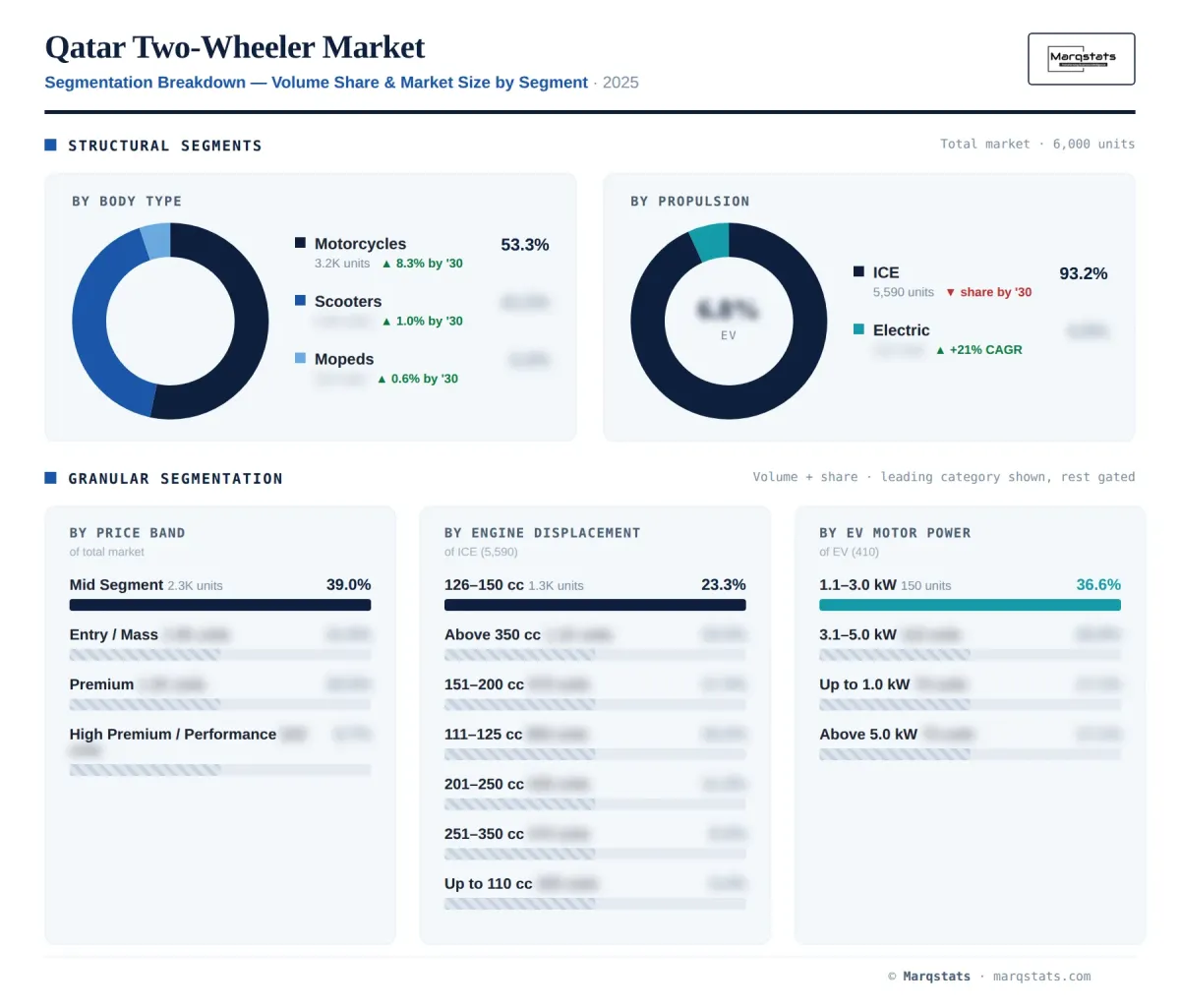
Motorcycles accounted for about 53% of 2025 volume, at roughly 3.2 thousand units, and are forecast to reach about 4.67 thousand units by 2030 at an 8.30% CAGR — the fastest-growing vehicle type. Growth is driven by riders trading up to larger-displacement and leisure machines, alongside commuting and delivery use, and motorcycles account for the bulk of the market's absolute growth.
Scooters accounted for about 42% of 2025 volume, at roughly 2.49 thousand units, growing to about 2.71 thousand units by 2030 at a 1.00% CAGR. Scooters retain a substantial share, valued for urban commuting and delivery convenience in Doha, however they grow slowly as demand shifts toward larger and premium motorcycles.
Mopeds accounted for about 5.2% of 2025 volume, at roughly 0.31 thousand units, and stay flat to about 0.32 thousand units by 2030. The segment is niche and static, serving low-cost short-trip mobility, and is increasingly overlapped by entry-level electric models.
ICE two-wheelers supplied about 93% of 2025 volume, at roughly 5.59 thousand units, and grow to about 6.74 thousand units by 2030 at a 3.50% CAGR. Petrol machines remain dominant, spanning commuter scooters and premium leisure motorcycles, however their share erodes gradually as electric models gain ground in the capital.
Electric two-wheelers accounted for about 7% of 2025 volume, at roughly 0.41 thousand units, expanding to about 0.96 thousand units by 2030 at a 20.90% CAGR — the fastest-growing propulsion class. Adoption is increasing owing to rising environmental awareness, premium electric models and expanding urban charging, and is moderated by limited charging access and hot-climate conditions.
Within ICE machines, the 126–150cc class was the largest displacement band in 2025 at about 1.3 thousand units, followed by the above-350cc class at about 1.08 thousand units and the 151–200cc class at about 0.97 thousand units. The defining pattern is premiumisation: the smallest commuter classes decline while the 251–350cc band grows fastest at a 12.60% CAGR, the 201–250cc class at 7.40%, and the above-350cc class at 5.10%. Across electric motor-power bands, the 1.1–3.0 kW class leads volume while the up-to-1.0 kW and above-5.0 kW categories grow fastest at a 22.50% CAGR, reflecting both entry-level and premium electric demand.
The unusually strong position of the above-350cc class — the second-largest band — marks Qatar out as a leisure and touring market rather than a commuter one. Where affordability-led markets concentrate in sub-150cc machines, a meaningful share of Qatar's demand is for large motorcycles bought for recreation, weekend touring and desert or coastal riding. The fast growth of the 200cc-plus bands, paired with higher prices, is the main reason revenue expands at an 8.50% CAGR against a 5.00% volume CAGR. On the electric side, both low-power urban models and higher-power premium machines lead the fastest growth.
The mid segment was the largest price band in 2025 at about 2.34 thousand units, or roughly 39% of volume, ahead of the entry and mass band at about 1.91 thousand units, or 32%, giving Qatar a far more premium price structure than affordability-led markets. The entry band grows at a 3.50% CAGR and the mid segment at 4.40%, while the premium band at about 1.23 thousand units grows at 7.10% and the high-premium/performance band at about 0.52 thousand units grows fastest at 8.40%. The strength and fast growth of the upper tiers confirm the market's premium character and drive the gap between value and volume growth.
The B2C segment accounted for about 48% of 2025 volume, at roughly 2.86 thousand units, and grows at a 5.60% CAGR as private and leisure ownership widens. Delivery and logistics use is the second-largest category at about 2.01 thousand units, or roughly 34% of volume, however it eases at a 1.80% negative CAGR as the segment matures after the event-driven build-up. Ride-hail, rental and tourism use, at about 0.45 thousand units, grows at 11.20%, B2B and fleet demand grows fastest at 13.70%, and government and institutional use expands from a low base.
This end-user pattern reflects the market's mixed commercial and lifestyle character. The large delivery share reflects Qatar's substantial expatriate delivery workforce and the app-based food and parcel economy in Doha, and its gentle easing follows the normalisation after the 2022 event surge. Private ownership, spanning both practical commuting and aspirational leisure riding, is the durable core and continues to grow, while tourism-linked rental and fast-growing fleet demand broaden the base. The overall mix is gradually rebalancing from delivery-led toward more diversified private and commercial use.
Offline dealerships retained about 89% of 2025 volume, at roughly 5.32 thousand units, and grow at a 1.10% CAGR, reflecting the importance of physical dealers for premium sales, financing, servicing and test rides. Online channels, though about 11% of volume at roughly 0.68 thousand units, grow fastest at a 24.90% CAGR as digital storefronts, marketplaces and brand platforms expand and reach younger, research-driven buyers.
The channel structure reflects the premium character of the market. Because many purchases involve higher-value machines that buyers wish to inspect and test, physical dealers remain central, particularly for premium and leisure brands that rely on showroom experience and after-sales relationships. Online growth is concentrated among younger urban buyers who research and compare models digitally before purchase, reinforced by accessory and apparel sales. Over the forecast period, digital and physical channels are expected to complement one another rather than the former displacing the latter.
By Geography
Two-wheeler demand in Qatar concentrates overwhelmingly in Doha and its surrounding municipalities, which contain most of the population, commerce and delivery activity, with limited additional demand in the outer municipalities. Regional differences are shaped by income, urbanisation and the concentration of the expatriate workforce, and these factors determine where premium, commuter and electric models are most prevalent.
Doha (Capital)
Doha is the dominant demand centre by a wide margin, concentrating income, commerce, delivery activity and the densest dealer networks. The capital anchors premium and leisure demand, hosts the majority of brand showrooms, and leads both electric adoption and online sales. It is also the focal point for the food-delivery and courier services that drive commercial two-wheeler use.
Al Rayyan & Greater Doha
Al Rayyan and the wider Greater Doha area, contiguous with the capital, form the main secondary base of commuter and commercial demand. Dealer and service networks extend across this densely populated zone, and demand mirrors that of the capital across both commuter and premium machines. The area's large residential population and proximity to Doha's commercial districts make it a natural extension of the capital's two-wheeler market rather than a distinct one.
Outer Municipalities
The outer municipalities, including Al Wakrah, Al Khor and Umm Salal, add a smaller base of demand tied to residential growth and industrial activity. Two-wheeler use here skews toward practical commuting and delivery, and premium and leisure demand remains concentrated closer to the capital. As new residential and mixed-use districts develop across Greater Doha under national planning, these areas are expected to contribute a rising share of commuter and delivery demand over the forecast period.
How Competition Is Evolving
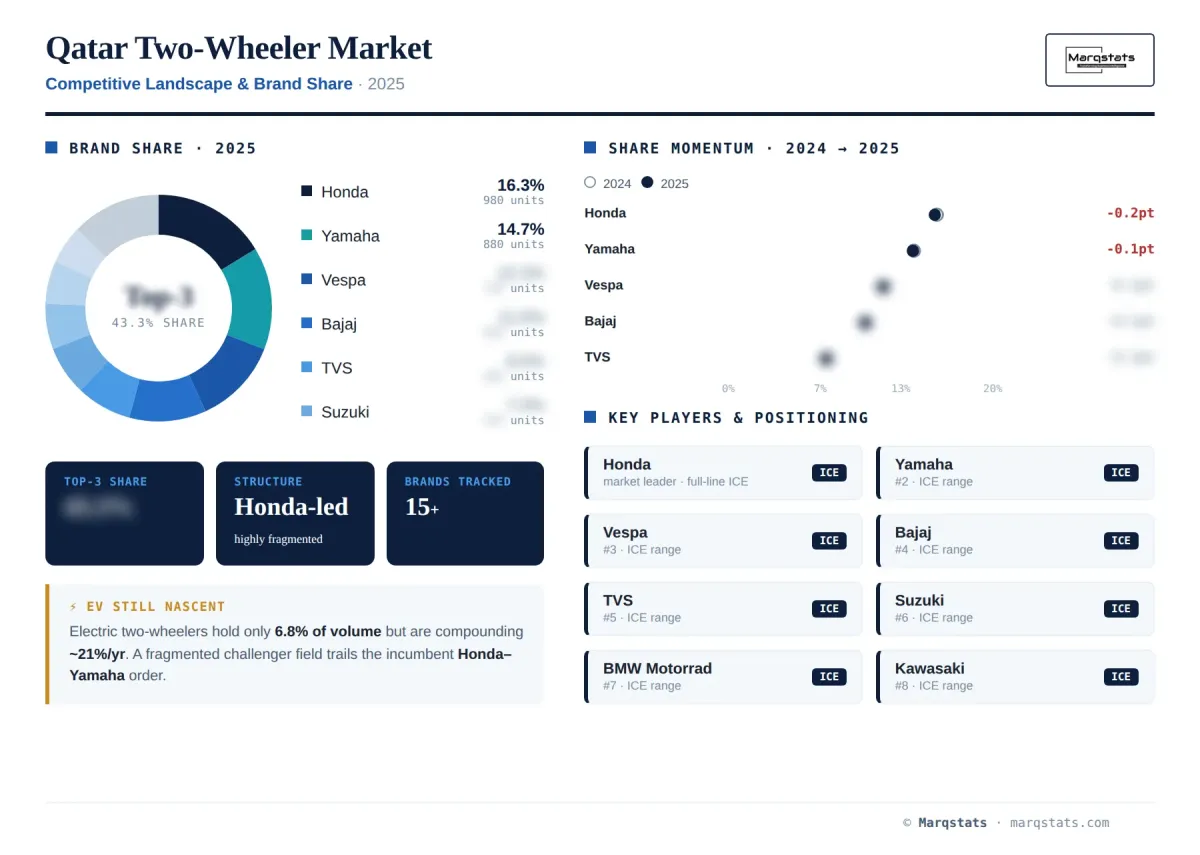
The Qatar two-wheeler market is moderately fragmented and premium-tilted, with no single brand dominating. Honda held about 16% of 2025 volume, followed by Yamaha at about 15%, Piaggio at about 12% and Bajaj at about 11%, with premium European marques BMW Motorrad, Kawasaki and Harley-Davidson holding meaningful shares. Competition centres on brand prestige, model range, dealer experience, after-sales support and, increasingly, larger-displacement and electric offerings.
The market's balance is its defining feature. Japanese brands Honda, Yamaha and Suzuki lead across commuter and mid segments on reputation and reliability, Piaggio and Vespa hold a strong scooter-premium position that reflects Qatar's high scooter share, and Indian brands Bajaj, TVS and Hero anchor the value tier. What sets Qatar apart is the strength of premium and leisure brands: BMW Motorrad, Kawasaki and Harley-Davidson serve the fast-growing large-displacement and touring segment, complemented by KTM and Ducati, while electric brands Yadea and Niu contest the emerging electric segment.
At the brand level, competition is shifting toward the premium and leisure segments where growth is fastest. Value and commuter brands compete on price and dealer coverage, while premium marques differentiate through prestige, performance and lifestyle appeal, supported by showroom experience and rider communities. Over the forecast period, brands positioned in larger-displacement, premium and electric machines are expected to gain share as the market continues its shift up the value curve, while entry-level commuter demand softens.
Companies Covered
The report profiles 16+ companies with full strategy and financials analysis, including:
Recent Market Activity
Table of Contents
Coverage & Segmentation
This report provides a comprehensive analysis of the Qatar two-wheeler market across a 2025 base year, historical data from 2021 to 2025, and forecasts spanning 2026 to 2030. The study sizes the market in both volume (thousand units) and value (USD million) and segments it by vehicle type (motorcycles, scooters and mopeds), propulsion type (internal combustion engine, electric), engine displacement and motor power, price band, end user, and sales channel. Brand-level analysis covers the Japanese and Indian OEMs and the premium European and electric brands that shape Qatari supply.
The study examines market drivers, restraints and trends, segment-level growth, regional demand across Doha and the wider country, competitive structure, and forward catalysts including the delivery economy, premiumisation, leisure and touring demand, and electrification. The 2022 volume spike is reconciled to the event-driven surge around the FIFA World Cup rather than a change in underlying demand or methodology. All market estimates represent Marqstats-reconciled figures derived from a bottom-up methodology validated against top-down benchmarks, using national statistics, trade indicators and registration data rather than any single external source.
The report is designed for two-wheeler manufacturers, importers and distributors, premium and leisure brands, delivery and rental operators, component and battery suppliers, and policymakers assessing Qatar's mobility path. It supports market sizing, brand and channel benchmarking, and scenario planning around premiumisation, electrification and tourism-linked demand. Volume and value forecasts are provided at segment level for the 2026–2030 window, with 2021–2025 historical context, enabling comparison against neighbouring Gulf and Middle Eastern markets.