Market Snapshot
Key Takeaways
Market Overview & Analysis
Report Summary
The Peru two-wheeler market covers motorcycles, scooters, and mopeds sold for private, commercial, and institutional use. The study measures demand in unit volumes and revenue across 2021 to 2025 historical years and 2026 to 2030 forecast years, with 2025 as the base year. Coverage spans propulsion type, engine displacement and motor power, price band, end user, sales channel, and brand.
Peru differs from most regional markets in the degree of motorcycle dominance. Motorcycles serve commuting, delivery, and income-generating transport rather than recreation. Small-displacement commuter models carry almost all volume, and average selling prices remain low. The market is budget-driven, and buyers weigh purchase price, fuel economy, and durability above brand prestige.
Import dependence shapes supply. Peru assembles a limited share of two-wheelers, so most units and components arrive from Asia. Landed cost tracks the exchange rate and freight conditions, and retail prices move with currency cycles. A favorable exchange rate and wider stock availability supported the recovery into 2025, while financing access broadened the buyer base at the entry tier.
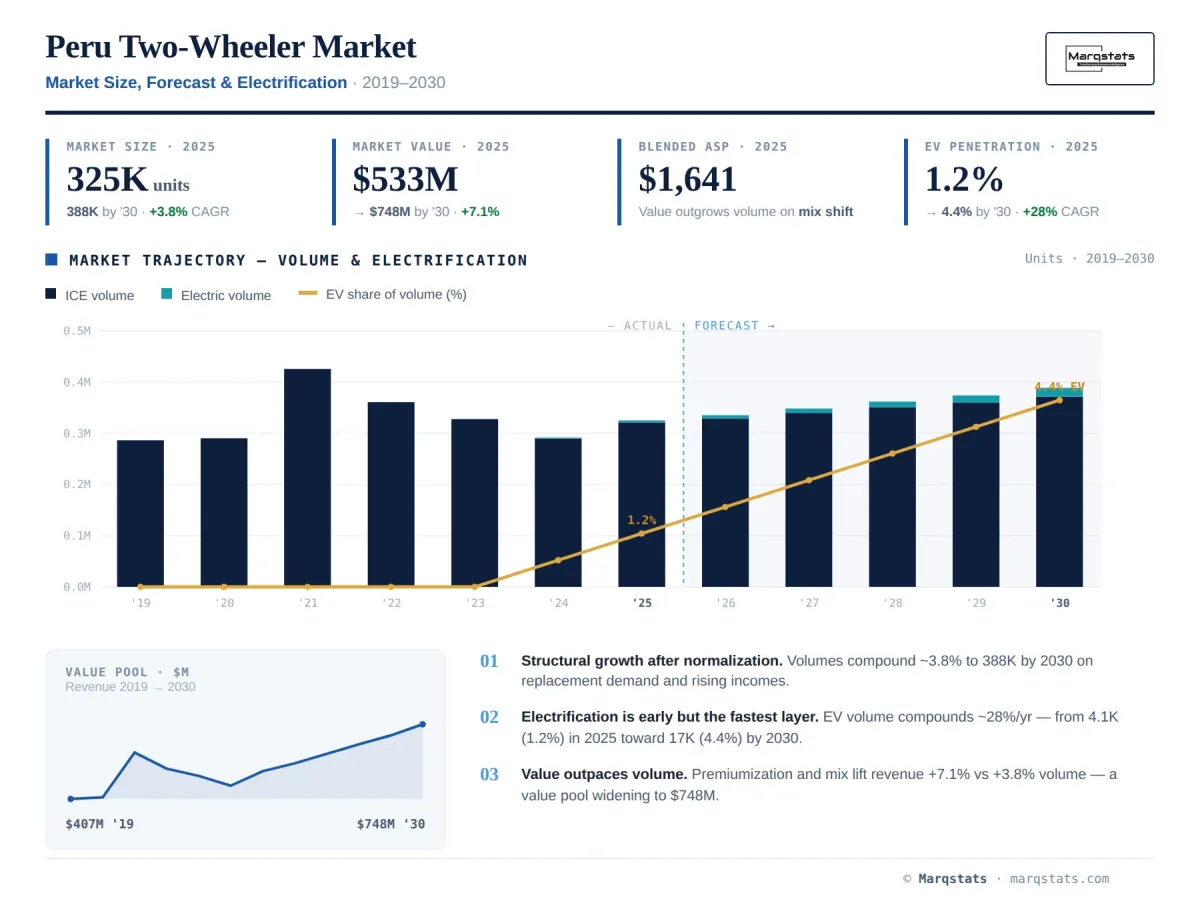
Growth is attributed to steady work-related demand, a large informal transport economy, improving financing access, and the renewal of units bought during the pandemic. The automotive association (aap.org.pe) describes two-wheelers as tools that sustain delivery, courier, and mobility services for lower-income households. Motorcycle demand in Peru resembles the work-tool and value-brand character tracked in the Africa two-wheeler market. Revenue grows faster than units as buyers move toward higher-value motorcycles and electric models.
Market Dynamics
Key Drivers
- Motorcycles serve as income-generating work tools for delivery, courier, and mobility services, which sustains steady demand across the country.
- A large informal and last-mile transport economy supports high motorcycle use, especially in the north and Amazon regions.
- Improving financing access and vehicle credit widen the buyer base, owing to stronger purchasing power and contained inflation.
- Renewal of units purchased during the pandemic supports replacement demand across the forecast period.
- A favorable exchange rate and wider model availability lower effective prices, which lifts entry-tier volumes.
Key Restraints
- Low consumer purchasing power constrains average selling prices, which caps premiumization.
- Municipal restrictions on motorcycle circulation, including two-occupant limits in certain zones, add uncertainty for riders.
- Sparse charging and service coverage outside major cities slows electric adoption.
- Political and economic uncertainty around the 2026 electoral cycle can defer purchase decisions.
Key Trends
- Electric two-wheelers gain share from a small base, rising from about 1% of units in 2025 toward 4% by 2030.
- Online retail scales rapidly and approaches half of unit sales by 2030.
- Chinese and Indian value brands expand at the entry tier, while the market leader holds a broad position.
- New rider-safety and identification rules, including helmet and vest standards, reshape compliance requirements.
Market Segmentation
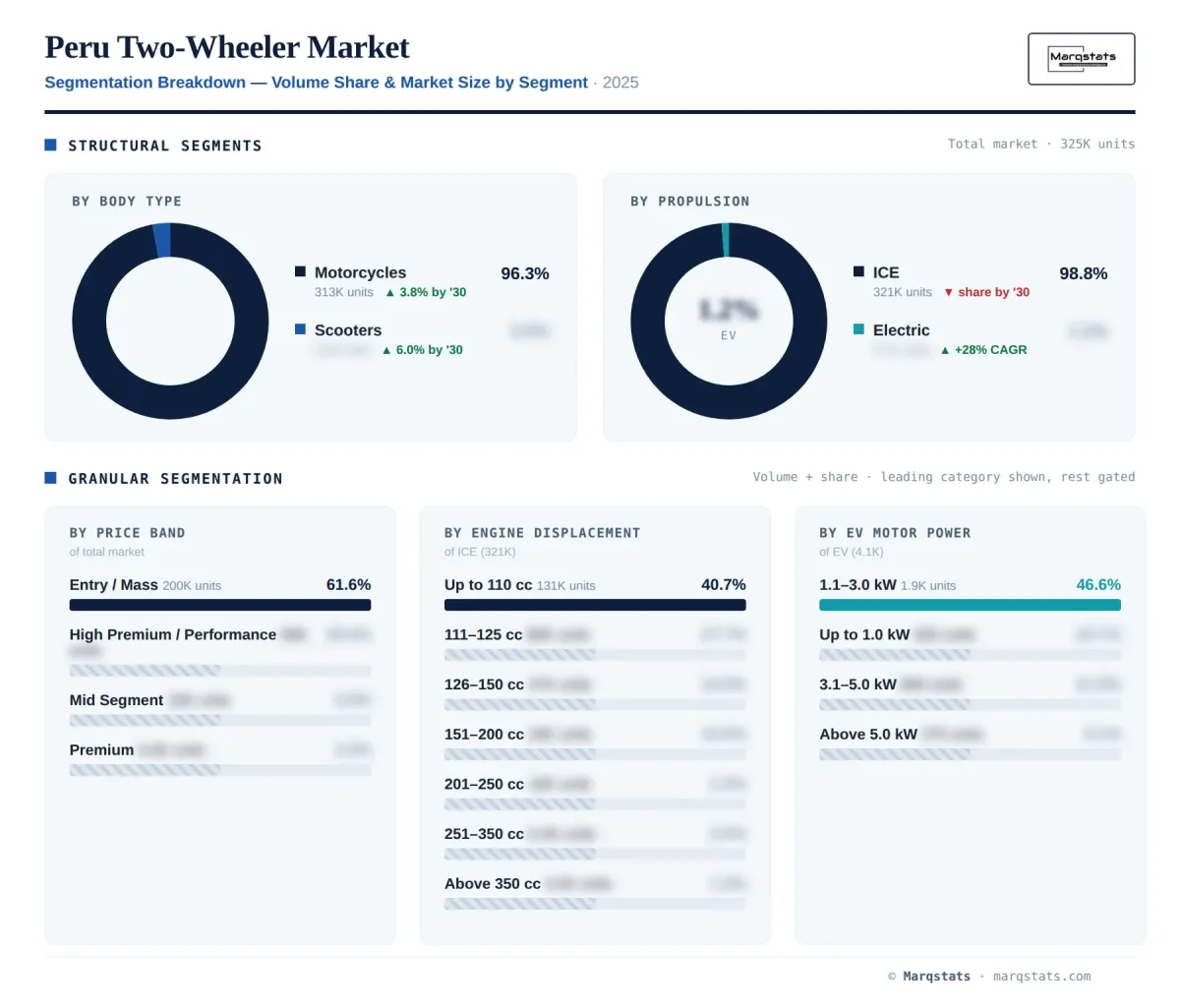
Motorcycles overwhelmingly dominate, at about 96% of unit sales in 2025. Volumes reach 312.98 thousand units in 2025 and are projected to reach 373.2 thousand units by 2030, a 3.8% CAGR. Small commuter and utility models drive volume, supported by work and last-mile use. This dominance is among the highest in the region and defines the market.
Within motorcycles, commuter and utility models in the 110 to 150 cc range carry the largest volumes. Buyers favor durable, low-maintenance machines suited to daily work and long distances. Larger displacement classes add value, however they remain a small share of demand.
Scooters form a small category, at about 3% of units in 2025. Volumes rise from 9.59 thousand units in 2025 to 14.73 thousand units by 2030, a 6.02% CAGR. Urban buyers favor scooters for short trips, and electric scooters add incremental demand within this category.
Scooter demand is concentrated in Lima and larger coastal cities, where automatic transmission and ease of use appeal to commuters and delivery riders. The category grows faster than motorcycles in percentage terms, however it remains a small share of the total market.
Mopeds are a very small and declining category. Volumes fall from 2.44 thousand units in 2025 to 0.48 thousand units by 2030, a negative 30.86% CAGR. Buyers migrate toward more capable motorcycles, which erodes moped demand.
Combustion models held close to 99% of units in 2025. Volumes move from 320.94 thousand units in 2025 to 371.43 thousand units by 2030, a 3.09% CAGR. Combustion remains the base of the market through the forecast period, owing to low prices, refueling convenience, and limited charging access outside major cities.
Electric two-wheelers are the fastest-growing propulsion type from a small base, with registrations beginning in 2024. Volumes rise from 4.06 thousand units in 2025 to 16.99 thousand units by 2030, a 28.25% CAGR, and revenue expands at a 30.92% CAGR. Growth is driven by delivery operators, urban commuters, and wider model availability. Electric share of units is projected to reach about 4% by 2030.
Delivery operators are among the earliest adopters, owing to daily mileage that rewards lower energy costs. Adoption remains constrained by purchase price, range, and limited charging and service coverage outside major cities. As model availability widens and financing improves, electric volumes scale quickly from a low base.
Small-displacement models anchor the market. Combined volumes for engines up to 125 cc account for about 68% of combustion units, with the up-to-110 cc band the single largest at 130.6 thousand units in 2025. Low prices and low running costs sustain this base, and work-related buyers favor durable commuter models.
Mid-capacity motorcycles serve buyers seeking more power for longer trips and heavier loads. This band grows steadily, owing to rising incomes and utility demand. Average selling prices exceed the entry tier, which supports revenue growth.
This mid band benefits from buyers upgrading from entry commuter models as incomes rise. It also serves rural and long-distance users who need additional power and load capacity, which supports steady demand across northern and highland regions through the forecast period.
Larger motorcycles form a small unit share, with the 251 to 350 cc band at 6.42 thousand units and above 350 cc at 4.05 thousand units in 2025. Above 350 cc grows fastest among displacement classes at an 11.07% CAGR, owing to recreational and premium demand among higher-income riders.
Demand for larger motorcycles concentrates in Lima and southern cities, where incomes support discretionary spending. These models anchor the premium revenue pool despite modest unit counts.
Within electric two-wheelers, the 1.1 to 3.0 kW band is the largest in 2025, while the above 5.0 kW band grows fastest at a 39.41% volume CAGR. Higher-power electric models gain share as performance and range improve.
The entry tier is the largest price band, at about 62% of units in 2025 with 200.13 thousand units, growing at a 5.5% CAGR. First-time buyers and work-related demand sustain this tier, and value brands hold strong positions here.
The entry tier is the volume core of the market and the primary battleground for value brands. Affordability, financing terms, and running costs determine purchase decisions, and durability supports strong resale demand across a large used market.
The mid and premium tiers are smaller and expand from a low base. The price-band classification was revised during the historical period, so tier shares are stated on a reconciled basis. Premium and performance models remain a limited share of a budget-driven market, however they lift average revenue where present.
Private consumers are the dominant end user, at roughly 95% of demand with 310.38 thousand units in 2025. Purchases serve commuting, personal mobility, and income-generating work. This base grows at a 3.48% CAGR through the forecast period, supported by household ownership and owner-operator work use.
Commercial and fleet demand is smaller and grows faster than private demand. Delivery and logistics volumes rise at an 8.34% CAGR, and ride-hail, rental, and tourism use expands at an 11.56% CAGR. Delivery operators drive much of this growth, and electric models gain early traction in this group.
Ride-hail, rental, and tourism use expands around Lima and southern tourism corridors. Institutional and government purchases, including police and municipal security fleets, add periodic demand that supports commercial volumes across the forecast period.
Dealerships and physical retailers held about 79% of units in 2025 with 258.13 thousand units. However, offline volumes decline at a negative 4.57% CAGR as buyers shift online. Physical channels retain value in regional markets, for service, and for financing.
Online retail is the fastest-growing channel. Volumes rise from 66.87 thousand units in 2025 to 184.3 thousand units by 2030, a 19.92% CAGR, and revenue grows at a 24.00% CAGR. Online sales approach half of unit volume by 2030, owing to e-commerce platforms, financing offers, and wider model access.
Online growth reflects both consumer buying habits and financing-led sales models. Platforms bundle credit and delivery, which lowers friction for first-time buyers. Physical dealers retain a role in regional markets, after-sales service, and higher-value sales, however their share of unit volume declines steadily through the forecast period.
By Geography
Northern Peru
Northern Peru, including Piura, Lambayeque, and La Libertad, is a core motorcycle heartland. Warm climate, dispersed settlement, and heavy work-related use support high motorcycle penetration. Entry-level commuter models dominate demand, and value brands hold strong positions here.
Northern cities combine dense commuting with agricultural and small-business use. Motorcycles support daily work across a wide area, which sustains steady replacement demand and a large aftermarket for parts and service.
The Amazon Regions
The Amazon regions, including Loreto, San Martin, and Ucayali, show some of the highest motorcycle dependence in the country. Limited road and public transport infrastructure makes motorcycles the primary means of mobility and work. Durable, low-cost models are most common.
In these regions, motorcycles function as essential infrastructure rather than a lifestyle choice. Rivers and limited roads shape mobility, and two-wheelers connect communities and support local commerce. Demand is price-sensitive and durability-focused.
Lima and Callao
Lima and Callao add commuting and delivery demand, and the metropolitan area is the largest market for new-model launches and electric two-wheelers. Registration data from the public registry (sunarp.gob.pe) records rising two-wheeler use in the capital, supported by courier and last-mile services.
Southern Peru
Southern Peru, including Arequipa and Cusco, adds demand around secondary cities and tourism corridors. Terrain and cooler highland conditions shape demand toward durable motorcycles, and mining and agricultural activity in the region sustains work-related purchases. Both entry and mid-capacity models sell here.
Tourism corridors around Cusco add rental and recreational demand, which lifts scooter and mid-capacity sales in season. Higher-altitude conditions favor reliable, well-supported models.
How Competition Is Evolving
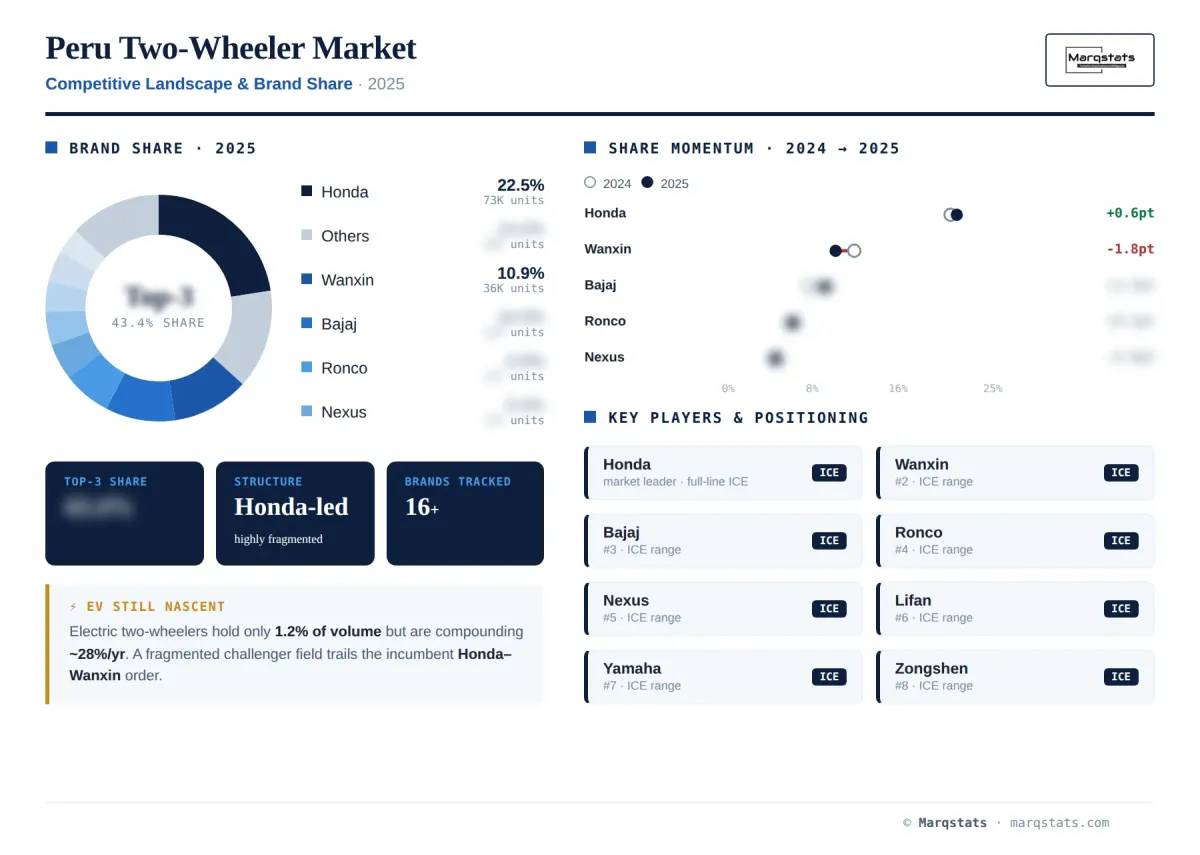
The Peru two-wheeler market is moderately fragmented, with a broad field of more than twenty brands. The market leader held about 22% of unit volume in 2025, ahead of Chinese and Indian value brands that hold strong entry-tier positions. The five largest brands together held close to 56% of volume, and a long tail of importers competes on price.
The market leader benefits from brand recognition, financing partnerships, and a broad service network. Chinese brands compete aggressively on price and expanding dealer coverage, while Indian brands hold established positions in the commuter tier. This mix keeps the market price-competitive across the entry and mid segments.
Competition centers on price, financing access, dealer and service coverage, and durability. Value brands compete on landed cost and affordability, owing to price-sensitive demand. The market leader competes on brand strength, reliability, and service network depth. Several distributor groups manage multiple brands across price tiers, which broadens their reach across the entry and mid segments.
Distribution strategy is a growing point of difference, and brands that build online sales and financing partnerships gain share as e-commerce scales. Electrification is early, and brands that secure charging support and service coverage position for the emerging electric tier. Service and parts availability remain decisive across a widely dispersed geography.
Brand strategy also reflects the shift toward online distribution and financing. Distributor groups that manage several brands compete across price tiers and regions, while the market leader defends share on reliability and service depth. Brands that pair competitive pricing with reliable parts supply hold share most effectively during periods of currency depreciation.
Companies Covered
The report profiles 16+ companies with full strategy and financials analysis, including:
Recent Market Activity
Table of Contents
Coverage & Segmentation
This report provides a comprehensive analysis of the Peru two-wheeler market across 2021 to 2030, with 2025 as the base year and 2026 to 2030 as the forecast period. The study measures market size in unit volumes and revenue, and it segments demand by vehicle type, propulsion type, engine displacement and motor power, price band, end user, sales channel, and brand.
The report examines demand drivers, restraints, and trends, along with competitive structure and brand positioning. Regional coverage spans Northern Peru, the Amazon regions, Lima and Callao, and Southern Peru. The analysis integrates registration data, import records, and primary interviews to reconcile brand-level and category-level estimates into a single two-wheeler view. Official figures that include three-wheeled vehicles are excluded from this two-wheeler scope.
The study also assesses distribution shifts, early electrification, and the balance between private and commercial demand. Forecasts are built at the segment level and reconciled to the total two-wheeler market, so that vehicle type, propulsion, displacement, price band, end user, and channel views remain internally consistent across the historical and forecast periods.