Market Snapshot
Key Takeaways
Market Overview & Analysis
Report Summary
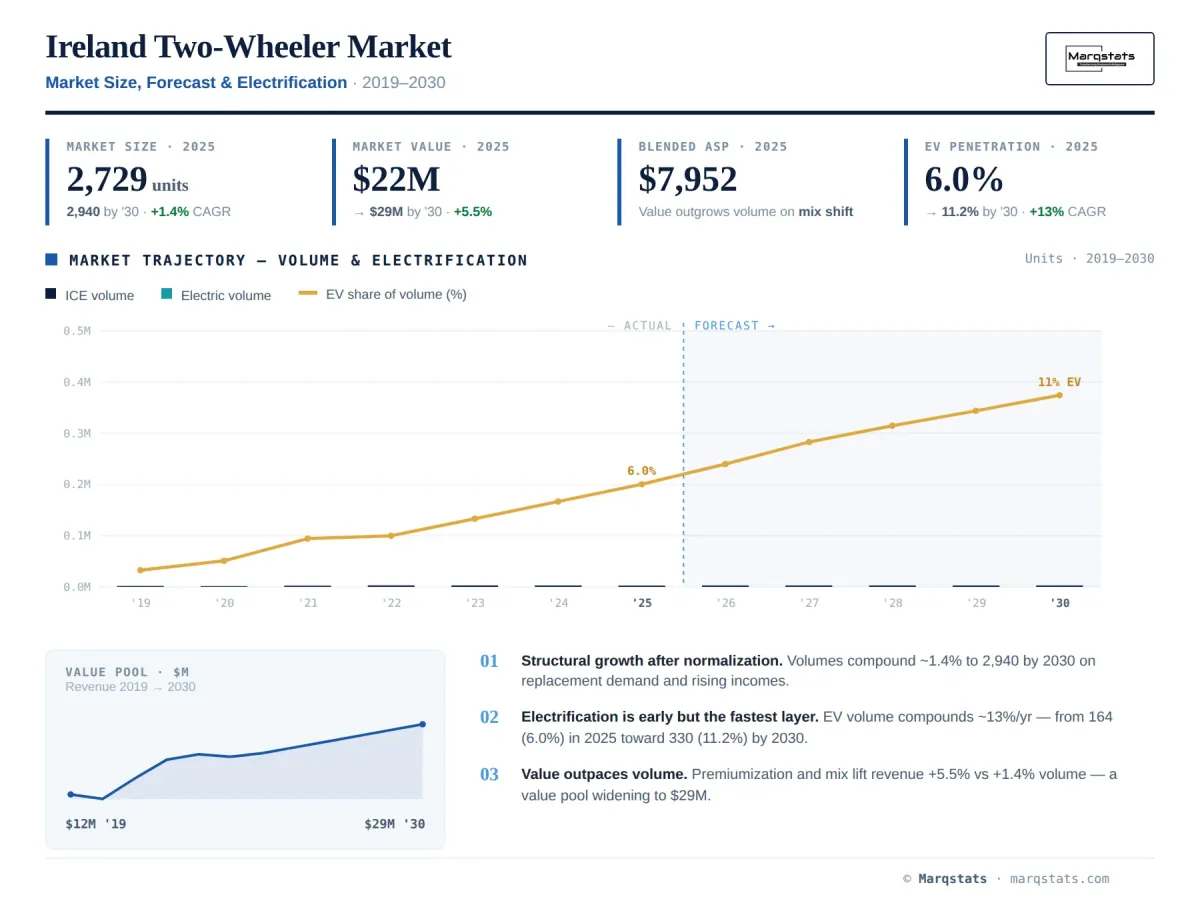
The Ireland two-wheeler market is a small, premium, leisure-led motorcycle market. Two-wheelers in Ireland serve recreational touring and enthusiast riding far more than commuting or utility use, and the country scenic countryside supports a rider base oriented toward larger, higher-value machines. The market generated USD 21.7 million in revenue in 2025 on roughly 2,730 units, one of the smallest two-wheeler markets in Western Europe by volume, yet with a high average value per unit owing to its big-bike mix.
Market structure is unusually concentrated at the large-displacement end. The above-350 cc band accounts for about two-thirds of combustion revenue, while the middle displacement classes are thin and scooters and mopeds contribute only a small share. This profile reflects the recreational nature of demand: riders in Ireland typically buy motorcycles for touring, adventure, and weekend use, supported by rising incomes and adventure-tourism appeal, rather than for daily commuting where cars and public transport dominate.
Regulation and market conditions shaped the recent path. The full introduction of the Euro 5+ emissions standard on 1 January 2025 reshaped combustion supply and pricing across the EU, while Irish dealers navigated a difficult trading environment after a weak 2024. New vehicle registrations in Ireland are published by the Society of the Irish Motor Industry, the official national source, and the same European registration patterns visible across larger markets also frame Irish demand for combustion and electric two-wheelers.
The recreational character of demand shapes every part of the market. Ireland has limited use of two-wheelers for commuting, where cars and public transport dominate, and almost no ride-hail or large-scale delivery use of motorcycles. Instead, demand is driven by weekend and touring riders drawn to the country scenic routes and adventure-tourism appeal. This concentrates spending on larger, higher-specification machines and explains why revenue growth of 5.52% far outpaces unit growth of 1.41%, as buyers trade up in value even where the number of riders expands slowly.
Climate and market scale act as structural constraints. A mild, wet climate and a short riding season limit year-round usage and keep volumes low, while the small size of the market limits economies of scale for importers and dealers. These conditions reinforce the premium orientation of the market: with few mainstream commuter or scooter buyers, the value base rests on enthusiasts who invest in touring, adventure, and sport motorcycles, supported by rising incomes and financing availability.
Market Dynamics
Key Drivers
- Recreational and touring demand anchors the market, with scenic road networks and adventure-tourism appeal drawing riders toward larger, higher-value motorcycles.
- Premiumisation lifts average selling prices, so revenue grows almost four times faster than units; the premium and high-performance bands expand fastest among all price tiers.
- Rising disposable incomes and favourable financing broaden access to premium motorcycles, supporting steady value growth in a low-volume market.
- Electrification accelerates from a small base, with electric two-wheeler revenue expanding at a 16.41% CAGR as light electric models widen availability.
- Growth in urban delivery lifts a small fleet segment, with delivery and logistics expanding at a 7.19% CAGR from a modest base.
Key Restraints
- Structurally low unit volumes, near 2,730 per year, cap absolute market size and limit economies of scale for importers and dealers.
- A mild, wet climate and a short riding season concentrate demand in warmer months, constraining year-round two-wheeler usage.
- Difficult dealer trading conditions after a weak 2024 pressured margins and inventory, tempering near-term volume growth.
- Minimal commuting and utility demand, owing to car and public-transport dominance, limits the mainstream and scooter segments that drive volume elsewhere.
Key Trends
- Big-bike demand deepens, with the above-350 cc band holding about two-thirds of combustion revenue and premium touring and adventure models driving value growth.
- Electric two-wheeler revenue grows fastest at 16.41% CAGR, rising from about 6% of the market in 2025 as light electric models widen availability.
- Online retail expands fastest among channels at an 11.86% CAGR, though physical dealers still handle the large majority of value.
- Value-oriented challenger brands broaden the field, adding options alongside the established Japanese and premium European marques that dominate the market.
Market Segmentation
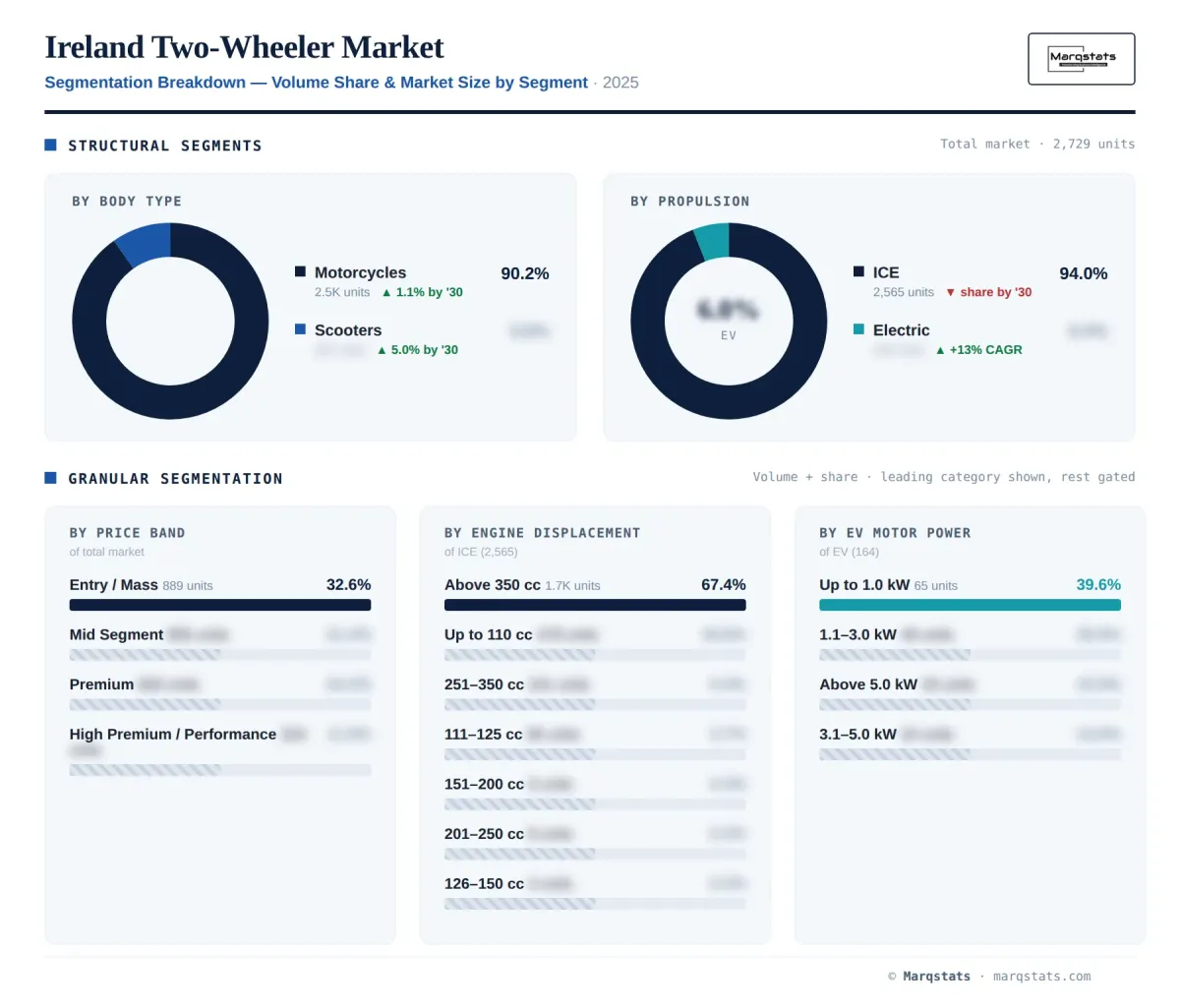
Motorcycles overwhelmingly dominate the vehicle-type segment, generating USD 19.6 million in 2025, roughly 90% of market revenue, and rising to USD 25.4 million by 2030 at a 5.25% CAGR. The segment reflects Ireland recreational and touring orientation, and it carries the high average price that defines the market value density. Touring, adventure, and sport motorcycles from Honda, Yamaha, BMW, and premium European marques anchor the segment.
Scooters and mopeds generated USD 2.1 million in 2025 and grow to USD 3.3 million by 2030 at a 7.76% CAGR, the faster-growing vehicle type from a very small base. The segment serves limited urban commuting in Dublin and other cities, where light two-wheelers handle short trips. Although scooters and mopeds expand faster than motorcycles in percentage terms, they remain a minor share of the market, consistent with Ireland motorcycle-led and leisure-oriented character.
The dominance of motorcycles over scooters and mopeds is more pronounced in Ireland than in almost any comparable European market. Where continental markets rely on scooters and mopeds for cost-efficient urban mobility, Ireland demand is overwhelmingly recreational, and its two-wheeler base is built around touring and adventure motorcycles. This orientation shapes the market response to premiumisation and electrification alike, as new demand tends to arrive at the premium, large-displacement end rather than in entry commuting machines.
Internal combustion engine models dominate the Ireland two-wheeler market, generating USD 20.4 million in 2025, about 94% of revenue, and growing to USD 25.4 million by 2030 at a 4.37% CAGR. Combustion demand is anchored in the large-displacement touring and adventure segments where electric alternatives remain limited. The combustion share declines gradually over the forecast period as electric models widen their presence in the light-vehicle tiers.
Electric is the fastest-growing propulsion category, expanding from USD 1.3 million in 2025 to USD 3.1 million by 2030 at a 16.41% CAGR. Electric revenue rises from about 6% of the market as light electric models widen availability, mirroring electric two-wheeler momentum visible in other electric two-wheeler markets tracked by Marqstats. Growth concentrates in light electric machines, and the higher-power electric bands expand fastest as the range of models widens, though the segment remains small in absolute terms.
Within combustion models, the above-350 cc band is by far the largest tier by revenue at USD 13.7 million in 2025, about two-thirds of combustion revenue, reflecting demand for touring, adventure, and sport motorcycles. The up-to-110 cc band follows at USD 3.8 million, capturing entry machines, while the 251 to 350 cc band adds USD 1.9 million. The middle displacement classes between 126 cc and 250 cc are notably thin, a distinctive feature of the Irish market that reflects the concentration of demand at the large-displacement leisure end and a small entry tier.
Within electric models, demand is spread across the power bands from a very small base, with the up-to-1.0 kW band at USD 0.5 million in 2025 and higher-power bands smaller still. The above-5.0 kW band expands fastest as full electric motorcycles enter the range. Because the electric segment is small in absolute terms, the motor-power mix will shift as new models arrive, and higher-power electric machines are set to gain share over the forecast period.
The entry and mid price bands together account for the largest share of revenue, at USD 7.1 million and USD 6.8 million in 2025, reflecting the volume base of the market. The premium and high-premium bands, however, grow faster, at 6.02% and 6.76% CAGR respectively, reflecting the premiumisation that carries the Irish market. The high-premium and performance band, at USD 2.6 million in 2025, is the fastest-expanding price tier, consistent with a market where large touring and adventure motorcycles command the highest prices and the strongest enthusiast demand. Taken together, the premium and high-premium tiers approach USD 7.8 million in 2025 and gain share over the forecast period, so the upper half of the market grows faster than the entry and mid segments and steadily lifts the average selling price.
The B2C segment overwhelmingly dominates the Ireland two-wheeler market, generating USD 20.5 million in 2025, about 94% of revenue, and growing at a 5.31% CAGR. Private ownership reflects the recreational and enthusiast nature of demand. Fleet and commercial demand is small yet faster-growing: the B2B and fleet segment expands at a 7.25% CAGR and delivery and logistics at 7.19%, both from modest bases. Government and institutional demand adds a further USD 0.3 million, and ride-hail and rental demand is negligible, consistent with a market centred on private, leisure-oriented ownership. The near-total dominance of private buyers distinguishes Ireland from markets where commercial fleets, delivery operators, and shared-mobility services form a meaningful share of demand, and it reinforces the enthusiast-led nature of the Irish two-wheeler market across the forecast period.
Offline dealers remain the dominant channel, handling USD 19.0 million of revenue in 2025 and growing at a 4.42% CAGR, owing to the service, financing, and registration support that motorcycle purchases require. Online sales, however, expand fastest at an 11.86% CAGR, rising from USD 2.7 million as digital marketplaces and dealer web channels gain share. The channel shift is gradual, and physical dealers retain the large majority of value through the forecast period, supported by the enthusiast preference for in-person purchase and service of premium machines.
By Geography
Dublin and the Greater Dublin Area
Dublin and the surrounding Leinster region form the largest demand centre for two-wheelers in Ireland. The capital concentrates the limited urban commuting demand, where scooters, mopeds, and light electric two-wheelers handle short trips, alongside a base of premium motorcycle owners. Greater Dublin hosts the densest dealer and service presence and leads adoption of electric two-wheelers within the national market.
Munster and the South
Munster, including Cork and Limerick, forms a significant demand cluster oriented toward touring and leisure riding. Demand here concentrates in larger-displacement motorcycles used for recreational touring across the southern road networks. Regional dealers serve both enthusiast riders and a smaller base of urban commuters in the larger towns and cities.
The West and Scenic Touring Regions
The western and northwestern regions, including Galway and the scenic Atlantic touring routes, anchor Ireland adventure- and touring-riding demand. These areas draw riders toward large adventure and touring machines suited to long scenic routes, reinforcing the above-350 cc band that dominates the national displacement mix. Touring and adventure demand across these regions underpins the leisure character of the Irish two-wheeler market.
Across all regions, national registrations followed the European pattern under the Euro 5+ transition, and the same demand dynamics visible in larger markets are documented in registration releases from the European motorcycle industry association, while value growth in Ireland is carried by premiumisation and the strength of large-displacement touring demand.
How Competition Is Evolving
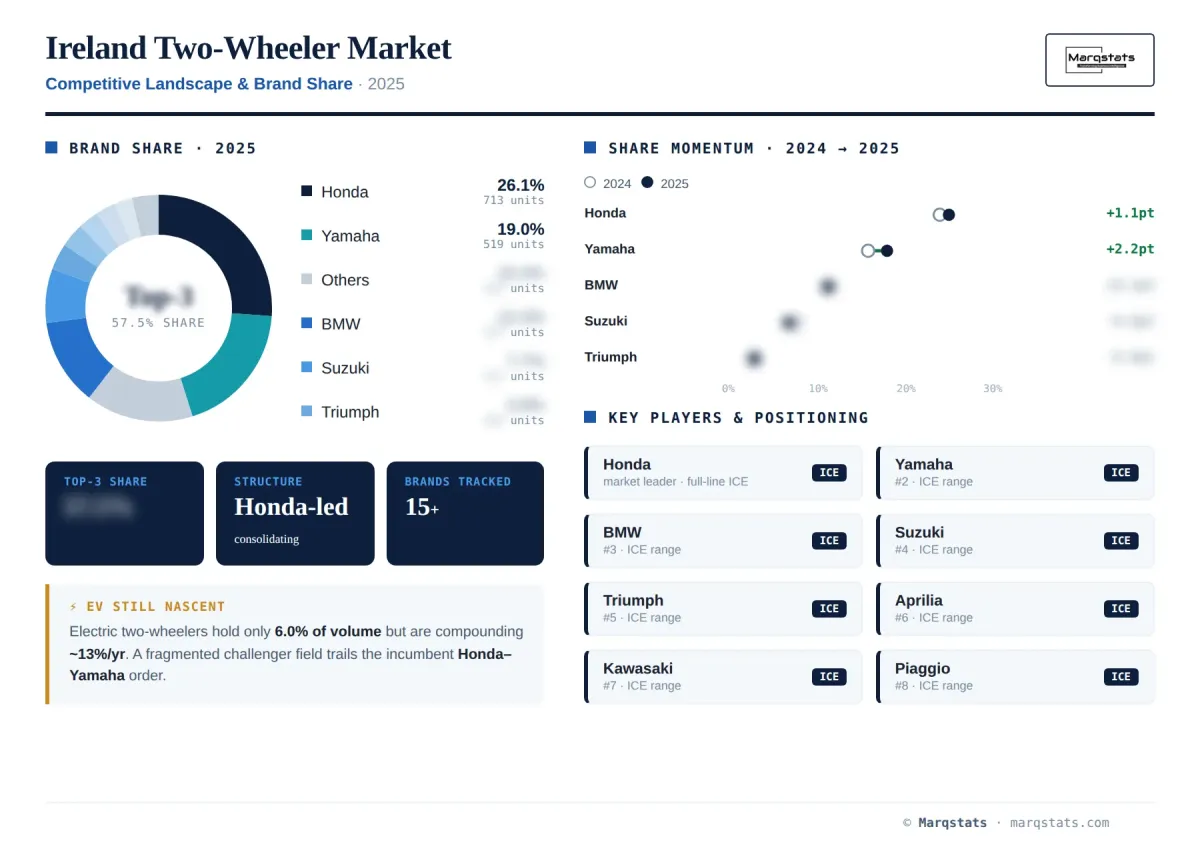
The Ireland two-wheeler market is moderately concentrated, dominated by Japanese and premium European marques. Honda holds the foremost position at about 25.8% of revenue in 2025, followed by Yamaha at 18.9% and BMW at 12.0%; together the three account for roughly 57% of the market. Suzuki, Triumph, Aprilia, Kawasaki, Piaggio, and Harley-Davidson complete the field, with premium and touring specialists holding strong positions consistent with the market leisure orientation.
Competition centres on the large-displacement touring and adventure segments where most value is concentrated. Honda breadth across touring, adventure, and entry machines underpins its lead, while BMW, Triumph, and Ducati compete strongly in the premium touring and performance tiers that define Irish enthusiast demand. Japanese marques Yamaha, Suzuki, and Kawasaki maintain loyal followings, and Italian brands including Aprilia, Piaggio, and Moto Guzzi hold niche premium positions.
Because the market is small, premium, and leisure-led, brand strategy in Ireland prioritises the touring and adventure segments, dealer relationships, and after-sales service over entry-level volume. Value-oriented challenger brands are broadening the field with competitively priced machines, and electric specialists address the emerging light electric segment. The pace of each participant model range in touring, adventure, and electric machines is the primary determinant of share in a market where enthusiast demand and premium positioning dominate.
The competitive structure is stable at the top yet gradually broadening below. Honda, Yamaha, and BMW anchor the market through wide touring and adventure ranges and strong dealer networks, while premium marques such as Triumph, Ducati, and Harley-Davidson defend enthusiast niches. Emerging value brands, including several Chinese manufacturers, are adding lower-priced options that widen access without displacing the established leaders, and light electric specialists are building an early presence. Over the forecast period, the balance of the market will depend on how effectively incumbents refresh their touring and adventure line-ups and how quickly electric machines gain acceptance among Irish enthusiast riders.
Companies Covered
The report profiles 16+ companies with full strategy and financials analysis, including:
Recent Market Activity
Table of Contents
Coverage & Segmentation
This report provides a comprehensive analysis of the Ireland two-wheeler market for the 2021 to 2025 historical period and the 2026 to 2030 forecast period, with 2025 as the base year. The study quantifies market size in revenue terms, in USD, and in unit volume, and segments the market by vehicle type, propulsion type, engine displacement and motor power, price band, end user, sales channel, and brand. It examines the drivers, restraints, and trends shaping demand, and profiles the competitive structure of the market.
The study focuses on registered two-wheelers, spanning motorcycles, scooters, mopeds, and electric light vehicles. Coverage addresses the leisure-led and big-bike-skewed character of the Irish market, the dominance of the above-350 cc segment, the small yet fast-growing electric segment, and the concentration of demand in private recreational ownership. Values are reported in USD MN throughout, consistent with a market well below USD 1 billion in size, and regional demand is examined across Dublin and the Greater Dublin Area, Munster, and the western touring regions.