Market Snapshot
Middle bar: base-year value × (1 + CAGR), rounded to two decimals. This is a calculated illustration, not a separately researched annual estimate.
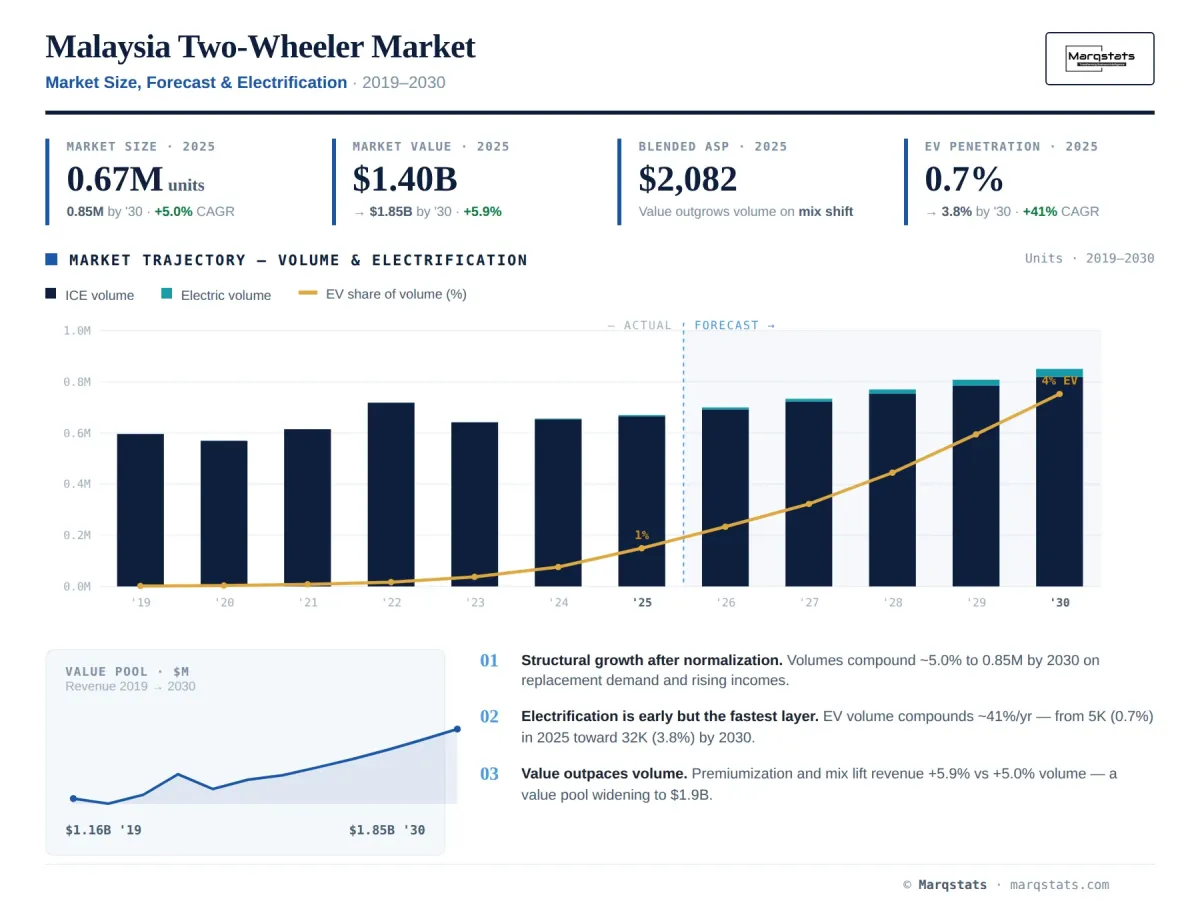
The Malaysia two-wheeler market reached 670 thousand units in 2025 and is projected to reach 850 thousand units by 2030, expanding at a 4.99% CAGR across the 2026–2030 forecast period; in value terms the market rises from USD 1.40 billion to USD 1.85 billion. Malaysia is the world's 13th-largest motorcycle market, with more than 13 million registered two-wheelers and motorcycle ownership in over 80% of households. The market is motorcycle-led, dominated by kapchai underbone commuters, yet it is steadily shifting upmarket toward larger-displacement and premium machines.
Two distinctive features set Malaysia apart within ASEAN. First, Yamaha, rather than Honda, is the market leader, holding close to half of unit sales, while Honda's share erodes and Chinese challengers such as Aveta and SM Sport rise quickly. Second, high-premium and performance models generate about half of total market revenue despite modest volume, reflecting a strong big-bike culture. Electrification is early, with electric models under 1% of volume, supported by the MARiiCas RM2,400 rebate for locally assembled electric motorcycles.
Growth is driven by urban commuting, a recovering economy, and premiumisation, tempered by weak entry-segment purchasing power and the after-effects of a 2022 demand spike. The Malaysia two-wheeler market therefore combines a shrinking low-cost commuter base with expanding mid, premium, and electric segments, producing modest headline volume growth alongside a pronounced shift in product mix and value.
Key Takeaways
Market Overview & Analysis
Report Summary
The Malaysia two-wheeler market comprises motorcycles, scooters, and mopeds sold for personal and commercial use across internal combustion and electric propulsion. This study segments demand by vehicle type, propulsion type, engine displacement and motor power, price band, end user, sales channel, and brand, with a 2025 base year, historical coverage from 2021 to 2025, and forecasts to 2030. Motorcycles are integral to Malaysian mobility, valued for affordability and congestion-beating agility, with the kapchai underbone the traditional workhorse of daily commuting.
Demand has been volatile. Industry volumes peaked near 686,000 units in 2022, lifted by a temporary spending surge tied to Employees Provident Fund withdrawals, then contracted sharply in early 2024 before recovering through 2025 as the economy strengthened. Registrations tracked by the Road Transport Department underpin a market of about 670,000 units in 2025, with scooters gaining share while conventional motorcycles slip.
Supply features strong local assembly and an unusual competitive order. Yamaha, through Hong Leong Yamaha, leads by a wide margin, followed by a declining Honda, the national brand Modenas, and a fast-rising cohort of Chinese and value brands including Aveta, SM Sport, and QJMotor. Electric two-wheelers remain a fraction of sales, contested by dedicated players such as Blueshark, Superlux, and Eclimo alongside Modenas, and supported by government rebates targeted at locally assembled models.
Malaysia's product mix is distinctive within Southeast Asia. Where Indonesia and Vietnam are overwhelmingly scooter markets, Malaysia remains motorcycle-led, built around the kapchai underbone that has defined commuting for decades. At the same time, the country sustains one of the region's most active big-bike cultures, with superbikes, adventure, and touring models generating a disproportionate share of value. Modenas, revived through an earlier alliance with India's Bajaj and a continuing technical relationship with Kawasaki, anchors national-brand supply and increasingly reaches beyond entry commuters into premium and electric segments. These features combine to make Malaysia a smaller yet higher-value and more premium-skewed two-wheeler market than its larger neighbours.
Market Dynamics
Key Drivers
- Growth is driven by urban commuting and congestion in Kuala Lumpur, Penang, and Johor Bahru, where more than 60% of motorcycle users rely on two-wheelers to avoid traffic.
- A recovering economy, with quarterly GDP growth accelerating to about 5% through 2025, restored consumer confidence and financing access after the 2024 downturn.
- Premiumisation lifts value, as rising incomes and enthusiast demand expand mid, premium, and big-bike segments faster than the shrinking entry tier.
- Delivery and logistics demand grows at a 10.18% CAGR, as food-delivery and e-commerce platforms sustain commercial two-wheeler use in dense urban centres.
Key Restraints
- Weak entry-segment purchasing power constrains volume, as the affordability-led kapchai base contracts under cost-of-living pressure and cautious lower-income spending.
- The 2022 demand spike pulled forward purchases, leaving a higher base that dampens headline growth as replacement cycles normalise.
- Electric adoption is limited by upfront cost and charging gaps, with the cheapest electric models still around RM1,000 dearer than comparable combustion bikes even after the MARiiCas rebate.
Key Trends
- Displacement is shifting upward, as sub-125cc kapchai volumes decline while 126–150cc and 151–200cc classes expand at 16% and 24% CAGRs respectively.
- Electrification accelerates from a small base, with electric two-wheeler registrations up about 200% in the first nine months of 2025; the Thailand electric two-wheeler market offers a regional benchmark for the transition.
- Chinese and value brands gain share rapidly, as Aveta, SM Sport, and QJMotor win younger commuters with aggressive pricing and modern styling, reshaping the challenger tier below Yamaha and Honda.
- Digital retail expands, with the online channel growing at a 15.19% CAGR alongside Malaysia's established dealer network.
Market Segmentation
Motorcycles, chiefly kapchai underbones and sport-commuter models, hold 71.7% of 2025 volume at 480,000 units and grow at a 4.16% CAGR. The category remains the backbone of daily commuting, though conventional underbone demand is slipping as buyers migrate toward automatic scooters and larger-displacement machines. Within motorcycles, sport-commuter and naked models retain strong appeal among younger riders, and this sub-segment increasingly drives replacement demand as the traditional low-cost kapchai loses ground.
Scooters account for 189,600 units in 2025, about 28% of volume, and grow faster at a 6.94% CAGR. Automatic transmission and urban practicality drive share gains, particularly among younger and city-based riders, and scooters host most electric two-wheeler models. As the kapchai base contracts, scooters are the principal beneficiary among combustion formats, and their higher average price relative to entry underbones also lifts market value.
Mopeds register negligible sales across the study period and do not form a material commercial segment in Malaysia, where the kapchai underbone occupies the affordable-commuter role that mopeds fill in some other markets.
Combustion models hold 99.25% of 2025 volume at 665,000 units and grow at about a 4% CAGR. Affordability, established dealer and service networks, and strong resale value keep combustion firmly dominant across commuter and premium classes, with performance and big-bike demand adding value at the top end. Fuel economy, familiarity, and the absence of range or charging concerns reinforce combustion ownership among the commuter majority, while enthusiasts sustain demand for large-capacity petrol machines that have no direct electric equivalent in the market today.
Electric two-wheelers hold under 1% of 2025 volume at 5,000 units, yet grow at a 40.65% volume CAGR to reach 32,000 units by 2030. Adoption is supported by the MARiiCas rebate for locally assembled models, road-tax exemption, and battery-swapping propositions, though price parity with combustion remains the central barrier. The RM2,400 rebate, restricted from 2025 to completely-knocked-down models assembled locally, is available to Malaysians earning up to RM120,000 a year, targeting the lower-income riders most reliant on motorcycles. Registered providers include Blueshark, Ebixon, RydeEV, Modenas, and Superlux, with a growing roster of approved CKD models. National policy under the Low Carbon Mobility Blueprint targets electric vehicles at 20% of vehicle sales by 2030 and 80% by 2050, framing meaningful upside even as the cheapest electric bikes still cost around RM1,000 more than comparable combustion models before the rebate.
The up-to-110cc and 111–125cc kapchai classes together account for the largest share of 2025 volume at roughly 406,000 units, yet both decline steeply, at about -17% and -13% CAGRs respectively. This contraction reflects a structural move away from the cheapest commuter machines toward higher-specification models, and it is the single most important shift shaping the market's product mix. Iconic kapchai models such as the Yamaha Y15ZR and Honda EX5 remain culturally central, yet the volume base beneath them is eroding as buyers with rising incomes trade upward and as scooters absorb entry-level urban demand.
The 126–150cc class expands at a 16.39% CAGR and the 151–200cc class at 24.24%, together forming the market's growth engine. Larger classes above 200cc grow more modestly from a small base, while premium and performance interest sustains demand for big-bike displacements.
The entry and mass band remains the volume core at 471,000 units in 2025, about 70% of the market, yet contracts at a -1.69% CAGR as low-cost demand weakens. The mid segment grows at a 13.64% CAGR, capturing buyers trading up from entry kapchai models. This migration from the entry tier into the mid band is the clearest expression of premiumisation in the market, and it steadily lifts average selling prices even as total unit growth stays modest.
Premium volumes grow at a 17.50% CAGR, while the high-premium and performance band, though modest in units, generates about half of total market revenue on the strength of superbikes, adventure, and touring models. This revenue concentration is a defining feature of Malaysia's enthusiast big-bike culture. Marques such as BMW Motorrad, Kawasaki, Triumph, and Ducati, alongside premium Modenas and Japanese sport models, sustain elevated average selling prices, so that a small slice of unit volume drives an outsized share of value. This barbell structure, a large low-priced commuter base at one end and a high-value performance segment at the other, distinguishes Malaysia from the more uniformly entry-level markets elsewhere in the region.
Private consumers account for about 90% of 2025 volume, sustaining the commuter, scooter, and premium segments in line with incomes and financing conditions across the peninsula and East Malaysia. Household reliance on motorcycles remains high, particularly among lower-income and younger buyers for whom a two-wheeler is the primary means of private transport, anchoring stable baseline demand even through economic cycles.
Commercial demand grows faster than private use. Delivery and logistics expands at a 10.18% CAGR as food-delivery and e-commerce scale, while B2B and fleet demand and ride-hail use add steady incremental volume in urban centres. For high-mileage delivery riders, running-cost savings make electric two-wheelers and battery-swapping propositions particularly attractive, positioning commercial fleets as an early adoption channel as suitable models and infrastructure mature.
Physical dealerships dominate, handling the large majority of sales and providing financing, registration, and after-sales service. Dense dealer coverage remains central to the competitive strength of Yamaha, Honda, and Modenas, and it is a barrier that new and electric entrants must address to scale beyond early-adopter urban buyers.
The online channel is the fastest-growing route to market at a 15.19% CAGR, as classified marketplaces and manufacturer platforms support research, pricing comparison, and booking, complementing the dealer network rather than replacing it. Younger buyers increasingly begin their purchase journey online, comparing specifications and financing before completing the transaction at a dealership, making digital presence a growing competitive factor for both incumbents and new entrants.
By Geography
Klang Valley & Central Region
The Klang Valley, encompassing Kuala Lumpur and Selangor, is the largest and most premium regional market. Congestion, a large commuter and gig-delivery workforce, and higher incomes concentrate demand for scooters, premium models, and nearly all electric two-wheeler activity. The region also hosts the densest dealer and charging networks, making it the primary launchpad for electric models and rebate uptake, and the testing ground for battery-swapping services aimed at delivery riders.
Northern Peninsular (Penang, Perak, Kedah)
The northern states combine urban centres such as Penang with extensive semi-urban and rural demand. Kapchai commuters and affordable scooters dominate, and Penang's manufacturing base supports commercial and delivery use. The concentration of electronics and industrial employment in the northern corridor sustains steady replacement demand, while rural districts in Kedah and Perak remain firmly anchored to the affordable commuter tier.
Southern Peninsular & Johor
Johor and the southern region benefit from proximity to Singapore, cross-border commuting, and industrial employment. Demand spans commuter motorcycles and a growing premium segment, with delivery use rising in Johor Bahru. The Johor–Singapore economic corridor and associated industrial and logistics investment support both fleet and private demand, and higher wages in border districts lift the mix toward mid and premium models relative to the national average.
East Coast & East Malaysia
The east-coast states and East Malaysia rely heavily on motorcycles for affordable mobility across dispersed populations. Entry-tier combustion models dominate, and electrification lags owing to limited charging infrastructure and lower incomes. In Sabah and Sarawak, distribution distances and terrain further raise effective vehicle costs and slow the arrival of newer models, so these regions are likely to remain a combustion stronghold and the last to electrify within the forecast period.
How Competition Is Evolving
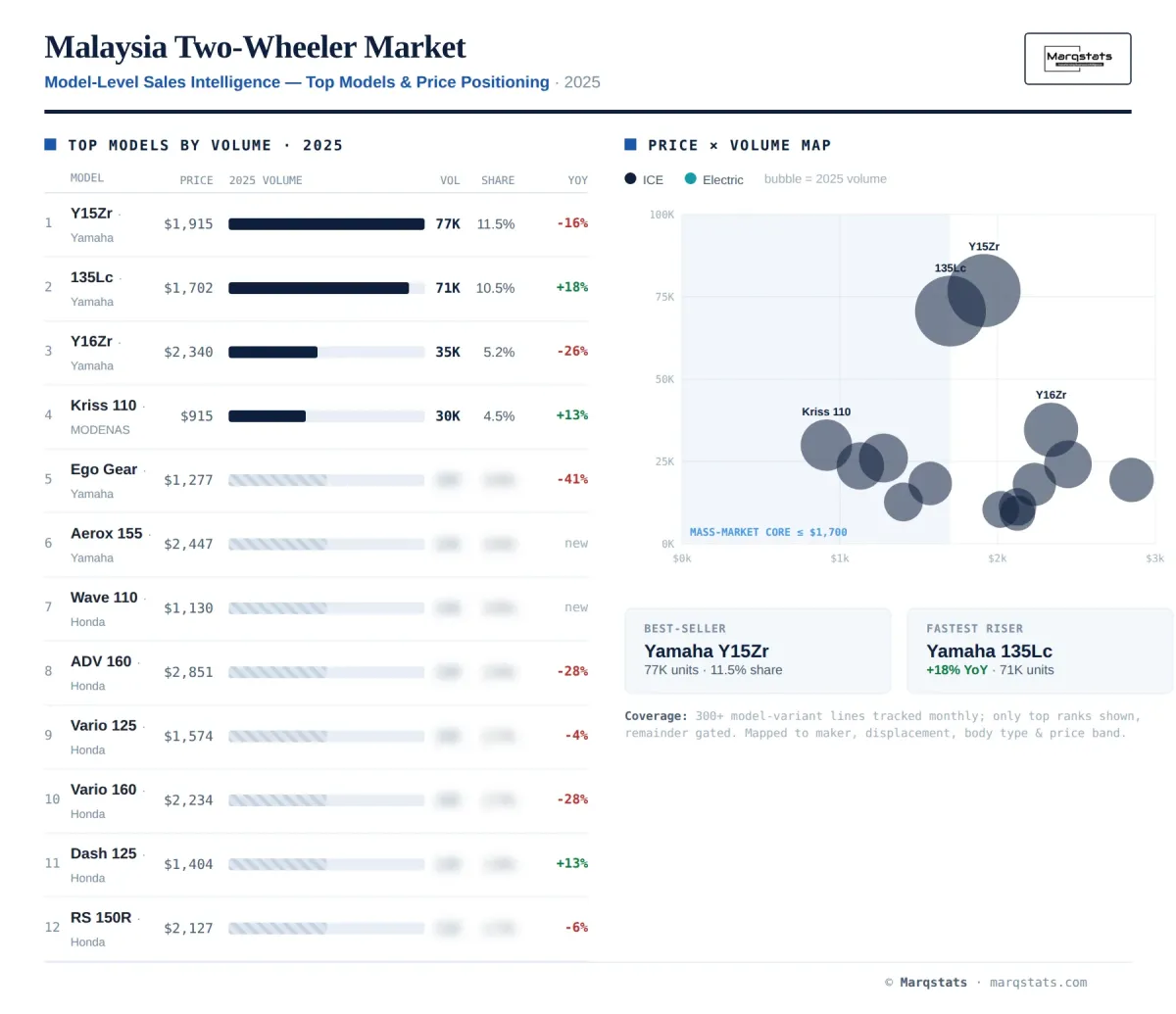
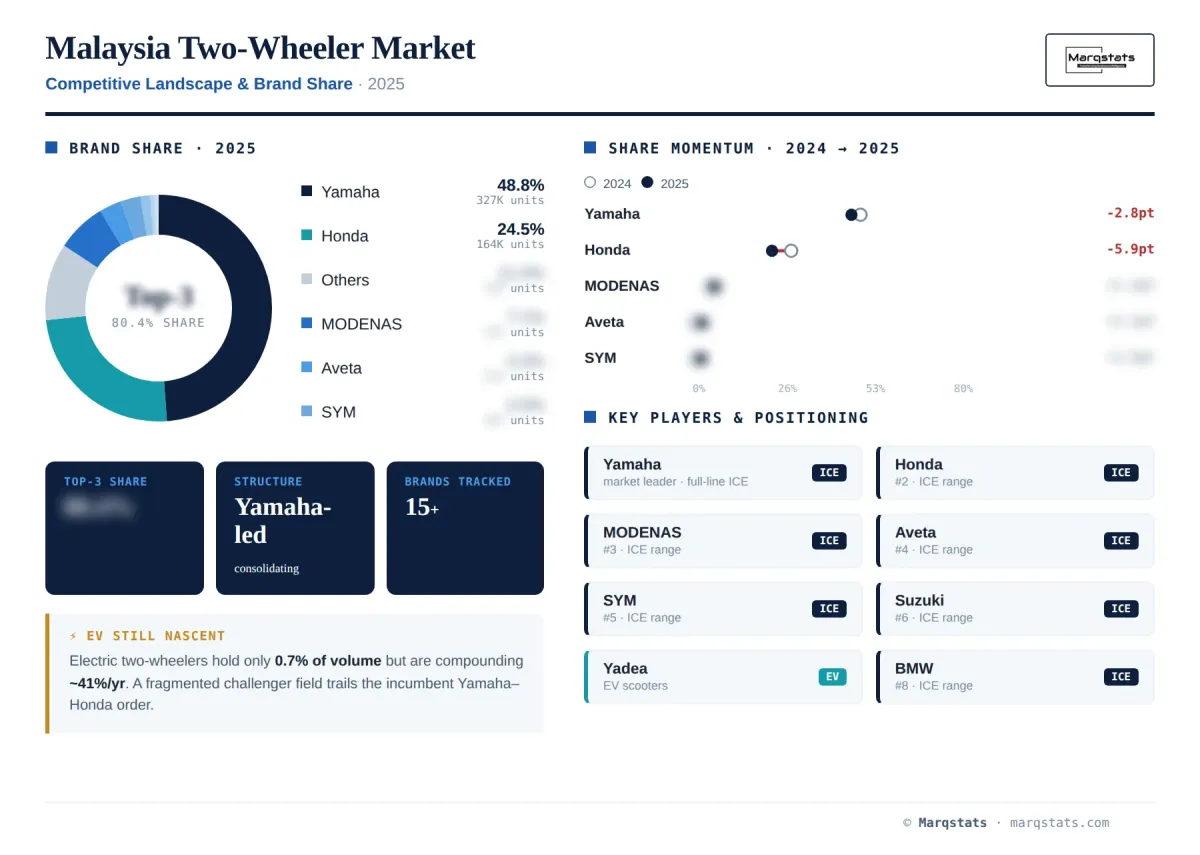
The Malaysia two-wheeler market is moderately concentrated around a clear leader, with Yamaha holding close to half of 2025 unit sales through Hong Leong Yamaha, spanning commuter, sport-commuter, and premium models. Honda, historically Yamaha's closest rival, has lost share, its volumes falling across recent years amid slower model renewal. Together the two Japanese brands still account for the majority of sales.
Below the leaders the field is fragmenting. Modenas, the national brand owned by DRB-HICOM and linked with Kawasaki, holds third position and is broadening from commuter kapchai into premium and touring models. Chinese and value brands, including Aveta, SM Sport, QJMotor, WMoto, and MODA, are growing quickly by targeting younger riders with aggressive pricing and modern styling. European marques such as BMW Motorrad, Triumph, and Ducati anchor the high-premium performance tier that drives market revenue.
Competition centres on model relevance, financing, and dealer reach in the commuter tiers, and on brand and performance in the premium tiers. The electric segment is contested by Blueshark, Superlux, Eclimo, Yadea, and Modenas, competing on rebate-eligible pricing, local assembly, and battery-swapping propositions. Growth is attributed to brands that refresh their line-ups quickly, moreover rewarding those able to localise electric production to qualify for incentives. Honda's recent decline, set against Yamaha's advance and the surge of value brands, illustrates how quickly share can move when model portfolios age; the coming years will test whether incumbents can defend their base while credible electric and premium challengers scale.
Companies Covered
Companies covered in the report include:
Recent Market Activity
Table of Contents
Coverage & Segmentation
This report provides a comprehensive assessment of the Malaysia two-wheeler market across a 2025 base year, historical data from 2021 to 2025, and forecasts spanning 2026 to 2030. Market sizing is presented in unit-volume terms and complemented by value analysis in United States dollars, with segmentation by vehicle type, propulsion type, engine displacement and motor power, price band, end user, sales channel, and brand. Brand-level shares, segment growth rates, and competitive positioning are quantified to support commercial and investment decisions.
The scope covers demand drivers, restraints, and structural trends, with particular focus on the shift in displacement and price mix, the unusual brand order led by Yamaha, the big-bike revenue concentration, and the early electrification transition and its incentive dependencies. Competitive analysis quantifies brand shares and profiles combustion and electric producers, while segment forecasts identify where volume and value growth concentrate through 2030. Particular attention is paid to how the contraction of the entry kapchai base interacts with premiumisation and electrification to reshape both volume and value. An extended forecast to 2035 is available under customization for subscribers requiring a longer planning horizon, alongside deeper cuts by region, brand, or channel on request.