
Why Italy's 2G Shutdown Risk Is Smaller Than the Forecast Assumed
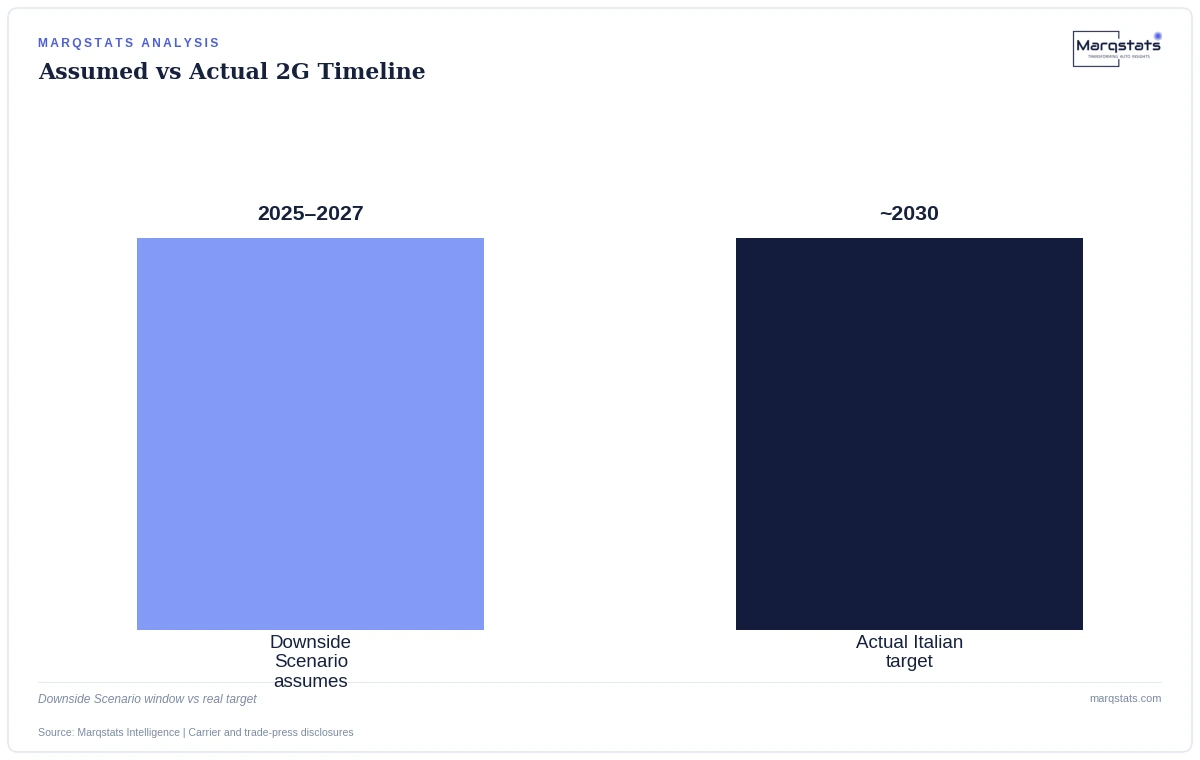
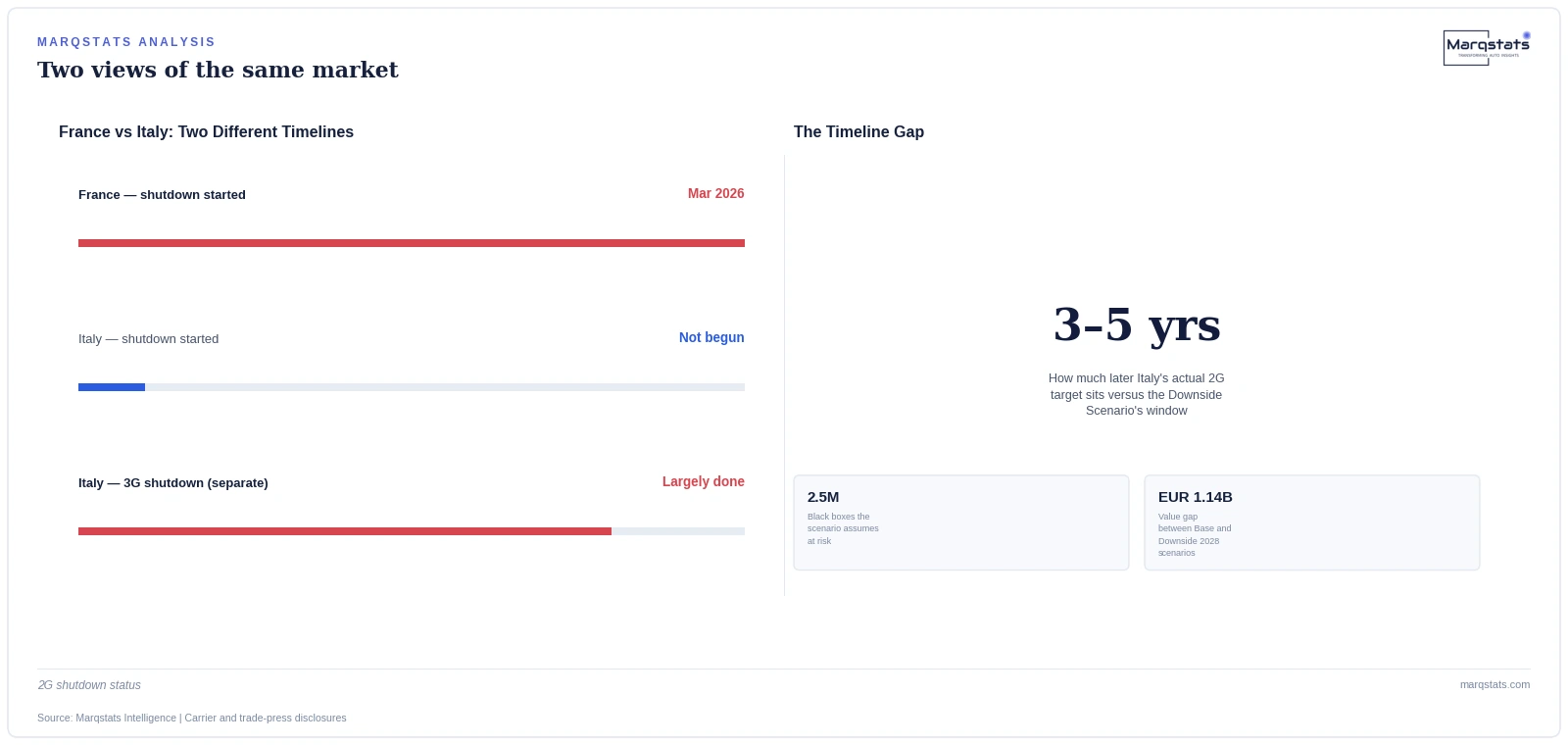
Because Italian carriers haven't started the shutdown the forecast is built around, and it's worth being specific about that. A widely cited downside scenario for Italy's connected car market assumes that TIM, Vodafone, WindTre and Iliad decommission their 2G networks between 2025 and 2027, stranding up to 2.5 million legacy insurance black boxes that cannot be upgraded. As of this piece's preparation, none of those four carriers has begun that transition — and industry coverage of France's own 2026 2G shutdown specifically singles out Italy as a market running on a much later timeline overall.
What the Downside Scenario Actually Assumes
The scenario's logic is not unreasonable on its face: aftermarket insurance black boxes, which make up roughly 61% of Italy's connected vehicle parc, are exactly the kind of legacy hardware that depends on 2G or 3G circuit-switched connections and cannot always be remotely upgraded to 4G. If carriers switched off 2G quickly, millions of devices would go dark, insurers would face replacement costs they cannot legally pass to consumers under Legge 124/2017, and the whole downside trajectory — EUR 5.10 billion by 2028 instead of the Base Scenario's EUR 6.24 billion — would follow in fairly short order.
That same logic drove the pack's own probability weighting across all three of its scenarios — Base, Upside and Downside — with the Downside case specifically anchored to network infrastructure risk rather than any demand-side or regulatory uncertainty. It is, in that sense, the cleanest of the three scenarios to independently verify, because it depends on a small number of named carriers making a small number of publicly disclosable network decisions, rather than on diffuse consumer behaviour or contested regulatory enforcement.
Why Italy Isn't Following France's Timeline
France began a phased national 2G shutdown in March 2026 and is targeting completion by December 2026. Italy, by clear contrast, is not on a comparable schedule. Trade press covering the French transition explicitly contrasts the two markets, citing an Italian 2G target closer to 2030 — roughly three to five years later than the window Italy's own Downside Scenario assumes. The reason is structural: 2G in Italy still carries a meaningful share of emergency voice calling and M2M devices, including elevator alarms and security systems, that Italian carriers have been reluctant to strand on a faster timeline.
What This Changes, and What It Doesn't
This correction does not mean the risk has disappeared — a 2G shutdown in Italy will eventually happen, and when it does, the same device-obsolescence dynamic the Downside Scenario describes will apply. What changes is the probability that the specific 2025-to-2027 window materializes as described. A downside scenario built on a near-term trigger that hasn't started, and isn't expected to start for several more years, should carry materially less weight in a reader's own probability-weighted forecast than the scenario's own framing implies.
The practical distinction is between a risk that requires urgent capital allocation today and one that warrants monitoring over a multi-year horizon. Insurers and telematics providers facing this decision should treat 2G-transition capital expenditure as a mid-decade planning item rather than an immediate operational priority, redirecting near-term investment toward the genuinely faster-moving 3G transition instead.
The Counter-Case: 3G Is Moving Faster, and That Matters Too
It would be a mistake to read this correction as "Italian networks aren't changing at all." Italy's 3G shutdown is considerably further along: WindTre began a phased 3G decommissioning in 2024, following Vodafone and TIM's own earlier 3G phase-outs, targeting substantial completion by the end of 2025. Devices that depend specifically on 3G, rather than 2G, face a nearer-term transition than the Downside Scenario's framing might suggest — the risk picture is more nuanced than either "nothing is changing" or "the shutdown described in the pack is imminent."
Why Carriers Reach Different Conclusions in Different Countries
The France-versus-Italy divergence is not arbitrary — it reflects genuinely different spectrum and usage pressures each market's carriers are managing. French carriers had a clearer near-term commercial incentive to reclaim 2G spectrum for 4G and 5G densification in a market where 2G's residual M2M and voice traffic had already fallen to a smaller share of total usage. Italian carriers, facing a larger residual base of 2G-dependent legacy devices — not only insurance black boxes but elevator alarms, security systems and rural voice coverage — have judged the near-term customer-disruption cost of an accelerated shutdown to outweigh the spectrum benefit, at least for now.
That is a commercial judgment carriers can revisit as their own device populations shrink naturally through attrition, which is part of why a 2030 target, rather than a fixed commitment, is the appropriate way to read Italy's current posture — it could move earlier if conditions change, just as easily as it could slip further.
A Named Comparison: What Happened When Other Markets Miscalibrated Network Risk
Overweighting an infrastructure risk that has not yet materialized is a recurring pattern in connected-vehicle market forecasting generally, not unique to Italy. A downside scenario built years in advance of an actual carrier decision necessarily has to guess at a timeline the carriers themselves may not have finalized when the forecast was written — which is exactly why revisiting scenario trigger conditions against live carrier disclosures, on a regular cadence, matters more for network-dependent connected-vehicle markets than for markets where the primary risk factors are purely economic or regulatory.
The Government Buyer Behind the Distinction
It is worth naming what makes this correction possible at all: Italian carriers are private companies, not government bodies, and their 2G shutdown timeline is ultimately a commercial decision rather than a regulatory mandate with a fixed statutory deadline. That gives the market genuine flexibility the Downside Scenario's fixed 2025-to-2027 window doesn't fully capture — carriers can and do revise these timelines as spectrum economics, device populations and customer complaint volumes shift.
What This Means for a Sizing or Sourcing Model
Anyone weighting Italy's three published scenarios by probability should adjust the Downside Scenario's likelihood downward specifically because its core trigger condition has not materialized on the assumed schedule at all. The full three-scenario breakdown this piece draws on is set out in the Marqstats analysis linked below.
Related reportItaly Connected Car Market Size, Share & Forecast 2026 – 2030