
Why Does a Province With 2% of Italy's Population Get 28% of Its Leased Cars?
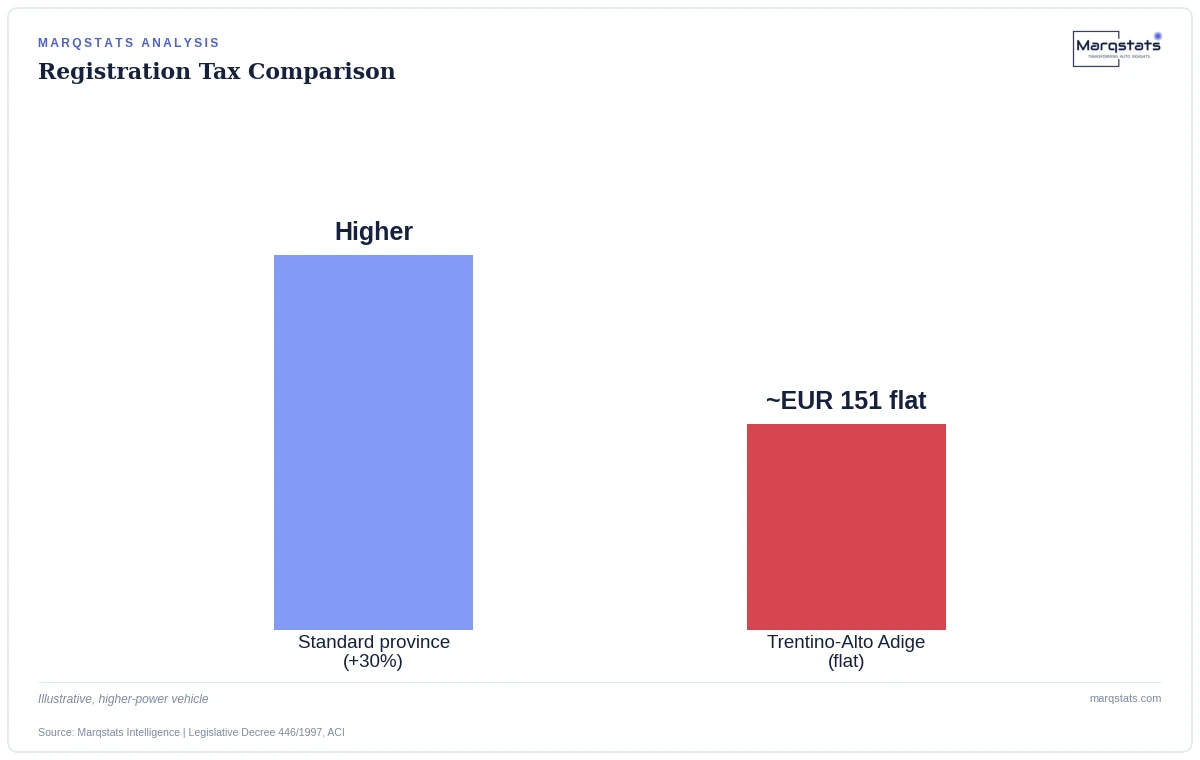
Because Trentino-Alto Adige charges a flat vehicle registration tax regardless of engine power, while every other major Italian province charges up to 30% more for bigger engines. That single tax difference is enough to make major leasing companies register vehicles there even when the cars themselves will spend their entire working life somewhere else entirely.
How the Tax Actually Works
Under Legislative Decree 446/1997, Trentino-Alto Adige's provincial authorities in Trento and Bolzano hold statutory autonomy over the Imposta Provinciale di Trascrizione, the registration tax applied when a vehicle changes ownership or gets its first plates issued. Standard metropolitan provinces — Rome, Milan, Naples — apply the maximum allowable surcharge, 30% above base tariffs, scaled to engine power. Trento and Bolzano instead charge a fixed rate, roughly EUR 151 per formality, completely independent of how powerful the engine is.
Who Actually Uses This, and How Much It Saves
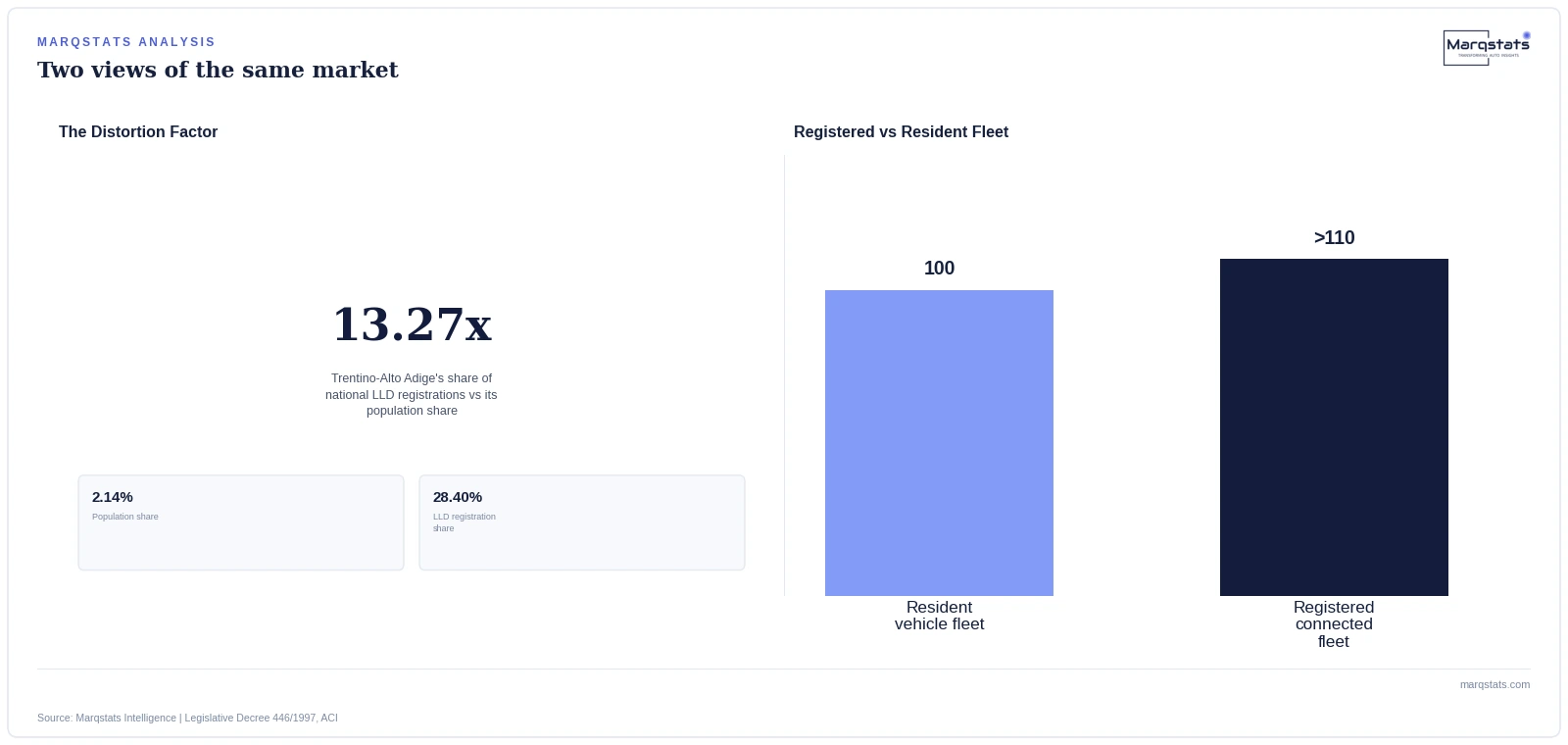
Major fleet leasing and long-term rental companies — Leasys, Ayvens Italia and Arval Service Lease Italia among them — concentrate commercial vehicle registrations in Trento and Bolzano specifically to lower balance-sheet acquisition costs. The scale is striking: Trentino-Alto Adige registers more than 120,000 passenger cars annually, capturing 28.40% of all national long-term rental registrations, despite the province holding just 2.14% of Italy's population. That is a concentration few other tax jurisdictions anywhere in Europe can match.
What This Does to the Region's Own Statistics
The practical consequence is that Trentino-Alto Adige's official connected-vehicle penetration rate reads as more than 110% of its own resident vehicle fleet — a mathematically impossible figure for actual local usage, but a perfectly accurate reflection of where vehicles are registered rather than where they operate. The vehicles themselves spend most of their working lives in Lombardy, Lazio and Emilia-Romagna, following the corporate fleets and rental customers that actually use them.
Why Provincial Authorities Haven't Closed This Loophole
The autonomous status that gives Trento and Bolzano control over their own Imposta Provinciale di Trascrizione is a long-standing feature of Italy's regional government structure, not a recent policy oversight, and closing the gap would mean voluntarily giving up a meaningful revenue stream the provinces currently capture from vehicles that will never actually drive on their roads. From the province's own fiscal perspective, attracting registration volume it would otherwise never see is a rational use of its statutory tax autonomy, even though the practical effect is to distort national vehicle statistics for every analyst working outside the two provinces themselves.
What a Fleet Buyer Should Actually Weigh
A leasing company or corporate fleet manager considering Trentino-Alto Adige registration should weigh the genuine balance-sheet saving against the administrative overhead of managing a fleet registered in a province where the vehicles themselves never operate — insurance, local compliance and any future regulatory scrutiny of registration arbitrage practices are all real considerations a purely tax-driven decision can overlook.
Is This Actually Illegal?
No — and that distinction matters for how the practice should be understood. Registering a vehicle in whichever jurisdiction offers the most favourable tax treatment is a legal, well-established practice across many tax systems, not specific to Italy or to vehicle leasing. What makes the Trentino-Alto Adige case unusually visible is simply the scale of the gap between the province's population and its share of national leasing volume — a 13-times distortion is large enough to show up clearly in national statistics, where a smaller tax-driven registration shift elsewhere might pass unnoticed.
A useful parallel is corporate registration in low-tax jurisdictions generally: nobody considers it illegal for a company to incorporate in Delaware or Luxembourg, even when the business itself operates entirely elsewhere. Vehicle leasing registration works on the same underlying logic, just applied at the provincial rather than national level.