
The 3 Million Italian Black Boxes That Aren't Actually Insured
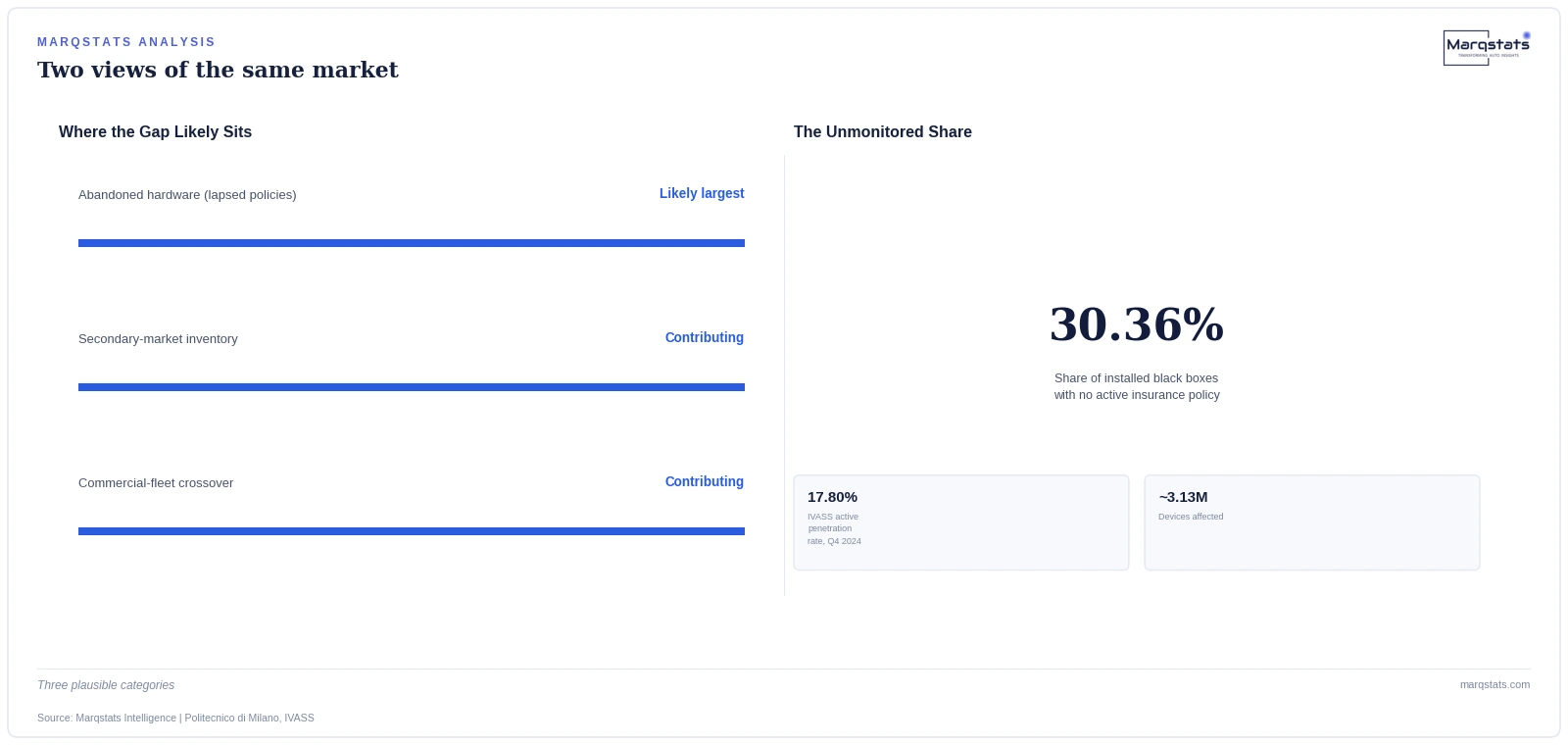
In brief: Italy's academic telematics census counts 10.3 million installed insurance black boxes in 2023. Regulatory data from IVASS, the insurance supervisory authority, reports a 17.80% active telematics policy penetration rate against a 40.3 million-vehicle fleet — which works out to roughly 7.17 million actively insured policies. The gap between the two figures, about 3.13 million devices, or 30.36% of the reported installed base, is not measurement error. It is a real population of hardware with no active commercial relationship attached to it.
Where the Missing Devices Actually Are
Three categories most plausibly account for the gap. First, abandoned hardware: a black box installed under one insurance policy does not automatically deactivate when that policy lapses or the vehicle changes hands, particularly in Italy's large second-hand car market. Second, secondary-market inventory: dealers and resellers may carry vehicles with previously installed devices that have not yet been re-activated under any new policy at all. Third, commercial-vehicle crossover: light commercial fleet installations captured in the broader telematics census are structurally excluded from IVASS's private passenger insurance filings, even though the devices themselves are physically identical.
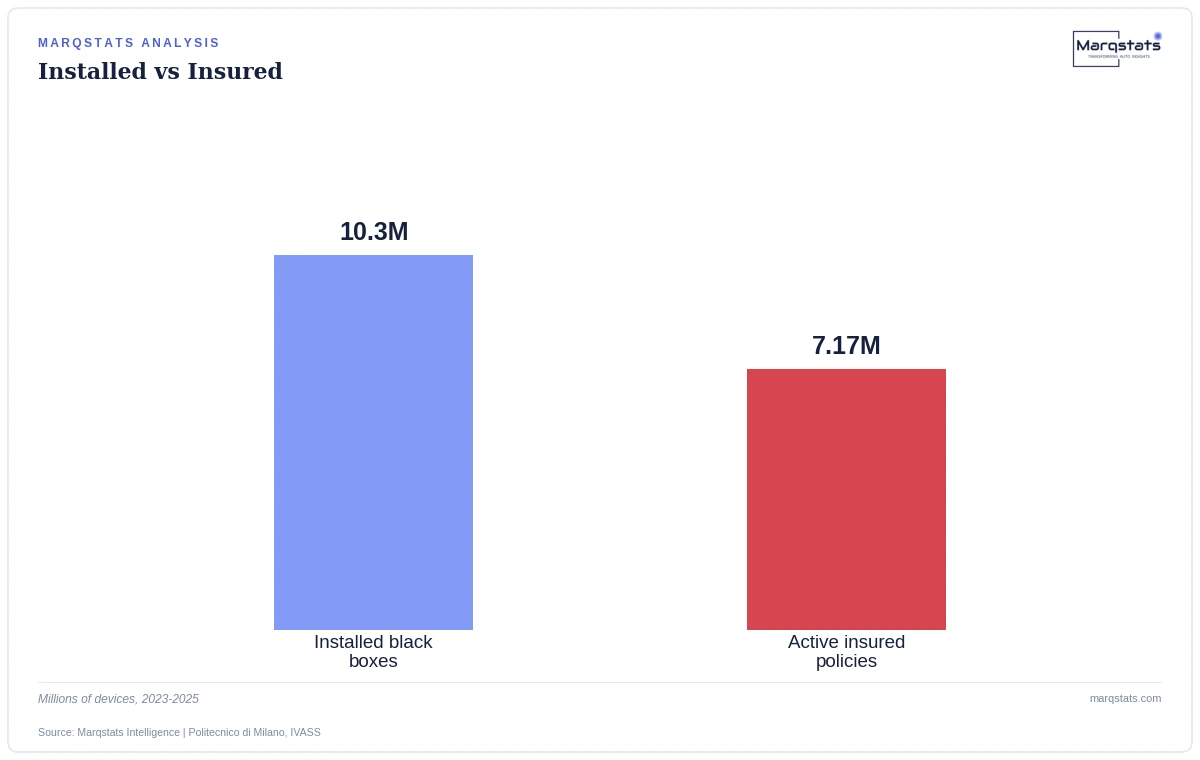
Estimating the relative size of each category precisely is difficult given the available public data, but the second-hand market channel is plausibly the largest single contributor, given Italy's above-average vehicle age and correspondingly active used-car resale market compared to other major European economies — more vehicle transactions structurally means more opportunities for an installed device to outlive the policy it was originally installed under.
Why This Gap Matters Commercially
An insurer or telematics provider using the 10.3 million installed-device figure as a proxy for the addressable market for renewal campaigns, data services, or hardware replacement programmes will overstate the actively reachable population by close to a third. The 7.17 million figure, derived from IVASS's own regulatory reporting, is the more defensible number for any commercial activity that depends on an active policy relationship — renewal outreach, usage-based insurance upsell, or claims-related data services.
This distinction also matters for how competing telematics providers should be benchmarked against each other. A provider reporting its own "installed base" without clarifying how many of those devices carry an active commercial relationship is making a claim that is technically accurate but potentially misleading for anyone comparing providers on a like-for-like basis — exactly the kind of ambiguity this market's own headline figures already demonstrate at the national level.
Nearly a third of Italy's reported insurance black box base has no active insurance policy attached to it.
— Marqstats Analyst Team
What the Dormant Devices Still Represent
The 3.13 million unmonitored devices are not worthless to every stakeholder, even if they generate no current insurance revenue. For a hardware manufacturer or a used-car buyer, a vehicle with an already-installed black box represents a lower-friction path back into an active policy than a vehicle with no hardware at all — reactivating existing hardware is cheaper than a fresh installation. An insurer's win-back campaign targeting lapsed policyholders with existing hardware is a fundamentally different, and likely more efficient, commercial motion than a cold acquisition campaign targeting uninstalled vehicles.
There is also a safety dimension worth naming, separate from the commercial one. A dormant black box, even without an active insurance policy attached, may still be capable of basic stolen-vehicle-recovery functionality if its underlying cellular connection has not been physically disconnected — meaning the 3.13 million figure likely overstates the population that is entirely non-functional, even though it accurately represents the population generating no active commercial revenue at all.
How This Compares to the 2022-to-2023 Restatement
This is not the first time Italy's connected-vehicle figures have needed a downward correction. The Politecnico di Milano's own census restated the connected parc down between its 2022 and 2023 releases, explicitly to correct for deactivated 2G-era endpoints and vehicles double-counted across both an insurer black box and an OEM factory modem. The installed-versus-insured gap this piece describes is a related but distinct problem — not double-counting or deactivation, but devices that remain physically present and technically functional and operable while commercially dormant.
The two corrections share a common lesson worth stating plainly: any single-year snapshot of Italy's connected-vehicle market should be treated as provisional until cross-referenced against at least one independent data source, given the market's own demonstrated history of needing material downward revision. A reader citing either the raw installed-device count or an uncorrected historical PoliMi figure without this context risks repeating a mistake this market has already made publicly, twice.
A Named Comparison: How Other Markets Handle This Reconciliation
Italy's willingness to publish two independently sourced telematics figures — one academic, one regulatory — that a researcher can cross-reference is itself unusual among European connected-car markets. Several comparable markets in this coverage set publish only a single headline connected-vehicle figure sourced from one methodology, with no equivalent regulatory cross-check available to reveal a gap of this kind even if one exists. That means the installed-versus-insured discrepancy described here may not be unique to Italy — it may simply be more visible in Italy because IVASS happens to publish the specific penetration-rate series that makes the reconciliation possible in the first place, a transparency advantage worth noting explicitly.
What This Means for a Regulator Considering Reform
For IVASS itself, or for the Politecnico di Milano census team, this gap suggests a concrete methodological improvement: publishing an explicit "active policy" connected-vehicle figure alongside the existing installed-device count would remove the reconciliation burden this piece has had to perform manually, and would give every downstream user of Italian connected-car statistics a cleaner, unambiguous starting point going forward.
Such a change would cost either body relatively little to implement, since both already collect the underlying data this reconciliation relies on — the missing step is simply publishing the cross-referenced figure directly and consistently, rather than leaving it to outside analysts to derive independently each time the question comes up.
What This Means for an Insurer's Renewal Strategy
A concrete application of this reconciliation, worth spelling out in practical terms: an insurer planning a win-back campaign for lapsed telematics policyholders should specifically target the subset of the 3.13 million unmonitored devices where the underlying vehicle is still registered to an identifiable owner, rather than treating the entire gap as a single undifferentiated opportunity. Vehicles that have since been scrapped, exported, or sold into markets with no active insurance relationship at all represent a meaningfully smaller, and more precisely and reliably targetable, population than the headline 3.13 million figure alone suggests.
What a Telematics Vendor Should Do With This Number
For a hardware vendor rather than an insurer, the 3.13 million figure represents something closer to a retrofit opportunity than a lost customer base. Vehicles carrying already-installed but dormant black boxes are strong candidates for a low-cost software or firmware reactivation offer, since the physical installation cost — typically the largest single line item in bringing a vehicle onto a telematics platform — has already been paid by whoever installed the device originally. A vendor that can identify and target this specific population, rather than treating all uninstalled and dormant vehicles identically, should see meaningfully lower customer acquisition costs than a vendor competing purely on new installations.
This also suggests a natural partnership opportunity between hardware vendors and insurers that neither party may currently be pursuing systematically: a vendor with visibility into which specific devices remain physically installed but dormant is sitting on exactly the data an insurer's win-back team would need to prioritise its own outreach, and a formal data-sharing arrangement between the two — subject to the same privacy and consent requirements governing any other vehicle telemetry use — could meaningfully improve reactivation rates on both sides of the relationship.
Outlook: One Trigger, Not Three
This market does not support a three-scenario outlook on the installed-versus-insured gap specifically. The single evidenced trigger is whether IVASS or the Politecnico di Milano census eventually reconcile their two data series into a single, unified reporting standard — until then, any analysis of this market needs to specify explicitly which of the two figures it is using and why.