Market Snapshot
Middle bar: base-year value × (1 + CAGR), rounded to two decimals. This is a calculated illustration, not a separately researched annual estimate.
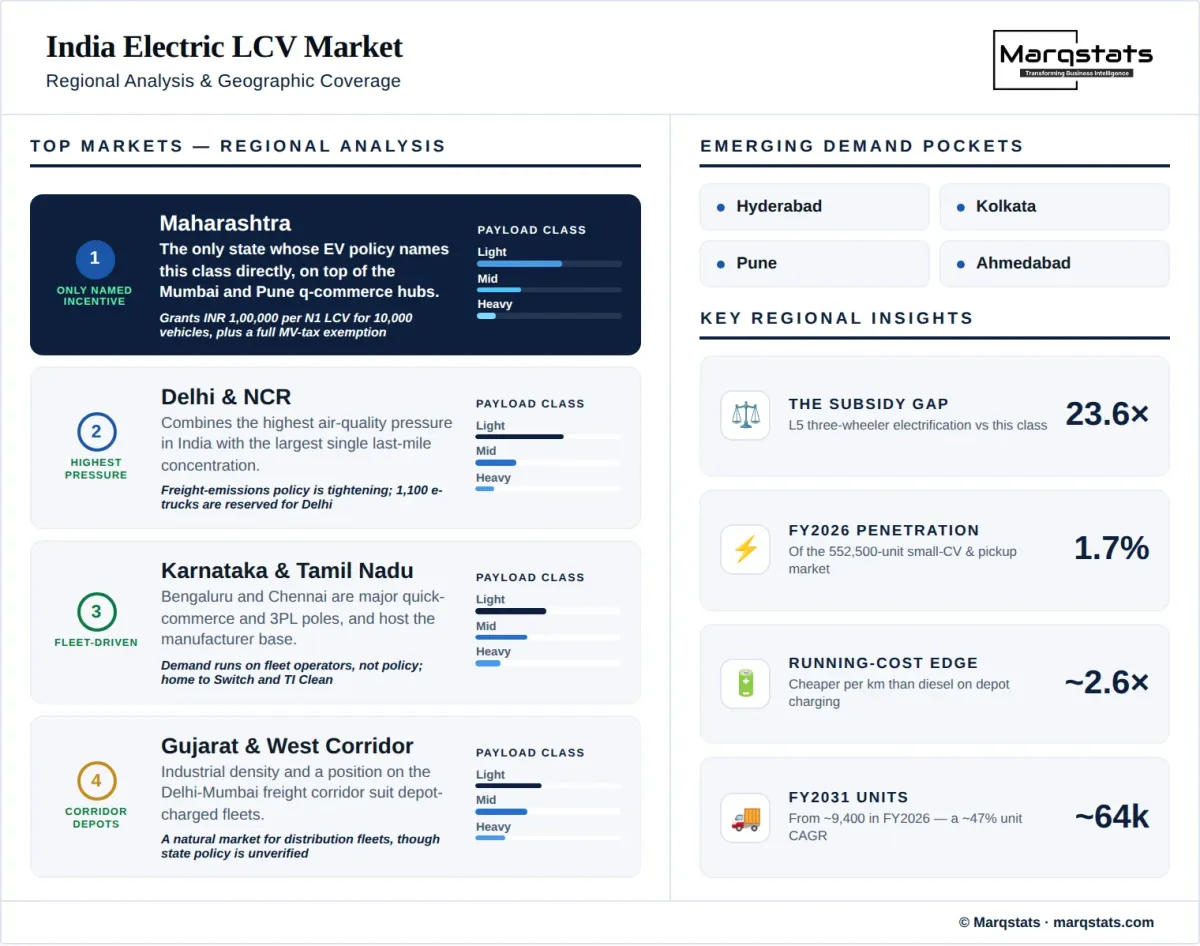
The India electric LCV market is estimated at USD 93.7 million in FY2026 and is projected to reach USD 518.0 million by FY2031, at a CAGR of 40.76%. Marqstats estimates battery-electric goods carriers under 3.5 tonnes at roughly 9,400 units in FY2026, or about 1.7% of the 552,500-unit small commercial vehicle and pickup market — no registration series exists for this class. Volumes rise to about 64,000 units by FY2031 and penetration to roughly 10%. This is the only goods-vehicle category in India excluded from every central purchase-incentive scheme.
Market size and forecast figures are generated using Marqstats' proprietary estimation framework, updated as of August 2026.
That last point is the defining fact of this market and it is verifiable from the gazette. PM E-DRIVE, India's flagship electric vehicle scheme, carries a total outlay of INR 11,900 crore, of which roughly INR 9,065 crore is allocated across six vehicle categories and the balance to public charging, testing infrastructure and administration. Its e-truck component, notified on 10 July 2025, defines eligibility as N2 goods vehicles above 3.5 tonnes and N3 goods vehicles above 12 tonnes. Vehicles below 3.5 tonnes are not an eligible category, were never notified as one, and do not appear in the scheme's disbursement dashboard. The Tata Ace EV class sits between an electric three-wheeler component whose 288,809-unit target was fully drawn down and closed in December 2025, and an electric truck component whose 5,643-unit target had produced just 138 registrations by August 2026 — a 2.4% take-up. It receives nothing from either.
The market has grown anyway. Tata Motors reported electric Ace retail sales up 42% in FY2025, and its own investor materials mark that growth as coming after the discontinuation of FAME-II support — a scheme that lapsed in 2022 or 2024 depending on which official source is read, and that never covered this class in any event. More than 10,000 electric Aces were deployed by September 2025. But the growth is off a base so small that the segment remains a rounding error inside its own parent market, and the comparison that matters is not with last year. Electrification of L5 three-wheeler sales ran at 40.2% in the quarter ended June 2026, on Mahindra's own disclosure. Marqstats estimates electrification of sub-3.5-tonne four-wheel goods vehicles at 1.7% in FY2026. On those two measures the subsidised class is roughly 23.6 times more electrified than the unsubsidised one sitting directly above it — a quarterly industry rate set against an annual estimate, so indicative rather than precise.
The parent market has been through a contraction. Combined small commercial vehicle and pickup volumes fell 3% between FY2024 and FY2025, from 508,000 units to 493,000; within that total, small commercial vehicles ran a negative compound growth rate of 2.4% across FY2020 to FY2025 while pickups grew 7.5% and three-wheelers grew 1.7%. Tata Motors' own diagnosis of its segment is a shift from small commercial vehicles to pickups and electric three-wheelers. On the segment definition adopted here the base stabilises and grows modestly through the forecast, at 2.07% a year to 612,000 units in FY2031. The electric LCV is therefore taking a rising share of a base that has stopped shrinking without returning to growth, against a subsidised substitute that has been winning on price.
Key Takeaways
Market Overview & Analysis
Report Summary
This study covers battery-electric goods carriers of category N1, meaning a gross vehicle weight not exceeding 3.5 tonnes, manufactured and sold in India. In product terms that is the Tata Ace EV, Ace Pro EV and Ace EV 1000, the Mahindra Zeo, the Switch Mobility IeV3, the Euler Storm and the Omega Seiki M1KA 1.0. Three-wheelers of every kind are excluded, as are goods vehicles above 3.5 tonnes, which belong to the electric truck market.
That boundary requires care in India, because two conventions collide on the word LCV. The Motor Vehicles Act, 1988 defines a light motor vehicle at section 2(21) as one whose gross vehicle weight does not exceed 7,500 kilograms. Indian industry convention follows the statute: it calls 3.5 to 7.5 tonnes the LCV band and reserves the term small commercial vehicle for everything below 3.5 tonnes. The type-approval convention used by PM E-DRIVE and by state EV policy runs on the N-category system, where N1 stops at 3.5 tonnes and N2 begins above it. This study uses the type-approval convention. Readers translating Indian trade data into it should note that the 3.5 to 7.5 tonne band excluded here is precisely the band PM E-DRIVE does subsidise, at up to INR 2.70 lakh a vehicle.
Marqstats sizes the India electric LCV market at USD 93.7 million in FY2026, rising to USD 518.0 million by FY2031 at a compound annual growth rate of 40.76%. Units, on the Marqstats estimate described below, grow faster than value — from roughly 9,400 to 64,000 at 46.67% — because average selling prices decline through the forecast as battery costs fall and volume builds. In rupee terms the market compounds at 42.27% from INR 801 crore to INR 4,672 crore. The 1.51-point gap between the two rates is currency: the rupee is assumed to weaken from 85.5 to 90.2 to the dollar, which suppresses the dollar CAGR rather than flattering it.
A word on how these figures were built, because it matters more here than in most markets. No published unit series exists for this segment. The Vahan registration database has no gross-vehicle-weight filter and no sub-3.5-tonne class; its goods buckets are Goods Carrier, Light Goods Vehicle, Medium Goods Vehicle and Heavy Goods Vehicle, of which Light Goods Vehicle is a permit and licensing category rather than the 3.5-tonne regulatory band. No manufacturer discloses a clean unit number either. Tata Motors publishes a cumulative deployed fleet and a growth rate but has never released an absolute annual figure, and does not publish the vehicle's price or battery capacity. Mahindra publishes full specifications for the Zeo but has never disclosed a unit volume for it in any period. The unit series in this report is therefore a Marqstats construction, reconstructed from disclosed cumulative fleet figures and market shares, and it is identified as such wherever it appears.
Market Dynamics
Key Drivers
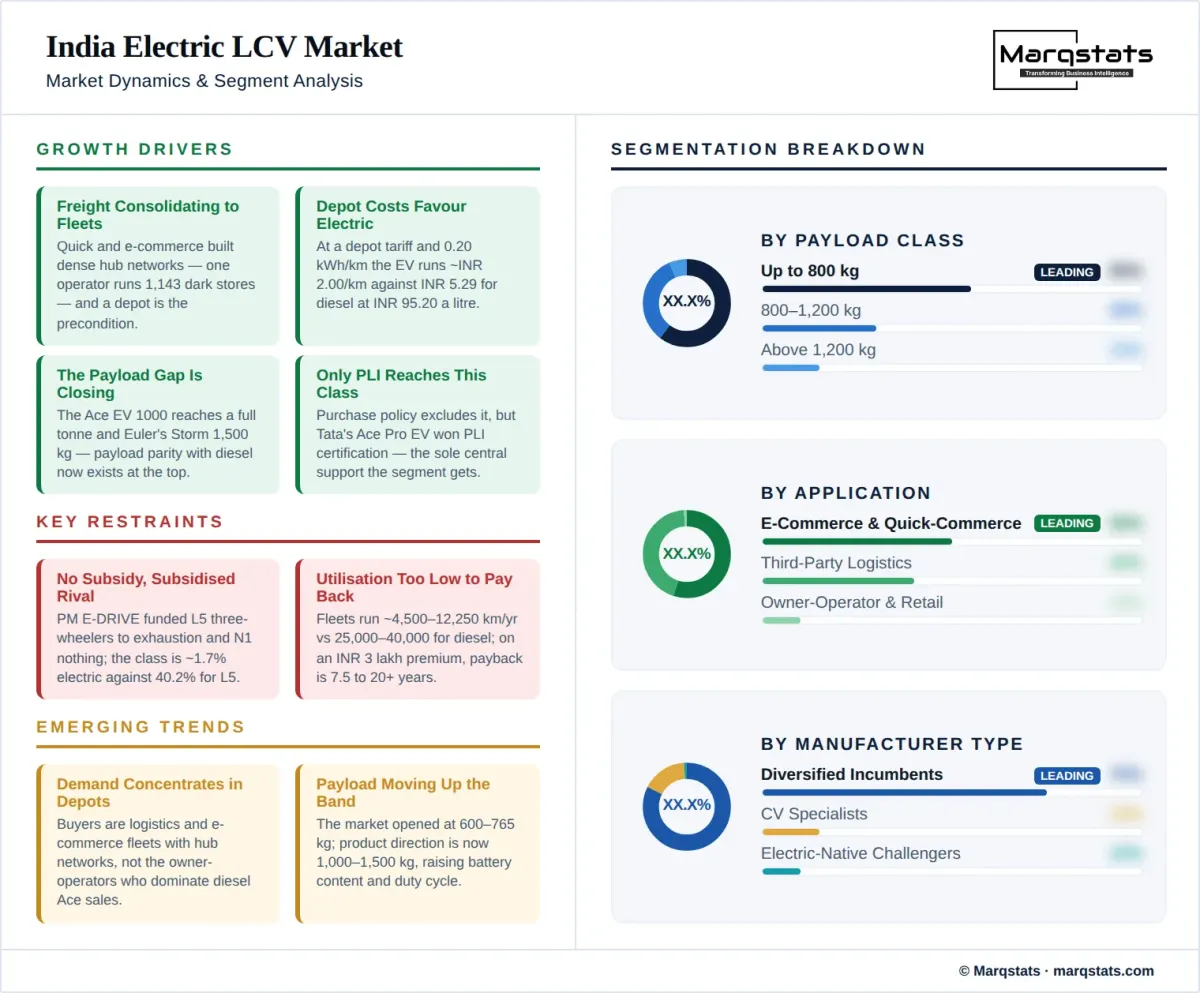
Urban last-mile freight is consolidating into professional fleets that can charge at a depot. Quick commerce and e-commerce logistics have built dense networks of hubs and dark stores — one listed operator runs 1,143 dark stores across more than 125 cities — and a fenced site with a grid connection is the precondition for the electric case to work at all.
Running costs favour electricity by a wide margin where depot charging is available. Diesel stood at INR 95.20 a litre in Delhi in August 2026 and compressed natural gas at INR 83.09 a kilogram in May 2026. At a depot tariff of INR 10 a unit and consumption of 0.20 kWh per kilometre, the electric vehicle runs at roughly INR 2.00 a kilometre against INR 5.29 for diesel at 18 kilometres to the litre.
The product gap that held the segment back is closing. The original Ace EV carried 600 kilograms against 900 for the diesel Ace Gold+. Tata answered with the Ace EV 1000 at a full tonne in May 2024 and has an Intra EV at 1,500 kilograms in its roadmap; Euler's Storm carries 1,500 kilograms at a declared 2,800-kilogram gross weight. Payload parity with diesel now exists at the top of the band.
Charging access has widened faster than the vehicle parc. Tata Motors reported more than 25,000 public charge points accessible to electric small commercial vehicle customers across over 150 cities in September 2025, with locations surfaced in the vehicle's own fleet telematics platform.
Manufacturing-side policy does reach this class even though purchase policy does not. Tata Motors confirmed PLI certification for the Ace Pro EV, making production-linked incentive the only central support the segment receives.
Key Restraints
There is no purchase subsidy, and the substitute below had one until it ran out. PM E-DRIVE directed INR 857 crore at 288,809 L5 electric three-wheelers until that component closed on 26 December 2025 with its target achieved, and INR 50 crore at electric rickshaws and carts, against nothing for N1 at any point. Tata markets the Ace Pro EV on offering better total cost of ownership than three-wheeler EVs, which is an explicit admission of what it is competing against.
Utilisation is too low for the arithmetic to work. Magenta Mobility's 350 vehicles and 50 lakh kilometres imply about 12,250 kilometres per vehicle-year; Tata's national fleet implies roughly 4,500, on a linear-ramp assumption and a cumulative kilometre figure that was quoted unchanged across two releases four months apart. Both sit far below the 25,000 to 40,000 kilometres an urban diesel LCV covers. No manufacturer publishes a price for an electric vehicle in this class, so the acquisition premium cannot be observed; on an assumed INR 3 lakh premium and a fuel saving of INR 3.29 per kilometre, payback runs from about seven and a half years at the higher utilisation figure to over twenty at the lower.
Range and charging time cap the vehicle at a single shift. Certified ranges cluster between 120 and 161 kilometres and the Ace EV takes eight hours on slow charge or 1.5 hours fast. A vehicle that cannot be turned around inside a working day cannot be worked hard enough to earn back its premium.
The GST reform of September 2025 narrowed the tax advantage. Goods vehicles moved from 28% plus compensation cess to 18% effective 22 September 2025 while electric vehicles were left untouched, closing roughly ten points of the gap that favoured electric.
Financing is a specialist product rather than a mainstream one. Lenders ring-fence electric vehicle loans into separate categories, one specialist financier reports that 85% of its customers have no prior credit history, and the Small Industries Development Bank of India has had to establish a dedicated electric vehicle risk-sharing facility — a public credit guarantee is built where commercial lenders decline the risk unaided.
Key Trends
Demand is concentrating in captive depot-charging fleets rather than owner-operators. The named early customers are logistics and e-commerce businesses with hub networks, not the individual buyers who dominate diesel Ace sales, and this is a structurally different customer from the one the segment was built for.
Payload is moving up the band. The market opened at 600 to 765 kilograms and the current product direction is toward 1,000 to 1,500, which raises battery content and the addressable duty cycle. Mix alone would push prices up; falling cell costs and rising volume more than offset it, and this study models blended selling prices down 3.0% a year through the forecast, which is why units compound faster than value.
The pledge-to-delivery gap is narrowing in disclosure quality if not in size. The 2022 launch memorandum for 39,000 units has produced roughly 10,000 vehicles across all customers; the more recent disclosures, such as Magenta's 350 against a 500-unit agreement, are being reported with the gap visible rather than concealed.
Western manufacturers are absent and domestic incumbents are consolidating the segment. No Maruti Suzuki electric commercial vehicle programme in this band could be identified from any public source, and among the challengers, several companies routinely listed as electric LCV players — including Altigreen — have no four-wheeler product at all.
Market Segmentation
This is where the market opened and, on the deployed product mix, where most of the installed base still sits. The Tata Ace EV at 600 kilograms, the Ace Pro EV at 750 and the Mahindra Zeo at 765 define the class, and it maps onto the intra-city parcel and grocery duty cycles that quick commerce and e-commerce generate. Battery packs are modest — the Zeo carries 21.3 kWh — which keeps the price premium containable and the depot charging load light. No unit split by payload class is published, so the shares in this section are qualitative; the payload penalty against a 900-kilogram diesel Ace is the reason manufacturers have moved product upward, which suggests the class is losing relative weight without a series to measure it.
The Ace EV 1000 at a full tonne and the Omega Seiki M1KA 1.0, also at a tonne on a derived gross weight of about 2,320 kilograms, occupy the middle of the band. This is the class that achieves genuine payload parity with the diesel vehicles it replaces, and third-party logistics operators are the buyers most likely to want it. Certified range of 161 kilometres on the Ace EV 1000 is the highest disclosed among vehicles confirmed inside the N1 boundary; the Montra EVIATOR claims 292 kilometres, but its 1.707-tonne payload implies a gross weight at or above 3.5 tonnes and it is treated here as outside the class.
The Switch Mobility IeV3 at 1.25 tonnes and the Euler Storm at 1.5 tonnes on a declared 2,800-kilogram gross vehicle weight sit at the top of N1. Euler is the only manufacturer in the segment that publishes a gross vehicle weight figure, which matters because several vehicles marketed as electric LCVs — the Switch IeV4 at 1.75 tonnes of payload and the Montra EVIATOR at 1.707 — very probably sit at or above the 3.5-tonne boundary and therefore outside this market. Buyers in this class are choosing between an N1 vehicle with no subsidy and an N2 vehicle that attracts up to INR 2.70 lakh.
This is the founding application and remains the core. The customers named at launch and first delivery — Amazon, Flipkart, Delhivery, DHL, FedEx, Safexpress, BigBasket and Trent — are all parcel or grocery networks with fixed hubs, predictable radial routes and the ability to install depot charging. A caution is essential here: the very large electric fleet numbers these companies publish are overwhelmingly two-wheelers. One listed food-delivery group reported more than 51,000 electric delivery partners as of March 2025; these are rider two-wheelers, and its published commitment is to electric food deliveries rather than to an electric goods-vehicle fleet. A second listed operator states outright that its electric programme is electric two-wheelers, and publishes no absolute count at all. Those fleets are not electric LCV demand and must not be counted as such.
Dedicated fleet operators running vehicles on behalf of shippers are the most committed buyers in the market. Magenta Mobility is the clearest case, with 350 electric Aces across ten cities and a stated intention to reach sixteen, roughly 50 lakh cumulative kilometres and named shipper relationships. This channel matters disproportionately because it solves the two binding constraints at once: it aggregates enough vehicles to justify a depot charger, and it puts a professional operator rather than an owner-driver behind the residual-value risk.
The retail buyer who dominates diesel Ace sales has barely entered this market. The economics require depot charging and high utilisation, and the financing is harder to obtain for a thin-file borrower; State Bank of India's facility for the Ace EV offers 90% of on-road price over a tenure of up to six years, but the rate is undisclosed and specialist electric vehicle lenders report that most of their customers have no credit history at all. No operator has published a retail owner-driver case for this vehicle class.
Tata Motors and Mahindra dominate the parent market on an all-fuel basis — Tata held 53% of small commercial vehicles in FY2025 and Mahindra 52.0% of its sub-3.5-tonne LCV segment in the quarter ended June 2026 — but only Tata has demonstrably carried that position into electric. Tata moved first, in 2022, and has the deepest charging and service ecosystem behind the product. Mahindra launched the Zeo later, it is the company's sole four-wheeler battery-electric product, and no volume for it has ever been published, so Mahindra's electric position in this class cannot be established from disclosure.
Ashok Leyland lists no electric variant of the Dost or Bada Dost on its own site, routing electric entirely to Switch Mobility. Switch reports more than 1,600 electric LCVs on the road, which is the cleanest pure-play parc figure available in the segment, and claims more than 80% share of the 2 to 3.5 tonne electric LCV band — a company claim in a self-selected band that excludes the lighter class where Tata and Mahindra actually compete.
Euler Motors, Omega Seiki Mobility and TI Clean Mobility's Montra Electric brand each field a four-wheeler product alongside larger three-wheeler ranges. None discloses volumes, funding, plant capacity or customers for its N1 vehicle, and Euler's public claim of more than 1,000 vehicles on the road covers three-wheelers and four-wheelers together and appears not to have been updated. The pattern across the segment is that the challengers built three-wheelers first and added a four-wheeler later, which is the reverse of the direction the incumbents travelled.
By Geography
No state-level registration split is published for electric goods carriers under 3.5 tonnes, for the same reason no national series is: the Vahan class taxonomy has no such bucket. The regional picture below is therefore built from where demand, policy and charging infrastructure are documented to concentrate, and it is ordered by the weight of that evidence rather than by a measured share.
Maharashtra
Maharashtra is the only state whose electric vehicle policy has been verified to name this vehicle class directly. The Maharashtra Electric Vehicle Policy-2025, notified on 23 May 2025 and effective from 1 April 2025 to 31 March 2030, offers N1 light commercial vehicles 15% of ex-factory cost capped at INR 1,00,000 a vehicle, for 10,000 vehicles, alongside a 100% motor vehicle tax exemption for all electric vehicles across the policy period. The tax waiver runs for the full policy period and is not capped per vehicle; its value relative to the INR 1,00,000 purchase grant depends on the state's goods-vehicle tax schedule, which is not quantified here. Mumbai and Pune are also among the country's principal e-commerce and quick-commerce hub clusters, though no city-level hub distribution is published.
Delhi and the National Capital Region
Delhi combines the highest air-quality pressure in India with the largest single concentration of last-mile logistics. An extension of the Delhi Electric Vehicle Policy 2020 was notified on 29 August 2025, though its contents could not be verified for this study and a successor policy has not been confirmed as notified. The clearest signal of Delhi's regulatory weight is indirect: PM E-DRIVE reserves roughly 1,100 of its 5,643 electric trucks and about INR 100 crore specifically for Delhi registrations. That carve-out applies to N2 and N3 vehicles, not to the class in this study, but it establishes the direction of freight-emissions policy in the region.
Karnataka and Tamil Nadu
Bengaluru and Chennai are major poles of Indian quick-commerce and third-party logistics demand, and both host manufacturer presence — Switch Mobility and TI Clean Mobility are both headquartered in Chennai, and Ashok Leyland's commercial vehicle base is there. Neither state's current electric vehicle policy could be verified from a primary government source for this study, so no incentive figures are stated. Demand in both states is driven by fleet operators rather than by policy.
Gujarat and the Western Corridor
Gujarat's industrial density and its position on the Delhi-Mumbai freight corridor make it a natural market for depot-charged distribution fleets, As with the southern states, the current electric vehicle policy contents could not be verified from a primary source, and no figures or claims about state support are made here.
Rest of India
Adoption outside the metropolitan clusters is limited by the same constraint everywhere: the vehicle needs a fenced site with a grid connection and enough daily distance to justify the premium. Tier-two and tier-three cities have the distance but not the depot infrastructure, and the public charging alternative carries a service charge of up to INR 13 a unit on top of the energy tariff, which removes most of the running-cost advantage. This is why the market is concentrated in a handful of metropolitan areas and is likely to remain so through the forecast period.
How Competition Is Evolving
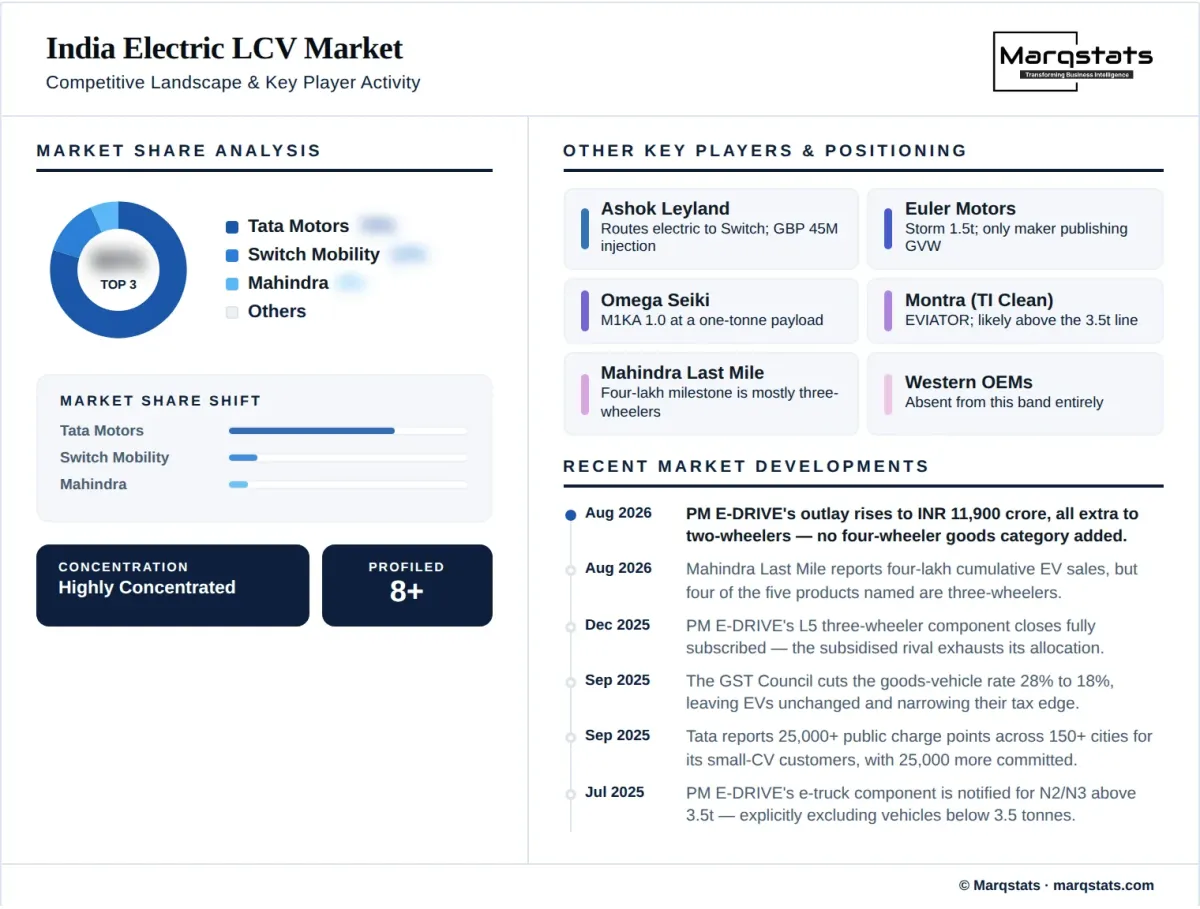
The India electric LCV market is highly concentrated and led by the incumbent that moved first. Tata Motors launched the Ace EV in May 2022, well ahead of the field, and had more than 10,000 vehicles deployed by September 2025 — a figure no competitor approaches. Switch Mobility, the second-clearest disclosure in the segment, reports more than 1,600 electric LCVs on the road. Mahindra, which leads the all-fuel sub-3.5-tonne segment with 52.0% share, has never published a single volume figure for the Zeo. On the available evidence Tata holds a substantial majority of the electric segment, and Marqstats estimates that share at roughly 70% in FY2026, declining through the forecast as the challengers scale.
Concentration here is a disclosure problem as much as a market structure. No manufacturer publishes annual unit sales for an N1 battery-electric goods carrier; the segment is visible only through cumulative deployed-fleet claims, growth percentages and all-fuel market shares. Two further hazards distort any casual reading. First, the headline electric volumes published by Mahindra's Last Mile Mobility business — including a four-lakh cumulative milestone announced in August 2026 — cover three-wheelers and four-wheelers together, and four of the five products named in that announcement are three-wheelers. Second, segment labels that appear to match this market do not: Mahindra's LCV under 3.5 tonne series, at 73,600 units in the quarter ended June 2026, is an all-fuel figure and is overwhelmingly diesel.
Competitive strategy is diverging along a clear line. The incumbents are competing on ecosystem rather than on the vehicle: Tata's position rests on 25,000 accessible public charge points, more than 200 electric-capable service centres, a bundled five-year maintenance package, a seven-year battery warranty on the Ace EV 1000 and a financing arrangement with State Bank of India at 90% of on-road price. The electric-native challengers compete on product specification and payload, with Euler the only manufacturer publishing a gross vehicle weight. Meanwhile the segment's most instructive competitive event happened offshore: Ashok Leyland approved a GBP 45 million equity injection into Switch Mobility's UK arm in February 2025 and, the following month, began consultation on ceasing manufacturing at its Sherburn facility, redirecting the business toward India. Switch India reported positive EBITDA and profit after tax across the first nine months of FY2026.
Companies Covered
Companies covered in the report include:
Recent Market Activity
Table of Contents
Coverage & Segmentation
This study covers battery-electric goods carriers of category N1 — gross vehicle weight not exceeding 3.5 tonnes — manufactured and sold in India. Three-wheelers of every category are out of scope, including L5N cargo vehicles and L3 electric carts, both of which are separately established markets with different regulation, economics and buyers. Goods vehicles above 3.5 tonnes are out of scope and belong to the electric truck market. Hybrid, compressed natural gas and diesel vehicles appear only as the comparison base. Market value is measured at manufacturer selling price in rupees and converted to United States dollars at annual average exchange rates, with both series reported because they diverge by 1.51 percentage points over the forecast.
The study runs on Indian fiscal years. FY2026 means the year ended 31 March 2026 and is the base year; the historical period is FY2022 to FY2026 and the forecast period FY2027 to FY2031, spanning April 2026 to March 2031. Those five forecast years are referred to in this report's title by the calendar year in which each begins, so FY2027 to FY2031 appears as 2026 to 2030. This matters because three reporting conventions coexist in the source record — PM E-DRIVE reports on fiscal years, registration data is frequently presented on calendar years, and manufacturers report fiscal quarters with a prefix convention in which the first quarter of FY2027 means April to June 2026. Figures drawn from calendar-year sources are identified as such.
Two further conventions govern the figures. First, every penetration rate in this report divides electric N1 units by the all-powertrain small commercial vehicle and pickup market, which was 493,000 units in FY2025 on Tata Motors' published figure and 552,500 in FY2026 on the extension described in the methodology. Readers should be aware that Indian sources using the term LCV frequently mean vehicles up to 7,500 kilograms under the Motor Vehicles Act definition, which produces a materially different denominator. Second, unit volumes in this study are a Marqstats construction rather than a published series, for the reasons set out in the methodology, and are identified as estimates throughout.