Market Snapshot
Key Takeaways
Market Overview & Analysis
Report Summary
The India battery-as-a-service market covers the provision of battery energy to electric vehicle users through swapping, subscription, leasing, and pay-per-use models, decoupling battery ownership from vehicle ownership. The market includes battery swapping infrastructure operators (stations, battery inventory, energy management), OEM-linked battery subscription programmes, battery leasing and financing platforms, and the associated technology stack encompassing battery management systems (BMS), IoT-enabled tracking, predictive maintenance, and digital battery passports. The addressable vehicle base spans electric two-wheelers (scooters and motorcycles), electric three-wheelers (e-rickshaws and L5 cargo vehicles), electric four-wheelers (passenger cars and light commercial vehicles), and the emerging heavy-commercial EV segment.
India’s electric two-wheeler segment crossed 1.40 million retail units in FY 2025–26, with 6.54% penetration of the overall two-wheeler market, while electric three-wheelers continue to dominate India’s overall EV volumes. The BaaS model addresses the two most significant barriers to EV adoption: high upfront battery cost (batteries represent 35–45% of an electric two-wheeler’s price) and range anxiety. By separating the battery from the vehicle, BaaS reduces upfront EV purchase costs by 20–40%, converts battery cost into a predictable operating expense, and eliminates charging downtime through sub-two-minute battery swaps. For commercial fleet operators running 80–150 km daily, BaaS transforms the economics of electric mobility from a capital expenditure decision into a variable-cost operating model.
The competitive landscape comprises four distinct operator categories: dense open-network operators (Battery Smart, Yuma Energy), energy and industrial-platform players (SUN Mobility, Indofast Energy), OEM-linked and semi-captive ecosystems (Honda e:Swap, VIDA BaaS, Ather BaaS, TVS BaaS), and emerging heavy-commercial BaaS providers (Blue Energy Motors, EIM-Foton). The market is also attracting significant investment: SUN Mobility raised approximately USD 135 million including a PIDG commitment of USD 20 million; Battery Smart raised USD 29 million in Series B1 (May 2025); VoltUp secured USD 8 million in seed funding (January 2025); and Yuma Energy announced a INR 200 crore investment plan in Uttar Pradesh.
Market Dynamics
Key Drivers
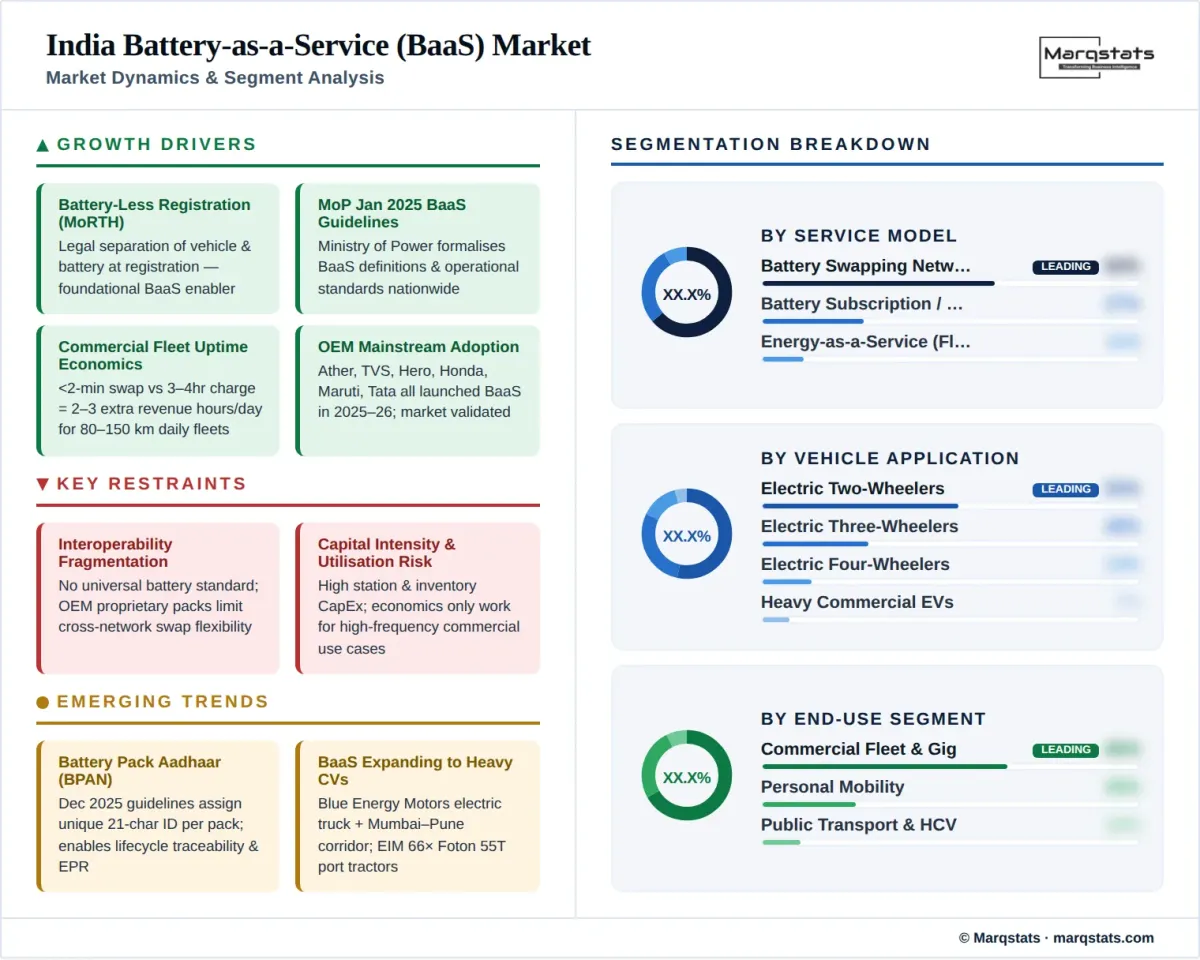
- Battery-less vehicle registration enabling legal separation of vehicle and battery: MoRTH’s clarification that EVs can be sold and registered without pre-fitted batteries is the foundational regulatory enabler of the BaaS model. This decision legally separates the vehicle from the battery at the point of sale and registration, allowing consumers to purchase a vehicle chassis at reduced cost while subscribing to battery energy through a third-party provider. Without this registration framework, the entire BaaS business model would face structural legal barriers.
- Ministry of Power’s January 2025 BaaS guidelines formalising the ecosystem: The Ministry of Power’s January 10, 2025 guidelines for battery swapping and charging stations formally define BaaS, establish operational standards, and provide a regulatory framework for swappable battery providers and station operators nationwide. The guidelines explicitly promote battery swapping and battery-as-a-service, creating regulatory certainty that supports investment and scaling.
- Commercial EV fleet economics favouring swapping over charging: For high-utilisation commercial EVs running 80–150 km daily in delivery, ride-hailing, and cargo operations, the economics of battery swapping are compelling. A sub-two-minute swap versus 3–4 hours of conventional charging translates directly into 2–3 additional revenue hours per vehicle per day. Battery Smart’s 100 million cumulative swaps and Yuma’s 50 million swaps demonstrate that this economic logic is scaling at pace.
- Rapid growth of quick-commerce and gig-economy fleets: The expansion of quick-commerce platforms (Blinkit, Zepto, Instamart) and food delivery services (Zomato, Swiggy) is creating sustained demand for always-available electric two-wheelers. Indofast Energy’s partnerships with EVeez (20,000 e-bikes), e-Sprinto (20,000 e-scooters), and Motovolt demonstrate how BaaS infrastructure is being directly integrated into fleet deployment strategies.
- OEM entry legitimising and broadening the BaaS model: The entry of established OEMs into BaaS has expanded the model beyond commercial fleet swapping into personal mobility. Ather Energy launched BaaS in August 2025 (Rizta from INR 76,000, 450 Series from INR 84,000); TVS Motor introduced BaaS across its EV portfolio in March 2026 (Orbiter V1 from INR 49,999 with BaaS); Hero MotoCorp’s VIDA VX2 offers pay-per-km battery subscription from INR 0.96/km; Honda’s e:Swap launched in Bengaluru, Delhi, and Mumbai; and Maruti Suzuki’s e VITARA offers BaaS at INR 3.99/km. This OEM participation signals mainstream market acceptance.
Key Restraints
- Interoperability and standardisation remain unresolved: The India battery swapping market currently operates with a mix of open-network models and OEM-specific proprietary ecosystems. IBSA is working with BIS and MHI on standards, but no universally interoperable battery pack architecture exists across vehicles, packs, and stations. This fragmentation increases capital costs for operators and limits consumer flexibility.
- Absence of a finalised standalone national battery swapping policy: While multiple regulatory enablers exist (MoRTH registration rules, MoP guidelines, PM E-DRIVE support), a comprehensive standalone national battery swapping policy remains in draft stage. NITI Aayog’s e-mobility page still lists a “Draft Battery Swapping Policy” that was discussed but not finalised as of the latest available information. This policy gap creates uncertainty around long-term regulatory direction.
- High capital intensity and utilisation dependency: Battery swapping networks require substantial upfront investment in stations, battery inventory, and energy infrastructure. The business model works well only when vehicle utilisation is intense and predictable. Low-utilisation personal mobility use cases generate weaker economics than high-frequency commercial fleet applications, which constrains the addressable market for pure swapping operators.
- Battery safety and compliance burden: Operators must manage AIS-156 and AIS-038 type approval, battery safety certification, battery lifecycle management, Extended Producer Responsibility under Battery Waste Management Rules 2022, and increasingly formal infrastructure rules. This compliance stack becomes more demanding as the market scales, potentially disadvantaging smaller or undercapitalised operators.
Key Trends
- Battery Pack Aadhaar creating digital traceability infrastructure: The Government of India’s December 2025 Battery Pack Aadhaar guidelines assign a unique 21-character alphanumeric identifier (BPAN) to each battery pack, creating a digital identity for lifecycle tracking. Tata Technologies’ WATTSync platform already supports BPAN generation and management. For BaaS operators who retain battery ownership, this traceability framework is critical for compliance, residual-value management, and second-life battery applications.
- Battery-as-a-service expanding from two-wheelers to heavy commercial vehicles: While the market is currently dominated by two-wheeler and three-wheeler applications, BaaS is beginning to move up the vehicle stack. Blue Energy Motors launched an electric heavy-duty truck with battery swapping technology in October 2025, alongside India’s first electric corridor for trucks from Mumbai to Pune. EIM partnered with Transvolt Mobility to supply 66 Foton 55-ton e-tractors with swappable batteries for port operations at Kandla and JNPT. This emerging heavy-commercial segment significantly expands the addressable market.
- Energy-company partnerships anchoring network deployment: The involvement of energy companies in BaaS infrastructure is accelerating network deployment. Indofast Energy, the 50:50 JV between IndianOil and SUN Mobility, targets 10,000 battery swapping stations across 40+ cities. IndianOil’s existing fuel-retail footprint provides access to high-traffic locations, power infrastructure, and operational discipline that pure-play startups cannot easily replicate.
- Pay-per-kilometre and subscription models reshaping EV ownership economics: OEM-driven BaaS models are moving beyond simple battery separation to sophisticated pay-per-km pricing. VIDA’s INR 0.96/km, Ather’s INR 1/km, Maruti Suzuki’s INR 3.99/km, and JSW MG Motor’s INR 4.5/km for the Windsor PRO EV represent a new ownership paradigm where battery cost becomes a transparent, usage-linked operating expense. This model addresses consumer anxiety about battery degradation, replacement cost, and resale value.
Market Segmentation
Battery swapping is the dominant BaaS model in India by transaction volume, focused on commercial EV fleets where charging downtime directly impacts earnings. The model involves operators deploying physical stations where users exchange depleted batteries for fully charged ones in under two minutes. Battery Smart (1,500+ stations, 100M+ swaps), Yuma Energy (2,000+ stations, 50M+ swaps), and Indofast Energy (1,200+ stations, 2.4M swaps/month) are the leading open-network operators. The model is strongest for electric two-wheelers and three-wheelers in delivery, ride-hailing, and cargo applications, where daily utilisation exceeds 80 km.
Battery subscription separates the battery from the vehicle purchase price, allowing consumers to pay a monthly fee or per-km charge for battery usage. This model has been adopted by major OEMs: Ather Energy (INR 1/km on 48-month plan), TVS Motor (Orbiter V1 from INR 862/month), Hero MotoCorp VIDA (INR 0.96/km), Ultraviolette (Battery Flex from INR 2,499/month), and Honda e:Swap. Battery subscription is expanding BaaS beyond commercial fleets into personal mobility, particularly for price-sensitive first-time EV buyers.
Energy-as-a-service (EaaS) is an emerging model where providers offer end-to-end energy solutions for commercial EV fleets, encompassing battery provision, charging/swapping infrastructure, energy management, and fleet analytics. ChargeZone’s Battery Passport System with BaaS underwriting for electric buses (200 kWh capacity) and Blue Energy Motors’ Energy-as-a-Service model for heavy-duty trucks represent the evolution of BaaS toward comprehensive fleet energy management.
Electric two-wheelers represent the largest BaaS application by transaction volume, driven by the 1.40+ million unit annual market and the high daily utilisation of delivery and ride-hailing scooters. Indofast Energy’s partnerships for 40,000+ electric two-wheeler deployments with battery swapping (EVeez, e-Sprinto, Motovolt) and Wardwizard’s Joy e-bike integration with Battery Smart demonstrate the scale of this segment. OEM battery subscription models from Ather, TVS, Hero, and Ola Electric further expand the two-wheeler BaaS addressable market.
Electric three-wheelers, particularly e-rickshaws, represent the earliest and most mature BaaS use case in India. E-rickshaws operate in high-density urban corridors with daily distances of 60–100 km, making battery swapping economically compelling. The segment benefits from lower battery capacities (1.5–3.5 kWh) that enable faster swaps and lower per-swap costs. Atul Auto’s acquisition of its subsidiary’s L5 electric three-wheeler business underscores the segment’s commercial maturity.
BaaS for electric four-wheelers is emerging primarily through OEM battery subscription models. Tata Motors’ Punch.ev offers BaaS at INR 2.6/km, Maruti Suzuki’s e VITARA at INR 3.99/km, and JSW MG Motor’s Windsor PRO at INR 4.5/km. These models separate the high-cost battery (30–53 kWh) from the vehicle purchase price, reducing the effective entry price by INR 200,000–400,000. Battery swapping for four-wheelers is not yet commercially deployed at scale in India due to the larger battery sizes and higher standardisation requirements.
Heavy-commercial BaaS is the newest and potentially most transformative segment. Blue Energy Motors’ battery-swappable electric heavy-duty truck (October 2025) and EIM’s Foton 55-ton e-tractor “Ashwa” deployment at Kandla and JNPT ports demonstrate that the swapping model is viable for high-payload commercial applications. GreenLine Mobility’s USD 275 million fundraise for LNG and electric trucking expansion, including battery-swapping facilities, further validates the heavy-commercial opportunity.
By Geography
Delhi-NCR
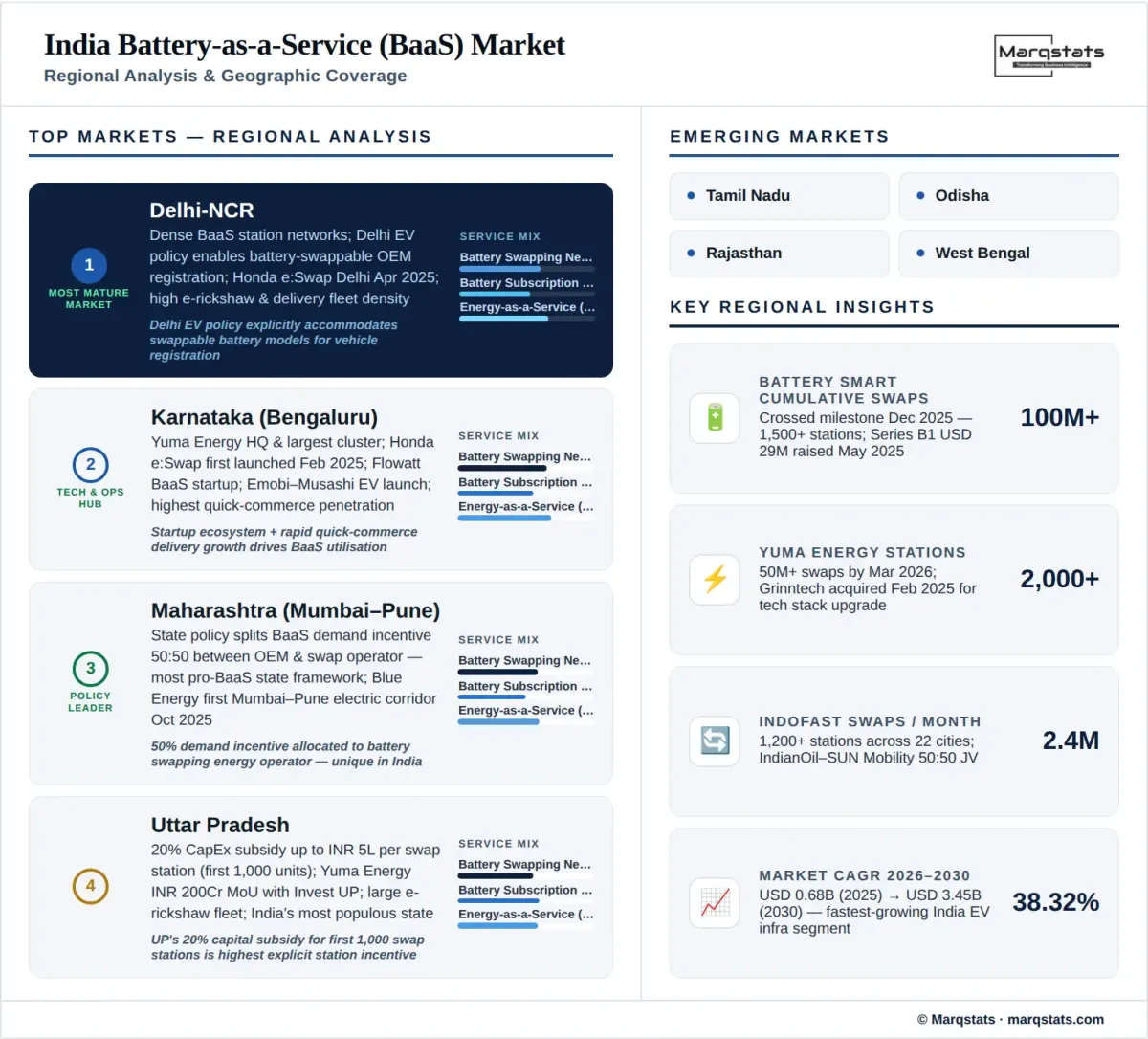
Delhi-NCR is one of the most mature BaaS markets in India, benefiting from Delhi’s EV policy that explicitly accommodates swappable battery models and allows OEMs to register eligible vehicles including battery-swappable configurations with the Transport Department. Honda’s e:Swap service launched in Delhi from April 2025, and multiple swapping operators maintain dense station networks across the NCR region. The high density of delivery, ride-hailing, and e-rickshaw fleets creates strong utilisation economics for swapping infrastructure.
Karnataka (Bengaluru)
Bengaluru is the technology and operational hub for several leading BaaS operators. Yuma Energy, founded in Bengaluru, operates its largest station cluster in the city. Honda’s e:Swap service launched first in Bengaluru (February 2025). Flowatt Battery Science, a Bengaluru-based deep-tech startup, raised INR 22 million for its BaaS pay-per-use model. Musashi Seimitsu launched its e-Axle-powered two-wheeler EV with Emobi in Bengaluru, compatible with Honda’s BaaS platform. The city’s thriving startup ecosystem and high quick-commerce penetration make it a natural lead market.
Maharashtra (Mumbai-Pune)
Maharashtra’s EV policy explicitly recognises vehicles sold without batteries, allocating 50% of the demand incentive to the OEM and 50% to the battery swapping energy operator. This is one of the most directly supportive state-level policy frameworks for BaaS in India. Blue Energy Motors inaugurated India’s first electric corridor for trucks from Mumbai to Pune in October 2025. Indofast Energy and SUN Mobility maintain significant station networks in both cities.
Uttar Pradesh
Uttar Pradesh provides one of the clearest explicit swap-station incentives in India: a 20% capital subsidy up to INR 5 lakh per unit for the first 1,000 swap stations under its 2022 EV policy. Yuma Energy signed an MoU with Invest UP for INR 200 crore in investment, linking station deployment to job creation across major UP cities. UP’s large population, expanding e-rickshaw fleet, and improving urban infrastructure make it a high-growth BaaS market.
Odisha and Eastern India
Odisha’s EV policy explicitly states that battery-as-a-service is seeing considerable offtake and provides a 25% capital subsidy for the first 100 public battery swapping stations. Zelio E-Mobility’s new plant in Cuttack adds local electric two-wheeler manufacturing capacity. Eastern India’s large e-rickshaw fleet and growing electric two-wheeler registrations (West Bengal +72.6%, Bihar +60.4% in FY25) create a substantial addressable base for BaaS expansion.
How Competition Is Evolving
The India battery-as-a-service market is moderately concentrated among infrastructure operators, with Battery Smart, Yuma Energy, SUN Mobility, and Indofast Energy collectively commanding the majority of the organised battery swapping network. Battery Smart, which crossed 100 million cumulative swaps by December 2025 and raised USD 29 million in Series B1 funding (May 2025), is the scale leader in commercial two-wheeler and three-wheeler swapping. Yuma Energy, the fastest-growing operator with 2,000+ stations and 50+ million swaps by March 2026, strengthened its technology capabilities through the February 2025 acquisition of Grinntech. SUN Mobility, with approximately USD 135 million in total capital raised including PIDG’s USD 20 million commitment, operates 900+ stations and targets 10,000 stations through the Indofast JV.
The OEM-linked BaaS segment is increasingly crowded and competitive. Ather Energy’s August 2025 BaaS launch (INR 1/km), TVS Motor’s March 2026 Battery-as-a-Service rollout across its EV portfolio, Hero MotoCorp’s VIDA BaaS (INR 0.96/km), Honda’s e:Swap (targeting 500 stations by March 2026), Ultraviolette’s Battery Flex (INR 2,499/month), Tata Motors’ Punch.ev BaaS (INR 2.6/km), and Maruti Suzuki’s e VITARA BaaS (INR 3.99/km) demonstrate that every major Indian EV OEM now offers some form of battery separation. This OEM proliferation validates the BaaS model while also introducing market fragmentation around proprietary battery and subscription architectures.
The market’s next phase of competitive evolution will likely be shaped by interoperability standards, energy-company partnerships (IndianOil, Shell, BPCL), and the extension of BaaS into heavy commercial vehicles. The involvement of international development finance (PIDG’s investment in SUN Mobility, IFC’s engagement with EV fleet financing) signals that the market is attracting institutional capital beyond venture funding, which could accelerate infrastructure deployment.
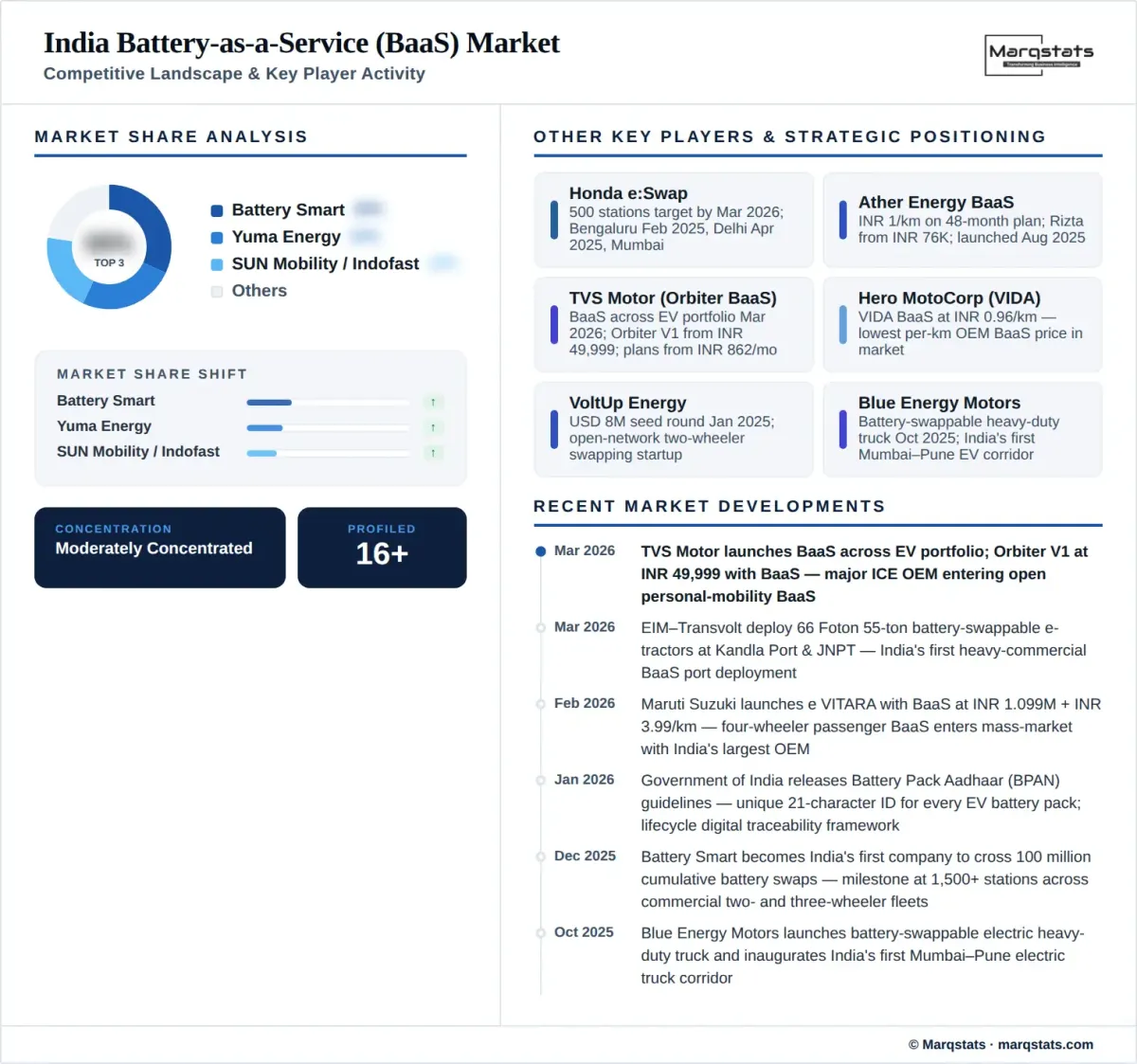
Companies Covered
The report profiles 16++ companies with full strategy and financials analysis, including:
Recent Market Activity
Table of Contents
Coverage & Segmentation
This report provides a comprehensive analysis of the India battery-as-a-service market covering the historical period 2021–2025 and forecast period 2026–2030, with 2025 as the base year. The study examines market size in value (USD million), segmented by service model (battery swapping networks, battery subscription/leasing, energy-as-a-service), vehicle application (two-wheelers, three-wheelers, four-wheelers, heavy commercial vehicles), battery capacity (≤10 kWh, 10–50 kWh, >50 kWh), end use (commercial fleet, personal mobility, public transport), and geography (state-level clusters covering Delhi-NCR, Karnataka, Maharashtra, UP, Tamil Nadu, Odisha, and rest of India). The competitive landscape profiles 16 leading operators and OEMs.
Primary research includes structured interviews with 40+ industry stakeholders spanning BaaS operators, battery manufacturers, OEM EV divisions, fleet operators, gig-economy platforms, charging infrastructure providers, and policy analysts. Secondary research draws from Ministry of Power guidelines, MoRTH notifications, NITI Aayog policy documents, PM E-DRIVE scheme data, company press releases and securities filings, IBSA publications, and patent databases. All market estimates represent Marqstats Intelligence proprietary calculations.