Market Snapshot
Middle bar: base-year value × (1 + CAGR), rounded to two decimals. This is a calculated illustration, not a separately researched annual estimate.
Market Size (2025, Base Year): USD 1.84 Billion (INR 15,364 Crore)
Estimated Value (2026): USD 2.32 Billion
Forecast Value (2030): USD 5.82 Billion
CAGR: 25.90% | Forecast Period: 2026 – 2030
Growth — Absolute: USD 3.98 Billion
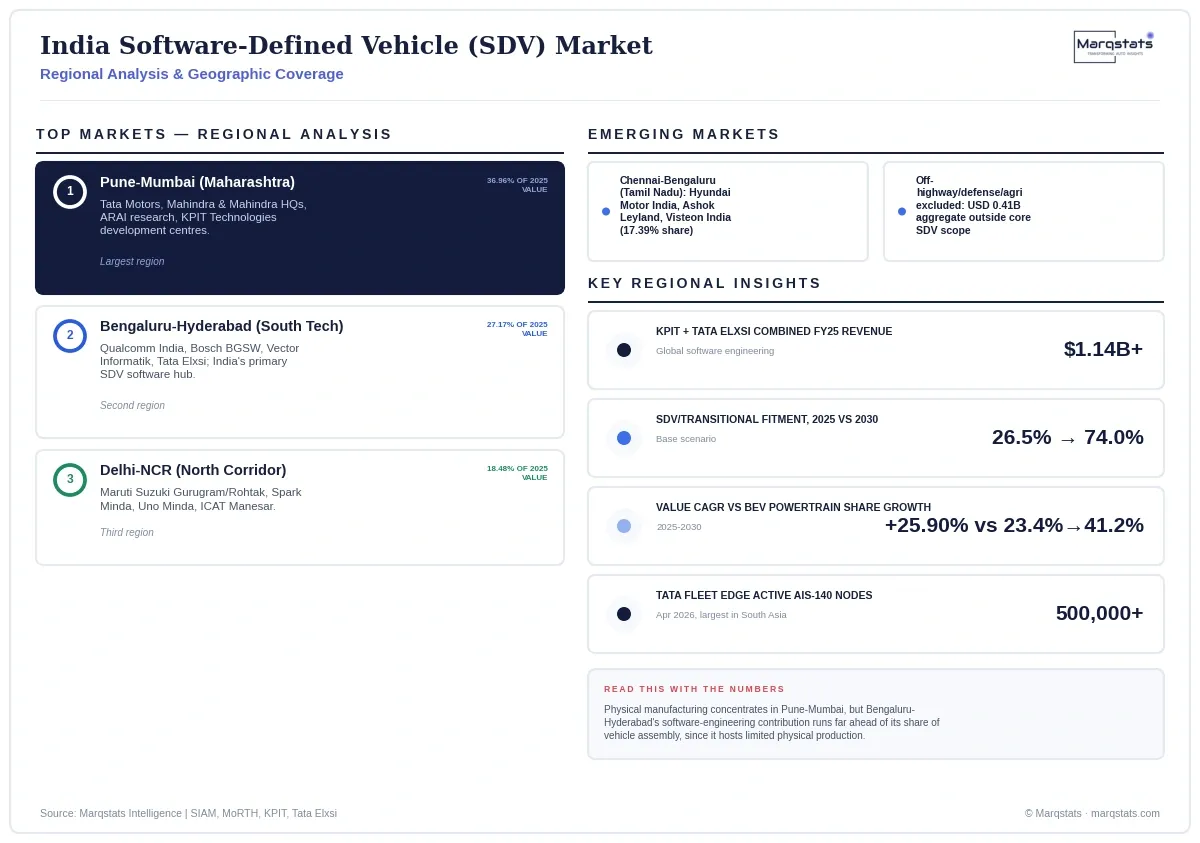
SDV/Transitional Fitment: 26.5% (2025) to 74.0% (2030) of Domestic PV Dispatches
Largest Market: Pune-Mumbai, Maharashtra (36.96% of 2025 value)
Fastest Growing Segment: Battery Electric Vehicles (23.37% to 41.24% share, 2025-2030)
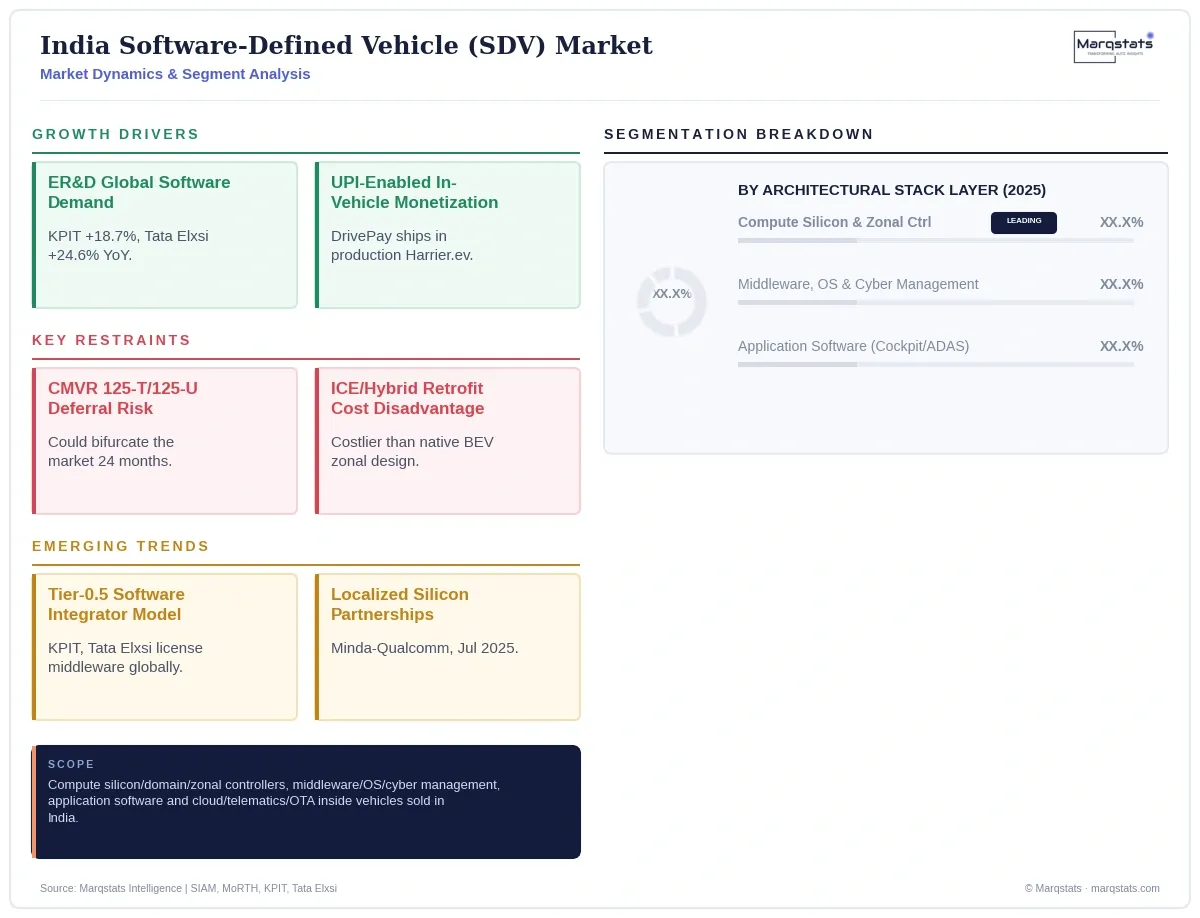
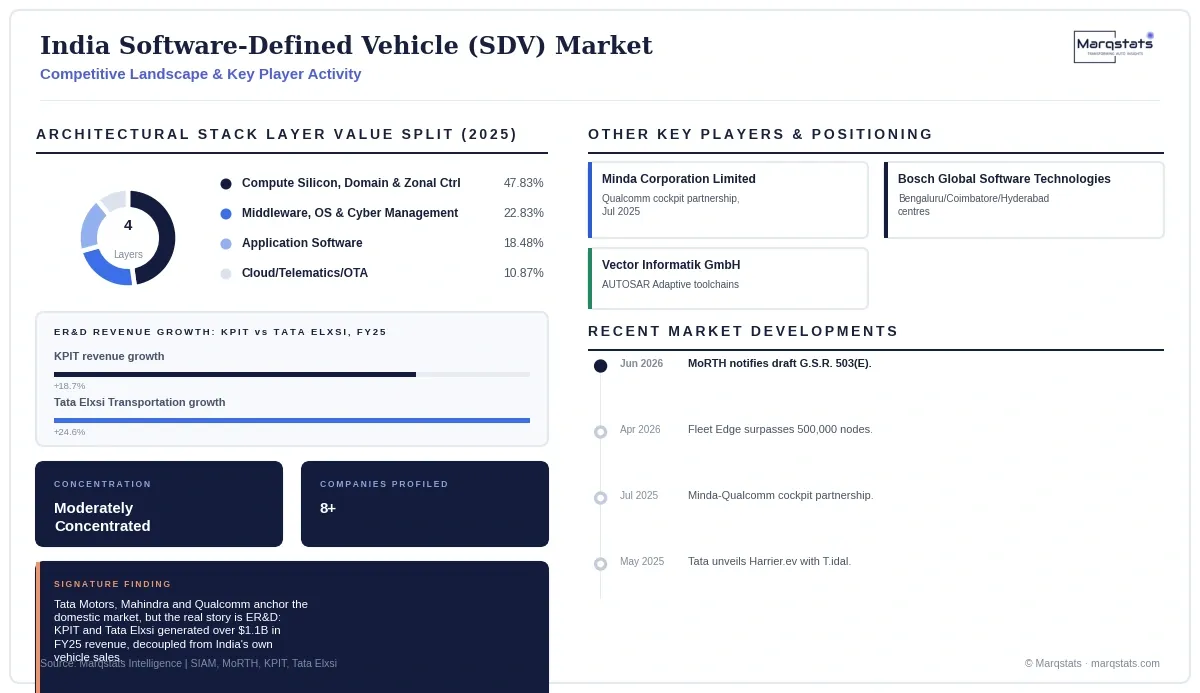
Dominant Layer: Compute Silicon, Domain & Zonal Controllers (47.83% of 2025 value)
Market Concentration: Moderately Concentrated (Tata Motors, Mahindra, Qualcomm Lead)
Base Year: 2025 | Historical Period: 2021 – 2025 | Forecast Period: 2026 – 2030
Units Considered: Value (USD Billion)
Segments Covered: 3 | Regions Covered: 4 | Companies Profiled: 8
Report Pages: 165 | Deliverables: PDF, Excel, PPT
Key Takeaways
Market Overview & Analysis
Report Summary
India's software-defined vehicle market is best understood through two parallel economies operating side by side: a domestic vehicle market fitting an increasing share of centralized compute, and a global engineering-services economy that has almost nothing to do with how many vehicles India itself produces.
The analysis measures the value of compute silicon/domain/zonal controllers, middleware/OS/cyber management stacks, application software, and cloud platforms/telematics/OTA services inside vehicles sold in India: USD 1.84 billion (INR 15,364 crore) in 2025, growing to USD 5.82 billion by 2030.
The headline sizing chain is a transparent construction from SIAM's own statutory dispatch data and named Indian trade press; no blocklisted publisher appears anywhere in the underlying research.
The analysis is written for four readers: an OEM deciding how much to invest in domestic zonal architecture versus global platform licensing, an ER&D firm evaluating the tier-0.5 software-integrator opportunity, a regulator or compliance officer tracking MoRTH's CMVR homologation timeline, and an investor tracking three regulation-anchored forward scenarios.
India's combination of the world's fastest-growing engineering-services export sector, a domestic vehicle market where utility vehicles now dominate sales, and a phased regulatory homologation pathway makes it structurally distinct from every EV-led or consortium-led SDV market elsewhere in this vertical, one worth reading on its own structural terms rather than as a smaller version of a Chinese or European pattern.
A Software Industry That Barely Needs India to Buy Cars
The most important number in this entire market isn't in the sizing table at all. It's in two engineering firms' quarterly earnings, and it says India's SDV capability has already outgrown its dependence on India's own vehicle sales.
KPIT Technologies generated USD 691 million in FY25 global revenue, up 18.7% on a constant-currency basis, and Tata Elxsi generated approximately USD 445 million, with its Transportation division growing 24.6% year-over-year. Neither figure depends meaningfully on how many vehicles Indian OEMs sell domestically; both are driven by software engineering contracts for automakers across Europe, the United States and Asia. That is a genuinely different growth engine than the domestic sizing model applied throughout this analysis, which tracks fitment rates and vehicle dispatches. India's ER&D firms function as strategic tier-0.5 software integrators, licensing proprietary middleware and engineering capability to global OEMs specifically seeking to avoid total dependence on silicon-vendor toolchains, a role that scales with the global automotive industry's software needs, not with India's own showroom traffic.
A Payment Rail Built Into the Dashboard, Because India's Already Has One
Most SDV market reports treat in-car payments as a distant, speculative monetization feature. Tata Motors shipped it in a production vehicle in 2025, because India already had the payment infrastructure to make it trivial.
The Harrier.ev's T.idal software stack, running over 500 million lines of code, integrates DrivePay, an in-vehicle Unified Payments Interface (UPI) system, alongside 540-degree surround sensing and Level 2 ADAS. This is not a hypothetical feature roadmap item; it shipped in a production vehicle because India's UPI payment rail was already a mature, near-universal consumer habit before the automotive industry ever got involved. Markets without an equivalent instant-payment infrastructure would need to build an entirely new commercial rail before in-car payments could work at all. India's SDV platforms get to skip that step, and DrivePay is a concrete example of how a country's existing digital infrastructure can pull a monetization feature into production years ahead of where the underlying vehicle technology alone would have justified it.
Two Silicon Vendors, One Vehicle, Deliberately Separated
Mahindra didn't just choose Qualcomm for compute. It chose to keep driving intelligence and cockpit compute on two entirely separate chips, on purpose.
Mahindra's INGLO platform integrates Qualcomm's Snapdragon Digital Chassis, including the 5-nanometre Snapdragon 8295 cockpit SoC delivering over 230,000 DMIPS across triple 12.3-inch displays, for infotainment and cockpit workloads. But rather than running Level 2+ driver assistance on the same silicon, Mahindra deployed Mobileye's EyeQ6 vision SoC to handle automated driving independently, with Snapdragon Auto 5G Modem-RF modules handling telematics and OTA connectivity as a third, separate function. That is a deliberate architectural choice to keep safety-critical perception isolated from infotainment compute rather than consolidating everything onto a single chip the way some competitors pursue. Whether that isolation strategy or full single-chip consolidation proves more robust and cost-effective at scale is one of the more consequential open engineering questions in the Indian SDV transition.
Why the Regional Map Splits Cleanly Into Who Builds and Who Codes
India's SDV geography breaks along a line most market maps miss entirely: physical vehicle assembly and software engineering concentrate in genuinely different places.
The Pune-Mumbai corridor captures 36.96% of national SDV value as the operational centre of physical platform architecture, homologation testing and OEM headquarters for Tata Motors and Mahindra. The Bengaluru-Hyderabad corridor, by contrast, captures 27.17% of value while hosting comparatively limited physical vehicle manufacturing, because it functions as the country's primary software development hub for global silicon vendors, toolchain providers and tier-1 software centres executing embedded OS, AUTOSAR Adaptive and AI model training work. Reading India's SDV opportunity purely through manufacturing-hub data would systematically undercount Bengaluru-Hyderabad's actual importance to the ecosystem, since its contribution shows up in engineering headcount and software contracts rather than assembly-line output.
A Definitional Ladder Built Specifically to Avoid Overcounting
Most market-sizing exercises have an incentive to find the largest defensible number. This pack instead builds a step-by-step ladder specifically designed to rule out the largest, easiest-to-reach-for number.
India's total automotive sector turnover reached USD 239.50 billion in FY25. Gross passenger-vehicle ex-factory revenue, calculated from 4.49 million dispatches at an average wholesale price of USD 13,000, comes to USD 58.37 billion. Total automotive electrical and electronic content, including wiring harnesses, lead-acid batteries and basic sensors alongside genuine compute hardware, totals USD 6.28 billion at an average 10.76% of gross turnover. The genuinely software-defined slice within that broader electrical total, isolating compute silicon, domain controllers, RTOS, AUTOSAR middleware and cybersecurity modules from manual wiring and basic switches, is USD 1.84 billion. Treating any of the larger upstream figures as the SDV market size would overstate the addressable opportunity substantially, and the explicit ladder here exists specifically to keep that overstatement from happening.
Why the Content-Per-Vehicle Curve Bends Twice, Not Once
Most cost curves in electronics move in one direction as an industry scales: down, and then flat. India's SDV content-per-vehicle curve does something less predictable, and the reason why says something real about where this market is headed.
Blended SDV content per fitted vehicle falls from USD 2,583 in 2021 to USD 1,350 by 2028, as automotive-grade silicon scales and software licensing models mature, the expected direction. But content per vehicle then rises again to USD 1,385 by 2030, as advanced Level 2+ driver assistance, multi-sensor perception stacks and mandatory software-update compliance mechanisms reach mass adoption across high-volume passenger vehicles rather than staying confined to premium trims. The first phase of the curve reflects hardware getting cheaper; the second phase reflects genuinely new, higher-value capability getting added back in once the cheaper hardware makes it affordable to deploy broadly. Reading only the 2021-2028 decline would suggest a market commoditizing toward zero differentiation; the full curve through 2030 shows the opposite is closer to the truth.
A Sensitivity Number That Names the One Variable That Actually Matters
This market's own methodology section states plainly which single input its 2025 valuation is most exposed to, a level of transparency most sizing exercises skip.
A 1.0 percentage-point shift in the domestic SDV penetration rate across the passenger vehicle fleet in 2025 alone alters total market value by approximately USD 69.4 million. That single sensitivity figure confirms that architectural adoption velocity, how fast Indian OEMs actually migrate from distributed ECUs to domain and zonal controllers, is the primary determinant of stack revenue growth, more than silicon pricing, more than currency movement, more than any individual OEM's product launch calendar. For anyone building their own model of this market, penetration rate is the one input worth stress-testing hardest, since it moves the headline number further than any other single assumption in the entire sizing chain.
Market Dynamics
Key Drivers
- India's engineering-services sector, led by KPIT and Tata Elxsi, is scaling independently of domestic vehicle sales, capturing global automotive software outsourcing demand as a structurally separate growth engine from the domestic fitment story.
- Utility vehicles' dominant and rising share of domestic passenger vehicle sales provides the transaction-value margin needed to absorb centralized compute hardware at scale, mirroring a pattern seen in several other markets in this vertical.
- Mandatory MoRTH homologation timelines under draft G.S.R. 503(E) are establishing a binding compliance floor for cybersecurity and OTA update management, accelerating centralized architecture adoption across the full range of vehicle price bands.
- India's mature UPI payment infrastructure is enabling in-vehicle monetization features, like Tata's DrivePay, to reach production years ahead of markets lacking equivalent digital payment rails.
- Rising native BEV architecture adoption is structurally favouring centralized compute over legacy distributed ECU topologies, since electric platforms are built around zonal architecture from inception rather than retrofitted onto it later.
Key Restraints
- A 24-month deferral of final CMVR Rules 125-T/125-U notification, driven by smaller-OEM compliance-cost concerns, would bifurcate the market into premium zonal platforms and low-cost distributed-ECU mass-market vehicles, the Delayed Homologation scenario's central trigger.
- Commercial fleet and lease-hire registration clustering in low-tax jurisdictions like Delhi-NCR and Maharashtra distorts regional demand data relative to where vehicles actually operate.
- ICE and hybrid platforms, still the majority of current production, require costlier retrofitted domain-controller integration over legacy distributed CAN buses compared to natively centralized BEV architectures, a structural cost gap that persists across the forecast period.
- Dependence on foreign silicon vendors for premium multi-SoC zonal configurations exposes domestic OEMs to global semiconductor supply and pricing volatility beyond their direct control.
Key Trends
- India's ER&D firms are increasingly functioning as strategic tier-0.5 software integrators, licensing proprietary middleware to global OEMs seeking silicon-vendor toolchain independence, a role distinct from traditional component supply.
- In-vehicle fintech integration, exemplified by Tata's DrivePay UPI payment system, is emerging as a India-specific monetization feature ahead of most other global SDV markets.
- Domestic Tier 1 suppliers are forming localized silicon partnerships, exemplified by Minda Corporation's July 2025 agreement with Qualcomm, to co-develop cockpit solutions tailored specifically to Indian commercial and passenger vehicle price bands.
- Deliberate architectural separation of driving-intelligence and cockpit-compute silicon, as Mahindra's Qualcomm/Mobileye split demonstrates, is emerging as an alternative to single-chip consolidation strategies.
Strategic Implications
- OEMs should prioritize centralized domain architecture rollout on utility vehicle and BEV platforms first, where transaction values and native zonal design already support compute-cost absorption, before extending to entry-level ICE nameplates where the economics remain far tighter.
- ER&D and software engineering firms should continue building global, not domestic, revenue diversification, since India's SDV engineering capability is scaling as a genuine export asset independent of domestic vehicle-market cyclicality, a resilience worth preserving deliberately.
- Tier 1 suppliers and technology vendors should build India-specific monetization features around existing digital infrastructure, following DrivePay's UPI integration, rather than simply importing global feature roadmaps unmodified.
- Investors should track MoRTH's G.S.R. 503(E) gazette notification timeline and G.S.R. 184(E) commercial ADAS mandate progress, the two named regulatory triggers separating the Base Case, Aggressive Homologation and Delayed Homologation scenarios, and should note that per-vehicle content coefficients here are a stated construction rather than a directly published statistic, since no Indian agency audits vehicle software value separately.
Outlook
Three scenarios are tested, each anchored to a distinct, named MoRTH homologation trigger rather than differing growth-rate assumptions applied to the same story.
Under the Base Case (Accelerated Zonal Adoption), MoRTH implements CMVR Rules 125-T and 125-U on the draft G.S.R. 503(E) schedule, enforcing mandatory CSMS/SUMS compliance from October 2026. Total SDV and transitional production reaches 4.20 million units by 2030 (74% of domestic PV dispatches), and value reaches USD 5.82 billion (INR 48,600 crore), a 25.90% CAGR.
Under Scenario 2 (Aggressive Homologation and Component Scaling), commercial ADAS mandates under draft G.S.R. 184(E) are notified early by 2027, and AIS-189 expands to high-speed electric two-wheelers by 2028. Fitted volume reaches 4.85 million units with blended content of USD 1,392 per vehicle, and value reaches USD 6.75 billion, a 29.69% CAGR.
Under Scenario 3 (Regulatory Deferral and Architectural Bifurcation), final gazette notification of CMVR Rules 125-T/125-U is deferred amid smaller-OEM compliance-cost representations, delaying AIS-189/190 enforcement by 24 months. Fitted volume reaches only 3.65 million units with blended content of USD 1,328 per vehicle, and value reaches USD 4.85 billion, a 21.39% CAGR.
Market Segmentation
USD 1.340 billion (72.83% share) in 2025, moving to USD 4.300 billion (73.88% share) by 2030.
USD 0.360 billion (19.57% share) in 2025, moving to USD 1.100 billion (18.90% share) by 2030.
USD 0.140 billion (7.61% share) in 2025, moving to USD 0.420 billion (7.22% share) by 2030.
USD 0.880 billion (47.83% share) in 2025, moving to USD 2.250 billion (38.66% share) by 2030.
USD 0.420 billion (22.83% share) in 2025, moving to USD 1.600 billion (27.49% share) by 2030.
USD 0.340 billion (18.48% share) in 2025, moving to USD 1.200 billion (20.62% share) by 2030.
USD 0.200 billion (10.87% share) in 2025, moving to USD 0.770 billion (13.23% share) by 2030.
USD 1.410 billion (76.63% share) in 2025, moving to USD 3.420 billion (58.76% share) by 2030.
USD 0.430 billion (23.37% share) in 2025, moving to USD 2.400 billion (41.24% share) by 2030.
By Geography
Pune-Mumbai (Maharashtra)
USD 0.680 billion (36.96% share) of national SDV value in 2025.
Bengaluru-Hyderabad (South Tech)
USD 0.500 billion (27.17% share) of national SDV value in 2025.
Delhi-NCR (North Corridor)
USD 0.340 billion (18.48% share) of national SDV value in 2025.
Chennai-Bengaluru (Tamil Nadu)
USD 0.320 billion (17.39% share) of national SDV value in 2025.
Registration-vs-Engineering Distinction
Commercial fleet registrations and lease-hire passenger vehicles, tracked through the VAHAN national registry, frequently cluster disproportionately within low-tax jurisdictions such as Delhi-NCR, Maharashtra, or Union Territories, while physical vehicle operation and software development activity are distributed broadly across the Pune-Mumbai, Bengaluru-Hyderabad, Delhi-NCR and Chennai-Bengaluru corridors.
How Competition Is Evolving
India's SDV ecosystem is structured around collaborative co-development models linking domestic OEMs, global semiconductor suppliers, local Tier 1 integrators, and engineering-services (ER&D) providers, a more pragmatic approach than the fully in-house vertical integration pursued by some Western and Chinese OEMs.
Tata Motors Limited runs its in-house T.idal SDV software architecture across its acti.ev+ compute platforms, with the Harrier.ev integrating over 500 million lines of code, a dual-SoC cockpit, 540-degree surround sensing, Level 2 ADAS and DrivePay in-car UPI payments. Its Fleet Edge commercial telematics platform maintains active connections to more than 500,000 AIS-140-compliant vehicles, the largest such deployment in South Asia.
Mahindra & Mahindra centralizes vehicle compute through its INGLO electric platform (BE 6e, XEV 9e), with its Mahindra Artificial Intelligence Architecture (MAIA) integrated with Qualcomm's Snapdragon Digital Chassis, including the 5nm Snapdragon 8295 cockpit SoC and independent Mobileye EyeQ6 processing for Level 2+ ADAS. Across its ICE/hybrid portfolio (XUV700, Scorpio-N, Thar ROXX, XUV 3XO), Mahindra sustains digital services through its Adrenox platform.
KPIT Technologies, an ER&D and software Tier-1 provider, reported FY25 global revenue of USD 691 million (18.7% constant-currency growth), specializing in AUTOSAR Adaptive, KSAR stacks and cloud-to-edge middleware as a strategic partner to Qualcomm and global OEMs. Tata Elxsi reported INR 3,729 crore (~USD 445 million) FY25 revenue, with its Transportation segment growing 24.6% YoY on AUTOSAR migration, Connected Vehicle Cloud Platform work and ADAS validation.
Minda Corporation, a domestic Tier 1 supplier, signed a strategic partnership with Qualcomm in July 2025 to co-develop localized software-defined cockpits for Indian platforms. Bosch Global Software Technologies operates engineering centres across Bengaluru, Coimbatore and Hyderabad anchoring embedded software exports and domestic delivery, while Vector Informatik supplies standardized AUTOSAR Adaptive stacks and diagnostic toolchains across Indian Tier 1 suppliers and OEM engineering centres.
Companies Covered
Companies covered in the report include:
Recent Market Activity
Table of Contents
Coverage & Segmentation
The analysis measures compute silicon/domain/zonal controllers, middleware/OS/cyber management stacks, application software (cockpit/UX/ADAS), and cloud platforms/telematics/OTA services inside vehicles sold in India, for a 2025 base year and a 2026 to 2030 forecast, in United States dollars and Indian rupees at an average exchange rate of USD 1 = INR 83.50. It excludes the mechanical chassis, physical battery chemistry, structural body-in-white, and ex-factory hardware valuation of the base vehicle.
The analysis covers three segmentation dimensions, vehicle category, architectural stack layer and powertrain, a four-corridor regional split, and eight profiled entities. No blocklisted publisher was found anywhere in the underlying research. See the verification log for full sourcing detail.