Market Snapshot
Middle bar: base-year value × (1 + CAGR), rounded to two decimals. This is a calculated illustration, not a separately researched annual estimate.
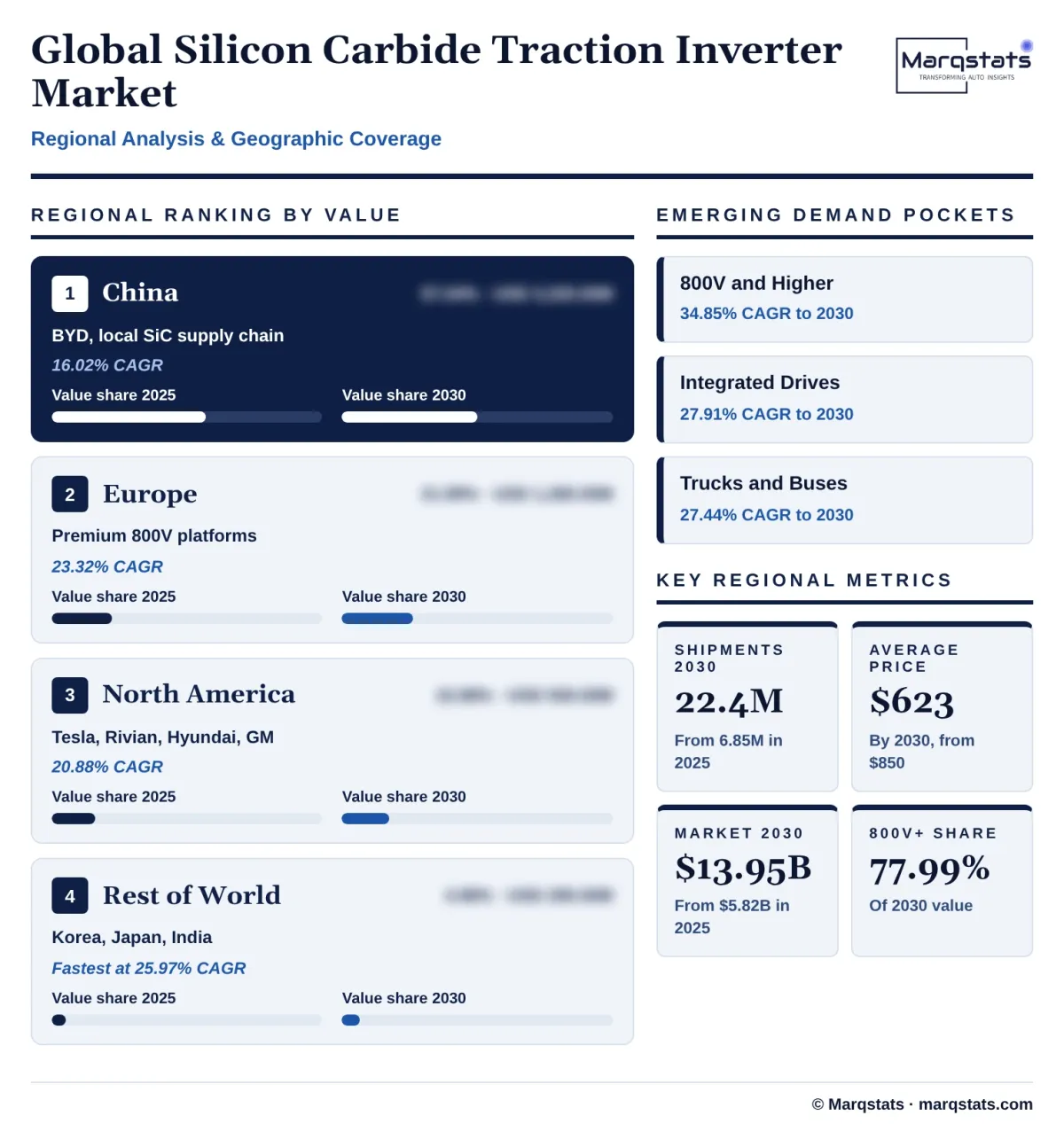
The global silicon carbide traction inverter market size is estimated at USD 5,820.00 million in 2025 and is projected to reach USD 13,950.00 million by 2030, growing at a CAGR of 19.11% over 2026 – 2030. Shipments rise from about 6.85 million inverters to 22.40 million, a 26.74% annual rate, while the average inverter price falls from about USD 850 to USD 623.
Marqstats defines the market as the ex-factory value of complete traction inverter assemblies that use silicon carbide (SiC) power semiconductors to drive the propulsion motors of battery electric, plug-in hybrid, range-extended and commercial electric vehicles. It covers the inverter housing, SiC switches or power modules, gate drivers, DC-link capacitors, control boards, current sensors, cooling plates and busbars. Silicon IGBT inverters, gallium nitride prototypes, motors, gearboxes, on-board chargers, DC-DC converters and bare SiC wafers are excluded. In-house inverters built by carmakers such as Tesla and BYD are valued at equivalent supplier prices.
Inverters for 400V vehicles account for an estimated 58.08% of 2025 value and passenger battery electric vehicles for 83.33%. China accounts for 57.04% of 2025 value and Europe for 21.99%. The study segments the market by voltage architecture, vehicle type, integration topology and region.
Key Takeaways
Market Overview & Analysis
Report Summary
Marqstats sizes the silicon carbide traction inverter market as the ex-factory value of complete inverter assemblies built with SiC power semiconductors for electric vehicle propulsion. The traction inverter converts direct current from the battery into the alternating current that drives the motor and recovers energy during braking. In 2025 about 6.85 million SiC traction inverters were shipped worldwide, worth an estimated USD 5,820.00 million at an average price of about USD 850.
SiC is replacing silicon in the switching devices at the heart of the inverter. Silicon carbide has a much wider bandgap than silicon, about ten times its breakdown strength and roughly three times its thermal conductivity, so SiC MOSFETs can block high voltages with thinner layers and switch faster with lower losses. Marqstats estimates switching losses fall by 70% to 80% against silicon IGBTs, raising drive cycle efficiency by 3.5% to 5.0%.
About 21.2 million electrified vehicles were built worldwide in 2025, including about 0.8 million commercial vehicles, and global electric car sales passed 20 million, about one in four new cars sold. Marqstats estimates about 5.55 million of these vehicles used SiC traction inverters. Because many dual-motor cars use two inverters, the average was about 1.23 SiC inverters per SiC-equipped vehicle in 2025, rising to about 1.35 by 2030.
SiC accounts for about 20% of traction inverter units but about 41% of traction inverter value, because SiC inverters cost more than silicon designs. The premium is largest in 800V platforms such as Hyundai E-GMP, Porsche and Audi PPE, BYD Super e-Platform and Xiaomi SU7 Max, and in heavy-duty trucks and buses that need 300 to 600 kW per driven axle.
The market grew from about USD 1,060.00 million in 2021 to USD 1,920.00 million in 2022, USD 3,120.00 million in 2023 and USD 4,320.00 million in 2024, an average of 42.08% a year as Tesla, BYD, Hyundai and Chinese 800V models scaled. Marqstats expects about 8.70 million shipments worth USD 7,050.00 million in 2026.
Two business models supply the market. Carmakers such as BYD and Tesla design inverters in-house and, in BYD's case, also make their own SiC chips and modules, which lets them update platforms quickly. Independent suppliers such as BorgWarner, Bosch, Schaeffler, ZF, Valeo and Denso design inverter housings that accept SiC modules from several chip makers, giving carmakers flexibility and protecting them against supply shortages. Chip makers such as Infineon, STMicroelectronics and onsemi sell modules and bare chips to both groups, and increasingly offer complete reference designs.
Global Silicon Carbide Traction Inverter Market Size and Forecast
The global silicon carbide traction inverter market grows from USD 5,820.00 million in 2025 to USD 13,950.00 million in 2030, a CAGR of 19.11%. Marqstats expects USD 8,510.00 million in 2027, USD 10,150.00 million in 2028 and USD 11,970.00 million in 2029. Annual growth slows from about 21% in 2026 to about 17% in 2030 as the market matures and prices keep falling.
Shipments rise from about 6.85 million inverters in 2025 to 8.70 million in 2026, 11.20 million in 2027, 14.30 million in 2028, 18.00 million in 2029 and 22.40 million in 2030. The average price falls from about USD 1,116 in 2021 to USD 849.64 in 2025 and USD 622.77 in 2030.
Prices vary widely by application. Marqstats estimates a mainstream 400V inverter of 120 to 150 kW sells for about USD 680, a premium 800V inverter of 250 to 300 kW for about USD 1,080, and a heavy-duty commercial inverter for about USD 2,200. Commercial vehicles made up only about 2.2% of SiC inverter units in 2025 but 9.97% of value.
Several assumptions drive the forecast. A USD 50 change in the average 2025 price moves the base-year market by about USD 342.50 million. A 0.05 change in the number of inverters per vehicle moves 2025 demand by about 277,500 units. A one percentage point change in SiC penetration of 400V platforms moves 2025 volume by about 125,000 units, and a 10% improvement in 200mm wafer yields would lower the 2030 market by about USD 627.20 million through faster price erosion.
Marqstats tracks four indicators to monitor the forecast: the share of new electric vehicle models launched on 800V platforms, SiC adoption in 400V mass-market models, 200mm SiC wafer output and yields at major fabs, and the average price of SiC power modules quoted to inverter makers.
The mix of value shifts over the forecast. Inverters for 800V and higher platforms rise from 41.92% to 77.99% of value, integrated drive units from 56.01% to 80.00%, and commercial vehicles from 9.97% to 13.98%. China remains the largest region but its share falls from 57.04% to 50.04% as Europe and the rest of the world grow faster.
Regulation shapes the pace but not the direction. The EU is easing parts of its CO2 framework, with three-year averaging for 2025 to 2027 and a December 2025 proposal to set the 2035 target at a 90% rather than 100% reduction, and the United States repealed federal vehicle greenhouse gas standards in 2026. Marqstats expects these changes to slow electric vehicle growth in some markets but not to reverse the shift to SiC within electric vehicles, because the efficiency and charging advantages of 800V SiC platforms are commercial rather than only regulatory.
Market Dynamics
Key Drivers
Six forces are moving electric vehicle traction inverters from silicon to silicon carbide.
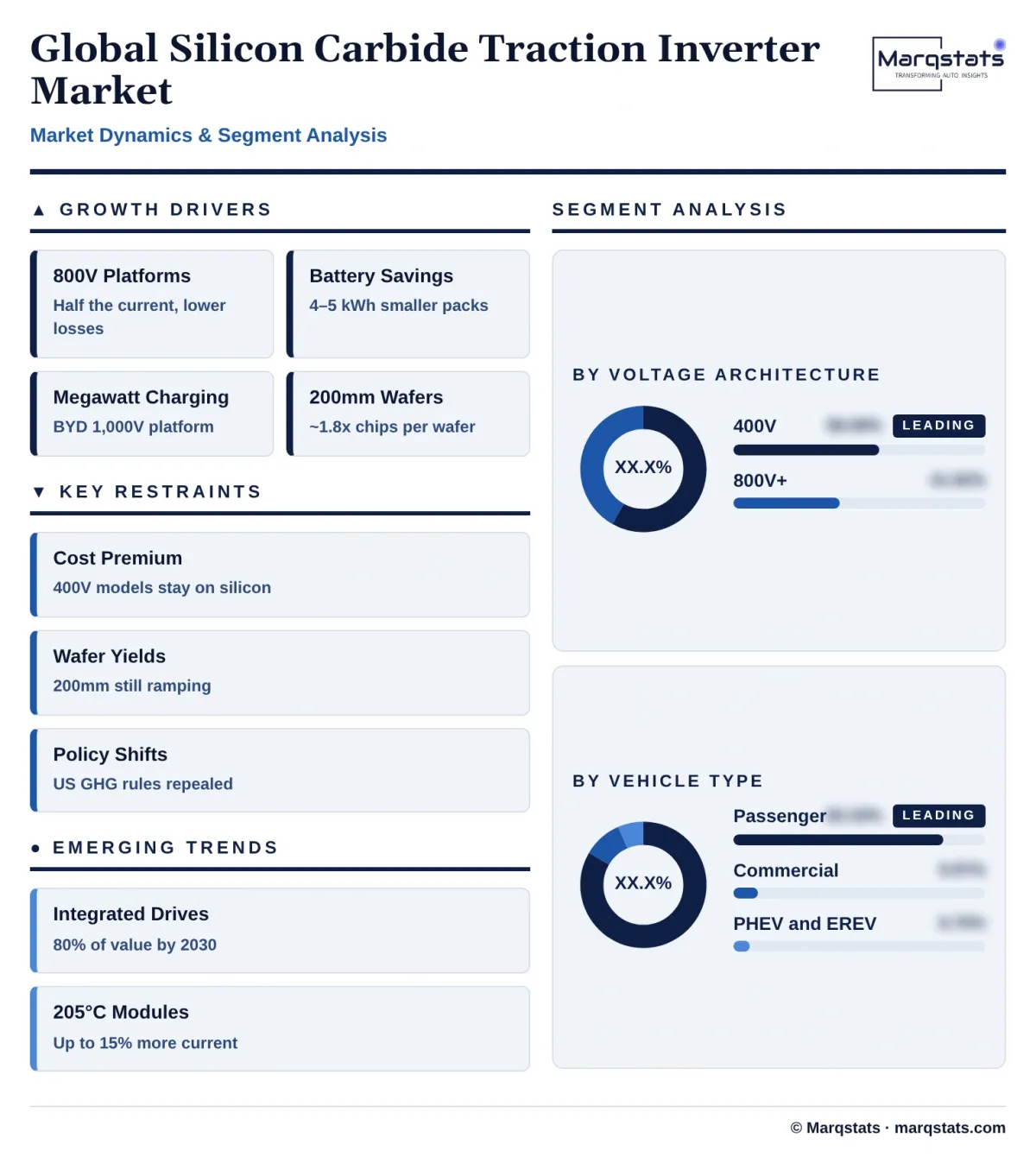
- 800V platforms. Doubling battery voltage from 400V to 800V halves the current for the same power, cutting resistive losses in cables and busbars by up to 75% and enabling charging at 250 to 400 kW. At these voltages SiC devices rated at 1,200V or more lose far less energy than silicon IGBTs, so almost every 800V vehicle uses SiC.
- Range and battery savings. SiC inverters raise drive cycle efficiency by 3.5% to 5.0%, letting carmakers fit smaller batteries for the same range and offset much of the SiC premium.
- Megawatt charging. BYD unveiled its Super e-Platform in March 2025 with a 1,000V architecture, self-developed SiC chips rated at 1,500V and charging at up to 1,000 kW, and China's ChaoJi standards support charging up to about 900 kW.
- Falling device costs. The move from 150mm to 200mm SiC wafers yields about 1.75 to 1.85 times more chips per wafer, and trench transistor designs reduce the silicon carbide area needed per amp, bringing inverter prices down.
- European CO2 rules. Regulation (EU) 2023/851 sets tighter fleet CO2 targets from 2025, with penalties of EUR 95 per g/km of excess emissions per vehicle, pushing carmakers to improve drivetrain efficiency.
- Commercial vehicle electrification. Electric trucks and buses need continuous drive power of 300 to 600 kW per axle and benefit most from SiC efficiency, and Europe's megawatt charging rollout for heavy vehicles under the Alternative Fuels Infrastructure Regulation supports 800V and higher truck platforms.
Key Restraints
Four constraints slow the adoption of silicon carbide traction inverters.
- Cost premium. SiC inverters still cost more than silicon IGBT designs, so many cost-sensitive 400V models continue to use silicon.
- Wafer supply and yields. SiC crystal growth is slow and defect-prone, and 200mm wafer yields are still improving, constraining supply and price falls.
- Policy uncertainty. The US EPA repealed federal vehicle greenhouse gas standards in February 2026, and the European Commission proposed in December 2025 to ease the 2035 car target from a 100% to a 90% CO2 reduction, weakening regulatory pressure for efficiency in some markets.
- Design complexity. Fast SiC switching causes voltage spikes and electromagnetic interference, requiring low-inductance packaging, new gate drivers and careful thermal design.
Key Trends
Five shifts are changing how silicon carbide inverters are designed, packaged and sourced.
- Integrated drive units. Carmakers combine the inverter, motor and gearbox in one housing, removing high-voltage cables and connectors and cutting powertrain mass by 15% to 25%, as in BYD multi-in-one drive units.
- Better packaging. Suppliers replace aluminium wire bonds with copper clips and sintered silver or copper joints, and use double-sided cooling to raise power density and reliability at junction temperatures above 175°C.
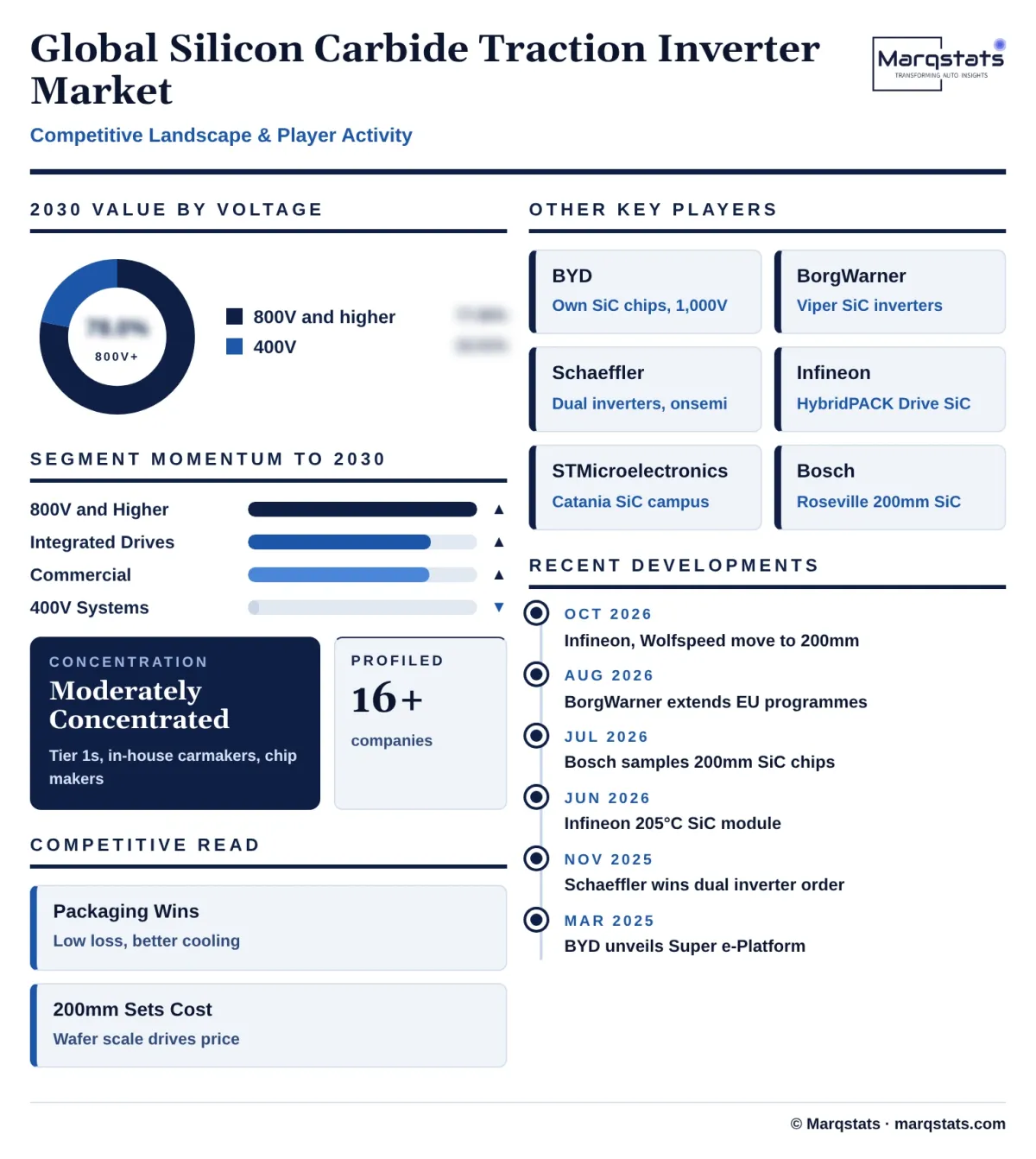
- Higher operating temperatures. Infineon introduced in June 2026 a 1,300V HybridPACK Drive SiC module that operates continuously at 205°C, giving up to 15% more output current than standard designs.
- Dual inverters for hybrids. Plug-in hybrid platforms use dual inverters that drive both the generator and the traction motor, as in recent Valeo and Schaeffler contracts.
- Chip makers move up the value chain. Infineon, STMicroelectronics and onsemi now offer complete power modules and inverter reference designs, and partnerships such as CISSOID with EDAG, announced in May 2025, offer ready-made 800V SiC inverter platforms to shorten carmaker development time.
Strategic Implications
- For carmakers, 800V SiC is becoming standard for mid-size and larger electric vehicles. Moving larger models to 800V SiC improves efficiency and charging speed, and the battery savings help offset the higher inverter cost.
- For inverter suppliers, packaging know-how is the main differentiator. Low-inductance designs, sintered joints, double-sided cooling and housings that accept modules from several chip makers protect margins against in-house production by BYD and Tesla.
- For SiC chip makers, 200mm capacity decides cost position. Plants such as STMicroelectronics in Catania, Infineon in Kulim and Bosch in Roseville will set the cost floor, and older 150mm lines will become uncompetitive.
- For commercial vehicle makers, SiC is the main route to efficient high-power drives. Heavy trucks and buses need 1,200V and 1,700V SiC inverters to handle continuous high power and megawatt charging.
- For investors, falling prices mean volume must keep growing fast. Average inverter prices fall about 6% a year, so suppliers need rising volumes and new platforms to grow revenue.
- For policymakers, local SiC capacity is a supply security issue. Europe and the United States are funding domestic SiC fabs to reduce reliance on Asian supply chains, and the speed at which these plants reach high yields will influence where inverters are built and how quickly prices fall outside China.
Market Segmentation
Inverters for 400V platforms, using 650V and 750V SiC devices, account for 58.08% of 2025 value, USD 3,380.00 million, but decline to USD 3,070.00 million by 2030, a CAGR of -1.91%, and 22.01% of the market. Tesla Model 3 and Model Y, BYD e-Platform 3.0 models and Stellantis STLA Medium vehicles anchor this segment, while many lower-cost 400V models stay with silicon IGBTs.
Inverters for 800V and higher platforms, using 1,200V and 1,700V SiC devices, account for 41.92% of 2025 value, USD 2,440.00 million, and grow at 34.85% a year to USD 10,880.00 million and 77.99% of the market by 2030. Hyundai E-GMP, Porsche and Audi PPE, BYD Super e-Platform and Xiaomi SU7 Max lead adoption.
Passenger battery electric vehicles account for 83.33% of 2025 value, USD 4,850.00 million, rising to USD 11,160.00 million by 2030, an 18.14% CAGR, while their share eases to 80.00%.
Electric trucks, buses and off-highway vehicles account for 9.97% of 2025 value, USD 580.00 million, and grow fastest, at 27.44% a year, to USD 1,950.00 million and 13.98% of the market by 2030, led by models such as the Mercedes-Benz eActros 600 and Volvo FH Electric.
Plug-in hybrid and range-extended vehicles account for 6.70% of 2025 value, USD 390.00 million, rising to USD 840.00 million by 2030, a 16.59% CAGR, through models such as Li Auto range-extended SUVs and high-end BYD DM-i variants.
Standalone inverters mounted separately from the motor account for 43.99% of 2025 value, USD 2,560.00 million, rising to USD 2,790.00 million by 2030, a 1.74% CAGR, while their share falls to 20.00%. BorgWarner, Schaeffler and Hitachi Astemo supply many standalone units.
Multi-in-one units that combine the inverter with the motor and gearbox account for 56.01% of 2025 value, USD 3,260.00 million, and grow at 27.91% a year to USD 11,160.00 million and 80.00% of the market by 2030, led by BYD, Bosch, Schaeffler and Huawei DriveONE.
By Geography
China
China is the largest market, with 57.04% of 2025 value, USD 3,320.00 million, rising to USD 6,980.00 million by 2030, a 16.02% CAGR, while its share falls to 50.04%. Electric cars made up nearly 55% of Chinese car sales in 2025, and dozens of models already use 800V platforms. BYD makes its own SiC devices and inverters, while local SiC substrate and device makers are expanding fast. Marqstats measures value at the place of production, so inverters built in China and exported inside vehicles count towards China.
Europe
Europe accounts for 21.99% of 2025 value, USD 1,280.00 million, and grows at 23.32% a year to USD 3,650.00 million and 26.16% of the market by 2030. Electric cars reached about 28% of European car sales in 2025, and premium 800V platforms such as Porsche and Audi PPE, BMW Neue Klasse and Mercedes-Benz MMA drive SiC demand. STMicroelectronics is building a EUR 5 billion integrated SiC campus in Catania, Italy, with production scheduled for 2026.
North America
North America accounts for 15.98% of 2025 value, USD 930.00 million, rising to USD 2,400.00 million by 2030, a 20.88% CAGR, and 17.20% of the market. Tesla, Rivian, Hyundai and General Motors drive demand, and Bosch began sample production of 200mm SiC chips at Roseville, California in July 2026. The repeal of federal vehicle greenhouse gas standards in 2026 slows the push for efficiency.
Rest of World
The rest of the world, mainly South Korea, Japan and India, accounts for 4.98% of 2025 value, USD 290.00 million, and grows fastest, at 25.97% a year, to USD 920.00 million and 6.59% of the market by 2030, led by Hyundai, Kia, Toyota and Lexus electric models.
How Competition Is Evolving
The silicon carbide traction inverter market is moderately concentrated. Independent suppliers such as BorgWarner, Bosch, Schaeffler, ZF, Valeo, Denso and Hitachi Astemo compete with carmakers that build inverters in-house, most notably BYD and Tesla.
Chip makers shape the market. Infineon, STMicroelectronics, onsemi, Wolfspeed, ROHM and BYD Semiconductor supply most SiC devices and modules, and their supply agreements and wafer capacity determine inverter cost and availability. Infineon and Wolfspeed signed a new multi-year agreement in October 2026 moving Wolfspeed substrate supply to Infineon from 150mm to 200mm wafers.
Contract wins show how quickly SiC is spreading. BorgWarner extended several high-volume inverter programmes with a major European carmaker in August 2026, including an 800V SiC inverter with dual-sided cooling for production from 2029. Schaeffler won an order in November 2025 for nearly one million dual inverters with onsemi SiC devices for a North American plug-in hybrid pickup platform, and Valeo won dual inverter contracts with two Chinese carmakers in October 2025.
Competition will be decided by packaging, cost and supply security. Suppliers that combine low-loss packaging, multi-source chip supply and integration with motors and gearboxes will win the largest programmes.
Capacity investment is moving to 200mm wafers. STMicroelectronics is building an integrated SiC campus in Catania, Italy, worth about EUR 5 billion with about EUR 2 billion of support under the EU Chips Act. Infineon is ramping its 200mm SiC fab in Kulim, Malaysia, and Bosch has started sample production of 200mm SiC chips in Roseville, California, with up to USD 225 million of US CHIPS Act funding. onsemi added SiC JFET technology through its January 2025 acquisition of Qorvo's SiC business.
Companies Covered
Companies covered in the report include:
Recent Market Activity
Table of Contents
Coverage & Segmentation
The study covers the global silicon carbide traction inverter market, with 2025 as the base year, 2021 – 2025 as the historical period and 2026 – 2030 as the forecast period. Values are in US dollars at ex-factory supplier prices, and volumes are annual inverter shipments. The market is segmented by voltage architecture, vehicle type, integration topology and region, with regional values measured at the place of production.
Silicon IGBT inverters, gallium nitride prototypes, motors, gearboxes and e-axle housings, on-board chargers, DC-DC converters, auxiliary inverters and bare SiC wafers are excluded. Segment and regional splits are Marqstats estimates built on vehicle production data, platform voltage mix, supplier disclosures and component price benchmarks.