Market Snapshot
Middle bar: base-year value × (1 + CAGR), rounded to two decimals. This is a calculated illustration, not a separately researched annual estimate.
The India last-mile delivery two-wheeler market — encompassing all scooters, motorcycles, and mopeds (ICE and electric) deployed specifically for paid last-mile delivery of food, grocery and quick commerce orders, parcels and e-commerce shipments, and pharmaceutical products — was valued at USD 1.80 billion in 2025 and is projected to reach USD 5.50 billion by 2030, expanding at a CAGR of 25.08% during the 2026–2030 forecast period. This market is distinct from the broader commercial two-wheeler market by excluding bike-taxi services and focusing exclusively on the delivery supply chain: vehicles that carry goods, not passengers, from fulfilment points to consumers.
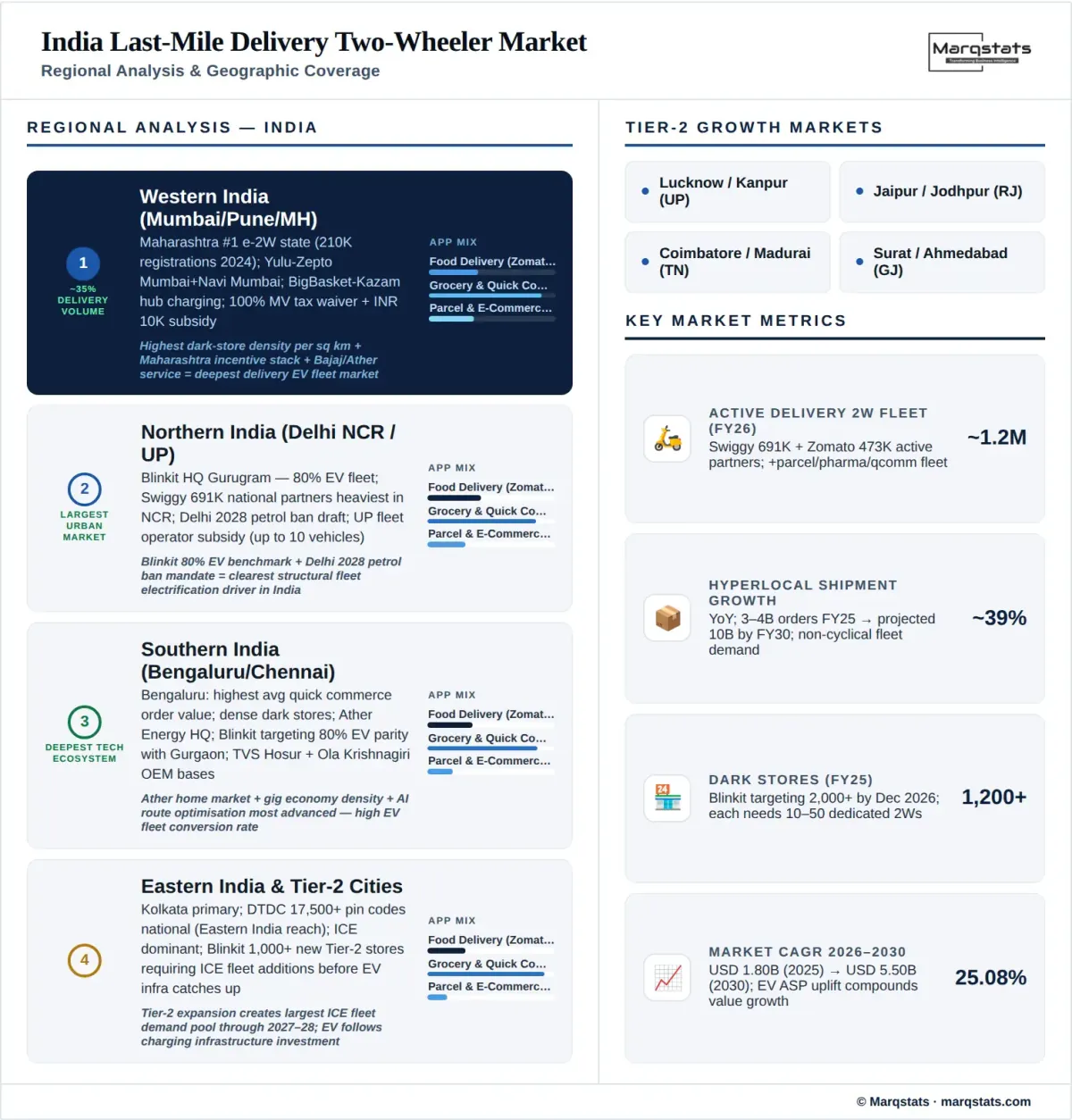
The scale of India's delivery two-wheeler ecosystem is extraordinary. On-demand hyperlocal shipments are growing at approximately 39% year-on-year, from an estimated 3–4 billion in FY25 to a projected 10 billion by FY30, driven primarily by quick commerce expansion. India's e-commerce shipments stand at 4.8–5.5 billion in FY25 and are projected to reach 15–17 billion by FY30 at a 23–24% CAGR. The active delivery two-wheeler fleet required to service this volume is estimated at approximately 1.2 million units in 2025–26 — a figure triangulated from Swiggy's disclosed ~691,000 average monthly transacting delivery partners by Q2FY26, Zomato's ~473,000 active partners, NCAER-Prosus's finding of 1.37 million direct food delivery employment, and the additional delivery volumes from parcel logistics, grocery, and pharmaceutical platforms. Delivery agents own approximately 80% of this fleet, with the remainder owned by fleet operators, logistics companies, and platforms directly.
Two structural forces are simultaneously expanding the delivery two-wheeler vehicle market. The first is volume: India's quick commerce dark-store network exceeded 1,200 locations in FY25 with Blinkit alone targeting 2,000+ stores by December 2026, each requiring 10–50 dedicated delivery two-wheelers. The second is value: fleet electrification is progressively replacing INR 65,000–85,000 ICE scooters with INR 90,000–1,30,000 electric equivalents, lifting per-vehicle market value by 30–50% on each conversion. Swiggy (~691,000 active partners), Zomato (~473,000 active partners), Amazon India (10,000 EVs, 500+ cities), Flipkart (10,000+ EVs), BigBasket (7,431 EVs), and express logistics operators (Delhivery, Xpressbees, DTDC) together constitute the demand side of this market. On the supply side, Hero MotoCorp, Honda, TVS, Bajaj, and their ICE portfolios — alongside Ola Electric, TVS iQube, Ather, and EV specialists Yulu and Zypp — serve the delivery fleet's vehicle requirements.
Key Takeaways
Market Overview & Analysis
Report Summary
The India last-mile delivery two-wheeler market covers all vehicles — scooters, motorcycles, and mopeds across ICE and electric powertrains — deployed specifically for the final leg of the delivery supply chain: from a fulfilment point (dark store, warehouse, restaurant, pharmacy) to the consumer's doorstep. The study period is 2021–2030, with 2025 as base year. The market scope explicitly excludes bike-taxi services and intra-city passenger transportation, focusing only on the delivery application layer. The five primary delivery applications covered are: food delivery (Zomato, Swiggy), grocery and quick commerce (Blinkit, Zepto, Swiggy Instamart, BigBasket, Amazon Fresh, Flipkart Minutes), parcel and e-commerce logistics (Amazon, Flipkart/Ekart, Delhivery, Xpressbees, DTDC, Blue Dart, Porter), pharmaceutical and healthcare delivery (1mg, PharmEasy, Apollo Pharmacy, Netmeds), and hyperlocal errand and on-demand delivery (Dunzo-type, Porter, Swiggy Genie).
Understanding this market requires understanding the delivery supply chain — not just the vehicle, but the ecosystem in which it operates. The vehicle is a tool serving a fulfilment network: dark stores are positioned for 2–3 km delivery radii; food restaurants typically serve a 5–7 km delivery radius; parcel logistics hubs serve 10–15 km zones. The delivery two-wheeler's utility is defined by its ability to handle 10–15 deliveries per hour in dense urban environments. In quick commerce, the delivery window is 10–30 minutes from order placement — a constraint that determines maximum delivery radius, fleet density per dark store, vehicle range requirements, and charging model (swap being superior to plug-in for multi-trip high-frequency use). In food delivery, the window is 25–45 minutes with peak demand in 12–2 PM and 7–10 PM clusters — a demand pattern that determines fleet sizing and on-shift vehicle utilisation.
The market's 2026–2030 growth trajectory is driven by three independent but reinforcing forces: (a) order volume growth from quick commerce expansion, e-commerce penetration deepening into Tier-2 cities, and food delivery market maturation; (b) fleet electrification raising per-vehicle market value as ICE units are replaced by higher-ASP EVs; and (c) fleet professionalisation driving incremental market value through FaaS rental, fleet management software, hub charging infrastructure, and purpose-built accessories (cargo boxes, mounts, GPS units) specific to the delivery application. The combination of volume growth, ASP uplift, and service ecosystem expansion makes this market grow significantly faster than the underlying vehicle market or delivery order volume individually.
Market Dynamics
Key Drivers
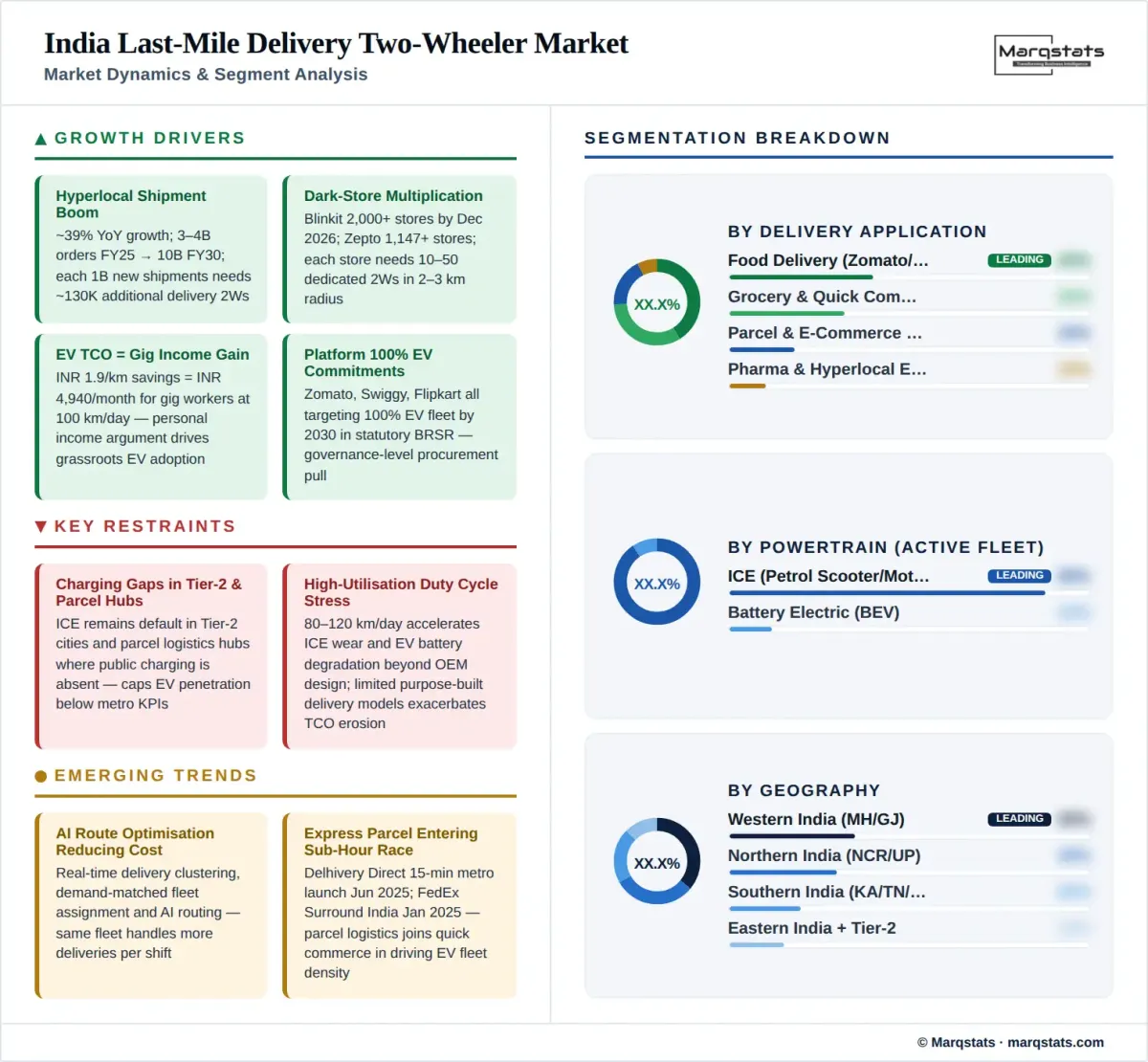
- Hyperlocal shipment volume explosion creating structural fleet demand: India's on-demand hyperlocal shipments are growing at approximately 39% year-on-year, from 3–4 billion in FY25 to a projected 10 billion by FY30. This is not seasonal or cyclical demand — it reflects the structural shift in Indian consumer behaviour toward instant fulfilment that quick commerce and food delivery platforms have created. Every incremental billion shipments requires approximately 120,000–150,000 additional active delivery two-wheelers to service, creating a mechanical link between India's delivery economy growth and delivery fleet expansion.
- E-commerce penetration into Tier-2 and Tier-3 cities adding new delivery fleet markets: India's e-commerce shipments are projected to reach 15–17 billion by FY30 at a 23–24% CAGR. DTDC already reaches 17,500+ pin codes. Delhivery launched a 15-minute metro delivery service in June 2025. Amazon and Flipkart are expanding same-day delivery capabilities beyond Tier-1 cities. Each new city added to last-mile delivery networks requires incremental fleet additions — predominantly ICE two-wheelers in the near term as EV charging infrastructure is still being built in these markets.
- Quick commerce dark-store multiplication directly driving fleet density requirements: Each dark store requires approximately 10–50 delivery two-wheelers operating simultaneously during peak hours within a 2–3 km service radius. With Blinkit targeting 2,000+ stores by December 2026 (from the current ~1,000), Swiggy Instamart at 1,100+ stores, and Zepto at 1,147+ stores — the aggregate fleet requirement from quick commerce alone is growing by thousands of vehicles per month. BigBasket deployed 4,000+ charging points at 773 locations specifically to serve its delivery fleet, reflecting the infrastructure investment dark-store expansion requires.
- Gig worker income optimisation driving individual EV adoption within delivery fleets: Industry analyses indicate that approximately 40% of delivery gig workers cite higher earnings per km as their primary need. The EV TCO advantage — INR 1.53/km versus INR 3.44/km for ICE — is not an abstract corporate sustainability metric for gig workers; it is a direct increase in take-home pay per delivery. At 100 km/day, an EV-riding gig worker saves approximately INR 190 per day in operating costs versus an ICE rider. Over a month of 26 working days, this is approximately INR 4,940 — meaningful against typical monthly gig earnings. This personal economic incentive makes individual gig worker EV adoption a grassroots demand pull, not just a platform-driven top-down programme.
- Platform fleet commitments creating institutional procurement demand: Platform-level EV fleet commitments from Zomato (100% EV by 2030), Swiggy (100% low-carbon by 2030), Flipkart (100% EV last-mile by 2030), and BigBasket (60% EV by 2030) translate into multi-year vehicle procurement pipelines that OEMs and fleet operators can plan against. These commitments are disclosed in statutory filings (BRSR, sustainability reports) making them governance-level obligations, not merely aspirational targets.
Key Restraints
- Charging infrastructure gaps limiting EV fleet scaling in parcel and Tier-2 delivery: While quick commerce dark stores are building hub-charging capability (BigBasket-Kazam partnership at 773 locations), parcel logistics hubs and residential buildings in Tier-2 cities remain largely without dedicated EV charging. Delivery agents operating in Tier-2 cities face a dual constraint: fewer model options (OEM service networks are concentrated in metros) and fewer charging points. This makes ICE the near-term default for Tier-2 fleet expansion and caps the total EV penetration rate below what metro-focused platform KPIs suggest.
- Multi-apping and informal fleet structures making fleet management complex: A significant portion of India's delivery gig workforce 'multi-apps' — working across Zomato, Swiggy, and quick commerce platforms simultaneously on a single vehicle. This creates operational complexity for platform-level EV fleet programmes (which vehicle is being used for which platform's orders?), challenges for FaaS operators who rent vehicles (utilisation accounting across platforms), and statistical uncertainty for fleet size estimation. It also means individual rider economics are more complex than simple per-platform analysis suggests.
- High-utilisation delivery duty cycles stressing vehicle durability beyond OEM design: Delivery riders covering 80–120 km/day create usage patterns that consumer-grade ICE scooters and EVs are not designed for. Frequent stop-start at traffic signals, constant payload loading, high daily distance, and multi-shift operation accelerate wear on both ICE engines and EV battery packs. Platform disclosures explicitly cite limited delivery-suitable models as a constraint. The consequence is higher-than-expected maintenance costs for ICE fleets and battery degradation beyond warranty assumptions for EV fleets — both eroding the TCO model used to justify fleet procurement decisions.
- Seasonal demand spikes creating over/under-fleet situations: Food and grocery delivery demand has pronounced peak patterns — Diwali, IPL season, monsoon season — that create temporary fleet requirement spikes of 20–40% above average. Platforms address this through on-demand gig worker activation rather than permanent fleet additions, but it creates planning complexity for fleet operators and FaaS providers who must manage utilisation rate volatility across their vehicle pools.
Key Trends
- Route optimisation and AI fleet management reducing per-delivery cost: The integration of AI-driven route optimisation into delivery apps — automatically clustering orders, minimising total rider distance, and matching delivery capacity to demand density in real time — is progressively reducing the per-delivery cost of two-wheeler fleets. This technology is simultaneously a competitive differentiator between platforms (better route optimisation means faster delivery and lower rider burn rate) and a fleet efficiency multiplier (the same fleet handles more deliveries per shift with AI routing than manual assignment).
- Cargo accessories and delivery-specific vehicle modifications creating a secondary market: The delivery application creates demand for vehicle accessories that consumer-spec vehicles do not include — insulated cargo boxes (food delivery), secure lockable cargo systems (pharma, parcel), GPS tracking units, mobile phone mounts, and rain-protection covers. This accessories market is growing alongside fleet scale and represents an additional revenue layer beyond vehicle procurement. Purpose-built delivery EVs (Quantum Bziness EMO, Hero Electric NYX HX) increasingly include cargo management features as standard specifications.
- Pharmaceutical delivery creating a specialized, compliance-driven fleet segment: Online pharmacy platforms (1mg, PharmEasy, Apollo Pharmacy) are growing rapidly as India's healthcare delivery ecosystem digitises. Pharmaceutical last-mile delivery requires vehicles with sealed cargo boxes (for controlled temperature), secure delivery confirmation workflows, and in some states, specific compliance documentation. This is creating demand for a specialised delivery two-wheeler sub-segment where vehicle selection is driven by compliance requirements rather than pure cost — a higher-value segment than mass food or grocery delivery.
- Delhivery and express logistics entering sub-hour delivery creating new quick-fleet demand: Delhivery's launch of its 15-minute metro delivery service (Delhivery Direct, June 2025), Blue Dart's focus on high-value sensitive shipments, and FedEx's FedEx Surround advanced monitoring solution (India launch January 2025) reflect the express logistics sector upgrading toward rapid-delivery capabilities previously only associated with food or quick commerce. As express parcel delivery joins the sub-hour delivery economy, it will require dedicated urban two-wheeler fleets comparable in density and EV penetration to food and quick commerce platforms.
Market Segmentation
Food delivery is the most established last-mile delivery application for two-wheelers in India, with Zomato and Swiggy together accounting for the majority of the estimated 1.2 million active delivery 2W fleet. Zomato's ~473,000 active monthly delivery partners (FY25) and Swiggy's ~691,000 average monthly transacting delivery partners (Q2FY26) represent the direct fleet demand anchors. Food delivery is characterised by 5–7 km typical delivery radius, 25–45 minute delivery windows, strong peak-hour concentration (lunch and dinner), and relatively low payload (1–3 kg per delivery). The typical vehicle is a consumer-grade scooter (Honda Activa, TVS Jupiter, Hero Splendor for ICE; TVS iQube, Bajaj Chetak for EV) used by rider-owners. EV adoption in food delivery has progressed furthest here: Zomato disclosed 8% of food delivery orders delivered by EVs in FY24, with EV partners growing rapidly since. Platform FaaS programmes (Zypp-Zomato, 1 lakh e-scooter target) are the primary scaling mechanism.
Grocery and quick commerce is the fastest-growing delivery application by fleet expansion rate, driven by dark-store proliferation and the 10-minute delivery commitment that defines the category. Blinkit, Zepto, Swiggy Instamart, BigBasket, and Amazon Fresh collectively deploy hundreds of thousands of two-wheelers within 2–3 km delivery radii of their 1,200+ dark stores. The quick commerce delivery profile is distinct from food delivery: shorter radius (1.5–2.5 km), lighter payload (1–5 kg per order), more trips per hour (10–15 versus 4–6 for food), and a strong economic case for battery-swap EVs given the frequent trips. Blinkit has reported 80% EV fleet density in Gurgaon — the highest in any Indian city for a major delivery platform — validating battery swap and hub charging as operationally viable at quick commerce density. The Yulu-Zepto partnership (20,000 shared DeX EVs) and BigBasket-Kazam (4,000+ charging points at 773 dark store locations) are the ecosystem anchors for this application.
Parcel and e-commerce last-mile delivery is the largest application by total shipment volume — India's e-commerce shipments of 4.8–5.5 billion in FY25 dwarf food and grocery delivery volumes by an order of magnitude. However, per-delivery economics differ: parcel deliveries have higher payloads (up to 10–15 kg), longer delivery radii (hub zones of 10–15 km), and lower urgency (same-day rather than 10–30 minute). Amazon's 10,000 EV fleet across 500 cities and Flipkart's 10,000+ EVs with chargers at 2,900 hubs represent the most developed institutional fleet EV programmes in parcel logistics. Express logistics players — Delhivery (Delhivery Direct, 15-minute metro service), Xpressbees, DTDC (17,500+ pin codes), Blue Dart, and Porter — operate two-wheeler fleets across the delivery speed spectrum from same-day to next-day. This application has the largest Tier-2 penetration and is therefore the primary growth market for ICE fleet additions as platforms expand delivery reach beyond charging-infrastructure-ready cities.
Pharmaceutical delivery is the highest-growth-rate specialty segment in India's last-mile delivery two-wheeler market, growing from a small base as online pharmacy penetration accelerates. 1mg (Tata Health), PharmEasy, Apollo Pharmacy, and Netmeds collectively serve tens of millions of prescription and OTC medicine orders. The pharmaceutical delivery profile requires sealed cargo boxes for controlled storage, regulatory-compliant delivery confirmation (particularly for Schedule H and narcotics), and time-sensitive delivery for critical medications. Two-wheeler vehicle selection in pharma delivery is driven by cargo security and compliance rather than pure cost, creating demand for higher-specification vehicles with lockable cargo systems. EV adoption in pharmaceutical delivery is at an early stage given the reliability requirements in markets where charging is still developing, but the sector is expected to follow food delivery's EV adoption trajectory with a 12–18 month lag.
The hyperlocal errand and on-demand delivery segment — platforms like Swiggy Genie (send/receive courier within city), Porter (intra-city on-demand from scooter to truck), and the former Dunzo model — represents a fragmented but meaningful additional demand pool for delivery two-wheelers. Porter specifically operates across multiple vehicle categories with two-wheelers serving the smallest delivery category. This segment is characterised by irregular order patterns, varying payload sizes, and a customer base that spans individual consumers to small businesses. EV adoption here is relatively low given the route variability and absence of hub-charging infrastructure for non-platform-affiliated riders.
ICE two-wheelers constitute approximately 88% of India's active delivery fleet in 2025 and will remain the dominant powertrain through the medium term — particularly in Tier-2 cities and in parcel logistics applications where charging infrastructure density is insufficient for reliable EV operation. The dominant delivery ICE models are the Honda Activa (scooter, ~60 KMPL, most-used food delivery vehicle), Hero Splendor Plus (motorcycle, ~65–70 KMPL, preferred for longer parcel routes), TVS Jupiter (scooter), and Bajaj Platina (motorcycle). ICE fleet economics at high utilisation (100 km/day) run approximately INR 3.44/km — competitively disadvantaged versus EVs but preferred in markets where charging access is unreliable. ICE fleet share will decline progressively from 88% in 2025 toward 40% in 2030 under the base forecast scenario.
Battery EVs account for approximately 12% of India's active delivery fleet in 2025 — approximately 140,000–160,000 vehicles — growing toward 60% under the base scenario by 2030. EV adoption is concentrated in metro quick commerce (Blinkit Gurgaon at 80% EV, Zomato 51,000+ EV partners) and grocery delivery (BigBasket 1-in-3 fleet electric). The delivery-grade EV models in active fleet use include the TVS iQube (2.2–5.3 kWh, 94–212 km claimed range), Bajaj Chetak (127–153 km), Ola S1X Gen3 (up to 242 km IDC), Ather 450 (corporate programme), Hero Electric NYX HX (150 kg payload, utility-oriented), and Yulu DeX (battery-swap, purpose-built). The per-km EV advantage of INR 1.9/km at 100 km/day is the primary adoption driver — both at fleet operator level (Chartered Bikes: INR 1.5–2/km versus INR 4 for petrol) and individual rider level (approximately INR 4,940/month in fuel savings).
By Geography
Western India — Mumbai, Pune, and Maharashtra
Western India — anchored by Mumbai, Pune, Nashik, and Ahmedabad — contributed approximately 35% of India's total last-mile delivery volume in FY25. Maharashtra is India's largest state by e-2W registration (210,112 in 2024), reflecting both consumer EV adoption and significant delivery fleet electrification. Mumbai is characterised by extreme delivery density in areas like Bandra, Andheri, and Lower Parel where dark-store clusters and high-rise residential concentrations create per-square-km delivery vehicle utilisation far above national averages. The Yulu-Zepto shared EV deployment specifically targets Mumbai and Navi Mumbai. The Maharashtra EV policy (April 2025–March 2030) provides 100% motor vehicle tax waiver and INR 10,000 subsidy per EV, directly reducing delivery fleet acquisition costs.
Southern India — Bengaluru, Chennai, Hyderabad
Southern India — Bengaluru, Chennai, Hyderabad, and surrounding tier-2 markets — is the region with the deepest quick commerce penetration outside Delhi NCR. Bengaluru's tech-worker-dominated consumer base has the highest average order value in Indian quick commerce and the densest dark-store network per square km in India. Blinkit's 80% EV fleet density in Gurgaon is considered a near-term target for Bengaluru given comparable demographics. Ather Energy's Bengaluru headquarters and service network make the city's delivery fleet operators the best-served market for EV service reliability. Karnataka's EV road-tax reversal plan in 2026 is a risk, but Bengaluru-based delivery fleet operators benefit from the city's tech ecosystem applying AI route optimisation and real-time fleet management more aggressively than other markets. Tamil Nadu (Chennai, Coimbatore) benefits from TVS Motor's Hosur manufacturing base — strong service network for TVS iQube delivery fleet operators.
Northern India — Delhi NCR, Lucknow, Jaipur
Delhi NCR is India's single largest urban delivery market by total delivery volume, combining food delivery, quick commerce, and e-commerce into the densest delivery ecosystem in the country. Swiggy's Q2FY26 active partner count (~691,000 nationally) is heaviest in NCR. Blinkit, headquartered in Gurugram, operates its most mature quick commerce network in NCR with the highest dark-store density and the most developed EV fleet — Gurgaon's 80% EV fleet is the national benchmark. Delhi's proposed petrol two-wheeler registration ban from 2028 — if enacted — would structurally force full delivery fleet electrification in India's largest delivery market on a defined regulatory timeline. The NCR corridor extending into UP cities (Noida, Ghaziabad, Lucknow, Kanpur) is a major Tier-2 expansion market for all major platforms, with Tier-2 fleet currently dominated by ICE vehicles.
Eastern India — Kolkata, Patna, Bhubaneswar
Eastern India — covering West Bengal, Odisha, Bihar, and Jharkhand — contributes approximately 15% of India's last-mile delivery market. Kolkata is the primary market, with food delivery (Zomato, Swiggy) and e-commerce logistics (Amazon, Flipkart) driving the majority of delivery two-wheeler demand. The region faces infrastructure challenges — road connectivity in smaller cities, lower gig worker density, and more limited EV charging infrastructure — making it primarily an ICE delivery market in the medium term. However, rising digital penetration and growing healthcare delivery needs are creating incremental fleet demand. DTDC's 17,500+ pin code coverage includes significant eastern India reach, primarily served by ICE motorcycles.
Tier-2 and Tier-3 Cities — The Next Growth Wave
The most important structural shift in India's last-mile delivery two-wheeler market through 2030 is the rapid expansion of platform delivery networks into Tier-2 and Tier-3 cities. Blinkit's 2,000-store target requires 700–1,000 new stores in cities beyond the six Tier-1 metros. Zepto has expanded to 60+ cities. Amazon and Flipkart are expanding same-day delivery capabilities into Lucknow, Jaipur, Coimbatore, Surat, Indore, Patna, and dozens of other cities. In all of these markets, the current delivery fleet is almost entirely ICE — the charging infrastructure, EV service network, and financial ecosystem for EV fleet procurement have not yet developed. The result is that Tier-2 expansion is simultaneously driving strong ICE fleet demand (sustaining ICE OEM volumes through 2028) while creating the scale at which EV infrastructure investment becomes commercially viable for fleet operators and charging companies.
How Competition Is Evolving
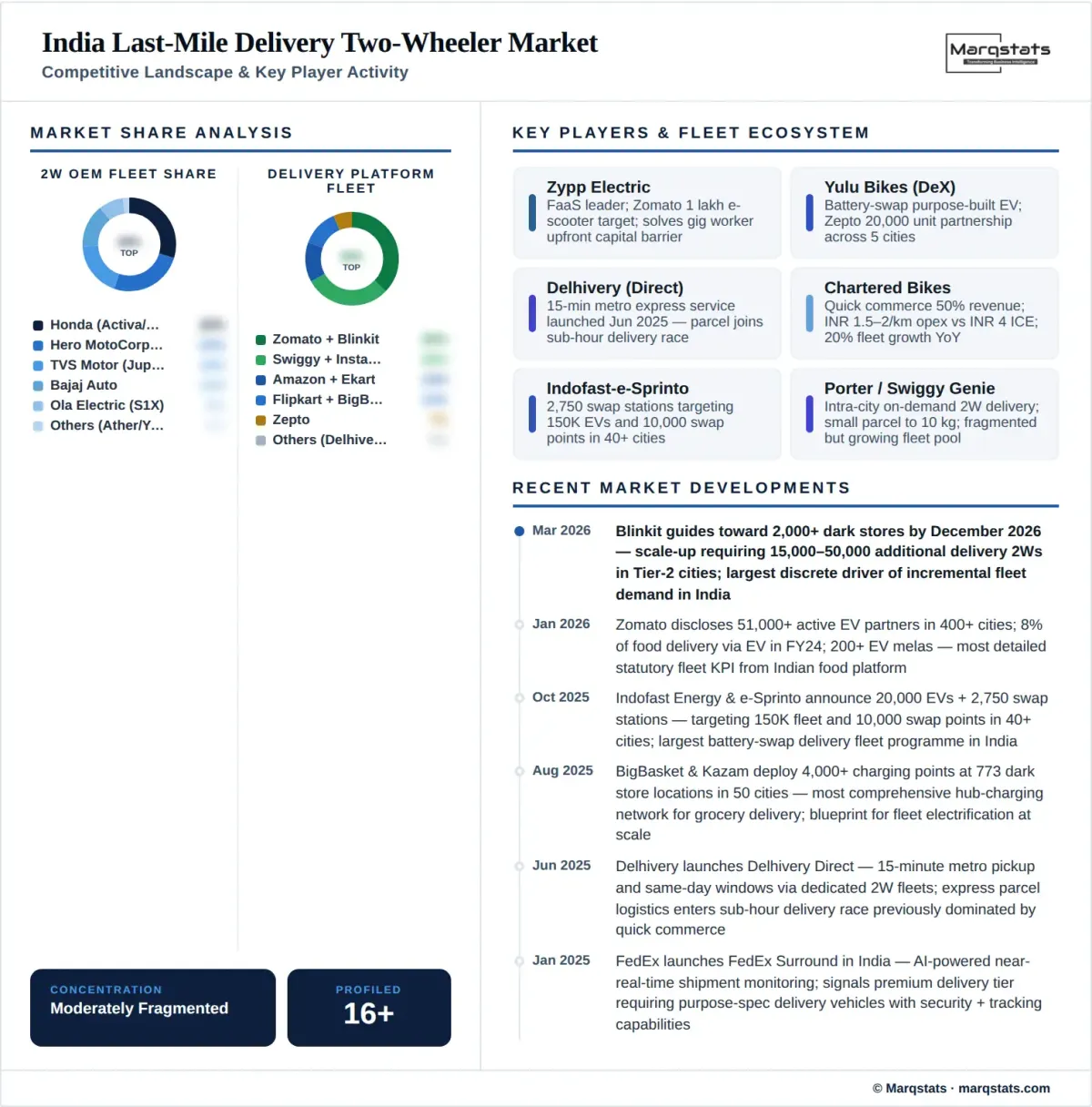
The India last-mile delivery two-wheeler market's competitive landscape is defined by two distinct but interconnected competitive arenas: the vehicle supply competition (between OEMs competing for delivery fleet procurement) and the platform competition (between delivery platforms competing for consumer mind-share and order volume, which determines the size of the fleet market). These arenas interact because platform growth determines fleet demand, and fleet economics (EVs reducing per-delivery cost) determine platform unit economics and competitive positioning.
In the vehicle supply arena, Hero MotoCorp, Honda Motorcycle and Scooter India, TVS Motor, and Bajaj Auto collectively supply approximately 85–90% of the ICE delivery fleet through consumer-grade commuter models (Hero Splendor, Honda Activa, TVS Jupiter) that delivery agents purchase independently. In the EV supply arena, TVS Motor has the strongest delivery-specific partnership track record (TVS-Swiggy MoU, TVS-Zomato deployment), Ola Electric has the highest consumer EV volume, and Ather Energy has the strongest corporate fleet programme. FaaS operators (Zypp Electric, Yulu, Chartered Bikes) serve as intermediaries between OEMs and gig workers, solving the financing access problem that constrains individual rider EV adoption. The competitive advantage in fleet supply belongs to OEMs and FaaS operators that can combine delivery-grade vehicle performance with platform-integrated financing and hub charging infrastructure.
In the platform competition arena, the quick commerce duopoly (Blinkit ~50% share, Zepto ~21-29%, Swiggy Instamart ~25-27%) is structurally driving the fastest growth in delivery fleet requirements. Food delivery remains a Zomato-Swiggy duopoly. Parcel logistics has a more fragmented landscape: Amazon (in-house Ekart/delivery network), Flipkart (Ekart), Delhivery, Xpressbees, DTDC, Blue Dart, and Porter compete across speed and coverage dimensions. The parcel logistics competitive landscape is also being disrupted by the entry of quick commerce platforms into express delivery (Amazon Now 10-minute delivery, Flipkart Minutes) — blurring the boundary between grocery and parcel last-mile delivery and creating new fleet requirements at the intersection.
Companies Covered
Companies covered in the report include:
Recent Market Activity
Table of Contents
Coverage & Segmentation
This report provides a comprehensive analysis of the India last-mile delivery two-wheeler market covering the 2021–2030 study period, with 2025 as base year. The study covers all scooters, motorcycles, and mopeds — ICE and electric — deployed specifically for last-mile delivery applications: food delivery, grocery and quick commerce, parcel and e-commerce logistics, pharmaceutical delivery, and hyperlocal errand services. Bike-taxi applications are explicitly excluded. Geographic coverage spans Western India (Maharashtra, Gujarat), Southern India (Karnataka, Tamil Nadu, Andhra Pradesh, Telangana), Northern India (Delhi NCR, Uttar Pradesh, Rajasthan), Eastern India (West Bengal, Odisha, Bihar), and the emerging Tier-2 delivery expansion markets across all regions. Policy analysis focuses on FAME-II, PM E-DRIVE, state EV policies, and dark-store and e-commerce logistics regulations. Primary research includes 40+ interviews with delivery platform fleet managers, third-party logistics operators, fleet-as-a-service providers, OEM commercial teams, and delivery gig workers across India's major markets.