Market Snapshot
Key Takeaways
Market Overview & Analysis
Report Summary
The India three-wheeler battery market comprises battery packs deployed in L3 passenger e-rickshaws, L5 passenger autos, and L5 cargo three-wheelers. The market is segmented by chemistry, capacity, vehicle type, and charging model. Lead-acid batteries currently power approximately 70% of the operational three-wheeler fleet, however new registrations are shifting rapidly toward lithium-ion chemistry. The shift is attributed to superior lifecycle economics, faster charging, and mandatory advanced-battery requirements under the PM E-DRIVE scheme.
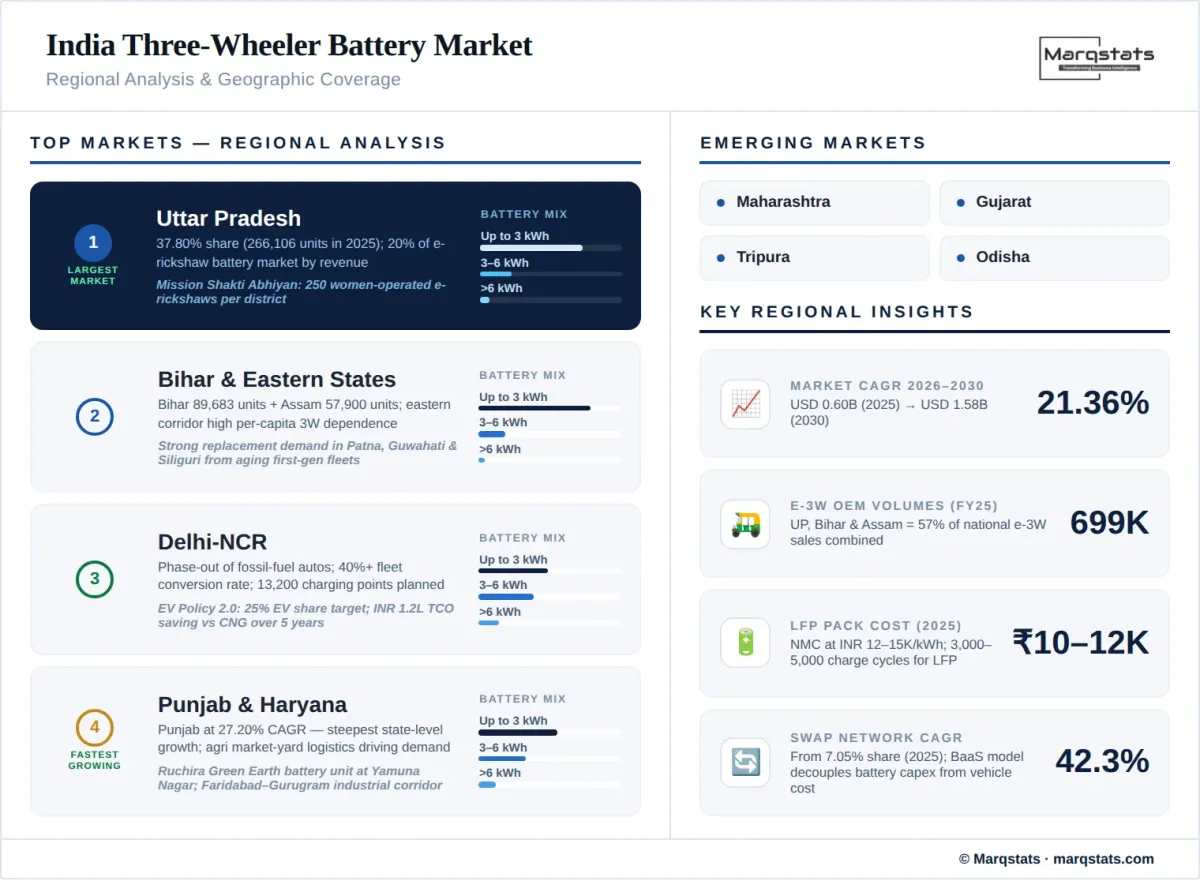
OEM volumes reached 699,000 electric three-wheelers in FY25, representing 16.9% year-on-year growth. Uttar Pradesh, Bihar, and Assam collectively contributed 57% of national electric three-wheeler sales in 2025. The overall India EV battery market was valued at USD 5.26 billion in 2024 and is projected to reach USD 19.47 billion by 2030, expanding at a CAGR of 24.4%. Within this ecosystem, three-wheeler batteries occupy a distinct commercial niche characterized by hyper-competitive total cost of ownership economics.
Unit-level battery pack sizes range from 1.2 kWh in entry-level e-rickshaws to 16 kWh in heavy L5 cargo vehicles. Battery pack costs in India have compressed to INR 10,000 to INR 12,000 per kWh for LFP systems, while NMC packs retail at INR 12,000 to INR 15,000 per kWh. The cost differential makes LFP the default chemistry for commercial three-wheelers, where total cost of ownership governs purchase decisions. For deeper analysis of the adjacent vehicle segment, the India Electric Three-Wheeler Market report on Marqstats provides detailed volume and pricing trends.
Government procurement frameworks, state-level EV policies, and bundled finance offerings are further reshaping demand. The Ministry of Heavy Industries allocated INR 10,900 crore under PM E-DRIVE for the period October 2024 to March 2028, with segment-specific incentives for e-rickshaws, L5 passenger vehicles, and L5 cargo variants. State-level initiatives, such as Delhi’s phase-out of fossil-fuel auto-rickshaws and Uttar Pradesh’s Mission Shakti Abhiyan, are expanding the addressable fleet base. The replacement aftermarket, driven by aging lead-acid fleets reaching end-of-life, is forecast to grow at a 10% CAGR through 2030.
Market Dynamics
Key Drivers
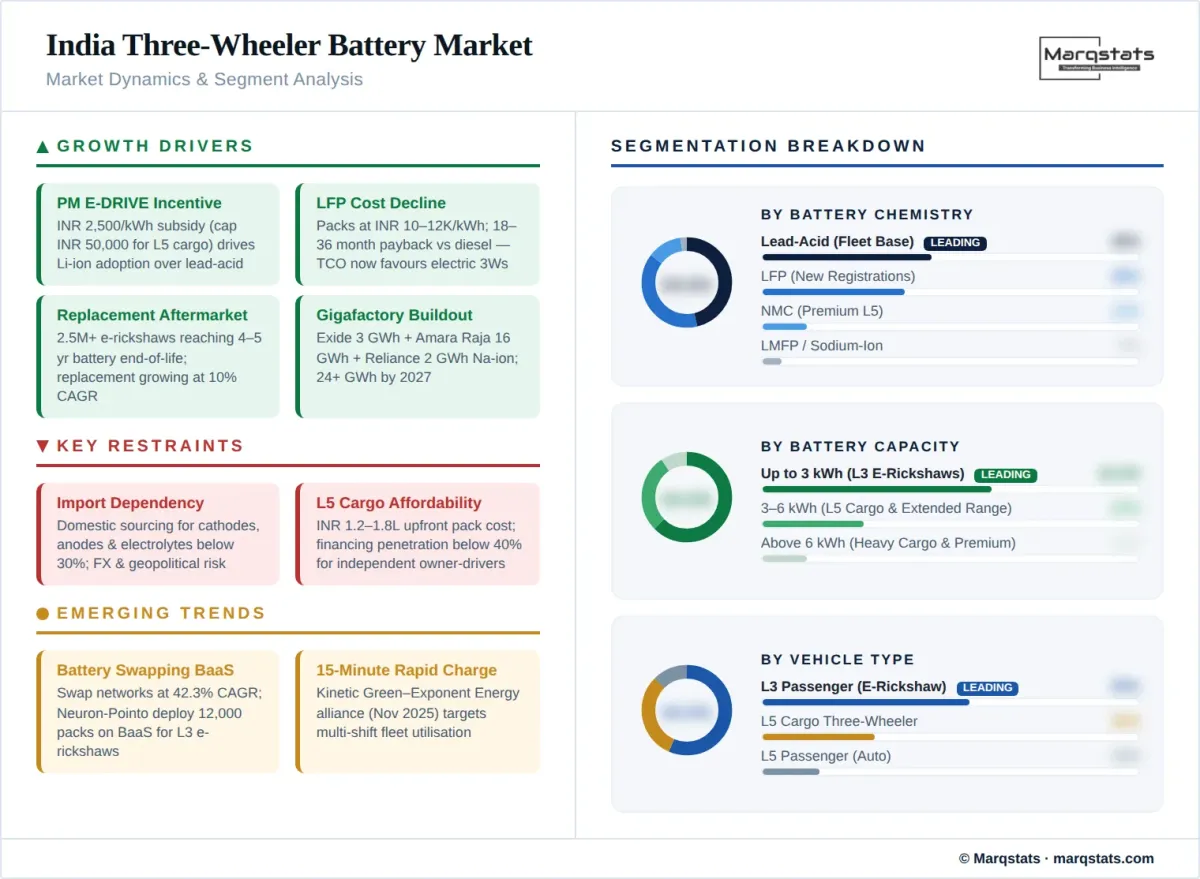
- PM E-DRIVE incentive structure of INR 2,500 per kWh directly reduces battery acquisition costs for OEMs and fleet operators, accelerating the transition from lead-acid to lithium-ion chemistry across passenger and cargo three-wheelers.
- Lithium-ion pack prices in India declined to INR 10,000 to INR 12,000 per kWh for LFP variants in 2025, bringing total cost of ownership below diesel auto-rickshaw equivalents and improving payback periods to 18 to 36 months.
- Replacement aftermarket expansion is accelerating owing to the aging first-generation e-rickshaw fleet. Lithium-ion cells offer approximately 1,500 charge cycles before degradation, creating recurring demand for pack replacement units every four to five years.
- Government mandates for advanced battery technology under PM E-DRIVE exclude lead-acid systems from subsidy eligibility, forcing OEMs to standardize lithium-ion pack designs and expand domestic cell sourcing.
- Gigafactory investments by Exide Industries, Amara Raja Energy & Mobility, and Reliance New Energy are compressing lithium-ion pack costs further. Cumulative domestic cell capacity additions exceed 24 GWh between 2025 and 2027.
Key Restraints
- Upstream dependency on imported cathodes, anodes, electrolytes, and specialized cell fabrication machinery exposes Indian battery manufacturers to foreign exchange and geopolitical risks. Domestic sourcing for these inputs remains below 30%.
- High upfront battery pack costs for L5 cargo three-wheelers, ranging from INR 1.2 lakh to INR 1.8 lakh, continue to restrict adoption among independent owner-drivers. Financing penetration in this segment remains below 40%.
- Charging infrastructure gaps in tier-2 and tier-3 cities slow the shift toward higher-capacity packs. High-tension power connections for depot charging involve approval cycles of six to twelve months in most states.
- Unorganized lead-acid supply chains continue to serve price-sensitive e-rickshaw buyers, with unit battery sets available at INR 9,000 to INR 35,000. Informal aftermarket channels erode brand-based lithium-ion penetration.
Key Trends
- Battery swapping networks are expanding rapidly, supported by operator demand for operational expenditure models that decouple battery ownership from vehicle purchase. Swapping adoption is forecast to grow at 42.30% CAGR through 2030.
- Rapid charging architectures offering 15-minute top-ups, such as the Kinetic Green–Exponent Energy alliance launched in November 2025, are gaining commercial adoption in e-rickshaw and L5 cargo fleets for higher daily utilization.
- Alternative chemistries are entering commercial deployment. Reliance New Energy commissioned 2 GWh of sodium-ion capacity in September 2025 at Jamnagar, offering a lithium-independent pathway for price-sensitive three-wheeler applications.
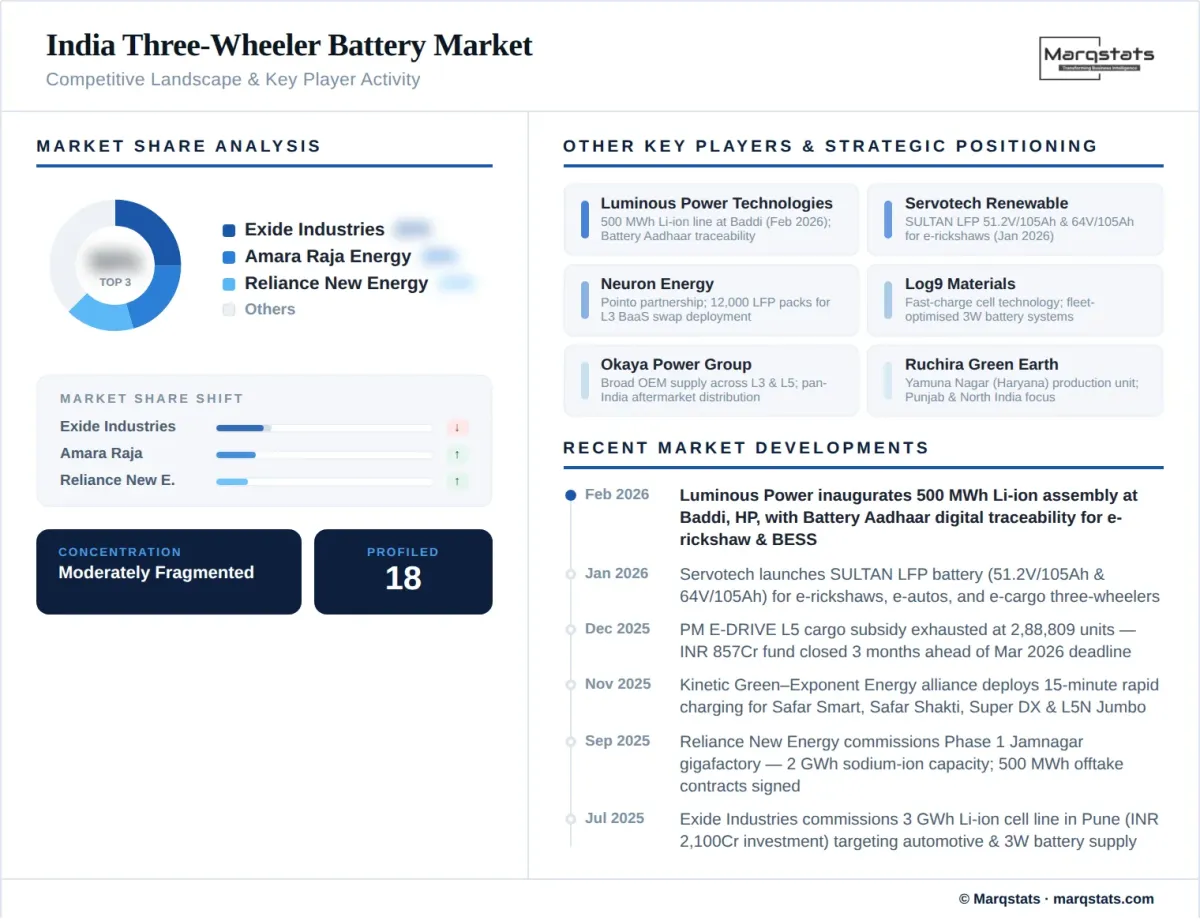
- Battery Aadhaar compliance and end-to-end traceability are emerging as standard manufacturing requirements. The Luminous Power Technologies facility at Baddi integrates Battery Aadhaar-aligned digital traceability for full lifecycle compliance.
Market Segmentation
Lead-acid batteries power approximately 70% of the operational three-wheeler fleet in India. The installed base is largely concentrated in first-generation e-rickshaws with purchase prices below INR 1.5 lakh. Lead-acid pack sets are priced between INR 25,000 and INR 60,000 for complete vehicle replacement, with service life of 12 to 18 months under commercial duty cycles. Time Technoplast’s subsidiary Power Build Batteries launched the e-START with SELENIUM lead-acid battery in February 2025, targeting the affordability-driven aftermarket.
LFP chemistry accounts for 38.27% share of the EV battery pack market in 2025. The chemistry is the default selection for new three-wheeler registrations. LFP packs deliver 3,000 to 5,000 charge cycles and withstand Indian tropical temperatures exceeding 45 degrees Celsius without active cooling. Servotech Renewable’s SULTAN battery, launched in January 2026, uses LFP chemistry across 51.2V/105Ah and 64V/105Ah configurations. LFP pack prices range between INR 10,000 and INR 12,000 per kWh.
NMC batteries offer higher gravimetric energy density however require sophisticated thermal management systems. The chemistry is priced at INR 12,000 to INR 15,000 per kWh. NMC adoption in three-wheelers remains limited owing to shorter cycle life and elevated thermal runaway risks. Deployment is largely confined to premium L5 passenger variants with extended range requirements.
LMFP is projected to record the fastest growth at 49.18% CAGR during the forecast period. The chemistry offers superior energy density compared with standard LFP while retaining thermal stability. Commercial deployment in three-wheelers is expected to accelerate from 2027 as cell manufacturers scale production at domestic gigafactories.
Sodium-ion batteries represent an emerging category for price-sensitive three-wheeler applications. Reliance New Energy commissioned Phase 1 of its Jamnagar facility in September 2025, adding 2 GWh of sodium-ion capacity with offtake contracts totaling 500 MWh. Sodium-ion chemistry eliminates lithium import dependency and offers cost advantages of 20 to 30% versus LFP at commercial scale.
Battery packs up to 3 kWh account for 61.20% of the three-wheeler battery market share in 2025. The segment is dominant in lightweight passenger e-rickshaws operating in tier-2 and tier-3 cities. Daily operational ranges of 80 to 120 km match the capacity envelope. Average pack retail prices sit between INR 25,000 and INR 45,000 for lithium-ion variants.
The 3 to 6 kWh category is the fastest-growing capacity segment, advancing at 33.85% CAGR through 2030. The capacity band serves L5 cargo three-wheelers and extended-range passenger variants. Fleet operators prioritize this capacity tier for last-mile delivery applications requiring 150 to 200 km daily range. Mahindra Treo, Bajaj RE, and Piaggio Ape deployments primarily use packs within this range.
Packs above 6 kWh serve heavy L5 cargo three-wheelers and premium passenger variants. Kinetic Green’s Safar Jumbo and Luminous Power Technologies’ top-tier configurations extend up to 16 kWh. The segment is expanding owing to the rise of B2B logistics fleets operating multi-shift schedules across e-commerce and intra-city freight corridors.
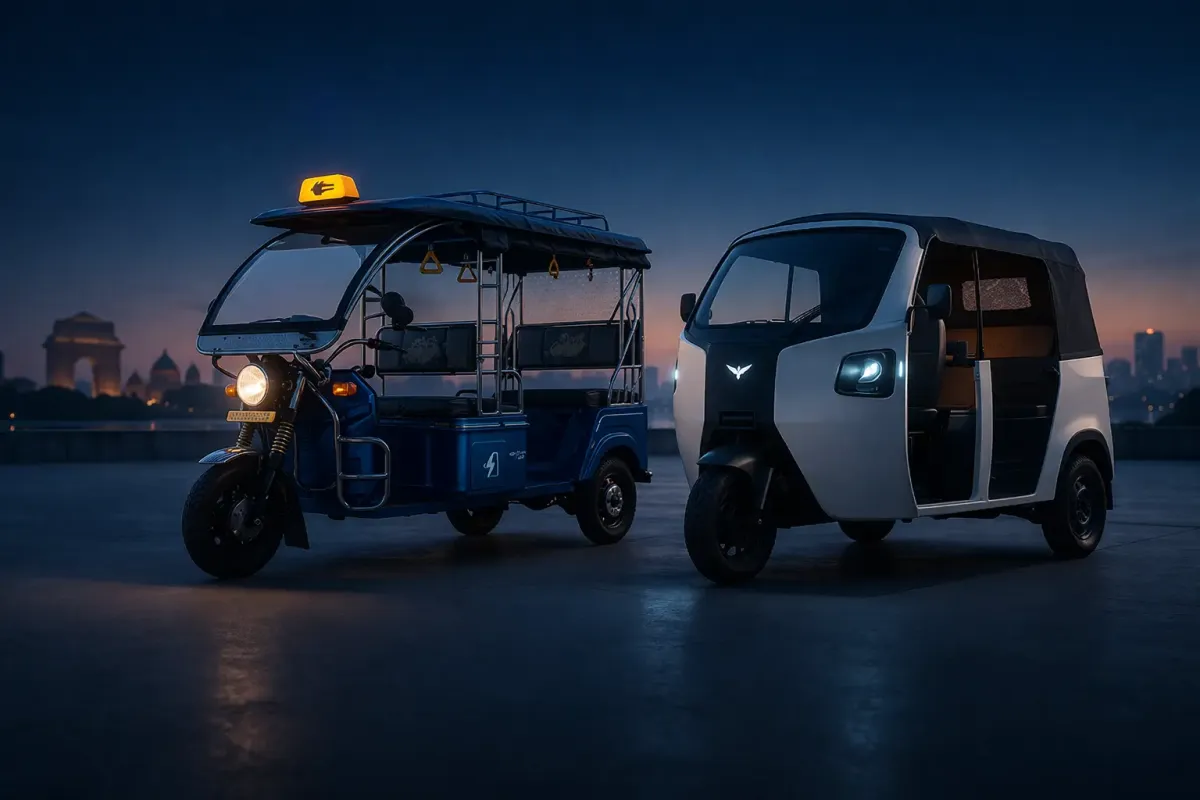
L3 passenger e-rickshaws dominate installed volume with more than 2.5 million operational units. Battery pack sizes range from 1.2 kWh to 4.8 kWh. The segment is characterized by high price sensitivity, unorganized distribution, and high replacement frequency. Uttar Pradesh, Bihar, and Assam account for the largest installed base. PM E-DRIVE funding allocation for L3 e-rickshaws was revised to INR 500 million in the March 2026 scheme amendment, with the window extended to March 2028.
L5 passenger three-wheelers comprise higher-speed variants such as Mahindra Treo and Bajaj RE Electric. Battery capacity ranges from 8 to 10 kWh. The PM E-DRIVE scheme allocated INR 2,500 per kWh with a per-vehicle cap of INR 12,500 for this segment. The category serves shared mobility operators and intra-city commercial transport.
L5 cargo three-wheelers registered 2,85,931 units under PM E-DRIVE subsidy support by December 22, 2025, approaching the 2,88,809-unit ceiling. Battery capacity ranges from 6 to 12 kWh. Per-vehicle subsidy reached INR 50,000 in phase 1 and INR 25,000 in phase 2. The L5 subsidy fund was exhausted in December 2025, three months ahead of the March 2026 deadline. The segment is the fastest-growing three-wheeler category, owing to last-mile e-commerce logistics expansion.
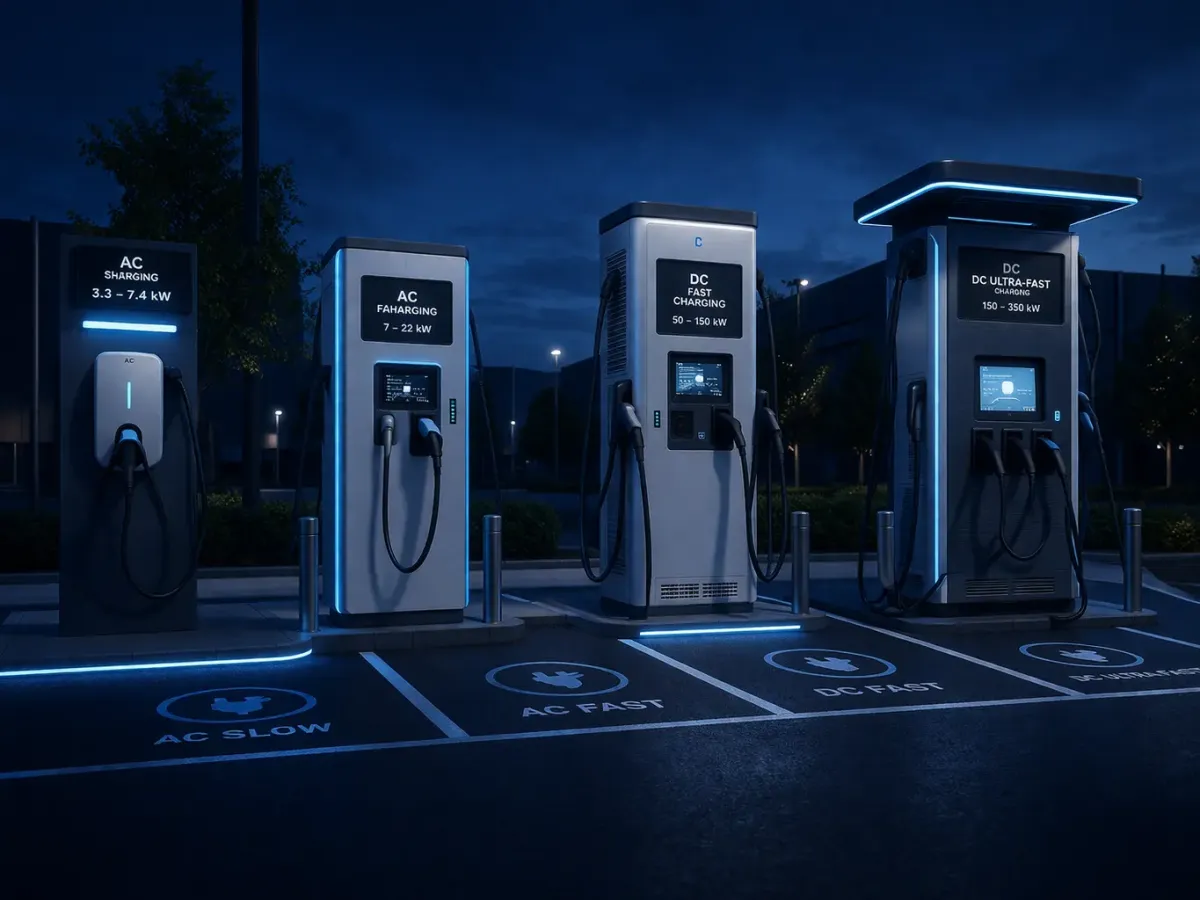
Plug-in charging accounts for 92.95% of market share in 2025. Depot-based AC charging at 3.3 kW to 7.4 kW output remains the dominant mode. Standard charging cycles range from 4 to 8 hours, aligning with overnight fleet schedules. Tier-1 city deployments increasingly favor 22 kW AC and 30 kW DC fast chargers for higher fleet utilization.
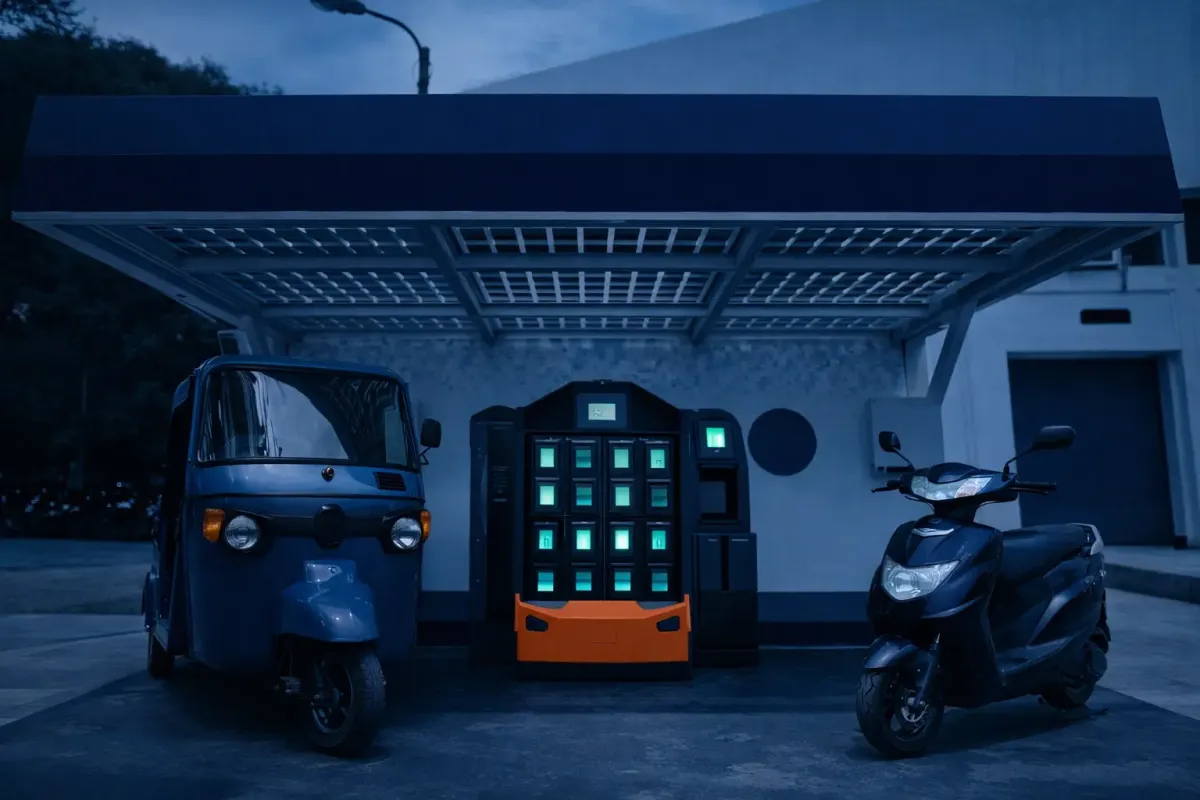
Battery swapping holds 7.05% share in 2025, however is forecast to advance at 42.30% CAGR through 2030. The model decouples battery capital expenditure from vehicle purchase, offering operational expenditure economics for fleet operators. Neuron Energy’s partnership with Pointo targets the deployment of 12,000 lithium-ion battery packs for L3 e-rickshaws on a Battery-as-a-Service basis. For a complete view of swapping network operators, the India EV Battery Swapping Market report on Marqstats offers detailed infrastructure data.
Rapid charging is emerging as a specialized category for high-utilization fleets. Kinetic Green’s November 2025 alliance with Exponent Energy introduced 15-minute charging for electric three-wheelers across the Safar Smart, Safar Shakti, Super DX, and L5N Jumbo loader models. The model supports multi-shift operations without depot charging downtime. Rapid charging infrastructure is presently concentrated in metro and tier-1 cities.
By Geography
Uttar Pradesh
Uttar Pradesh accounts for 37.80% of electric three-wheeler sales in 2025, registering 266,106 units. The state also holds 20% of the electric rickshaw battery market by revenue. Dense tier-2 and tier-3 city populations, robust fiscal incentives, and a maturing dealer network sustain demand. The state’s Mission Shakti Abhiyan initiative targets 250 women-operated e-rickshaws per district, expanding the addressable fleet base. Lucknow, Kanpur, Ghaziabad, and Noida are the primary demand clusters.
Bihar and Eastern States
Bihar ranks second with 89,683 electric three-wheeler registrations, followed by Assam with 57,900 units. West Bengal contributes significant volumes through Kolkata and surrounding municipal areas. The eastern corridor is characterized by high per-capita dependence on three-wheelers for short-distance mobility. Replacement battery demand is particularly strong owing to early-generation fleet aging across Patna, Guwahati, and Siliguri.
Punjab and Haryana
Punjab records the steepest state-level growth at 27.20% CAGR. Agricultural market-yard logistics and rising urban commute requirements drive adoption. Haryana contributes through the Faridabad–Gurugram industrial corridor, with battery manufacturers such as Ruchira Green Earth establishing production units in Yamuna Nagar. Tripura is emerging as the fastest-growing state by percentage increase, albeit from a small base.
Delhi-NCR
Delhi’s directive to phase out fossil-fuel auto-rickshaws supports accelerated three-wheeler battery demand. The region plans 13,200 charging points, backed by the Delhi EV Policy. Commercial fleet conversion rates exceed 40% annually, yielding total cost of ownership savings of INR 1.2 lakh per vehicle over a five-year cycle compared with CNG alternatives. The EV Policy 2.0 targets 25% EV share in new vehicle registrations.
Maharashtra and Gujarat
Maharashtra registered 32,625 electric three-wheelers in 2025, while Gujarat reported 31,738 units. The states host major gigafactories, including Amara Raja Energy & Mobility’s 16 GWh facility and Exide Industries’ 3 GWh Pune line. Domestic battery supply proximity supports OEM production hubs in Pune, Ahmedabad, and Sanand. Electric three-wheeler penetration remains moderate, at 15.48% in Maharashtra and 4.07% in Gujarat.
Southern States
Tamil Nadu, Karnataka, and Andhra Pradesh contribute through battery manufacturing rather than consumption volumes. Chennai hosts major battery cell assembly operations, while Hyderabad’s E-Mobility Valley accommodates Cygni Energy’s 4.8 GWh BESS gigafactory commissioned in April 2025. Southern states record lower three-wheeler penetration owing to rail-metro commuting patterns and a higher share of two-wheeler and four-wheeler EVs.
How Competition Is Evolving
The competitive environment in the India three-wheeler battery market is moderately fragmented. The market comprises legacy lead-acid giants pivoting to lithium-ion, pure-play lithium-ion cell manufacturers, and vertically integrated OEM-battery tie-ups. The top 10 organized players account for approximately 55% of revenue in 2025. Market concentration is increasing as gigafactory-scale manufacturers expand production capacity and squeeze unorganized lead-acid suppliers from the aftermarket.
Legacy battery manufacturers are aggressively scaling lithium-ion capacity to defend market share. Exide Industries commissioned a 3 GWh lithium-ion line in Pune in July 2025 after investing INR 2,100 crore. Amara Raja Energy & Mobility is constructing a 16 GWh cell and 5 GWh pack gigafactory with an INR 9,500 crore commitment. Both companies leverage existing distribution networks spanning tens of thousands of retail touchpoints, providing aftermarket advantages unavailable to new entrants. Amara Raja’s new energy business revenue crossed INR 2 billion in Q3 FY2026 despite broader profitability pressures.
Vertically integrated OEM-battery tie-ups are reshaping procurement economics. Mahindra Electric integrates battery packs within the Treo and Treo Zor platforms, while Bajaj Auto partners with multiple cell suppliers for its RE Electric range. New-age cell manufacturers, including Reliance New Energy, Log9 Materials, and Lohum Cleantech, are entering through technology differentiation. Reliance’s sodium-ion 2 GWh capacity addition at Jamnagar in September 2025 signals chemistry-level diversification. Strategic partnerships for raw material sourcing, cell fabrication know-how, and charging infrastructure access are the primary competitive differentiators for the 2026-2030 period.
Companies Covered
The report profiles 18 company profiles+ companies with full strategy and financials analysis, including:
Recent Market Activity
Table of Contents
Coverage & Segmentation
The India Three-Wheeler Battery Market report analyzes the market across chemistry, capacity, vehicle type, charging model, and state-level geography for the period 2021 to 2030. The report covers historical data for 2021-2025, with 2025 as the base year, and forecasts spanning 2026-2030. Market sizing is conducted in USD millions and unit volumes. The study examines the full value chain, including upstream cell manufacturing, pack assembly, BMS integration, aftermarket replacement, and end-of-life recycling.
The scope encompasses L3 passenger e-rickshaws, L5 passenger three-wheelers, and L5 cargo variants. The study evaluates policy impact from PM E-DRIVE, FAME-II legacy effects, state-level EV policies, and Production-Linked Incentive schemes for Advanced Chemistry Cells. Competitive profiling covers 18 battery manufacturers and OEM-battery integrators operating in India. The report includes pricing analysis, segmental forecasts, value chain margins, and capacity expansion schedules across domestic gigafactories.