Market Snapshot
Key Takeaways
Market Overview & Analysis
Report Summary
The Egypt REEV market covers passenger vehicles in which electric motors provide propulsion and an internal combustion engine functions principally as a generator charging the battery rather than driving the wheels. Conventional hybrids and standard parallel plug-in hybrids are excluded, which distinguishes this measure from the wider Egyptian hybrid and range-extended vehicle market that contains it. The architectural distinction is not cosmetic: a range extender delivers an electric driving experience with gasoline-generated range, which places its customer proposition closer to a battery electric vehicle than to a hybrid.
The 2025 base is the weakest figure on the page and is presented as a technology proxy rather than a count. The supplied model-level dataset records 209 Deepal S05 units and 94 Deepal S07 units under mixed battery-electric and plug-in-hybrid coding, plus 19 Li Auto plug-in-hybrid units, giving a 322-unit proxy from which the 320-unit estimate is drawn. Because the mixed codes cannot establish that every unit is a range extender, confidence is graded low and the published sizing range runs from 200 to 500 units for 2025.
What is documented is the pace at which the category acquired supply. Deepal recorded 431 brand sales across the first four months of 2026 alone. Between July and August 2026 three dedicated range-extended nameplates entered: the iCAUR V27 through GB Auto, the IM LS9 through Mansour Motors and the AVATR 07 through Kasrawi Group. In June 2026, before any of them launched, ROX Motor and Ezz El Arab El Sewedy had already agreed to manufacture range-extended vehicles in Egypt, moving the segment past completely-built-up supply within a single year of it becoming measurable.
Range-Extended Electric Vehicle Sales in Egypt
Annual range-extended electric vehicle sales rise from 320 units in 2025 to 11,600 in 2030, a 105.05% compound annual growth rate and an absolute increase of 11,280 units. The indicative 2031 endpoint is approximately 18,000 vehicles. The 2026 estimate of 2,000 units is anchored on observed launch timing and early brand performance rather than interpolated, since three dedicated nameplates entered within six weeks of each other and Deepal was already running at 431 units across four months.
Both growth rates belong on the page because they answer different questions. The 105.05% five-year rate measures the distance travelled from a 320-unit technology proxy to a recognised segment. The 55.19% rate from 2026 onward measures how fast the segment grows once it exists, and it is the figure that should drive any volume assumption after 2026. Reading the headline rate forward would overstate 2030 volume by a factor of several times, which is why the sizing range for 2031 is published as 12,000 to 25,000 rather than as a point estimate alone.
Retail value grows from USD 15.36 million to USD 417.60 million, a 93.59% compound annual growth rate. Average transaction value falls from approximately USD 48,000 to USD 36,000, a decline of about 5.59% each year, as the mix broadens from premium introductions such as the IM LS9 and AVATR 07 toward mainstream nameplates and, from 2027, locally produced ROX models. Value therefore compounds more slowly than units, the signature of a category moving from premium entry toward volume.
The subset relationship with the wider electrified market deserves stating numerically rather than in words, because the two pages will be read together. Egypt's hybrid and range-extended vehicle market carries 2,100 vehicles in 2025, 5,800 in 2026, 26,100 in 2030 and approximately 38,000 in 2031. This market carries 320, 2,000, 11,600 and approximately 18,000 across the same years. Range-extended share of the containing market therefore moves from roughly 15.2% to 34.5% to 44.4% to 47.4%, rising monotonically and never exceeding the parent. A reader encountering both figures should treat the smaller as contained within the larger at every point in the series.
Market Dynamics
Key Drivers
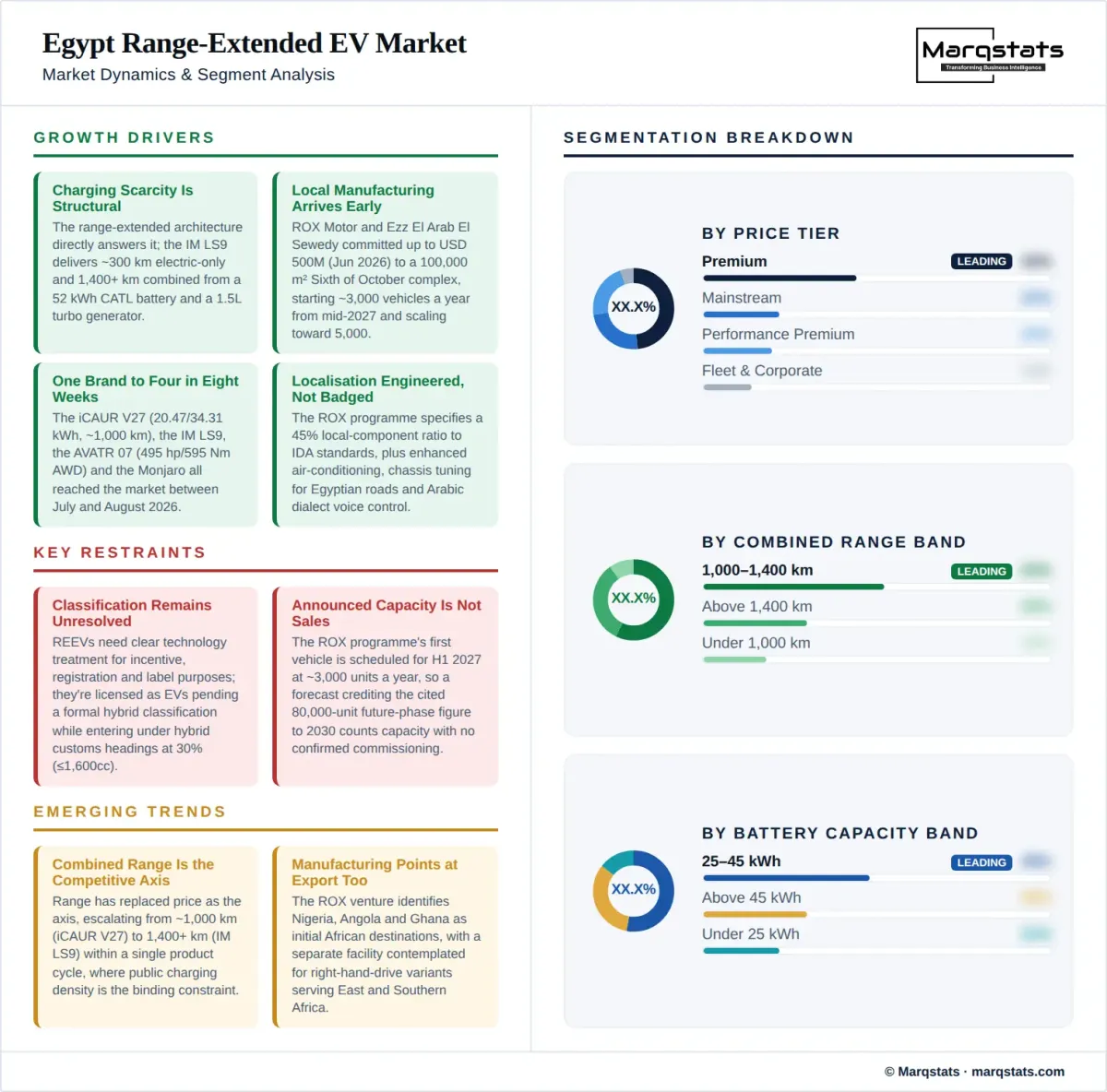
- Charging infrastructure scarcity is the structural driver, and the range-extended architecture is the direct answer to it, with the IM LS9 delivering roughly 300 kilometres of electric-only driving and more than 1,400 kilometres combined from a 52 kWh CATL battery and a 1.5-litre turbo generator.
- Local manufacturing arrives unusually early in the category's life, with ROX Motor and Ezz El Arab El Sewedy committing up to USD 500 million in June 2026 to a venture at a 100,000 square metre complex in the Sixth of October industrial district, starting near 3,000 vehicles annually and scaling toward 5,000 within three years.
- Supply breadth expanded from one brand to four within eight weeks, with the iCAUR V27 offering 20.47 kWh and 34.31 kWh battery options and about 1,000 kilometres combined range, and the AVATR 07 producing 495 horsepower and 595 Newton metres in all-wheel-drive form.
- Distribution is being handled by established Egyptian groups rather than by new importers, with GB Auto carrying iCAUR, Mansour Motors carrying IM Motors, Kasrawi Group carrying AVATR and Ezz El Arab El Sewedy taking both the ROX manufacturing venture and Chery's OMODA and JAECOO brands.
- Localisation is being engineered rather than badged, with the ROX programme specifying a 45% local component ratio aligned to Industrial Development Authority standards alongside enhanced air conditioning, chassis tuning for Egyptian road conditions and Arabic dialect voice control.
Key Restraints
- Classification remains unresolved, since range-extended models require clear technology treatment for incentive, registration and efficiency-label purposes and have been licensed in the electric vehicle category pending a formal hybrid classification, while entering under hybrid customs headings at 30% duty for generators of 1,600cc and below.
- Announced manufacturing capacity is not sales, and the ROX programme's first vehicle is scheduled for the first half of 2027 at roughly 3,000 units annually, so any forecast crediting the 80,000-unit figure cited for future phases to the 2030 horizon is counting capacity that has no confirmed commissioning date.
- Residual values and battery warranty performance are unproven for an architecture no Egyptian cohort has yet run to fleet age, and the earliest measurable volume dates only to 2025, so no vehicle in the category has completed a typical three to five year ownership cycle.
- Consumer understanding of the architecture is itself a constraint, since a buyer comparing a range extender against a plug-in hybrid on a specification sheet sees two similar battery and engine combinations without seeing that only one drives the wheels electrically at all times.
Key Trends
- Combined range has become the competitive axis in place of price, escalating from about 1,000 kilometres on the iCAUR V27 to more than 1,400 on the IM LS9 within a single product cycle, in a market where public charging density is the binding constraint.
- The premium and performance end formed first, with the AVATR 07 at 495 horsepower and the IM LS9 in the six-seat premium class arriving before any mainstream-priced dedicated range extender, inverting the sequence most emerging electrified markets follow.
- Manufacturing intent is pointing at export as much as at domestic demand, with the ROX venture identifying Nigeria, Angola and Ghana as initial African destinations and a separate facility contemplated for right-hand-drive variants serving East and Southern Africa.
- Every dedicated range extender launched in Egypt during 2026 uses a 1.5-litre generator, which places it below the 1,600cc customs threshold where duty rises from 30% to 100%, making the architecture a tariff design decision as much as an engineering one.
Market Segmentation
The premium band and the one delivering meaningful electric-only range, defined in Egypt by the IM LS9 with its 52 kWh CATL Freevoy pack supporting roughly 300 kilometres of electric driving. Larger packs raise landed cost sharply and are viable only at transaction values near the USD 48,000 average that characterised the 2025 mix, which is why the band leads on value while carrying modest volume.
The band where the category is consolidating, covering the AVATR 07 with its 39.05 kWh LFP pack supporting 120 kW DC charging and the larger 34.31 kWh option on the iCAUR V27. It balances usable electric range against pack cost, and as average transaction values fall toward USD 36,000 by 2030 this band absorbs most of the mix moving down from the premium tier.
The entry band, represented by the 20.47 kWh option on the iCAUR V27, where the generator carries proportionally more of the driving burden and the vehicle behaves closer to a series hybrid than to an electric car. It is the band most likely to expand as locally produced volume arrives from 2027 at price points below the roughly USD 48,000 average of the imported premium cohort.
The long-range tier created by the IM LS9 in July 2026, pairing a 52 kWh battery with a 1.5-litre turbo generator for more than 1,400 kilometres combined. The band exists because Egyptian intercity distances and charging scarcity make total range a purchase criterion in a way that is unusual in markets with dense charging networks.
The volume tier and the one most nameplates target, anchored by the iCAUR V27 at roughly 1,000 kilometres combined. The band covers the Cairo to Alexandria return journey and most Delta and Canal Zone intercity patterns without refuelling, which is the specific use case marketing in this category addresses.
The smallest band and a shrinking one, since a range extender offering less than about 1,000 kilometres combined forfeits the argument that distinguishes it from a plug-in hybrid at similar cost. Competitive escalation from 1,000 toward 1,400 kilometres within a single product cycle indicates manufacturers reached the same conclusion.
The narrowest tier by volume and the highest by transaction value, defined by the AVATR 07 at 495 horsepower and 595 Newton metres in all-wheel-drive configuration with 120 kW DC charging from 30% to 80% in about fifteen minutes. Its presence at the category's formation is what pushed the 2025 and 2026 average transaction value toward USD 48,000.
The tier carrying most 2026 volume, spanning the IM LS9 in the six-seat class and the higher iCAUR V27 variants. It is where the imported cohort concentrates and where the roughly 44.4% share of Egypt's electrified market that range extenders reach by 2030 is initially won, before mainstream pricing arrives.
The tier that barely exists in 2026 and carries the forecast, since average transaction value falls from about USD 48,000 to USD 36,000 by 2030 and that decline requires mainstream-priced volume. Locally produced ROX models from the first half of 2027, starting near 3,000 units annually, are the most visible route into this tier.
A tier defined by usage rather than by price, and the one where the architecture's economics are strongest. High-mileage corporate and intercity users capture the fuel-cost advantage of electric drive across the roughly 300 kilometres of electric range the IM LS9 offers while retaining more than 1,400 kilometres of combined range for unplanned duty. The tier is small in 2026 against total category volume near 2,000 units but is the most defensible source of repeat volume once residual values are established.
The whole market through 2026 and the majority of it through the forecast period, covering every nameplate launched between July and August 2026. Imported range extenders enter under hybrid customs headings at 30% duty for generators of 1,600cc and below rather than at the 0% applying to pure battery electric vehicles, a differential that sets the floor under imported pricing.
A route that does not yet exist and begins in the first half of 2027, with the ROX venture at Ezz El Arab El Sewedy's 100,000 square metre Sixth of October complex starting near 3,000 vehicles annually and scaling toward 5,000 within three years against a 45% local component ratio. Local production removes the 30% import duty from the cost stack, which is the mechanism by which mainstream pricing becomes possible.
By Geography
Greater Cairo
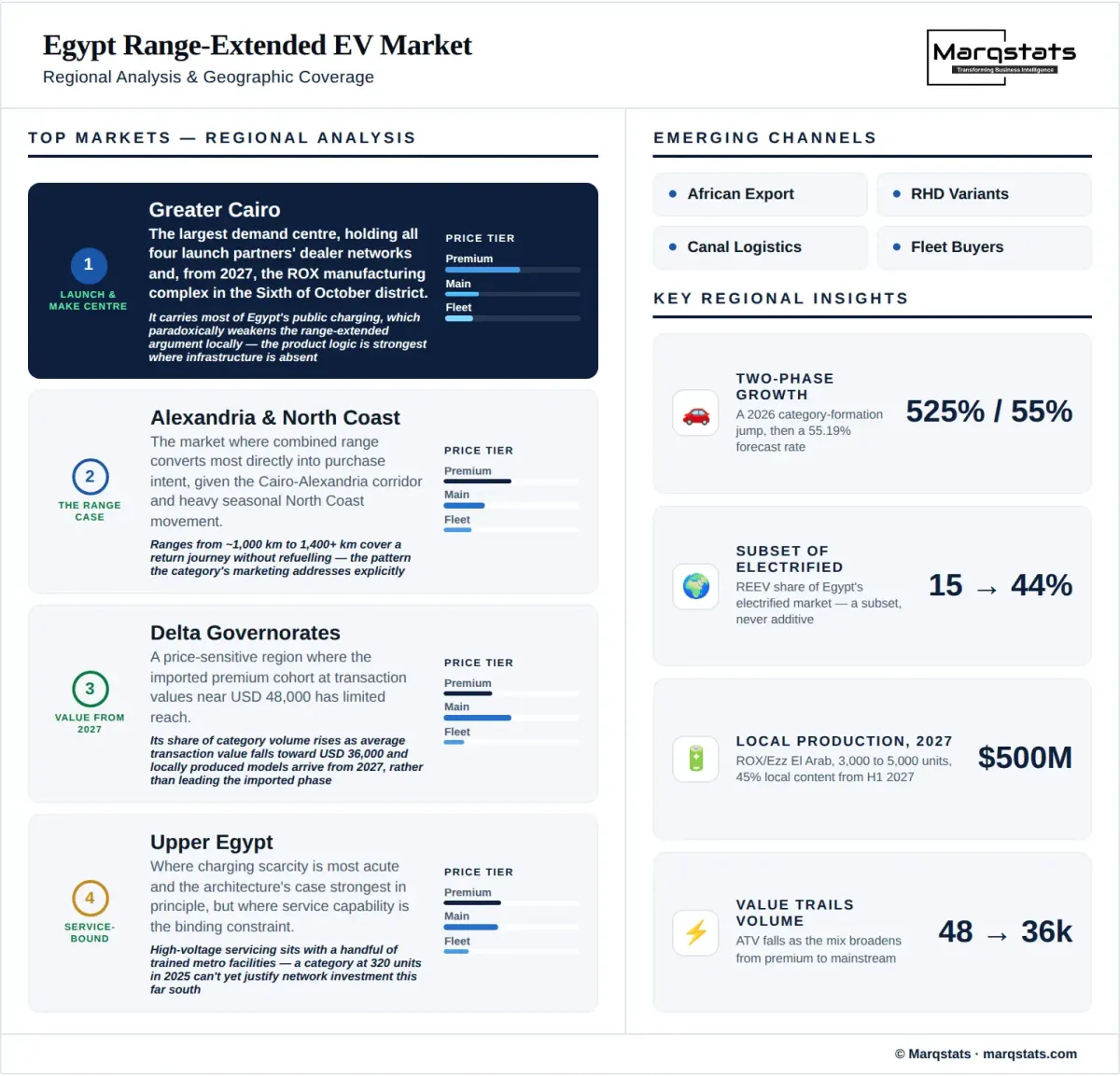
The largest demand centre, holding the dealer networks of all four launch partners and, from 2027, the ROX manufacturing complex in the Sixth of October industrial district. It also carries most of Egypt's public charging capacity, which weakens rather than strengthens the range-extended argument locally: the category's product logic is strongest where the capital's infrastructure is absent.
Alexandria and the North Coast
The market where combined range converts most directly into purchase intent, given the Cairo to Alexandria corridor and heavy seasonal North Coast movement. Ranges from about 1,000 kilometres on the iCAUR V27 to more than 1,400 on the IM LS9 cover a return journey without refuelling, and marketing in the category addresses this pattern explicitly.
Delta Governorates
A price-sensitive region where the imported premium cohort at transaction values near USD 48,000 has limited reach. Its share of category volume rises through the forecast period as average transaction value falls toward USD 36,000 and locally produced models arrive from 2027, rather than leading adoption in the imported phase.
Upper Egypt
The region where charging scarcity is most acute and the architecture's case strongest in principle, but where service capability is the binding constraint. High-voltage battery and power-electronics servicing sits with a handful of trained facilities concentrated in the metropolitan centres, and a category running at 320 units in 2025 cannot yet justify network investment this far south.
Canal Zone and Red Sea
A smaller demand centre with distinctive supply economics given free-zone proximity, and one whose relevance shifts once local production begins in 2027, since the ROX venture identifies Nigeria, Angola and Ghana as initial African export destinations and canal logistics serve that trade rather than domestic delivery.
How Competition Is Evolving
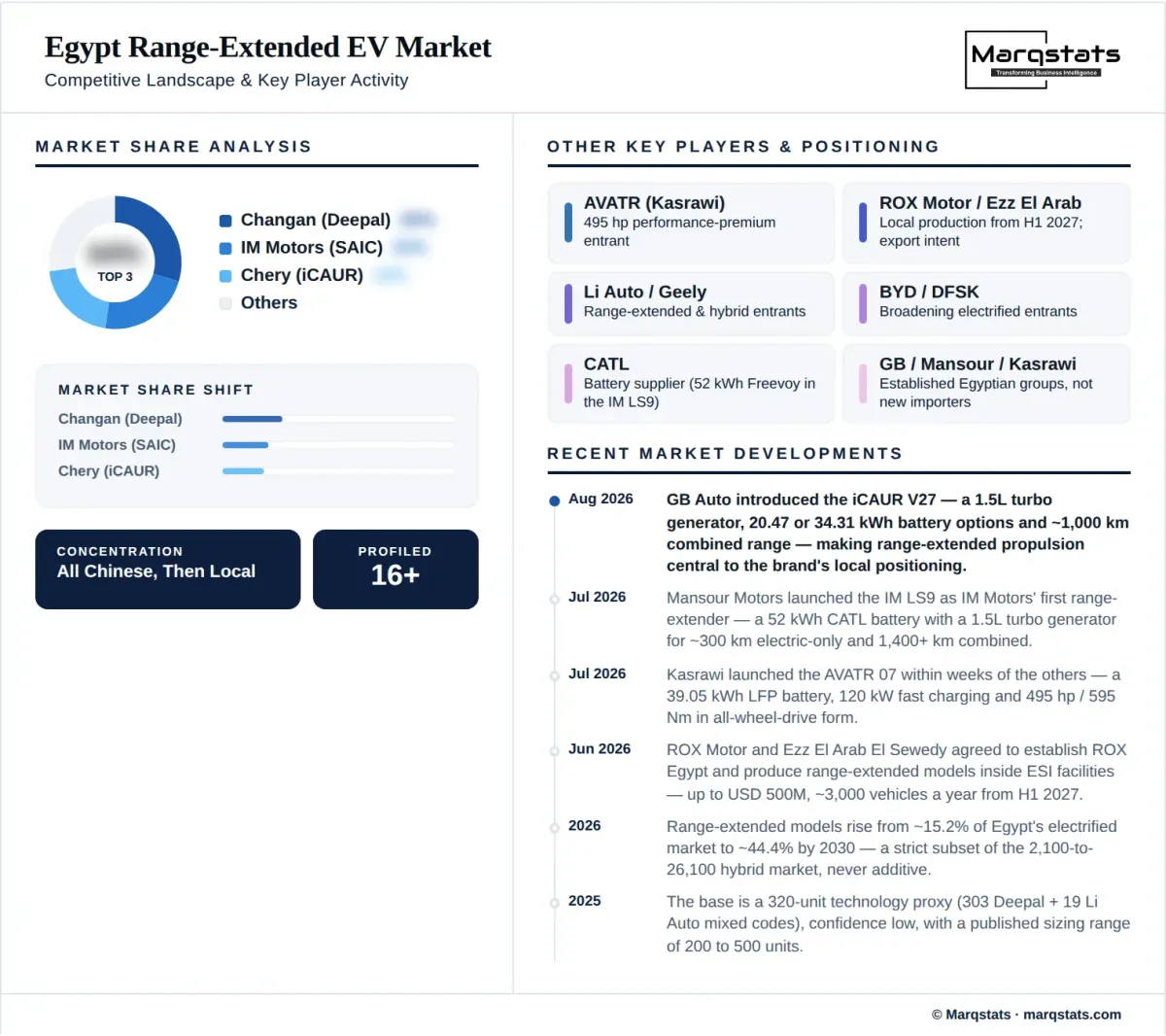
Competition in this category is between four brands that did not sell a vehicle in Egypt eighteen months ago, mediated by Egyptian groups that have sold vehicles for decades. Chery's iCAUR reaches buyers through GB Auto, IM Motors through Mansour Motors, AVATR through Kasrawi Group, and ROX through Ezz El Arab El Sewedy, which is simultaneously building the manufacturing venture and distributing Chery's OMODA and JAECOO brands. Changan's Deepal, the only nameplate with measurable 2025 volume at roughly 303 units under mixed coding, provides the early-adopter baseline against which the 2026 cohort is measured.
The competitive axis is combined range and battery capacity rather than price, which is unusual for a category at this stage and follows from the infrastructure position. Battery packs across the launch cohort span 20.47 kWh to 52 kWh, combined ranges run from about 1,000 kilometres to more than 1,400, and charging capability differentiates further with the AVATR 07 supporting 120 kW direct current charging from 30% to 80% in roughly fifteen minutes. No participant has yet competed on transaction value, and the forecast decline from about USD 48,000 to USD 36,000 assumes that changes.
Local manufacturing is the variable most likely to reorder the field, and its timing is known rather than speculative. The ROX and Ezz El Arab El Sewedy venture, capitalised at up to USD 500 million through a structure combining Chinese-origin range-extended technology with an Abu Dhabi-headquartered investment entity and Egyptian manufacturing capacity, targets a first vehicle in the first half of 2027 at roughly 3,000 units annually rising toward 5,000 within three years. That removes a 30% import duty from one participant's cost stack while the rest remain exposed to it, and it does so in a category whose total 2026 volume is estimated at 2,000 vehicles. Announced future-phase figures above 80,000 vehicles carry no commissioning date and are treated as capacity intent rather than as forecast supply.
The question a client should actually test is whether local production arrives fast enough to matter to the 2030 figure. The ROX venture targets roughly 3,000 vehicles annually from the first half of 2027 and about 5,000 within three years, against a forecast category total of 11,600 units in 2030. Even delivered on schedule and sold entirely domestically, that is under half the market, and the venture has identified Nigeria, Angola and Ghana as export destinations, which means a share of that capacity leaves Egypt. The practical consequence is that imported supply at 30% duty still sets the price for most of the category through 2030, and the transaction value decline from about USD 48,000 to USD 36,000 depends more on the imported mix broadening than on local production displacing it.
Companies Covered
The report profiles 16+ companies with full strategy and financials analysis, including:
Recent Market Activity
Table of Contents
Coverage & Segmentation
The study covers passenger vehicles in which electric motors provide propulsion and an internal combustion engine functions principally as a generator, across the 2021 to 2025 historical period and the 2026 to 2030 forecast period, with 2025 as the base year and an indicative 2031 endpoint. Conventional hybrids and standard parallel plug-in hybrids are excluded. This market is a strict subset of the Egypt hybrid and range-extended vehicle market, representing roughly 15.2% of it in 2025 and about 44.4% by 2030, so the two measures overlap entirely rather than summing.
Sizing is model-driven rather than top-down, because aggregate estimates are too fragile at this stage to carry a forecast alone. The 2025 base of 320 units is a technology proxy assembled from 209 Deepal S05 units, 94 Deepal S07 units and 19 Li Auto units, all carrying mixed powertrain codes that cannot establish range-extended architecture for every vehicle. Confidence is graded low and the sizing range is published rather than implied: 200 to 500 units for 2025, 1,400 to 2,800 for 2026 and 12,000 to 25,000 for 2031. Announced local manufacturing capacity is treated as a supply signal and is not credited to volume before confirmed start of production and delivery.