Market Snapshot
Middle bar: base-year value × (1 + CAGR), rounded to two decimals. This is a calculated illustration, not a separately researched annual estimate.
The global electrified trailer market size is estimated at USD 125.38 million in 2025 and is projected to reach USD 1,727.00 million by 2030, growing at a CAGR of 68.97% over 2026 – 2030. Annual deliveries of electrified trailer powertrains rise from about 3,850 to 44,000, a 62.78% annual rate, as EU CO2 targets for trailers, low-emission zones and fuel savings push fleets from passive trailers to trailers with their own electric axles and batteries.
Marqstats defines the market as the value of the electrified powertrain fitted to semi-trailers and trailers: generator or electric drive axles, high-voltage battery packs with their enclosures and thermal management, inverters and power electronics, and the control units and sensors, such as load-sensing kingpins, that manage how the trailer recovers energy or helps push the vehicle. The trailer body and chassis, conventional axles, aerodynamic devices and the refrigeration unit itself are excluded. Generator-axle systems that power refrigeration units are also counted as part of complete systems in the Marqstats electric transport refrigeration unit study, so the two markets measure different layers and should not be added together.
Energy recovery systems that power trailer refrigeration account for an estimated 80.06% of 2025 value and refrigerated trailers for 83.35%. Europe accounts for 62.00% of 2025 value and North America for 28.00%. The study segments the market by architecture, trailer body type, sales channel and region.
Key Takeaways
Market Overview & Analysis
Report Summary
Marqstats sizes the electrified trailer market as the value of the electric powertrain fitted to semi-trailers and trailers. For more than a century, trailers have been passive: they carry the load and add weight and drag, but have no power of their own. Electrified trailers add an electric machine in the axle, a battery and power electronics, so the trailer can recover energy when the vehicle slows and either use it to run equipment on the trailer or help drive the vehicle forward. In 2025 the market was worth an estimated USD 125.38 million from about 3,850 systems.
Two designs are used. Energy recovery systems fit a generator into the trailer axle. The generator turns braking and coasting energy into electricity, which charges a lithium iron phosphate battery of about 30 to 45 kWh and powers an all-electric refrigeration unit. These systems never drive the wheels, which keeps approval simple. Propulsion-assist systems fit electric motors with 150 to 295 kW of power to the axle and carry batteries of 150 kWh to more than 300 kWh, and in some designs much more. They help the tractor accelerate and climb hills, recover energy when braking, and turn a diesel tractor and trailer into a hybrid combination or extend the range of a battery-electric tractor.
Propulsion-assist trailers need sensors that measure the pushing and pulling force between tractor and trailer, usually in the kingpin or drawbar. The control unit uses this measurement to add drive force only when the tractor is accelerating or climbing, and never to push the tractor, which could destabilise the combination. UNECE regulators are amending UN Regulation No. 13 braking rules to cover trailers with their own electric drive, with draft provisions that limit trailer drive force above low speeds and cut the drive whenever the brakes are applied or the tractor's stability control intervenes.
The market sits within a much larger trailer industry. About 1.05 million semi-trailers are built worldwide each year, worth about USD 34.50 billion, and about 310,000 of these are refrigerated trailers and regional distribution trailers with the high energy use or frequent braking that make electrification attractive. Electrified powertrains were fitted to only about 1.2% of these trailers in 2025.
The market grew from about USD 2.20 million and 45 systems in 2021, mostly prototypes and pilots, to USD 8.45 million in 2022, USD 27.55 million in 2023 and USD 66.60 million in 2024, as BPW began series production of its ePower generator axle in October 2023 and Schmitz Cargobull, SAF-HOLLAND and Thermo King brought generator-axle refrigerated trailers to market. Marqstats expects USD 215.00 million in 2026 from about 6,500 systems.
Fleet economics depend on the route. Urban grocery and multi-drop routes with more than 15 stops an hour recover the most braking energy and can cut the combined fuel use of tractor and refrigeration unit by 35% to 50%. Regional routes with frequent slowdowns and hills cut diesel use by 22% to 35%. Long-haul motorway routes with little braking cut diesel use by 12% to 20% and depend on charging the trailer battery from the grid. Electric braking also cuts brake pad and disc wear by more than half, and electric refrigeration removes diesel engine servicing and allows quiet night-time deliveries in cities.
Global Electrified Trailer Market Size and Forecast
The global electrified trailer market grows from USD 125.38 million in 2025 to USD 1,727.00 million in 2030, a CAGR of 68.97%. Marqstats expects USD 215.00 million in 2026, USD 422.40 million in 2027, USD 740.00 million in 2028 and USD 1,123.40 million in 2029, with annual deliveries rising from about 6,500 systems in 2026 to 12,000 in 2027, 20,500 in 2028, 31,000 in 2029 and 44,000 in 2030.
Energy recovery systems lead volume throughout the forecast. Deliveries rise from about 3,650 systems in 2025 to 32,500 in 2030, a 54.85% annual rate, as generator axles become standard equipment on new refrigerated trailers in Europe and North America. Their value grows from USD 100.38 million to USD 715.00 million while the average price falls from about USD 27,500 to USD 22,000 as battery packs are standardised and generator production scales up.
Propulsion-assist systems grow faster from a small base. Deliveries rise from about 200 systems in 2025 to 11,500 in 2030, a 124.87% annual rate, and value from USD 25.00 million to USD 1,012.00 million. The average price falls from about USD 125,000 to USD 88,000 as battery cell prices fall, battery packs are assembled automatically and electric axle production reaches truck industry volumes. Propulsion-assist value overtakes energy recovery value in 2029.
Factory fitting takes a larger share. Systems fitted on the trailer production line account for 78.00% of 2025 value, USD 97.80 million, and grow at 71.90% a year to USD 1,467.95 million and 85.00% of 2030 value, as trailer builders design chassis, battery housings and wiring for electrification from the start. Retrofit kits, such as Carrier Transicold's 38.5 kWh ReCool battery system launched in Europe in July 2026, grow at 56.52% a year to USD 259.05 million.
Marqstats tracks four indicators to monitor the forecast: certified trailer CO2 results under the EU VECTO tool as the 2030 targets approach, the final form of the UN Regulation No. 13 provisions for trailers with electric drive, battery pack prices, and the number of propulsion-assist trailers moving from pilot fleets into series orders. Faster approval of electric drive at motorway speeds or EU weight allowances for zero-emission trailers would push the market above the base path, while delays in depot grid connections would slow propulsion-assist adoption.
Market Dynamics
Key Drivers
Five forces are turning semi-trailers into electrified, energy-managing vehicles.
- EU CO2 targets for trailers. Regulation (EU) 2024/1610 requires trailer manufacturers to cut certified CO2 by 10% for semi-trailers and 7.5% for other trailers, with an excess emissions premium of EUR 4,250 per gram of CO2 per tonne-kilometre for each vehicle from 2030. Electrified axles are the main way to meet these targets.
- Fuel and operating savings. Propulsion-assist trailers can cut tractor fuel use by up to about 40% on suitable routes, and energy recovery systems remove the diesel engine from trailer refrigeration units entirely.
- Low-emission zones and noise rules. City access restrictions for diesel engines and night-time noise limits favour trailers whose refrigeration runs on recovered energy and batteries.
- Range for battery-electric tractors. A propulsion-assist trailer with its own battery can extend the range of a battery-electric tractor to more than 600 km, reducing dependence on public megawatt charging.
- Trailer and axle makers bring products to market. Schmitz Cargobull, KRONE, SAF-HOLLAND, BPW, Thermo King and Carrier Transicold now sell electrified trailers, axles or battery systems, and investors such as the European Investment Bank are financing propulsion-assist developers.
Key Restraints
Four constraints slow the take-up of electrified trailers.
- High purchase price. Energy recovery systems add about USD 27,500 and propulsion-assist systems about USD 125,000 to the price of a trailer in 2025, several times the cost of the trailer's conventional running gear.
- Weight. Propulsion-assist systems add 1,800 to 2,600 kg, reducing payload on heavy freight that reaches the 40-tonne EU or 80,000-pound US weight limit before the trailer is full.
- Approval rules still developing. The UN Regulation No. 13 provisions for trailers that drive their wheels are still being finalised, and draft limits on drive force at higher speeds reduce the savings available on motorway routes.
- Charging and interoperability. Large propulsion-assist batteries need depot charging, and trailers must work with tractors from different makers, which requires standard communication and kingpin-based control that does not depend on the tractor's own data.
Key Trends
Four shifts are changing how electrified trailers are designed, sold and used.
- From refrigeration to propulsion. Electrification is moving from generator axles that power refrigeration units to drive axles that help move the vehicle, opening the much larger dry freight trailer fleet.
- Tractor-independent control. Developers such as Trailer Dynamics and Range Energy use sensors in the trailer kingpin to control drive force, so the trailer can work behind any diesel or electric tractor without access to the tractor's data.
- Partnerships between trailer builders and specialists. KRONE works with Trailer Dynamics, Thermo King with BPW, and Range Energy with ZF, combining trailer manufacturing with electric drive and battery expertise.
- Transferable and second-life batteries. Battery systems such as Carrier Transicold's ReCool can be moved between trailers and later reused for stationary energy storage at warehouses.
Strategic Implications
- For trailer manufacturers, electrification protects margin and meets CO2 targets. Builders that integrate axles, batteries and controls, as Schmitz Cargobull does, can capture more value per trailer, while others need chassis designs that accept powertrains from several suppliers. Sales teams that can show customers how electrified axles improve certified CO2 results will have an advantage as 2030 approaches.
- For axle and suspension suppliers, electric axles are the next product generation. Designs that fit existing suspension arms, ride heights and track widths reduce retooling costs for trailer builders and protect suppliers' share of running gear.
- For drivetrain and battery suppliers, the trailer is a new market for electric axles, inverters and battery packs. Control systems that work with any tractor will be needed for propulsion-assist trailers to move beyond captive fleets.
- For fleet operators, route choice decides returns. Energy recovery suits refrigerated trailers on urban and regional routes, while propulsion-assist trailers pay back fastest on hilly regional routes carrying light, bulky freight that fills the trailer before reaching the weight limit.
- For regulators, approval rules and weight allowances shape adoption. Finalising UN Regulation No. 13 provisions for trailers with electric drive and allowing extra weight for zero-emission trailers would remove two of the main barriers.
Market Segmentation
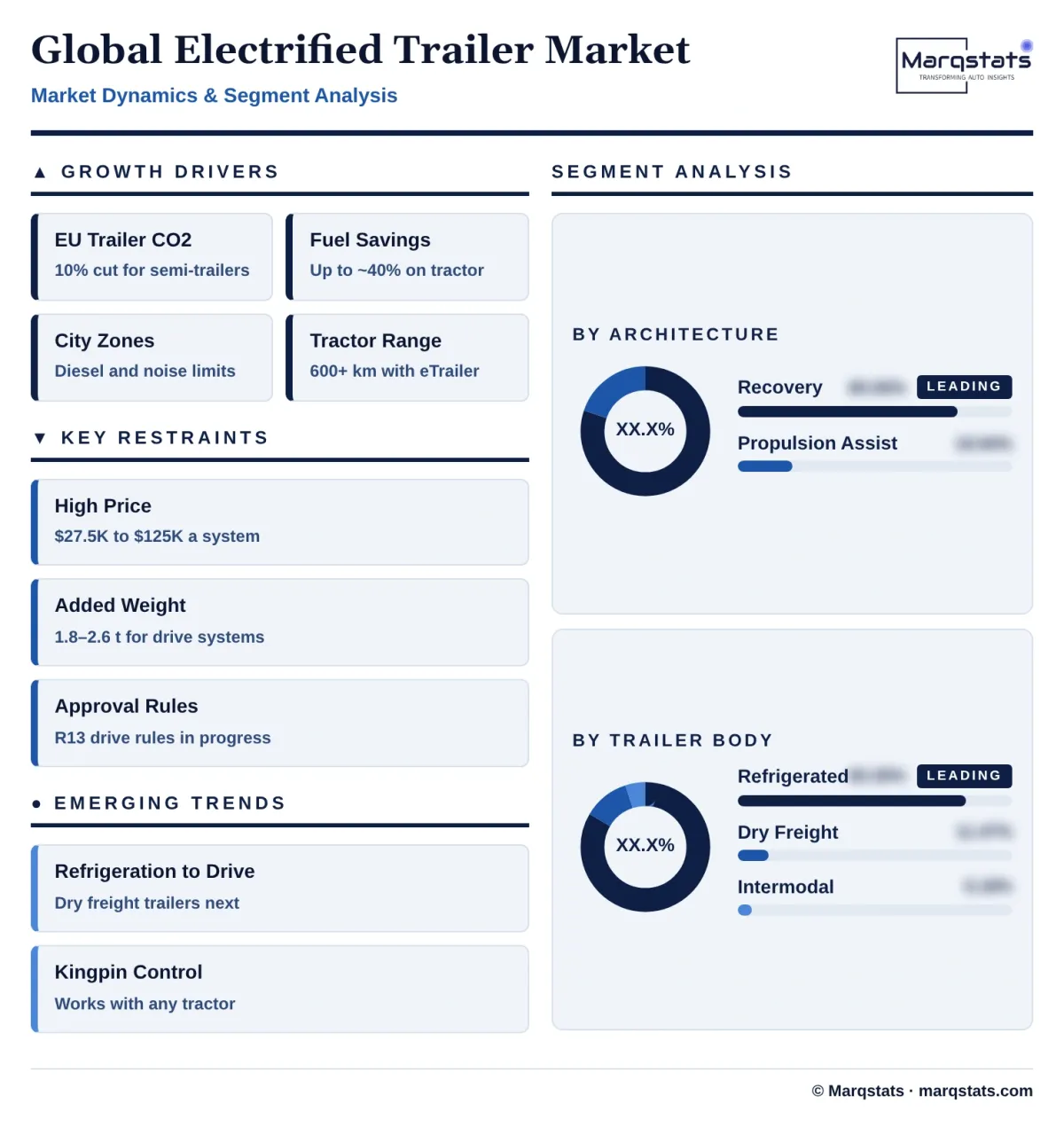
Systems that use a generator axle to recover braking energy and power trailer equipment, mainly refrigeration units, account for 80.06% of 2025 value, USD 100.38 million and about 3,650 systems. Value grows at 48.09% a year to USD 715.00 million, while the share falls to 41.40% by 2030. Generator axles from SAF-HOLLAND, BPW and Schmitz Cargobull, used in systems such as Thermo King AxlePower and the Schmitz Cargobull S.KOe COOL, lead this segment.
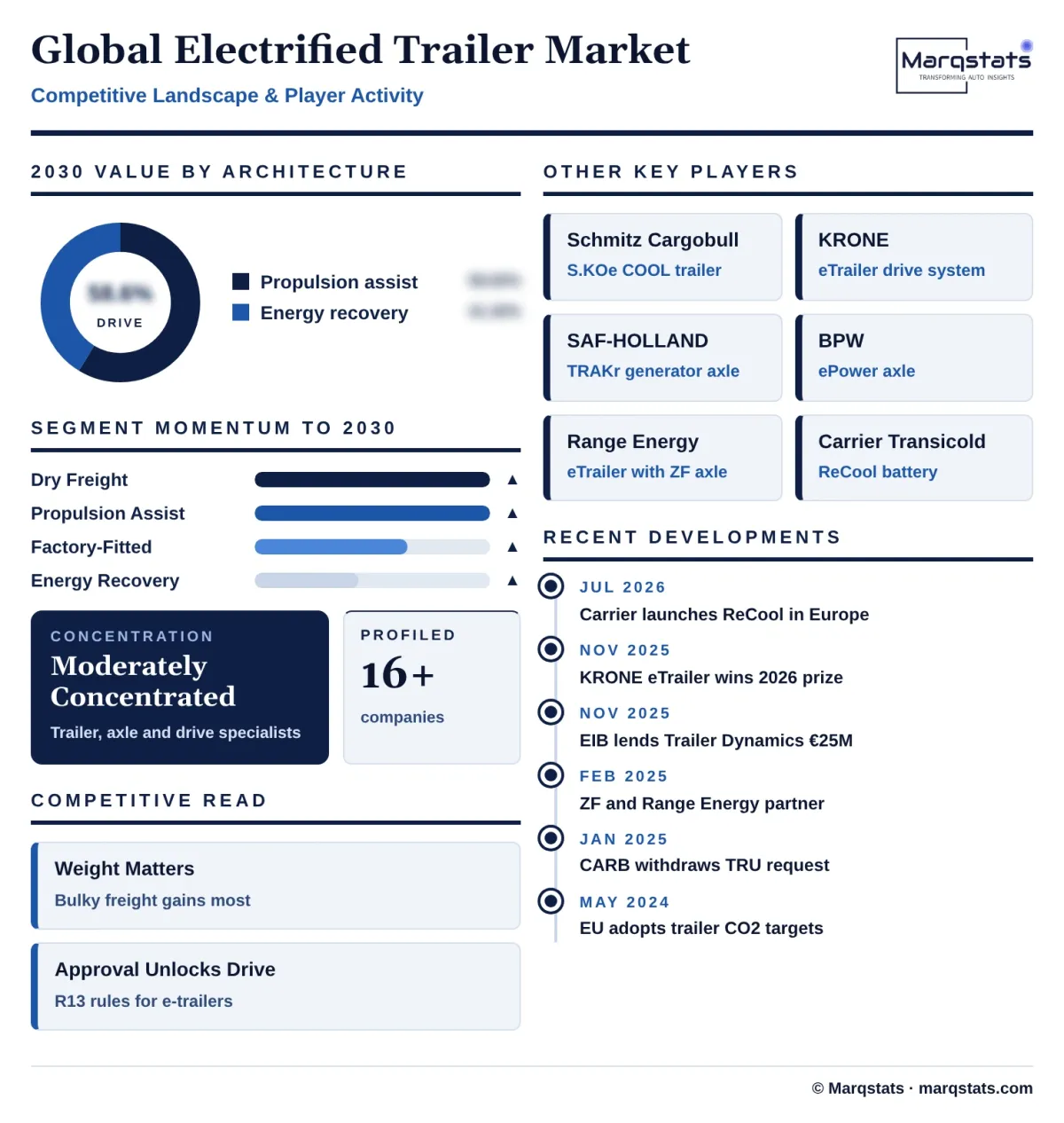
Systems with electric drive axles that help move the vehicle account for 19.94% of 2025 value, USD 25.00 million and about 200 systems, and grow at 109.63% a year to USD 1,012.00 million and 58.60% of the market by 2030, led by the KRONE and Trailer Dynamics eTrailer and the Range Energy eTrailer System with ZF's AxTrax 2 axle.
Refrigerated box trailers account for 83.35% of 2025 value, USD 104.50 million, and grow at 53.76% a year to USD 898.00 million, 52.00% of 2030 value, as generator axles replace diesel engines in trailer refrigeration units.
Dry freight box and curtainsider trailers account for 11.47% of 2025 value, USD 14.38 million, and grow fastest, at 109.99% a year, to USD 587.20 million and 34.00% of 2030 value as propulsion-assist systems reach regional distribution fleets.
Container chassis, tipping trailers and other specialist trailers account for 5.18% of 2025 value, USD 6.50 million, and grow at 106.11% a year to USD 241.80 million, 14.00% of 2030 value, including self-powered tipping trailers that run hydraulic pumps from their own batteries.
Systems fitted on the trailer production line account for 78.00% of 2025 value, USD 97.80 million, and grow at 71.90% a year to USD 1,467.95 million and 85.00% of 2030 value.
Retrofit kits and conversions of existing trailers account for 22.00% of 2025 value, USD 27.58 million, and grow at 56.52% a year to USD 259.05 million, 15.00% of 2030 value, limited by the structural and electrical work needed on older chassis.
By Geography
Europe
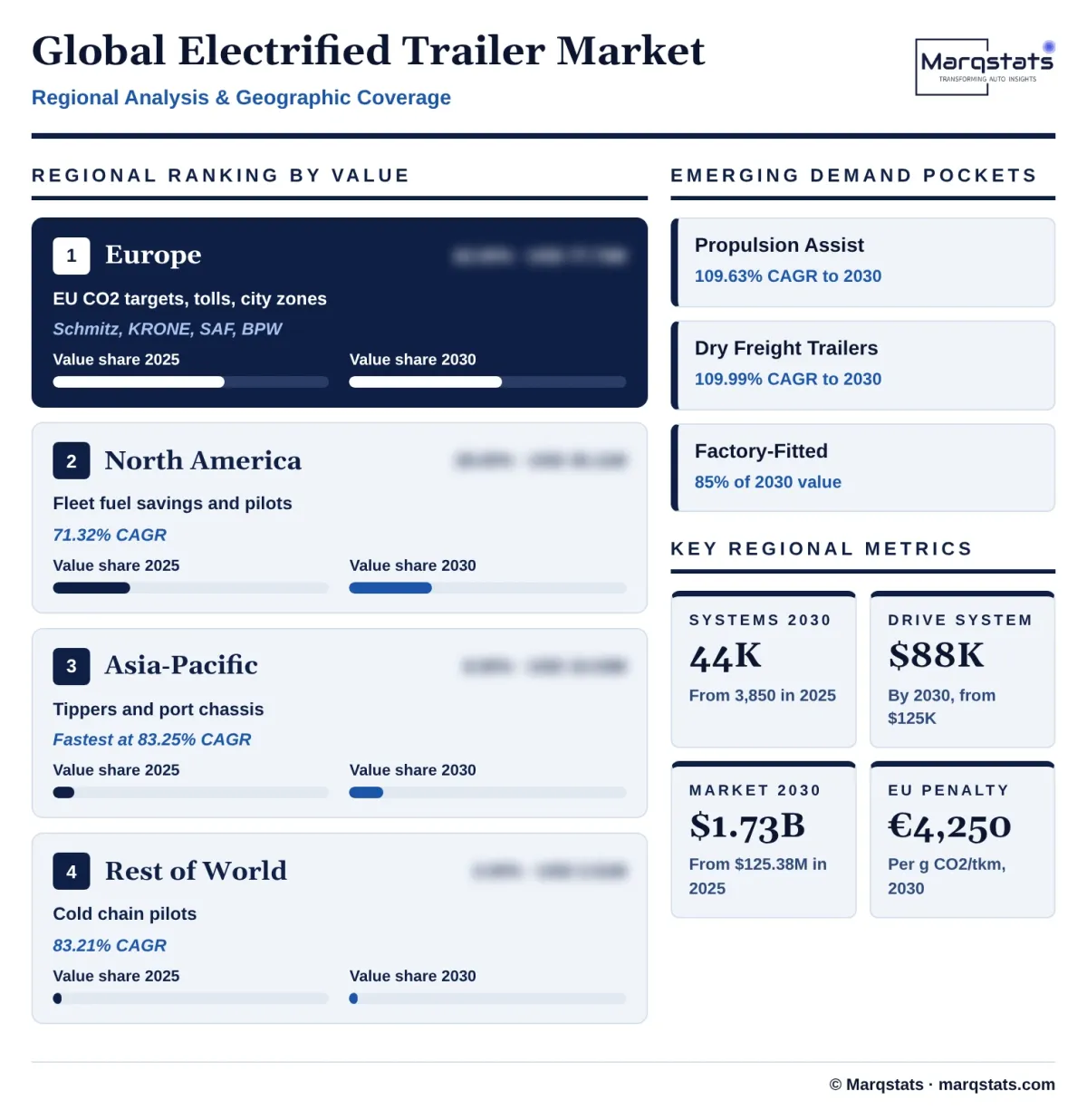
Europe is the largest market, with 62.00% of 2025 value, USD 77.73 million and about 2,450 systems, rising to USD 949.85 million and about 24,640 systems by 2030, a 64.97% CAGR, while its share falls to 55.00%. The EU trailer CO2 targets, distance-based road tolls in Germany, Austria and Switzerland, city low-emission zones and German trailer and axle makers such as Schmitz Cargobull, KRONE, SAF-HOLLAND and BPW drive the market. Schmitz Cargobull sells its S.KOe COOL generator-axle refrigerated trailer in Germany, the UK, Ireland and New Zealand, and Carrier Transicold launched its ReCool battery system across Europe in July 2026.
North America
North America accounts for 28.00% of 2025 value, USD 35.11 million and about 1,020 systems, and grows at 71.32% a year to USD 518.10 million and 30.00% of the market by 2030. Private fleets pursuing emissions targets are testing propulsion-assist trailers, and Range Energy works with ZF on its eTrailer System. California's plan to require zero-emission trailer refrigeration units was put on hold in January 2025 when the California Air Resources Board withdrew its request for federal authorisation, so adoption depends more on fleet economics and corporate targets. Quebec relaunched its Écocamionnage clean trucking rebate programme in December 2025, running to March 2028.
Asia-Pacific
Asia-Pacific accounts for 8.00% of 2025 value, USD 10.03 million and about 320 systems, and grows fastest, at 83.25% a year, to USD 207.24 million and 12.00% of the market by 2030. CIMC Vehicles, the world's largest semi-trailer maker, is developing electrified tipping trailers and container chassis for mining, bulk and port transport, and electric semi-trailers are entering service in New Zealand.
Rest of World
Latin America, the Middle East and Africa account for 2.00% of 2025 value, USD 2.51 million, rising to USD 51.81 million by 2030, an 83.21% CAGR, mainly from refrigerated trailer pilots on cold chain routes.
How Competition Is Evolving
The electrified trailer market is moderately concentrated. European trailer builders and axle makers lead energy recovery systems: Schmitz Cargobull with its S.KOe COOL trailer and S.CUe electric refrigeration unit, SAF-HOLLAND with the TRAKr generator axle, in production since late 2022, and BPW with the ePower axle, in series production since October 2023 as part of Thermo King AxlePower. Carrier Transicold competes with battery systems built on technology from Addvolt, which it acquired in 2025.
Propulsion-assist systems are led by specialist developers working with established partners. Trailer Dynamics develops the eTrailer with KRONE, received a EUR 25 million venture debt loan from the European Investment Bank in November 2025 to scale production, and signed an agreement with DB Schenker in 2022 covering up to 2,000 eTrailers. Range Energy in the United States uses ZF's AxTrax 2 electric axle under a partnership announced in February 2025.
Large trailer builders shape the market's direction. Schmitz Cargobull, Europe's largest trailer maker, reported turnover of about EUR 2.25 billion for 2025/26, and CIMC Vehicles is developing electrified trailers in China and through its LAG brand in Europe.
Competition will be decided by system cost, weight, approval and fleet references. Suppliers that cut battery and axle costs, keep added weight low, secure type approval for drive functions and show measured fuel savings in large fleets will win the most orders.
Companies Covered
Companies covered in the report include:
Recent Market Activity
Table of Contents
Coverage & Segmentation
The study covers the global electrified trailer market, with 2025 as the base year, 2021 – 2025 as the historical period and 2026 – 2030 as the forecast period. Values are in US dollars and volumes are annual deliveries of electrified trailer powertrain systems. The market covers generator and electric drive axles, high-voltage batteries, power electronics and control systems fitted to semi-trailers and trailers, and is segmented by architecture, trailer body type, sales channel and region.
The trailer body and chassis, conventional axles, aerodynamic devices and the refrigeration unit itself are excluded. Generator-axle refrigeration systems are also valued as complete systems in the Marqstats electric transport refrigeration unit study, and the two markets should not be added together. Segment and regional splits are Marqstats estimates built on manufacturer disclosures, regulatory requirements, fleet trial results and system price benchmarks.