Market Snapshot
Key Takeaways
Market Overview & Analysis
Report Summary
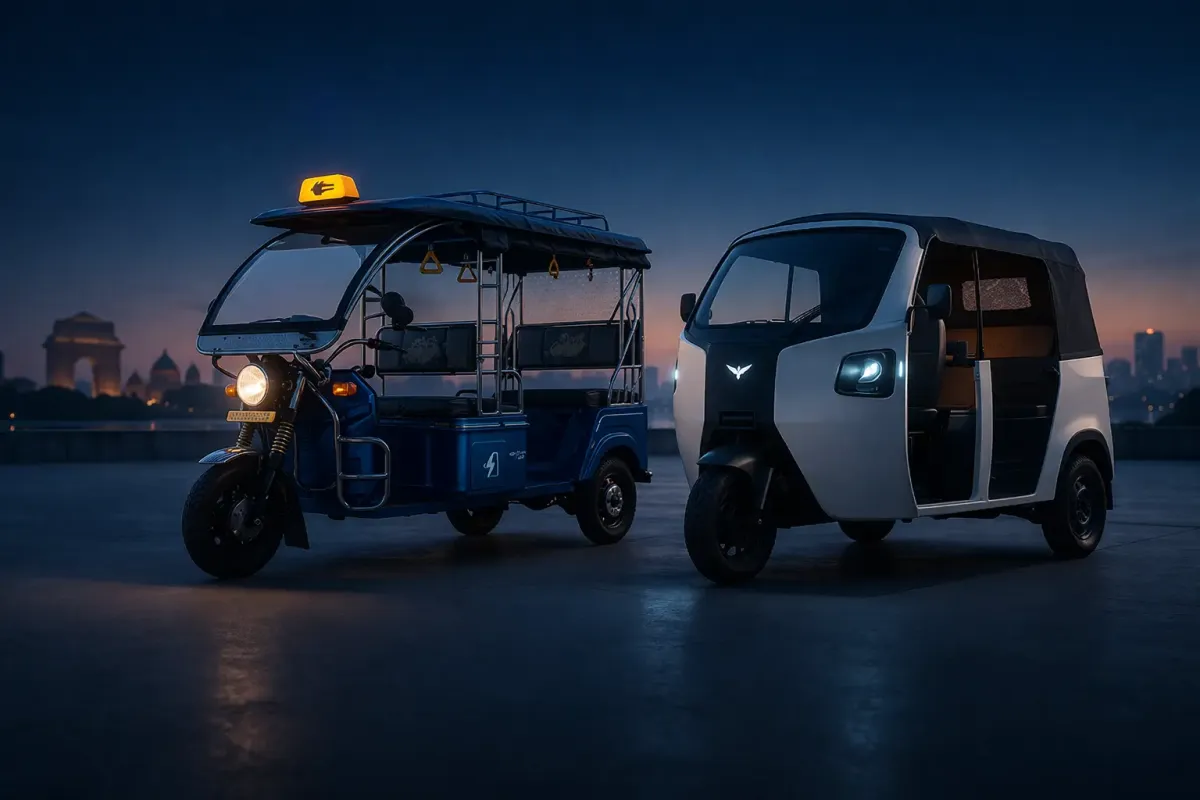
The India two-wheeler and three-wheeler motor market encompasses electric traction motors used in L1, L2, L3, and L5 category vehicles. The market is segmented by motor type, integration topology, vehicle type, power rating, and sales channel. BLDC motors account for approximately 72% of installed units in 2025, supported by cost-efficiency and mechanical simplicity. PMSM units hold the remaining share, concentrated in higher-power applications. The segment is shaped by aggressive localization mandates, rare-earth magnet security concerns, and technological convergence toward integrated e-axle architectures.
India sold over 1.97 million electric vehicles in FY25, including 1.15 million electric two-wheelers and nearly 700,000 electric three-wheelers. Each incremental two-wheeler requires a 2 to 4 kW motor, while three-wheelers demand 5 to 10 kW motors. This volume translates into a predictable procurement pipeline for domestic motor manufacturers. Motor assembly capacity additions by Lucas TVS, Bosch India, Nidec Corporation, Tsuyo Manufacturing, and Valeo India collectively target more than 5 million units annually by 2027.
R&D spending by Indian automotive component makers averages approximately 2% of revenue, compared with 7 to 8% globally. This gap has sustained import dependency for rare-earth magnets, specialized cathode and magnet materials, and complex semiconductor-based motor controllers. The Ministry of Heavy Industries and the Ministry of Electronics and Information Technology have responded with the PLI-Auto scheme (INR 57,942 crore) and the SPECS programme, the latter offering a 25% capital expenditure subsidy for BLDC motor, PCB, and semiconductor localization. For further detail on the three-wheeler vehicle ecosystem, the India Electric Three-Wheeler Market report on Marqstats provides volume and OEM-level data.
Integrated e-axle architectures are emerging as the dominant procurement format for premium two-wheelers, L5 cargo three-wheelers, and commercial buses. The e-axle configuration combines motor, inverter, and reducer into a 3-in-1 assembly, reducing vehicle integration complexity and improving efficiency. The Bosch–Tata Autocomp 50:50 joint venture announced in March 2026, and the Valeo Pune e-axle line commissioned in the same month, exemplify the shift. Rising domestic cell manufacturing capacity, through captive OEM gigafactories, creates upstream pull for locally sourced motors and drivetrains.
Market Dynamics
Key Drivers
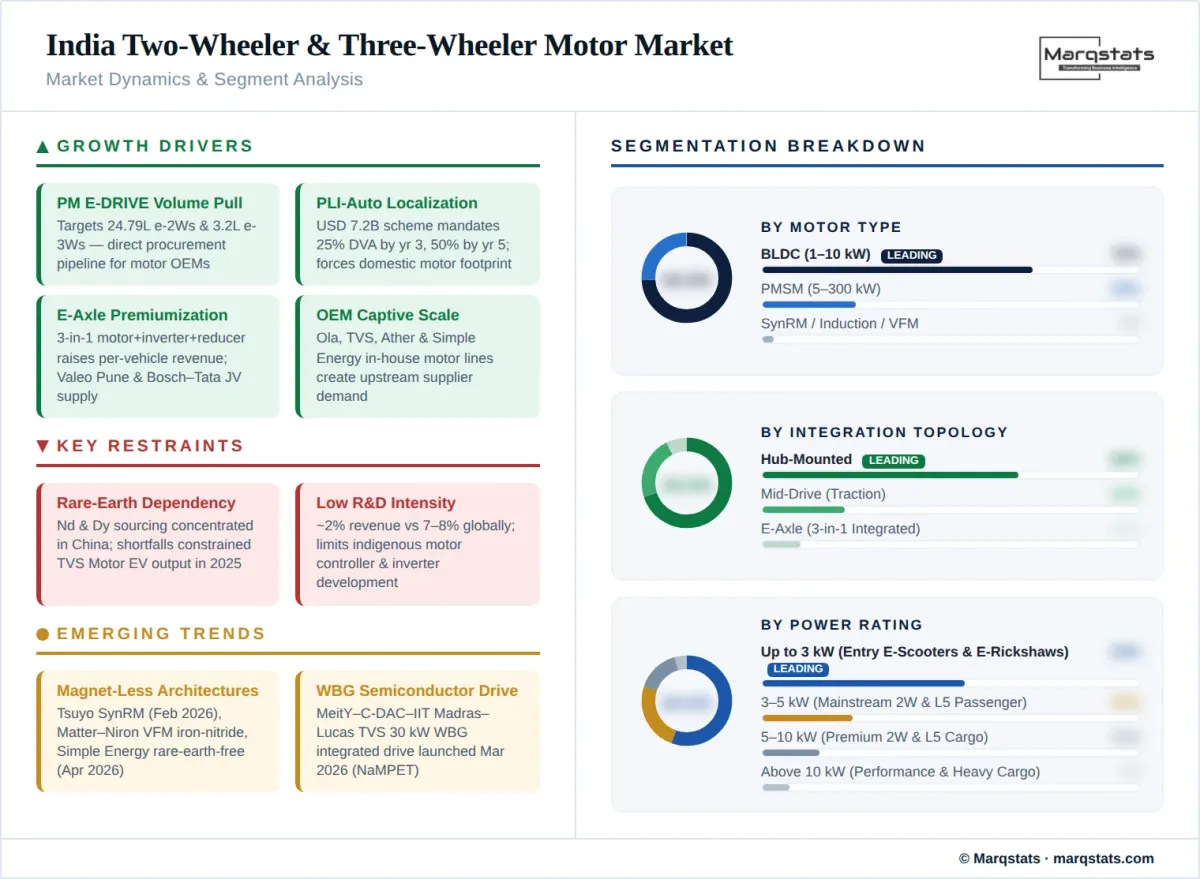
- PM E-DRIVE incentive framework of INR 2,500 per kWh accelerates OEM procurement volumes. The scheme targets 24.79 lakh electric two-wheelers and 3.2 lakh electric three-wheelers, translating directly into motor demand. Post-subsidy economics continue to support L5 cargo three-wheeler adoption.
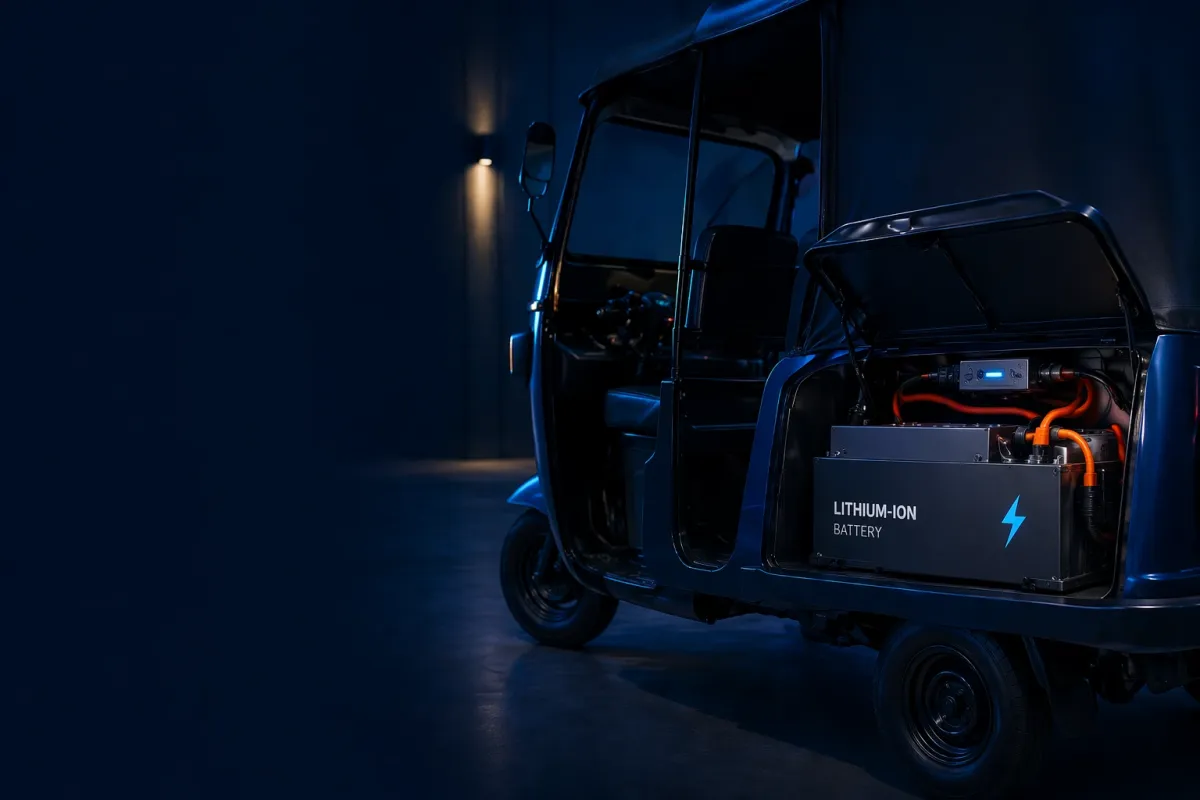
- Declining lithium-ion pack costs, combined with rising fuel prices, have compressed total cost of ownership gaps. Fleet operator conversion rates exceed 40% annually in metro markets, translating into sustained motor procurement volumes for last-mile delivery and passenger transit applications.
- The PLI-Auto scheme allocates approximately USD 7.2 billion for component localization. The programme mandates 25% Domestic Value Addition by year three and 50% by year five, forcing OEMs and Tier-1 suppliers to commit to localized motor manufacturing footprints.
- Rising domestic cell and battery manufacturing capacity creates upstream pull for locally sourced motors. Captive motor demand from vertically integrated OEMs such as Ola Electric, TVS Motor, Simple Energy, and Matter Motor Works supports domestic scale economies and component supplier growth.
- E-axle commercialization for premium two-wheelers and L5 cargo three-wheelers increases per-vehicle motor revenue through integrated 3-in-1 assemblies. The Bosch–Tata Autocomp JV, Valeo Pune line, and ZF Friedrichshafen orders signal rapid e-axle market expansion.
Key Restraints
- Rare-earth magnet import dependency, concentrated in China, exposes Indian motor manufacturers to supply chain disruptions and price volatility. Neodymium and dysprosium sourcing shortfalls constrained TVS Motor EV production during 2025.
- Historically low R&D intensity of approximately 2% of revenue limits indigenous development of high-performance motor controllers, semiconductor-based inverters, and advanced hairpin-winding technologies.
- Semiconductor sourcing for motor controllers remains fragile. Domestic fabrication capacity for microcontrollers, IGBTs, and silicon-carbide inverters is limited, requiring continued import reliance through 2026 to 2027.
- Unorganized aftermarket channels, particularly for lead-acid e-rickshaw replacement motors, sustain price-based competition that erodes margins for organized OEM-tier motor suppliers.
Key Trends
- Magnet-less motor architectures are entering commercial deployment. Tsuyo Manufacturing launched a patented magnet-less Synchronous Reluctance motor for electric three-wheelers in February 2026. Matter Motor Works and Niron Magnetics showcased an iron-nitride Variable Flux Motor prototype at CES 2026.
- Integrated e-axle assemblies are replacing standalone motor sales. Valeo inaugurated a 3-in-1 e-axle line at Pune in March 2026, supplying Mahindra’s Born Electric platform. ZF Friedrichshafen secured multi-year Indian orders for the AxTrax 2 LF electric portal axle.
- Domestic joint ventures are accelerating. Bosch Limited and Tata Autocomp Systems announced a 50:50 JV in March 2026 for e-axle and electric traction motor manufacturing. Minda Corporation and Turntide Drives (UK) formed a 49:51 JV in March 2026 for axial flux motors and high-voltage motor controllers.
- Wide Band Gap (WBG) semiconductor integration is advancing. The Ministry of Electronics and Information Technology, in collaboration with C-DAC Thiruvananthapuram, IIT Madras, and Lucas TVS, launched a 30 kW WBG-based integrated drive system in March 2026 under the NaMPET programme.
Market Segmentation
BLDC motors dominate the low-to-medium power spectrum for electric two-wheelers and standard three-wheelers. The segment accounted for approximately 72% of installed motor units in 2025. Typical power ratings range from 1 kW to 10 kW. BLDC motors offer cost-efficiency, mechanical simplicity, and high durability. Maintenance requirements are drastically reduced owing to the absence of physical brushes. BLDC is the default selection for passenger e-rickshaws, entry-level e-scooters, and commercial delivery fleets. Lucas TVS, Nidec Corporation, Bosch India, and Ola Electric represent the primary BLDC suppliers.
PMSM architectures serve high-power applications including L5 cargo three-wheelers, premium e-scooters, and commercial electric buses. Typical power ratings range from 5 kW to 300 kW. PMSM offers superior power density, better torque delivery at low speeds, and enhanced efficiency through sinusoidal commutation. The architecture requires sophisticated motor controllers and depends on rare-earth magnets. PMSM deployment is expected to expand at 28% CAGR through 2030, supported by premium vehicle volume growth and e-bus fleet electrification.
Magnet-less motor architectures represent an emerging category. Synchronous Reluctance (SynRM) motors, which eliminate rare-earth magnet dependency, entered commercial deployment in February 2026 with Tsuyo Manufacturing’s launch for electric three-wheelers. Variable Flux Motors using iron-nitride magnets offer an additional rare-earth-free pathway. Simple Energy became the first Indian OEM to commercially produce heavy, rare-earth-free motors in April 2026, offering a lifetime motor warranty. Greaves Cotton allocated a portion of its INR 5–7 billion capital plan for rare-earth-free motor development.
AC induction motors serve limited niche applications in commercial vehicles. The architecture is free from rare-earth dependency, however offers lower efficiency compared with PMSM at equivalent power ratings. Induction motor deployment in electric two-wheelers and three-wheelers remains below 3% of market share and is concentrated in experimental L5 cargo platforms.
Hub motors integrate directly into the wheel hub, eliminating mechanical transmission requirements. The segment holds approximately 68% share in 2025. Hub motors are inexpensive, simple to mount, and free chassis space for larger battery packs. Unsprung mass penalties restrict deployment to low-speed e-rickshaws (below 25 km/h) and budget commuter e-scooters. Lucas TVS and several regional BLDC specialists operate the widest hub motor product lines.
Mid-drive motors mount centrally within the vehicle frame and connect through a secondary transmission or chain drive. The configuration removes unsprung mass penalties and supports central weight distribution. Mid-drive motors are increasingly demanded by premium two-wheeler OEMs and performance L5 cargo manufacturers. Ola Electric deployed an 11 kW mid-drive motor in its S1 X+ scooter launched in April 2026. Kerb weight advantages, torque delivery at low speeds, and superior gradient-climbing capability support extended vehicle range.
E-axle configurations combine motor, inverter, and reducer into integrated 3-in-1 assemblies. The segment is the fastest-growing topology, advancing at 38% CAGR through 2030. Valeo India commissioned a 3-in-1 e-axle line at Pune in March 2026 for Mahindra’s Born Electric platform, featuring automated U-Pin hairpin stator winding and full digitalization. ZF Friedrichshafen’s AxTrax 2 LF secured multi-year Indian city-bus orders delivering up to 360 kW continuous power. The Bosch–Tata Autocomp JV announced in March 2026 targets e-axle production for commercial platforms.
Electric two-wheelers account for approximately 58% of the two-wheeler and three-wheeler motor market in 2025. Typical motor power ratings range from 1 kW to 11 kW. The segment is characterized by high volume and moderate unit value. OEM deployments include the Ola Electric S1 X+ (11 kW mid-drive with integrated MCU), Yamaha EC-06 (6.7 kW IPMSM), Royal Enfield Flying Flea C6 (15.4 kW peak), TVS Orbiter V1 (1.8 kWh pack, mid-drive), and Suzuki e-ACCESS (4.1 kW motor).
L3 passenger three-wheelers dominate unit volume within the three-wheeler motor segment. Typical motor power ratings range from 2 kW to 4 kW. BLDC hub motor configurations serve the vast majority of the installed base. Unorganized aftermarket channels supply significant replacement motor volumes. Segment growth is tempered by the mature installed base and the post-subsidy transition for e-rickshaws through March 2028.
L5 passenger three-wheelers integrate motors with 5 to 10 kW ratings. Mahindra UDO, launched in February 2026, uses a 10 kW peak PMS motor delivering 52 Nm torque. The segment is characterized by higher unit pricing and commercial shared-mobility fleet usage. Bajaj RE Electric and Piaggio Ape Electric compete with Mahindra in this segment.
L5 cargo three-wheelers require 6 to 10 kW motor ratings. The segment grew through PM E-DRIVE subsidy support, with 2,85,931 registrations logged by December 2025 before the L5 subsidy fund exhausted in the same month. Post-subsidy economics continue to support volume growth. Automated Manual Transmission (AMT) integration, launched by Tsuyo Manufacturing in February 2026, improves load capacity and gradeability, allowing lower-power motors to serve more demanding duty cycles.
The up-to-3 kW segment serves entry-level e-scooters and passenger e-rickshaws. The segment accounts for approximately 54% of motor unit volume in 2025. BLDC hub motor architecture dominates. Cost-efficiency and ease of aftermarket replacement sustain this segment through 2030.
The 3 to 5 kW segment serves mainstream electric two-wheelers and L5 passenger three-wheelers. Mid-drive and hub configurations compete on price and efficiency. The segment is advancing at 25% CAGR through 2030, supported by premium two-wheeler adoption.
The 5 to 10 kW segment serves premium two-wheelers, L5 passenger three-wheelers, and L5 cargo three-wheelers. Royal Enfield, Ola Electric, and Mahindra Last Mile Mobility represent key OEM customers. PMSM architectures gain share in this band owing to torque and efficiency advantages.
The above-10 kW segment serves performance two-wheelers and heavy L5 cargo vehicles. Ultraviolette, Ather Energy, Simple Energy, and Royal Enfield Flying Flea operate in this band. Motor power densities and thermal management complexity are significantly higher, requiring liquid cooling and advanced motor controllers.
By Geography
Northern India
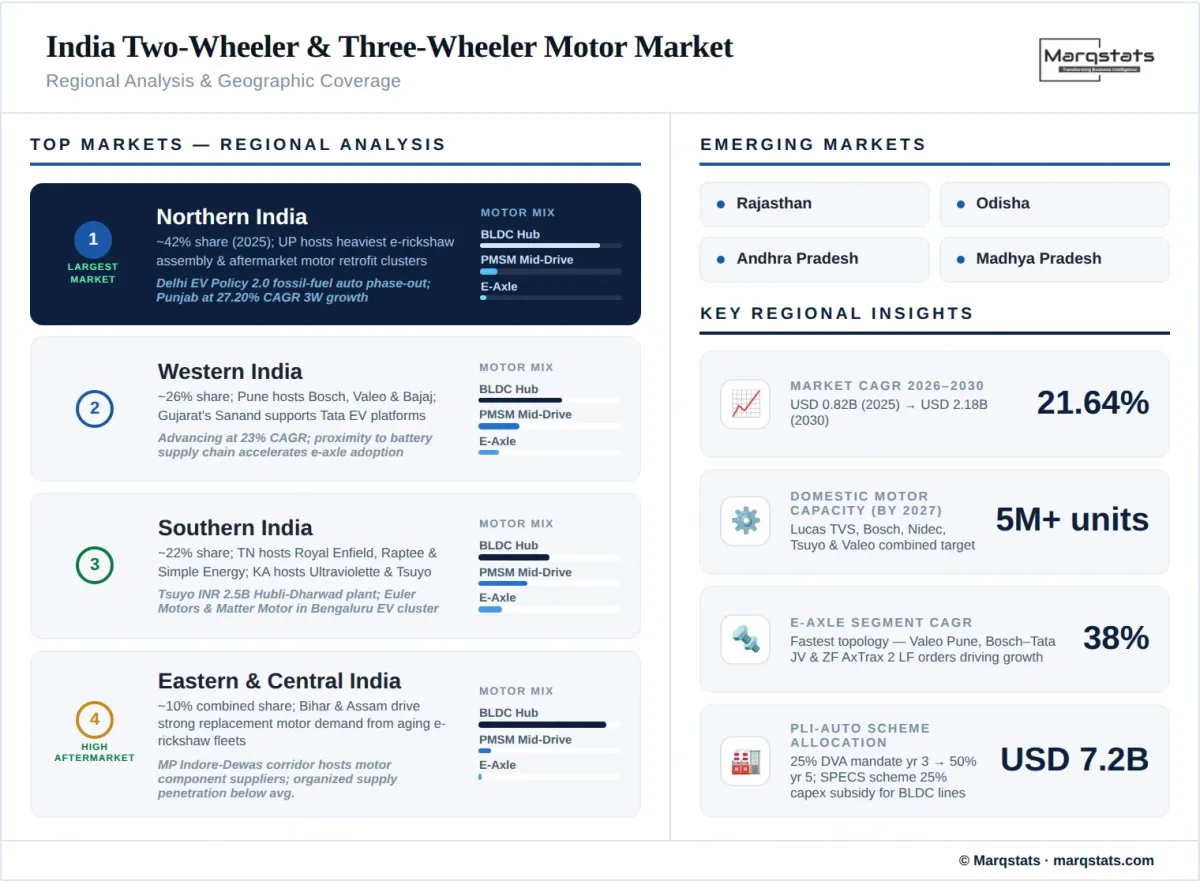
Northern India is the largest regional market for electric two-wheeler and three-wheeler motors, accounting for approximately 42% share in 2025. Uttar Pradesh hosts the heaviest concentration of e-rickshaw assemblers and aftermarket motor retrofitters. Delhi-NCR is a primary premium e-scooter demand cluster, supported by the Delhi EV Policy 2.0 and fossil-fuel auto-rickshaw phase-out. Haryana’s Faridabad-Gurugram corridor hosts motor component manufacturing units, while Punjab records the steepest state-level growth at 27.20% CAGR for three-wheeler vehicle registrations.
Western India
Western India holds approximately 26% share in 2025. Maharashtra hosts OEM integration centres including Pune, where Bosch India, Valeo India, and Bajaj Auto maintain major operations. Gujarat contributes through Sanand’s manufacturing base and supports Tata Motors Passenger Vehicles’ electric platform production. The region is advancing at 23% CAGR through 2030, supported by proximity to battery and component supply chains.
Southern India
Southern India holds approximately 22% share in 2025. Tamil Nadu hosts Chennai-based OEM operations including Royal Enfield, Tata Motors, Simple Energy, and Raptee Energy. Karnataka serves Bengaluru-based startups including Ultraviolette, Euler Motors, and Matter Motor Works. Tsuyo Manufacturing is establishing a 20-acre EV powertrain plant in Hubli-Dharwad with INR 2.5 billion investment, targeting powertrains up to 1,100 kW. Andhra Pradesh and Telangana support component manufacturing and testing infrastructure.
Eastern and Central India
Eastern and Central India hold approximately 10% combined share in 2025. Bihar and Assam are primary e-rickshaw demand clusters, with replacement motor demand supported by aging first-generation fleets. Madhya Pradesh’s Indore-Dewas industrial corridor hosts motor component suppliers. West Bengal contributes through Kolkata-based operations. The region records strong aftermarket motor demand, however organized OEM-tier supply penetration remains below the national average.
How Competition Is Evolving
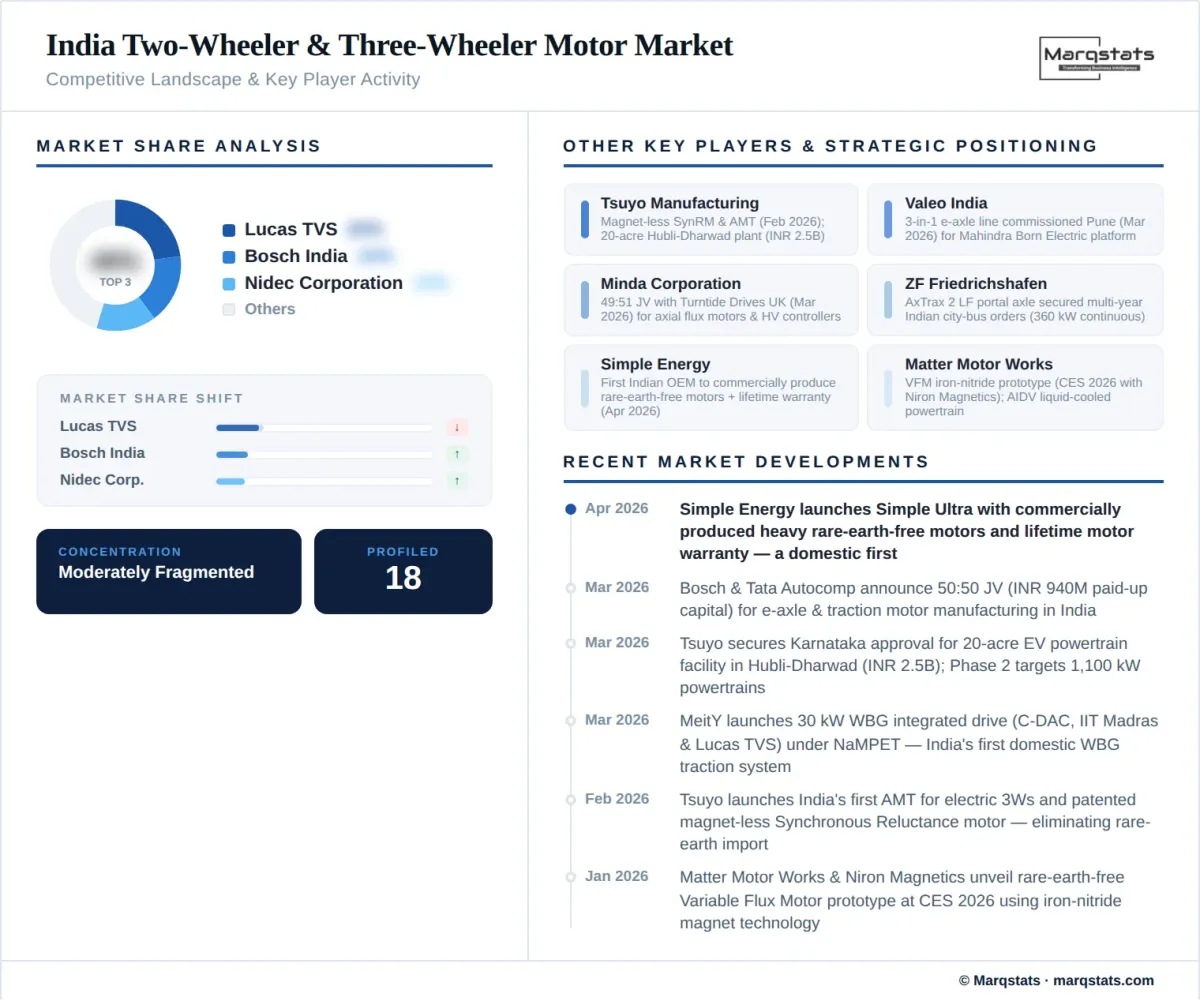
The competitive environment in the India two-wheeler and three-wheeler motor market is moderately fragmented. The market comprises global Tier-1 integrators expanding local capacity, pure-play domestic motor specialists, and vertically integrated OEM captives. The top 10 organized players account for approximately 48% of revenue in 2025. Market concentration is increasing as PLI-driven localization favours scaled manufacturers, squeezing unorganized aftermarket suppliers from the organized supply chain.
Global Tier-1 suppliers are aggressively localizing Indian operations. Bosch Limited invested USD 23 million in capacity expansion at its Jaipur facility and announced a 50:50 JV with Tata Autocomp Systems in March 2026 for e-axles and traction motors, with authorised paid-up capital of up to INR 940 million. Nidec Corporation maintains Indian manufacturing operations supported by its global network of over 300 group companies. Continental AG, Valeo India, and ZF Friedrichshafen represent the additional global cohort with localized production commitments and multi-year Indian OEM orders.
Domestic specialists are scaling rapidly. Lucas TVS holds the top position in the BLDC motor segment through Indian-validated hub and traction motor designs featuring extreme sealing capabilities against monsoon water ingress. Tsuyo Manufacturing is building a 20-acre EV powertrain plant in Karnataka targeting powertrains up to 1,100 kW by Phase 2. Minda Corporation (via Spark Minda Green Mobility Systems) formed a 49:51 JV with Turntide Drives UK in March 2026 for axial flux motors and high-voltage motor controllers. OEM captives including Ola Electric, TVS Motor, Simple Energy, Matter Motor Works, and Ather Energy increasingly develop motors in-house. Strategic partnerships for rare-earth-free magnet technology, AI-based motor control, and semiconductor integration are the primary competitive differentiators for the 2026–2030 period.
Companies Covered
The report profiles 18 company profiles+ companies with full strategy and financials analysis, including:
Recent Market Activity
Table of Contents
Coverage & Segmentation
The India Two-Wheeler and Three-Wheeler Motor Market report analyzes the market across motor type, integration topology, vehicle type, power rating, sales channel, and regional geography for the period 2021 to 2030. The report covers historical data for 2021-2025, with 2025 as the base year, and forecasts spanning 2026-2030. Market sizing is conducted in USD billions and unit volumes. The study examines the full motor value chain, including raw material sourcing, magnet supply, stator and rotor assembly, motor controller manufacturing, and aftermarket service.
The scope encompasses L1 and L2 electric two-wheelers, L3 passenger e-rickshaws, L5 passenger three-wheelers, and L5 cargo three-wheelers. The study evaluates policy impact from the PLI-Auto scheme, SPECS programme, PM E-DRIVE, the Phased Manufacturing Programme, and critical-minerals policy. Competitive profiling covers 18 motor manufacturers and OEM captives operating in India. The report includes pricing analysis, segmental forecasts, value-chain margins, and capacity expansion schedules across domestic manufacturing sites.