Market Snapshot
Middle bar: base-year value × (1 + CAGR), rounded to two decimals. This is a calculated illustration, not a separately researched annual estimate.
The global LNG truck market size is estimated at USD 14,367.80 million in 2025 and is projected to reach USD 14,644.00 million by 2030, growing at a CAGR of 0.38% over 2026 – 2030. Annual sales fall from about 221,200 trucks to 192,700, a 2.72% annual decline, as China's natural gas truck boom reverses, while value holds steady because sales shift towards higher-priced trucks in Europe, North America and India.
Marqstats defines the market as the ex-factory value of new heavy-duty trucks fuelled by liquefied natural gas, covering Class 8 trucks in North America and N3 trucks above 16 tonnes gross vehicle weight in Europe and Asia. It includes spark-ignited natural gas engines, high-pressure direct injection engines that use a small diesel pilot, and factory dual-fuel trucks, all fitted with cryogenic LNG tanks. Trucks running on compressed natural gas, medium-duty trucks, buses, aftermarket conversions, refuelling stations and fuel sales are excluded.
China accounts for an estimated 77.45% of 2025 value and about 90% of units. Spark-ignited engines account for 87.96% of value and long-haul trucks for 82.00%. The study segments the market by engine technology, application and region.
Key Takeaways
Market Overview & Analysis
Report Summary
Marqstats sizes the LNG truck market as the ex-factory value of new heavy-duty trucks that run on liquefied natural gas. Liquefied methane stores more than twice the energy per litre of compressed natural gas, so LNG is used on heavy long-haul trucks that need ranges of 800 to 1,600 km and full payloads. In 2025, about 221,200 LNG trucks were sold worldwide, worth an estimated USD 14,367.80 million at an average ex-factory price of about USD 64,950.
China dominates. Chinese natural gas heavy truck sales reached 178,200 in 2024, up 17%, and a record 198,700 in 2025, up 12%, as fleets moved from diesel to LNG after the China VI-b emission standard took effect in July 2023 and LNG traded well below diesel. Chinese LNG tractors from FAW Jiefang, Sinotruk, Shaanxi Auto and Dongfeng, mostly with Weichai engines of 13 to 17 litres, sell at around USD 55,000 to 60,000, far below Western prices.
Outside China the market is small but higher-value. Europe registered about 12,500 heavy gas trucks in 2025, mainly Iveco S-Way, Scania and Volvo FH LNG models selling at around USD 150,000. North America sells LNG versions of Class 8 trucks with the Cummins X15N engine, India sells 55-tonne LNG tractors from local makers, and Russia's KAMAZ builds an LNG version of its K5 tractor.
Two engine technologies compete. Spark-ignited stoichiometric engines, used by Weichai, Cummins, FPT Industrial and Scania, use a simple three-way catalyst and reach thermal efficiency of 39% to 42%. High-pressure direct injection engines, developed by Westport and used by Volvo, inject gas into a diesel pilot flame, reaching 46% to 50% efficiency and diesel-like torque but needing full diesel exhaust treatment and two fuel systems.
The market grew from USD 6,524 million in 2021 to USD 5,900 million in 2022, when gas prices spiked, then USD 10,766 million in 2023 and USD 12,799 million in 2024. Marqstats expects value to fall to about USD 12,790 million in 2026 as Chinese sales drop, before recovering to USD 14,644.00 million in 2030 as growth in other regions offsets lower Chinese volume.
Three groups buy LNG trucks. Chinese bulk freight operators carrying coal, steel and construction materials buy most of the world's volume and react quickly to fuel prices. European and North American logistics companies buy LNG and bio-LNG trucks to meet customer emission targets and reduce tolls. In India and Russia, industrial companies and state-backed fleets buy LNG trucks to cut fuel costs on fixed freight corridors where anchor customers guarantee fuel demand for new stations.
LNG trucks store fuel in double-walled, vacuum-insulated tanks at about minus 162 degrees Celsius. Tanks of 450 to 1,060 litres give long-haul tractors ranges of 1,000 to 1,600 km, but fuel warms when trucks stand idle, and tanks vent gas after roughly one to two weeks without use. This makes LNG best suited to trucks that run every day on long routes, and less suited to irregular or seasonal work. Cryogenic tanks also account for half or more of the price premium over diesel, which is why fleets need high annual mileage to recover the extra cost.
Global LNG Truck Market Size and Forecast
The global LNG truck market moves from USD 14,367.80 million in 2025 to USD 14,644.00 million in 2030, a CAGR of 0.38%. Marqstats expects value of about USD 12,790 million in 2026, USD 12,615 million in 2027, USD 13,216 million in 2028 and USD 13,964 million in 2029. Unit sales fall from about 221,200 in 2025 to 186,300 in 2026 and 175,700 in 2027, then recover to 192,700 in 2030.
China drives the decline. Chinese natural gas heavy truck sales reached about 122,000 in January to August 2026, up 5% year on year, but monthly sales fell to about 4,000 in August as LNG prices rose above RMB 6 per kilogram while diesel sold at about RMB 8.2 per litre. Natural gas trucks took about 15% of heavy truck sales in January to August, against 22% for new energy trucks. Marqstats expects Chinese LNG truck sales of about 160,000 in 2026, falling to about 145,000 in 2027 and recovering slowly to 150,000 by 2030 as LNG keeps a role on long-distance bulk routes beyond the reach of battery trucks.
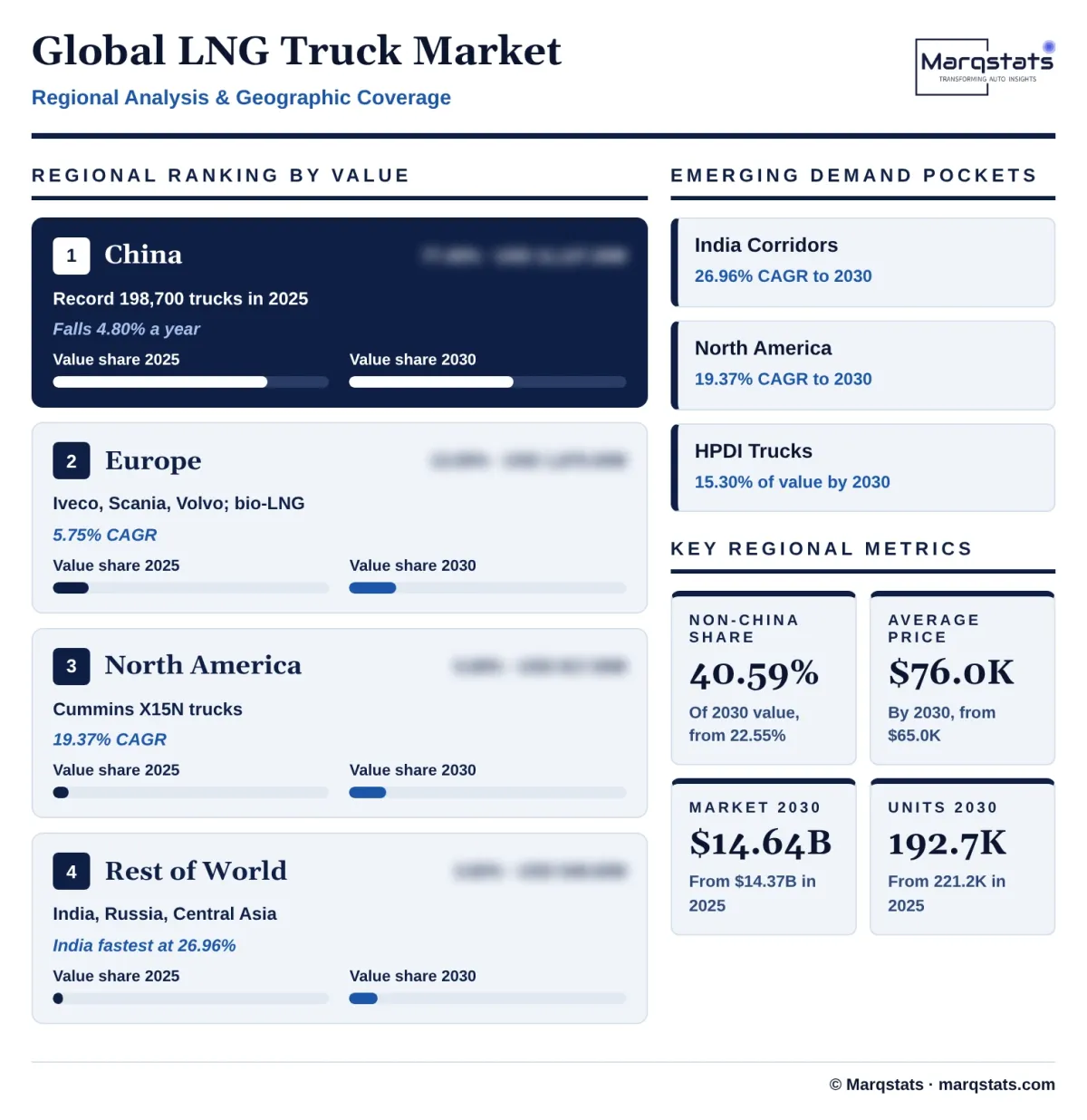
Other regions grow. Marqstats expects sales outside China to rise from about 22,500 trucks in 2025 to 42,700 in 2030, led by Europe at 16,000, North America at 9,000, India at 9,500 and Russia at about 5,000 a year. Because these trucks sell at two to four times the Chinese price, their share of market value rises from 22.55% to 40.59%.
Average prices rise. Marqstats estimates the average ex-factory price rises from about USD 64,950 in 2025 to USD 76,000 in 2030, mainly because of the regional mix. Within regions, prices rise slowly as engines move to 15 and 17 litres and trucks carry larger cryogenic tanks of up to about 1,060 litres.
Marqstats tracks four indicators to monitor the forecast: the ratio of LNG to diesel prices in China, Europe, the United States and India; monthly Chinese natural gas and new energy heavy truck sales; the number of LNG refuelling stations on freight corridors; and changes to CO2 rules that could recognise bio-LNG. A sustained fall in Chinese LNG prices would lift sales above the base path, while faster growth in battery-swapping trucks would push them below it.
The forecast assumes no lasting return to the very low Chinese LNG prices of 2023 to 2025, steady growth of bio-LNG supply in Europe, continued production of the Cummins X15N in North America and further LNG station building in India and Russia. It also assumes that EU CO2 rules continue to count tailpipe emissions only through 2030. A change in any of these would move the forecast, with Chinese fuel prices having the largest effect because China still accounts for most of global volume in 2030.
Market Dynamics
Key Drivers
Five forces support demand for heavy trucks running on liquefied natural gas.
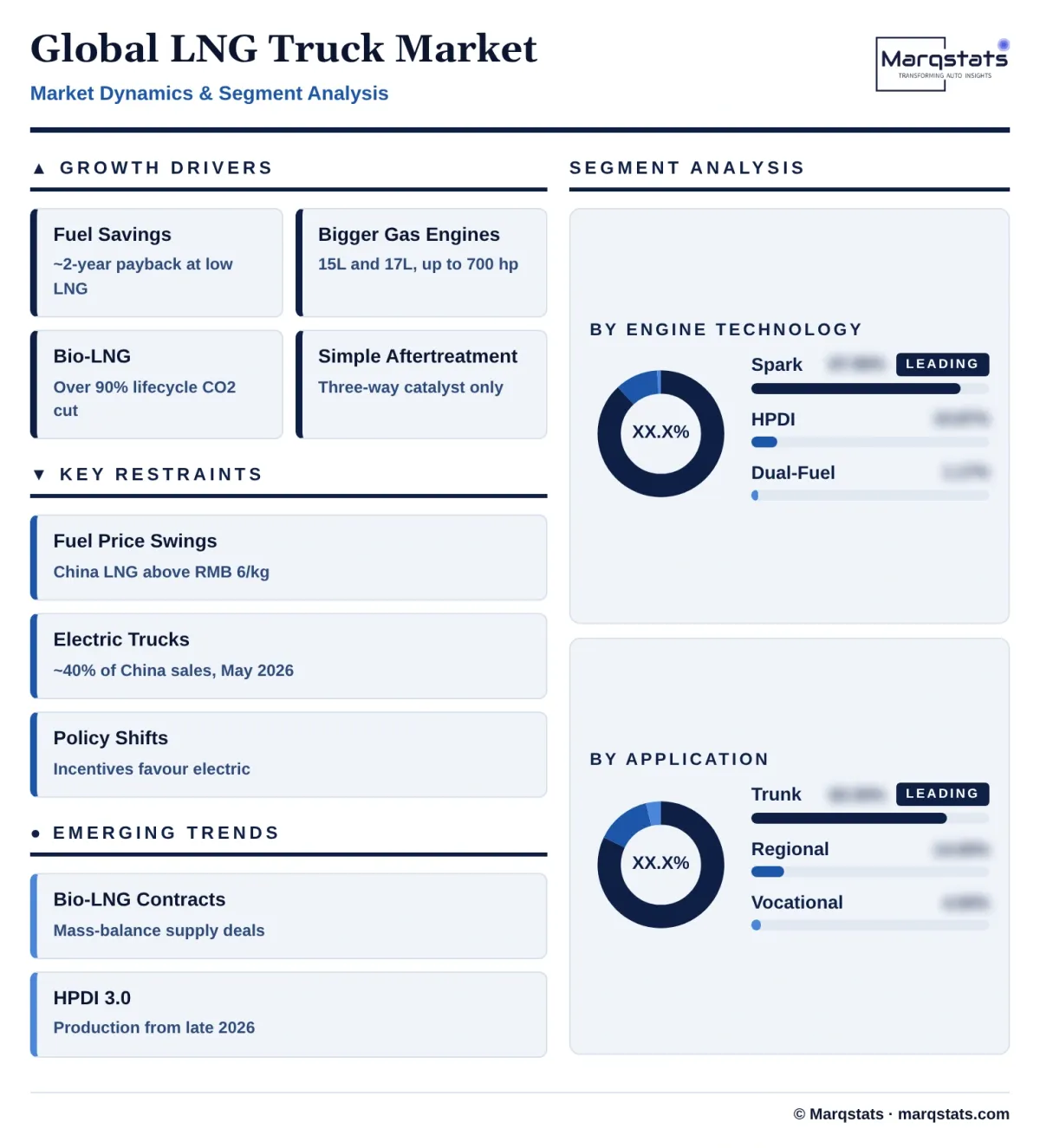
- Fuel cost savings. When LNG is cheap relative to diesel, a long-haul truck covering 150,000 km a year can recover a USD 30,000 price premium in about two years, which drove China's sales to a record in 2025.
- Larger gas engines. Weichai's 15 and 17 litre gas engines with up to 700 horsepower and Cummins' 15-litre X15N give gas trucks the power needed for heavy loads, removing a long-standing barrier.
- Bio-LNG. Liquefied biomethane can cut lifecycle CO2 emissions by more than 90%, letting European and North American fleets meet customer emission targets and qualify for lower tolls and low-carbon fuel credits.
- Simple emission control. Stoichiometric gas engines meet China VI and Euro VI with a three-way catalyst, avoiding the diesel particulate filters and urea dosing that raise diesel maintenance costs.
- Corridor programmes in emerging markets. India and Russia are building LNG stations along freight corridors, and companies such as GreenLine in India and KAMAZ in Russia are adding LNG trucks for industrial customers.
Key Restraints
Four constraints are cutting into LNG truck demand, above all in China.
- Fuel price swings. Demand collapses when LNG prices rise towards diesel, as in Europe in 2022 and China in 2026, making fleet economics unpredictable.
- Electric trucks. Battery-electric heavy trucks with battery swapping or megawatt charging are taking short and medium routes in China, where new energy trucks reached about 40% of truck sales in May 2026.
- Policy shifts. A June 2026 policy from 11 Chinese ministries directed truck incentives to electric and fuel cell trucks and excluded LNG trucks, and EU CO2 rules give no credit for gas trucks, discouraging carmakers from investing in new gas models.
- Infrastructure cost. An LNG station costs about USD 1.2 million to 2.5 million, and outside China only a few hundred stations serve heavy trucks, limiting where fleets can operate.
Key Trends
Four shifts are changing where and how LNG trucks are sold.
- Bio-LNG supply contracts. European fleets increasingly buy certified liquefied biomethane through mass-balance contracts to reduce reported emissions and road tolls.
- Next-generation HPDI. Cespira's HPDI 3.0 system, announced in September 2026, adds new pressure control and support for larger engines, with production expected from late 2026.
- Multi-fuel engine platforms. Engine makers are designing base engines that can run on diesel, natural gas, biomethane or hydrogen with shared parts, limiting the risk of investing in gas-only engines.
- Flexible production. Chinese truck and axle makers are adjusting production between gas, diesel and electric trucks within weeks to follow fast changes in fuel prices.
Strategic Implications
- For truck makers, flexibility matters more than gas-specific investment. Shared engine and chassis platforms that can switch between fuels reduce the risk of sudden demand swings such as China's 2026 decline.
- For fleets, fuel contracts decide returns. LNG trucks pay off on high-mileage routes above about 140,000 km a year with indexed fuel supply, but buying on spot LNG exposes operators to rapid margin loss when the LNG-to-diesel ratio rises above about 0.75.
- For fuel suppliers, anchor customers reduce station risk. New LNG stations should be placed on freight corridors with committed fleet demand and designed to serve both LNG and compressed gas, and later biomethane or hydrogen.
- For component suppliers, growth is outside China. Cryogenic tank, fuel system and injector makers should focus on Europe, North America and India, where volumes grow and trucks carry more expensive equipment.
- For policymakers, lifecycle accounting is the key decision. Whether CO2 rules recognise bio-LNG will decide whether gas trucks remain a bridge technology or fade after 2030 in Europe.
- For investors, the market is now a regional story. Value growth over the forecast period comes almost entirely from Europe, North America, India and Russia, while China's large but volatile market moves with fuel prices and policy, so exposure to suppliers serving markets outside China offers steadier growth.
Market Segmentation
Spark-ignited stoichiometric engines from Weichai, Cummins, FPT Industrial and Scania account for 87.96% of 2025 value, USD 12,637.80 million, falling 0.68% a year to USD 12,215.00 million by 2030 and 83.41% of value as Chinese volume declines.
HPDI trucks, mainly Volvo FH and FM LNG models using Westport technology, account for 10.87% of 2025 value, USD 1,562.00 million, and grow 7.48% a year to USD 2,240.00 million and 15.30% of value by 2030 as HPDI 3.0 enters production.
Factory dual-fuel trucks that mix gas with diesel account for 1.17% of 2025 value, USD 168.00 million, rising 2.38% a year to USD 189.00 million, limited by higher methane slip.
Long-haul trucks on routes above 500 km account for 82.00% of 2025 value, USD 11,782.00 million, falling 0.49% a year to USD 11,495.50 million and 78.50% of value by 2030 as Chinese demand weakens.
Regional distribution trucks on routes of 150 to 500 km account for 14.00% of 2025 value, USD 2,011.50 million, rising 3.74% a year to USD 2,416.30 million by 2030.
Vocational, mining and heavy-haul trucks account for 4.00% of 2025 value, USD 574.30 million, and grow fastest, at 4.98% a year, to USD 732.20 million and 5.00% of value by 2030, supported by coal corridors and port logistics in India and Russia.
By Geography
China
China is the largest market, with an estimated 77.45% of 2025 value, USD 11,127.20 million, on record sales of 198,700 natural gas heavy trucks, but value falls 4.80% a year to USD 8,700.00 million and 59.41% of the market by 2030. Monthly sales fell sharply from mid-2026 as LNG prices rose above RMB 6 per kilogram, a June 2026 policy directed incentives to electric and fuel cell trucks, and new energy trucks took a growing share of short and medium routes. LNG remains competitive on long-distance coal and bulk routes in Inner Mongolia, Shanxi, Shaanxi and Xinjiang, served by more than 5,000 LNG stations.
Europe
Europe accounts for an estimated 13.05% of 2025 value, USD 1,875.00 million on about 12,500 trucks, rising 5.75% a year to USD 2,480.00 million by 2030. Diesel still makes up more than 93% of new truck registrations, but LNG and bio-LNG trucks from Iveco, Scania and Volvo serve long-haul routes in Germany, France, Italy, Spain, Poland and Sweden. Bio-LNG lowers lifecycle emissions and tolls, but Regulation (EU) 2024/1610 counts only tailpipe CO2 and requires a 45% fleet cut from 2030, which gas trucks cannot meet.
North America
North America accounts for an estimated 5.69% of 2025 value, USD 817.00 million, and grows 19.37% a year to USD 1,980.00 million by 2030. The 15-litre Cummins X15N, offered by Freightliner, Kenworth and Peterbilt, gives gas trucks diesel-level power, and renewable natural gas from dairy farms and landfills supports demand from fleets such as UPS. Most X15N trucks use compressed gas, with LNG used on long routes in Texas, California and the Midwest. The repeal of federal vehicle greenhouse gas standards in February 2026 removes one compliance incentive, while state low-carbon fuel programmes remain.
India
India accounts for an estimated 1.40% of 2025 value, USD 201.60 million, and grows fastest, at 26.96% a year, to USD 665.00 million by 2030. Government policy aims to move a large share of long-haul trucks to LNG, Blue Energy Motors builds 55-tonne LNG tractors with FPT engines, Tata Motors and Ashok Leyland offer LNG models, and GreenLine operates hundreds of LNG trucks for industrial customers with plans for its own fuel stations.
Russia, CIS and Rest of World
Russia, the CIS and other regions account for an estimated 2.42% of 2025 value, USD 347.00 million, rising 18.74% a year to USD 819.00 million by 2030. KAMAZ planned about 2,100 LNG versions of its K5 tractor in 2026, with a 460 horsepower engine, two cryogenic tanks totalling about 1,060 litres and a range of 1,200 to 1,400 km, while Chinese truck makers export LNG tractors to Central Asia and other markets.
How Competition Is Evolving
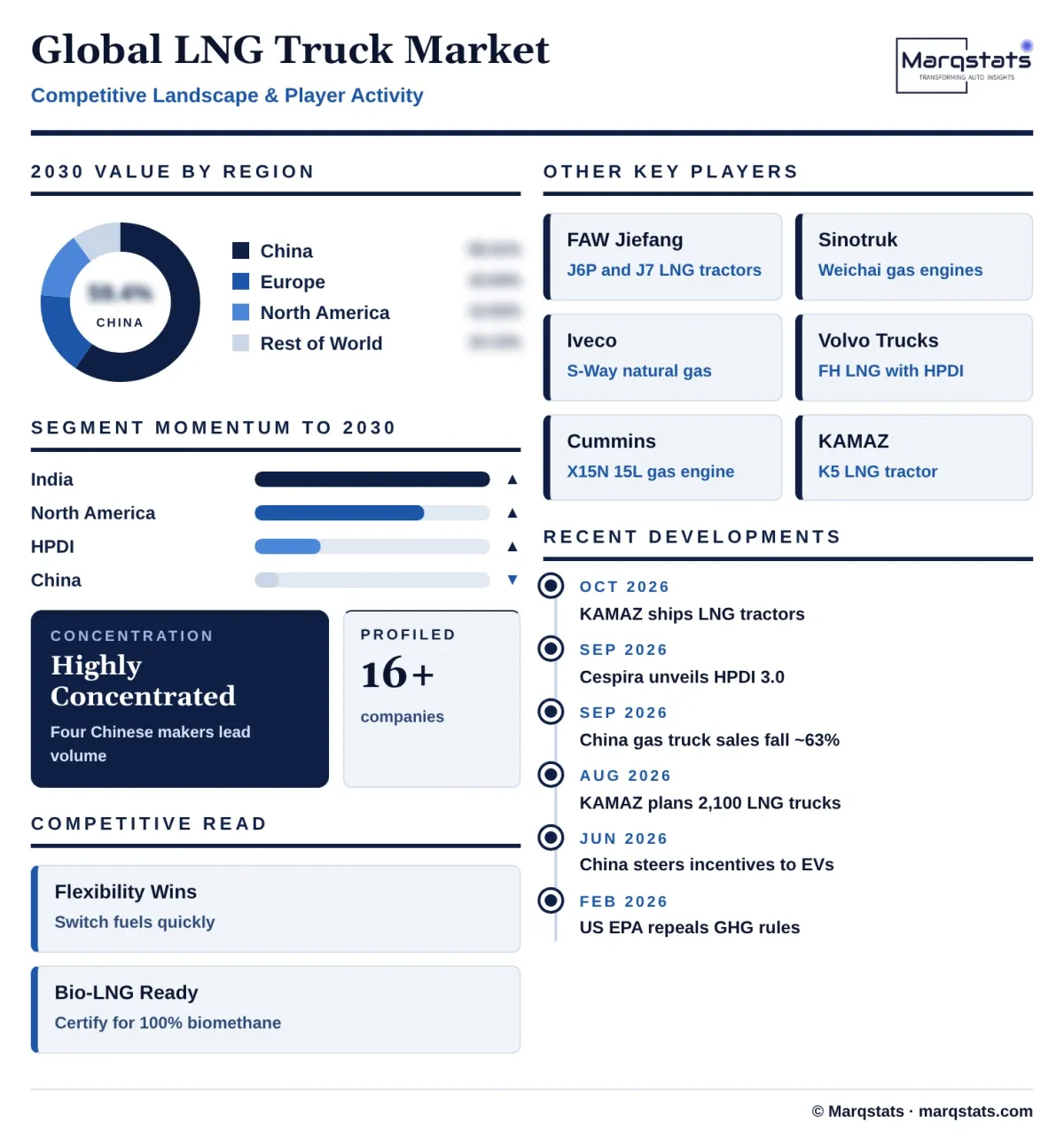
The LNG truck market is highly concentrated. Marqstats estimates that FAW Jiefang, Sinotruk, Shaanxi Auto and Dongfeng together account for over 80% of global unit sales, reflecting China's dominance. Weichai Power supplies most of the gas engines used in Chinese trucks.
Outside China, a few makers lead. Iveco is Europe's largest gas truck maker with its S-Way natural gas range and FPT engines, Volvo Trucks offers HPDI-based FH and FM LNG models, and Scania sells gas trucks with its 13-litre engine. In North America, Cummins supplies the X15N to Daimler Truck North America and PACCAR's Kenworth and Peterbilt brands.
Suppliers matter. Westport Fuel Systems, through its Cespira joint venture with Volvo Group, supplies HPDI fuel systems, while CIMC Enric, Chart Industries and other cryogenic specialists build LNG tanks, and Hexagon Agility supplies fuel systems for X15N trucks.
Competition is shifting to flexibility and bio-LNG readiness. Makers that can switch production quickly between fuels, certify trucks for 100% bio-LNG and offer engines that can later run on hydrogen will be best placed as the market matures.
Emerging-market makers are gaining ground. KAMAZ in Russia and Blue Energy Motors, Tata Motors and Ashok Leyland in India are building local LNG truck supply backed by corridor fuel programmes, while Chinese makers export LNG tractors to Central Asia and Southeast Asia.
Price competition is fierce in China. Chinese LNG tractors sell for a fraction of Western models, and makers compete on fuel efficiency, engine power and financing, with SHACMAN, FAW Jiefang and Sinotruk offering 15-litre models with heat recovery and automated gearboxes. When fuel prices turn against gas, the same makers quickly shift output to electric and diesel trucks, so their market shares in LNG can change sharply from month to month.
Companies Covered
Companies covered in the report include:
Recent Market Activity
Table of Contents
Coverage & Segmentation
The study covers the global LNG truck market, with 2025 as the base year, 2021 – 2025 as the historical period and 2026 – 2030 as the forecast period. Values are in US dollars at ex-factory prices, and volumes are annual sales of new trucks. The market covers Class 8 and N3 heavy-duty trucks fuelled by liquefied natural gas or liquefied biomethane and is segmented by engine technology, application and region.
Trucks running on compressed natural gas, medium-duty trucks, buses, aftermarket conversions, refuelling stations and fuel sales are excluded. Segment, regional and price estimates are Marqstats estimates built on truck sales data, manufacturer disclosures, fuel price data and vehicle price benchmarks.