Market Snapshot
Middle bar: base-year value × (1 + CAGR), rounded to two decimals. This is a calculated illustration, not a separately researched annual estimate.
The China electric heavy-duty truck market size is estimated at USD 14.15 billion in 2025 and is projected to reach USD 29.30 billion by 2030, at a CAGR of 15.68%. Volumes reached 231,100 units in 2025, a 182% increase, lifting new-energy penetration of Chinese heavy truck sales to 28.89% for the year and to 53.89% in December alone. China now accounts for close to nine in ten zero-emission medium- and heavy-duty vehicles sold worldwide. Battery demand from this segment alone reaches 303.7 GWh by 2030.
Market size and forecast figures are generated using Marqstats' proprietary estimation framework, updated as of August 2026.
The China electric heavy-duty truck market covers new-energy trucks above 14 tonnes gross vehicle weight sold into domestic use — battery-electric models charged by cable, battery-electric models designed for pack swapping, hydrogen fuel-cell trucks and plug-in hybrids. Battery-electric machines are 96.4% of the total. December 2025 was the month the argument ended: 45,300 new-energy heavy trucks were registered against a total heavy truck market of roughly 84,000, and for the first time in any large economy an electric heavy truck was the more likely purchase. Pure battery-electric models alone took 48.6% of that month.
What makes this market unlike any other commercial vehicle market is that it is not a subsidy story. The vehicle purchase tax exemption was halved from 1 January 2026 and the market grew 78.6% in the first half of the year regardless. The economics are carried instead by a fuel-price gap that has become structural. A battery-electric tractor unit lists at RMB 450,000 to 470,000 against RMB 260,000 to 280,000 for the diesel equivalent, a premium of roughly RMB 180,000; the blended transaction price across all body types was RMB 440,000 in 2025. CATL puts the operating saving for its standardised swap trucks at RMB 0.62 per kilometre against diesel and RMB 0.20 against liquefied natural gas, which is close to RMB 60,000 a year at 100,000 kilometres and pays the premium back in about three years, or inside two above 150,000 kilometres. In 2025 liquefied natural gas heavy truck sales grew 12% to 198,700 units and still lost share, falling from 29.55% to 24.83% while new energy climbed past them.
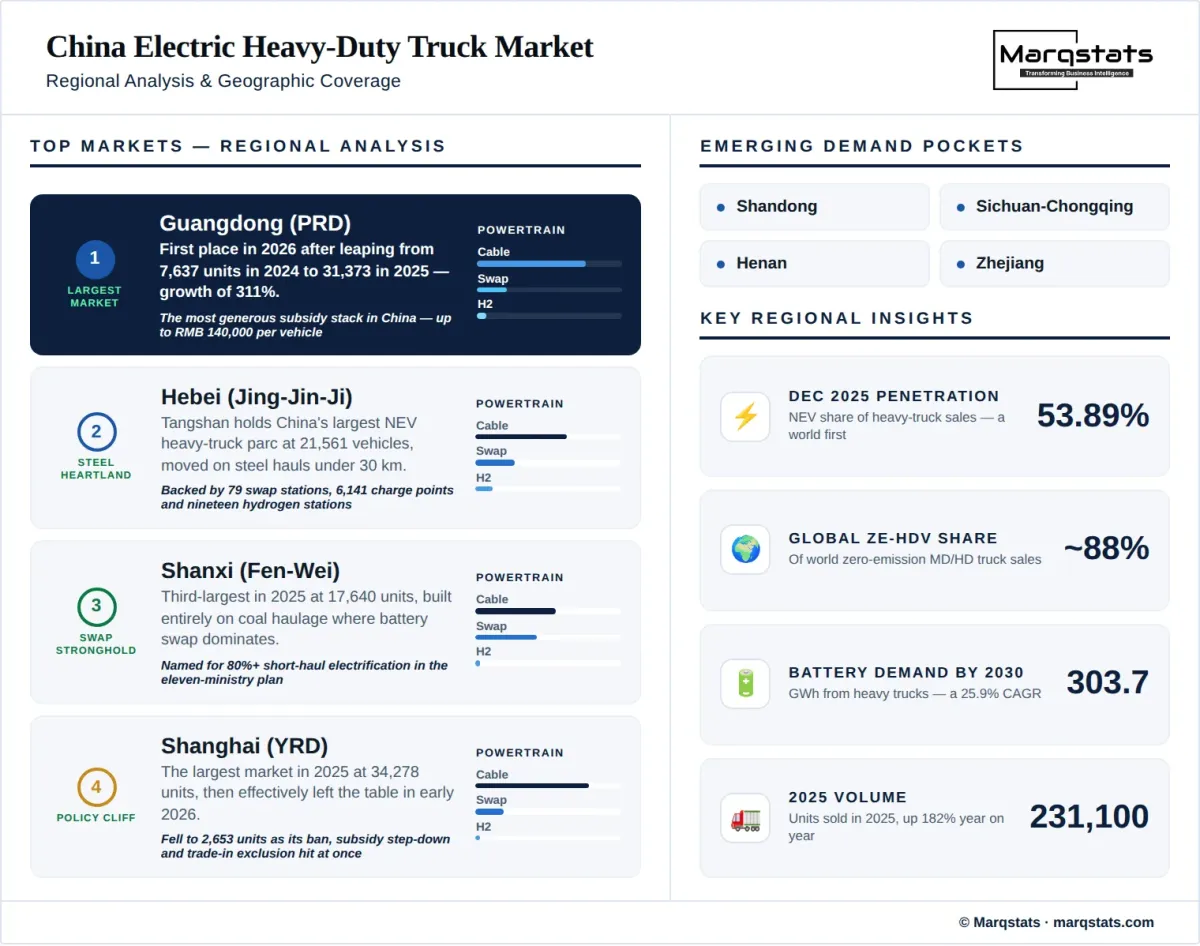
The market is also, in an important sense, not yet a national market. It is a rolling sequence of municipal diesel bans and scrappage windows, each producing a local surge and a local collapse. Shanghai sold 34,278 new-energy heavy trucks in 2025 and was the largest regional market in China; in the first four months of 2026 it sold 2,653. Guangdong, which sold 7,637 units in 2024, sold 31,373 in 2025 and took first place in 2026. Understanding this market means understanding which city is inside its policy window, not which OEM has the better product.
Key Takeaways
Market Overview & Analysis
Report Summary
China's heavy truck fleet numbers roughly 8.6 million vehicles and produces about 40% of the country's transport-sector carbon emissions. Until 2023 the electric share of new heavy truck sales was below 5%. In 2024 it reached 13.61%; in 2025 it reached 28.89%; and in December 2025 it reached 53.89% in a single month. No other heavy-duty vehicle market anywhere has moved at that speed, and the gap is not close — independent analysis by the International Council on Clean Transportation puts China at 88% of global zero-emission medium- and heavy-duty vehicle sales in 2025, 457,300 units of a global 520,000.
The mechanism is arithmetic rather than ideology. Chinese heavy trucks work harder than their Western counterparts, and a large share of them work in closed loops. Around two-thirds of freight heavy trucks in China serve coal, steel, electricity, non-ferrous metals and building materials. In Tangshan's steel logistics the typical haul is under thirty kilometres, run ten to thirty times a day, returning to the same yard every night. That duty cycle needs a 350 kWh pack, not a 600 kWh pack; it needs one depot charger, not a national network; and it accumulates 90,000 to 270,000 kilometres a year, enough to convert a RMB 0.62 per kilometre operating advantage into payback in two to three years. Penetration in short-haul closed-loop scenarios, defined as trips under 200 kilometres, already exceeds 40%. In open-road trunk logistics it remains in single digits.
That divide defines where the growth comes from next. The short-haul pool is finite and is being consumed quickly; closed-loop penetration is projected to reach roughly 90% by 2030. Trunk logistics is the far larger prize and is where the infrastructure argument is now being settled. Megawatt-class charging has arrived — a single pile now delivers 1.2 to 1.5 MW and takes a truck from 10% to 90% state of charge in roughly eighteen minutes — but fewer than 5% of trucks on the road can accept 600 kW or more. The eleven-ministry plan issued on 29 May 2026 and published in mid-June commits the state to roughly 3,000 heavy-truck charging and swap stations and 30,000 kilometres of zero-carbon freight corridors by 2030, with 18% of expressway freight volume moving on new-energy heavy trucks.
Marqstats sizes the China electric heavy-duty truck market at USD 14.15 billion in 2025, rising to USD 29.30 billion in 2030 at a CAGR of 15.68%. Unit volumes grow faster than value — 231,100 to 553,125 at a CAGR of 19.07% — because average selling prices are falling at 4.64% a year. In renminbi the market compounds at 13.55%; the 2.13-point difference is currency translation, the yuan having appreciated from an average of 7.1874 to the dollar in 2025 to 6.8410 through August 2026, with further modest appreciation assumed to 6.55 by 2030. Both figures are reported here because the dollar series overstates the underlying industrial growth.
Market Dynamics
Key Drivers
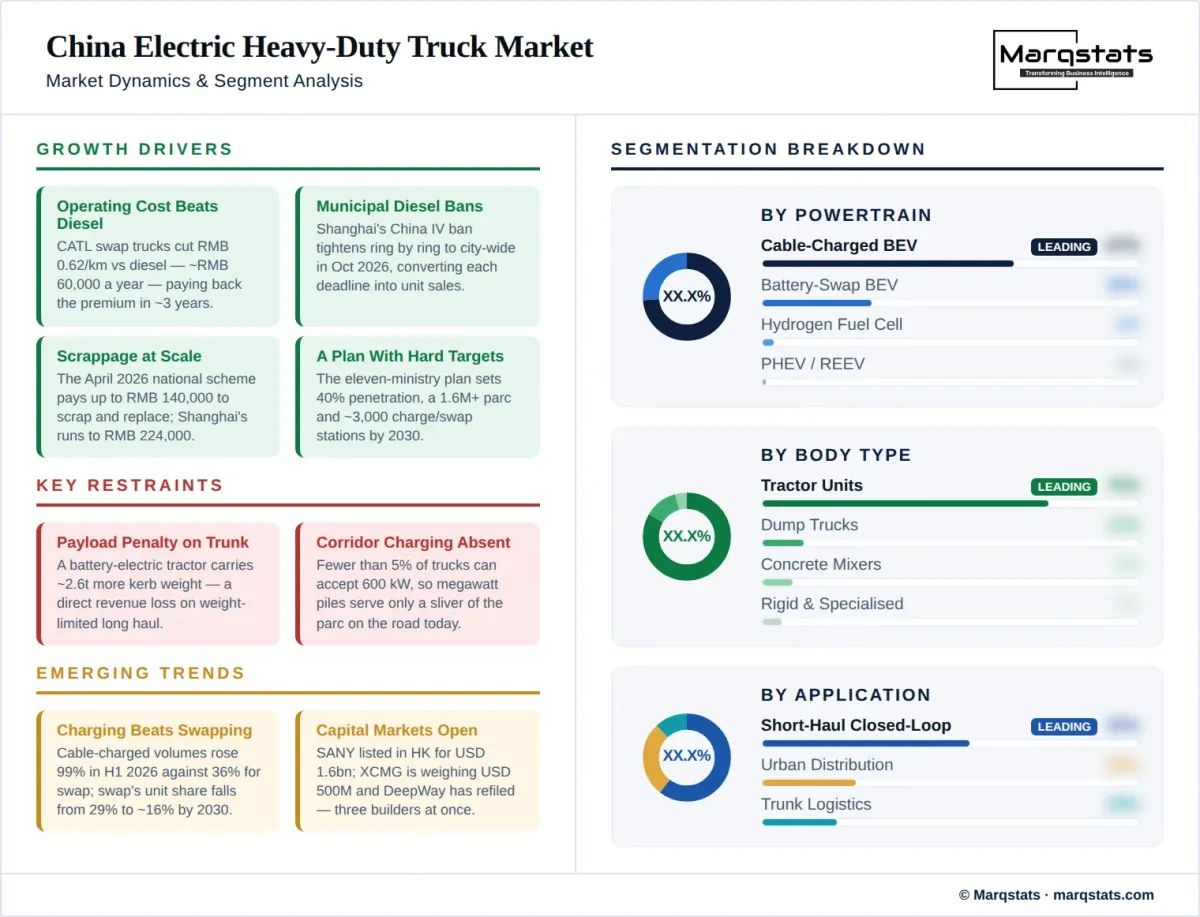
Operating cost advantage that no longer depends on subsidy. CATL states that battery-swap trucks equipped to its standardised 75# block cut operating cost by RMB 0.62 per kilometre against diesel — about RMB 60,000, or roughly USD 8,350 at 2025 average rates, over 100,000 kilometres — and by RMB 0.20 per kilometre against liquefied natural gas. Against a list-price premium of roughly RMB 180,000 over diesel, that pays back in about three years at 100,000 kilometres a year and inside two years above 150,000.
Municipal diesel bans that create captive replacement demand. Shanghai's phased China IV diesel truck restriction removed access inside the S20 ring from October 2024, inside the G1503 outer ring from 15 October 2025 and city-wide from October 2026, against a China IV parc of roughly 130,000 vehicles and around 35% of the city's heavy truck fleet. Each step converts a compliance deadline directly into unit sales.
Scrappage and replacement subsidies at scale. The Ministry of Transport and National Development and Reform Commission programme formalised on 28 April 2026 pays up to RMB 45,000 for scrapping a heavy commercial truck and up to RMB 95,000 for replacing it with an electric truck, a combined RMB 140,000. Guangdong and Shenzhen match that ceiling; Hangzhou reaches RMB 190,000 by uniquely covering China V vehicles; Shanghai's ecology-bureau scheme runs to RMB 224,000 and remains open to 31 December 2028.
A national plan with quantified 2030 targets. The eleven-ministry Implementation Plan for Large-Scale Application of New Energy Heavy Trucks sets 40% penetration, a parc above 1.6 million vehicles, roughly 3,000 heavy-truck charging and swap stations, 30,000 kilometres of zero-carbon freight corridors and above 80% electrification of fixed short-haul routes in the Beijing-Tianjin-Hebei region and the Fen-Wei Plain.
A domestic battery supply chain that has removed the cost floor. Average pack size rose to 431 kWh in 2025 and is forecast at 498 kWh in 2026, up 15.6%, while unit prices fell 19.66% at the one manufacturer that discloses them. Rising energy content and falling prices simultaneously is only possible where cell costs are collapsing, and it is what allows the electric truck to close the gap with liquefied natural gas.
Key Restraints
A payload penalty that trunk operators cannot absorb. A battery-electric tractor unit carries roughly 2.6 tonnes of additional kerb weight against its diesel equivalent. In closed-loop bulk haulage that is tolerable; in weight-limited long-distance freight it is a direct revenue loss on every trip, and it is the single clearest reason trunk penetration remains in single digits.
Charging infrastructure that is concentrated where it is least needed. Fewer than 5% of heavy trucks in service can accept 600 kW or more, so the megawatt-class piles now being installed serve a small fraction of the parc. Depot charging is adequate for short-haul work and is where most capital has gone; corridor charging, which trunk logistics requires, is still being built against a 2030 deadline.
The purchase tax step-down and the pull-forward it created. Full exemption ended on 31 December 2025 and a 5% effective rate applies through 2027, worth roughly RMB 13,000 to 27,000 per vehicle. December 2025 registrations reached 45,300, up 198% year on year and 62% month on month, borrowing demand from early 2026 and leaving an air pocket that took until the second quarter to clear.
Subsidy dependence at the municipal level, and the cliff when a window closes. Shanghai's collapse from 34,278 units in 2025 to 2,653 in January to April 2026 followed a 20% subsidy step-down, the exhaustion of the vehicle pool inside the newly banned zone, and the exclusion of trucks from the city's 2026 trade-in scheme entirely. The national series is smooth only because the municipal ones are not.
Residual value and battery health remain unpriced. There is no established secondary market for a five-year-old electric heavy truck in China and no standard for assessing pack state of health at resale, which raises the effective cost of capital for owner-operators and keeps the segment skewed toward corporate and captive fleets.
Key Trends
Charging is winning the argument against swapping. Cable-charged volumes grew 99% in the first half of 2026 against 36% for battery swap, and swap's share fell from roughly 32% to 24%. On value the divergence is wider still: charging-model revenue compounds at 18.69% to 2030 against 2.08% for swap. Battery swap remains structurally important in Shanxi, Hebei and Shenzhen, but it is no longer the market's centre of gravity.
The swap network is missing its own targets. CATL's Qiji heavy-truck network reached 305 stations at the end of 2025 against a 300-station goal, then stood at only 'more than 300' in April 2026 against a 900-station target for the year. The company's passenger-vehicle Choco network passed 2,000 stations over the same period, adding more than 200 a month. Capital is flowing to the passenger network.
Consolidation at the top, insurgency below. The top five manufacturers hold 66.9% of 2025 volume and the top ten roughly 94%, yet the fastest growth belongs to newcomers — United Truck at plus 370% in the first half of 2026 and DeepWay at 8,020 units from 509 two years earlier. More than RMB 8 billion flowed into new-energy heavy truck start-ups between January and May 2026.
Capital markets have opened. SANY Heavy Industry completed a USD 1.6 billion Hong Kong listing on 28 October 2025; XCMG Automobile converted to a joint-stock company on 5 June 2026 and is reported to be weighing a USD 500 million Hong Kong listing; DeepWay refiled its Hong Kong prospectus on 7 May 2026. Three of the market's leading builders are pursuing public capital simultaneously.
Export is becoming a second engine. SANY shipped 883 electric tractor units in June 2026, the largest single new-energy tractor export order recorded from China, built in four days at a peak rate of 240 units a day. Chinese builders now supply electric heavy trucks into the United Arab Emirates, Indonesia, Singapore, the United States and Europe, though export volumes fall outside the domestic registration series used in this report.
Market Segmentation
Cable-charged battery-electric trucks accounted for 67.38% of 2025 volume, 155,715 units, and USD 9.35 billion of value. This is the segment absorbing almost all incremental demand: volumes grew 99% in the first half of 2026 while the market grew 78.6%, and the segment compounds at 22.92% in units and 18.69% in value to 2030, reaching 436,969 units and USD 22.03 billion. Rising pack sizes and megawatt-class charging have removed the two arguments that once favoured swapping, and manufacturers have followed — SANY sells 97.3% of its new-energy heavy trucks as charging models.
Battery-swap trucks were 29.00% of 2025 volume at 67,019 units, and remain the preferred configuration where duty cycles are intense and predictable: steel short-haul in Tangshan, coal haulage in Shanxi and port drayage in Shenzhen, which alone registered 4,586 swap tractors in 2025, more than any other Chinese city. But share is falling — to 24% in the first half of 2026 and a projected 16.00% by 2030 — and value growth of 2.08% a year is close to flat. Farizon is the purest swap play at roughly 86% of its own volume; Foton runs 46%; Sinotruk 14%.
Fuel-cell heavy trucks were 3.12% of 2025 volume, 7,210 units, but carry an average selling price more than twice that of a battery-electric equivalent, giving them USD 1.02 billion of value on a small unit base. This is the fastest-growing powertrain in percentage terms at 29.24% in units and 24.79% in value to 2030, concentrated in demonstration cities. Tangshan operates 2,349 fuel-cell heavy trucks with nineteen hydrogen stations in service and seven under construction; Shenzhen registered more than 800 fuel-cell tractors in 2025 and Guangzhou 434 fuel-cell dump trucks, both national firsts in their body class.
Plug-in hybrid and range-extended heavy trucks remain marginal at 0.50% of 2025 volume, 1,156 units. Great Wall Motor's June 2025 entry with the G1050 — four variants from RMB 536,600, 19.9 litres per 100 kilometres on highway and the first Chinese heavy truck below 30 litres per 100 kilometres — is the segment's most credible product, but it competes against liquefied natural gas rather than against battery-electric trucks, and the segment is modelled at 0.30% of volume by 2030.
Tractor units are the market: 174,758 units and 75.62% of 2025 volume, USD 10.42 billion or 73.7% of value, growing to USD 22.71 billion by 2030 at a CAGR of 16.85%. They are also the only body type that spans both duty cycles, serving port drayage and steel short-haul today and trunk logistics as corridor charging arrives. XCMG Automobile has led the new-energy tractor sub-segment for eight consecutive months to July 2026, a sub-segment that alone was roughly 19,000 units in that month.
Dump trucks, including sanitation variants, were 25,883 units and 11.20% of 2025 volume, USD 1.73 billion of value at an average selling price roughly 12% above the tractor. Almost all of this demand is urban construction and mining haulage inside closed sites, which makes it the most electrified body type by duty cycle and the most exposed to construction cycles. The segment grows at 12.08% in value to 2030, below the market, as share drifts to 9.50% of units.
Concrete mixers were 18,765 units and 8.12% of 2025 volume, USD 1.37 billion. Mixers carry the highest average selling price of any mainstream body type, roughly 22% above a tractor, because the superstructure and the pack must both be paid for. Growth is the slowest in the study at 9.75% in value, tracking a Chinese construction sector that is not expanding, and share of units falls to 6.20% by 2030.
Rigid cargo trucks were only 2,473 units in 2025, 1.07% of volume, with other specialised bodies — tankers, wreckers, refuse and utility vehicles — accounting for a further 3.99%. Rigid cargo is the fastest-growing body type in the study at 20.43% in value to 2030, from a base so small that the growth rate flatters it; the segment matters mainly as evidence that electrification is spreading outward from the tractor into general haulage.
Short-haul closed-loop work — steel plants, coal mines, cement works, ports, quarries and industrial parks — is where this market was built and where penetration already exceeds 40%. The economics are unambiguous: haul distances within thirty kilometres, ten to thirty round trips a day, a pack of 350 kWh or less, and a single depot charger. Hebei steel plants moved in-plant transport from below 10% new energy in 2022 to above 60% in 2024. Regulators expect closed-loop penetration near 90% by 2030, which means this pool is being consumed rather than expanded.
Trunk logistics carries the majority of Chinese freight tonne-kilometres and remains in single-digit penetration. The obstacles are a 2.6-tonne payload penalty, corridor charging that does not yet exist at density, and a parc in which fewer than 5% of trucks can accept 600 kW charging. This is also where the entire policy apparatus is now aimed — 30,000 kilometres of zero-carbon corridors, 18% of expressway freight volume and a five-radial, four-longitudinal, five-latitudinal backbone network built along the G1, G2, G3, G4, G5, G15, G25, G45, G65, G20, G30, G42, G60 and G80 expressways by 2030.
Urban distribution, refuse collection and municipal service work sits between the two, benefiting from the same overnight-depot pattern as closed-loop haulage while operating on public roads under city emission rules. It is the application most directly created by diesel bans rather than by economics, which makes it the most policy-sensitive part of the market and the clearest explanation for why municipal volumes swing as violently as they do.
By Geography
Guangdong and the Pearl River Delta
Guangdong is the largest regional market in China as of 2026, with 9,240 units in the first four months against a national 72,825, or 12.68%. Provincial and city figures in this section follow the group-consolidated registration series covering vehicles above 12 tonnes, which places 2025 national sales at 233,206 rather than the 231,100 of the headline series — a 0.9% difference that does not affect the shares. Its rise has been abrupt: 7,637 units in 2024, 31,373 in 2025 for growth of 311%, and first place from the first quarter of 2026. The driver is the most generous subsidy stack in the country — a provincial non-commercial scheme paying RMB 10,000 to 45,000 for scrappage and RMB 35,000 to 95,000 for electric replacement, a combined ceiling of RMB 140,000, matched by Shenzhen for commercial fleets with applications open from 17 August to 31 December 2026. Guangzhou is now the largest city market at 3,198 units, ahead of Shenzhen at 2,897, with Foshan seventh nationally at 1,141, and trade reporting, single-sourced, puts provincial plans at 173 heavy-truck megawatt charging stations over the current five-year plan.
Hebei and the Beijing-Tianjin-Hebei Region
Hebei was the largest market in 2024 at 11,218 units and remains second in 2026 at 6,517 units, or 8.94%. Tangshan holds the largest new-energy heavy truck parc of any prefecture-level city in China — 21,561 vehicles as of April 2026, of which 19,212 are battery-electric and 2,349 hydrogen fuel-cell, supported by 79 swap stations, 6,141 heavy-truck charge points and nineteen hydrogen stations. The logic is steel: Tangshan produced roughly 120 million tonnes of crude steel in 2024, about one-ninth of national output, moved almost entirely on hauls under thirty kilometres. The province held roughly 33,000 new-energy heavy trucks in early 2025 against a target of 40,000 by 2027, and city-level penetration in Tangshan is reported to have passed 40% by May 2026, on a single trade source.
Shanxi and the Fen-Wei Plain
Shanxi was the third-largest provincial market in 2025 at 17,640 units, or 7.56%, having been second in 2024 at 7,919. Coal haulage is the entire story, and battery swap is unusually dominant here — trade reporting, single-sourced, puts the province at around 60 swap stations with 300 service points offering 24-hour response and a bottom-swap assembly plant in Datong rated at 25,000 units a year, with local incentives for scrapping and buying a bottom-swap electric truck reaching RMB 130,000. Datong targets a heavy truck replacement rate above 20% in 2026 and above 50% in 2027. The Fen-Wei Plain is one of two regions named in the eleven-ministry plan for above 80% electrification of fixed short-haul routes by 2030.
Shanghai and the Yangtze River Delta
Shanghai was the largest regional market in China in 2025 at 34,278 units, 14.70% of the national total, and then effectively left the table: 2,653 units in the first four months of 2026, less than Marqstats estimates it sold in December 2025 alone. Three things happened at once. The China IV diesel ban stepped inside the G1503 outer ring on 15 October 2025, clearing the vehicle pool inside the zone; the municipal replacement subsidy stepped down 20% from 1 January 2026, from a ceiling of RMB 280,000 to RMB 224,000; and the city's 2026 trade-in scheme was written to cover passenger cars only, excluding trucks entirely. The subsidy itself runs to 31 December 2028 and the city-wide ban takes effect in October 2026, so a second wave is likely — but 2025 will not be repeated.
Shandong and the Eastern Corridor
Shandong ranked third nationally in the first four months of 2026 at 4,698 units, or 6.45%, and has announced the most aggressive build programme aimed at trunk logistics rather than short-haul. Announcements in April 2026 covered a planned 48 expressway megawatt charging stations across 24 paired service areas on a 2,600-kilometre network, plus 107 ordinary-road stations across a 6,600-kilometre network, alongside 28 separate support measures for electric heavy truck adoption. None of these stations was in service at the time of announcement. More than 20,000 electric heavy trucks are already in operation in the province.
Sichuan, Chongqing and the Western Corridors
The Chengdu-Chongqing cluster is one of four regions prioritised for heavy-truck charging and swap infrastructure in the July 2026 State Council briefing, alongside Beijing-Tianjin-Hebei, the Yangtze River Delta and the Greater Bay Area. Chongqing registered 1,346 units and Chengdu 1,073 in the first four months of 2026, and Sichuan was among the top three provinces as recently as September 2025 before Shanxi overtook it. The region's strategic significance is the 1,250-kilometre Chengdu-Wuhan battery-swap corridor opened on 23 December 2025 with twelve bidirectional stations, China's longest, cutting transit time below eighteen hours and serving a 1,000-truck agreement with Bashu Logistics Group.
How Competition Is Evolving
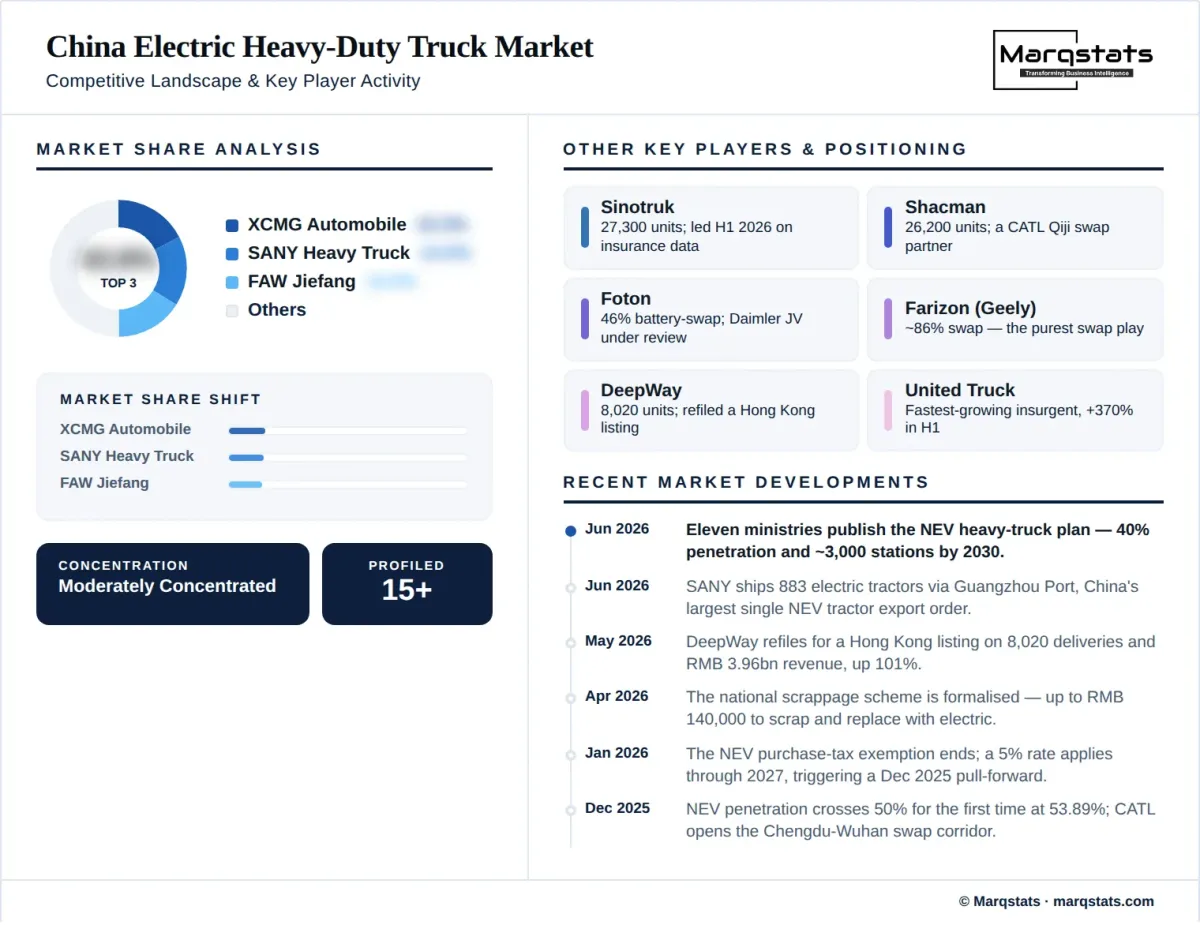
The China electric heavy-duty truck market is moderately concentrated and consolidating. The top five manufacturers took 66.9% of 2025 registrations and the top ten roughly 94%, a tighter structure than the diesel heavy truck market from which it emerged. What is unusual is who leads. XCMG Automobile took first place in 2025 with 35,400 units and 15.3% share, ahead of SANY Heavy Truck at 33,600 and FAW Jiefang at 32,400 — two of the top three coming from construction machinery rather than from traditional truck-building. Sinotruk followed at 27,300 and Shacman at 26,200. In the first half of 2026 Sinotruk overtook XCMG on the compulsory insurance series with 22,100 units against 21,700, growing 135%; on the group-consolidated series covering vehicles above 12 tonnes, XCMG remains first. Any claim about who leads this market is meaningless without naming the data caliber.
Competitive strategy divides along the charging-versus-swapping line more sharply than along any product line. SANY has committed almost entirely to charging, with battery swap at 2.7% of its own new-energy volume; Sinotruk sits at 14%, and its swap volumes actually fell in the first half of 2026. At the other extreme Farizon runs roughly 86% swap and is the market's purest battery-swap play, with Foton at 46% and XCMG — the largest swap seller by absolute volume — at 30%. CATL's Qiji standard, with more than ten manufacturer partners and thirty-plus standardised chassis-swap models, is the coordinating mechanism for the swap side, and FAW Jiefang and Shacman are its confirmed partners. The strategic risk sits with the swap-led builders, because the volume data has been moving against them for eighteen months.
Capital markets have become an active front. SANY Heavy Industry completed a USD 1.6 billion Hong Kong listing on 28 October 2025 and is reported to be weighing a separate listing for its electric truck unit; XCMG Automobile converted to a joint-stock company on 5 June 2026 after raising RMB 6.444 billion from thirty strategic investors in February 2025, and is reported to be considering a USD 500 million Hong Kong offering; DeepWay refiled its Hong Kong prospectus on 7 May 2026 after an initial filing lapsed. Below them, more than RMB 8 billion flowed into new-energy heavy truck start-ups between January and May 2026, and the fastest growth in the market belongs to insurgents — United Truck at plus 370% in the first half of 2026 and Zero One Auto at five times prior-year volume through April. Structural risk exists at the other end: Daimler Truck took a full impairment on its stake in the Beijing Foton Daimler joint venture in 2024 and has been reported since July 2025 to be negotiating its dissolution.
Companies Covered
Companies covered in the report include:
Recent Market Activity
Table of Contents
Coverage & Segmentation
This study covers new-energy heavy-duty trucks above 14 tonnes gross vehicle weight sold for domestic use in mainland China, across four powertrains — cable-charged battery-electric, battery-swap battery-electric, hydrogen fuel-cell, and plug-in hybrid or range-extended — and across tractor units, dump trucks, concrete mixers, rigid cargo trucks and specialised bodies. Exports, military vehicles, medium-duty trucks below 14 tonnes, off-highway mining and construction vehicles, buses and coaches, and aftermarket parts and service revenue fall outside scope. Market value is measured at manufacturer selling price in renminbi and converted to United States dollars at annual average exchange rates, with both currency series reported because they diverge by 2.13 percentage points over the forecast period.
The base year is 2025, the historical period 2022 to 2025 and the forecast period 2026 to 2030. Unit volumes follow the compulsory insurance registration caliber, the de facto Chinese industry standard, which places 2025 sales at 231,100 units. Three other calibers circulate and are not interchangeable: the operating-certificate registration series gives 195,600 for the same year, the group-consolidated insurance series covering vehicles above 12 tonnes gives 233,206, and the Ministry of Ecology and Environment cites 198,000 — a spread of 19.2% between the highest and lowest. Where segment, provincial or body-type splits were available only on the group-consolidated series, they have been applied as ratios to the compulsory insurance base, a caliber difference of 0.9%, and are identified as such in the accompanying research database.